The Smell of Molten Projects in the Morning

Ed Nisley's Blog: Shop notes, electronics, firmware, machinery, 3D printing, laser cuttery, and curiosities. Contents: 100% human thinking, 0% AI slop.

Category: PC Tweakage

Remembering which tweaks worked

  • Raspberry Pi: Jessie Lite Setup for Streaming Audio

    As a first pass at a featureless box that simply streams music from various sources, I set up a Raspberry Pi with a Jessie Lite Raspbian image. I’m mildly astonished that they use dd to transfer the image to the MicroSD card, but it certainly cuts out a whole bunch of felgercarb that comes with a more user-friendly interface.

    I used dcfldd (for progress reports while copying) and verify the copied image:

    sudo dcfldd statusinterval=10 bs=4M if=/mnt/diskimages/ISOs/Raspberry\ Pi/2015-11-21-raspbian-jessie-lite.img of=/dev/sdb
    sudo dcfldd statusinterval=10 bs=4M if=/dev/sdb of=/tmp/rpi.img count=350
    truncate --reference /mnt/diskimages/ISOs/Raspberry\ Pi/2015-11-21-raspbian-jessie-lite.img /tmp/rpi.img
    diff -s /tmp/rpi.img /mnt/diskimages/ISOs/Raspberry\ Pi/2015-11-21-raspbian-jessie-lite.img
    

    That fits neatly on a minuscule 2 GB MicroSD card:

    df -h
    Filesystem      Size  Used Avail Use% Mounted on
    /dev/root       1.8G  1.1G  549M  67% /
    devtmpfs        214M     0  214M   0% /dev
    tmpfs           218M     0  218M   0% /dev/shm
    tmpfs           218M  4.5M  213M   3% /run
    tmpfs           5.0M  4.0K  5.0M   1% /run/lock
    tmpfs           218M     0  218M   0% /sys/fs/cgroup
    /dev/mmcblk0p1   60M   20M   41M  34% /boot
    

    Set the name of the Raspberry Pi to something memorable, perhaps streamer1.

    Disable IPV6, because nothing around here supports it, by tweaking /etc/modprobe.d/ipv6.conf:

    alias ipv6 off
    

    Enable the USB WiFi dongle by adding network credentials to /etc/wpa_supplicant/wpa_supplicant.conf:

    ctrl_interface=DIR=/var/run/wpa_supplicant GROUP=netdev
    update_config=1
    
    network={
     ssid="your network SSID goes here"
     psk="pick your own"
    }
    

    Nowadays, there’s no need for a fixed IP address, because after adding your public key to the (empty) list in ~/.ssh/authorized_keys, you can sign in using a magic alias:

    ssh -p12345 pi@streamer1.local
    

    I have absolutely no idea how that works, nor how to find out. If it ever stops working, I’m doomed.

    The Raspberry Pi Model B+ has “improved” audio that, to Mary’s ears, comes across as pure crap; even my deflicted ears can hear low-level hissing and bad distortion at moderate volumes. An old Creative Labs Sound Blaster USB box sidesteps that problem, but requires a tweak in /etc/asound.conf to route the audio to the proper destination:

    # Make USB sound gadget the default output
    
    pcm.!default {
     type hw card 1
    }
    ctl.!default {
     type hw card 1
    }
    

    ALSA then seems to default to the wrong channel (or something), although this tweak in the middle of /usr/share/alsa/alsa.conf may not be needed:

    #pcm.front cards.pcm.front
    pcm.front cards.pcm.default
    

    Good old mplayer seems to handle everything involved in streaming audio from the Interwebs.

    Set up blank /etc/mplayer/input.conf and ~/.mplayer/input.conf files to eliminate kvetching:

    # Dummy file to quiet the "not found" error message
    

    Set up ~/.mplayer/config thusly:

    prefer-ipv4=true
    novideo=true
    #ao=alsa:device=hw=1.0
    ao=alsa
    format=s16le
    #mixer-channel=Master
    softvol=true
    volume=25
    quiet=true
    

    The commented-out ao option will force the output to the USB gadget if you want to route the default audio to the built-in headphone jack or HDMI output.

    Telling mplayer to use its own software volume control eliminates a whole bunch of screwing around with the ALSA mixer configuration.

    The quiet option silences the buffer progress display, while still showing the station ID and track information.

    With that in hand, the Public Domain Project has a classical music stream that is strictly from noncommercial:

    mplayer -playlist http://relay.publicdomainproject.org/classical.aac.m3u
    

    Send them a sack of money if you like them as much as we do.

    By contrast, the local NPR station comes across as talk radio:

    mplayer http://live.str3am.com:2070/wmht1
    

    You can’t feed nested playlists into mplayer, but fetching the contents of the stream playlists produces a one-station-per-line playlist file that one might call RadioList.txt:

    http://relay.publicdomainproject.org:80/classical.aac
    http://relay.publicdomainproject.org:80/jazz_swing.aac
    http://live.str3am.com:2070/wmht1
    

    So far, I’ve been manually starting mplayer just to get a feel for reliability and suchlike, but the setup really needs an autostart option with some user-friendly way to select various streams, plus a way to cleanly halt the system. A USB numeric keypad may be in order, rather than dinking around with discrete buttons and similar nonsense.

    There exists a horrible hack to transfer the stream metadata from mplayer onto an LCD, but I’m flat-out not using PHP or Perl. Perhaps the Python subprocess management module will suffice to auto-start a Python program that:

    • starts mplayer with the default playlist
    • parses mplayer’s piped output
    • updates the LCD accordingly
    • reads / translates keypad input

    This being a Pi, not an Arduino, one could actually use a touchscreen LCD without plumbing the depths of absurdity, but that starts looking like a lot of work…

  • Linux Mint Login: HTML vs. GDM

    Linux Mint uses an HTM-based login screen that displays an assortment of lush images. That would be fine, except that on the Lenovo Q150, the rendering engine (or whatever you call it) drives one core at full throttle whenever the login screen is up. That turns out to be all the time when I’m signed in through ssh and, for that box, the HTML engine is just a sucking chest wound.

    To fix that:

    System → Login → Theme tab

    Mint Linux - Login Theme Selection
    Mint Linux – Login Theme Selection

    Then pick any theme using GDM rather than HTML; they’re marked to the right of the theme name.

    Being that type of guy, I picked SimpleGreeter, which presents a dead-centered field in a blank screen:

    Mint Linux - SimpleGreeter Login
    Mint Linux – SimpleGreeter Login

    Set it to auto-select the previous user (in the Options tab) and you’re good to go.

    Burns zero CPU and works for me, anyhow.

  • Lenovo Q150: Setup for HP 7475A Plotter Demo

    Starting with a blank 120 GB SSD, I had to disable the “Plug-n-Play OS” BIOS option to get the Lenovo Q150 to boot from a System Rescue CD USB stick. While the hood was up, I told the BIOS to ignore keyboard errors so it can boot headless.

    Partitioning:

    • 50 GB ext4 partition for Mint
    • 8 GB swap
    • The remainder unallocated

    Booting & installing Mint Linux 17.2 XFCE from another USB stick went smoothly, after which it inhaled the usual gazillion updates. Rather than wait for the auto-updater to wake up and smell the repositories, I generally get it done thusly:

    sudo apt-get update
    sudo apt-get upgrade
    apt-get dist-upgrade
    apt-get autoremove
    

    Add my user to the dialout group, so I have access to the USB serial converter on /dev/ttyUSB0 that will drive the plotter.

    Configure a static IP address that appears in the appropriate /etc/hosts files.

    Install some useful packages:

    • nfs-common
    • openssh-server
    • htop and iotop

    Set up ssh for public key authentication, rather than passwords, on an unusual port, so everything else can happen from the Comfy Chair upstairs.

    Install packages that Chiplotle will need:

    • build-essential
    • python-setuptools
    • python-dev
    • python-numpy
    • python-serial
    • hp2xx

    I think some of those would be auto-installed as dependencies by the next step, but now I can remember what they are for the next time around this action loop:

    sudo easy_install -U chiplotle
    ... blank line to show underscore above ...
    

    Plug the old hard drive into a USB-SATA adapter to copy:

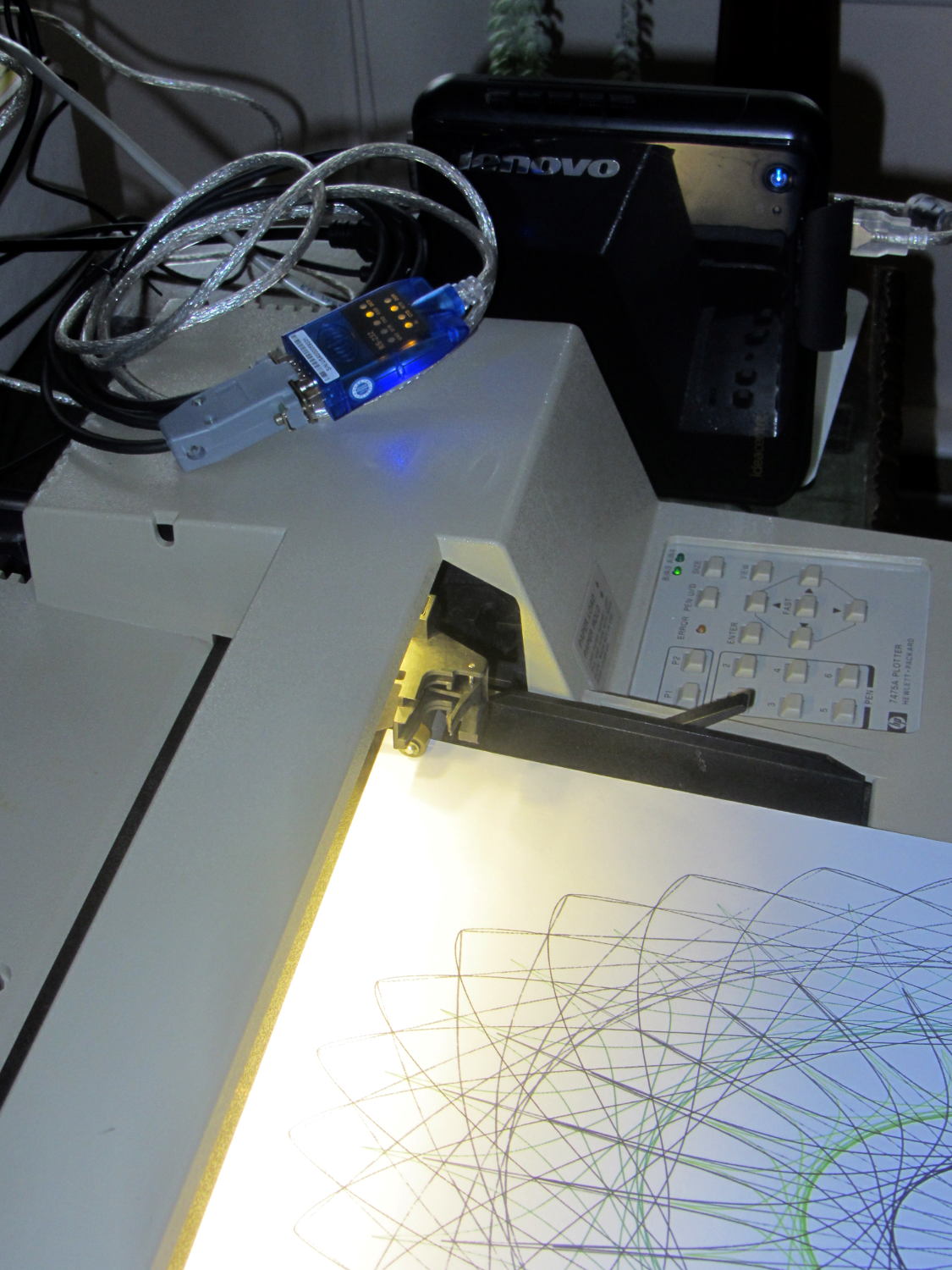
    Then chuck up some paper and pens to let it grind out art:

    HP 7475A - demo plot
    HP 7475A – demo plot

    It’s good clean fun…

  • Lenovo Q150: Opening the Case For an SSD

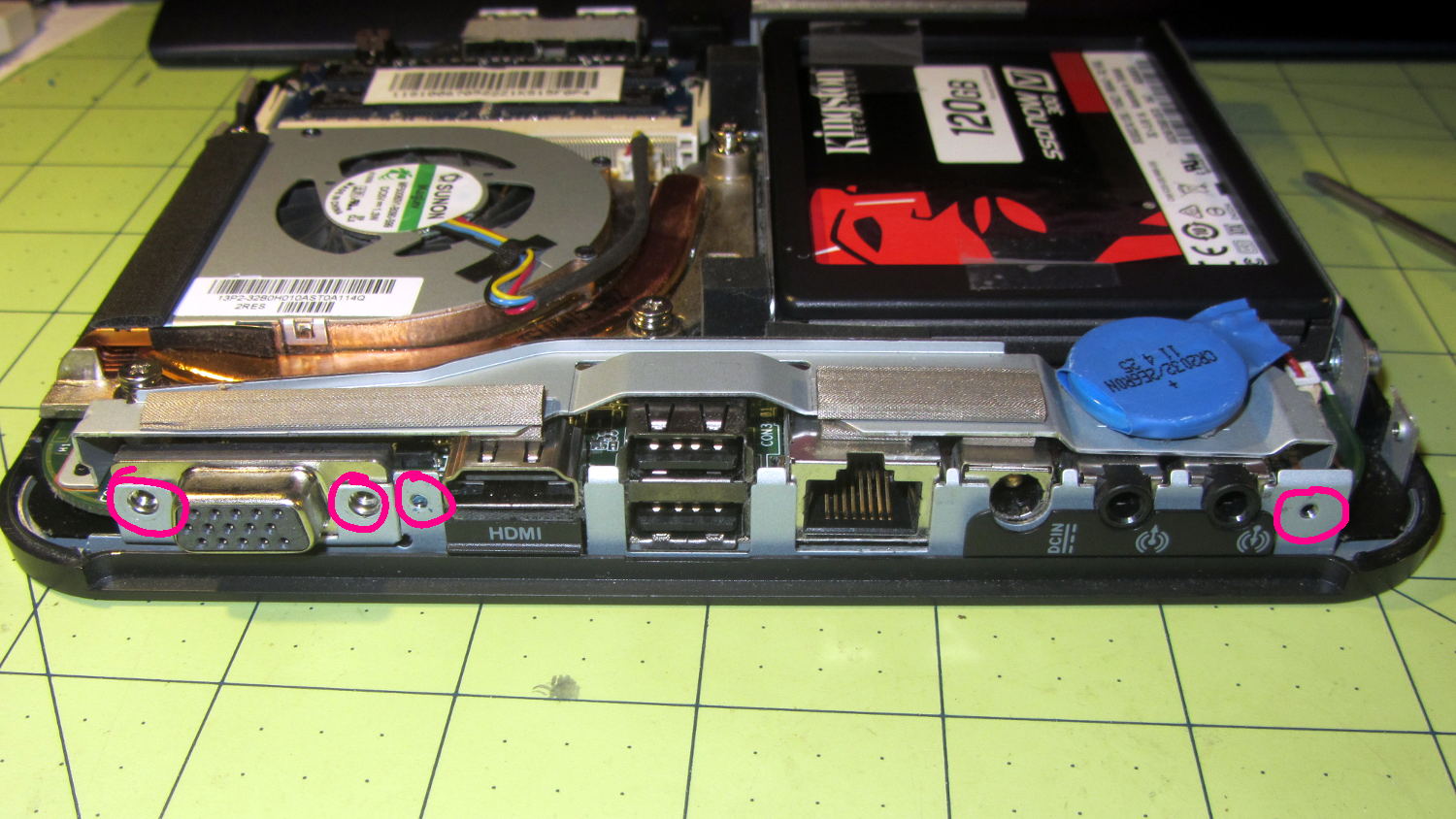
    A pre-Christmas sale brought a cheap SSD that rendered my oath not to install one in the Lenovo Q150 inoperative, so I had to figure out how to open the case. Removing the visible screws didn’t release the cover, but some exploratory prying eventually popped the internal snap latches. Knowing the latch & screw locations will simplify harvesting the SSD when that time comes…

    Front (with USB & SPDIF jacks):

    Lenovo Q150 - case latches - front
    Lenovo Q150 – case latches – front

    Rear (with all the other jacks):

    Lenovo Q150 - case screws - rear
    Lenovo Q150 – case screws – rear

    Top (with the heatsink outlet):

    Lenovo Q150 - case latches - top
    Lenovo Q150 – case latches – top

    Bottom (with the mounting boss):

    Lenovo Q150 - case latch screws - bottom
    Lenovo Q150 – case latch screws – bottom

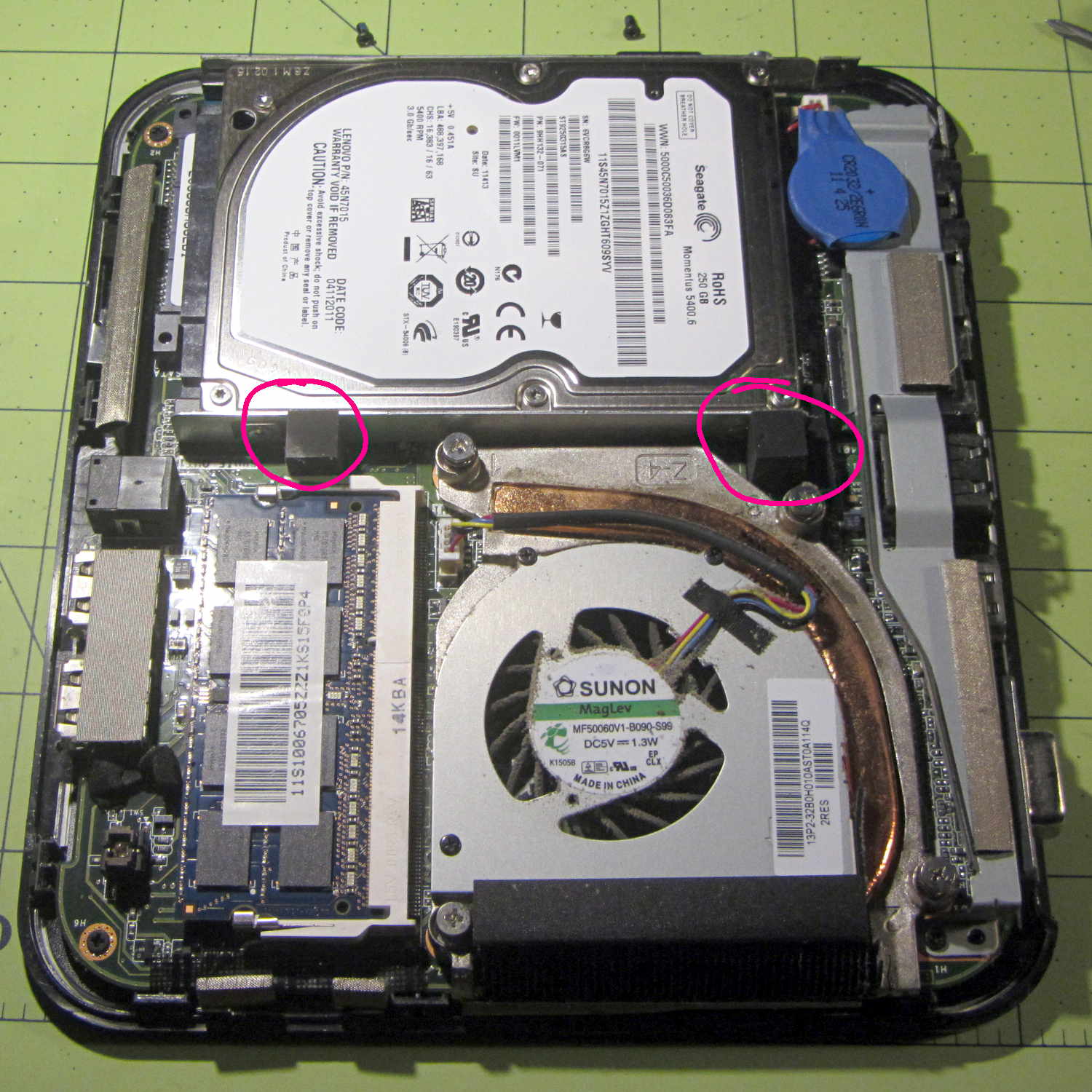
    With the cover off, the inside looks like this:

    Lenovo Q150 - interior overview
    Lenovo Q150 – interior overview

    The two rubber blocks glued to the hard drive bracket (carrier / sled / whatever) conceal the screws holding that side to the chassis. However, removing the blocks and the screws didn’t release the bracket, because it had what looked like a black adhesive layer below the screw flanges:

    Lenovo Q150 - hidden drive bracket screw
    Lenovo Q150 – hidden drive bracket screw

    Gentle prying from the edge of the bracket eventually released it, showing that the black plastic was just an insulating layer. Below that, two thin foam strips had firmly affixed themselves to the PCB, despite not having any adhesive on that side:

    Lenovo Q150 - drive bracket - foam strips
    Lenovo Q150 – drive bracket – foam strips

    With the bracket on the bench, installing the SSD went exactly as you’d expect and reinstalling the cover was, quite literally, a snap.

  • Forcing UDEV to Not Rename Network Adapters

    I use System Rescue CD to repartition / backup / restore hard drive partitions, but a not-very-recent change to udev caused the familiar eth0 name to come up as something like enp0s26u1u2 on the Lenovo Q150. Which would be OK, but feeding either that or eth0 into net-setup causes it to fall over dead.

    Avoiding that mess requires an incantation in the kernel boot parameters: select a main boot option, hit Tab, type net.ifnames=0 (with a leading space), and whack Enter to boot. Then good old eth0 appears where it should and everything works.

    It’s annoying, but not quite enough to create a specialized SysRescCD image with that incantation preloaded.

  • Lenovo Q150 Restoration Utility

    The general idea was to put the old Lenovo Q150 to work as a dedicated Superformula generator attached to the HP 7475A plotter: connect the serial cable, fire ’em up, and It Just Works. As part of the first pass, I installed Mint Linux atop an old Ubuntu install, got Python & Chiplotle set up, and That Just Works:

    Lenovo Q150 with HP 7475A
    Lenovo Q150 with HP 7475A

    However, the Q150 sports a dual-core Intel Atom, underpowered even back in the day, that hasn’t gotten any peppier over the years. The Lenovo-installed Windows 7 pushed the CPU hard enough to require full-throttle fan whine, even at idle, and mysterious issues with memory usage (something involving a memory leak in svchost.exe or perhaps over-aggressive Windows Update prefetching) reduced performance to a crawl as the system paged its brains out to the 5400 RPM laptop-style drive (*). As part of this adventure, I figured I’d boot the Lenovo restore partition and burn Win 7 back to bedrock before installing Mint.

    Turns out that the Lenovo restore utility doesn’t work when the drive has an unusual partition structure; it tells you to repartition the drive and try again. So I blew away the Ubuntu installation’s extended partition (containing swap, main, and spare partitions), then rebooted, only to discover that, of course, the missing partitions contain Grub’s later stages. Having previously wasted far too much time trying to resuscitate various half-dead Grubs, I created a fourth partition, installed Mint Linux (ignoring its strenuous objections about not having a swap partition) to refresh Grub, booted the Lenovo restore utility, and ended up at a raw Windows terminal emulator box atop a picture of some weird tropical greenery. Apparently the restore utility depends on something that got blown away during all the flailing around.

    So, just for completeness, I shrank Mint a bit, added a swap partition, and got the results shown above. One core runs at 100%, probably dribbling bytes to the USB-to-serial adapter, but the thing runs much cooler. In this context, it should be noted, a 110 °F surface and 140 °F exhaust temperature counts as “cool”; the fan isn’t at full throttle, but it’s surprisingly noisy for a computer billed as a multimedia streaming device.

    I actually have a complete backup of the original contents of all three partitions, so I could whack it back to mid-2011. Modulo, of course, resetting the actual partition sizes and positions and suchlike, which I’m sure will be vital to having the restore utility do its thing. Maybe that’s worthwhile just to remind me why it’s such a terrible idea.

    (*) Blowing $50 on an SSD is so not happening, OK?


  • Fixing the Sudo Timeout

    So I can find it again, the way to change the sudo timeout for a particular user (that would be me) involves adding a line to the /etc/sudoers file using sudo visudo, thusly:

    Defaults:       ed timestamp_timeout=90
    # blank line to make the underscore visible

    Note the colon! Should you add the timeout to the global Defaults env_reset line, then everybody gets a monster timeout, which may not be what you want.

    You can change the default editor (nano in Ubuntu) thusly:

    sudo update-alternatives --config editor

    Or, in Arch / Manjaro, add a stanza:

    Defaults	editor=/usr/bin/nano

    Because my vi hand is weak:

    • :wq to save & exit
    • :q! to bail out
    • i and a at cursor, I and A in line
    • o and O at line
    • back to command mode

    That’s all I need to insert the proper stanza & move on.