The Smell of Molten Projects in the Morning

Ed Nisley's Blog: Shop notes, electronics, firmware, machinery, 3D printing, laser cuttery, and curiosities. Contents: 100% human thinking, 0% AI slop.

Category: Oddities

Who’d’a thunk it?

  • AD8310 Log Amp Module: LF Response

    The label atop a generic AD8310 Log Amp module seemed unambiguous:

    AD8310 Log Amp module - overview
    AD8310 Log Amp module – overview

    Firing the HP 8591 tracking generator into the InHi SMA, terminating InLo (not shown above, for reasons you’ll see below), connecting the Out SMA to the scope’s Trace 1, and the spectrum analyzer’s sweep output to Trace 2 produced an oddity:

    AD8310 Log Amp - 100 kHz 500 MHz
    AD8310 Log Amp – 100 kHz 500 MHz

    The upward-sloping ramp (lower trace) shows the HP 8591’s horizontal sweep, with the tracking generator tuning from 100 kHz to 500 MHz during the 20 ms sweep. The log amp output (upper trace) drops more-or-less linearly with increasing frequency, which seems odd. The tracking generator signal should be pretty much level and the log amp’s output should be more-or-less flat.

    My oscilloscope tops out at 150 MHz. The displayed RF is down by 3 dB = 0.6 div at 1.5 division = 190 MHz into the sweep:

    AD8310 Log Amp - 100 kHz 500 MHz - RF 50 ohm term
    AD8310 Log Amp – 100 kHz 500 MHz – RF 50 ohm term

    However, the RF looks pretty much flat up to 125 MHz and it’s still visible beyond 400 MHz, so I think the tracking generator is doing what it’s supposed to. If the RF were decreasing, then the trace would look different, methinks.

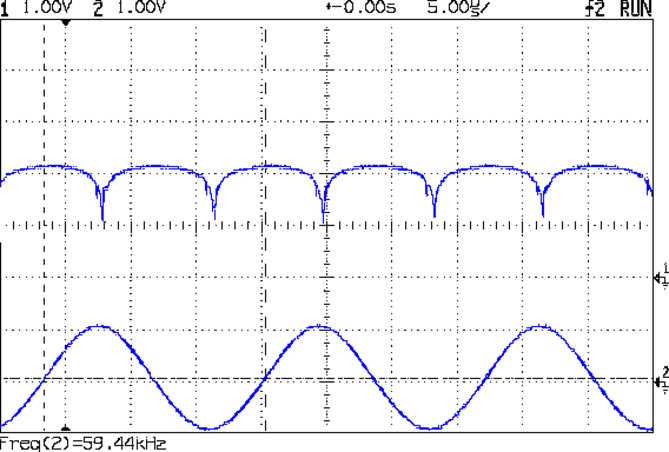
    The response to a 60 kHz sine wave doesn’t look quite right:
    AD8310 Log Amp - 60 kHz 1 Vpk
    AD8310 Log Amp – 60 kHz 1 Vpk

    Eyeballometrically, it might be a log response to the absolute value of the derivative: kinda flat on the ups-and-downs, kinda zero-ish at the tops-and-bottoms. Or maybe it’s the log response to a phase-shifted version of the input, with the lows corresponding to the zero crossings.

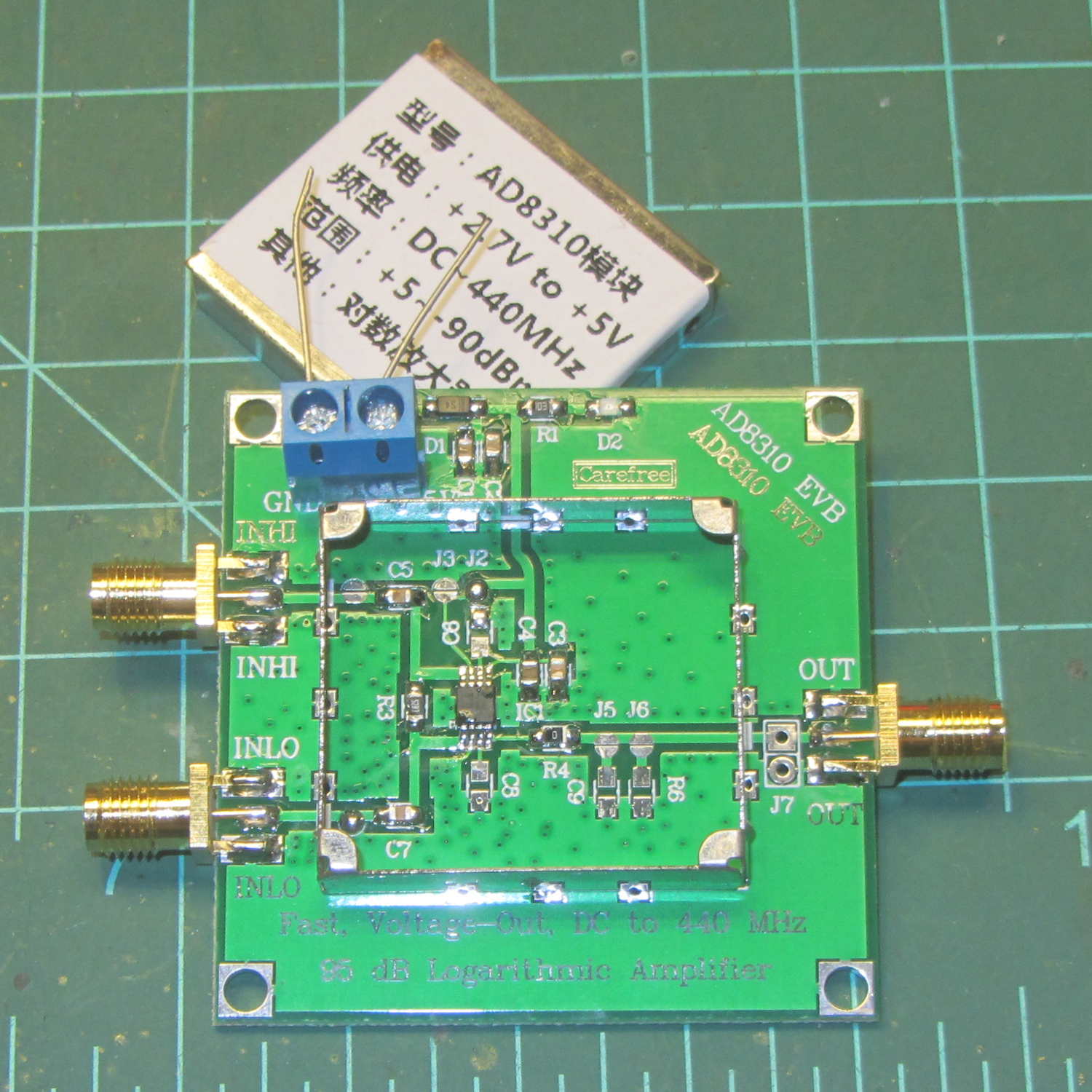
    Documentation for the circuit seems nonexistent, because eBay. Fortunately, one can pop the top to reveal the straightforward PCB layout:
    AD8310 Log Amp module - uncovered
    AD8310 Log Amp module – uncovered

    A closer look:

    AD8310 Log Amp module - PCB detail
    AD8310 Log Amp module – PCB detail

    A capacitance meter says input capacitors C5 and C7 are both 10 nF.

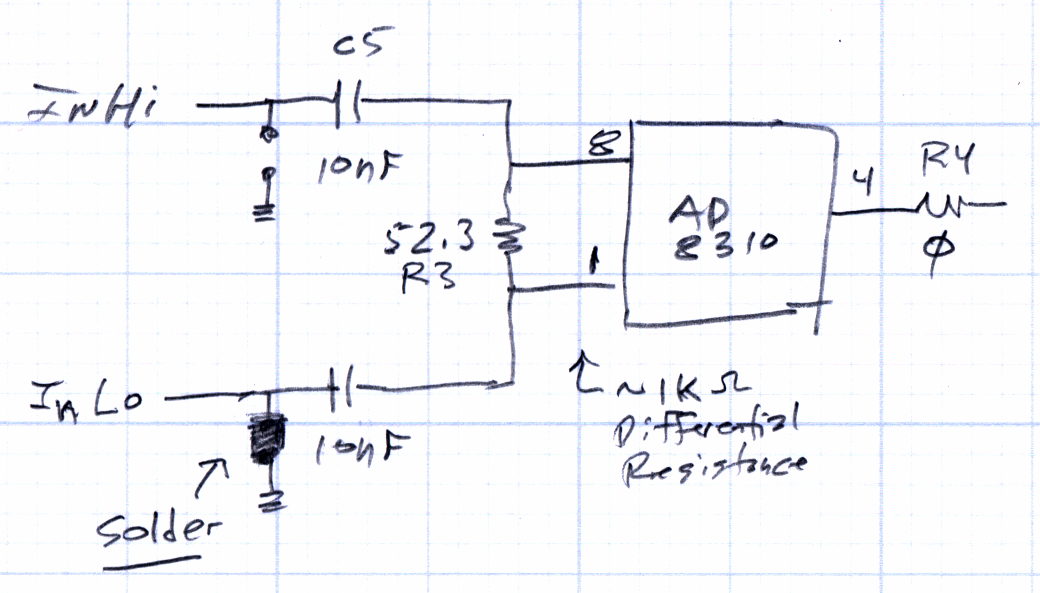
    A sketch of the circuitry:
    AD8310 Log Amp module - input circuit
    AD8310 Log Amp module – input circuit

    The datasheet puts the terminating resistor on the other side of the input caps, where it surely belongs:

    AD8310 Datasheet - Basic Connections diagram
    AD8310 Datasheet – Basic Connections diagram


    Achtung: the solder blob just to the left of C7 grounds the signal pin on the InLo SMA. Don’t connect anything to InLo which might take offense at having its output shorted to ground; the SMA terminator I used had no effect whatsoever.

    The AD8310 chip (assuming that’s what it really is) has a differential input resistance = 1 kΩ and capacitance = 1.4 pF in parallel with R3, the 52.3 Ω terminating resistor, making the net resistance just under 50 Ω.

    At 60 kHz, the input caps have a reactance of 270 Ω apiece, which means the “terminating” resistor is maybe 10% of the mostly capacitive input impedance seen at the InHi connector. That means the AD8310 inputs see maybe 10% of the input signal.

    In fact, if you regard those three parts as an RC high pass filter and merge the caps into a single 5 nF unit, it rolls off at 620 kHz = 1/(2π · 52 · 5 pF). Obviously, it’ll be a fine differentiator at 1/10 the breakpoint frequency.

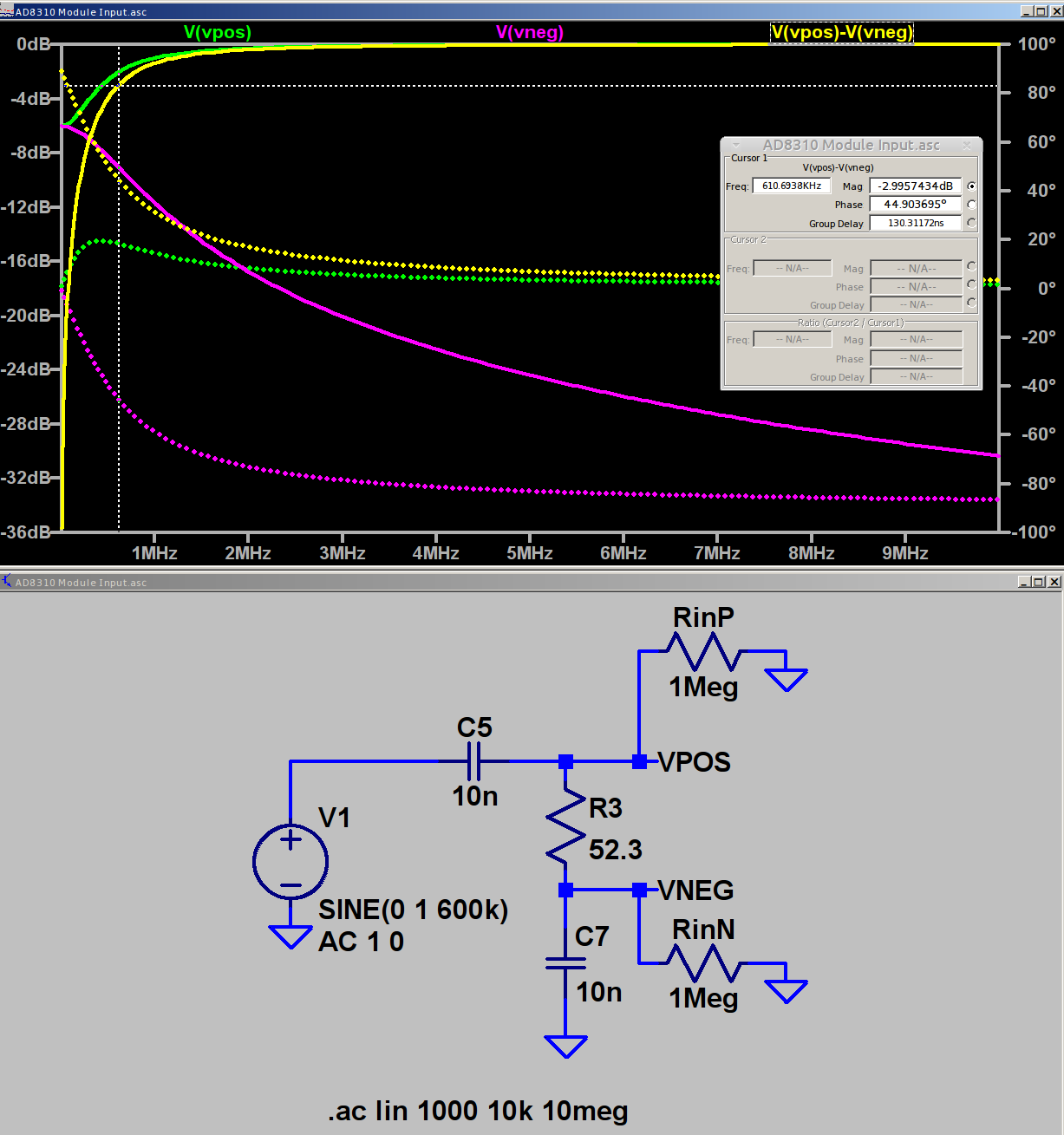
    A simulation shows it in action (clicky for more dots):
    AD8310 Log Amp module - input circuit simulation
    AD8310 Log Amp module – input circuit simulation

    The two 1 MΩ resistors provide a balanced DC path-to-ground for R3 to keep the simulator happy.

    The (+) input tends toward 0 dB as C5 tends toward a short, the (-) input tends toward ground as C7 does likewise, but their difference isn’t a constant value. Seeing as how a log amp should respond to small differences, methinks it’s hard at work.

    The AD8310 data sheet says the scale factor is about 24 mV/dB between 10 MHz and 200 MHz, with no frequency dependence worth mentioning. Eyeballometrically, the output has a 240 mV = 10 dB straight-line decrease over the entire frequency range of that scope shot. It drops by 220 mV = 9.2 dB in the decade from 50 to 500 MHz, half of the 20 dB you’d expect from a first-order filter response.

    The AD8310 has an internal 2 MHz high pass feedback loop to suppress low frequency input offset voltages. The doc recommends a 1 µF cap from OLFT to ground for frequencies down in the low audio range. One might solder the cap across the convenient pads labeled C8 below the chip.

    Rearranging the input circuitry seems in order:

    • Move R3 outside C5 and C7, per the datasheet
    • Increase C5 and C7 to 1 µF -ish
    • Add 100nF – 1 µF bypass cap at C8

    I have the uneasy feeling I’m overlooking something obvious …

    Update – The rest of the story: Corrected Input Circuit and Video Bandwidth Rolloff.
  • Verizon FiOS at 1 Gb/s for $70? Really‽

    Jessica: Hi! I am a Verizon specialist, can I help you today?

    You (that would be me = Ed): Verizon has announced gigabit Internet service for $70/month. That isn’t listed as one of the my “upgrade” options. Is it available in this area? If not, why do the 25 and 50 Mb/s services cost 90 and $100/month?

    Jessica: By chatting with us, you grant us permission to review your services during the chat to offer the best value. Refusing to chat will not affect your current services. It is your right and our duty to protect your account information. For quality, we may monitor and/or review this chat.

    Jessica: Hey there! My name is Jessica. Happy to help!

    Jessica: Thank you for being a valued Verizon customer, I will be glad to check the information for you.

    Jessica: For security and protection of your account records, please provide your first and last name as it appears on your account, plus one of the following pieces of information. Either your:

    [redacted]

    You: [redacted]

    Jessica: Thank you for the information, Edward Nisley!

    Jessica: Please give me few minutes to check the information.

    Jessica: I appreciate your patience.

    Jessica: Thank you for safeguarding the account.

    Jessica: Thank you for your years of loyalty to Verizon!

    Jessica: It looks like you currently have just Verizon Fios Internet up to 25/25 Mbps plan.
    Just to confirm, are you looking to make upgrade for just Fios Gigabit Connection?

    You: That’s correct: I do /not/ want phone or TV service.

    Jessica: I have checked the information and it looks like Verizon Fios Gigabit Connection is not available for your location.

    However, you can make the upgrade for Verizon Fios Internet up to 100/100 Mbps and above speed plan.

    You: Which gives me the opportunity to pay twice as much for 10% of the bandwidth: definitely an unattractive offer.

    Jessica: We are offering different speed plan with different prices and great discounts.

    Jessica: It looks like you are currently paying just $45.99/mo. for your Verizon Fios Internet upto 25/25 Mbps plan.

    Jessica: Just to confirm, are you looking to make any upgrade?

    You: I was interested in 1 Gb/s for $70. I’m uninterested in bait-and-switch tactics for lower bandwith at higher prices. Based on the gigabit price, I should be getting 25 Mb/s for $1.75/month … what sort of discount can you offer to make up for that sort of overcharge?

    Jessica: I understand how you feel.

    Jessica: The availability of speed and price vary from location to location.

    You can get our Verizon Fios Internet up to 50/50 Mbps plan at just $59.99/mo. before taxes with new 2 year agreement.

    Jessica: The base price of this plan is $99.99/mo. before taxes. However, you will be getting $40 OFF for 24 months with new 2 year agreement plan.

    Jessica: So, its just $59.99/mo. before taxes.

    The estimated price would be just $62.48/mo. including taxes and fees.

    Jessica: Just to confirm, would you like to go ahead and make the upgrade for this speed plan?

    Jessica: I haven’t heard from you for a few moments. Would you like to continue chatting?

    You: That’s the bait-and-switch tactic I’m /not/ interested in; DO NOT change my service. Verizon tacks on a few bucks a month for a “Municipal Construction Charge” without actually building anything. Let me know when you can offer me a gigabit for $70, then we can talk. Before then, DO NOT CHANGE ANYTHING. Thanks …

    We are sorry, but the agent was disconnected, please wait for the agent to reconnect..

    We apologize for the unexpected delay, an agent should be with you very soon.

    Agent Carl enters chat

    Carl: Hi there! You have reached Carl. How may I help you today?

    You: Do you have access to the previous half hour of chat before Agent Jessica was mysteriously disconnected?

    Carl: It seems that the previous agent lost connection.

    Carl: I am sorry for the inconvenience caused to you. She might have faced some technical issues.

    Carl: Pleasure assured no changes will be made on your account without your consent.

    Carl: I read that you wish to check the availability of Gigabit speeds for your home. Correct?

    You: That’s what I asked, half an hour ago, and was told it’s not available, but I /can/ pay more than that (minus a teaser discount) for 10% of the bandwidth. If that’s still the best you can do, it’s not what I want.

    Carl: The availability of services and plans is address specific. I see that the previous agent informed the Gigabit speed is not available.

    Carl: The prices and promotions are time specific.

    Carl: You get discounts and promotions available at the time of signing up for new services.

    Carl: When you signed up for services 2 year back, you get the promotions available at that time.

    You: OK, we’re going in circles. Let me know when you can deliver what Verizon offers to other FiOS customers. Thanks …

    Carl: Right now, the customer who sign up for new service on a new account for 1st time, they get the offers available right now.

    Carl: You’re welcome.

    Carl: Is there anything else I can help you online today?

    You: Nope, we’re off to a concert. Have a good rest of the evening!

    Carl: You too have a great evening.

    Carl: If you need assistance in the future, visit us anytime on the My Fios App or at Verizon.com. Thank you for chatting with Verizon.

  • Relics of the Empire: Bearing Samples

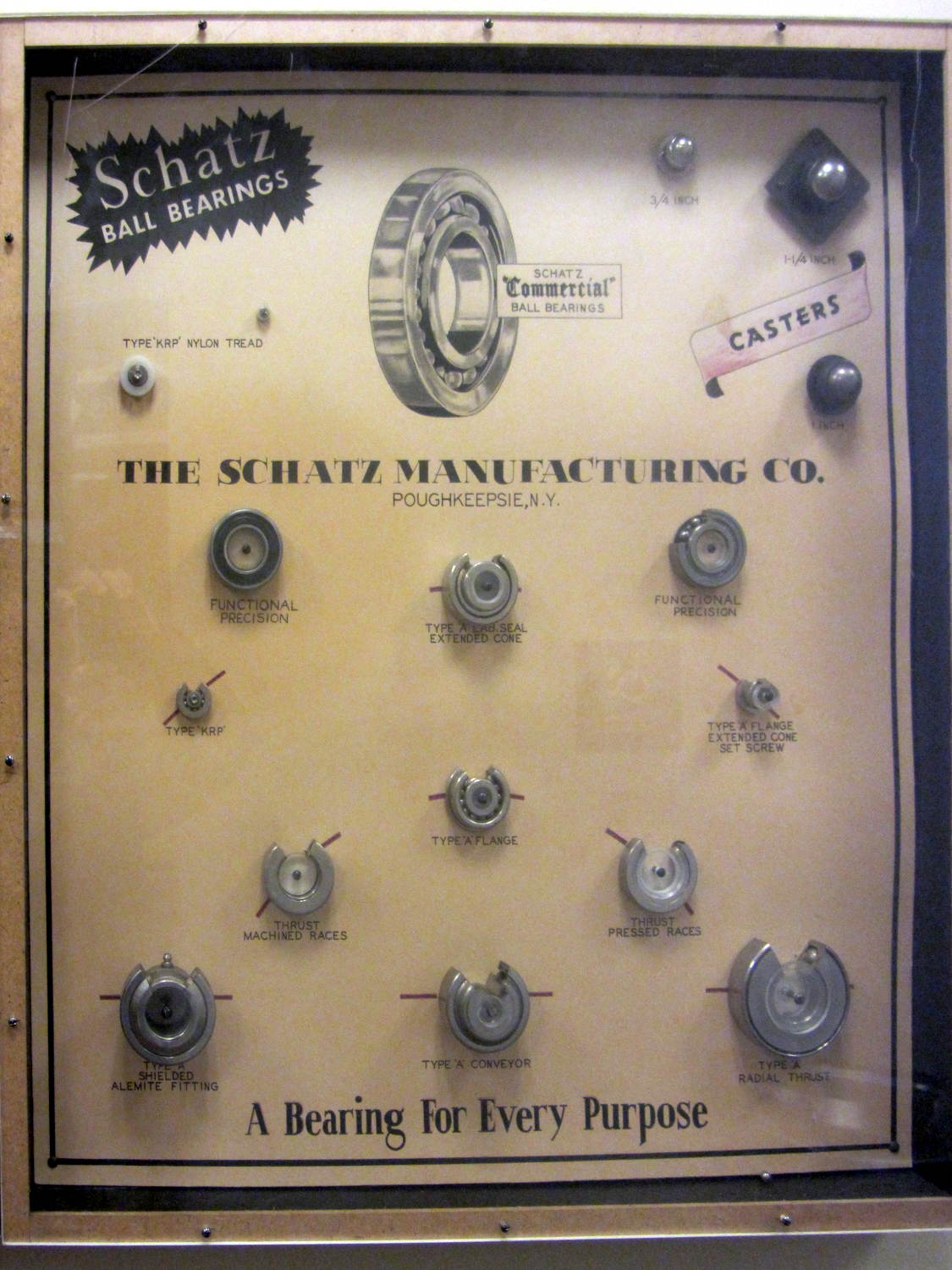
    Schatz Manufacturing, a major bearing producer in Poughkeepsie, made a sample case to show off their wares:

    Schatz Ball Bearings
    Schatz Ball Bearings

    You can tell by the yellowed backing paper that these have been around for a looong time.

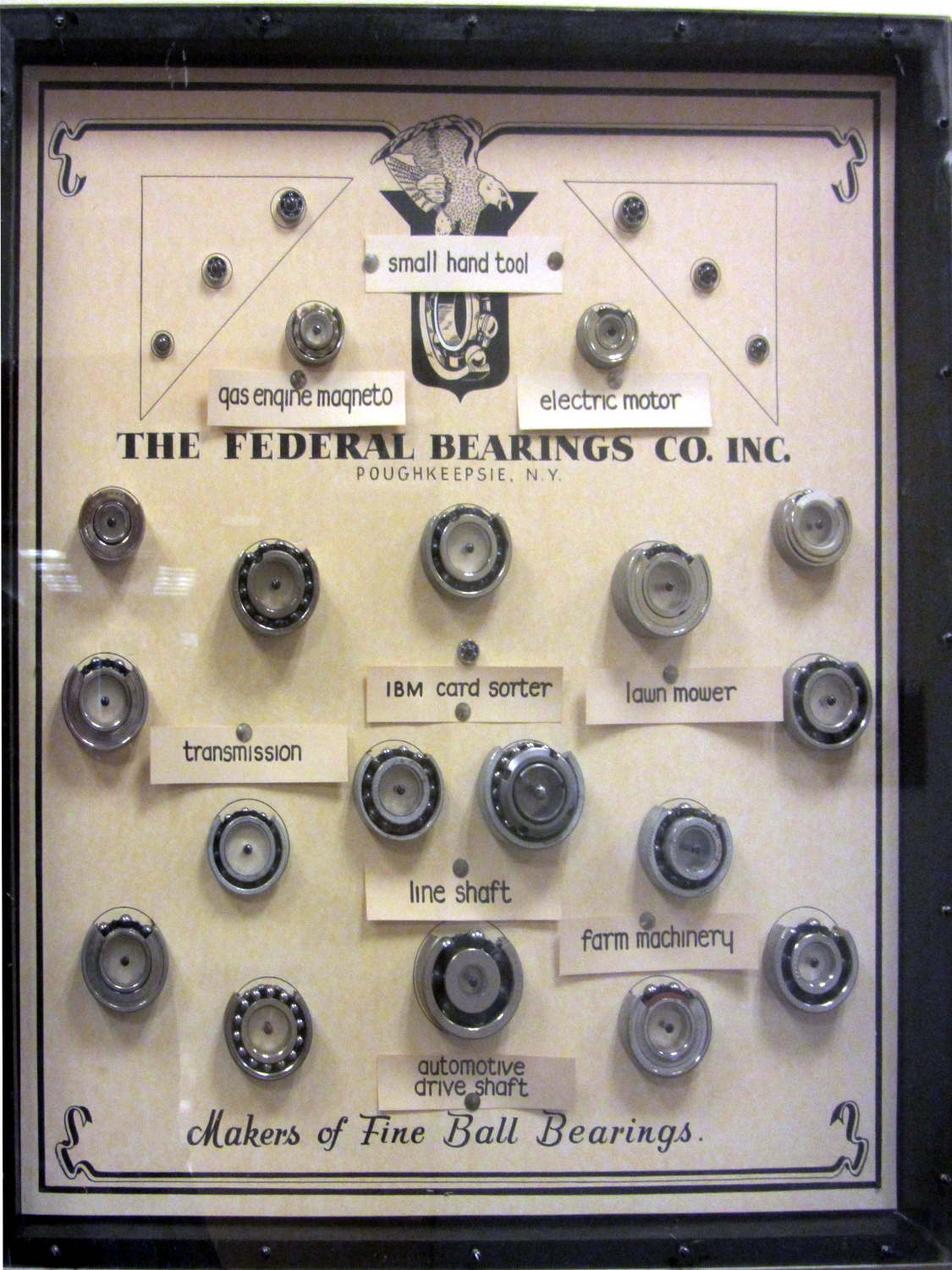
    It turns out that Poughkeepsie had two bearing manufacturers. Federal Bearings went into the products of other locally important industries:

    Federal Bearings
    Federal Bearings

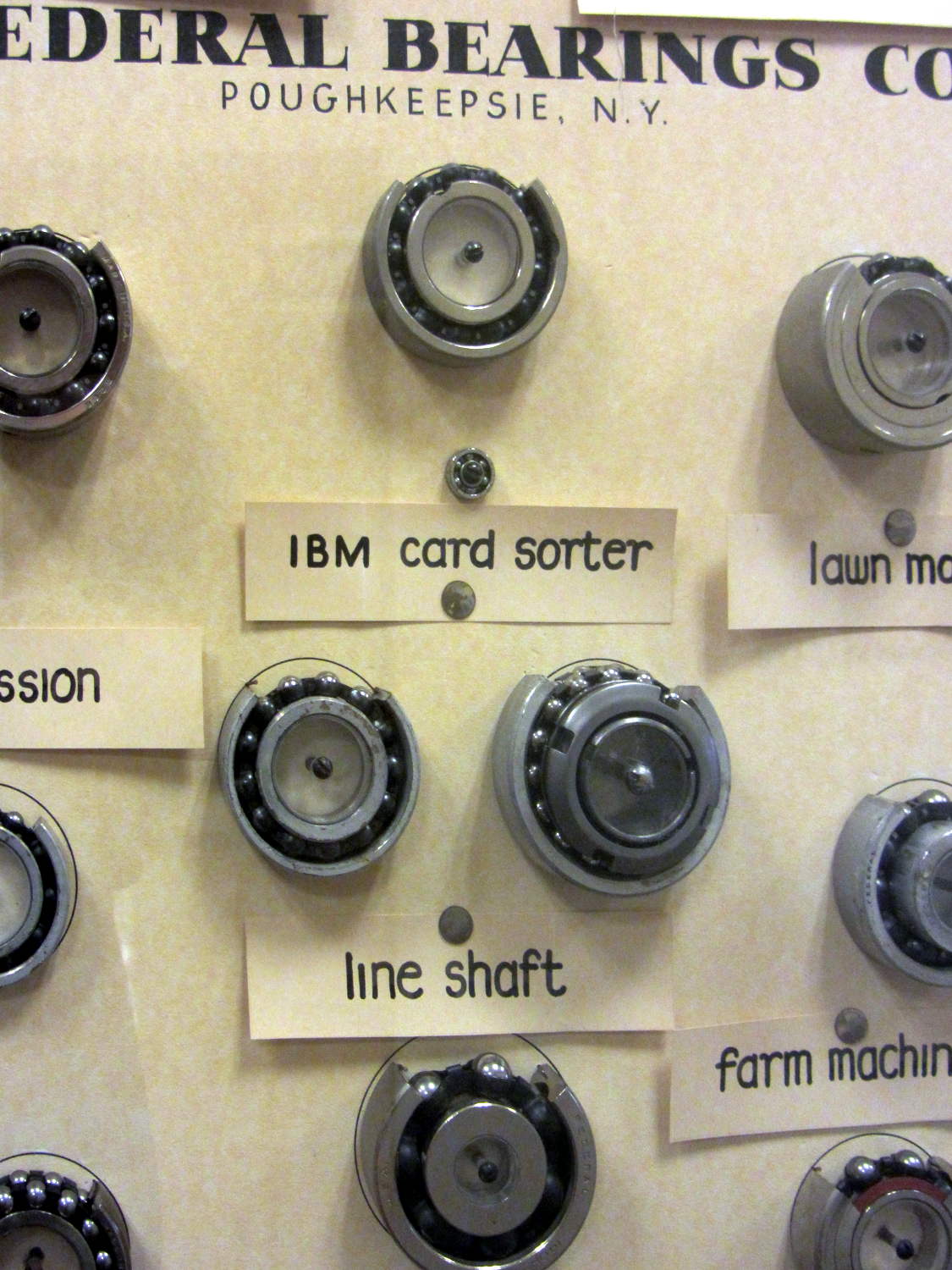
    A detailed look shows what was important, back in the day:

    Federal Bearings - Detail - IBM Card Sorter
    Federal Bearings – Detail – IBM Card Sorter

    Schatz and Federal later merged into Shatz Federal Bearings, eventually become Shatz Bearings, and still operate in Poughkeepsie. Some of their industrial waste remains here, too.

    Out in the garage I still have a few grease pilots (*) from the final Schatz Federal downsizing / going-out-of-business / moving / whatever sale. A friend bought several sets of heavy-duty steel chests-of-drawers which contained, very much to his surprise, a huge assortment of grease pilots, ranging in size from fit-on-your-thumb to cover-a-dinner-plate, which he obviously had no use for. He unloaded them on me with a phrase that has lived on forevermore:

    They’re a buck apiece, unless you take all of them, in which case they’re free.

    You’ll find the sample cases on the top floor of Adriance Library, should you ever be in town.

    Taken handheld in ambient light to avoid harsh flash shadows, then perspective-distorted to make them look like I was standing directly in front of the reflective plastic covers.

    (*) Different from a “pilot bearing”. A “grease pilot” is a two-part circular steel assembly used to inject grease into the bearing races before snapping the shields in place. They’re painstakingly machined to cup the balls and fill the gaps, with a pipe fitting on the back surface for the grease pump.

  • Dropbox Tour: To Keep Learning, Click Cancel

    After copying a Digital Machinist column to my Dropbox folder, I went to the site to get the link, discovered they improved the UI, declined a Flash-based tour of the new features, and got this baffling confirmation dialog:

    Dropbox - tour exit dialog
    Dropbox – tour exit dialog

    So. Many. Wrongs.

  • Garage Door Openers: Pity the Color Blind

    The small garage door opener I tote around in the Tour Easy’s underseat bag failed after many years of exposure to the elements, so I paid a few bucks more for a cheap replacement in order to get fast delivery from a (US!) eBay supplier:

    Garage door opener remote controls
    Garage door opener remote controls

    For whatever it’s worth, before buying the replacement I tried:

    • Cleaning the battery contacts
    • Installing a new CR2032 battery
    • Programming the hitherto-unused buttons to open the door

    The remote control would occasionally work, but none of the “repairs” made much difference; I suspect corrosion hidden under the components or cracked solder joints.

    The eBay item description clearly, if inarticulately, specifies the compatibility requirement:

    key chain remote control
    compatible for purple learn button

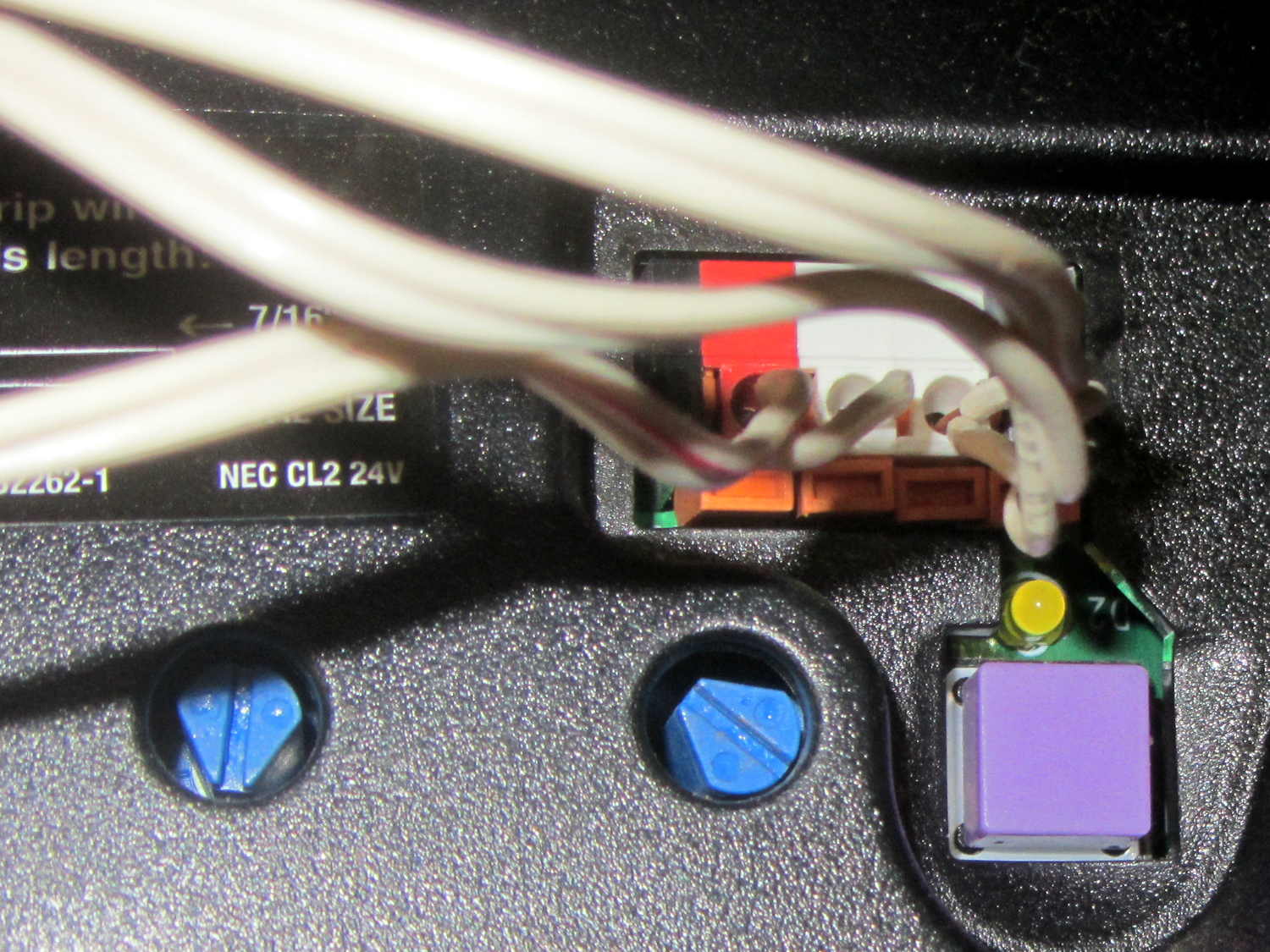
    So I trotted out to the garage and inspected the button:

    Sears Garage Door Opener - purple button
    Sears Garage Door Opener – purple button

    Looks purple to me, but, being that type of guy, I also read the adjacent instruction sticker:

    Sears Garage Door Opener - instructions
    Sears Garage Door Opener – instructions

    Nobody, nobody, maintains the documentation. [sigh]

    I figured if they went to all the trouble of ordering a bazillion switches with purple caps, then the PCB surely holds the corresponding RF filters & firmware & whatever else that button signifies.

    Seeing as how we have exactly one garage door opener and no lights or other doodads, I told the opener to obey both the 1 and 2 buttons, thereby dramatically reducing the dexterity required to open the door while pedaling up the driveway. The opener can remember an unspecified number of transmitters, so I didn’t go for all four buttons.

  • Monthly Science: CR2023 Lithium Cells vs. Wearable LEDs

    Those wearable LEDs spent the last five months sitting on the kitchen window sash, quietly discharging their CR2032 lithium cells:

    Wearable LED with CR2023 cell
    Wearable LED with CR2023 cell

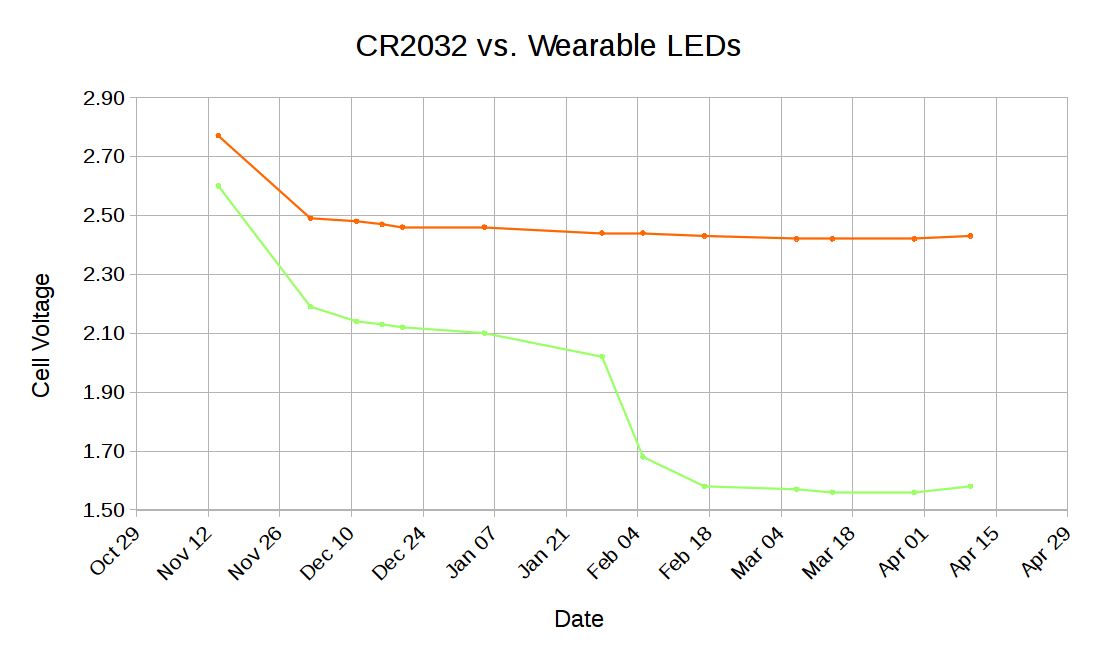
    Occasional voltage measurements produced an interesting graph:

    CR2032 vs Wearable LEDs
    CR2032 vs Wearable LEDs

    CR2023 primary lithium cells start out around 3.3 V, so these were pretty much dead (from their previous lives in dataloggers) when I slipped them into their holders. The LEDs seem to be blue LEDs, with threshold voltages around 3.6 V, with colored phosphors / filters, so they started out dim and got dimmer. The green(-ish) LED obviously fell over a cliff and went dark in late January; I have no way to measure long-term microamp currents, alas.

    The reddish LED is still going, mmm, strong.

    If you need a rather dim light for a surprisingly long time, these things will do the trick.

    I should gimmick up another astable multivibrator to blink one LED.

    The original data:

    CR2032 vs Wearable LEDs - data
    CR2032 vs Wearable LEDs – data
  • The Perils of PDF

    The Dodge Ram ProMaster cargo van we rented to haul our bikes to Glens Falls (and bring some furniture back) sat on their 2500 truck chassis, thus weaponizing an obvious phishing email waiting for me on our return:

    Subject: About the Dodge ram 2500
    Kindly review full details of your order.
    Methner

    The From and To addresses were identical, which is always a tipoff, as was the fact neither were any of my addresses. The email had an attached PDF, of course, although the context suggested handling it with the same nonchalance I’d use with any lump of high-level radioactive waste.

    That brief text tripped my junk filters, but, somewhat to my surprise, all the scanners at VirusTotal passed Order 372.PDF without complaint (since then, one scanner woke up, smelled the scam, and tagged the file as “PDF/Phishing.A.Gen”).

    Converting the PDF to plain text with pdftotext produced an empty file, so the PDF payload isn’t a script.

    Passing the PDF through strings revealed a URL for a (probably compromised) server unrelated to the (obviously bogus) email address, wrapped with layout verbiage suggesting a clickable link:

    <</Subtype/Link/Rect[ 205.25 467.11 369.91 499.51] /BS<</W 0>>/F 4/A<</Type/Action/S/URI/URI(http://bogus-domain-here.com/wp-settings/bloglist/hh/index.php) >>>>
    

    Passing the PDF through pdftoppm produced this comforting image:

    Bogus Order Form - Image
    Bogus Order Form – Image

    The “100% SECURE” padlock logo, with a green check for added confidence, is a nice touch.

    At this point, if a product involves The Cloud, you can deal me out.