Ed Nisley's Blog: Shop notes, electronics, firmware, machinery, 3D printing, laser cuttery, and curiosities. Contents: 100% human thinking, 0% AI slop.
Birds flow through the Hudson River Valley during spring and fall migratory seasons, leading to tragedies such as this:
Dead Swainsons Thrush – ventral
We think it’s a Swainson’s Thrush that mistook our bedroom window for open sky:
Dead Swainsons Thrush – left side
We’ve tried several techniques to prevent birds from making that mistake, but to no avail.
It weighed 38 grams, a bit heavier than the typical 30-ish grams reported in our bird books. If I were flying to Mexico I’d want a little extra padding, too.
I put it out for recycling in the back yard; in Nature, nothing goes to waste…
That tag should ensure any TSA agent will sideline me for an enhanced inspection sufficient to reset breakfast to last Tuesday. Or I get to ride in the cockpit. Maybe both.
Aitch is one of the very few people in the world who can use a business trip to the Atacama Desert as a cover story for his real activities, about which I know absolutely nothing because I’m Still Alive™. The fact that he returns with a camera full of gorgeous pix merely demonstrates the cover team’s finesse. The NSA schwag came from another trip. So he says, anyway.
Oh, that tag originally hung from the drawstring of a very nice black velveteen pouch containing an NSA-logo sippy cup along with the matching coaster. All made in China, of course: if irony were energy, we could saw off the entire Middle East and be done with it…
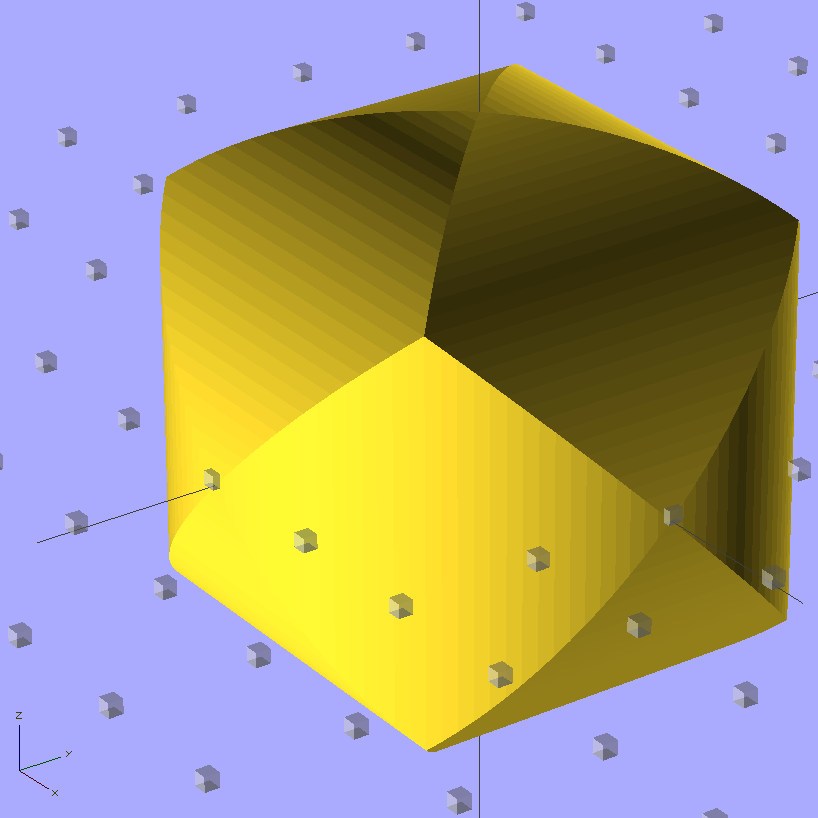
My buddy Mark One asked me to make a golf-ball sized Thing that’s the intersection of three mutually orthogonal cylinders. He claims I (subtractively) machined one from solid plastic, many many years ago, but I cannot imagine I ever had that level of machine shop fu; right now, I’m not sure how I’d fixture the thing.
Cylinder Thing – solid model
It’s much easier with a 3D printer…
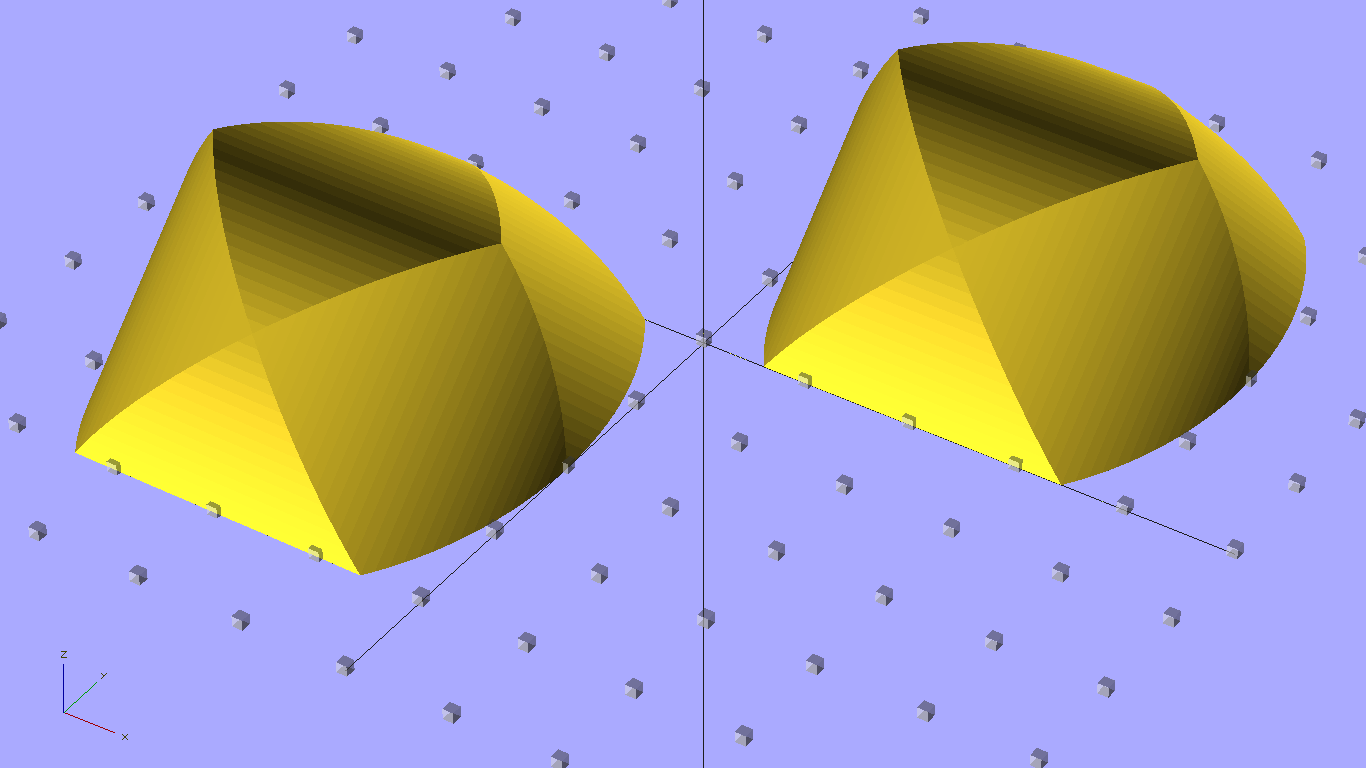
Of course, spheroids aren’t printable without support, but you can chop one in half to reveal the nice, flat interior surfaces, then add holes for alignment pegs. Using 0.50 infill makes for a compact mesh inside the ball:
Cylinder Thing – building
Smooth a few imperfections from the mating surfaces and add four pegs (the other two are busy propping the right-hand half off the countertop). Somewhat to my surprise, the alignment holes came out a perfect push fit for the 2.9 mm actual-OD filament with my more-or-less standard 0.2 mm HoleWindageFinagle Constant. This also uses the 1.005 XY scale factor to adjust for ABS shrinkage, not that that matters in this case:
Cylinder Thing – alignment pegs
Then solvent-bond everything together forever more:
Cylinder Thing – clamped
The seam is almost imperceptible around the equator, perhaps because I didn’t slobber solvent right up to the edge. I did print one without the alignment pegs and demonstrated that you (well, I) can’t glue a spheroid without fixturing the halves; that one goes in my Show-n-Tell heap.
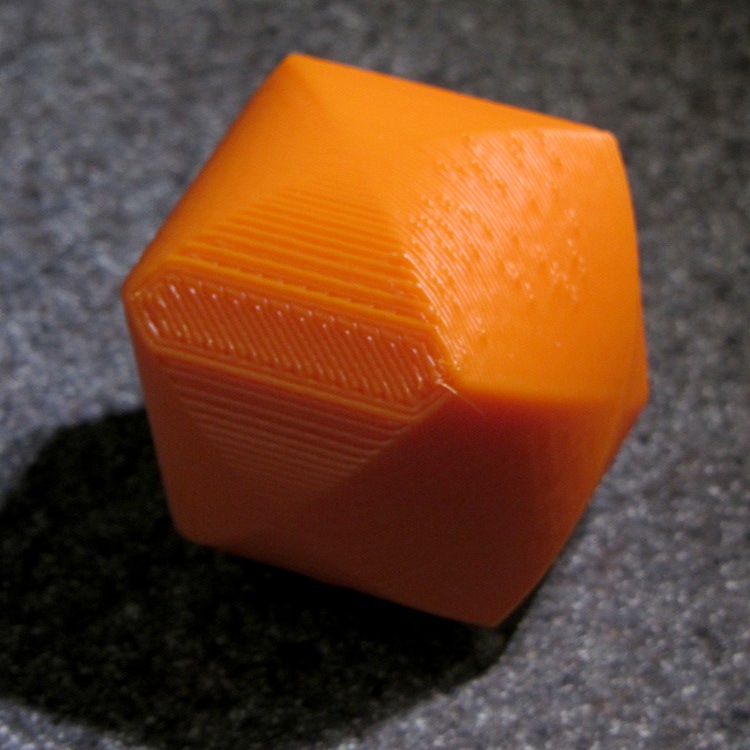
The 0.33 mm Z resolution produces sucky North and South poles; the East, West, Left, and Right poles are just fine, as are the eight Tropical Vertices. After mulling for a bit, I rotated a cylindrical profile upward:
Cylinder Thing Rotated – solid model
The obvious contour lines fit the cylinder much better, although you can see where better Z resolution would pay off:
Cylinder Thing – rotated
This was at 0.33 mm x 0.66 mm, 200 °C, 30 & 100 mm/s, 2 rpm. No delamination problems; I applied a wood chisel to persuade those big flat surfaces to part company with the Kapton tape.
The OpenSCAD source code:
// Three intersecting cylinders
// Ed Nisley KE4ZNU - Oct 2011

Layout = "Build";			// Show Build

//- Extrusion parameters must match reality!
//  Print with +1 shells and 3 solid layers
//  Use infill solidity = 0.5 or more...

ThreadThick = 0.33;
ThreadWidth = 2.0 * ThreadThick;

HoleWindage = 0.2;

Protrusion = 0.1;			// make holes end cleanly

//------ Model dimensions

CylDia = 2*IntegerMultiple(40.0/2,ThreadThick);
CylRad = CylDia/2;

echo(str("Actual diameter: ",CylDia));

Angle = [45,0,0];			// rotate to choose build orientation

$fn=128;

AlignPegDia = 2.90;

//-------

function IntegerMultiple(Size,Unit) = Unit * ceil(Size / Unit);

module PolyCyl(Dia,Height,ForceSides=0) {			// based on nophead's polyholes

  Sides = (ForceSides != 0) ? ForceSides : (ceil(Dia) + 2);

  FixDia = Dia / cos(180/Sides);

  cylinder(r=(FixDia + HoleWindage)/2,h=Height,$fn=Sides);
}

module ShowPegGrid(Space = 10.0,Size = 1.0) {

  Range = floor(50 / Space);

	for (x=[-Range:Range])
	  for (y=[-Range:Range])
		translate([x*Space,y*Space,Size/2])
		  %cube(Size,center=true);

}

//------- Model bits & pieces

module OneCyl() {
  cylinder(r=CylRad,h=CylDia,center=true);
}

module ThreeCyl() {
  intersection() {
	OneCyl();
	rotate([90,0,0]) OneCyl();
	rotate([0,90,0]) OneCyl();
  }
}

module HemiThing() {
  difference() {
	rotate(Angle)
	  ThreeCyl();
	translate([0,0,-CylRad])
		cube(CylDia,center=true);
	for (Index = [0:3])
	  rotate(Index*90)
		translate([CylRad/2,0,-Protrusion])
		  PolyCyl(AlignPegDia,5+Protrusion);
  }
}

//---------

ShowPegGrid();

if (Layout == "Show")
  ThreeCyl();

if (Layout == "Build") {
  translate([CylRad,CylRad,0])
	HemiThing();

  translate([-CylRad,-CylRad,0])
	  HemiThing();
}
Our neighbor’s back yard features an unkempt apple tree about 3 feet from the fence that must be 40 feet high by now. It grows Macintosh-style fruit and drops half of them into our yard. Most land in the garden, some land in the yard, a few bounce off his plastic storage shed with resounding bonks, and every critter out there loves them. Mary makes applesauce from the best of the harvest and tosses the rest far away to keep the wasps out of her veggies.
The chipmunks and groundhogs have a belly-busting good time:
Chipmunk with apple
The deer, of course, eat ’em like candy, another reason for clearing the garden.
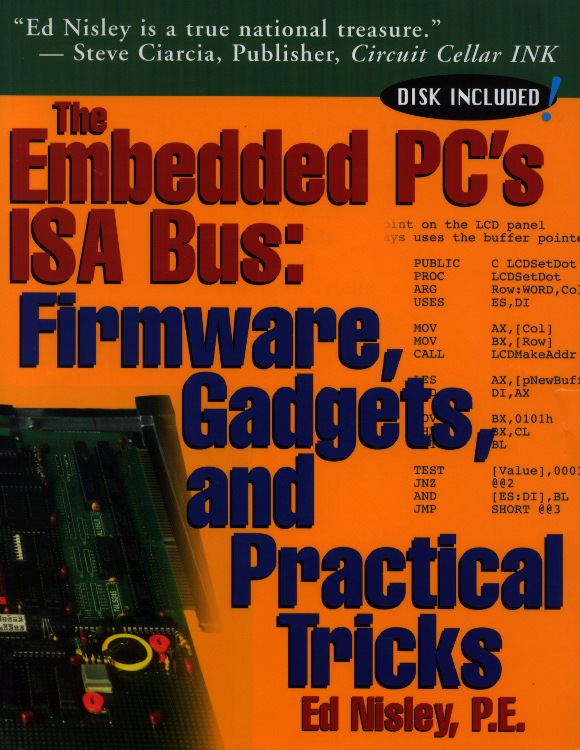
A long time ago, in a universe far away, I wrote a book that (barely) catapulted me into the ranks of the thousandaires. Time passes, companies get sold / fail / merge / get bought, and eventually the final owners decided to remainder the book; the last royalty check I recall was for $2.88.
Anyhow, now that it’s discontinued and just as dead as the ISA bus, I own the copyright again and can do this:
They’re both ZIP files, disguised as ODT files so WordPress will handle them. Just rename them to get rid of the ODT extension, unzip, and you’re good to go. Note, however, that I do retain the copyright, so if you (intend to) make money off them, be sure to tell me how that works for you.
The big ZIP has the original pages laid out for printing, crop marks and all, so this is not as wonderful a deal as it might first appear. The little ZIP has the files from the diskette, which was unreadable right from the start.
Words cannot begin to describe how ugly that front cover really is, but Steve’s encomium still makes me smile.
The text and layout is firmly locked inside Adobe Framemaker files, where it may sleep soundly forever. The only way I can imagine to get it back into editable form would be to install Windows 98 in a VM, install Framemaker, load up the original files, and export them into some non-proprietary format. Yeah, like that would work, even if I had the motivation.
If you prefer a dead-tree version, they’re dirt cheap from the usual used-book sources. Search for ISBN 1-57398-017-X (yes, X) and you’ll get pretty close.
Or, seeing as how I just touched the carton of books I’ve been toting all these years, send me $25 (I’m easy to find; if all else fails, look up my amateur callsign in the FCC database) and get an autographed copy direct from the source. Who knows? It might be worth something some day…
I fumble-fingered a plate, it fell between my tummy and the counter, and hit the floor edge-on. There’s a lot of energy stored in that stretched-glass ceramic layer! [Update: The glass is under compression.]
Shattered Corelle plate on floor
The fragments tend to be slivers rather than chunks, all with better-than-razor-sharp edges:









 The Smell of Molten Projects in the Morning