The Smell of Molten Projects in the Morning

Ed Nisley's Blog: Shop notes, electronics, firmware, machinery, 3D printing, laser cuttery, and curiosities. Contents: 100% human thinking, 0% AI slop.

Category: Machine Shop

Mechanical widgetry

  • Current Sensing: Powered Iron Toroid

    Dell built the GX270 I’m repurposing back in 2004, early on in the capacitor plague years, but only one of the system board caps showed signs of leakage:

    Capacitor plague - 2004 Dell Edition
    Capacitor plague – 2004 Dell Edition

    While I was harvesting some of the connectors, it occurred to me that those powdered iron inductors might make good current sensors, as they’re already wound with heavy gauge copper wires.

    I picked an inductor with enough turns and, although slitting didn’t pose much of a problem, the saw did make a mess of the turns adjacent to the cut:

    Powdered iron toroid - slitting
    Powdered iron toroid – slitting

    Iron powder has more magnetic remnance than ferrite, to the extent that iron swarf clogged the gap. After the first pass, I ran the slit toroid through the degausser to shake it clean and see what damage had been done. It looked OK, so I realigned it on the saw blade and continued the mission, with all the dust vanishing into the vacuum cleaner’s snout.

    Removing the damaged sections left 22 turns. For comparison, I converted the 56 turn ferrite toroid into a 25 turn model by paralleling two 25 turn sections:

    Slit toroids - iron - ferrite
    Slit toroids – iron – ferrite

    The enamel wire on the iron toroid measures 40 mil diameter, close enough to 18 AWG.

    Paralleling two 24 AWG windings on the ferrite toroid produces twice the copper area of a single winding, so the resistance is the same as a single 21 AWG winding (3 AWG steps = factor of two area change). That’s three steps smaller than the 18 AWG on the iron toroid, so the resistance is a factor of two larger than the heavier wire.

    The paralleled winding has the advantage of reducing the power dissipation required to produce the same magnetic flux density, without the difficulty of winding heavier wire. That may not actually matter, given the relatively low currents required by the motor in normal operation.

    Wedging a Hall sensor into the gaps and stepping the current produced two useful graphs:

    Iron and ferrite toroids - Hall sensor output
    Iron and ferrite toroids – Hall sensor output

    The iron toroid has lower permittivity (less flux density for a given magnetizing force), which means the full-scale range exceeds 3 A and the useful range up to 1 A covers only 300 mV.

    The last point on the ferrite curve shows the Hall sensor output saturating just over 4 V, with 1.5 V of range.

    The slope, in mV/A

    • Powdered iron: 340
    • Ferrite: 540

    Boosting the slope of the powdered iron by 25/22 gives 386 mV/A, so the iron permeability really is 70% of the ferrite. That’s modulo the gap size, of course, which surely differs by enough to throw out all the significant digits.

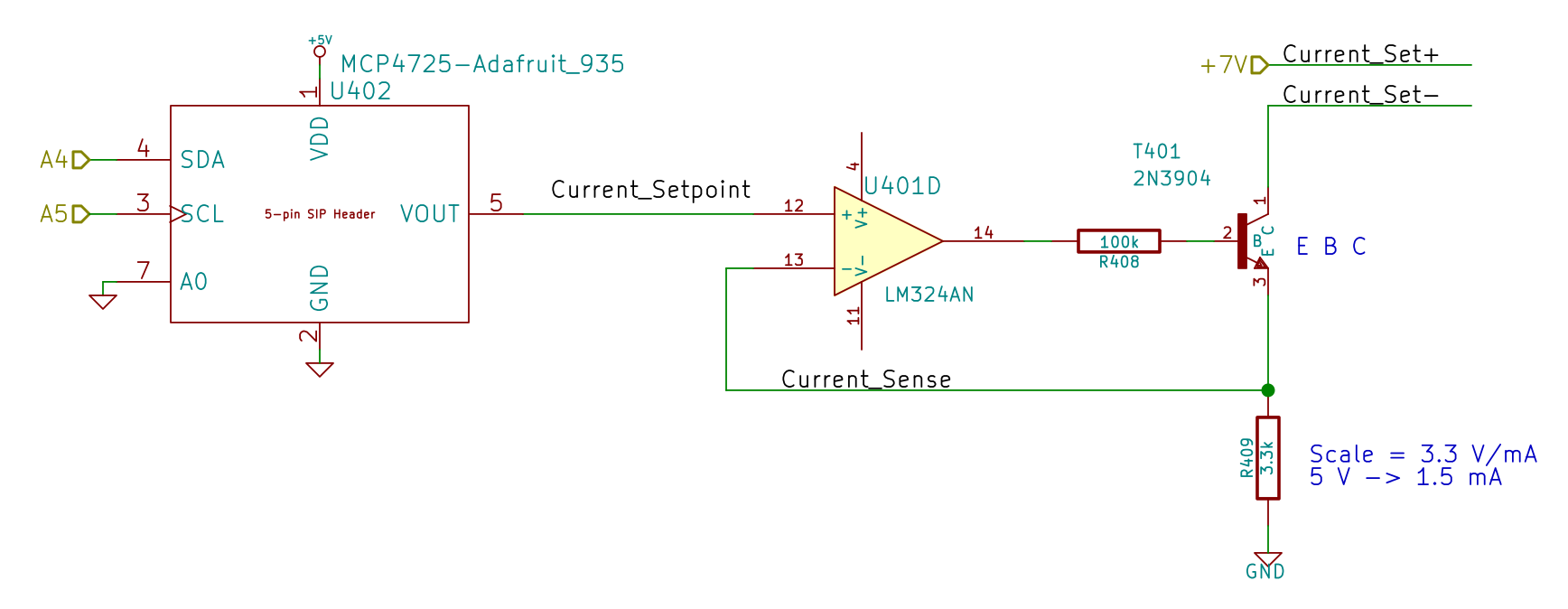
    Obviously, an op amp circuit to remove the offset and rescale the output to 0-5 V will be in order.

    The previous graph for the ferrite toroid with the complete 56 turn winding shows, as expected, about twice the output of this 25 turn version:

    FT82-43 - 56 turns - 24 AWG
    FT82-43 – 56 turns – 24 AWG

    The linear part of that line is 1375 mV/A, although I can’t vouch that the data came from the same Hall effect sensor. Scaling it by 25/56 gives 613 mV/A, suggesting it’s not the same sensor.

    Having developed an emotional attachment to the ferrite toroid, I’ll use it in the first pass of the current feedback circuit. If the motor need a bit less sensitivity or lower resistance, the powdered iron toroid looks like a winner.

    Memo to self: Always degauss iron toroids before slitting!

  • FC1002 Frequency Counter Faceplate: BLAM!

    So I picked up the frequency counter and found this:

    FC1002 Frequency Counter - split shattered faceplate
    FC1002 Frequency Counter – split shattered faceplate

    The outer, previously cracked pieces of the faceplate split parallel to the front panel, separating into two layers, and popped free of their mount. The layer closest to the panel remains intact.

    The fragments were flexible and the bottom layer was rigid, suggesting the faceplate consisted of two parts, perhaps an acrylic (?) base with a soft silicone (?) poured atop it for armor and scratch protection.

    It still works fine and the acrylic (?) layer will suffice for my simple needs, despite being slightly marred by the cyanoacrylate glue I slobbered into the cracks.

    I definitely didn’t see that coming…

  • Dis-arming a Steelcase Leap Chair

    Steelcase lists the arm rests on their Leap chairs as “factory installed” and not removable, perhaps because the brackets supporting the arms also support the backrest. In the event you must ever remove the arms, perhaps because your wife decides she’d like to try the chair without them, it’s straightforward.

    Loosen the Torx screw visible through the slot in the bottom of the plastic shroud about a dozen turns (it will not click or feel loose), use a flat screwdriver to unlock the shroud from the flat plastic plate on the seat side of the bracket, then forcibly pull the sides of the shroud outward until you can pull the arm extension mechanism up-and-out of these slots in the bracket:

    Steelcase Leap - arm bracket
    Steelcase Leap – arm bracket

    This view from the side of the chair shows the screw hole in the bottom, with a pair of holes for alignment pins beside it:

    Steelcase Leap - arm bracket
    Steelcase Leap – arm bracket

    You can remove the flat plate by pushing the latch at the top center (just below the backrest screw boss), then sliding the plate upward.

    As nearly as I can tell, there’s no way to remove the shroud from around the arm extension mechanism, so you must pull off the whole thing in one lump:

    Steelcase Leap - arm mechanism
    Steelcase Leap – arm mechanism

    The two pairs of slots in the edges of the shroud engage tabs on the plastic plate; that’s why you need the flat screwdriver.

    The two pins on the bottom lock the arm into the bracket: you must raise it vertically until those come out, after which you can ease the bottom outward until the pins on the sides (which you can’t see inside the shroud) disengage from the bracket slots.

    It takes a whole lot more force than seems necessary, but it can be done.

    Wrap Gorilla tape around the raw edges until you decide whether it’s worthwhile to design and print a pair of plastic caps to cover the whole bracket.

  • Eroded PTT Cable

    While installing new underseat packs (about which, more later) on my Tour Easy, I discovered a bight of PTT cable had been touching the top of the chain:

    Eroded PTT cable - Tour Easy
    Eroded PTT cable – Tour Easy

    The gentle ripples to the right of the worn-through section seem particularly nice; you couldn’t do that deliberately if you had to.

    This section of cable should have been taped to the upper frame bars. It’s hidden under the seat, just in front of the rear fender, and between the under-seat packs, so it’s basically invisible from any angle.

    Soooo, that probably explains a bit of the intermittent trouble I’d been having with the PTT switch, although most of it came from the corroded switch contacts.

    Rather than replace the whole cable, I cut out the eroded section, spliced the conductors, and taped it firmly back on the tubes.

  • Dell Power Supply: Extracting Some AC

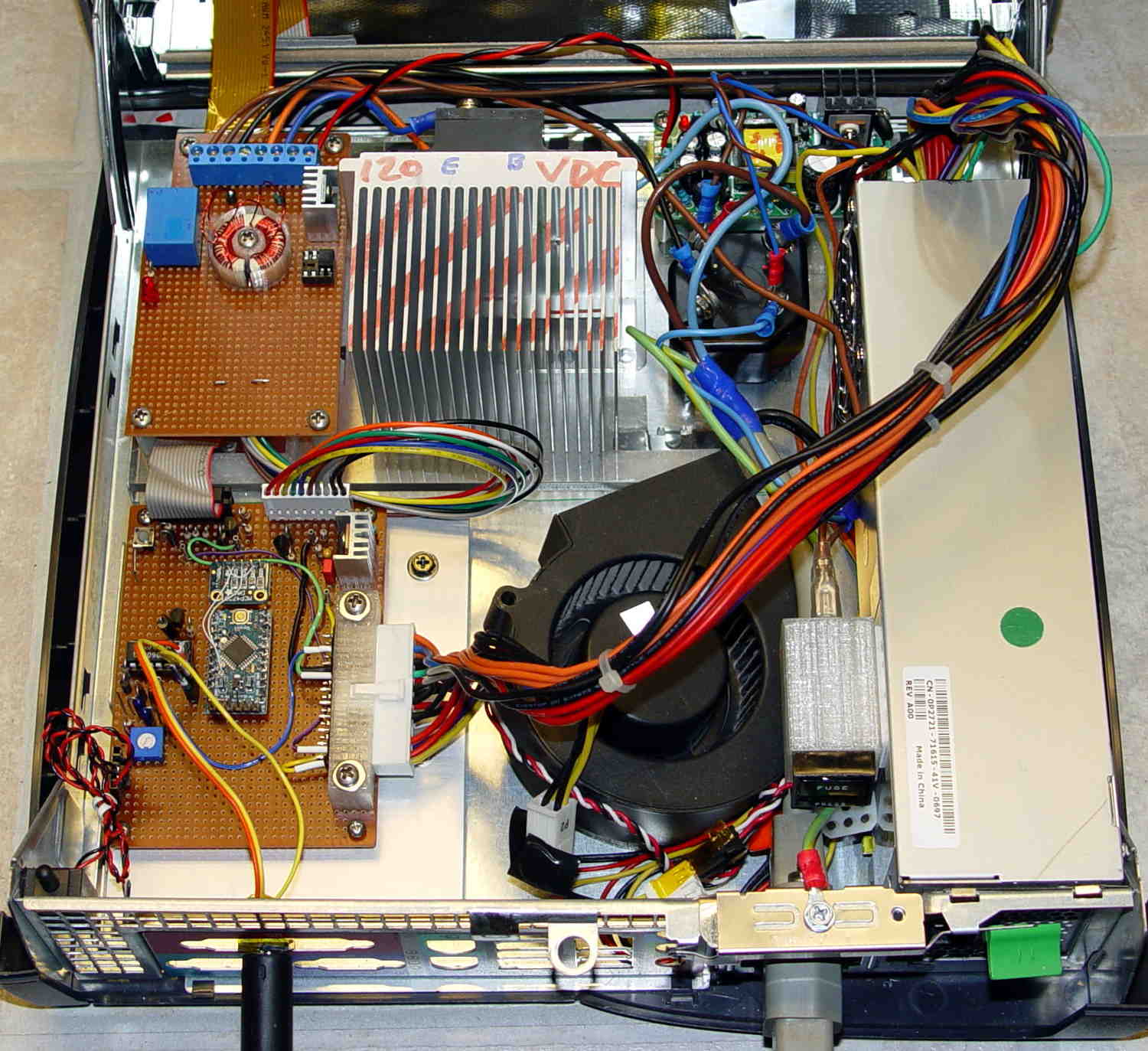
    The case from a Dell Optiplex GX270 will hold the Kenmore 158 sewing machine’s motor control electronics, because it has a well-grounded metal box inside the plastic shell that will protect fragile humans from line voltages. The GX270 power supply will suffice for the usual stuff, but the bridge rectifier, power transistor, and suchlike require a direct connection to the AC line.

    Rather than add another plug, I soldered a nice two-wire line cord to the IEC socket terminals inside the GX270’s power supply:

    Modified Dell power supply - interior
    Modified Dell power supply – interior

    The cord follows the IEC/EU standard color code:

    • Blue – neutral
    • Brown – hot

    The power supply follows the US standard color code:

    • White – neutral
    • Black – hot

    The nice thing about standard color codes: everybody can have one!

    The yellow cable tie anchors the cord to a metal tab that, when bent at right angles, provides a convenient exit from the power supply at exactly the right location:

    Modified Dell power supply - AC cord exit
    Modified Dell power supply – AC cord exit

    The power supply mounts with the label facing inward, directly adjacent to the PCI slot covers. The new cord emerges near the bottom, inside the recess that formerly accommodated the board.

    Definitely not UL approved, but we’re well beyond that stage anyway…

  • Monthly Science: Basement Safe vs. Summer Humidity

    So much for sealing the basement safe door:

    Basement_Safe
    Basement_Safe

    The desiccant definitely lasts longer during the winter, even though the dehumidifier fights the basement air to a standstill around 55%RH during the summer.

    Each desiccant bag contains 500 g of silica gel and the most recent one adsorbed 73 g of water.

  • Revlon Tweezers: Bad Spot Welds

    Mary bought a pair of Revlon tweezers a while ago, picking a Name Brand to avoid hassles with bottom-dollar crap:

    Revlon tweezers - bad spot welds
    Revlon tweezers – bad spot welds

    Well, that didn’t work.

    I contend that the only difference between Name Brands and the bottom-dollar crap I tend to buy is a bit of QC and a lot of price. I’ll agree that’s not strictly true, but it does fit a goodly chunk of the observed data.

    Anyhow.

    I milled a recess into the corner of some scrap plastic to locate the handle end, then arranged a step block to capture the business end:

    Revlon tweezers - drilling setup
    Revlon tweezers – drilling setup

    That setup ensures the holes go into the corresponding spots on both pieces, because I couldn’t figure out how to clamp them together and drill them both at once. I drilled the other piece with its good side up to align the holes; doing it bad side up would offset the holes if they’re not exactly along the center line.

    A closer look:

    Revlon tweezers - drilling fixture
    Revlon tweezers – drilling fixture

    Talk about a precarious grip on the workpiece!

    I filed the welds flat before drilling, so the pieces lay flat and didn’t distract the drill.

    Then:

    • Center-drill
    • Drill 2-56 clearance
    • Scuff up mating surfaces with coarse sandpaper
    • Apply epoxy
    • Insert screws
    • Add Loctite
    • Tighten nuts to a snug fit
    • Align jaws
    • Tighten nuts
    • Fine-tune jaw alignment
    • Apply mild clamping force to hold jaws together
    • Wait overnight
    • Saw screws and file flush
    • Done!

    The clamping step:

    Revlon tweezers - epoxy curing
    Revlon tweezers – epoxy curing

    Those nicely aligned and ground-to-fit jaws were the reason Mary bought this thing in the first place.

    The screw heads look OK, in a techie sort of way:

    Revlon tweezers - fixed - front
    Revlon tweezers – fixed – front

    The backside won’t win any awards:

    Revlon tweezers - fixed - rear
    Revlon tweezers – fixed – rear

    But it won’t come apart ever again!

    There’s surely a Revlon warranty covering manufacturing defects, printed on the long-discarded packaging, that requires mailing the parts with the original receipt back to some random address at our own expense.

    Ptui!