The Smell of Molten Projects in the Morning

Ed Nisley's Blog: Shop notes, electronics, firmware, machinery, 3D printing, laser cuttery, and curiosities. Contents: 100% human thinking, 0% AI slop.

Category: Machine Shop

Mechanical widgetry

  • OttLite LED Conversion

    Although Mary liked the illumination from her OttLite (an old 13 W fluorescent Folding Task Lamp), neither of us liked its tiny base and tippy nature. It recently fell / was dropped / jumped to its doom, smashing the CFL tube and wreaking havoc on the tiny plastic studs holding its large cast-iron weight and steel base in position. Given that the CFL ballast had started humming a while ago, I took it apart to see whether I could salvage anything from the rubble.

    Remove:

    • Four screws under the fuzzy felt feet
    • One screw under the label on the back
    • A final screw that becomes visible only after disemboweling the hinge assembly by unscrewing the obvious endcaps:
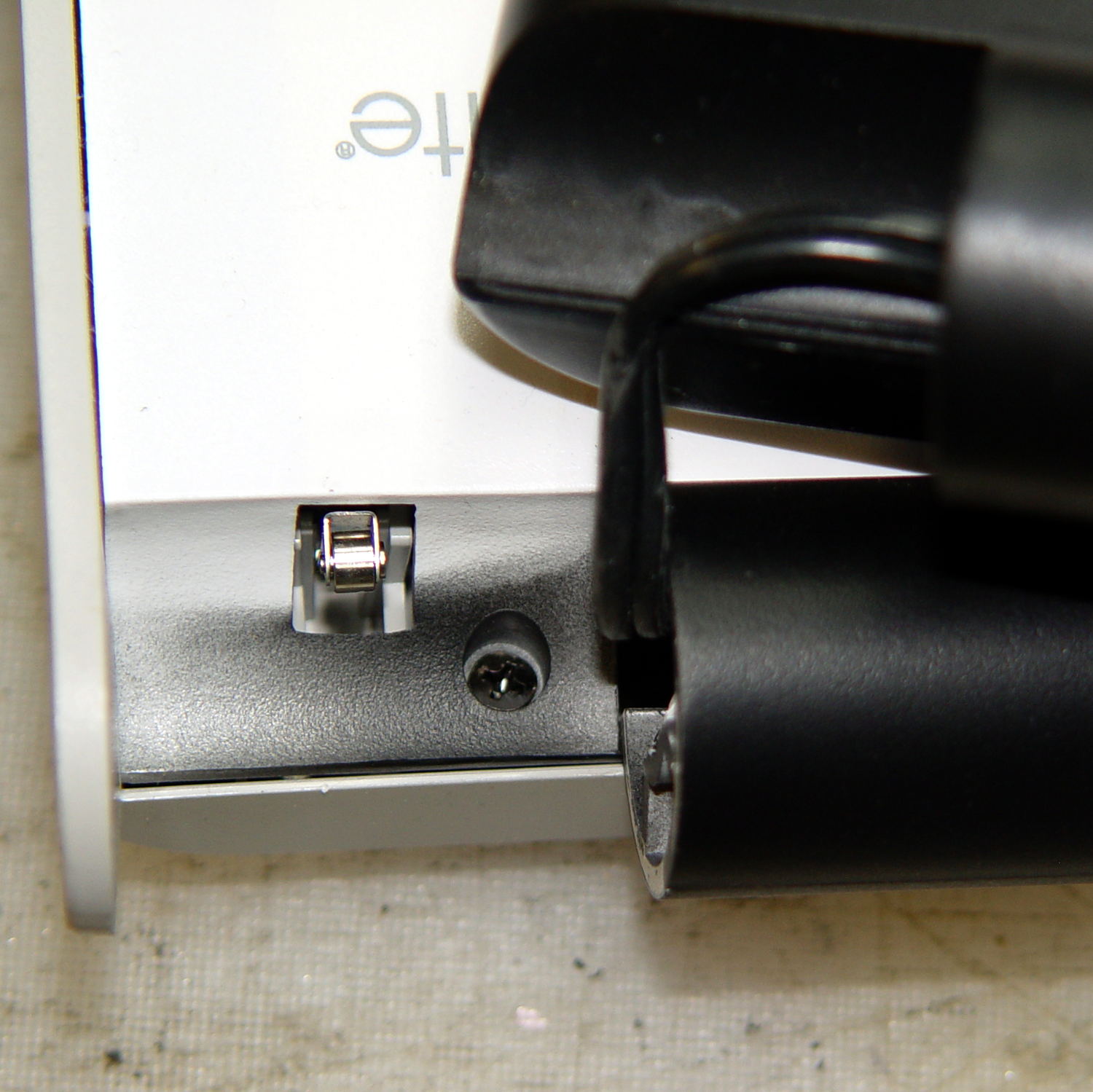
    OttLite LED Conversion - hinge screw
    OttLite LED Conversion – hinge screw

    Pull the hinge end of the white inside panel away from the outer stand at enough of an angle to disengage all three latches holding it to the base, then remove it just enough to let you start cutting wires around the ballast…

    I rebuilt the thing with a pair of 24 V 150 mA warm-white LED panels (good industrial surplus, not the usual cheap eBay crap) powered by a 19 V laptop adapter (from IBM, no less) through a (cheap eBay) boost converter sticky-foam-taped where the fluorescent ballast used to live:
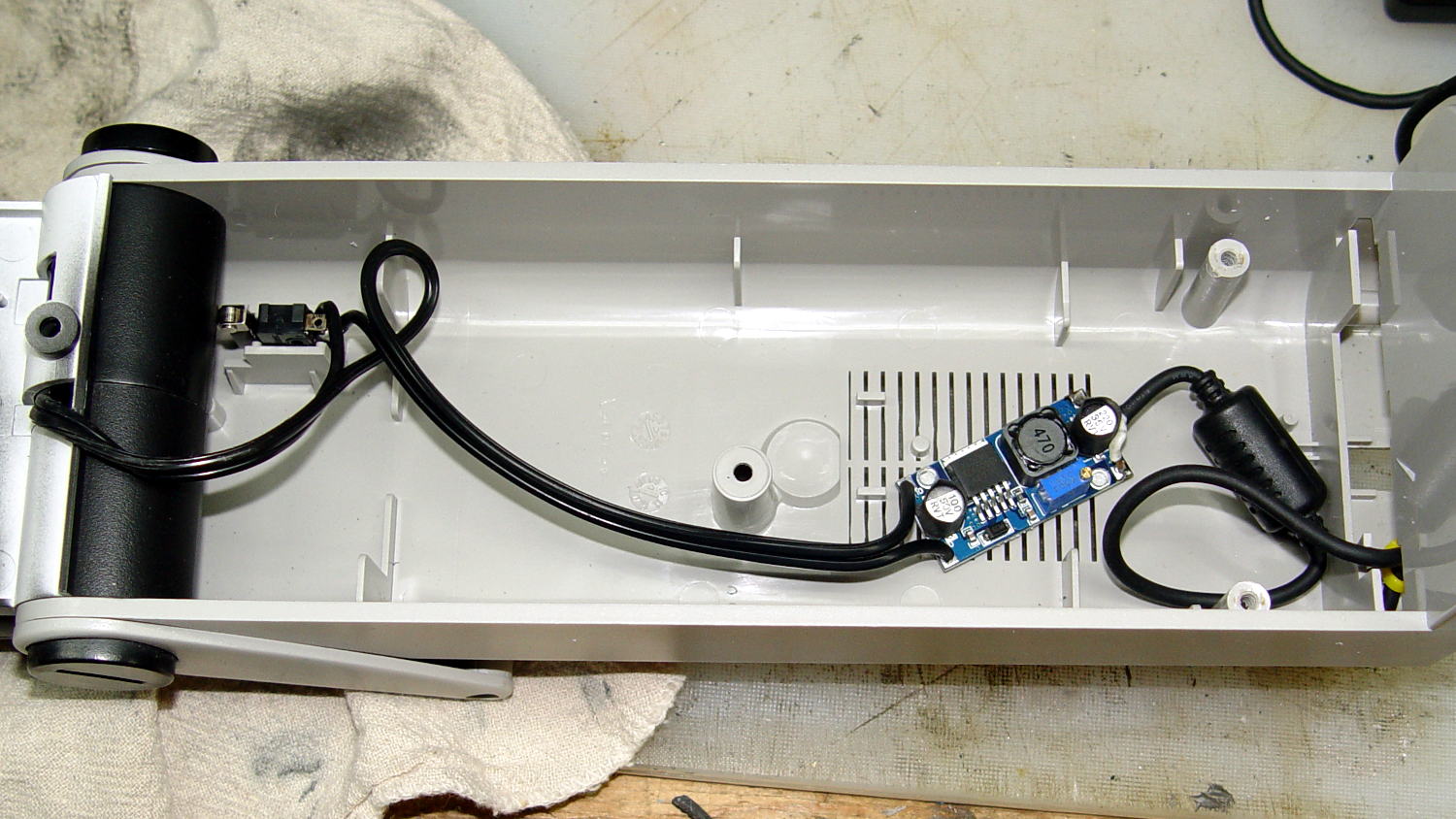
    OttLite LED Conversion - boost supply wiring
    OttLite LED Conversion – boost supply wiring

    The power supply had only two conductors, the central wire surrounded by twisted shielding, and didn’t require a fussy interface. Hooray for simple bulk power supplies; I lopped off the connector and soldered the wires directly to the boost converter.

    The original lamp wiring has a 120 VAC switch inside the hinge that turned the lamp on as you raise the arm holding the CFL tube: exactly what I need for its new use. That eliminated figuring out how to crack the arm apart to rewire it.

    I harvested the base from a(nother) defunct CFL bulb:

    OttLite LED Conversion - harvested CFL base
    OttLite LED Conversion – harvested CFL base

    By soldering wires directly into the pins, I could reuse the existing CFL socket in the lamp arm, the existing wiring, and the switch.

    The LED panels dissipate 3-ish W each:
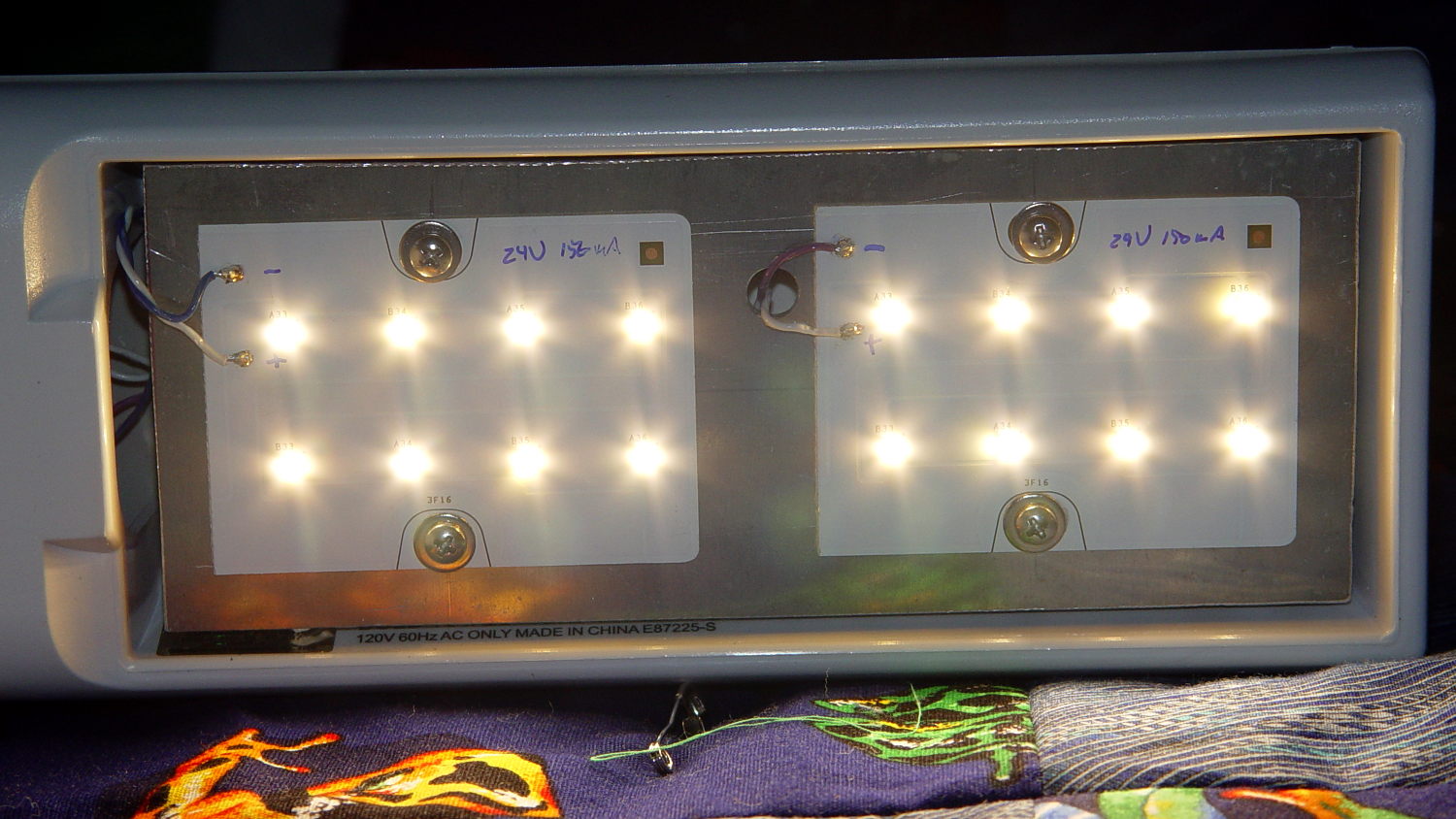
    OttLite LED Conversion - LED panel layout
    OttLite LED Conversion – LED panel layout

    They’re mounted on a 0.1 inch aluminum sheet from the heap that required exactly one saw cut to fit into the space available, so I defined it to be perfect. The 4-40 screws holding the panels in place continue through the plate and 3/8 inch aluminum standoffs into a quartet of knurled inserts epoxied into eyeballometrically match-drilled holes in the lamp arm:

    OttLite LED Conversion - epoxied threaded inserts
    OttLite LED Conversion – epoxied threaded inserts

    The faint yellowish discoloration from the CFL tube’s heat and UV is much more visible in real life, but nobody will ever see it again. The scrawled blue (+) and (-) marks give the socket polarity; it’s not mechanically polarized and a bit of care is in order. The black rectangle is actually a shiny metal sheet intended to reflect heat from the CFL tube’s base away from the plastic arm.

    I set the boost converter to 23.5 V, at which point the LED panels draw about 100 mA each and get just over uncomfortably warm after an hour or two:
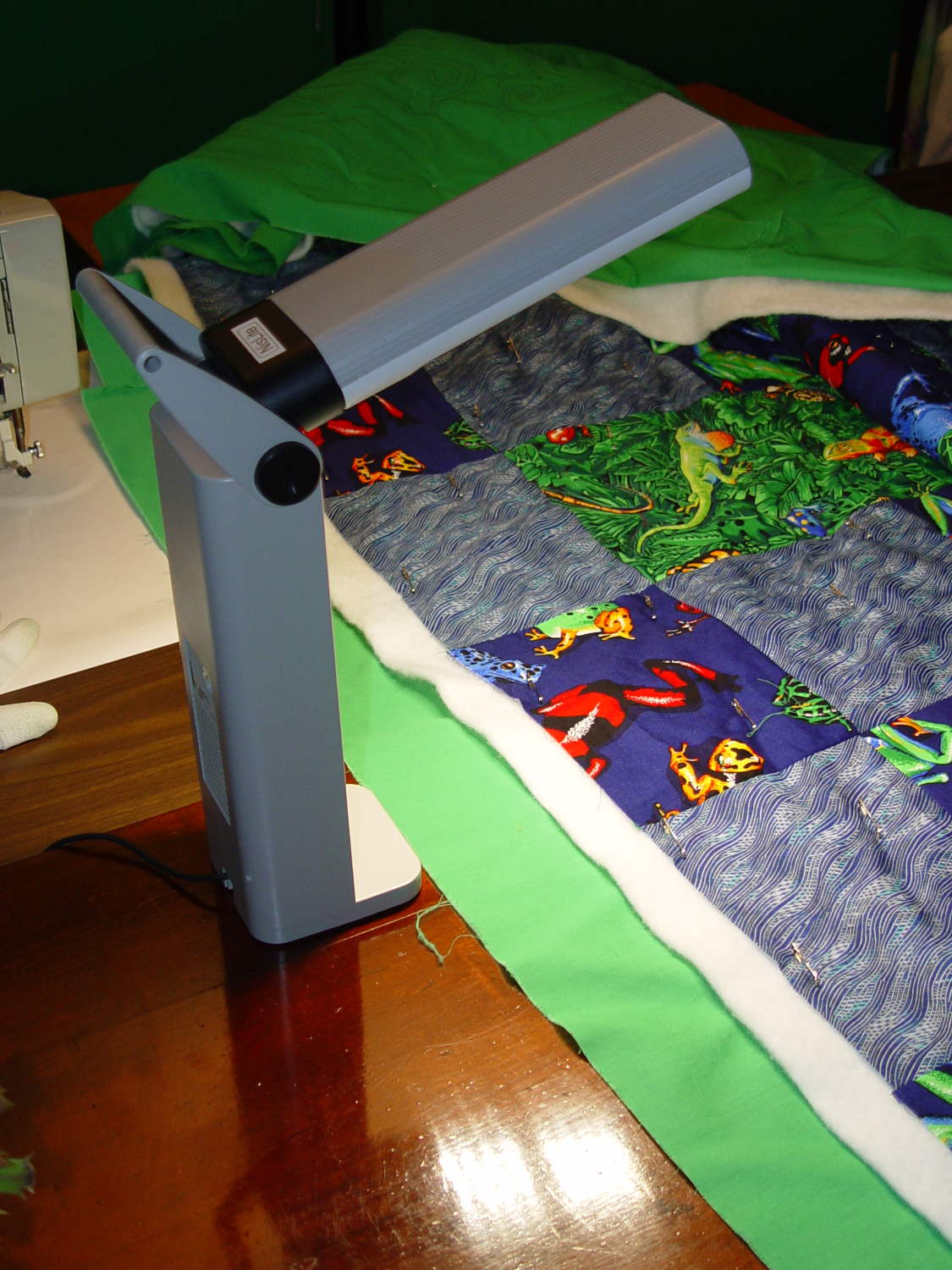
    OttLite LED Conversion - in action
    OttLite LED Conversion – in action

    The panels run 120 °F = 50 °C and the SMD LEDs probably exceed 150 °F = 65 °C. The scant surplus doc touted “No heatsink required” and the single-sided FR4 PCB insulates the LEDs from the aluminum sheet, but I still smeared some heatsink compound behind the panels in the hopes of spreading the heat out a bit.

    I glued the shattered base studs back in place with IPS #3, surrounded them with generous epoxy fillets, plunked the cast iron weight in place atop some waxed paper to mold the epoxy to fit (and let me remove it again, if needs be), screwed everything together, and stuck a foam sheet over the steel base plate. It’s as tippy as before, but at least the LEDs won’t shatter if when it falls. It really needs a larger base; a polycarbonate plate might work, if only I could figure out how to attach it.

    All in all, the lamp looks good and the warm-white LEDs with DC drive don’t produce that horrible fluorescent flicker.

    The lamp now sports a label identifying it as a NisLite; because P-Touch labeler.
  • Tour Easy: Long-Deferred Drivetrain Maintenance

    A few months back, the 13-tooth sprocket on my Tour Easy started skipping, which reminded me that I planned to replace all the drivetrain components. Time passed, the winter remained unseasonably warm and sunny, we kept riding, the skipping got much worse, and I just shifted across that sprocket.

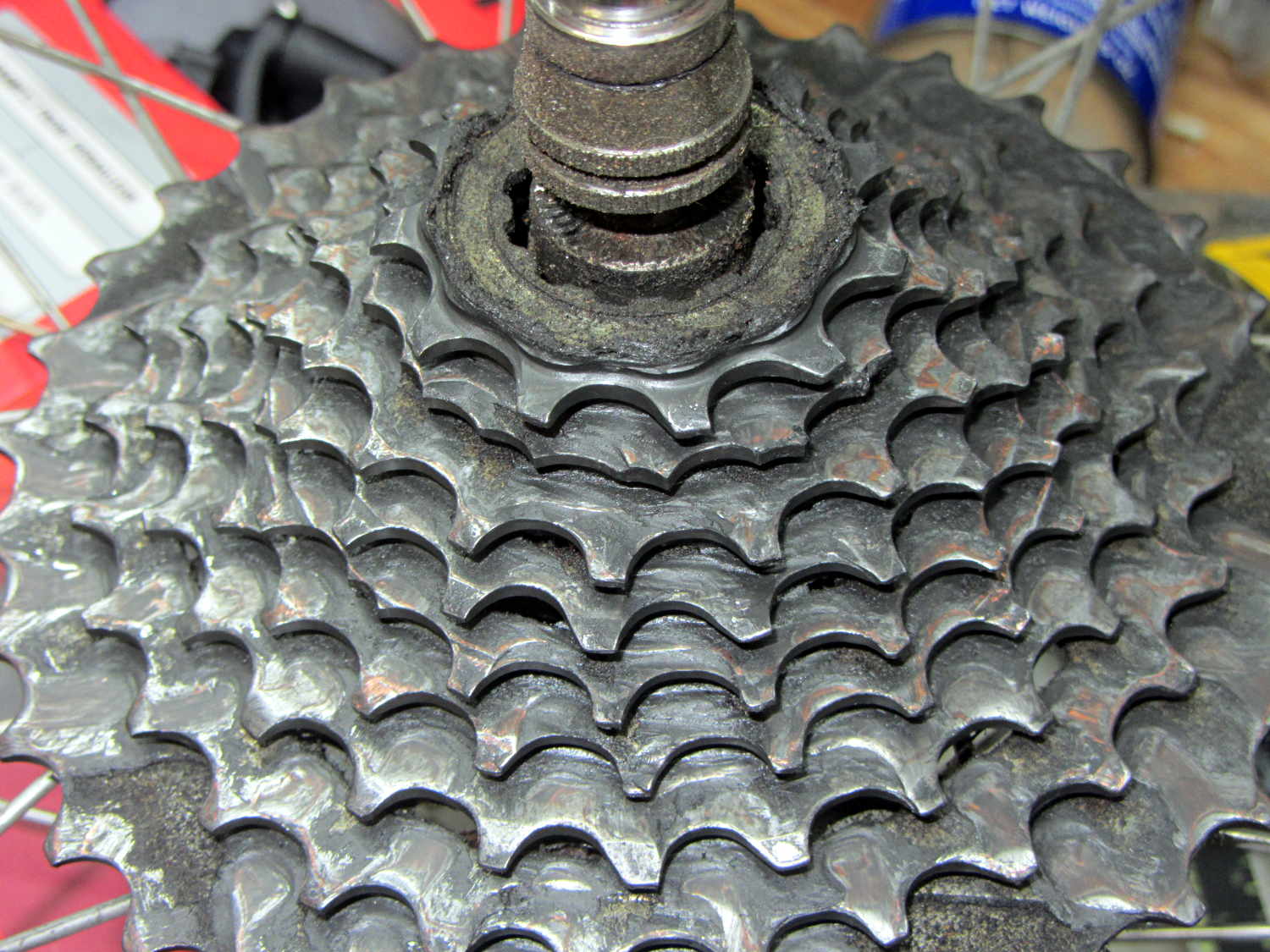
    Finally, the rains returned, I heaved the bike up on the workstand, and started replacing things. Judging from the accumulated crud and severe wear, it’s been on there for quite a while:

    Sprocket with broken teeth - as found
    Sprocket with broken teeth – as found

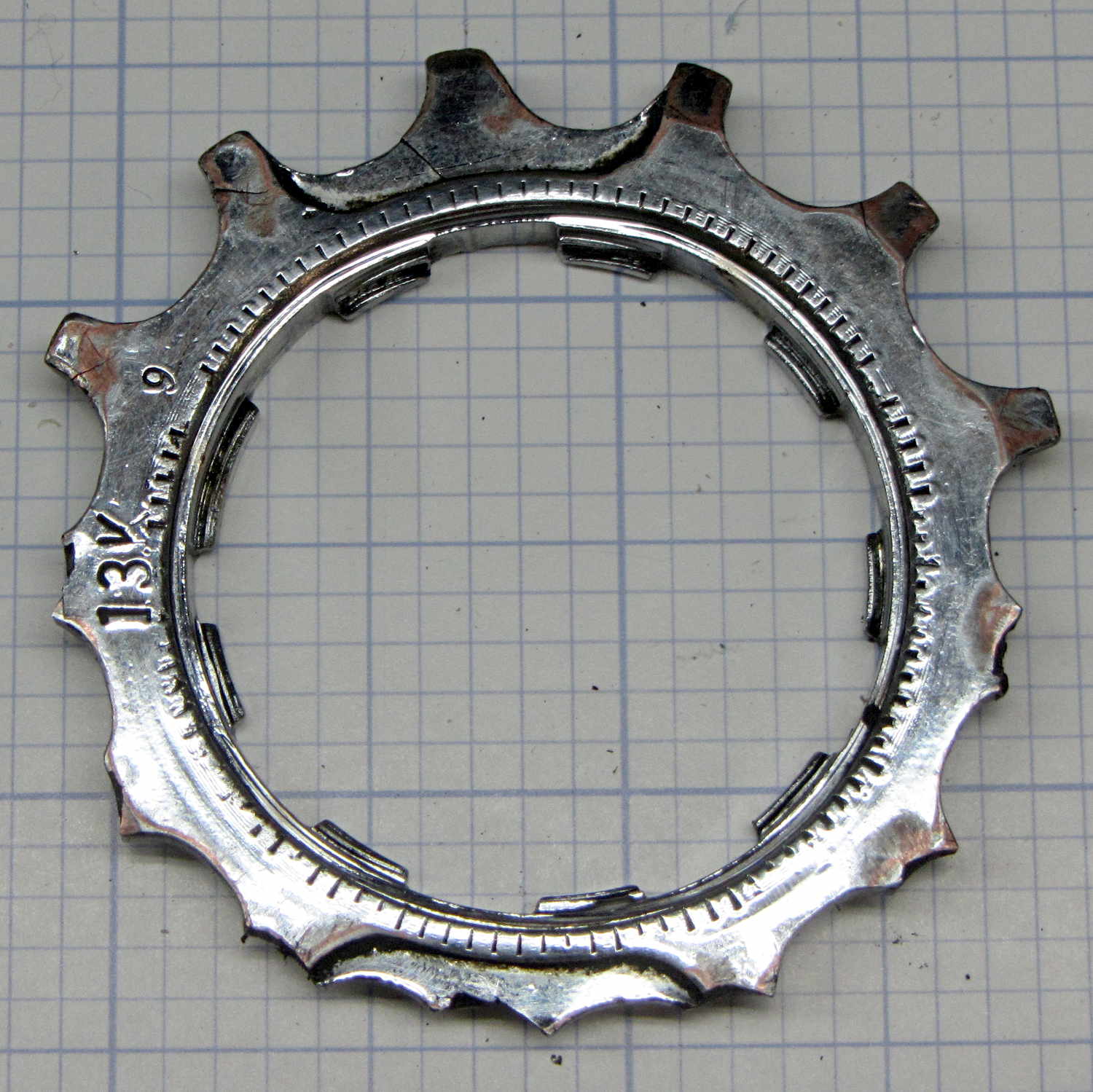
    Here’s the offending 13-tooth sprocket, all shined up;

    Sprocket with broken teeth - detail
    Sprocket with broken teeth – detail

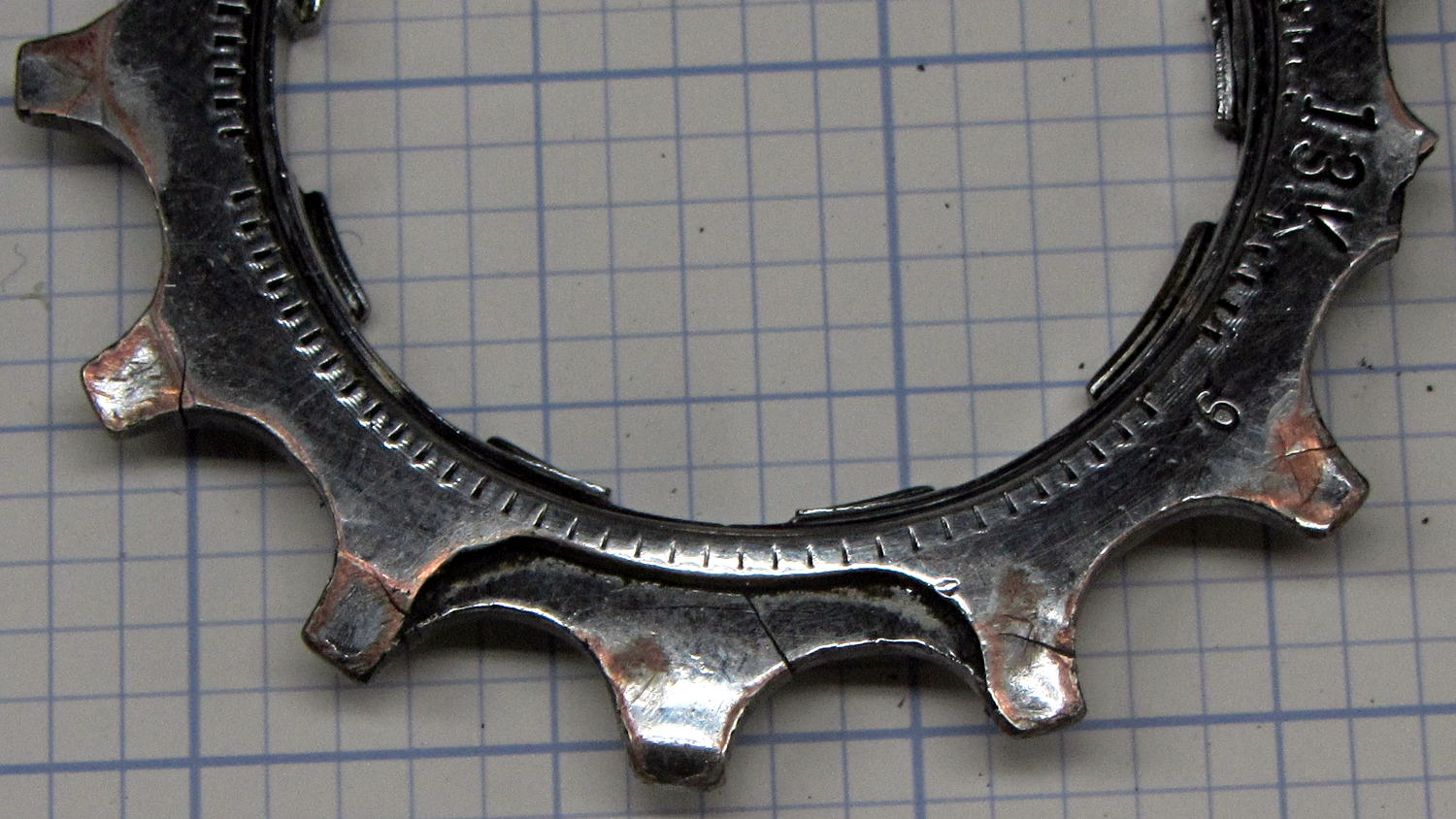
    I don’t recall a catastrophic failure that stripped all those teeth off in one shot. A closer look showed cracks in the few remaining teeth:

    Sprocket with broken teeth - cracked teeth
    Sprocket with broken teeth – cracked teeth

    Which explains why the skipping gradually got worse: the poor sprocket shed teeth as I rode blithely along.

    Huh.

    That’s what happens with a severely worn sprocket: the chain applies tension to just the topmost tooth, rather than distributing it on the teeth around a third (or more) of the sprocket, and, one by one, that force breaks the teeth. The top picture shows at least one other sprocket with a missing tooth; all display the shark-fin profile of heavy wear.

    As you can tell from the other bike pix & repairs around here, I’d rather ride than mess around with cleaning and suchlike. We’re on our second set of drivetrain components in 15 years, so I’d say treating all that stuff as consumable seems a fair tradeoff…

  • Knurled Inserts: Epoxy Anchoring

    After taking the incandescent lamp socket off its base, I drilled the tapped (yeah, in plastic) 6-32 holes out to a firm press fit for the knurled 6-32 inserts, buttered the inserts with epoxy, and pressed them firmly in place:

    Lamp Base - epoxy knurled insert
    Lamp Base – epoxy knurled insert

    Fast forward a day and they’re stuck in there like they were glued. You can see a bit of the epoxy around the right rim of the insert; I wiped a bit more off around the other one.

    Putting The Right Amount of epoxy on the insert requires dialing back my “The bigger the blob, the better the job” enthusiasm, but wasn’t all that difficult. It’s certainly more tedious than just ramming the inserts into a printed hole and might actually produce better retention. I doubt that will make the least difference for (almost) anything I build.

    On the whole, they look good…

  • Fluorescent Shoplight Capacitor: Wow!

    You just can’t make this stuff up:

    Fluorescent Shoplights - nasty cap termination
    Fluorescent Shoplights – nasty cap termination

    That shredded plastic can’t possibly be a Good Thing; the endcap contained plenty of loose shreds.

    Perhaps I’m overly critical, but I think the only way these fixtures could have a UL approval certificate was that somebody else didn’t notice their certificate went missing. Most likely, of course, the fixtures sent for approval looked lovely and bore no relation to the junk actually sold to Lowe’s / Home Depot.

    That emerged from the fourth defunct fluorescent fixture I converted to use LED tubes.

  • Raspberry Pi Streaming Radio Player: Marginally Viable Product

    The least horrible way to get events from the keypad turned out to be a simple non-blocking poll from Python’s select library, then sucking the event input queue dry; the main loop now does what might be grandiosely overstated as cooperative multitasking. Well, hey, it reads lines from mplayer’s output pipe and processes keypad events and doesn’t stall (for very long) and that’s multi enough for me.

    It extracts the stream title from the ICY Info line, but I still haven’t bothered with a display. It may well turn out that this thing doesn’t need a display. The stream title will be enclosed in single quotes, but it may also contain non-escaped and non-paired single quotes (a.k.a. apostrophes): the obvious parsing strategy doesn’t work. I expect titles can contain non-escaped semicolons, too, which will kill the algorithm I’m using stone cold dead. Some try - except armor may be appropriate.

    This code does not tolerate a crappy WiFi connection very well at all. I eventually replaced a long-antenna WiFi adapter with an actual Ethernet cable and all the mysterious problems at the far end of the house Went Away. Soooo this code won’t tolerate random network stream dropouts very well, either; we’ll see how poorly that plays out in practice.

    The hackery to monitor / kill / restart / clean up after mplayer and its pipes come directly from seeing what failed, then whacking that mole in the least intrusive manner possible. While it would be better to wrap a nice abstract model around what mplayer is (assumed to be) doing, it’s not at all clear to me that I can build a sufficiently durable model to be worth the effort. Basically, trying to automate a program designed to be human-interactive is always a recipe for disaster.

    The option for the Backspace / Del key lets you do remote debugging by editing the code to just bail out of the loop instead of shut down. Unedited, it’s a power switch: the Pi turns off all the peripherals and shuts itself down. The key_hold conditional means you must press-and-hold that button to kill the power, but don’t run this on your desktop PC, OK?

    Autostarting the program requires one line in /etc/rc.local:

    sudo -u pi python /home/pi/Streamer.py &
    

    AFAICT, using cron with an @REBOOT line has timing issues with the network being available, but I can’t point to any solid evidence that hacking rc.local waits until the network is up, either. So far, so good.

    I make no apologies for any of the streams; I needed streams behind all the buttons and picked stuff from Xiph’s listing. The AAC+ streams from the Public Domain Project give mplayer a bad bellyache; I think its codecs can’t handle the “+” part of AAC+.

    All in all, not bad for a bit over a hundred lines of code, methinks…

    More fiddling will happen, but we need some continuous experience for that; let the music roll!

    The Python program as a GitHub Gist:

    from evdev import InputDevice,ecodes,KeyEvent
    import subprocess32
    import select
    import re
    import sys
    Media = {'KEY_KP7' : ['Classical',['mplayer','-playlist','http://stream2137.init7.net/listen.pls'%5D%5D,
    'KEY_KP8' : ['Jazz',['mplayer','-playlist','http://stream2138.init7.net/listen.pls'%5D%5D,
    'KEY_KP9' : ['WMHT',['mplayer','http://live.str3am.com:2070/wmht1'%5D%5D,
    'KEY_KP4' : ['Dub 1',['mplayer','-playlist','http://dir.xiph.org/listen/2645/listen.m3u'%5D%5D,
    'KEY_KP5' : ['Dub 2',['mplayer','http://streaming207.radionomy.com:80/MiamiClubMusiccom'%5D%5D,
    'KEY_KP6' : ['WAMC',['mplayer','http://pubint.ic.llnwd.net/stream/pubint_wamc'%5D%5D,
    'KEY_KP1' : ['Oldies 1',['mplayer','http://streaming304.radionomy.com:80/keepfree60s'%5D%5D,
    'KEY_KP2' : ['Oldies 2',['mplayer','http://streaming207.radionomy.com:80/1000Oldies'%5D%5D,
    'KEY_KP3' : ['Soft Rock',['mplayer','http://streaming201.radionomy.com:80/SoftRockRadio'%5D%5D,
    'KEY_KP0' : ['Smooth',['mplayer','http://streaming202.radionomy.com:80/The-Smooth-Lounge'%5D%5D
    }
    CurrentKC = 'KEY_KP7'
    Controls = {'KEY_KPSLASH' : '/',
    'KEY_KPASTERISK' : '*',
    'KEY_KPENTER' : ' ',
    'KEY_KPMINUS' : '<',
    'KEY_KPPLUS' : '>'
    }
    # set up event input and polling
    k=InputDevice('/dev/input/keypad')
    kp = select.poll()
    kp.register(k.fileno(),select.POLLIN + select.POLLPRI + select.POLLERR)
    # set up files for mplayer pipes
    lw = open('/tmp/mp.log','w') # mplayer piped output
    lr = open('/tmp/mp.log','r') # … reading that output
    # Start the default stream
    print 'Starting mplayer on',Media[CurrentKC][0]," -> ",Media[CurrentKC][-1][-1]
    p = subprocess32.Popen(Media[CurrentKC][-1],stdin=subprocess32.PIPE,stdout=lw,stderr=subprocess32.STDOUT)
    print ' … running'
    #— Play the streams
    while True:
    # pluck next line from mplayer and decode it
    text = lr.readline()
    if 'ICY Info: ' in text:
    trkinfo = text.split(';')
    for ln in trkinfo:
    if 'StreamTitle' in ln:
    trkhit = re.search(r"StreamTitle='(.*)'",ln)
    TrackName = trkhit.group(1)
    print 'Track name: ', TrackName
    break
    elif 'Exiting…' in text:
    print 'Got EOF / stream cutoff'
    print ' … killing dead mplayer'
    p.kill()
    print ' … flushing pipes'
    lw.truncate(0)
    print ' … discarding keys'
    while [] != kp.poll(0):
    kev = k.read
    print ' … restarting mplayer: ',Media[CurrentKC][0]
    p = subprocess32.Popen(Media[CurrentKC][-1],stdin=subprocess32.PIPE,stdout=lw,stderr=subprocess32.STDOUT)
    print ' … running'
    continue
    # accept pending events from keypad
    if [] != kp.poll(0):
    kev = k.read()
    for e in kev:
    if e.type == ecodes.EV_KEY:
    kc = KeyEvent(e).keycode
    if kc == 'KEY_NUMLOCK':
    continue
    # print 'Got: ',kc
    if (kc == 'KEY_BACKSPACE') and (KeyEvent(e).keystate == KeyEvent.key_hold):
    if True:
    print 'Backspace = shutdown!'
    p = subprocess32.call(['sudo','shutdown','-HP',"now"])
    else:
    print 'BS = bail from main, ssh to restart!'
    sys.exit(0)
    if KeyEvent(e).keystate != KeyEvent.key_down:
    continue
    if kc in Controls:
    print 'Control:', kc
    try:
    p.stdin.write(Controls[kc])
    except Exception as e:
    print "Can't send control: ",e
    print ' … restarting player: ',Media[CurrentKC][0]
    p = subprocess32.Popen(Media[CurrentKC][-1],stdin=subprocess32.PIPE,stdout=lw,stderr=subprocess32.STDOUT)
    print ' … running'
    if kc in Media:
    print 'Switching stream to ',Media[kc][0]," -> ",Media[kc][-1][-1]
    CurrentKC = kc
    print ' … halting player'
    try:
    p.communicate(input='q')
    except Exception as e:
    print 'Perhaps mplayer died?',e
    print ' … killing it for sure'
    p.kill()
    print ' … flushing pipes'
    lw.truncate(0)
    print ' … restarting player: ',Media[CurrentKC][0]
    p = subprocess32.Popen(Media[CurrentKC][-1],stdin=subprocess32.PIPE,stdout=lw,stderr=subprocess32.STDOUT)
    print ' … running'
    print 'Out of loop!'
    view raw Streamer.py hosted with ❤ by GitHub
  • Vacuum Tube LEDs: Octal Tube on a CD

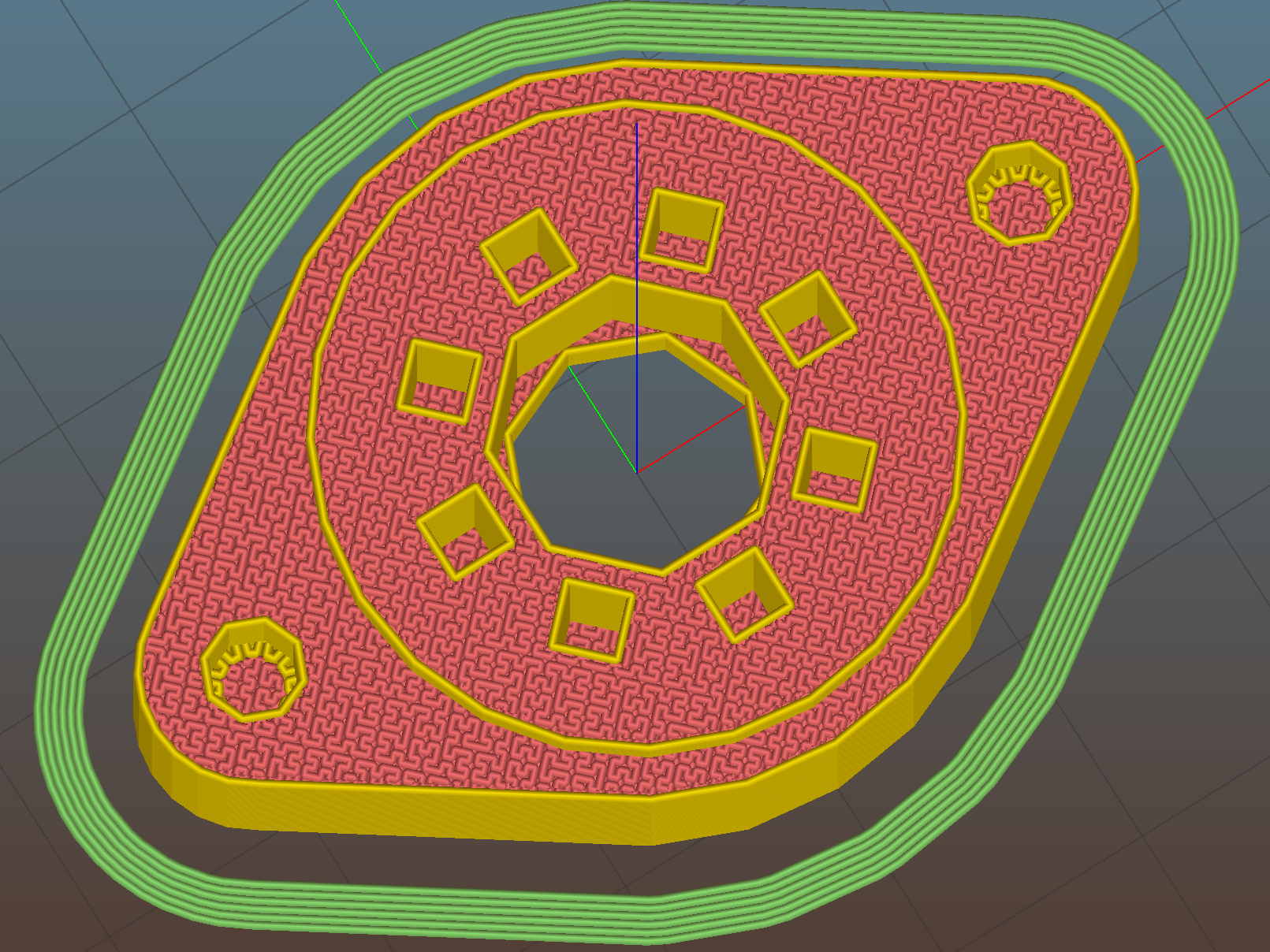
    Mounting an octal tube socket in a CD requires nothing more than printing one from the same OpenSCAD code that produced the Noval socket:

    Vacuum Tube Lights - octal socket - Slic3r preview
    Vacuum Tube Lights – octal socket – Slic3r preview

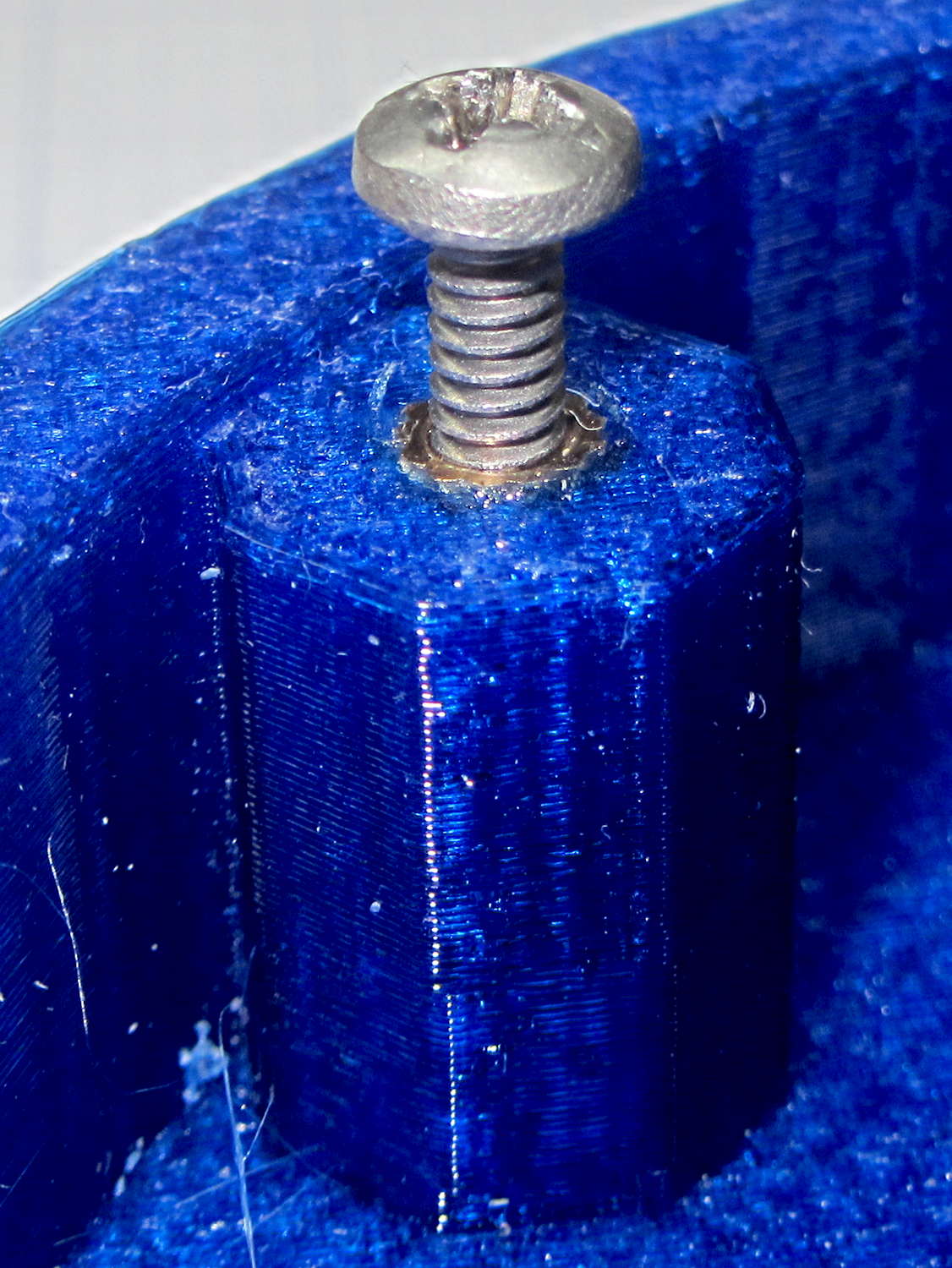
    Then apply a 1-1/8 inch Greenleee punch to a randomly chosen scrap CD, match-drill two screw holes, push the knurled inserts into the socket, and screw everything together:

    Octal socket in CD - screw detail
    Octal socket in CD – screw detail

    I totally forgot about the raised ring around the central hole, so the OpenSCAD source code now moves the screws outward to 47 mm OC for a bit of head clearance. The 6-32 screws don’t look nearly so large next to that big Bakelite base.

    The 2.36 mm tube pins fit perfectly into the (square!) socket holes without reaming.

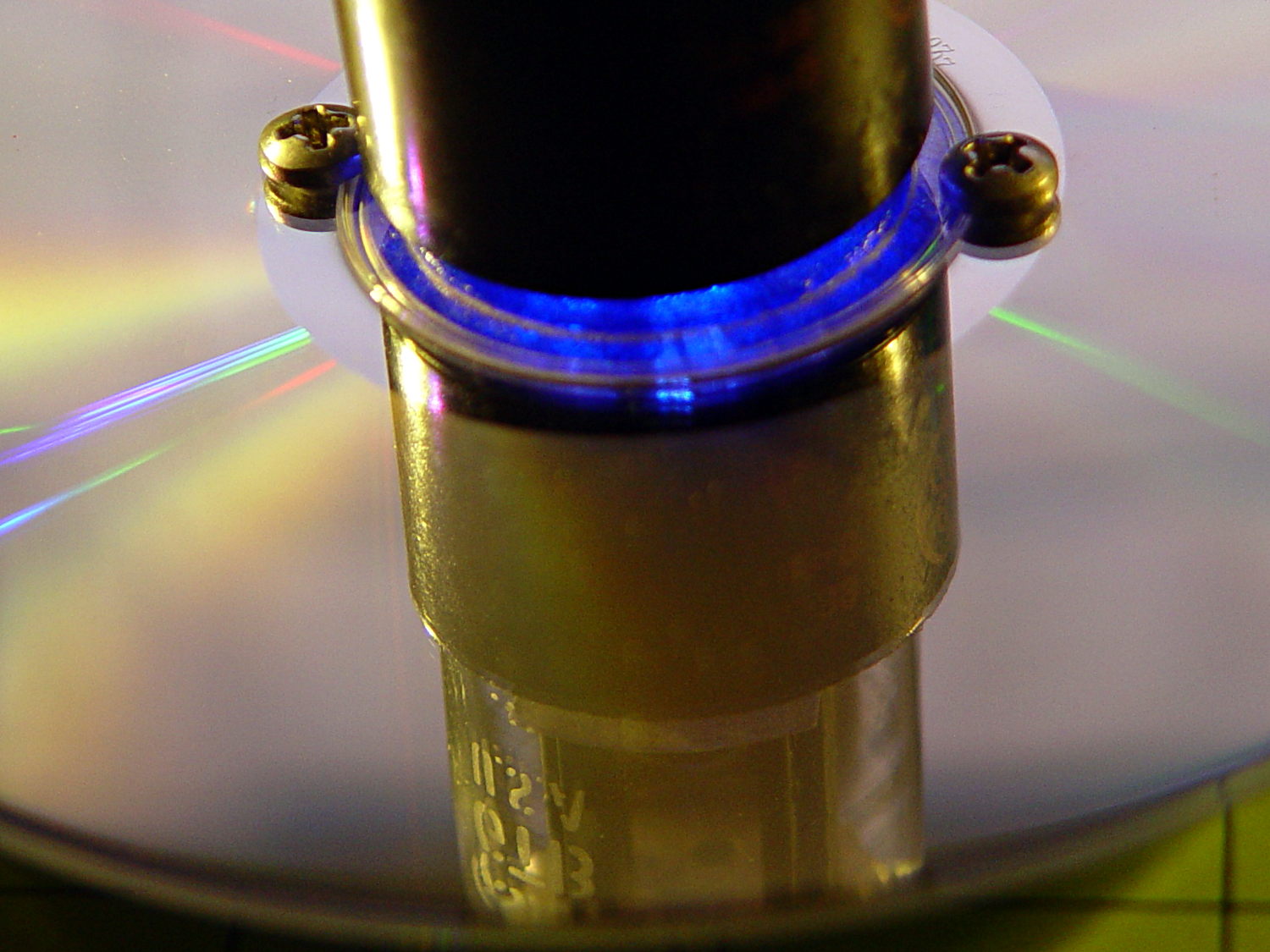
    This 6SN7GTB would definitely benefit from a ersatz plate cap with an LED shining down on the mica spacer; fortunately, the getter flash is on the side, not the top. You can see the plate cap atop the adjacent duodecar tube diffracted in the grooves, so a CD “chassis” will add some pizzazz to a rather drab tube:

    Octal socket in CD - LED diffraction
    Octal socket in CD – LED diffraction

    In person, you see distinct RGB spots, not a continuous spectrum.

    This tube has a completely broken-off base spigot (the keyed cylinder around the evacuation tip), so (I think) more light gets through the base than from a cut-off spigot end. Perhaps the plate cap will add enough light to turn the base LEDs into an accent.

  • Vacuum Tube LEDs: Fire in the Noval

    Replacing the original Noval socket in the string with the platter-friendly version, bracing the wiring with duct tape, balancing it on my desk, and firing it up:

    Noval socket - red phase
    Noval socket – red phase

    The green phase looks nice, too:

    Noval socket - green phase
    Noval socket – green phase

    Those screws are too big.

    The getter flash covers the entire top of the tube; shining an LED down through the evacuation tip won’t work and even a laser doesn’t do much. That saves me the trouble of trying to create a cap that doesn’t wreck the tube’s good looks.

    I originally planned to use white / natural PETG for the socket, but the more I see of those things, the more I think black is the new white. The sockets should vanish into the background, to let the tubes (and their reflections) carry the show.

    The (yet to be designed) base must vanish under the platter edge, too, which puts a real crimp on its overall height. I’m not sure how to fit an Arduino Pro Mini and an FTDI board beside the existing socket; perhaps this calls for a unified socket-base design held on by those screws, rather than a separate socket inside a base enclosure.

    Even though I know the tubes are inert and cool, I still hesitate before removing them from their sockets with the Neopixels running: you simply do not unplug a hot, powered device!