Ed Nisley's Blog: Shop notes, electronics, firmware, machinery, 3D printing, laser cuttery, and curiosities. Contents: 100% human thinking, 0% AI slop.
The latch closing my tea ball consists of a nice stainless steel dingus held on by a grotty rivet of unknown provenance that I’ve repeatedly staked over the years. It finally came undone this morning, so I had a few minutes of Quality Shop Time right after breakfast.
My tiny-screw box (left over from the long-gone Leichtung Workshops) has some stainless 0-80 screws that I found somewhere, but only brass nuts. Ah, well, we used to use brass water fixtures and lead pipe, so an 0-80 nut in hot water isn’t going to kill me.
The ball rim has a recess for the rivet head, but the screw head was slightly larger. I braced the rim of the ball across the vise jaws and give the recess a few shots with a fat punch to enlarge it.
Stainless screw and brass nut
Then…
A dot of Loctite on the threads
Assemble everything
Take it apart to put the latch on the correct side of the rim
Reassemble
Attempt to close
Gently bend the rim to flatten it out
Close
Attempt to latch
Brace closed rim on vise opening with screw head up
A few shots with a drift punch to settle recess around screw head
Success!
It seems I ain’t worth a damn in the morning without a hot cuppa. The rituals must be preserved.
I tossed the ball in the dishwasher and opted for a tea bag today…
Heat pumps behave like bidirectional refrigerators: they cool the building by heating the outside air or heat the building by cooling the outside air. In relatively mild, dry weather, this works perfectly.
Here in the Northeast US, it’s not such a bright idea. For about half the year, the ambient temperature is low enough and the humidity high enough that pumping heat out of the exchanger drops its temperature below the dew point, whereupon ambient moisture condenses on the fins and, given the temperature differential between ambient and coil, freezes solid.
In that situation, the efficiency of the heat exchanger drops well below zero: it turns on electric resistance heating bars to warm the inside air and runs a defrost cycle on the exterior heat exchanger.
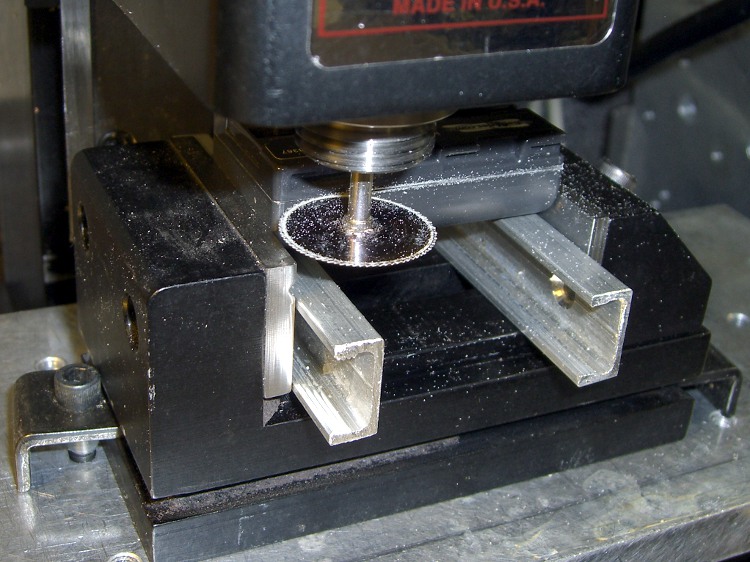
Just for curiosity’s sake, I applied a slitting saw to the oldest defunct generic NP-FS11 battery pack, cutting carefully along the bonded joint between the two parts.
No coolant, 1000 rpm, 200 mm/min, the saw is 22 mm diameter. Much slower than you’d use if you were in production, but I’m not.
First cut all the way around at 0.5 mm inside the case, then another pass at 1.0 mm. The second cut went ting as it passed the tabs at the base of the cells, so I knew the halves were released.
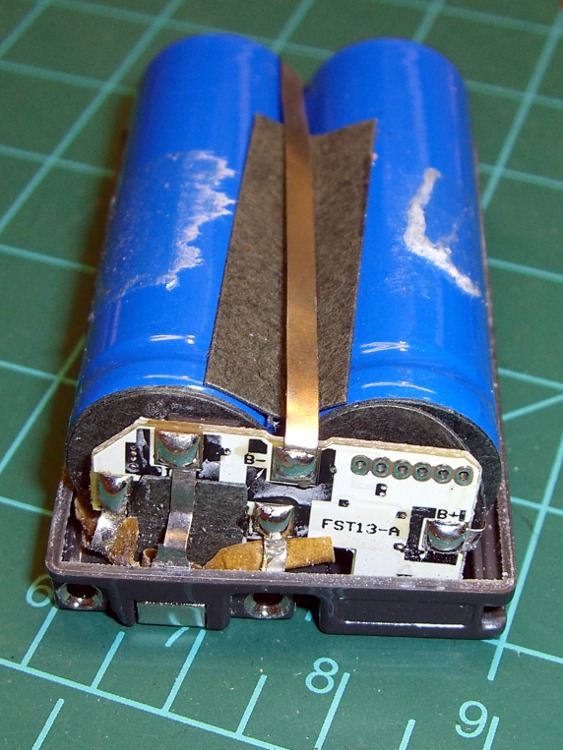
Inside we find a pair of 14430 Li-Ion cells, wired in parallel, with a little protection circuit board just jam-packed with teeny parts. One may reasonably assume the circuit controls over-charge and over-discharge, as well as current limiting.
Pack opened
So a reasonable (or, perhaps, amusing) thing to do would be to buy raw cells from a nominally reputable supplier, do a heart transplant, and see if that improves the situation.
Protection Circuit – Outboard
Photos of the protection PCB, showing the cell connections. Positive end of the cells is toward the PCB. I think there’s enough clearance in the camera’s battery compartment to allow a wrap of tape around the case in lieu of re-bonding the plastic together.
Sony no longer offers the NP-FS11 Li-Ion batteries required for my DSC-F505V camera, so I’ve been using “generic” replacements for quite some time. My experience has been mixed: some batteries provide a reasonable amount of run time, others provide almost none.
Feeding the appropriate keywords into Froogle gives you a range of battery suppliers, with offerings from, as of this writing, $3 to $103. Perhaps not surprisingly, the image for a $70 battery exactly matches the one on my desk that cost perhaps $15 a few years ago… although I’m certain that the actual battery you’d get wouldn’t match that picture.
I just bought three NP-FS11 batteries from the usual low-buck Hong Kong eBay supplier: six bucks apiece, shipped halfway around the world. The eBay listing claimed 1800 mAh, which seemed aggressive, and the batteries sport a 3900 mAh label, which is flat-out impossible.
Frankly, I didn’t expect much and here’s the discharge test graph to show I wasn’t disappointed. I used a 1-amp rate as a reasonable guess at the camera’s peak draw, although that might be a touch high for a continuous discharge.
Generic Sony NP-FS11 Li-Ion Batteries
The top blue curve is from a two-year-old literally no-name battery (no logo, no nothing!) that still provides decent run time; it’s the one matching that $70 battery. It provides about 1100 mAh, reasonably close to its 1300 mAh rating.
The middle curves, black and purple, are two of the new cells that provide about 900 mAh: half the as-listed-on-eBay capacity, 25% of the absurd label value. Their very low terminal voltage during most of the discharge says that these won’t provide much run time at all.
The green curve piddling off on the bottom is the third new cell, which is obviously defective. As I said, I didn’t expect much and I certainly wasn’t surprised.
The red curve is an old and completely defunct batteries.com offering that never provided good service.
Here’s another plot of three successive charge-discharge cycles for just the three new batteries. The first curves (at 1.0 A) correspond to what you see above, the remaining two sets (at 0.5 A) are the next two cycles. Batteries G and I have improved, H remains a dud.
MaxPower NP-FS11 Battery Tests
Given the varied offerings on the Web, I believe that there is no way to ensure you’re getting a known-good battery from a reputable supplier. It’s absolutely certain that price does not correlate with quality; the ones I bought simply establish that low-end offerings are crap.
The purchase was worth it for the amusement value alone; I don’t expect any action from the vendor, although I did send a copy of that graph with some explanatory text. The question is whether I should give them a five-star rating for prompt delivery…
As it happens, there’s enough room to slide a standard CR123A-size cell into the battery compartment. I think a bit of Quality Shop Time applied to a dead NP-FS11 battery case (and the vital Sony “Infolithium” DRM module) will provide a baseplate with all the proper connectors. Perhaps I can conjure up a “battery” containing a single cell of known-good quality?
Primary CR123A cells supply only 3 V, not the 3.6 V the camera really wants, so I can’t use disposable cells.
I have an X10 CM11A “Two Way Computer Interface” handling the very very very few scheduled events for our house. Basically, it turns the living room lights on in the evening and everything off much later.
As a result, I tend to ignore it for years at a time. A recent power outage killed the regularly scheduled events, which suggested that the backup batteries needed changing… and, yes, they were pretty well corroded.
With that out of the way, I discovered that the last time I’d loaded a program into the thing was so long ago that the heyu config files had either gone missing or were on a system not near the top of my heap. It’s easy enough to configure, so I installed heyu and spun up a new set of config files.
All the doc I can find says the CM11A has an RJ11 modular phone jack, which mates with the standard 6-position 4-conductor dingus found on the end of every phone in this part of the world. My CM11A, however, has a 4P4C jack, the narrower dingus found on phone handsets. Given that heyu reports
Firmware revision Level = 1
I suspect that this thing is slightly older than some of the folks reading this post and the X10 factory switched to a somewhat less bizarre connector in mid-stream.
Anyhow, the DB9 (yeah, it’s a DE9, but nobody calls it that) connector has “X10 Active Home” printed on it in my very own handwriting, with a standard RJ11 plug on the end. A double-jack adapter connects a hank of cable with an RJ11 plug on one end and a 4P4C connector on the other. I have no idea where that cable came from; perhaps I replaced the 4P4C plug with something less bizarre to add that extension so the cable would stretch from PC to wall outlet?
I plugged the thing into a USB-RS232 adapter and heyu had no trouble talking to the CM11A. However, trying to execute
heyu dim n13 10
produced the discouraging report
RI serial line may be stuck.
A bit of deft multimeter work produced this pinout list, which agrees with most of the doc you’ll find elsewhere. Hold the 4P4C connector with the tab down and the cable away from you: the pin numbers are 4 3 2 1 from left to right. The RS-232 pins are printed right on the DB-9 connector.
4P4C   DB9
 1      2 RxD
 2      9 RI
 3      3 TxD
 4      5 Gnd
It’s entirely possible the USB converter doesn’t support RI or it doesn’t do a good job of it. I jammed the cable into the serial port on the back of the PC and shazam it works perfectly.
The x10.conf file, for the next time around
TTY /dev/ttyS0

HOUSECODE N

LATITUDE 	41:40N
LONGITUDE	73:53W

ALIAS MBR_Dresser	N1
ALIAS Front_Hall	N5
ALIAS RV_XCVR		N9
ALIAS Couch		N10
ALIAS Mary_Reading	N11
ALIAS LR_Ceiling	N12
ALIAS Fireplace		N13
ALIAS Kitchen		N14
ALIAS Patio		N15
ALIAS Garage_Spots	N16

START_ENGINE	AUTO

LOG_DIR		/var/log/heyu/

DATE_FORMAT	YMD '-'
This herd, a family unit that’s been traveling around the neighborhood in recent weeks, paused for morning brunch in our neighbor’s yard. They generally cross the road at a dead run, but haven’t gotten themselves or anyone else killed. Yet.
They and their ilk are why our vegetable gardens must have ten-foot fences with robust supports. There are no understory plants left in the wooded areas and precious few young trees; the deer population is literally eating everything in sight.
Vassar College recently culled 60-odd deer on their preserve in about ten hours, much to the dismay of the local animal huggers. It wasn’t a hunt; professional sharpshooters took ’em out.
We have a proposal: if you like deer so much, adopt ’em, haul ’em home, and take care of the things. Let them eat your shrubbery, crap all over your lawn, and infect your children, but keep them off the streets and out of your neighbor’s yards. Fair enough?
And let’s not get started about deer ticks. Dutchess County is the epicenter of Lyme Disease infections, for well and good reason.
Got the replacement X10 controller from the usual eBay source and it works fine, except it has a red LED that’s on unless it’s sending an X10 command.
That’d be OK, except that I’ve spent the last few months associating a red LED at that spot on the dresser with a jammed X10 controller.
Not to mention that red LEDs are sooo 20th Century…
Four screws hold the baseplate in place; it takes a bit of prying to release the stiffening collars around the front screws and remove the baseplate. One more screw holds the circuit board in place.
Surprisingly, they used the same metal-dome switch plates!
Anyhow, with the board out, it’s easy to unsolder the red LED and replace it with a green one from my bag o’ mixed LEDs. It’s not quite the same shape and doesn’t have a big shoulder to keep it in place, but it’s good enough for me.
New green LED
The heat of soldering melted the thermoplastic glue that held the original LED in place. The new one isn’t quite as firmly bonded, but I don’t intend to jam a paperclip into the hole after shoving the LED out of the way.