
Having reset the waste ink counter on my Epson R380 printer, I finally got around to installing the external waste ink tank that will prevent the printer from drooling all over its innards.
Fortunately, rerouting the waste ink hose out of the printer doesn’t require the complete teardown mandated to remove the waste ink tank itself: you can do it by removing the cover, drilling a hole, moving the hose, and abandoning the tank in place.
The recommended way to remove the right-side side cover (as you face the printer) involves jamming a steel ruler into the “vent” (it’s actually a decorative feature) and shoving a latch out of the way. I trimmed a bit of stainless steel strip, shoved it in, and it worked fine. The cover latch is the complex central feature in the vertical gap between the case and the cover. The hose is routed out through a new hole down in the lower right corner.
With the cover off, it turns out that the “tank” is actually a “tray” (which is what it’s called in the maintenance manual) filled with absorbent fuzz. There’s no lid, so it appears they’re counting on evaporation to keep the total volume under control and surface tension on the fuzz to keep the ink from leaking when you tip the printer. I suspect if the printer spent a lot of time on its ear, though, things would get messy.
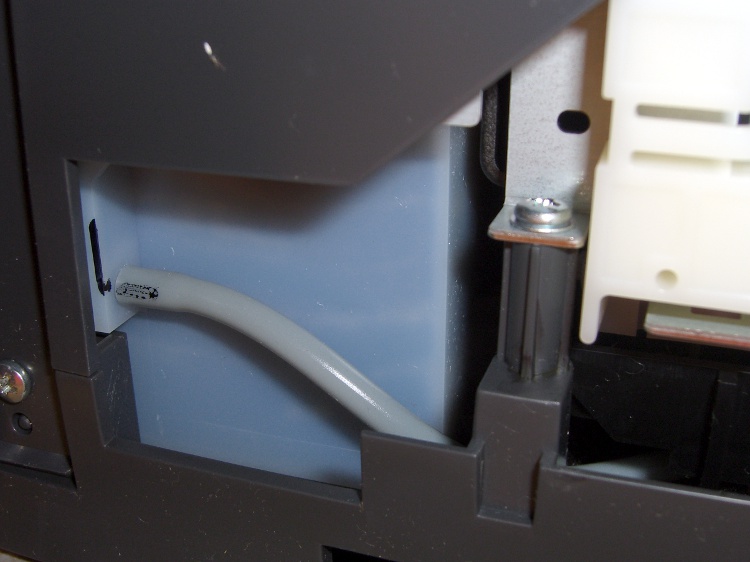
Removing the hose from the barbed fitting goes easier with a small screwdriver pushing it along; you (well, I) can’t just pull the hose off. It’s a very flexible silicone rubber (?) hose with an internal liner: very nice stuff.
The hose seems to drain only the head-cleaning station, not the long waste ink tank / tray across the width of the printer that catches overspray from borderless printing. That counter is at 5% of its rated maximum, so I’ll let it slide.
The ink, being adsorbed in the fuzz, won’t leak back out of the tray, so there’s no need to plug the barbed fitting.

I used the 1/4-inch tip of a fat step drill to poke a hole at the very bottom of the plastic case, behind the pillar holding the white printer mechanism. The far end of the hose connects to a pump somewhere back in the bowels of the printer and that hole position freed up the longest amount of hose.
Much to my surprise, the tube wasn’t full of ink and didn’t bloosh blackness all over everything. Perhaps the hose drains back to the pump between head cleanings?
Then it’s just a matter of buttoning up the case, joining the hoses with the supplied barbed fitting, sticking the external tank’s hook-and-loop strip to the printer, and trimming the hose to fit. It Would Be Nice If the new tank hose were the same flexy silicone stuff as the OEM hose, but it looks to be ordinary Tygon-ish tubing and is a bit stiffer than I’d like.
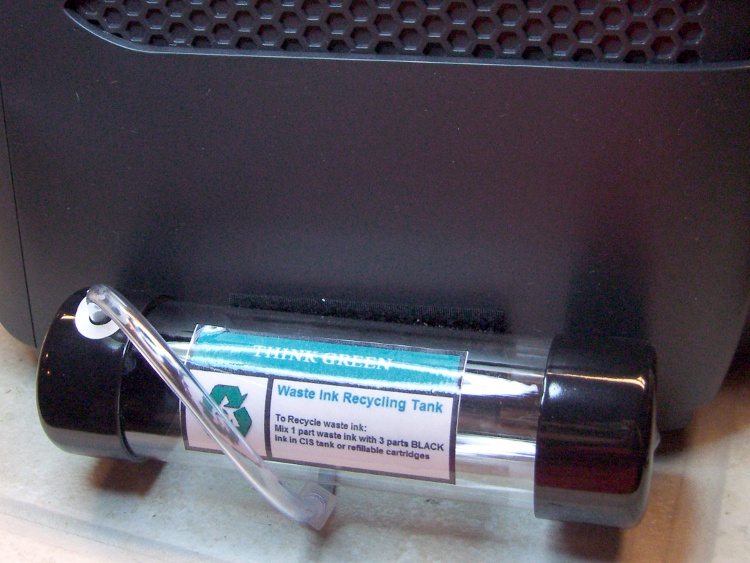
No ink has reached the new hose yet, but I’m sure the next few head cleaning cycles will push out some oodge.
The tank vendor suggests “recycling” the waste ink by diluting it with black ink, but I’ll just discard it. Bulk ink isn’t all that expensive, compared to OEM ink cartridges, and I’d rather not borrow trouble.








 The Smell of Molten Projects in the Morning