Ed Nisley's Blog: Shop notes, electronics, firmware, machinery, 3D printing, laser cuttery, and curiosities. Contents: 100% human thinking, 0% AI slop.
The switch on that screwdriver failed again, this time by having the internal switch mounting bosses disintegrate:
Cordless screwdriver – broken switch mounts
Not being one to worry about outside appearances, I simply drilled out the bosses to fit a pair of 4-40 screws, put the nuts inside, and it was all good:
Cordless screwdriver – switch with screws
Except that the switch now required an unseemly amount of force to operate in the forward direction. The switch is the cheapest possible collection of bent metal strips and injection molded plastic bits you can imagine, but with some bending and re-staking and general futzing around, it works fine again.
The air conditioning in our Toyota Sienna van emitted some barely cool air during the previous heat wave, which was definitely new news and not to be tolerated. The sight glass showed white foam when running and nothing when stopped, but the compressor hadn’t locked out on low pressure yet. My guess was that everything still worked and that the refrigerant had just slowly leaked away over the last 11.5 years; nothing lasts any more, eh?
I consulted with my cronies and devoted a few hours to discovering that many seemingly qualified people don’t understand the notion of vapor pressure, but that a DIY recharge wasn’t exactly rocket science. Picked up a Harbor Freight manifold gauge (on sale for 50 bucks, less one of the ubiquitous 20% coupons = $40) and two cans of R134a plus a can tapper from Autozone. Parked the car in the garage and popped the hood to let things cool off overnight.
The never-sufficiently-to-be-damned Toyota engineers put the low pressure port far back on the inside of the right-side wheel well, where I can barely reach it by standing next to the car facing forward, reaching backwards with my left arm, easing my outstretched hand through the gap between the well and the engine, then feeling around to find and unscrew and not drop the cap. No, I’m not left-handed, I just can’t contort my right hand sufficiently to do more than touch the cap.
Aligning and securing the low-pressure fitting on that port requires far more agility and strength than should reasonably be expected from one’s weak-side hand. A pox on their backsides!
Anyway.
The static pressure started out at 67 psi in the morning, which is roughly correct for R134a in the low 20 °C range: chart or table. That’s a good sign indicating that the sump still had liquid refrigerant, confirmed by the myriad bubbles in the sight glass. Eyeball the outer ring of the low-side gauge to find the R134a temperature corresponding to the pressure on the inner ring.
Harbor Freight AC Low Pressure Gauge
That gauge shows whatever pressure was left in the hose after finishing the job a few hours prior to the picture. It seems the manifold / hoses / valves hold pressure quite well, which is not a foregone conclusion given Harbor Freight’s QC.
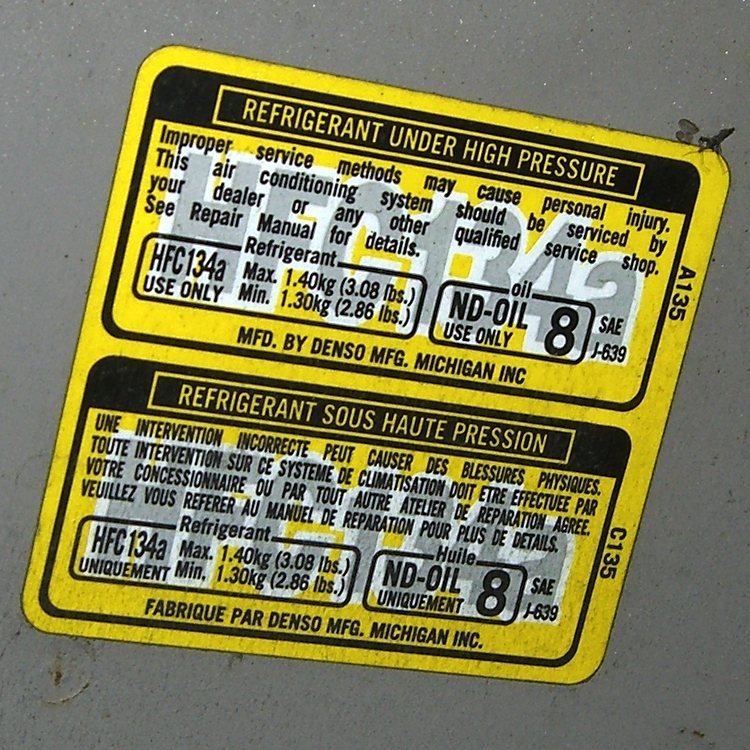
The sticker under the hood reports the AC requires about 3 pounds of refrigerant. That’s far more than most cars because the van also has a rear-cabin AC evaporator with one honkin’ big compressor for both.
2000 Toyota Sienna Refrigerant Sticker
I made the working assumption that if the AC still had some liquid refrigerant, it also had pretty nearly all the OEM oil. Most of the year the AC stays off, so I figure we’ve got a slooowww gas leak past the (usually) non-rotating seals driven by vapor pressure, all of which left the oil down in the sump. In addition, I haven’t the slightest idea if Toyota’s ND-OIL 8 gets along with the current PAG oil and adding too much oil seemed worse than having slightly too little.
The running pressures were 7 and 75 psi: grossly low.
So I fired in both cans of R134a: one with UV leak detector and another with leak sealer. That brought the pressures up to 20 / 120 psi: still too low, but at least air from the center vent now came out at 9 °C. The sight glass showed mostly foam, although with bursts of bubbly fluorescein green liquid. No leaks in evidence anywhere I could find without a nose-to-tail under-the-car inspection back to that rear evaporator.
Another trip (this time by bike) to the Autozone fetched a third can of straight R134a, which gradually cleared up the sight glass and got the pressures up to 35 / 150 psi, roughly matching the actual evaporator and condenser temperatures. I figured a few excess ounces wouldn’t do the least bit of damage; the three cans add up to 35 ounces of refrigerant, so the system was about 3/4 empty.
Early reports from the current heat wave seem encouraging.
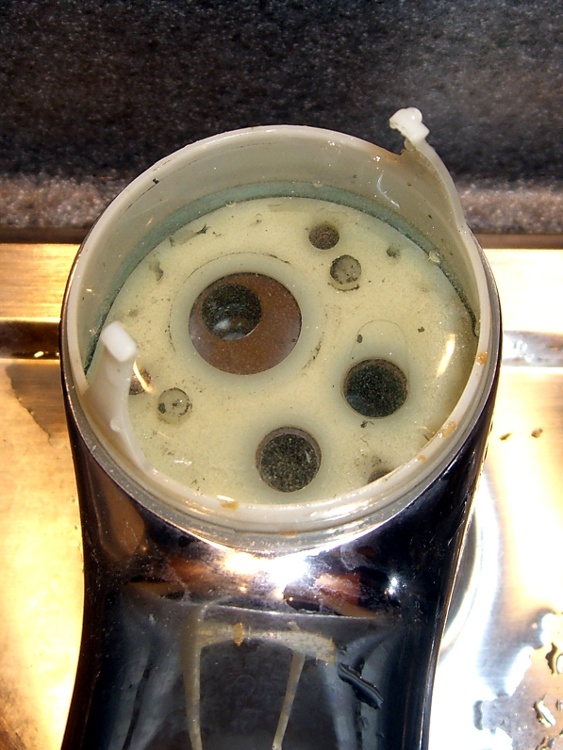
One evening I noticed that the kitchen faucet handle was skewed far off to one side and didn’t rotate to the other side as it should. I took the thing apart and found the whole pedestal was rotated:
Rotated kitchen faucet – top
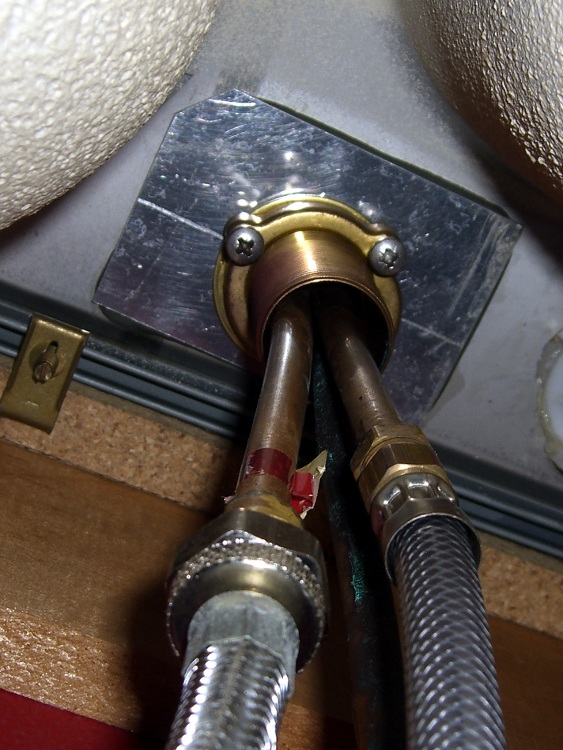
It turns out that the screws on the clamping ring below the sink had worked loose over the last decade or so, allowing the pedestal to rotate just a wee bit as we swung the spout from basin to basin.
Kitchen faucet clamping ring
Of course it only rotated a little bit in one direction and never the other way…
I epoxied that aluminum plate when I installed the faucet, because the stainless steel sink top seemed too flexy. The plate stiffened it right up and it’s been fine ever since.
Cutting those compliant washers required a really really sharp blade, which prompted me to put a new one in the cutter.
As a matter of course, I run a marker along the edge of all the new blades when I restock the utility cutter’s supply. The idea is that sometimes I can’t tell if the current blade’s been used; there’s nothing worse than sawing away at something delicate with a dull blade.
Utility cutter with marked blade
I generally use a blue marker, but the last time around the red one must have been closer to hand. I won’t make that mistake again…
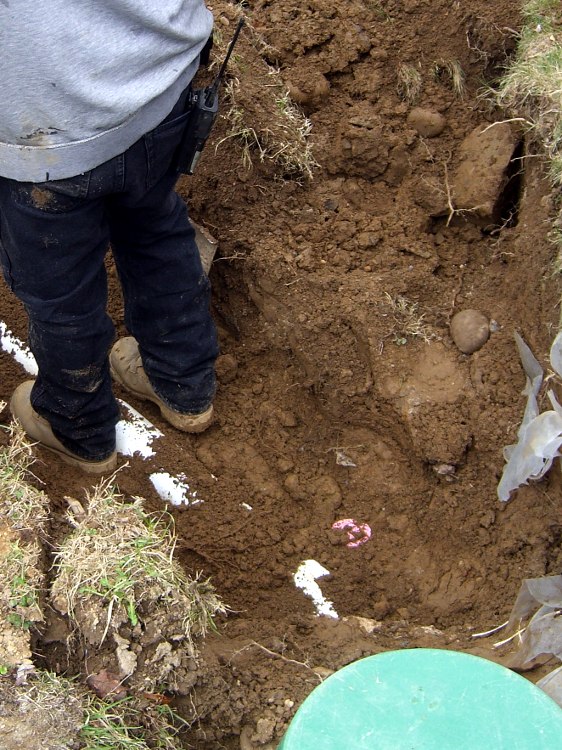
Some day, when all we know has crumbled to dust, somebody will unearth that plug and wonder “WTF was this all about?” Maybe the pipe and tank nearby will be a hint, but for all I know ABS will outlast even concrete.
This was our last sighting before the earth closed over it…
The new drain field works fine and, even better, it’ll be months before I need even think of mowing the front yard for the first time.
A bit of laparoscopic surgery on the front yard unearthed the drain line from the septic tank to the leach field. Drilling a 1-1/2 inch hole in the top of the pipe revealed that it’s 3/4 full of sludge, which is a Bad Thing: the leach field should get only liquid from the middle of the septic tank.
On the other paw, the house was built a bit over half a century ago and the records that came with it showed the tank was pumped two decades before we arrived. So it goes.
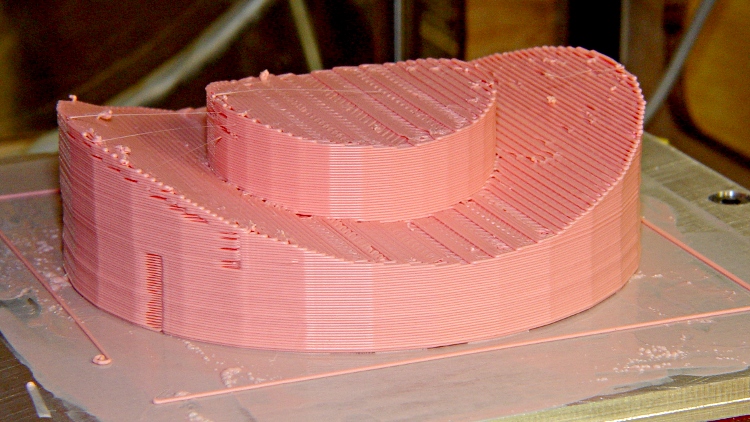
Rather than leave the hole in the pipe open until we get a new drain field, I built a plug that fit the 5 inch OD drain pipe and the 1-1/2 inch drilled hole.
Plug on aluminum plate
The aluminum build plate produces a smooth surface that’s entirely irrelevant on this part. The ABS film covers the blind hole in the middle that will serve as a drill guide in the unlikely event I must remove the plug.
Pipe plug – bottom view
I’ll admit it looks a bit out of place down there, though. I slobbered urethane adhesive around the central pillar and across the saddle, plugged it in, put a rock on top, and the adhesive foamed into a sludge-tight seal. At least I hope that’s how it worked out; I’m not going to pop it off just to find out.
Pipe plug in position
The solid model looks about like you’d expect:
Leach Pipe Plug Solid model
Never let it be said that a Thing-O-Matic lacks practical applications…
The OpenSCAD source:
// Plug for septic drain field pipe hole
// Ed Nisley - KE4ZNU - Mar 2011

include </home/ed/Thing-O-Matic/lib/MCAD/units.scad>

// Extrusion values

ThreadThickness = 0.33;
ThreadWT = 1.75;
ThreadWidth = ThreadThickness * ThreadWT;

HoleWindage = ThreadWidth;			// enlarge hole dia by extrusion width

// Pipe dimensions

PipeOD = 5 * inch;					// which is *4* inch cast iron pipe
PipeWall = (3/8) * inch;
PipeID = PipeOD - 2*PipeWall;

PipeLength = 2*PipeOD;				// for ease of viewing

HoleDia = (1 + 1/2) * inch;			// from a 1-1/2 inch hole saw

PatchOD = 2*HoleDia;
PatchThick = 10.0;					// a burly patch for a big old pipe

DrillDia = (1/4) * inch;			// pilot hole for removal, just in case

// Convenience settings

Protrusion = 0.1;					// extend holes beyond surfaces for visibility

// The central plug

module PlugBody() {
  difference() {
	cylinder(r=HoleDia/2,h=(PipeOD/2 + PatchThick));
	rotate([90,90,0])
	  cylinder(r=PipeID/2,h=PipeLength,center=true);
  }
}

// The shell on the pipe

module PlugShell() {
  difference() {
	cylinder(r=PatchOD/2,h=(PipeOD/2 + PatchThick));
	rotate([90,90,0])
	  cylinder(r=PipeOD/2,h=PipeLength,center=true);
  }
}

// Build it, with rotate/translate to put it flat on its back

rotate([0,180,0])
  translate([0,0,-(PipeOD/2 + PatchThick)])
	difference() {
	  union() {
		PlugBody();
		PlugShell();
	  }
	  translate([0,0,PipeOD/2])
		cylinder(r=DrillDia/2,h=(PatchThick + Protrusion));
	}
The hose on our aging Samsung Quiet Jet (used to be a Quiet Storm, but I suspect they lost a trademark fight) vacuum cleaner has been a constant nuisance. Most recently, the end toward the handle began splitting:
Splitting vacuum hose
The fix consisted of a tight duct tape wrap, which has absolutely nothing to recommend it other than expediency.
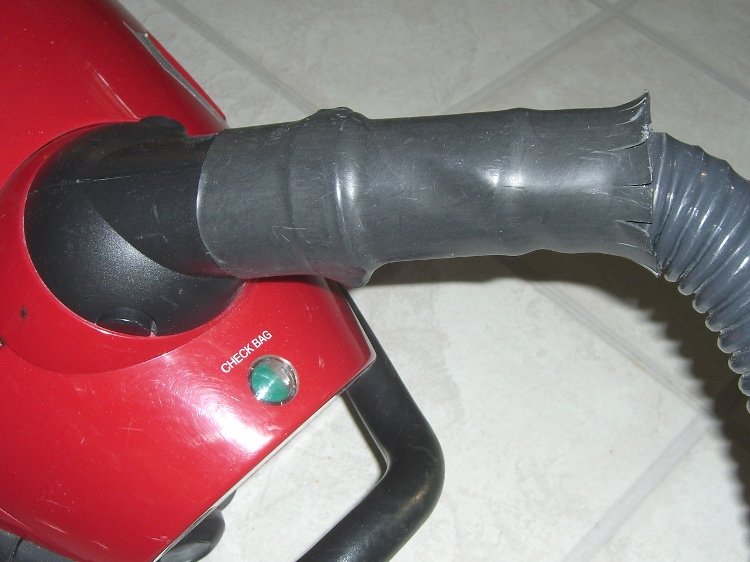
When the same thing happened on the other end, I sealed it up and added a length of husky heatshrink tubing.
Strain relief on vacuum hose
The flared end isn’t particularly decorative, but it serves to reduce the strain on the hose. Alas, there’s no practical way to do the same thing on the handle end.
The replacement cost for the hose roughly equals a new vacuum, so when we run out of bags, this one gets harvested for the shop’s Parts Heap.