The Smell of Molten Projects in the Morning

Ed Nisley's Blog: Shop notes, electronics, firmware, machinery, 3D printing, laser cuttery, and curiosities. Contents: 100% human thinking, 0% AI slop.

Category: Home Ec

Things around the home & hearth

  • Monthly Image: Ice Crystals

    The recent bout of single-digit (Fahrenheit!) temperatures produced ice crystals on some of our leakier windows:

    Window Ice Feathers
    Window Ice Feathers
    Window Ice Spines
    Window Ice Spines
    Window Ice Feathers
    Window Ice Feathers
    Window Ice Feathers
    Window Ice Feathers

    The windows came with the house, date back to 1955, do have storm windows, and we’ll grant the next owners the joy and delight of replacing them…

  • Toyota Sienna: Key Wear

    And it came to pass in the Christmas Season that our ignition keys began jamming in the lock, rather than just starting the van. It seems Toyota used split wafers in their locks up through the early part of this millennium, with the result that the delicate wafer edges tend to wear out both themselves and the edges of the keys.

    I can’t vouch for the wafers, but the keys definitely aren’t in good shape:

    Ignition keys - worn vs new
    Ignition keys – worn vs new

    Given that picture, someone can probably conjure up a shiny new key and drive away with our 14-year-old Sienna van. It just rolled over 90 k miles and is in pretty good condition. New battery and hood prop pivot, too.

    Being that type of guy, the first thing I did with the new van was to get duplicate keys and drop the OEM keys into the “2000 Sienna” file folder. The middle key in that photo has had maybe a dozen uses and is in pristine condition.

    Rumor has it that one can cannibalize a set of split wafers from the glove box lock:

    Glove box latch
    Glove box latch

    Or, according to different sources, you can simply discard the split wafers and be done with it.

    The trick to removing the lock cylinder lies in turning the key to the Accessory position, then poking a pointy object into a small hole to depress an internal spring-loaded pin. Of course, one must disable the air bags, dismantle the steering wheel, and remove half a dozen trim panels to reveal the small hole.

    Fortunately, the two “new” keys from the file folder work perfectly and we’ll run with them for a while. I suppose I should get another set of duplicates, but …

  • Caig DeoxIT Bottle: Lid Crack

    For years this bottle of DeoxIT has been covered with a very thin layer of red juice, despite having the lid screwed firmly in place and a cap (removed here) pushed over the tube:

    Caig DeoxIT bottle - lid crack repair
    Caig DeoxIT bottle – lid crack repair

    Turns out that there’s a minute crack in the cap. Every time I use the bottle, I refresh the oil layer on the inside of the bottle, which then gets pumped outside through capillary action. I’d been keeping the bottle in a tall ziploc baggie, specifically to contain the oil, and always assumed it was a simple leak.

    The bottle still contains a lifetime supply of DeoxIT that may become a cherished family heirloom, one to be handed down through the generations. I can’t think of a better applicator, either, so I’m kind of stuck with that cap.

    The cap is, of course, un-bondable polyethylene covered with thin oil, so there’s no possible way to repair it. I wiped it down with alcohol and acetone, then quick-like-a-bunny dabbed on a blob of Duco cement (which is the irregular shape on the cap) and worked it into the crack, in the hope it would stick well enough to reduce the pumping.

    We shall see…

  • Kenmore Dishwasher Sound Deadening Sheets: Slip Sliding Away, Redux

    The springs balancing the dishwasher door started twanging again, which I now know is the diagnostic sign that an asphalt sound deadening sheet has slipped off the tub. A sheet on the right side almost perpetrated a clean escape, but the flap drooping over the spring gave it away:

    Dishwasher sound deadener - slipped away
    Dishwasher sound deadener – slipped away

    Another sheet on the left side was inching away, but hadn’t quite gotten over the fence:

    Dishwasher sound deadener - slipping away
    Dishwasher sound deadener – slipping away

    They’re pretty much a rigid solid at room temperature:

    Dishwasher sound deadener - wrinkled asphalt sheet
    Dishwasher sound deadener – wrinkled asphalt sheet

    It puts one in mind of the pitch drop experiments now running in various labs. In this case, we now know it takes about four years for an asphalt sheet to slide completely off the tub; those two sheets were definitely in place when I buttoned it up after the previous one broke free.

    I applied a heat gun to soften the sheets, then smoothed them around the tub again. This time I applied long strips of Gorilla Tape from one side to the other, rather than short strips of ordinary duct tape along the edges, and maybe this fix will outlast either the dishwasher or our tenure here, whichever comes first…

  • Optiplex 980 PCI Card Clamp Cover Repair

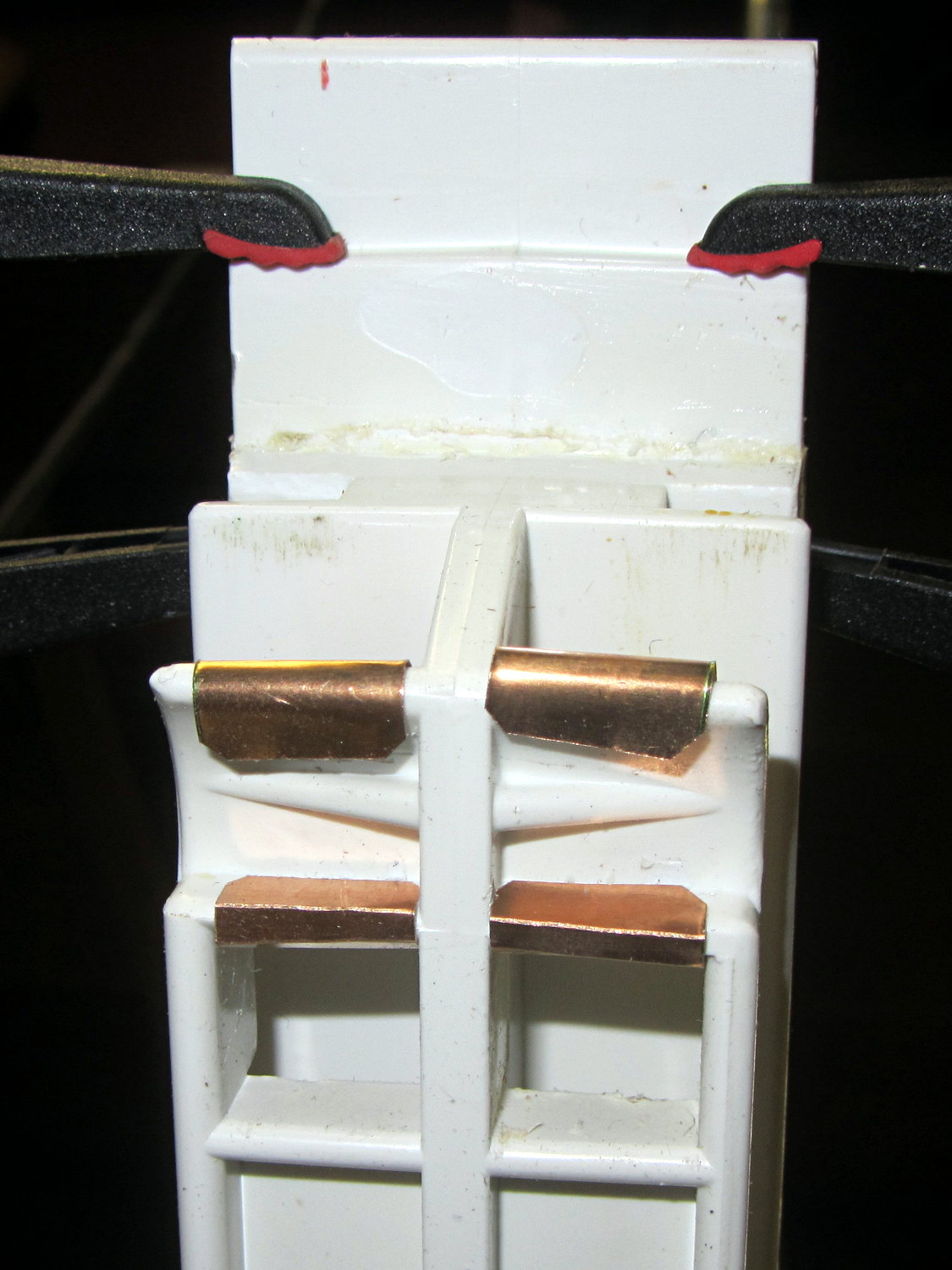
    The new-to-me Optiplex 980 has a tool-free clamp securing the PCI card brackets to the chassis, with a nice plastic dress cover that really finishes off that side of the case. Alas, it’s secured by five small heat-staked plastic pegs that I managed to shear off as part of a finger fumble that you’ll recognize when it happens to you and which I need not further discuss:

    Optiplex 980 PCI Clamp Cover - disassembled
    Optiplex 980 PCI Clamp Cover – disassembled

    So I drilled two slightly undersized holes for the tiniest screws in the Little Box o’ Tiny Screws:

    Optiplex 980 PCI Clamp Cover - drilling
    Optiplex 980 PCI Clamp Cover – drilling

    The two end plates sticking up are the only square parts of the cover, so that thing is actually clamped by the right-side plate and sheer will power. I ran the drill down 3 mm from the top of the post at the slowest manual jog speed from the Joggy Thing and I did not break through the top and did not hit that lathe bit under the cover.

    The screw threads and a dab of epoxy hold them in place:

    Optiplex 980 PCI Clamp Cover - tiny screws
    Optiplex 980 PCI Clamp Cover – tiny screws

    I’d like to say the finished repair looked like this:

    Optiplex 980 PCI Clamp Cover - in place
    Optiplex 980 PCI Clamp Cover – in place

    But, alas, the eagle-eyed reader will note that the screws are gone, replaced by two dabs of clear acrylic caulk; those faint threads and epoxy were no match for the snap of that latching lever and the slight distortion caused by the spring fingers applying force to the brackets.

    Ah, well, it’s close enough…

  • Microsoft Comfort Curve Keyboard Cleaning Redux

    Part of the routine cleaning around here involves running the vacuum cleaner nozzle over the keyboard to suck up random debris, but that doesn’t extract crud from under the keycaps. Almost exactly three years after the previous cleaning, I finally decided the keys had lost enough of their normal feel to justify the hassle of taking the thing apart.

    Bolstered by that experience, however, I just yanked the keycaps off with a removal tool from my old bag of tricks, revealing the horror that lies beneath the surface:

    Microsoft Comfort Curve Keyboard - crud buildup
    Microsoft Comfort Curve Keyboard – crud buildup

    Obviously, I got nasty habits

    Microsoft Comfort Curve Keyboard - crud detail
    Microsoft Comfort Curve Keyboard – crud detail

    The keycaps took a swim in a dishpan full of hot soapy water, endured some scrubbing, and emerged looking like new. Thwacking them on a towel ejected the remaining water from the posts.

    With the electronics still in place, I vacuumed the larger chunks out of the tray, scrubbed the aforementioned hot soapy water around the bushings with an acid brush, then cleaned up the residue with cotton swabs. There’s a paper towel under the drain gutters to catch the runoff, which worked surprisingly well.

    The keycap legends have been eroding, as they’re basically a decal stuck on the surface. Eventually I’ll have a crappy non-clicky Das Keyboard Model S Ultimate.

    [Update: a spammer’s script has been attempting to create hundreds of junk comments per day, so I’ve temporarily disabled comments for this post. Drop me a direct note using the About / Copyright / Contact link on the right if it’s critical. I expect this to pass in a few days, but I may be underestimating the stupidity out there. ]

    A note from regular commenter Frans:

    Don’t get a Das Keyboard if you want a keyboard without a keypad. Look into e.g. a Leopold Tenkeyless Otaku. The one to which I include a link comes with the same Cherry MX Brown switches as the Das Keyboard Silent.

    Elite Keyboards

    I want one too.

    They look good to me, too, although I hope the weird Esc key is optional…

  • Water Heater Anode Rod – One Year Check

    A one-year-old magnesium rod looks pretty good, all things considered:

    Water Heater Anode Rod - one year
    Water Heater Anode Rod – one year

    The previous one was still working after seven years, although I had to wreck it to get it out…