The Smell of Molten Projects in the Morning

Ed Nisley's Blog: Shop notes, electronics, firmware, machinery, 3D printing, laser cuttery, and curiosities. Contents: 100% human thinking, 0% AI slop.

Category: Electronics Workbench

Electrical & Electronic gadgets

  • LED Ring Desk Lamp

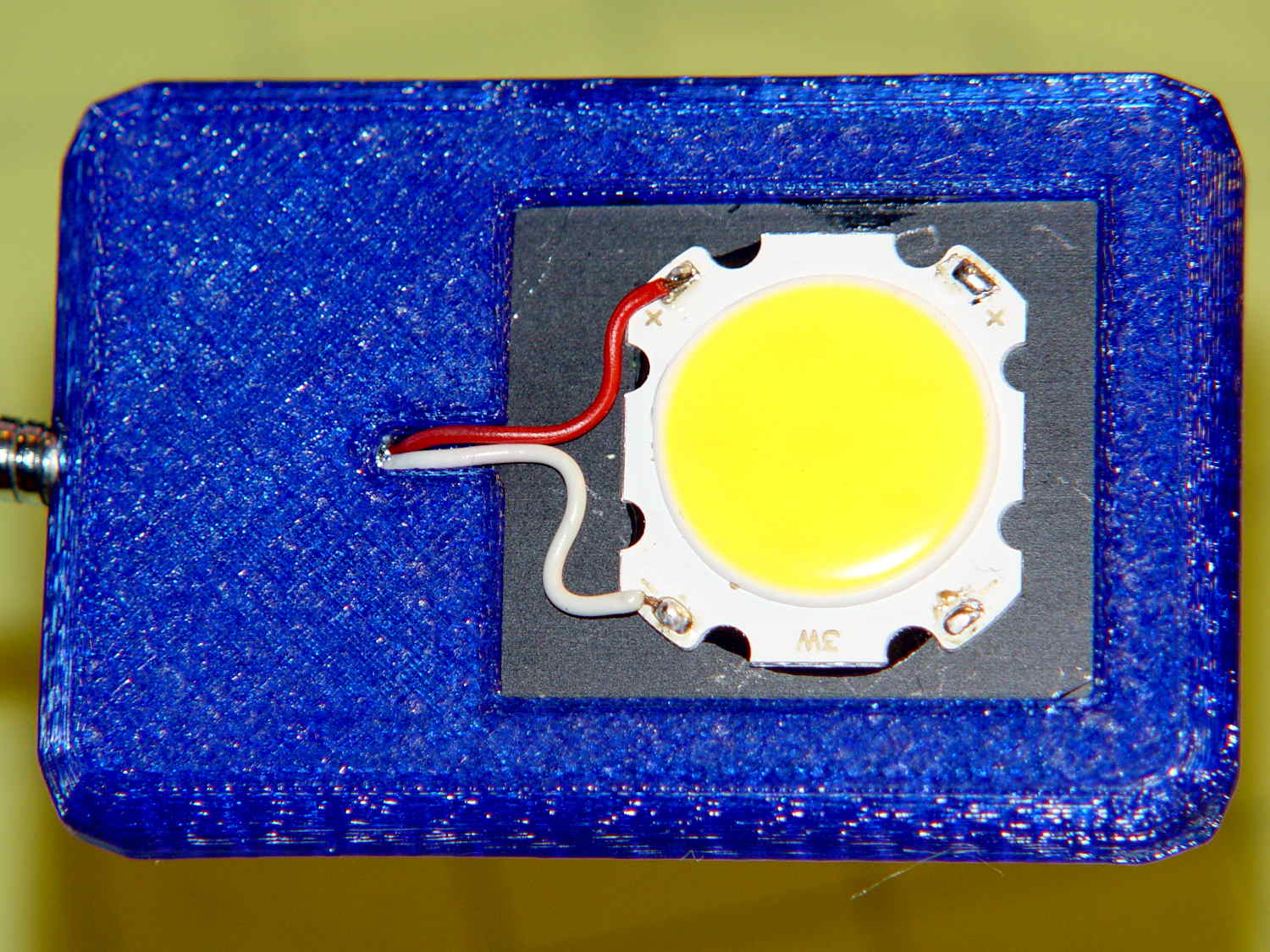
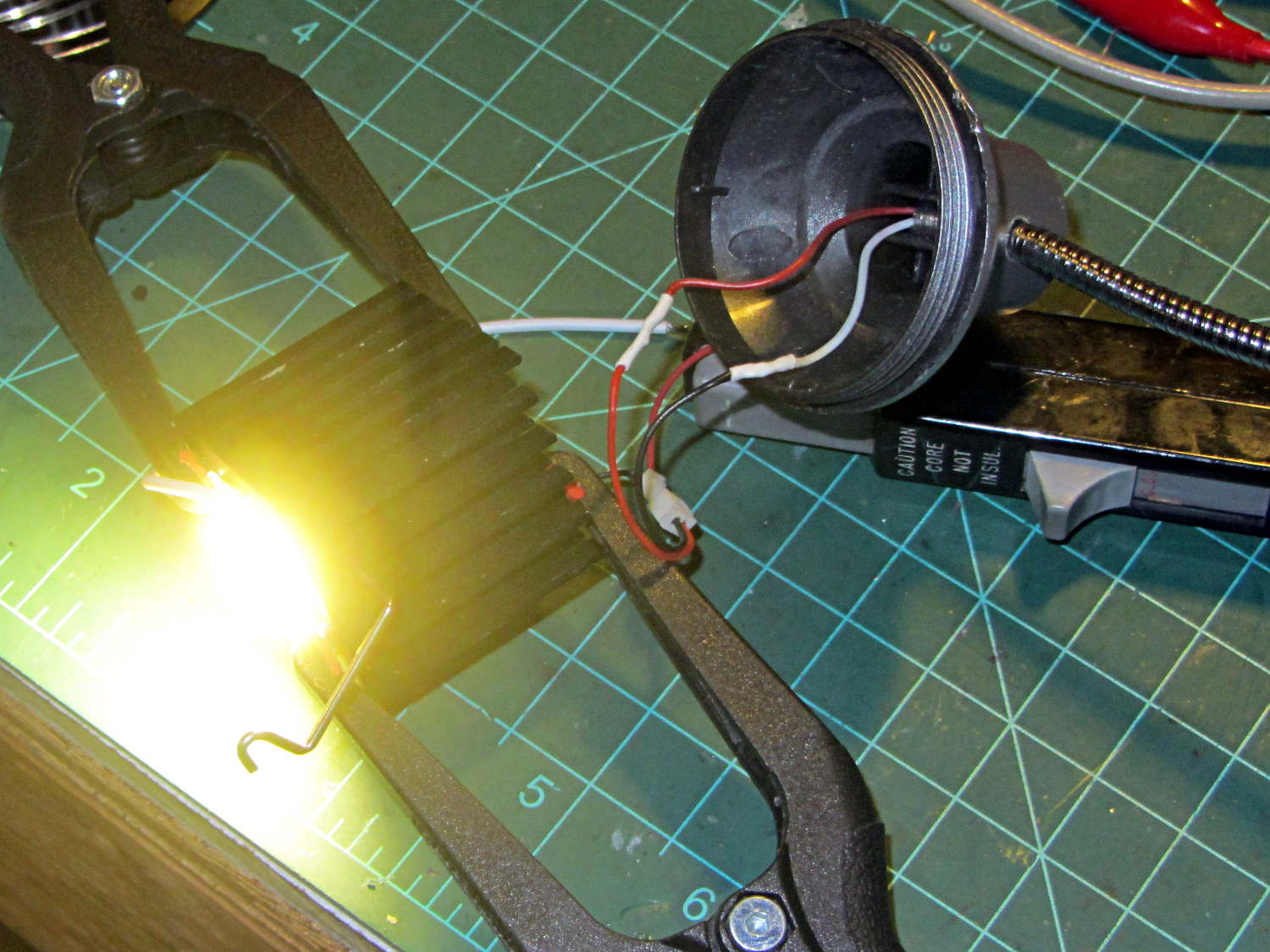
    A defunct desk lamp emerged from the clutter and cried out for bright, new LEDs. This adapter puts a small LED ring and nine white LEDs on the original lamp head:

    Ring Light Mount - in operation
    Ring Light Mount – in operation

    Peering into the business end, before mounting it on the lamp, shows some abrasive adjustment on the inside layer:

    Ring Light Mount - LEDs installed
    Ring Light Mount – LEDs installed

    That layer printed over a quick-and-easy support spider:

    Ring Light Mount - solid model - bottom
    Ring Light Mount – solid model – bottom

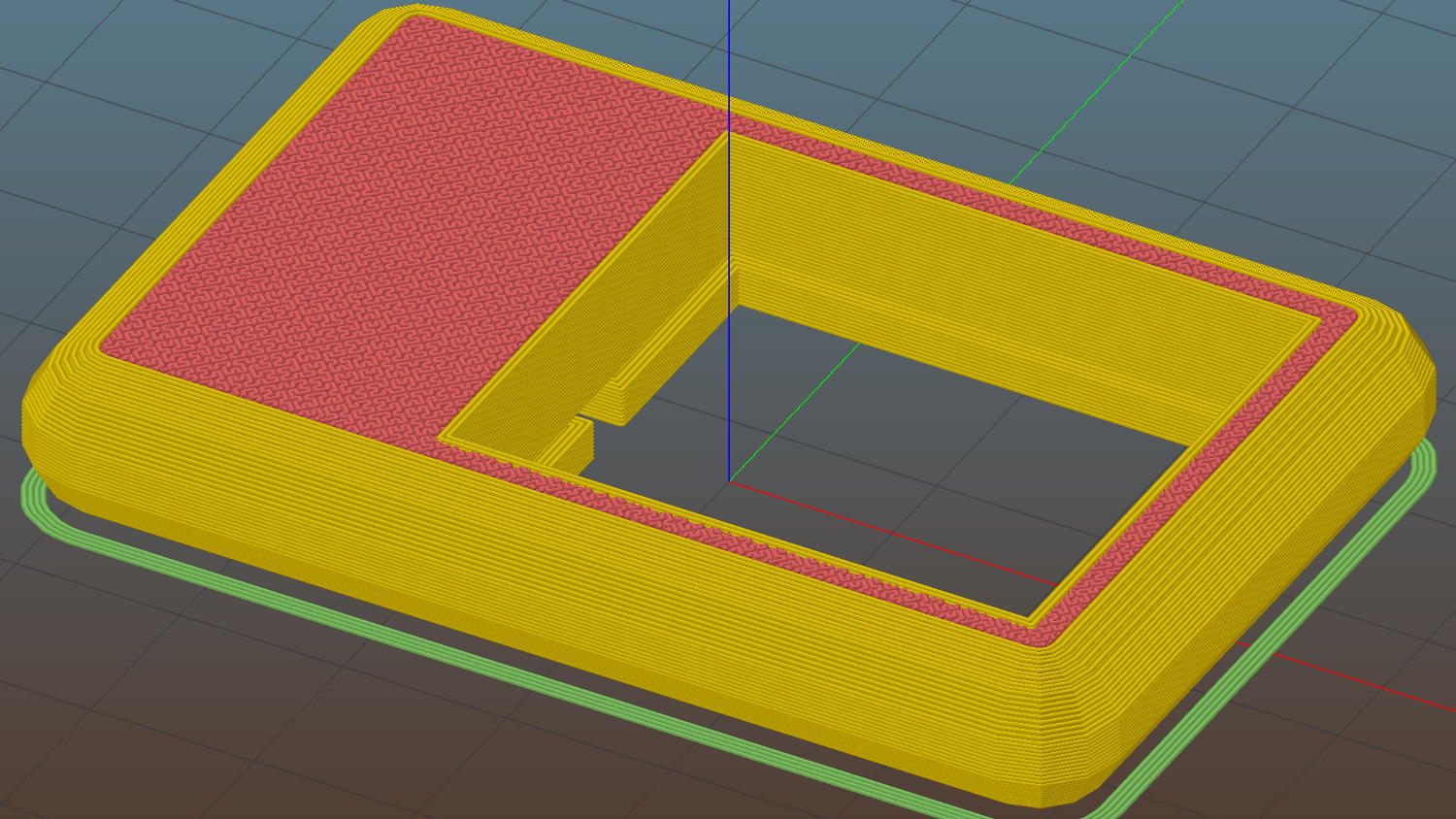
    The Slic3r preview looking down through the layer just over the support shows that the perimeter of those LED holes doesn’t have much support:

    Ring Light Mount - Slic3r preview - bridge layer
    Ring Light Mount – Slic3r preview – bridge layer

    The obvious threads drooped in the predictable way, so I just clipped them off, sanded the high spots into submission, and epoxied everything in place:

    Ring Light Mount - LED wiring
    Ring Light Mount – LED wiring

    That nice Hilbert Curve infill is completely wasted inside the OEM shade, but the smooth curve around the rim had to be on the top surface.

    Rather than beefing up the support, you should print the bottom ring (or the top rim) separately, then glue it back on, but I wanted to see how well simple support worked with PETG.

    It came out reasonably well:

    Ring Light Mount - support spider
    Ring Light Mount – support spider

    That’s far more hair than usual, even for PETG, because I made the spider’s legs exactly three thread widths wide. Slic3r reduced the single infill thread to, literally, a hair that didn’t stick to the platform; the model now has four-thread-wide legs.

    Slic3r’s automatic support would do a better job of holding up the underside, albeit with more plastic and printing time:

    Ring Light Mount - Slic3r preview - auto support
    Ring Light Mount – Slic3r preview – auto support

    The top view looks about like you’d expect:

    Ring Light Mount - solid model - top
    Ring Light Mount – solid model – top

    Those two solid models show the small hole for the LED ring wiring, which I drilled into the as-printed plastic. The original layout included just the LED ring, with the wire through a big central hole, but then I realized the wall wart had enough moxie for a few more LEDs. So it goes.

    Anyhow, the lamp provides just enough illumination below my big monitors to suffice. The gooseneck might not be quite long enough, but that’ll be another project…

    The OpenSCAD source code:

    // LED Ring Light Mount
    // Ed Nisley KE4ZNU October 2015
    
    DoSupport = true;
    
    //- Extrusion parameters must match reality!
    
    ThreadThick = 0.25;
    ThreadWidth = 0.40;
    
    HoleWindage = 0.2;
    
    Protrusion = 0.1;			// make holes end cleanly
    
    inch = 25.4;
    
    function IntegerMultiple(Size,Unit) = Unit * ceil(Size / Unit);
    
    //----------------------
    // Dimensions
    
    NumSides = 8*4;						// number of sides on each "cylinder"
    
    LENGTH = 0;
    ID = 1;
    OD = 2;
    
    Shade = [6.0,45.2,47.5];			// threaded end of OEM lamp shade
    RingLED = [4.5,36.0,51.0];
    
    SpotLED = [2.0,0,5.0];				// discrete LEDs in center
    NumSpots = 8;						// discrete LEDs around the one in the middle
    
    Support = [(RingLED[LENGTH] - 1*ThreadThick),0,(RingLED[OD] - 4*ThreadWidth)];
    NumSupports = NumSides/2;
    
    ThreadBase = RingLED[LENGTH] + SpotLED[LENGTH];
    OAHeight = ThreadBase + Shade[LENGTH];
    
    //----------------------
    // Useful routines
    
    module PolyCyl(Dia,Height,ForceSides=0) {			// based on nophead's polyholes
    
      Sides = (ForceSides != 0) ? ForceSides : (ceil(Dia) + 2);
    
      FixDia = Dia / cos(180/Sides);
    
      cylinder(r=(FixDia + HoleWindage)/2,
               h=Height,
    	   $fn=Sides);
    }
    
    //----------------------
    // Build it
    
    	difference() {
    		union() {																				// overall shape
    			translate([0,0,ThreadBase])
    				rotate_extrude(convexity = 2, $fn=NumSides)
    					translate([Shade[OD]/2,0])
    						circle(r=Shade[LENGTH],$fn=NumSides);
    			cylinder(d=(Shade[OD] + 2*Shade[LENGTH]),h=ThreadBase,$fn=NumSides);
    			translate([0,0,ThreadBase])
    				cylinder(d=Shade[OD],h=Shade[LENGTH],$fn=NumSides);
    		}
    		
    		translate([0,0,ThreadBase - Protrusion])
    			cylinder(d=(Shade[ID] + HoleWindage),h=(Shade[LENGTH] + 2*Protrusion),$fn=NumSides);	// opening for shade thread
    			
    		translate([0,0,-Protrusion])
    			cylinder(d=(RingLED[OD] + HoleWindage),h=(RingLED[LENGTH] + Protrusion),$fn=NumSides);	// opening for LED ring
    			
    		rotate(180/NumSides)																		// LED ring power wire
    			translate([RingLED[ID]/2,0,0])
    				rotate(180/6)
    					PolyCyl(2.5,OAHeight,6);
    			
    		rotate(180/8  - 180/NumSides)
    			PolyCyl(SpotLED[OD],OAHeight,8);														// central LED SpotLED
    			
    		for (i=[0:NumSpots-1])																		// surrounding spots
    			rotate(i*360/NumSpots - 180/NumSides)
    				translate([(RingLED[ID] - 2*SpotLED[OD])/2,0,0])
    						rotate(180/8)
    							PolyCyl(SpotLED[OD],OAHeight,8);
    	}
    	
    //-- Support structure
    
    	if (DoSupport)
    		color("Yellow")
    		rotate(180/NumSides)													// align bars to flat internal faces
    			for (i=[0:NumSupports/2 - 1]) {
    				rotate(i * 360 / NumSupports)
    					translate([0,0,Support[LENGTH]/2])
    						cube([Support[OD],4*ThreadWidth,Support[LENGTH]],center=true);
    			}
    
    
  • Amazon Packaging

    Restocking the AA and AAA alkaline cell supply delivered this example of underprotection from Amazon:

    Amazon Packaging - alkaline batteries
    Amazon Packaging – alkaline batteries

    I think that scrap of plastic was once an air pillow, but it sure didn’t last long and definitely didn’t fill the entire space around the boxes.

    Allowing that much mass to thrash around inside the box can’t possibly be a Good Thing, even if the cells weren’t damaged. One would hope they’d do a better job with lithium cells.

    I’ve seen worse

  • Scrubbing Old Hard Drives

    The shelf that collects old hard drives filled up, so I’ve been wiping the data before recycling them. This takes a while, but we know what happens when your hardware falls into unexpected hands. The routine goes a little something like this…

    Set the drive’s jumper to Master, plug the drive into the USB adapter, plug the adapter directly into a USB port on the PC (because outboard hubs tend to be flaky), make sure there’s no valuable data, unmount.

    time sudo dd if=/dev/urandom of=/dev/sdc bs=4096
    [sudo] password for ed: 
    dd: error writing ‘/dev/sdc’: No space left on device
    73259047+0 records in
    73259046+0 records out
    300069052416 bytes (300 GB) copied, 22276.7 s, 13.5 MB/s
    
    real	371m19.003s
    user	0m22.884s
    sys		370m34.906s 

    Good old dd works for me; the only trick is not obliterating the system’s main hard drive with a simple finger fumble. Numbers from /dev/urandom suffice for this purpose; that’s where most of the packaged programs get their data, too. I do hardcore style, just because.

    Ordinary desktop drives, at least those from long ago, can write at a bit over 12 MB/s → 40 GB/h on the average, with the higher peak rates that generally appear in the drive descriptions remaining an occasional sight. They won’t go much faster, even when plugged directly into the system board, but it’s not as if I sit there waiting until it’s done. USB 2.0 “high speed” transfers can hit 60 MB/s, including all the overhead, so that’s not the limiting factor; I’d expect the adapter’s firmware to throttle the data long before the bus strangles.

    Use gparted to write a fresh partition table with a single NTFS (because the next user will probably run Windows) partition labeled Scrubbed spanning the entire drive.

    Then stack the drive neatly on the outbound heap:

    Scrubbed hard drives
    Scrubbed hard drives

    That cardboard box isn’t quite as full of unscrubbed drives as it was a few weeks ago.

    The stack in the back contains all those worthless 30 to 80 GB 5400 RPM drives from old Dells, plus a few 1.5 and 2.0 (!) GB drives from who knows where. I have a plan for those platters…

  • 0D3 Voltage Regulator Tube

    A quartet of ceramic octal tube sockets arrived from halfway around the planet and matched up nicely with the business end of a 0D3 voltage regulator tube from the Hollow State Electronics box:

    0D3 voltage regulator tube in socket
    0D3 voltage regulator tube in socket

    If the 1-48 on the side of the tube base (facing away in the picture) means anything, then General Electric built it in January 1948.

    The pinout view in the datasheet assumes you’re looking at the bottom of the socket, which makes perfect sense given the hand-wired chassis construction techniques of the day:

    0D3 Voltage Regulator Tube - pinout
    0D3 Voltage Regulator Tube – pinout

    So the view is backwards when seen from the top, not that you’d ever need it:

    Ceramic octal tube socket - 0D3 pinout
    Ceramic octal tube socket – 0D3 pinout

    The internal jumper across pins 3-7 allows you to disconnect the downstream circuit when the regulator isn’t in the socket, which is a Very Good Idea with a shunt regulator.

    Not having a 200 V power supply ready to hand, but having recently restocked the 9 V alkaline battery box, this actually worked:

    0D3 voltage regulator test setup
    0D3 voltage regulator test setup

    That’s 16 x 9-ish V = 150 V across the battery terminals, plus a 50 V adjustable bench power supply coming in on clip leads from the upper right, with current shown on a digital panel meter across a 1 Ω sense resistor. The classic 1.5 kΩ carbon resistor emerged from from a coffee can of parts that Came With The House™ and seemed appropriate for the occasion.

    The tube conducts a few milliamps through a small plasma filament discharge at 150 V. The current ramps up to about 10 mA as the supply voltage increases to 180 V, whereupon the tube fires and the current jumps to 30 mA (which is less than the spec, but I ran the power supply in constant-current mode to avoid whoopsies).

    Reducing the current to 10 mA slightly reduces the area involved in the plasma discharge, but the tube still produces a nice display through the mica spacer / insulator atop the plate:

    0D3 voltage regulator - 10 mA current
    0D3 voltage regulator – 10 mA current

    That isn’t quite in focus, but should give you the general idea.

    I didn’t measure the operating voltages across the tube, mostly because I didn’t want more cheap clip leads cluttering the bench.

    It’d make a very low intensity nightlight that dissipates a watt or two. Boosting the current to the absolute maximum 40 mA would brighten it up a bit, but dissipating 6 W in the tube probably won’t do it any good.

    This obviously calls for an Arduino monitoring the tube current with a Hall-effect sensor and regulating it with a hulking MOSFET…

  • A Mystery Block of Electronics

    Back in the day, this surely represented an achievement in high-density electronics packaging:

    Electronics Block - 1
    Electronics Block – 1

    A view from the other corner suggests the layout wasn’t quite right:

    Electronics Block - 2
    Electronics Block – 2

    It has no identification, the transistors have house numbers, and the PCB looks like a prototype. As nearly as I can tell from the capacitor date codes, it dates back to the mid-1960s.

    Two pairs of electrically isolated and thermally bonded transistors suggest an analog Class-AB driver + amplifier or a pair of digital flipflops, but there’s no way to tell.

    Judging from the ugly solder and dislodged via rings, somebody had to apply extensive modifications after initial assembly; it trailed half a dozen red wires soldered to vias and components.

    One hopes it eventually worked…

  • Beckman DM73 Circuitmate Multimeter: Ground Clip

    Among the many treasures Mad Phil left me was a Beckman DM73 CircuitMate multimeter (manual at the Boat Anchor Manual Archive):

    Beckman DM73 - new ground clip
    Beckman DM73 – new ground clip

    Although it’s rated to 500 V, it violates the fundamental principle of high-voltage electronics debugging:

    Always keep one hand in your pocket!

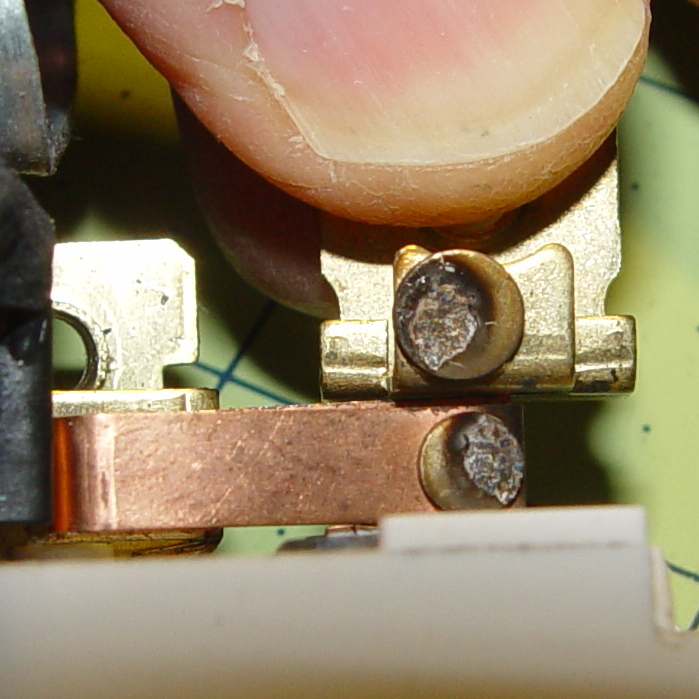
    The scorched and truncated probe tip on the “ground wire” shows Phil slipped at least once:

    Beckman DM73 - probe tip
    Beckman DM73 – probe tip

    After far too long, I sacrificed a black multimeter probe from the heap, soldered an alligator clip on the end, and, henceforth, will use it appropriately. Mostly, I never do any high-voltage work, but you never know.

    I suppose I should splice that nice black probe onto the end of the Beckman wire for low-voltage work…

  • Sony HDR-AS30V Audio Mute

    The Sony HDR-AS30V has extremely high audio gain, which is precisely what you need for the mic on an action camera. It sends that audio, along with the video, through its HDMI output, so when you drive a display from the camera in enclosed space, the audio is REALLY LOUD and causes severe feedback. For obscure reasons, given the staggering cost of the venue’s AV system, there’s no way to mute the audio channel of the video input when you’re also using a mic attached to someone giving a presentation.

    The obvious solution, a shorted jumper (formerly an earbud plug) in the external mic jack, looked like this:

    Sony HDR-AS30V - Dummy external mic
    Sony HDR-AS30V – Dummy external mic

    Contrary to what I expected, the camera doesn’t disable the internal mic with the jumper in place. The amp probably uses an analog multiplexer, rather than a mechanical switch, and even an off-channel isolation of, say, 76 dB (from the MAX4544 spec, for example) isn’t enough to completely mute the mic. You could, given sufficient motivation, measure the actual isolation, but the surviving audio isn’t subtle at all.

    The not-obvious solution turned out to be putting the camera into either single or interval photo mode, rather than the movie mode I use for bike rides. It seems that when the video format doesn’t require audio, the camera either disables the audio inputs or (more likely) just doesn’t include audio data in the HDMI output.

    Which produces exactly what I want: a video output with no accompanying audio.