The Smell of Molten Projects in the Morning

Ed Nisley's Blog: Shop notes, electronics, firmware, machinery, 3D printing, laser cuttery, and curiosities. Contents: 100% human thinking, 0% AI slop.

Category: Electronics Workbench

Electrical & Electronic gadgets

  • 3D Printer Design Conversation: Part 2

    Wherein I continue dumping my responses to a large-format 3D printer project …

    (Continued from yesterday)

    What do you mean by 12 hour mean time to failure

    In round numbers, the cries of anguish on the M2 forum seem to increase as parts require more than a dozen hours from start to finish; while you can print things that require 48 hours, that’s not the way to bet. There are more ways for things to go wrong than for them to go right, given the rather rickety collection of software & firmware making everything happen, plus the gummy nature of squeezing hot plastic into precise heaps.

    Most of the time, it works fine.

    much cheaper hardened polished rod system that the taz 6 uses?

    Unless they’re doing something non-obvious to make a kinematic assembly, two rods on four hard mounts with four one-degree-of-freedom slides will be severely overconstrained and, I expect, a continuing hunk o’ trouble:

    https://softsolder.com/2011/02/04/thing-o-matic-x-and-z-axis-rod-alignment/

    FWIW, linear slides don’t eliminate the need for a rigid and well-aligned frame. Even the slab atop an M2 can deform by more than 0.1 mm under belt tension, which is enough to wreck the nozzle-to-platform alignment across the length of the X axis.

    “Arduino-class firmware (Marlin, et. al.) is a dead end” Why is that?

    Marlin is a dead end: they’re trying to jam hard real time motor control, soft real time command parsing, and non real time UI control into an 8 bit microcontroller teleported from the mid 90s. AVR microncontrollers worked really well up through the Cupcake and have held back printer design & performance ever since.

    Which inexpensive all in one board would you go with

    Machinekit on a Beaglebone seems to be the least awful of the current alternatives, but I haven’t examined the field recently enough to have a valid opinion. You’ll find plenty of proprietary “solutions” out there, none of which I’d be interested in.

    Am I wrong?

    I think so, but, then, I may be wrong, too. [grin]

    It’s incredibly easy to slap together a bunch of parts that look like they should become a 3D printer. It’s remarkably difficult to engineer a reliable, stable, accurate device that actually produces dependable results.

    Mooching design cues and parts from here & there doesn’t get you to the goal; if it did, Kickstarter wouldn’t be a graveyard of cheap 3D printer projects.

    design a very rigid system for cheap

    If it’s for your personal satisfaction, have at it, but a one-off large-format printer won’t be any cheaper than, say, a Taz 6. Some diligent searching will uncover any number of homebrew printer projects along the lines of what you’re considering; learning from their mistakes will certainly be edifying.

    Anything is possible, but if you want to end up with a state of the art machine, you must begin with numbers showing how & why it actually meets the requirements. 3D printing now operates at accuracies, speeds, and controls comparable to CNC machines, with corresponding structural demands. There’s a reason high-end CNC machines aren’t made of sheet metal and don’t use 8 bit microcontrollers.

    You might want to start at the beginning of my blog and read through my adventures with the Thing-O-Matic, which will explain why I’m such a curmudgeon …

    (Continues tomorrow)

  • 3D Printer Design Conversation: Part 1

    I recently engaged in a wide-ranging email exchange with a guy planning to scratch-build a large-format 3D printer. He figured it would be a straightforward exercise and asked for some advice; I may be more cynical that he expected.

    Over the next few days, I’ll dump my side of the conversation so I can refer to it in other contexts. I’ve left his side of the conversation as the short quotes that prompted my replies, but you can probably infer what he was thinking.

    He’s well-acquainted with CNC machining and recently added a Makergear M2 to his collection …

    I’m hooked.

    All of sudden, you realize what you’ve been missing!

    In round numbers, I’ve been designing & printing one “thing” every week for the last five years. Granted, my “things” look a lot like brackets, because they go into other shop projects, but 3D printing is how I make nearly all the shapes I formerly bashed from metal.

    I loves me my 3D printer!

    an open source design with AFFORDABLE, EASILY ACCESSIBLE parts with a build platform of at least 150% X/Y volume of the MakerGear

    Some years ago, I had the same general idea. Then I bought an M2 (replacing my Thing-O-Matic), considered LinuxCNC / Machinekit for motion control, and realized there wasn’t much point; I didn’t want to devote far too much time & effort to solving an already solved problem.

    A larger build volume doesn’t buy you as much as you think, while imposing far too many hard constraints. Basically, good-resolution extruders run at 2 to 10 mm³/s, so large objects require print times beyond the 12-hour MTTF of the “printing system”: something will go wrong often enough to drive you mad.

    Bonus: plastic’s thermal coefficient guarantees bed adhesion problems. Using high-traction materials (PEI / hairspray / whatever) introduces problems in the other direction. There’s a limit to how big you can make things before they either don’t stick or stick too hard.

    Some the fundamental design problems that nobody recognizes until far too late in their design:

    • nozzle-to-platform accuracy < ±0.05 mm
    • XY axis speeds 30 mm/s to 500 mm/s
    • Z axis stiction & backlash < 0.1 mm
    • filament drive with excellent retraction control / speed
    • bed adhesion vs. part removal vs. Z accuracy
    • Arduino-class firmware (Marlin, et. al.) is a dead end
    • Windows is crap in any part of a machine-control problem

    Those are hard requirements. At a minimum, your design must satisfy all of them: miss any one and you’re not in the game. It’s easy to build a cheap and crappy fused-filament 3D printer (see Kickstarter), but exceedingly difficult to build one at the state of the art (see patent litigation).

    The M2 descends from the original RepRap design, with the Y axis slinging far too much mass back & forth. That kills nozzle-to-platform accuracy, introduces temperature instability, and soaks up bench space. On the other paw, look at the problems Makerbot (not Makergear) had with their direct-drive extruder on an XY platform; getting that right requires nontrivial engineering

    Bowden filament drives have improved, but really can’t provide enough retraction control / speed. Delta printers always use Bowden drives, because they can’t sling a direct-drive extruder with enough XYZ speed & accuracy. Bowden on an XY platform has the worst of both worlds: bad retraction and difficult mechanical design.

    I think the M2 occupies a sweet spot in 3D printer design: excellent results without excessive complexity or expense. It’s not perfect, but good enough.

    But, then, I’m a known curmudgeon …

    (Continues tomorrow)

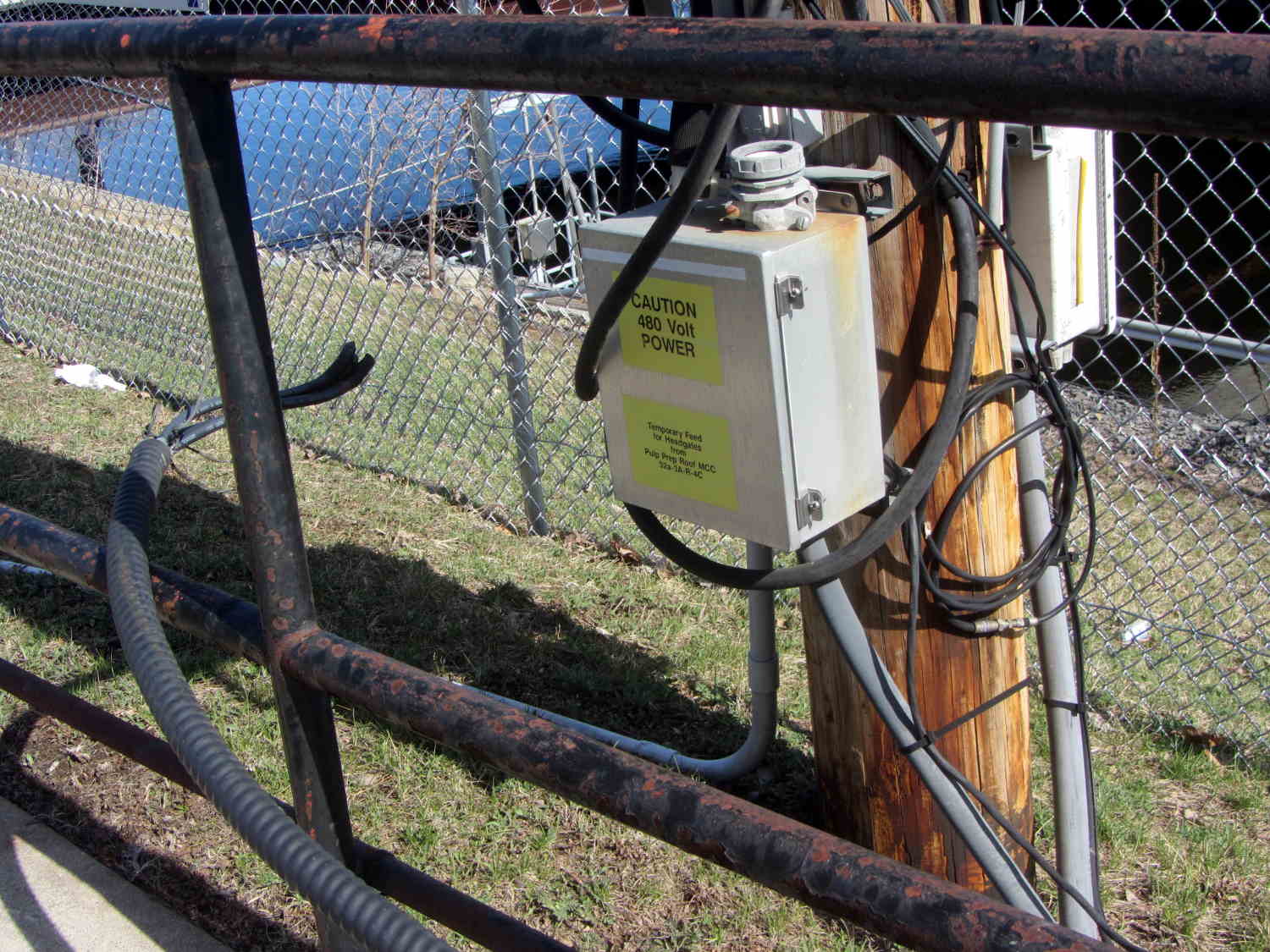
  • Caution 480 V Power

    This seemed rather … casual:

    Caution 480 Volt Power
    Caution 480 Volt Power

    The armored cable draped over the fence probably came from the gland at the top of the box, which now sports a blocking plate that might actually be weatherproof. It had taped-over ends and I assume it fed something downstream that’s now disconnected; the far end of a large loop to the right burrows underground along the sidewalk.

  • Cheap WS2812 LEDs: Test Fixture Failure 2

    A second WS2812 RGB LED in the test fixture failed:

    WS2812 LED - test fixture failure 2
    WS2812 LED – test fixture failure 2

    The red pixel in the second row from the top sends pinball panic to the six downstream LEDs (left and upward). Of course, it’s not consistently bad and sometimes behaves perfectly. The dark row below it contains perfectly good LEDs: they’re in a dark-blue part of the cycle.

    The first WS2812 failed after about a week. This one lasted 7 weeks = 50-ish days.

    The encapsulation seal went bad on this one and, for whatever it’s worth, the remainder still pass the Sharpie test. Perhaps the LEDs fail only after heat (or time-at-temperature) breaks the seal. Assuming, equally of course, the seal left the factory in good order, which seems a completely unwarranted assumption.

  • DDS Musings: AD9850 and AD9851

    The general idea is to build a specialized sine-wave source as part of a test fixture to measure quartz crystal / tuning fork resonators in the 10 kHz to 100 kHz band. AD9850 / AD9851 DDS modules are cheap & readily available, albeit with crappy two-layer PCB layouts and no attention to signal integrity:

    AD8950 DDS module
    AD8950 DDS module

    Documentation seems scanty, at best. The Elecfreaks page may be as good as it gets, with a summary:

    Serial mode just need connect GND,D7 WCLK, FQUP, REST, VCC, I-R

    More doodling will be required.

    Because the AD9850 has an upper clock limit of 125 MHz, of course those boards sport a 125 MHz oscillator-in-a-can. The AD9851 has a 180 MHz limit and an internal 6× multiplier, so it gets a more reasonable 30 MHz oscillator and can run at either 30 MHz or 180 MHz.

    The included 70 MHz (?) reconstruction filter won’t do much to improve a 60 kHz signal. A much much lower outboard lowpass filter will be in order.

    As far as the AD9850 goes, the output frequency comes from a 32 bit value determining the phase increment:

    f = Δφ · osc / 232

    Where

    • f = output frequency
    • Δφ = phase increment
    • osc = oscillator frequency (30, 125, or 180 MHz)
    • 232 = DDS phase counter width

    The smallest frequency difference between successive phase increments is thus osc/232, which is 0.029 103 83 Hz at 125 MHz. Obviously, you can’t get nice round frequencies like 60.000 kHz, except by accident, but you can get close.

    Alas, the resolution conflicts with tuning fork characterization, where you (well, I) want to step the frequency in nice round 0.1 Hz units across a 2 Hz range around 60.000 kHz. Because the crystal characterization requires closely spaced frequencies, where the difference between the test frequencies matters, you shouldn’t work from the nicely rounded frequencies on a display.

    For example, successive values of Δφ produce these frequencies near 60 kHz:

    • 2 061 580 → 59.999 874 793
    • 2 061 581 → 59.999 903 897
    • 2 061 582 → 59.999 933 006
    • 2 061 583 → 59.999 962 104
    • 2 061 584 → 59.999 991 208
    • 2 061 585 → 60.000 020 312
    • 2 061 586 → 60.000 049 416
    • 2 061 587 → 60.000 078 520

    In an ideal world, you could pick an oscillator frequency to produce nice increments. For, oh, say, 0.025 Hz increments, all you need is osc = 0.025 × 232 = 107.374 182 MHz. Riiiight.

    The computations require more numeric resolution than built-in Arduino data types and math operations can provide. Floating point numbers have 6-ish significant digits (double is the same as float), which cannot represent the Δφ values or frequencies. Unsigned integers top out at 32 bits (unsigned long long int is not a thing), enough for 9 significant digits that can hold the Δφ values, but integer multiplication and division do not produce 64 bit results and overflow / underflow without warning.

    Other than that, an Arduino would be just about ideal: the generator needs a small display, a knob, and a few buttons.

    Perhaps storing precomputed Δφ values for specific frequencies in a table, then computing nearby frequencies as offsets from that value would suffice. This will require doodling some absurd significant figures.

  • eBay Purchase Gone Bad: Chronology

    So those LED filaments weren’t packed nearly well as necessary to get them halfway around the planet:

    Broken LED Filament 3
    Broken LED Filament 3

    The complaint I eventually filed with PayPal went like this (with commentary in parentheses):

    3/15/2017 10:00 EDT – Buyer: eBay issue tracking: xxx Paypal Case ID: yyy

    This eBay seller shipped delicate parts without padding, did not ship replacements as promised, has repeatedly offered a refund without actually doing so, and has attempted eBay feedback extortion.

    Chronology:

    11 Jan – broken parts received in unpadded envelope. Contacted through eBay, sent photos

    13 Jan – “we can resend you and it will take 35-45 days,so is it ok for you ?”

    (I asked for a refund, which was ignored)

    16 Jan – replacements allegedly send by untracked mail, not received by 15 March = 60 days

    (and still missing: draw your own conclusions)

    18 Jan – “if you still haven’t received within the promised , please feel free to contact me ,i can solve the problem for you”

    28 Feb – “If you agree with me, I will send your money to your paypal account, […] And meanwhile I will also send you one ebay feedback revision request, […], revise your negative feedback into positive feedback with all 5 star point.”

    (I pointed out that feedback extortion is contrary to eBay policy and asked for a refund)

    7 Mar – “I am really sorry for this issue. And please trust me. I’m a responsible eBay seller. I will be in charge of this problem. I will do my best to solve the problem and meet your satisfaction.”

    7 Mar – “So could you please do me a little favor to send me a photo?”

    (Photos first sent 11 Jan, re-sent 8 Mar)

    9 Mar – “I’m so sorry about that issue . we can refund partial money for you. So is it ok for u”

    (I disagreed and, again, asked for a complete refund)

    10 Mar – “i will refund you soon, may i refund to your paypal?”

    (I insisted on a refund through eBay for tracking)

    10 Mar – “Please give me some time, I will check it for you.”

    14 Mar – The seller will send you a $ 5.13 USD refund after they receive the returned item.

    (At which point I escalated this to a claim with this summary)

    I put pictures of the broken parts on my blog: https://softsolder.com/2017/01/21/led-filaments-whoops/

    The attempted feedback extortion on 28 Feb calls for a complete refund and punitive action.

    Returning $5.13 worth of parts to China is obviously absurd and the seller knows that, having avoided mentioning that “requirement” while previously offering refunds.

    After two and a half months, it’s long past time for a complete refund.

    Thank you.

    Those brief snippets don’t convey the flavor of the seller’s correspondence, again with (commentary in parentheses):

    12 January 2017
    can you use?

    (No, I cannot)

    13 January 2017
    Dear buyer ,
    thanks for your patience and understanding .
    we can resend you and it will take 35-45 days,so is it ok for you ?looking forward to your reply .
    Best wishes.

    (No, I want a refund)

    16 January 2017
    Hello, my dear friend,
    Thanks for your kind communication.
    I place order for you now and it will be resent in 24 hours. I will call post office to deliver quickly. Hope you can get it soon. If you still haven’t received within the promised , please feel free to contact me ,I can solve the problem for you. Thank you.
    Best wishes.

    (I asked for the tracking number)

    17 January 2017
    dear buyer,
    we have tracking number but it shows only the information in China, there is no information abroad, as it is an economical shipping, we have to reduce our loss, so is it ok? looking forward to your reply.
    Best wishes.

    (This was when I realized they were in scammer mode)

    18 January 2017
    if you still haven’t received within the promised , please feel free to contact me ,i can solve the problem for you. Thank you.
    Best wishes.

    (The “promised” was far beyond eBay’s claim limit. I said I would file a claim in late February)

    28 February 2017
    Hello Buyer:
    I just got your negative feedback.
    From your feedback, I know that you are not satisfied with the item. I am so sorry for that. And I am also so depressed with your negative feedback. It really hurt me a lot.
    So I think I can give you fully money back, and you can just keep that item for compensation.
    But I really hope you can revise your negative feedback into positive feedback with all 5 star seller performance. That is very important.
    If you agree with me, I will send your money to your paypal account, And you can log in your paypal and accept that money. And meanwhile I will also send you one ebay feedback revision request, you can view it in your ebay message box, revise your negative feedback into positive feedback with all 5 star point.
    That is the most important for me.
    Is everything OK for you?
    I really hope your kindly understanding.
    Looking forward your answer.
    God Bless you and all your family.
    Best Wishes

    (I filed a claim and posted negative feedback, as I wasn’t thrilled with the purchase)

    8 March 2017
    Dear buyer,
    Thank you for your message. I’m so sorry about that issue . we can refund partial money for you. So is it ok for u?Looking forward to your reply .
    Best wishes.

    (I dsagreed and asked for their long-promised full refund)

    9 March 2017
    Dear buyer,
    Please give me some time, I will check it for you. Thank you for you email.
    Best wishes

    (Time was not on my side)

    As it turned out, the eBay claim period ended a few days earlier than I expected and eBay’s customer support recommended filing a dispute on Paypal. I asked how to handle issues like this in the future and was told, very firmly, to open an issue immediately when a problem occurs on an order from a foreign seller. A formal eBay issue, rather than just “send a message to the seller”, starts the resolution clock and provide a powerful incentive to Make Things Happen.

    So noted.

  • Colpitts Oscillator at 32.768 kHz

    After some fumbling, a Colpitts oscillator sorta-kinda works at 32 kHz:

    Colpitts 32.768 kHz - 47p 470p waveform
    Colpitts 32.768 kHz – 47p 470p waveform

    Even though the Darlington provides enough DC gain for megohm-scale bias resistors, I think they still loaded the crystal tuning fork a bit too much:

    Quartz resonator - Colpitts oscillator - schematic
    Quartz resonator – Colpitts oscillator – schematic

    It didn’t start reliably and a JFET would probably produce better results. As it turns out, my transistor assortment currently lacks JFETs, a situation shortly to be resolved by an ePacket from halfway around the planet.

    The proto board has two oscillator circuits behind the crystal test fixture, with the 32 kHz resonator hanging from the header pins on the lashup toward the rear:

    Quartz resonators - Colpitts oscillator test fixtures
    Quartz resonators – Colpitts oscillator test fixtures

    My copy of Crystal Oscillator Circuits (Mattys, 1983) suggests useful component values:

    Colpitts JFET RC Values
    Colpitts JFET RC Values

    The value of of the recommended shunt resistor Rhi shows why I figured the Darlington and its bias resistors wouldn’t work:

    Colpitts Crystal Shunt Resistance Values
    Colpitts Crystal Shunt Resistance Values

    The other Colpitts circuit worked just fine for a 3.58 MHz crystal and reasonably well for a 60 kHz tuning fork, so some fine tuning should improve the results.