The Smell of Molten Projects in the Morning

Ed Nisley's Blog: Shop notes, electronics, firmware, machinery, 3D printing, laser cuttery, and curiosities. Contents: 100% human thinking, 0% AI slop.

Category: Administrivia

Overhead

  • Blog Summary – 2010

    The numbers as of yesterday:
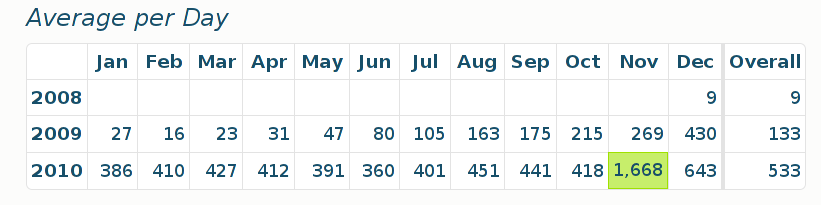
    Site State - Per Day - Dec 2010
    Site State – Per Day – Dec 2010

    That green block highlights the flash mob from hackaday.com descending on the bed bug posts; other than that, things are pretty quiet around here.

    Half of the daily traffic arrives by search engine for topics of general interest. The hackaday firestorm skews the numbers (the Alpha Geek clock was hackaday’s favorite a year ago), but a few other topics peek through.

    Views	Title
    73159	Home page
    6063	Bed Bugs: Wrapup
    5754	Bed Bugs: Hot Box Disinsector
    5148	Changing the Arduino PWM Frequency
    3688	Arduino Hardware-assisted SPI: Synchronous Serial Data I/O
    2823	Arduino Command Line Programming: Avrdude Puzzlement
    2768	Ubuntu 9.10 Partition Backup: ext4 vs partimage vs dd
    2751	Bed Bugs: Overview
    2450	Alpha-Geek Clock
    2291	Ubuntu 9.10 HAL FDI: Input Device Configuration - Kensington Expert Mouse FAIL
    2202	Finding Transformer Pi Model Parameters
    2184	Arduino vs. ATMega168 Chip Pinouts
    2091	Bed Bugs: Infestation and Breeding
    2019	Arduino Fast PWM: Faster
    1981	Sherline Mill Counterweight Gantry
    1890	Cold & Fractured Solder Joints
    1851	Bed Bugs: Dying on Planet Sticky
    1848	Bed Bugs: Living on Planet Sticky
    1830	Bed Bugs: Assured Destruction
    1734	Bed Bugs: Killing Fields
    1692	Bed Bugs: Traps From Planet Powder
    1637	Bed Bugs: Thermal Kill
    1488	Dell GX270 Auto-On Power Setting
    1481	Bed Bugs: Lures
    1364	Removing a Water Heater Anode Rod
    1356	Bed Bugs: Disinsecting the Bedroom
    1352	Arduino LiquidCrystal Library vs Old HD44780 LCD Controller
    1319	Bed Bugs: Furniture Isolation
    1208	Kensington Expert Mouse Trackball: Scroll Ring Troubles
    1199	Camera Microscope Adapter
    1193	Bed Bugs: Pesticides
    1177	Sunglasses Repair: Half a Hinge Is Better Than None
    1152	Kubuntu Remote Desktop via SSH Tunnel
    1123	Mysterious USB Disconnects
    1039	Recumbent Bicycle Amateur Radio Antenna Mount
    1027	American Standard Elite Kitchen Faucet Disassembly
    1005	Bullet Hole in Plate Glass
    

    The search terms are fascinating, at least to me:

    Views	Search
    832	arduino pwm frequency
    795	arduino pwm
    500	arduino pinout
    460	chain catcher
    433	milling
    408	arduino spi
    397	staghorn beetle
    357	transformer model
    355	atmega168 pinout
    351	atmega328 pinout
    317	cold solder joints
    255	cold solder joint
    253	bellows
    245	partimage ext4
    231	avid rollamajig
    226	triple alert redemption
    214	arduino fast pwm
    203	sherline
    193	avrdude arduino
    192	arduino command line
    176	photoresistor circuit
    172	turkey hen
    162	camera microscope
    160	kubuntu remote desktop
    158	magnetizer
    155	front derailleur cable
    147	dl1414
    145	sinking ship
    145	arduino avrdude
    144	cold solder
    140	resistance soldering
    137	hen turkey
    134	rollamajig
    130	pspice transformer
    125	giant swallowtail butterfly
    123	milling projects
    122	the smell of molten projects
    121	arduino struct
    121	visible light blocking filter
    116	swallowtail butterfly
    115	rats leaving a sinking ship
    115	dragonfly
    109	tektronix 492
    109	taxact vs turbotax
    108	garrotte
    108	bob yak
    107	hv transformer
    107	nielsen tv survey
    107	arduino cnc
    107	sherline mill
    106	ss president coolidge
    105	if you can read this roll me over
    105	wwvb receiver
    104	trackball
    104	pwm arduino
    101	stag horn beetle
    101	backup ext4
    101	scratch paper
    

    I knew Arduino hardware and programming was interesting, but I would not ever have predicted that the fourth most popular search term would land there! Must be a lot of bicyclists with chain troubles out there…

    And I seem to be the go-to guy for pictures of staghorn beetles and turkey hens. Who knew?

    So much for my tech interests…

  • Scraped Into Gibberish

    Every now and again I search for a few obvious keywords to discover where my posts have wandered off to; there’s a straightforward Creative Commons license (on the About page) that scrapers seem unable to comprehend. In a surprising number of cases, a simple note to the plagiarist webmaster suffices to eliminate the problem.

    Lately, though, the scrapers collect a page of text, run it bodily through a thesaurus, then post the ensuing gibberish. I think this gives the page some overall search-engine-friendly English syntax while concealing the deed from the original author.

    For example, my original deathless prose:

    Loose plugs, it turns out, vibrate the HT’s jacks right off the circuit board in short order and those jacks are a major pain to replace.

    A trip through the shredder produces this gem (I won’t reward them with a link):

    Loose plugs, it turns out of the closet, quiver the HT’s jacks all there potty the lap conquer rooms in butt in fail ask for and those jacks are a foremost ass effort to be a sensation.

    Doesn’t that give you the impression of someone locked in a room with a foreign-language dictionary, desperately trying to force an important message through a noisy channel?

    For the record, note that I did not refer to anyone’s posterior anatomy. It seems their phrase-o-matic converter fills in some obvious (to them, anyway) empty spots. All those, um, keywords appeared, as if by magic, in the “translation”.

    Sometimes, though, they get it right. My summary:

    Memo to Self: It’s always the connectors.

    emerged with just one change:

    Memo to Self: It’s everlastingly the connectors.

    Isn’t that cute?

    I collect some of the more amusing spam efforts there.

  • Blog Impulse Response

    Those of you following the blog comments by RSS probably noticed a frenzy of commentary on the bed bug posts last week. Turns out that hackaday.com posted an article mentioning my Hot Box Disinsector on the afternoon of 22 November, producing this blip in the traffic numbers:

    Page Views - November 2010
    Page Views – November 2010

    I noticed the jump shortly before suppertime, at which point the WordPress counters weren’t keeping up with the hit rate: the statistics page produced essentially random numbers for the next day.

    About 1/4 of the newcomers (welcome!) read all of the bed bug articles, punching the views up by an order of magnitude. Of course, for a real website, 16k hits per day rounds off to zero, but it’s still invigorating for a simple guy like me.

    WordPress.com inserts ads on their blogs, over which I have no control. As nearly as I can tell, most of my articles have such esoteric topics that they attract no ads at all, but, wow, Google sure knows exactly what to do with bed bugs!

    Now, I’ll return to my usual practice of fixing stuff and writing about how that goes down…

  • Conversation With a Scraper

    Several trackbacks along the lines of “Click for the original post” recently arrived in the comment queue; I have moderation turned on for well and good reason. Their common URL resolved to a blog containing half a dozen posts ripped in their entirety from here.

    Huh. How about that…

    The IP address resolved to [mumble].com, a dedicated server provider, and the blog actually had a contact page with what looked like a non-bogus email address. Here’s the exchange, with me doggedly CC-ing abuse@[mumble].com:

    Me

    Much of the content at [scraper URL].info has been ripped directly from my blog at softsolder.com, in direct violation of the Creative Commons copyright given in the About page.

    Remove all of the content taken from my blog and notify me when you have done so.

    You may post links to my blog, but you may not re-use the text or pictures without following the applicable Creative Commons copyright rules.

    Thank you.

    Scraper

    Thanks for your email.  This was generated by a sofware program and has been removed as requested. Regards,  David

    Me

    OK, I’m puzzled: you imply that your site uses content that a program automatically rips from other blogs.

    What’s the point of that?

    Scraper

    FYI there are alot of different software programs out there that create autoblogs in much the same manner. These are being actively promoted to internet marketers.  All that is required is subscribing to your rss feed and the software does the rest. It populates the blog, and publishes the content.  I’m sure that you will run into this some more as these type programs become used by more and more marketers.  David

    Me

    Ah, now it makes sense: the lure of money for nothin’!

    I suppose I should be flattered that you considered my blog worth stealing.

    Frankly, I doubt you’ll get very far with second-hand content, at least based on the readership I’ve built up over the past two years by creating an original post every single day.

    I’ve always wondered at the financial reward from a scraper blog. Let me know how that business model works out for you in, say, late January of next year.

    OK?

    Thanks…

    Something tells me I’m not going to get a reply.

    There are many “bloggers” like David who think there’s money to be made by pretending they’re competent. Many of the comments you never see lead to spam and malware blogs that link back here, evidently to boost their clickiness.

    My RSS post feed has teaser excerpts, not the entire blog post, which seems to discourage scrapers: copy-and-pasting a URL Is so much more difficult than just clicking an RSS button. I suppose that makes David one of the more enterprising “internet marketers” in his field of non-expertise…

  • New Theme?

    There’s no way to tell if a theme will actually look right without enabling it and investing an hour fiddling with the options.

    That’s why it looks different with each refresh…

  • Trinity College Fire Fighting Home Robot Contest Rules

    As it turns out, I edit the contest rules.

    The draft document is a hulking PDF that’s too large for email, which means the Tech Committee needs a central repository.

    This blog serves as my notebook, so here’s where I put various revisions of the draft. Because the drafts are not intended for public dissemination, the page holding them is password-protected. At least, it should be…

    Because you aren’t on the Tech Committee, you don’t have the password.

    That’s what’s going on; the regular daily posts will continue apace.

    (But, wow, it’s a great way to discover how many folks are up early in the morning…)

  • How to Impress a Contest Judge

    Every now and again, I’m asked to judge a technical contest of one sort or another. Let us assume, for the purposes of this discussion, that you are participating in such a contest and I’ve just begun to look at your entry…

    Rule 0: Send a PDF

    The contest rules will tell you what document files they expect; typically, it’ll involve some version of Microsoft Word. Why they do that, I cannot say, but Word documents aren’t really suited to read-only document distribution. Not to mention, some of us don’t have MS Word installed…

    In addition to those files, also include a PDF of your final document file so that when I open it, it’ll look exactly the way you intended. MS Word documents tend to look weird on any PC other than yours, particularly if you have any odd fonts or formatting options turned on. If you can’t figure out how to produce a PDF, install OpenOffice and use the direct PDF export; that’ll also show you how weird MS Word can appear in a different word processor.

    Don’t waste time on a fancy layout, but do pay attention to the basics:

    • Images must fit inside the margins of a single page
    • Use simple fonts that are large enough to read
    • Avoid complex tables and drawings: use PNG images instead

    Hint: ask a friend to review your submission, ideally a few days before you plan to submit it. Take any comments you get very seriously.

    Rule 1: Tell Me What You Did

    The first two paragraphs of your documentation must tell me:

    • What your project does
    • Why that’s a great idea

    That should take, at most, half of the first page.

    You have two paragraphs to catch my attention; sweat bullets over those words!

    Hint: If you can’t summarize what your project does in one sentence, maybe you don’t have a good project.

    Rule 2: Let Me Judge How Easy (or Hard) It Was

    Going on at length about how easy the project was produces the impression that maybe there’s not enough effort in there to justify a few kilobucks of prize money. Conversely, kvetching about how hard you worked indicates that you bit off more than you can chew.

    Let the project tell the story. A good project requires more than a few evenings of effort and, believe it or not, the amount of effort will show up in your description, even if you don’t mention it at all.

    Hint: If you’re trying to be funny, it probably won’t work.

    Rule 3: Use Good Pictures

    Examine all the pictures with a hyper-critical eye.

    • If they’re blurry, delete them and take them again.
    • If you think a picture might be out of focus, it is.
    • If there is the slightest trace of doubt in your mind about the quality of a picture, delete it and try again until you get it right.

    When you get the focus right, ruthlessly crop your pictures. Hint: I don’t need to see the crap on your workbench or the dirty laundry in the corner of your room. Devote all the pixels to your project!

    When you don’t care enough to invest a few minutes getting a good picture, the rest of your project is probably sub-optimal, too. Don’t bother to submit it, OK?

    Crisp pictures can’t sell a weak project. Blurry images rarely accompany a good project.

    Hint: That big LCD on the back of your camera is there for a reason. Use it!

    Rule 4: Support Your Claims

    If you claim to have built a multi-node, RF-networked, high-bandwidth, vibration sensor measurement system, then you must include data supporting your claims. Otherwise, I’ll assume you don’t know what you’re talking about or haven’t actually gotten it working, should my back-of-the-envelope calculations indicate there’s not enough RF bandwidth / range / compute power to pull it off.

    You must convince me that your project does what you claim!

    Hint: Should you claim to have built a snake-armed robot that balances atop a ball while serving drinks from a refrigerator, a video demonstrating it in action is worth a thousand words.

    Rule 5: Don’t Hide a Skeleton

    You may encounter a serious problem that simply can’t be fixed before the contest deadline. When that happens, explain what you intended to have happen, what the problem is, and what you propose as a solution. As long as the problem is secondary to the project’s intent, that’ll be fine.

    For example, if your project involves half a dozen different sensors and you just can’t get the humidity sensor working, explain your debugging efforts and the results.

    Conversely, if it’s a networking project and you can’t get the Ethernet code working, then your entire project just went down the drain and you shouldn’t submit it. I can generally tell when a project simply isn’t going to work, so your efforts to hide the corpse won’t gain you any points.

    Hint: Start your project early enough so that when something goes wrong, you have time to fix it.

    Rule 6: Use the Specified Hardware and Use It Hard!

    The contest is generally about using some particular microcontroller or chunk of hardware. Your project should fully utilize that chip: make sure you read the manual and exploit a whole bunch of its unique features.

    Hint: a project where all the action takes place in a Javascript routine or another, entirely different microcontroller probably isn’t making good use of the specified chip.

    The Bottom Line

    If you’ve got a good project and describe it well, you’re probably in the money. Plenty of other entrants will ignore these suggestions and wind up on the bottom of the pile.

    Fair enough?