Ed Nisley's Blog: Shop notes, electronics, firmware, machinery, 3D printing, laser cuttery, and curiosities. Contents: 100% human thinking, 0% AI slop.
Our Craftsman lawn mower has both a deadman grip for the motor (the Operator Presence Control Bar) and a Drive Control Lever that engages the rear wheel drive. The latter requires a death grip to keep the belt engaged, which means you (well, I) spend about two hours clenching the grip.
Lawn mower – compound leverage handle
I’ve long since flipped the control to the left side and added thick foam padding, but there’s no adjustment that reduces the death-grip requirement: you can change the engagement distance, not the spring constant.
Evidently the Sears engineers have much stronger hands than anyone in our family.
The doodad hose-clamped to the upright part of the mower handle is a basically a hinge that applies force to the tip of the red handle. The hinge axis lies far enough from the handle’s pivot so that holding the hinge against the handle requires very little force; at least it’s no longer a death grip.
Lawn mower – compound leverage handle engaged
It’s not an ideal solution, but it engages and (more importantly) disengages easily. I still don’t like mowing the lawn, but at least I don’t return with a crippled-up hand.
The hinge is actually a lock hasp, so it has a slot that slides neatly over the Drive Control Lever’s tab. I beat both sides into a more-or-less cylindrical form over a piece of pipe, while miraculously not bending the hinge pin.
Evidently the Sears engineers never actually used the damn mower for two hours at a time.
We hold these truths to be self-evident, that all men are created equal, that they are endowed by their Creator with certain unalienable Rights, that among these are Life, Liberty and the pursuit of Happiness. That to secure these rights, Governments are instituted among Men, deriving their just powers from the consent of the governed, That whenever any Form of Government becomes destructive of these ends, it is the Right of the People to alter or to abolish it, and to institute new Government, laying its foundation on such principles and organizing its powers in such form, as to them shall seem most likely to effect their Safety and Happiness. Prudence, indeed, will dictate that Governments long established should not be changed for light and transient causes; and accordingly all experience hath shewn, that mankind are more disposed to suffer, while evils are sufferable, than to right themselves by abolishing the forms to which they are accustomed. But when a long train of abuses and usurpations, pursuing invariably the same Object evinces a design to reduce them under absolute Despotism, it is their right, it is their duty, to throw off such Government, and to provide new Guards for their future security.
We read the original document in DC a few months ago, while doing the touristy thing. These days, that means submitting to a search on the way into each museum; Mary lost her forgotten-in-the-bottom-of-her-purse Swiss Army Knife to the Smithsonian guards.
We left town feeling that something has gone badly wrong in the last decade or so.
The Casio EX-Z850 camera living in my pocket finally developed a problem. Two buttons on the back select the Review and Camera modes; the former stopped working, which means I can’t see pictures after I take them. The Camera button may still work, but because I can’t display pix, that’s pretty much moot.
Taking the camera apart require a Philips 00 screwdriver bit and some care, but eventually you’re confronted with this:
Casio EX-Z850 camera – opened
The buttons and the mode selector dial all connect to the same flexible PCB substrate, which ends up in this connector. You should ease the black pressure bar (seen edge-on here) upward to release the flex PCB:
Casio EX-Z850 button connector
As it turns out, the two buttons have a common contact that’s the second trace from the top in the flat cable. Both buttons have good snap action, good conductivity, and seem to work fine. That puts the problem deeper inside the camera, where I don’t see much point in going; I can certainly make things much worse and likely not make them any better.
In fact, it turns out that the two buttons on the USB/charging cradle don’t work now, either, which implies that the camera buttons run in parallel with those. So there’s something blown in the camera’s guts, which is definitely Bad News.
Back in the Bad Old Days, you used to take a picture and wait a week or two to get the results back from the drug store. Perhaps it’s fashionably retro to have a digital camera without a Review mode?
That comment prompted me to rummage around for one of my favorite photos: a much younger version of my Shop Assistant helping us shred leaves in the front yard.
Shop Assistant in Autumn leaf pile
She thinks it’s entirely right & proper to:
don safety goggles while doing anything even remotely eye-unsafe
wear a dust mask to mow the lawn
jam 30 dB foam plugs into her ears during thrash metal concerts
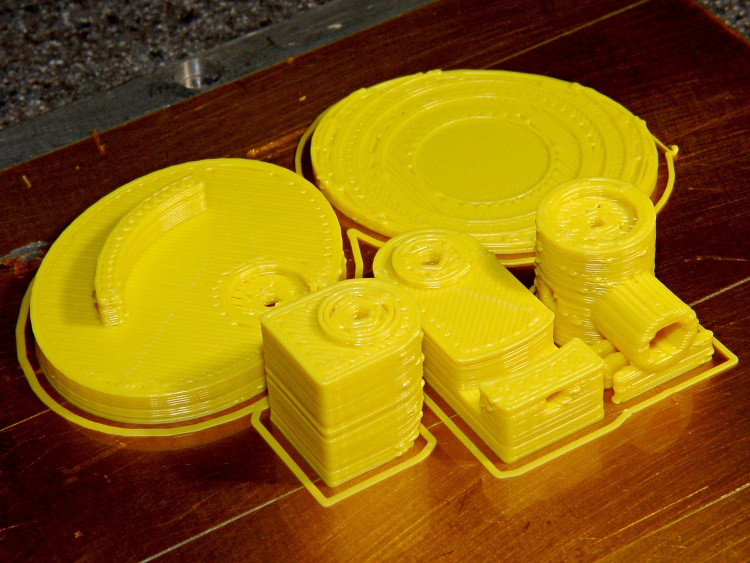
Printing went smoothly after two preliminary passes to work out the sizes and alignments; this is the second pass, which you can tell because the mirror shoulder has three supports instead of the two shown in the solid model:
Mirror mount parts on build plate
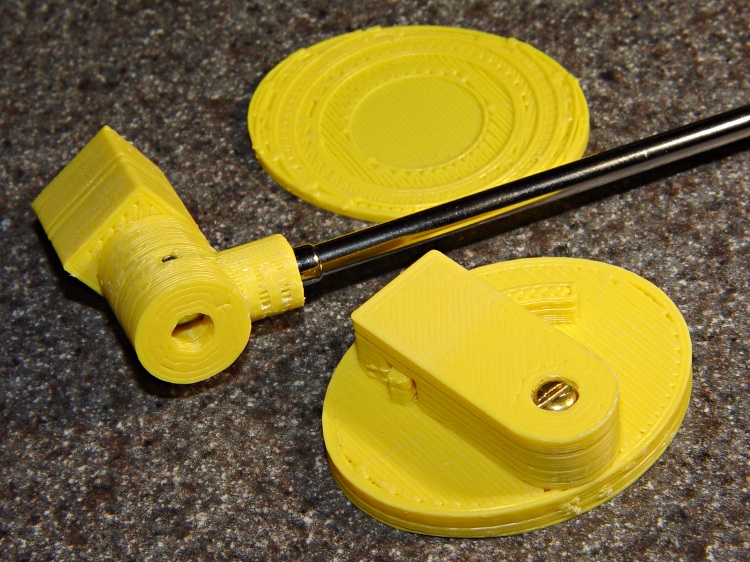
One view of the parts, with the mirror shaft in place:
Mirror mount partial assembly – top
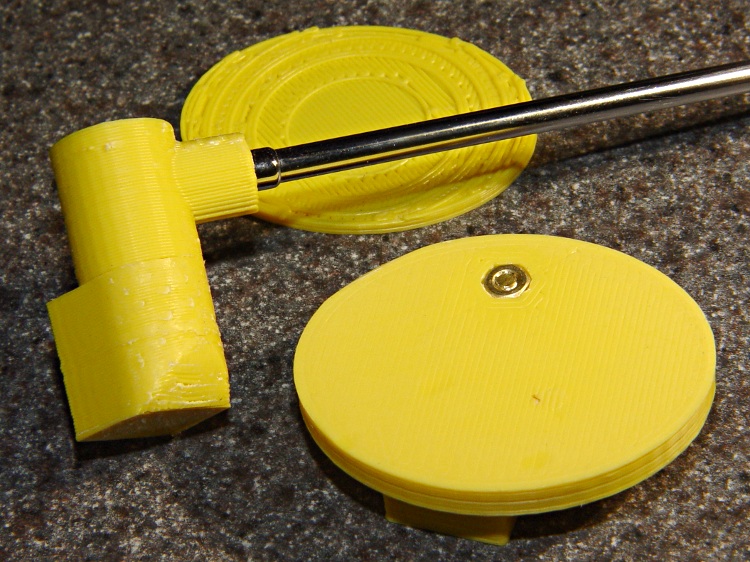
Another view, showing the bottom of the Elevation Plate with the recessed nut:
Mirror mount parts partial assembly – bottom
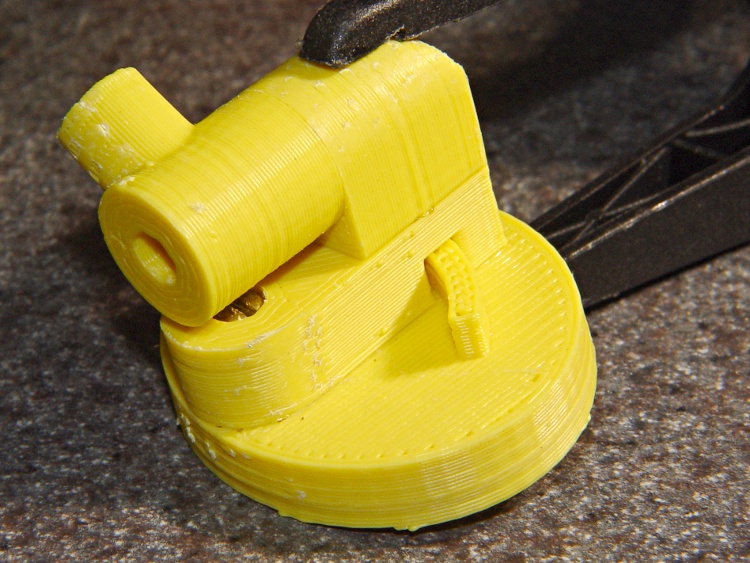
Assembling the two glue joints required an overnight clamping:
Mirror mount – glued and clamped
Then a layer of double-stick foam tape affixes it firmly to the helmet:
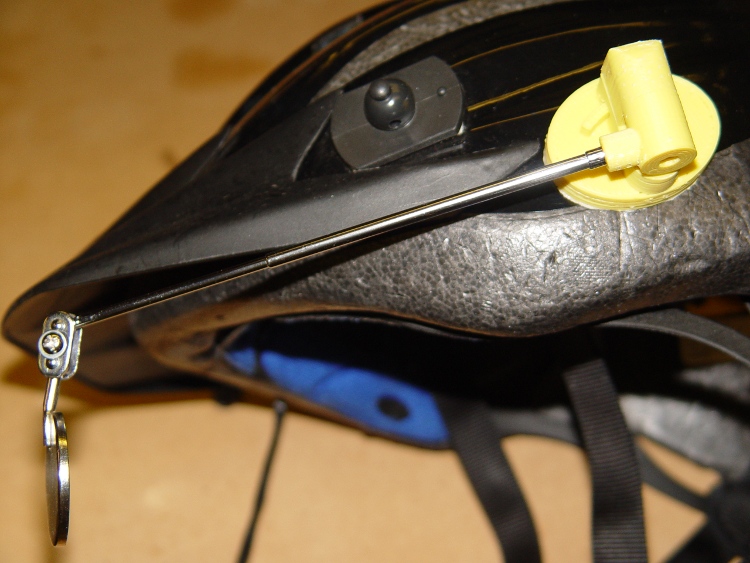
Mirror mount – on helmet
It’s a bit too big and way ugly, but works pretty much as expected.
Two lengths of heatshrink tubing now lock the mirror shaft sections in place; they tended to rotate slightly under normal vibration.
The OpenSCAD code and model have a few modifications from this object. The next one won’t have the third section of mirror shaft, which makes the shoulder and Az Mount smaller, and the Az Mount is 1 mm closer to the El Body. That shaves a few millimeters off the whole thing.
The mirror clamp out there on the end is much too large and has too many fiddly parts. I think a little printed doodad would work, but that’s in the nature of fine tuning.
A long time ago, I read this in E. E. “Doc” Smith’s The Skylark of Space:
He could study safeblowing fifteen minutes and be top man in the field
Even back then, I knew knowledge didn’t work that way. If your fingers haven’t done it, you don’t know how to do it. The more you do it, the better you get.
After a bit of OpenSCAD twiddling, those doodles turned into a printable model. This view shows what it looks like all neatly assembled:
The tiny hole on the top of the Elevation Body accepts a 2-56 setscrew that grabs the arc protruding from the Elevation Plate and locks the up-and-down setting. The Azimuth Mount pivots on the 3-48 screw holding it to the Elevation Mount.
Both of those pivots must be loose enough to move when you bump the mirror and tight enough to stay put in normal use. It’s a delicate balance and I’m not convinced this will work for the long term, but it’s a brassboard.
The 2-56 stud on the end of the mirror shaft screws into a socket in the rear side of the Az Mount. Another 2-56 setscrew in the Az Mount (facing the El Body), grabs the side of the shaft and prevents it from rotating.
The mirror shaft shoulder on the Az Mount (front center) sticks out in mid air and requires a little bit of support.
The El Mount (left rear) builds surprisingly well with its curved top surface downward. If it’s rotated 90 degrees with the curve facing to the left, Skeinforge grumps about not being able to do something or another and generates totally bogus G-Code.
The Helmet Plate has a 3 mm deep depression that more-or-less corresponds to the helmet’s surface. It’s gouged out by a huge sphere sitting on the plate, with a radius calculated from the measured helmet curvature.
The OpenSCAD source code has two useful parameters near the top:
Layout selects the overall appearance: Fit, Show, or Build
Examine selects a single part for inspection & tweakage
You’ll need the MCAD and Visibone libraries to make this work. It’s the original code, without the tweaks to the grid mentioned in the comments there:




 The Smell of Molten Projects in the Morning