The Smell of Molten Projects in the Morning

Ed Nisley's Blog: Shop notes, electronics, firmware, machinery, 3D printing, laser cuttery, and curiosities. Contents: 100% human thinking, 0% AI slop.

Author: Ed

  • NY SAFE Act Magazine Capacity: Assumptions

    I AM NOT A LAWYER.

    To review, PL 265.00 Section 23 as amended defines a large capacity magazine (a.k.a. “ammunition feeding device”):

    23. “Large capacity ammunition feeding device” means a magazine, belt, drum, feed strip, or similar device, that
    (a) has a capacity of, or that can be readily restored or converted to accept, more than ten rounds of ammunition, or

    PL 265.36, defines unlawful possession:

    § 265.36 Unlawful possession of a large capacity ammunition feeding device.

    It shall be unlawful for a person to knowingly possess a large capacity ammunition feeding device manufactured before September thirteenth, nineteen hundred ninety-four, and if such person lawfully possessed such large capacity feeding device before the effective date of the chapter of the laws of two thousand thirteen which added this section, that has a capacity of, or that can be readily restored or converted to accept, more than ten rounds of ammunition.

    Despite the period at the end, that’s not actually a complete sentence.

    Taken together, both sections assert that a magazine with “a capacity of, or that can be readily restored or converted to accept, more than ten rounds of ammunition” is (or will be, as of one year from the effective date of the legislation:15 January 2014) illegal.

    The wording implies that an existing, formerly legal “large capacity” magazine can be brought into compliance by a modification that limits its capacity to ten rounds, with the caveat that actually inserting more than seven rounds may be illegal, depending on the situation and the effect of various amendments to PL 265.00, as discussed previously.

    The legislation requires such a modified magazine must not be “readily restored or converted” to hold more than ten rounds. I cannot find the legislative definition of “readily”, despite some diligent searching. As mentioned earlier, the NY State Police guidelines use the word “permanently”, a much stronger word than “readily”, seemingly without basis in the law.

    Merriam-Webster defines it thusly (slightly reformatted):


    read·i·ly
    adverb \ˈre-də-lē\
    : quickly and easily
    : in a way that shows you are willing to do something
    : without hesitation or complaint
    Full Definition of READILY
    : in a ready manner: as
    a : without hesitating : willingly <readily accepted advice>
    b : without much difficulty : easily <for reasons that anyone could readily understand>

    The full definition suggests that, in order to be “readily restored or converted”, the process must be both temporally short (“without hesitating”) and easy to accomplish (“without much difficulty”).

    I realize that the legislature sometimes uses words in a special way, but it’s been two weeks since I asked my legislators for clarification and haven’t heard anything substantive, so I’m doing the best I can with what I have.

    It also seems reasonable to assume “readily” includes the notion of something an ordinary person could do, without special tools. An experienced machinist in a well-equipped shop can readily accomplish tasks that seem impossible, right up through building a complete magazine (or, heck, a firearm) from scratch; permanently has no real meaning.

    On that scale, I’m much closer to an ordinary person than an experienced machinist, but perhaps I can come up with a magazine modification that isn’t readily un-do-able.

    I also assume any magazine modification should meet some practical requirements, even though they’re not spelled out in the legislation:

    • Safety – no change to OEM material specifications, properties, or designs
    • Function – no change to OEM specified operation or maintenance
    • Reliability – no change to critical dimensions or mechanical features

    In short, the smaller and fewer the changes required to reduce the magazine capacity, the better.

  • New Video Card: Pinball Panic!

    Picked up a new Jaton PX610GT-EX video card, just like that one, for the new desktop box that’s slowly taking shape. Dropped it into the slot, fired it up, and …

    Jaton PX610GT-EX - Pinball Panic
    Well, that doesn’t look quite right. In real life, the pattern sparkled and the horizontal bar slid slowly down the screen; this is a photo, because the UI was completely hosed.

    In truth, that’s what happened when I swapped it into the current desktop box to figure out whether the fault lay in the card, the PC, or the OS. In the new PC, the card flat-out didn’t work at all, so the fact that it booted and got the OS GUI up, before getting wedged, counted for something.

    Given that the two cards are identical, the new one is on its way back for an exchange.

    The full desktop picture is over there.

  • Dehumidified Processor Crackers

    The cracker recipe I’m using produces eight sets of crackers, so this time I added a variety of toppings to see what would work out best:

    • Plain
    • Salt
    • Sugar
    • Cinnamon
    • Garlic
    • Chopped chocolate
    • Chopped cashews
    • Chopped walnuts

    Garlic wins over everything else, hands-down, no contest, but the mixture of all the toppings in the bottom of the cooling bowl was wonderful.

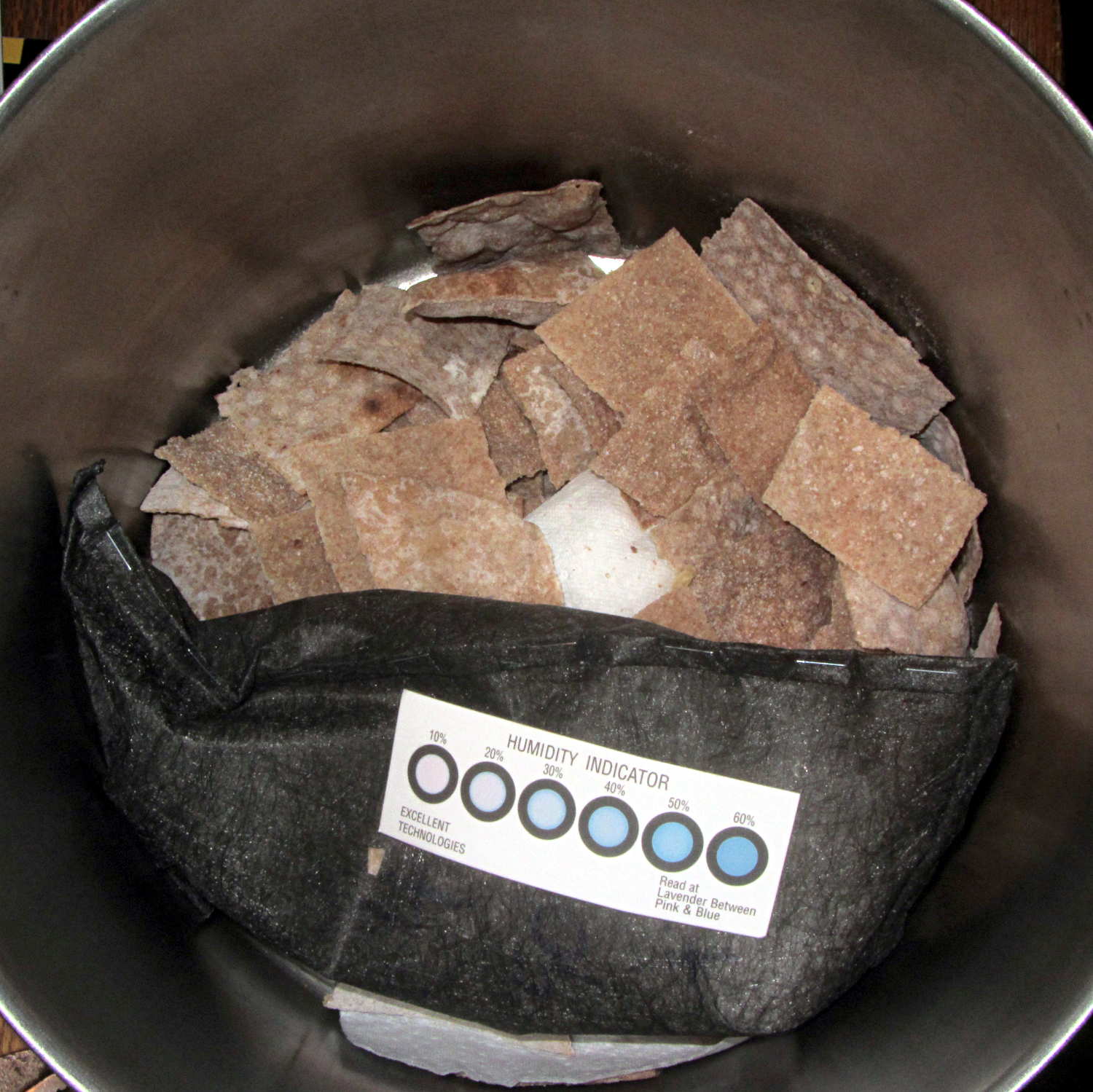
    The crackers went into a large pot with a bag of desiccant:

    Whole wheat crackers with desiccant
    Whole wheat crackers with desiccant

    It pulled out 30 grams of water while reducing the humidity to 20% overnight; the crackers started out crisp and became really snappy. Definitely the right way to get the job done.

    These vaguely resemble the Processor Crackers recipe in Flatbreads & Flavors (Alford & Duguid):

    • 3 C hard whole wheat flour
    • 1 tsp salt
    • 1 C warm water, more as needed
    • Toppings
    • Water sprayer

    I’m using coarse-ground red wheat that doesn’t soak up the water like fine-ground flour. The original recipe called for 1-½ C water, which produced a sticky ball.

    • Blend wheat & salt in food processor
    • Add water in a slow stream until dough firms up
    • Blend another minute
    • Knead half a minute on cutting board
    • Cover
    • Let rest 30 minutes while you prepare toppings

    Finely chopped toppings work best; the nuts were too coarse.

    • Preheat oven to 500 °F
    • Divide dough in eight pieces, cover

    For each piece of dough:

    • Roll to about 2 mm
    • Put dough on vented pizza pan
    • Cut cracker shapes with pizza cutter
    • Sprinkle topping
    • Spritz with water
    • Put in oven on top rack
    • Punch timer for 3 minutes
    • Prepare next piece
    • Swap pans
    • Iterate

    Toss the crackers into a big bowl to cool, sampling as needed.

    When crackers cool:

    • Dump into large pot
    • Add desiccant bag & humidity card
    • Cover
    • Snarf combined toppings from bowl
    • Leave crackers to dry overnight

    Wonderful!

    Memo to Self: Shredded Parmesan cheese would be pretty good…

  • NY SAFE Act Magazine Capacity: Legislator Responses

    Seeing as how both my NY Senator and Assemblymember voted in favor of the NY Safe Act, I sent each one an email asking for a pointer to the actual wording of the current law.

    They both use autoresponders, of course.

    From Senator Gipson:

    Thank you for taking the time to e-mail me. Your comments and suggestions are very important to me and an integral part of the legislative process.

    From Assemblymember Barrett:

    Thank you for contacting my office. I greatly appreciate hearing from you as it helps guide my work in Albany as well as here at home.

    I apologize for this automated response, but given the volume of e-mails and letters that my office receives each day, we do not always have the resources to answer each one immediately. I want to assure you that I read every letter and email that comes in and take your views into consideration.

    If you live in my Assembly district, and have an urgent matter, please call my office at 845-454-1703. Again, thank you for your correspondence; it is a privilege to serve you.

    Sincerely,
    Didi Barrett
    Assemblymember
    106th Assembly District

    I eventually got an email from Gipson’s office and a call from Barrett’s office with pointers to more information. It’ll take a while for all that to settle down, though.

  • NY SAFE Act Magazine Capacity: Legislative Rewrites

    I AM NOT A LAWYER.

    Some concerted rummaging reveals the source of the enigmatic reference “ch 1/2013 § 58” in the previous post to be part of Senate Bill S2670D-2013 and Assembly Bill A3007D-2013:

    • Passed by the NY Senate: 27 March 2013
    • Passed by the NY Assembly: 28 March 2013
    • Signed by Governor Cuomo: 29 March 2013

    This legislation (seems to) change the definition of a large capacity ammunition feeding device by making sections (b) and (c) “not effective”:

    S 4. Subdivision b of section 58 of chapter 1 of the laws of 2013 amending the criminal procedure law and other laws relating to suspension and revocation of firearms licenses, is amended to read as follows:

    b. The amendments to subdivision 23 of section 265.00 of the penal law made by section thirty-eight of this act shall take effect on the ninetieth day after this act shall have become a law, except that the amendments [made to] DESIGNATING paragraph (a) of subdivision 23 shall take effect immediately; AND PROVIDED FURTHER THAT THE EFFECTIVE DATE OF THE AMENDMENTS ADDING PARAGRAPHS (B) AND (C) TO SUCH SUBDIVISION SHALL BE SUSPENDED AND NOT EFFECTIVE;

    Note that the asterisk leading to that footnote in the previous post seemed to apply to only section (b), not (c).

    I cannot find the text defining the amendments to section (a), but if that part stands as written, then the definition of a “large capacity ammunition feeding device” reduces to:

    23. “Large capacity ammunition feeding device” means a magazine, belt, drum, feed strip, or similar device, that
    (a) has a capacity of, or that can be readily restored or converted to accept, more than ten rounds of ammunition

    S2670D-2013 / A3007D-2013 redefined unlawful possession based on the actual number of rounds in the ammunition feeding device, rather than its maximum capacity:

    S 2. Section 265.37 of the penal law, as added by chapter 1 of the laws of 2013, is amended to read as follows:

    S 265.37 Unlawful possession of certain ammunition feeding devices.

    It shall be unlawful for a person to knowingly possess an ammunition feeding device [that such person lawfully possessed before the effective date of the chapter of the laws of two thousand thirteen which added this section, that has a capacity of, or that can be readily restored or converted to accept more than seven but less than ten rounds of ammunition,] where such device contains more than seven rounds of ammunition.

    If such device containing more than seven rounds of ammunition is possessed within the home of the possessor, the person so possessing the device shall, for a first offense, be guilty of a violation and subject to a fine of two hundred dollars, and for [a second] EACH SUBSEQUENT offense, be guilty of a class B misdemeanor and subject to a fine of two hundred dollars and a term of up to three months imprisonment. If such device containing more than seven rounds of ammunition is possessed in any location other than the home of the possessor, the person so possessing the device shall, for a first offense, be guilty of a class B misdemeanor and subject to a fine of two hundred dollars and a term of up to six months imprisonment, and for [a second] EACH SUBSEQUENT offense, be guilty of a class A misdemeanor.

    S2670D-2013 / A3007D-2013 does not, however, amend NY PL 265.36, so the penalty for possession of a large capacity ammunition feeding device, as defined in PL 265.00 Section 23, remains intact.

  • NY SAFE Act Magazine Capacity: Overvew

    The NY SAFE Act limits the capacity of firearm magazines, as defined in NY Penal Law Article 265.00 Section 23  (reformatted for readability):

    23. “Large capacity ammunition feeding device” means a magazine, belt, drum, feed strip, or similar device, that
    (a) has a capacity of, or that can be readily restored or converted to accept, more than ten rounds of ammunition, or
    * (b) contains more than seven rounds of ammunition, or
    (c) is obtained after the effective date of the chapter of the laws of two thousand thirteen which amended this subdivision and has a capacity of, or that can be readily restored or converted to accept, more than seven rounds of ammunition; provided, however, that such term does not include an attached tubular device designed to accept, and capable of operating only with, .22 caliber rimfire ammunition or a feeding device that is a curio or relic.

    * NB Suspended and NOT Effective per ch 1/2013 § 58, as amended by ch 57/2013 Pt. FF § 4

    The official NY SAFE Act website has more information, as does A Guide to the New York Safe Act prepared in September by the NY State Police Office of Division Counsel.

    NY PL 265.36 states:

    § 265.36 Unlawful possession of a large capacity ammunition feeding device.

    It shall be unlawful for a person to knowingly possess a large capacity ammunition feeding device manufactured before September thirteenth, nineteen hundred ninety-four, and if such person lawfully possessed such large capacity feeding device before the effective date of the chapter of the laws of two thousand thirteen which added this section, that has a capacity of, or that can be readily restored or converted to accept, more than ten rounds of ammunition.

    An individual who has a reasonable belief that such device is of such a character that it may lawfully be possessed and who surrenders or lawfully disposes of such device within thirty days of being notified by law enforcement or county licensing officials that such possession is unlawful shall not be guilty of this offense. It shall be a rebuttable presumption that such person knows that such large capacity ammunition feeding device may not be lawfully possessed if he or she has been contacted by law enforcement or county licensing officials and informed that such device may not be lawfully possessed.

    Unlawful possession of a large capacity ammunition feeding device is a Class A misdemeanor.

    A Class A misdemeanor sets you up for a kilobuck fine or a year in jail.

    NY PL 265.37 states:

    § 265.37 Unlawful possession of certain ammunition feeding devices.

    It shall be unlawful for a person to knowingly possess an ammunition feeding device where such device contains more than seven rounds of ammunition.

    If such device containing more than seven rounds of ammunition is possessed within the home of the possessor, the person so possessing the device shall, for a first offense, be guilty of a violation and subject to a fine of two hundred dollars, and for each subsequent offense, be guilty of a class B misdemeanor and subject to a fine of two hundred dollars and a term of up to three months imprisonment.

    If such device containing more than seven rounds of ammunition is possessed in any location other than the home of the possessor, the person so possessing the device shall, for a first offense, be guilty of a class B misdemeanor and subject to a fine of two hundred dollars and a term of up to six months imprisonment, and for each subsequent offense, be guilty of a class A misdemeanor.

    I AM NOT A LAWYER.

    As I understand those sections, a large capacity feeding device, as defined by PL 265.00 Section 23, either:

    • Has a capacity of more than ten rounds or
    • “[C]an be readily restored or converted to accept more than ten rounds”.

    It appears to be the intent of the law that an existing large capacity feeding device can be converted to a legal, non-large capacity feeding device by modifying it in such a way that its new 10 round capacity cannot be “readily restored or converted” to the original large capacity.

    There is no definition of “readily”.

    The NYSP Guide uses a different terminology:

    … those who possess these devices have one year from the enactment of the Safe Act to transfer, dispose of, or permanently modify the magazines to a capacity of 10 rounds or less.

    There is no definition of “permanently”.

    However, there’s that enigmatic asterisk and footnote in PL265.00 Section 23.

  • Dummy 9 mm Luger Cartridge: 100 μm Layers

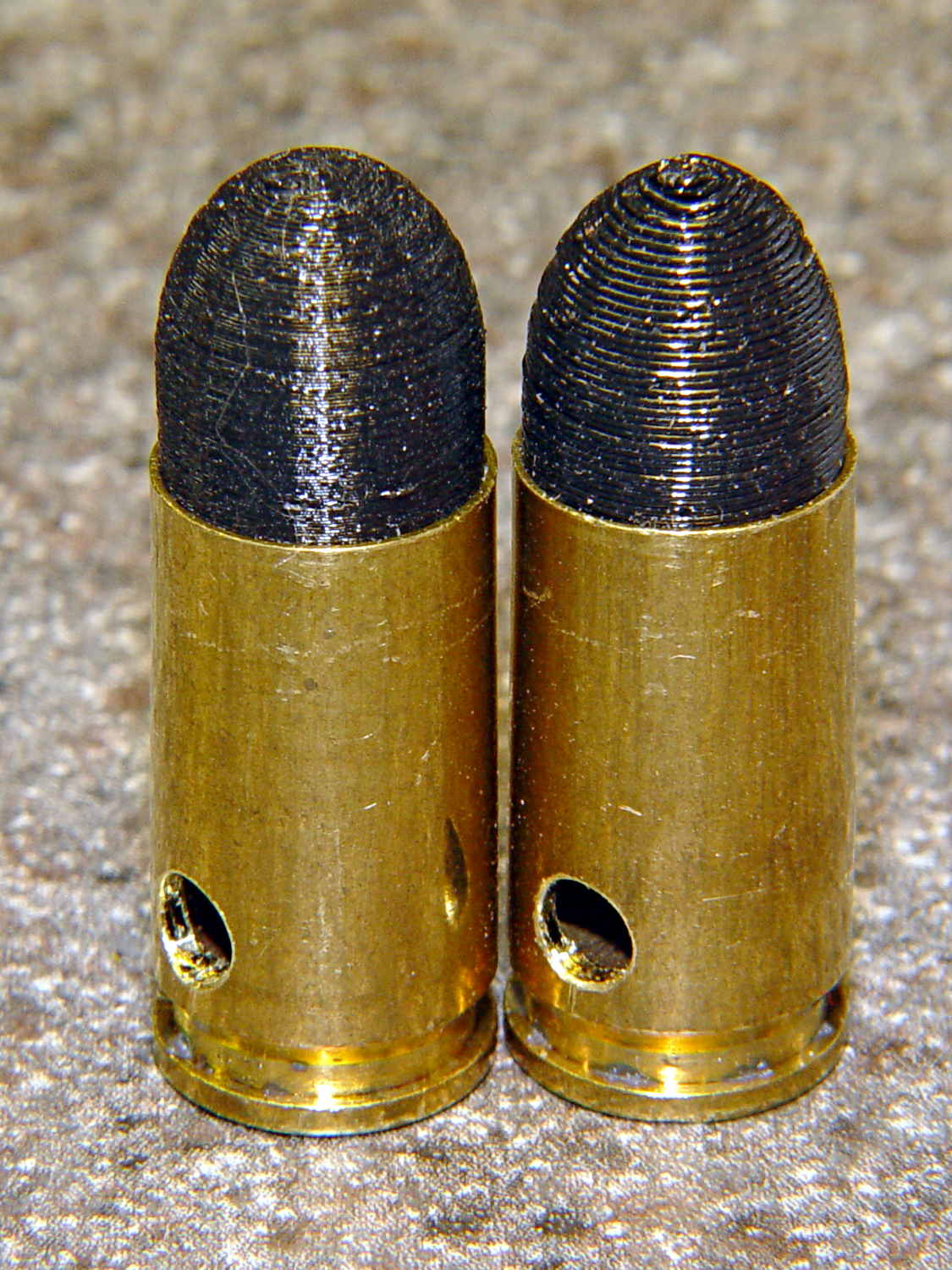
    As you might expect, changing the layer thickness to 0.1 mm = 100 μm dramatically improves the appearance of the dummy 9 mm Luger bullet on the left, compared to the 0.25 mm = 250 μm layers on the right:

    Dummy 9 mm Luger cartridges - 0.1 mm layer - overview
    Dummy 9 mm Luger cartridges – 0.1 mm layer – overview

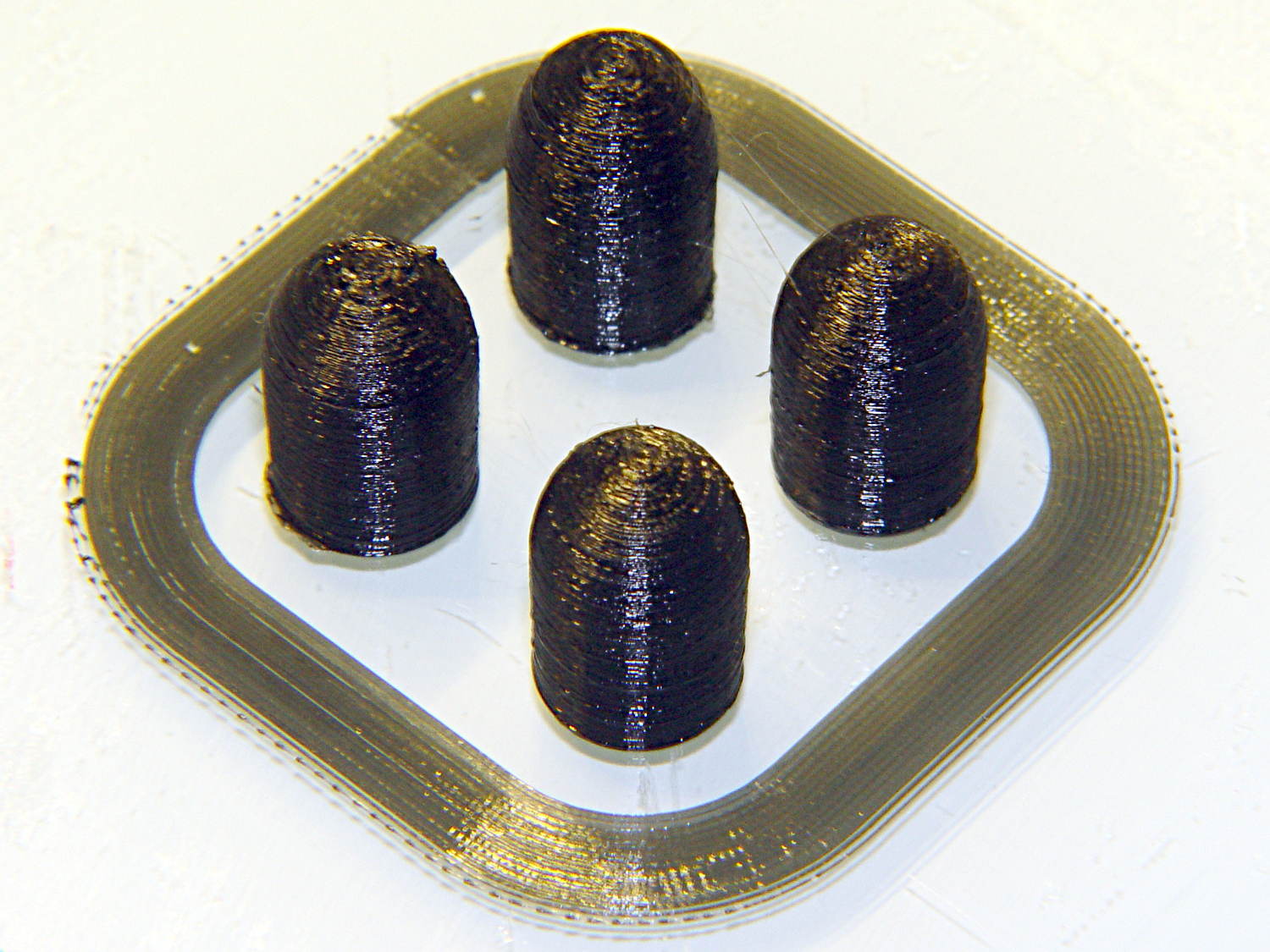
    The inside edge of the translucent skirt around the quartet measured 90 to 110 μm, so the layer height is spot on:

    Dummy 9 mm Luger bullets - 0.1 mm layer - overhead on platform
    Dummy 9 mm Luger bullets – 0.1 mm layer – overhead on platform

    That required no adjustments to the M2 at all; It Just Works. Admittedly, that’s with a custom platform and firm supports replacing the springs, plus better Z-axis homing, but the overall structure was fine to start with.

    I used the same Slic3r settings as before, with the only change being the layer thickness. Letting it pick the layer width might produce better results, but a 0.35 mm nozzle won’t go much narrower than 0.40 mm anyway.

    A closer look at the bullet show the thinner layers provide a better rendition of the stretched sphere forming the nose; it’s less pointy than the one assembled from thicker layers:

    Dummy 9 mm Luger bullets - 0.1 mm layer - side
    Dummy 9 mm Luger bullets – 0.1 mm layer – side

    The nose closes better with thinner layers:

    Dummy 9 mm Luger bullets - 0.1 mm layer - nose
    Dummy 9 mm Luger bullets – 0.1 mm layer – nose

    None of that really matters for this application, but it’s a useful data point.

    The downside is that printing with thinner layers requires more time: a single bullet (of 16) requires 2.2 minutes at 250 μm and (of 4) 9 minutes at 100 μm. The simple ratio of layer thicknesses predicts a factor of 2.5, not 4, but the skirt requires a larger fraction of the total time. The estimated time for a 4×4 array at 100 μm comes out at 5.2 minutes each, a factor of 2.4, which is close enough.

    Although 100 μm certainly looks better, it doesn’t really improve anything for most of the blocky stuff I make…