The Smell of Molten Projects in the Morning

Ed Nisley's Blog: Shop notes, electronics, firmware, machinery, 3D printing, laser cuttery, and curiosities. Contents: 100% human thinking, 0% AI slop.

Author: Ed

  • UDEV Rules for Cheap Numeric Keypads

    I’m thinking of numeric keypads as control panels for Raspberry Pi projects like a simpleminded streaming radio player, so:

    Numeric keypads
    Numeric keypads

    Sorta like wedding pictures: you can expose for the groom-in-black or the bride-in-white, but not both at the same time.

    The wireless keypad does not have a slot for the USB radio: put ’em in a bag to keep ’em together when not in use.

    The general idea is to create a standard name (/dev/input/keypad) for either keypad when it gets plugged in, so the program need not figure out the device name from first principles. This being an embedded system, I can ensure only one keypad will be plugged in at any one time.

    The wired keypad has an odd name that makes a certain perverse sense:

    cat /proc/bus/input/devices
    ... snippage ...
    I: Bus=0003 Vendor=13ba Product=0001 Version=0110
    N: Name="HID 13ba:0001"
    P: Phys=usb-20980000.usb-1.4/input0
    S: Sysfs=/devices/platform/soc/20980000.usb/usb1/1-1/1-1.4/1-1.4:1.0/0003:13BA:0001.0007/input/input6
    U: Uniq=
    H: Handlers=sysrq kbd event0
    B: PROP=0
    B: EV=120013
    B: KEY=10000 7 ff800000 7ff febeffdf f3cfffff ffffffff fffffffe
    B: MSC=10
    B: LED=7
    

    It’s a single-function device, so this rule in /etc/udev/rules.d/KeyPad.rules suffices:

    ATTRS{name}=="HID 13ba:0001", SYMLINK+="input/keypad"
    

    Using the Vendor and Device ID strings (13ba:0001) might make more sense.

    The wireless keypad isn’t nearly that easy, because it reports for duty as both a keyboard and a mouse:

    cat /proc/bus/input/devices
    ... snippage ...
    I: Bus=0003 Vendor=062a Product=4101 Version=0110
    N: Name="MOSART Semi. 2.4G Keyboard Mouse"
    P: Phys=usb-20980000.usb-1.4/input0
    S: Sysfs=/devices/platform/soc/20980000.usb/usb1/1-1/1-1.4/1-1.4:1.0/0003:062A:4101.0008/input/input7
    U: Uniq=
    H: Handlers=sysrq kbd event0
    B: PROP=0
    B: EV=120013
    B: KEY=10000 7 ff9f207a c14057ff febeffdf ffefffff ffffffff fffffffe
    B: MSC=10
    B: LED=7
    
    I: Bus=0003 Vendor=062a Product=4101 Version=0110
    N: Name="MOSART Semi. 2.4G Keyboard Mouse"
    P: Phys=usb-20980000.usb-1.4/input1
    S: Sysfs=/devices/platform/soc/20980000.usb/usb1/1-1/1-1.4/1-1.4:1.1/0003:062A:4101.0009/input/input8
    U: Uniq=
    H: Handlers=kbd mouse0 event2
    B: PROP=0
    B: EV=1f
    B: KEY=3f 3007f 0 0 0 0 483ffff 17aff32d bf544446 0 0 1f0001 130f93 8b17c000 677bfa d941dfed 9ed680 4400 0 10000002
    B: REL=1c3
    B: ABS=1f01 0
    B: MSC=10
    

    That may be because the 0x06a2 Vendor ID was cloned (that’s pronounced “ripped-off”) from Creative Labs. My guess is they ripped the entire chipset, because the 0x4101 device ID came from a Creative Labs wireless keyboard + mouse:

    lsusb
    ... snippage ...
    Bus 001 Device 011: ID 062a:4101 Creative Labs
    ... snippage ...
    

    Because it’s a dual-mode wireless device, we need more information to create the corresponding udev rule. The keyboard part appears (on this boot) as event0, which we find thusly:

    ll /dev/input/by-id
    total 0
    lrwxrwxrwx 1 root root 9 Feb  5 17:39 usb-Burr-Brown_from_TI_USB_Audio_CODEC-event-if03 -> ../event1
    lrwxrwxrwx 1 root root 9 Feb  5 17:39 usb-MOSART_Semi._2.4G_Keyboard_Mouse-event-kbd -> ../event0
    lrwxrwxrwx 1 root root 9 Feb  5 17:39 usb-MOSART_Semi._2.4G_Keyboard_Mouse-if01-event-mouse -> ../event2
    lrwxrwxrwx 1 root root 9 Feb  5 17:39 usb-MOSART_Semi._2.4G_Keyboard_Mouse-if01-mouse -> ../mouse0
    

    Some spelunking suggests using the environment variables set up by the default udev rules, which we find thusly:

    udevadm test /sys/class/input/event0
    ... vast snippage ...
    .INPUT_CLASS=kbd
    ACTION=add
    DEVLINKS=/dev/input/by-id/usb-MOSART_Semi._2.4G_Keyboard_Mouse-event-kbd /dev/input/by-path/platform-20980000.usb-usb-0:1.4:1.0-event-kbd
    DEVNAME=/dev/input/event0
    DEVPATH=/devices/platform/soc/20980000.usb/usb1/1-1/1-1.4/1-1.4:1.0/0003:062A:4101.0012/input/input17/event0
    ID_BUS=usb
    ID_INPUT=1
    ID_INPUT_KEY=1
    ID_INPUT_KEYBOARD=1
    ID_MODEL=2.4G_Keyboard_Mouse
    ID_MODEL_ENC=2.4G\x20Keyboard\x20Mouse
    ID_MODEL_ID=4101
    ID_PATH=platform-20980000.usb-usb-0:1.4:1.0
    ID_PATH_TAG=platform-20980000_usb-usb-0_1_4_1_0
    ID_REVISION=0108
    ID_SERIAL=MOSART_Semi._2.4G_Keyboard_Mouse
    ID_TYPE=hid
    ID_USB_DRIVER=usbhid
    ID_USB_INTERFACES=:030101:030102:
    ID_USB_INTERFACE_NUM=00
    ID_VENDOR=MOSART_Semi.
    ID_VENDOR_ENC=MOSART\x20Semi.
    ID_VENDOR_ID=062a
    MAJOR=13
    MINOR=64
    SUBSYSTEM=input
    ... more snippage ...
    

    So when that vendor and device appear with ID_INPUT_KEYBOARD set, we can create a useful symlink using this rule in /etc/udev/rules.d/KeyPad.rules:

    ATTRS{idVendor}=="062a", ATTRS{idProduct}=="4101", ENV{ID_INPUT_KEYBOARD}=="1", SYMLINK+="input/keypad"
    

    Because only one keypad will be plugged in at any one time, the /etc/udev/rules.d/KeyPad.rules file can contain both rules:

    ATTRS{name}=="HID 13ba:0001", SYMLINK+="input/keypad"
    ATTRS{idVendor}=="062a", ATTRS{idProduct}=="4101", ENV{ID_INPUT_KEYBOARD}=="1", SYMLINK+="input/keypad"
    

    Reload the rules and fire them off:

    sudo udevadm control --reload
    sudo udevadm trigger
    

    And then It Just Works:

    ll /dev/input/by-id
    total 0
    lrwxrwxrwx 1 root root 9 Feb  5 17:39 usb-Burr-Brown_from_TI_USB_Audio_CODEC-event-if03 -> ../event1
    lrwxrwxrwx 1 root root 9 Feb  5 19:03 usb-MOSART_Semi._2.4G_Keyboard_Mouse-event-kbd -> ../event0
    lrwxrwxrwx 1 root root 9 Feb  5 19:03 usb-MOSART_Semi._2.4G_Keyboard_Mouse-if01-event-mouse -> ../event2
    lrwxrwxrwx 1 root root 9 Feb  5 19:03 usb-MOSART_Semi._2.4G_Keyboard_Mouse-if01-mouse -> ../mouse0ll /dev/input
    
    ll /dev/input
    total 0
    drwxr-xr-x 2 root root     120 Feb  5 19:03 by-id
    drwxr-xr-x 2 root root     120 Feb  5 19:03 by-path
    crw-rw---- 1 root input 13, 64 Feb  5 19:03 event0
    crw-rw---- 1 root input 13, 65 Feb  5 17:39 event1
    crw-rw---- 1 root input 13, 66 Feb  5 19:03 event2
    lrwxrwxrwx 1 root root       6 Feb  5 19:03 keypad -> event0
    crw-rw---- 1 root input 13, 63 Feb  5 17:39 mice
    crw-rw---- 1 root input 13, 32 Feb  5 19:03 mouse0
    

    My configuration hand is strong

    Note: Once again, I manually restored the source code after the WordPress “improved” editor shredded it by replacing all the double-quote and greater-than symbols inside the “protected” sourcecode blocks with their HTML-escaped equivalents. Some breakage may remain and, as always, WP can shred sourcecode blocks even if I don’t edit the post. They’ve (apparently) banned me from contacting Support, because of an intemperate rant based on years of having them ignore this (and other) problems. I didn’t expect any real help, so this isn’t much of a step backwards in terms of actual support …

  • Removing Old Kernels

    Mostly, I don’t worry about the accumulation of old kernels building up in /boot and sudo apt-get autoremove may scrub most of them, but sometimes it doesn’t when I’m doing something else and I must wade through the accumulation of old packages in Synaptic. Removing all those packages by hand gets tedious, but I’m reluctant to unleash a rarely used script on the clutter for fear of creating a worse problem.

    The iterator in this burst of Bash line noise:

    for f in $(ls /boot | grep vmlinuz | cut -d\- -f2,3 | sort | head -n -1) ; do dpkg -l | grep "^ii\ \ linux-" | grep $f | cut -d" " -f 3 >> /tmp/pkgs.txt ; done
    

    … parses the list of kernels in /boot into version numbers, finds the corresponding installed packages, sorts them in ascending order, discards the last entry so as to not uninstall the most recent kernel, and passes each line of the resulting list into the loop.

    N.B: The grep argument has two spaces after the ii that WordPress would destroy without the escaping backslashes. You can try "^ii linux-", but if the loop puts nothing in the file, that’s why.

    Given each kernel version number, the loop extracts the package names from the installed kernel packages and glues the result onto a file that looks like this:

    cat /tmp/pkgs.txt
    linux-headers-3.13.0-73
    linux-headers-3.13.0-73-generic
    linux-image-3.13.0-73-generic
    linux-image-extra-3.13.0-73-generic
    linux-headers-3.13.0-74
    linux-headers-3.13.0-74-generic
    linux-image-3.13.0-74-generic
    linux-image-extra-3.13.0-74-generic
    linux-headers-3.13.0-76
    linux-headers-3.13.0-76-generic
    linux-image-3.13.0-76-generic
    linux-image-extra-3.13.0-76-generic
    

    Convert that file into a one-line string of package names and verify what would happen:

    paste -s -d " " /tmp/pkgs.txt | xargs sudo apt-get --dry-run purge
    

    If everything looks good, change --dry-run to --yes and blow ’em away.

    No, I can’t possibly remember or type that gibberish by hand, but I do know where to find it…

  • Knurled Inch Inserts

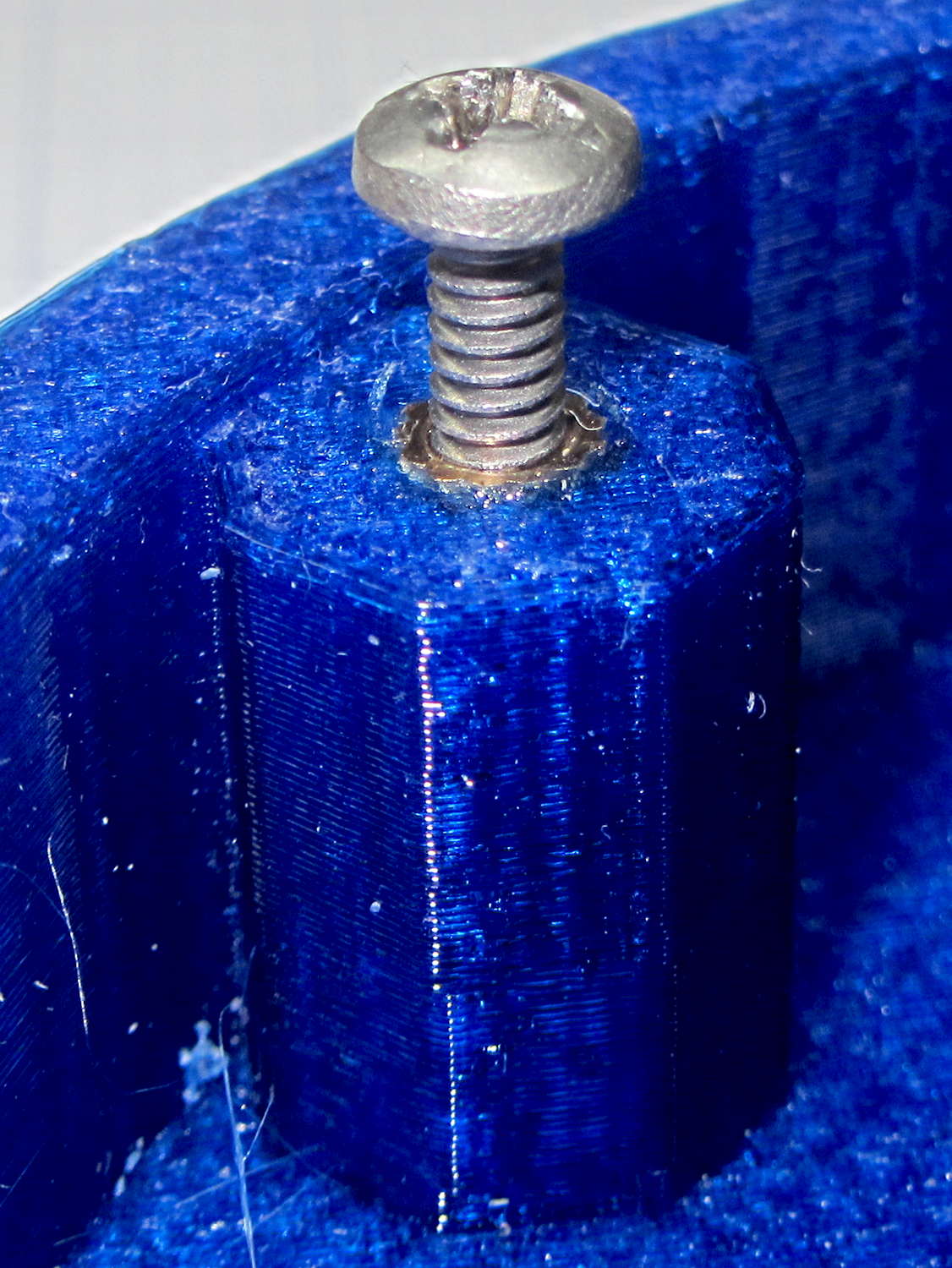
    Tagging along behind the metric inserts, a sack of knurled brass inch-size screw inserts arrived:

    Threaded Inserts - metric and inch
    Threaded Inserts – metric and inch

    The nice stainless steel screws on the right range from 4-40 to 10-32, which suffice for nearly everything I build around here.

    Unlike the splined metric inserts on the left, these inserts have actual knurls and ridges that should hold them firmly in place. The specs give hard-inch dimensions, of course, that (seem to) correspond to the root diameter of the knurls. You can find nice engineering drawings of precise tapered holes (by drilling down into the Heat-Set Inserts for Plastics item on that page), but a few metric measurements of the actual parts on hand should suffice for my simple needs.

    Thread: overall length x small rim OD x (knurl length x larger knurl OD)

    • 4-40: 5.8 x 3.9 x (4.0 x 4.6)
    • 6-32: 7.1 x 4.7 x (4.6 x 5.5)
    • 8-32: 8.1 x 5.5 x (5.9 x 6.3)
    • 10-32: 9.5 x 6.3 x (7.0 x 7.1)

    Rather than fussing with a tapered hole, just punch a cylinder with the small rim OD (to clear the screw) through the part and put a cylinder with the knurl OD x length at the surface.

    Using cylinders without diameter correction will make them slightly undersized for heat bonding. The usual 3D printing tolerances don’t justify anything fussier than that.

    Using PolyCyl diameter correction will make the holes nearly spot on for epoxy bonding: butter ’em up, ram ’em in, pause for curing, done.

    That’s the plan, anyhow…

  • Monthly Image: Frost Growth

    The northeast vent on the well pit grew an ice rim during the same night that frosted the roofing nails:

    Well Pit Vent Frost
    Well Pit Vent Frost

    The other vent remained clear, so the prevailing breeze definitely goes in one hole and out the other:

    Well Pit Vent Frost - inlet
    Well Pit Vent Frost – inlet

    Well Pit Vent Frost – inlet

    A waterproof Hobo datalogger hangs from the string.

  • Self-Cleaning Bird Nest Box

    We celebrate the start of Spring by cleaning the previous season’s nest(s) from our bird boxes, so this “improved” design caught our eye on a walk around the neighborhood:

    Self-cleaning bird nest box
    Self-cleaning bird nest box

    Birds being the way they are, the most recent occupants surely piled more twigs & grass atop their foundation to make the level come out right. An industrious mouse might find a convenient route inside.

  • Autodesk Privacy Statement: “Do Not Track” and Similar Mechanisms

    Autodesk just Borged Netfabb and, in the process of merging their address lists, asked me to update my info and agree to their very detailed Privacy Statement. You should take a look at it; the link will open in a new tab / window / whatever, so you don’t lose your place here.

    Have you noticed how those “statements” always have a very long and firmly fixed line width that doesn’t adapt to your window size, use various shades of light-gray-on-white typefaces in the smallest sizes, and continue for pages and pages. I don’t believe in coincidences, either.

    Here’s what they think of my Do Not Track browser setting (emphasis added):

    “Do not track” and similar mechanisms

    Some web browsers may transmit “do-not-track” signals to websites with which the browser communicates. Because of differences in how web browsers incorporate and activate this feature, it is not always clear whether users intend for these signals to be transmitted, or whether they are even aware of them.

    Participants in the leading Internet standards-setting organization that is addressing this issue are in the process of determining what, if anything, websites should do when they receive such signals. Autodesk currently does not take action in response to these signals. If and when a final standard is established and accepted, we will reassess how to respond to these signals.

    For information about cookies, web beacons and similar technologies, please read our Cookie Policy.

    After plowing through much of their “statement”, I decided Autodesk doesn’t do anything I need to know about and, seeing as how Netfabb gradually faded from my attention when their web service joined Microsoft’s Azure cloud, I declined to “confirm my preferences” and didn’t click the big blue button. I doubt such inaction will remove my email address from their list, but it’s the only choice they offer.

    Because I can’t tell if a website really wants to track me, I block ads, disable Flash, and destroy all cookies when I leave their site, Just In Case they inadvertently deployed all that crap. I’m sure they never intend to serve malware through an ad slot brokered on their site, but mistakes do happen, and I’m glad to assist them.

    If you’re seeing ads on this page right now, they come from WordPress and I get a small cut. You should start using an ad blocker right now; if your browser doesn’t permit you to block ads, change browsers. If you worry that reducing my advertising revenue will compromise the quality and quantity of what you see here, send me a sack of money through Paypal. Fair enough?

    Also: Linux, dammit.

  • Vacuum Tube LEDs: Ersatz Heat Sink Plate Cap

    I wanted a slightly larger “plate cap” to fit a big incandescent bulb and it seemed a fake heatsink might add gravitas to the proceedings:

    Vacuum Tube LEDs - large incandescent bulb
    Vacuum Tube LEDs – large incandescent bulb

    Yeah, that antique ceramic socket holds the bulb at a rakish angle. Worse, even though I painstakingly laid out the position of the heatsink atop the bulb, it’s visibly off-center. Which wouldn’t be so bad, had I not epoxied the damn thing in place.

    After reaming out the M2’s filament drive, the entire blue base printed without incident.

    A closer look at the cap:

    Vacuum Tube LEDs - ersatz heatsink plate cap
    Vacuum Tube LEDs – ersatz heatsink plate cap

    Memo to Self: Next time, line it up with the vertical glass support inside the bulb and ignore the external evidence.

    The boss has a hole for the braid-enclosed cable to the knockoff Neopixel:

    Vacuum Tube Lights - finned cap - Slic3r preview
    Vacuum Tube Lights – finned cap – Slic3r preview

    The cupped surface perfectly fits the bulb’s 3.75 inch diameter. While you wouldn’t mill out a real heatsink, it definitely looks better this way and (alas) gives the epoxy more footprint for a better grip.

    I built the fins with a 1/8 inch cutter in mind, so the fin root radius allows for a G3/G3 arc without gouging. I doubt machining a fake heatsink from aluminum makes any sense, but the cheap extruded heatsinks on eBay don’t look very good. Plus, they sport completely unnecessary tapped holes for LED mounts and suchlike.

    A cross-section shows the wiring channel and cable entry:

    Vacuum Tube Lights - fin cap solid model - section
    Vacuum Tube Lights – fin cap solid model – section

    I epoxied the Neopixel in place, applied double-sided carpet tape to the whole thing, then painstakingly trimmed around the fins with an Xacto knife:

    Vacuum Tube LEDs - Ersatz Heatsink plate cap - tape
    Vacuum Tube LEDs – Ersatz Heatsink plate cap – tape

    That looked better from the top side (where it was completely hidden) and came heartbreakingly close to working, but after about a day the cable + braid put enough torque on the cap to peel it off the bulb. Obviously, the tape holds much less enthusiastically after that.

    Part of the problem came from the cable’s rather sharp angle just outside the cap:

    Vacuum Tube LEDs - Ersatz Heatink plate cap - detail
    Vacuum Tube LEDs – Ersatz Heatink plate cap – detail

    Rakish angle, indeed. Two of ’em, in fact.

    Unlike the smaller cap on the halogen bulb, this time I didn’t bother with a brass tube ferrule, mostly to see how it looks. I think it came out OK and the black braid looks striking in person. Conversely, a touch of brass never detracts from the appearance.

    Obviously, the cable wasn’t long enough, either. Part of that problem came from underestimating the braid length: it shortens dramatically when slipped over the cable, even when you expect shortening. Somehow I managed to overlook that, despite cutting the cable quite long enough, thankyouverymuch. There’s a tradeoff between gentle angles and having the cable stick out too far for comfort.

    Memo to Self: Use a cable at least four inches longer than necessary, measure the combined cable + braid assembly after screwing the bulb in the socket, and don’t epoxy anything before all the parts are ready for assembly.

    That’s why it’s a prototype made out of blue PETG…

    Protip: running old ceramic sockets through the dishwasher greatly simplifies their subsequent cleanup.

    All in all, I like it.

    The OpenSCAD source code as a GitHub gist:

    // Vacuum Tube LED Lights
    // Ed Nisley KE4ZNU January 2016
    Layout = "FinCap"; // Cap LampBase USBPort Socket(s) (Build)FinCap
    Section = true; // cross-section the object
    Support = true;
    //- Extrusion parameters must match reality!
    ThreadThick = 0.25;
    ThreadWidth = 0.40;
    HoleWindage = 0.2;
    Protrusion = 0.1; // make holes end cleanly
    inch = 25.4;
    function IntegerMultiple(Size,Unit) = Unit * ceil(Size / Unit);
    //———————-
    // Dimensions
    // https://en.wikipedia.org/wiki/Tube_socket#Summary_of_Base_Details
    T_NAME = 0; // common name
    T_NUMPINS = 1; // total, with no allowance for keying
    T_PINBCD = 2; // tube pin circle diameter
    T_PINOD = 3; // … diameter
    T_PINLEN = 4; // … length (overestimate)
    T_HOLEOD = 5; // nominal panel hole from various sources
    T_PUNCHOD = 6; // panel hole optimized for inch-size Greenlee punches
    T_TUBEOD = 7; // envelope or base diameter
    T_PIPEOD = 8; // light pipe from LED to tube base
    T_SCREWOC = 9; // mounting screw holes
    // Name pins BCD dia length hole punch env pipe screw
    TubeData = [
    ["Mini7", 8, 9.53, 1.016, 7.0, 16.0, 11/16 * inch, 18.0, 5.0, 22.5],
    ["Octal", 8, 17.45, 2.36, 10.0, 36.2, (8 + 1)/8 * inch, 32.0, 11.5, 39.0],
    ["Noval", 10, 11.89, 1.1016, 7.0, 22.0, 7/8 * inch, 21.0, 5.0, 28.0],
    ["Duodecar", 13, 19.10, 1.05, 9.0, 32.0, 1.25 * inch, 38.0, 12.5, 39.0],
    ];
    ID = 0;
    OD = 1;
    LENGTH = 2;
    Pixel = [7.0,10.0,3.0]; // ID = contact patch, OD = PCB dia, LENGTH = overall thickness
    Nut = [3.5,8.0,3.0]; // socket mounting nut recess
    BaseShim = 2*ThreadThick; // between pin holes and pixel top
    SocketFlange = 2.0; // rim around socket below punchout
    PanelThick = 2.0; // socket extension through punchout
    //———————-
    // Useful routines
    module PolyCyl(Dia,Height,ForceSides=0) { // based on nophead's polyholes
    Sides = (ForceSides != 0) ? ForceSides : (ceil(Dia) + 2);
    FixDia = Dia / cos(180/Sides);
    cylinder(r=(FixDia + HoleWindage)/2,h=Height,$fn=Sides);
    }
    //———————-
    // Tube cap
    CapTube = [4.0,3/16 * inch,10.0]; // brass tube for flying lead to cap LED
    CapSize = [Pixel[ID],(Pixel[OD] + 3.0),(CapTube[OD] + 2*Pixel[LENGTH])];
    CapSides = 6*4;
    module Cap() {
    difference() {
    union() {
    cylinder(d=CapSize[OD],h=(CapSize[LENGTH]),$fn=CapSides); // main cap body
    translate([0,0,CapSize[LENGTH]]) // rounded top
    scale([1.0,1.0,0.65])
    sphere(d=CapSize[OD]/cos(180/CapSides),$fn=CapSides); // cos() fixes slight undersize vs cylinder
    cylinder(d1=(CapSize[OD] + 2*3*ThreadWidth),d2=CapSize[OD],h=1.5*Pixel[LENGTH],$fn=CapSides); // skirt
    }
    translate([0,0,-Protrusion]) // bore for wiring to LED
    PolyCyl(CapSize[ID],(CapSize[LENGTH] + 3*ThreadThick + Protrusion),CapSides);
    translate([0,0,-Protrusion]) // PCB recess with clearance for tube dome
    PolyCyl(Pixel[OD],(1.5*Pixel[LENGTH] + Protrusion),CapSides);
    translate([0,0,(1.5*Pixel[LENGTH] – Protrusion)]) // small step + cone to retain PCB
    cylinder(d1=(Pixel[OD]/cos(180/CapSides)),d2=Pixel[ID],h=(Pixel[LENGTH] + Protrusion),$fn=CapSides);
    translate([0,0,(CapSize[LENGTH] – CapTube[OD]/(2*cos(180/8)))]) // hole for brass tube holding wire loom
    rotate([90,0,0]) rotate(180/8)
    PolyCyl(CapTube[OD],CapSize[OD],8);
    }
    }
    //———————-
    // Heatsink tube cap
    CableOD = 3.5; // cable + braid diameter
    BulbOD = 3.75 * inch; // bulb OD; use 10 inches for flat
    FinCutterOD = 1/8 * inch;
    echo(str("Fin Cutter: ",FinCutterOD));
    FinSides = 2*4;
    FinCapSize = [(Pixel[OD] + 2*FinCutterOD),30.0,(10.0 + 2*Pixel[LENGTH])];
    BulbRadius = BulbOD / 2;
    BulbDepth = BulbRadius – sqrt(pow(BulbRadius,2) – pow(FinCapSize[OD],2)/4);
    echo(str("Bulb OD: ",BulbOD," recess: ",BulbDepth));
    module FinCap() {
    NumFins = floor(PI*FinCapSize[ID] / (2*FinCutterOD));
    FinAngle = 360 / NumFins;
    echo(str("NumFins: ",NumFins," angle: ",FinAngle," deg"));
    difference() {
    union() {
    cylinder(d=FinCapSize[ID],h=FinCapSize[LENGTH],$fn=2*NumFins); // main body
    for (i = [0:NumFins – 1]) // fins
    rotate(i * FinAngle)
    hull() {
    translate([FinCapSize[ID]/2,0,0])
    rotate(180/FinSides)
    cylinder(d=FinCutterOD,h=FinCapSize[LENGTH],$fn=FinSides);
    translate([(FinCapSize[OD] – FinCutterOD)/2,0,0])
    rotate(180/FinSides)
    cylinder(d=FinCutterOD,h=FinCapSize[LENGTH],$fn=FinSides);
    }
    rotate(FinAngle/2) // cable entry boss
    translate([FinCapSize[ID]/2,0,FinCapSize[LENGTH]/2])
    cube([FinCapSize[OD]/4,FinCapSize[OD]/4,FinCapSize[LENGTH]],center=true);
    }
    for (i = [1:NumFins – 1]) // fin inner gullets, omit cable entry side
    rotate(i * FinAngle + FinAngle/2) // joint isn't quite perfect, but OK
    translate([FinCapSize[ID]/2,0,-Protrusion])
    rotate(0*180/FinSides)
    cylinder(d=FinCutterOD/cos(180/FinSides),h=(FinCapSize[LENGTH] + 2*Protrusion),$fn=FinSides);
    translate([0,0,-Protrusion]) // PCB recess
    PolyCyl(Pixel[OD],(1.5*Pixel[LENGTH] + Protrusion),FinSides);
    PolyCyl(Pixel[ID],(FinCapSize[LENGTH] – 3*ThreadThick),FinSides); // bore for LED wiring
    translate([0,0,(FinCapSize[LENGTH] – 3*ThreadThick – 2*CableOD/(2*cos(180/8)))]) // cable inlet
    rotate(FinAngle/2) rotate([0,90,0]) rotate(180/8)
    PolyCyl(CableOD,FinCapSize[OD],8);
    if (BulbOD <= 10.0 * inch) // curve for top of bulb
    translate([0,0,-(BulbRadius – BulbDepth + 2*ThreadThick)]) // … slightly flatten tips
    sphere(d=BulbOD,$fn=16*FinSides);
    }
    }
    //———————-
    // Aperture for USB-to-serial adapter snout
    // These are all magic numbers, of course
    module USBPort() {
    translate([0,28.0])
    rotate([90,0,0])
    linear_extrude(height=28.0)
    polygon(points=[
    [0,0],
    [8.0,0],
    [8.0,4.0],
    // [4.0,4.0],
    [4.0,6.5],
    [-4.0,6.5],
    // [-4.0,4.0],
    [-8.0,4.0],
    [-8.0,0],
    ]);
    }
    //———————-
    // Box for Leviton ceramic lamp base
    module LampBase() {
    Bottom = 3.0;
    Base = [4.0*inch,4.5*inch,20.0 + Bottom];
    Sides = 12*4;
    Retainer = [3.5,11.0,1.0]; // flat fiber washer holding lamp base screws in place
    StudSides = 8;
    StudOC = 3.5 * inch;
    Stud = [0.107 * inch, // 6-32 mounting screws
    min(15.0,1.5*(Base[ID] – StudOC)/cos(180/StudSides)), // OD = big enough to merge with walls
    (Base[LENGTH] – Retainer[LENGTH])]; // leave room for retainer
    union() {
    difference() {
    rotate(180/Sides)
    cylinder(d=Base[OD],h=Base[LENGTH],$fn=Sides);
    rotate(180/Sides)
    translate([0,0,Bottom])
    cylinder(d=Base[ID],h=Base[LENGTH],$fn=Sides);
    translate([0,-Base[OD]/2,Bottom + 1.2]) // mount on double-sided foam tape
    rotate(0)
    USBPort();
    }
    for (i = [-1,1])
    translate([i*StudOC/2,0,0])
    rotate(180/StudSides)
    difference() {
    # cylinder(d=Stud[OD],h=Stud[LENGTH],$fn=StudSides);
    translate([0,0,Bottom])
    PolyCyl(Stud[ID],(Stud[LENGTH] – (Bottom – Protrusion)),6);
    }
    }
    }
    //———————-
    // Tube Socket
    module Socket(Name = "Mini7") {
    NumSides = 6*4;
    Tube = search([Name],TubeData,1,0)[0];
    echo(str("Building ",TubeData[Tube][0]," socket"));
    echo(str(" Punch: ",TubeData[ID][T_PUNCHOD]," mm = ",TubeData[ID][T_PUNCHOD]/inch," inch"));
    echo(str(" Screws: ",TubeData[ID][T_SCREWOC]," mm =",TubeData[ID][T_SCREWOC]/inch," inch OC"));
    OAH = Pixel[LENGTH] + BaseShim + TubeData[Tube][T_PINLEN];
    BaseHeight = OAH – PanelThick;
    difference() {
    union() {
    linear_extrude(height=BaseHeight)
    hull() {
    circle(d=(TubeData[Tube][T_PUNCHOD] + 2*SocketFlange),$fn=NumSides);
    for (i=[-1,1])
    translate([i*TubeData[Tube][T_SCREWOC]/2,0])
    circle(d=2*Nut[OD],$fn=NumSides);
    }
    cylinder(d=TubeData[Tube][T_PUNCHOD],h=OAH,$fn=NumSides);
    }
    for (i=[0:(TubeData[Tube][T_NUMPINS] – 1)]) // tube pins
    rotate(i*360/TubeData[Tube][T_NUMPINS])
    translate([TubeData[Tube][T_PINBCD]/2,0,(OAH – TubeData[Tube][T_PINLEN])])
    rotate(180/4)
    PolyCyl(TubeData[Tube][T_PINOD],(TubeData[Tube][T_PINLEN] + Protrusion),4);
    for (i=[-1,1]) // mounting screw holes & nut traps
    translate([i*TubeData[Tube][T_SCREWOC]/2,0,-Protrusion]) {
    PolyCyl(Nut[OD],(Nut[LENGTH] + Protrusion),6);
    PolyCyl(Nut[ID],(OAH + 2*Protrusion),6);
    }
    translate([0,0,-Protrusion]) { // LED recess
    PolyCyl(Pixel[OD],(Pixel[LENGTH] + Protrusion),8);
    }
    translate([0,0,(Pixel[LENGTH] – Protrusion)]) { // light pipe
    rotate(180/TubeData[Tube][T_NUMPINS])
    PolyCyl(TubeData[Tube][T_PIPEOD],(OAH + 2*Protrusion),TubeData[Tube][T_NUMPINS]);
    }
    }
    // Totally ad-hoc support structures …
    if (Support) {
    color("Yellow") {
    for (i=[-1,1]) // nut traps
    translate([i*TubeData[Tube][T_SCREWOC]/2,0,(Nut[LENGTH] – ThreadThick)/2])
    for (a=[0:5])
    rotate(a*30 + 15)
    cube([2*ThreadWidth,0.9*Nut[OD],(Nut[LENGTH] – ThreadThick)],center=true);
    if (Pixel[OD] > TubeData[Tube][T_PIPEOD]) // support pipe only if needed
    translate([0,0,(Pixel[LENGTH] – ThreadThick)/2])
    for (a=[0:7])
    rotate(a*22.5)
    cube([2*ThreadWidth,0.9*Pixel[OD],(Pixel[LENGTH] – ThreadThick)],center=true);
    }
    }
    }
    //———————-
    // Build it
    if (Layout == "Cap") {
    if (Section)
    difference() {
    Cap();
    translate([-CapSize[OD],0,CapSize[LENGTH]])
    cube([2*CapSize[OD],2*CapSize[OD],3*CapSize[LENGTH]],center=true);
    }
    else
    Cap();
    }
    if (Layout == "FinCap") {
    if (Section) render(convexity=5)
    difference() {
    FinCap();
    // translate([0,-FinCapSize[OD],FinCapSize[LENGTH]])
    // cube([2*FinCapSize[OD],2*FinCapSize[OD],3*FinCapSize[LENGTH]],center=true);
    translate([-FinCapSize[OD],0,FinCapSize[LENGTH]])
    cube([2*FinCapSize[OD],2*FinCapSize[OD],3*FinCapSize[LENGTH]],center=true);
    }
    else
    FinCap();
    }
    if (Layout == "BuildFinCap")
    translate([0,0,FinCapSize[LENGTH]])
    rotate([180,0,0])
    FinCap();
    if (Layout == "LampBase")
    LampBase();
    if (Layout == "USBPort")
    USBPort();
    if (Layout == "Socket")
    if (Section) {
    difference() {
    Socket();
    translate([-100/2,0,-Protrusion])
    cube([100,50,50],center=false);
    }
    }
    else
    Socket();
    if (Layout == "Sockets") {
    translate([0,50,0])
    Socket("Mini7");
    translate([0,20,0])
    Socket("Octal");
    translate([0,-15,0])
    Socket("Duodecar");
    translate([0,-50,0])
    Socket("Noval");
    }