The Smell of Molten Projects in the Morning

Ed Nisley's Blog: Shop notes, electronics, firmware, machinery, 3D printing, laser cuttery, and curiosities. Contents: 100% human thinking, 0% AI slop.

Author: Ed

  • Vacuum Tube Prices, Then and Now

    Quite by coincidence, a Pile o’ Stuff disgorged a 1975 Radio Shack Catalog listing three dense pages of vacuum tubes, including a 21HB5A:

    Radio Shack 1975 Catalog - 21HB5A Tube Listing
    Radio Shack 1975 Catalog – 21HB5A Tube Listing

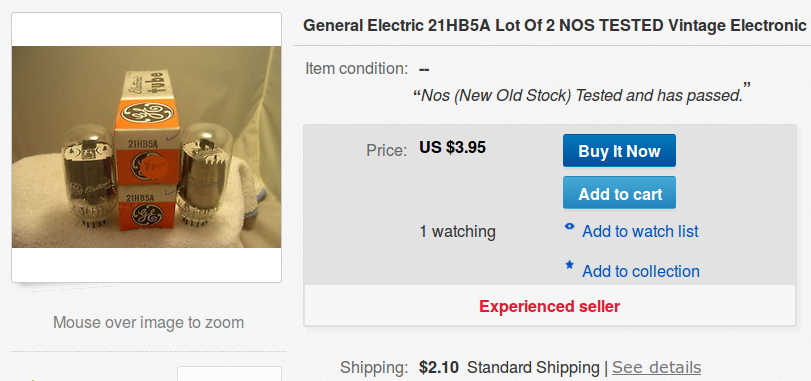
    These days, you buy New Old Stock 21HB5A tubes from eBay for about the same in current dollars with shipping:

    eBay - 21HB5A Tubes
    eBay – 21HB5A Tubes

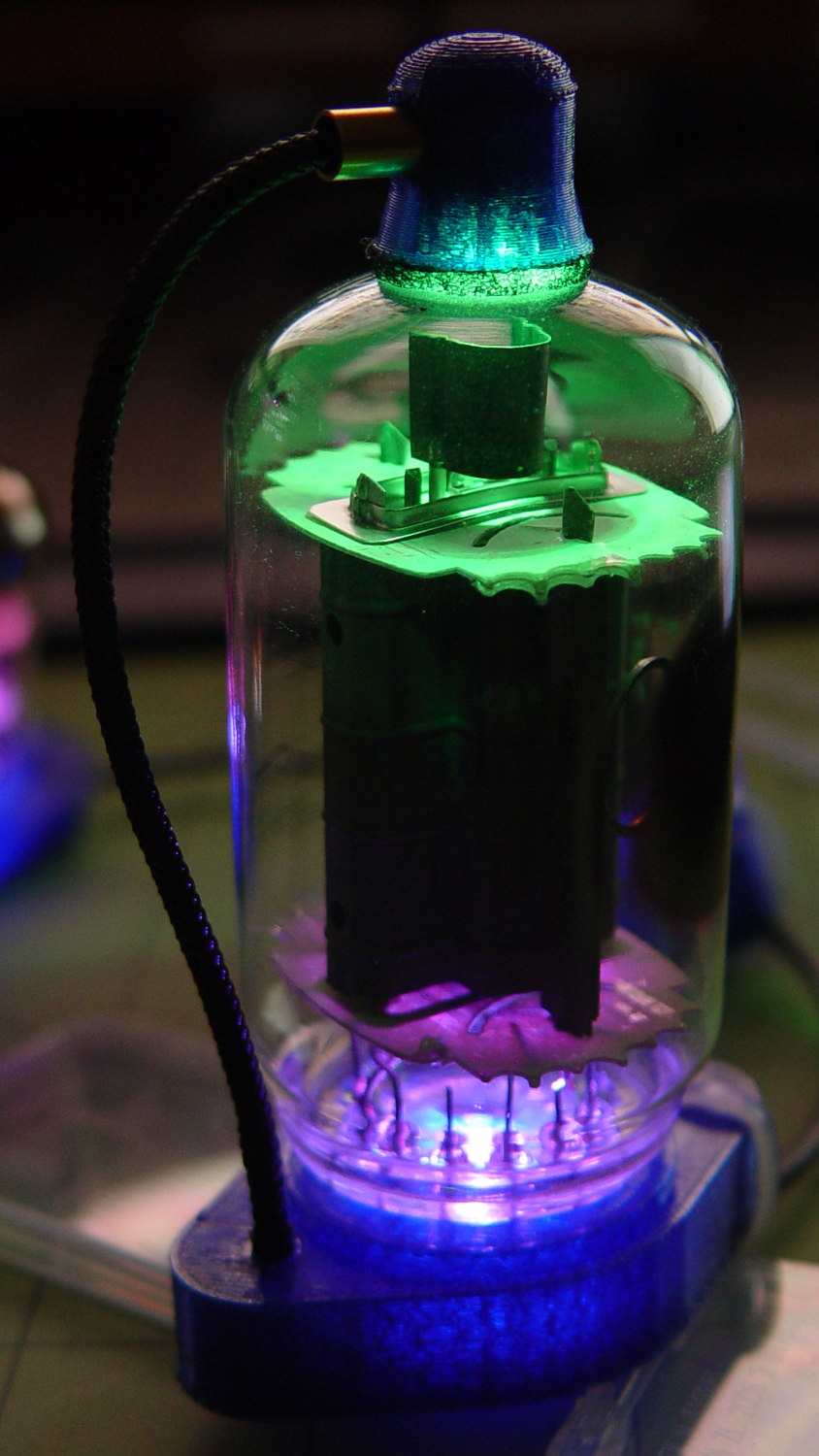
    I should stock up and light up!

    Vacuum Tube LEDs - IBM 21HB5A Beam Power Tube - green violet phase
    Vacuum Tube LEDs – IBM 21HB5A Beam Power Tube – green violet phase


  • Command-Line CD Ripping, Redux

    A slight improvement to my two-step manual CD ripping process, with the intent of avoiding any thoughts about abcde:

    cdparanoia -B -v ; eject cdrom
    

    Ejecting the CD after cdparanoid finishes with it provides a visual cue for the next step.

    Set up the disk number and maximum number of tracks, then unleash lame:

    d=1
    tm=19
    for t in $(seq -w 1 $tm) ; do lame --preset tape --tt "D${d}:T${t}" --ta "Michael Lewis" --tl "The Big Short" --tn "${t}/${tm}" --tg "Audio Book" --add-id3v2 track${t}.cdda.wav D${d}-${t}.mp3 ; done
    rm track*
    

    The $(seq -w 1 $tm) expansion generates a list of zero-filled numbers for the tracks.

    There’s surely a one-liner to extract $tm, the maximum track number, from the track* files, but I’ll leave that for later.

    You can increment the disk number with let "d++" if the ripping goes smoothly. If not, that’s fraught with peril, because you (well, I) will do it once too often.

    Iterate for each CD in the set, washing & primping as needed for good results.

    And that’s that, at least for a while…

  • Streaming Player: Wireless Keypad

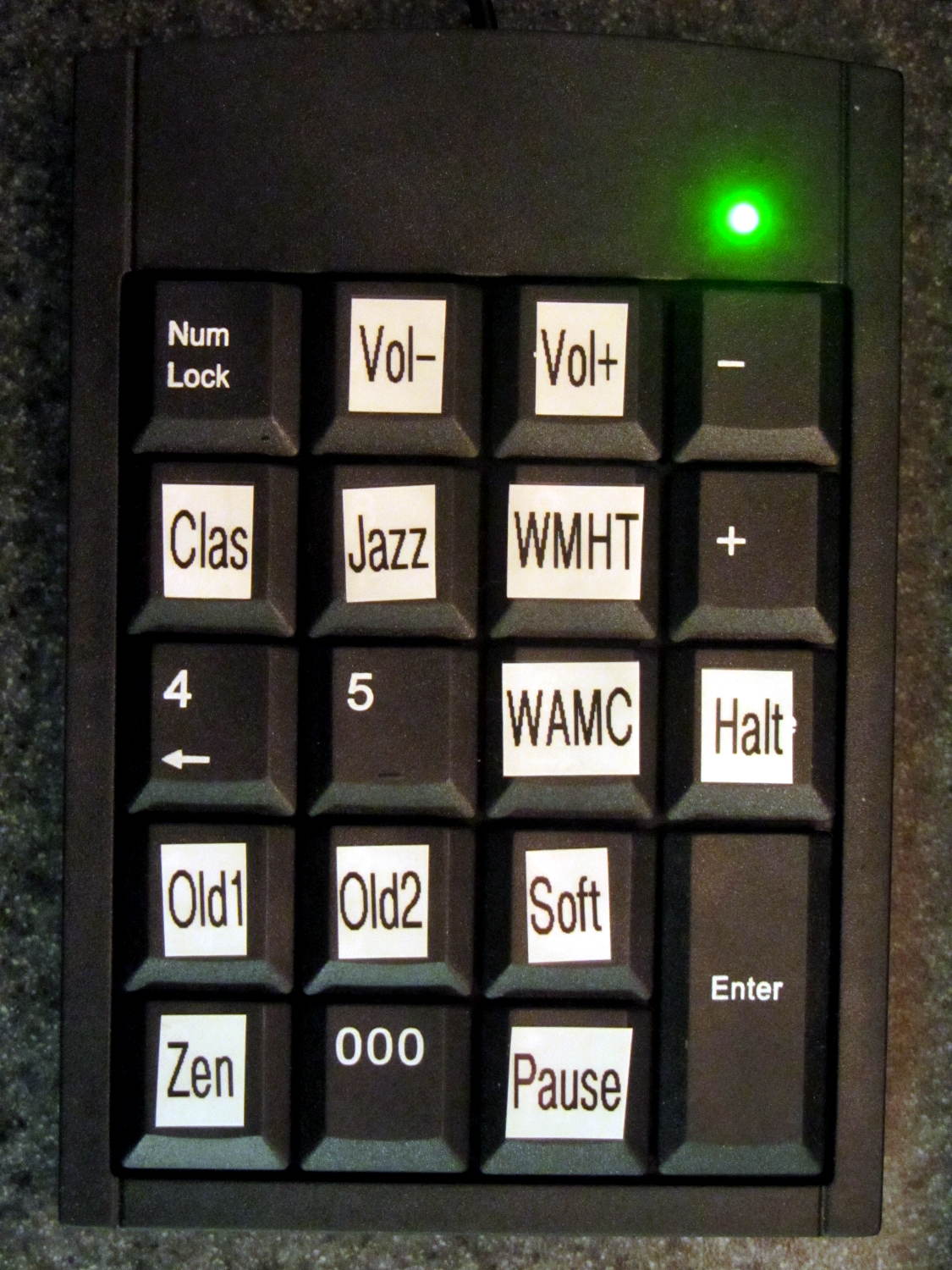
    Moving the streaming media player control panel across the Sewing Room for E-Z access:

    Wireless Keypad - colored labels
    Wireless Keypad – colored labels

    Stipulated: garish labels that don’t fit the keys well at all.

    I need more than one stream for testing; the only one that matters is Classical.

    The keypad uses the same 2.4 GHz ISM band as the Raspberry Pi’s Wifi radio, which means holding a key down (which should never happen) puts a dent in mplayer’s cache fill level. Even absent that interference, the WiFi link seems more than a little iffy, probably because it’s at the far end of the house and upstairs from the router.

    Other WiFi devices report that 2.4 GHz RF has trouble punching through the intervening fifty feet of hardwood floor (on the diagonal, the joists amount to a lot of wood) and multiple sets of doubled wallboard sheets; the RPi probably needs a better radio with an actual antenna. I did move the WiFi control channel away from the default used by the (relatively distant) neighbors, which seemed to improve its disposition.

  • Raspberry Pi Streaming Radio Player: Minimum Viable Product

    With the numeric keypad producing events, and the USB audio box producing sound, the next steps involve starting mplayer through Python’s subprocess interface and feeding keystrokes into it.

    There’s not much to it:

    As much hardware doc as you need:

    RPi Streaming Player - first lashup
    RPi Streaming Player – first lashup

    The green plug leads off to a set of decent-quality PC speakers with far more bass drive than seems absolutely necessary in this context. The usual eBay vendor bungled an order for the adapter between the RCA line-out jacks and the 3.5 mm plug that will avoid driving the speakers from the UCA202’s headphone monitor output; I doubt that will make any audible difference. If you need an adapter with XLR female to 1/4 inch mono, let me know…

    The keypad labels provide all the UI documentation there is:

    Numeric Keypad - stream labels
    Numeric Keypad – stream labels

    The Python source code as a GitHub Gist:

    from evdev import InputDevice,ecodes,KeyEvent
    import subprocess32
    Media = {'KEY_KP7' : ['mplayer','http://relay.publicdomainproject.org:80/classical.aac'%5D,
    'KEY_KP8' : ['mplayer','http://relay.publicdomainproject.org:80/jazz_swing.aac'%5D,
    'KEY_KP9' : ['mplayer','http://live.str3am.com:2070/wmht1'%5D,
    'KEY_KP6' : ['mplayer','http://pubint.ic.llnwd.net/stream/pubint_wamc'%5D,
    'KEY_KP1' : ['mplayer','-playlist','http://dir.xiph.org/listen/5423257/listen.m3u'%5D,
    'KEY_KP2' : ['mplayer','-playlist','http://dir.xiph.org/listen/5197460/listen.m3u'%5D,
    'KEY_KP3' : ['mplayer','-playlist','http://dir.xiph.org/listen/5372471/listen.m3u'%5D,
    'KEY_KP0' : ['mplayer','-playlist','http://dir.xiph.org/listen/5420157/listen.m3u'%5D
    }
    Controls = {'KEY_KPSLASH' : '/',
    'KEY_KPASTERISK' : '*',
    'KEY_KPDOT' : ' '
    }
    k=InputDevice('/dev/input/keypad')
    print 'Starting mplayer'
    p = subprocess32.Popen(Media['KEY_KP7'],stdin=subprocess32.PIPE)
    print ' … running'
    for e in k.read_loop():
    if (e.type == ecodes.EV_KEY) and (KeyEvent(e).keystate == 1):
    kc = KeyEvent(e).keycode
    if kc == 'KEY_NUMLOCK':
    continue
    print "Got: ",kc
    if kc == 'KEY_BACKSPACE':
    print 'Backspace = shutdown!'
    p = subprocess32.call(['sudo','halt'])
    break
    if kc in Controls:
    print 'Control:', kc
    p.stdin.write(Controls[kc])
    if kc in Media:
    print 'Switching stream to ',Media[kc]
    print ' … halting'
    p.communicate(input='q')
    print ' … restarting'
    p = subprocess32.Popen(Media[kc],stdin=subprocess32.PIPE)
    print ' … running'
    print "Out of loop!"

    The Media dictionary relates keycodes with the command line parameters required to fire mplayer at the streaming stations. With that running, the Controls dictionary turns keycodes into mplayer keyboard controls.

    There’s no display: you have no idea what’s going on. I must start the program manually through an ssh session and can watch mplayer‘s console output.

    Poking the Halt button forcibly halts the RPi, after which you squeeze the Reset button to reboot the thing. There’s no indication that it’s running, other than sound coming out of the speakers, and no way to tell it fell of the rails other than through the ssh session.

    The loop blocks on events, so it can’t also extract stream titles from the (not yet implemented) mplayer stdout pipe / file and paste them on the (missing) display; that’s gotta go.

    There’s a lot not to like about all that, of course, but it’s in the tradition of getting something working to discover how it fails and, in this case, how it sounds, which is even more important.

  • Raspberry Pi: USB Keypad Via evdev

    The general idea is to use keystrokes plucked from a cheap numeric keypad to control mplayer, with the intent of replacing some defunct CD players and radios and suchlike. The keypads look about like you’d expect:

    Numeric keypads
    Numeric keypads

    The keypad layouts are, of course, slightly different (19 vs 18 keys!) and they behave differently with regard to their NumLock state, but at least they produce the same scancodes for the corresponding keys. The black (wired) keypad has a 000 button that sends three 0 events in quick succession, which isn’t particularly useful in this application.

    With the appropriate udev rule in full effect, this Python program chews its way through incoming events and reports only the key-down events that will eventually be useful:

    from evdev import InputDevice,ecodes,KeyEvent
    k=InputDevice('/dev/input/keypad')
    for e in k.read_loop():
    if (e.type == ecodes.EV_KEY) and (KeyEvent(e).keystate == 1):
    if (KeyEvent(e).keycode == 'KEY_NUMLOCK'):
    continue # we don't care about the NumLock state
    else:
    print KeyEvent(e).scancode, KeyEvent(e).keycode

    Pressing the keys on the white keypad in an obvious sequence produces the expected result:

    82 KEY_KP0
    79 KEY_KP1
    80 KEY_KP2
    81 KEY_KP3
    75 KEY_KP4
    76 KEY_KP5
    77 KEY_KP6
    71 KEY_KP7
    72 KEY_KP8
    73 KEY_KP9
    98 KEY_KPSLASH
    55 KEY_KPASTERISK
    14 KEY_BACKSPACE
    74 KEY_KPMINUS
    78 KEY_KPPLUS
    96 KEY_KPENTER
    83 KEY_KPDOT
    

    Observations

    • KeyEvent(e).keycode is a string: 'KEY_KP0'
    • e.type is numeric, so just compare against evcodes.EV_KEY
    • KeyEvent(e).scancode is the numeric key identifier
    • KeyEvent(e).keystate = 1 for the initial press
    • Those KeyEvent(e).key_down/up/hold values don’t change

    If you can type KEY_KP0 correctly, wrapping it in quotes isn’t such a big stretch, so I don’t see much point to running scancodes through ecodes.KEY[KeyEvent(e).scancode] just to compare the enumerations.

    I’m surely missing something Pythonic, but I don’t get the point of attaching key_down/up/hold constants to the key event class. I suppose that accounts for changed numeric values inside inherited classes, but … sheesh.

    Anyhow, that loop looks like a good starting point.

  • Makerspace Starter Kit Available

    For a variety of reasons that aren’t relevant here, I must dramatically reduce the amount of stuff in the Basement Laboratory / Machine Shop / Warehouse.

    If you (or someone you know) has / is starting / will start a makerspace or similar organization, here’s an opportunity to go from zero to hero with a huge infusion of tools / instruments / make-froms / raw material / gadgets / surplus gear.

    Think of it as a Makerspace Starter Kit: everything you need in one acquisition.

    You’ve seen much of the stuff in these blog posts during the past five years, although I tightly crop the photos for reasons that should be obvious when you consider the backgrounds.

    A few glimpses, carefully chosen to make the situation look much tidier than it really is:

    This slideshow requires JavaScript.

    I’m not a hoarder, but I can look right over the fence into that territory…

    I want to donate the whole collection to an organization that can figure out how to value it and let me write it off. Failing that, I’m willing to sell the whole collection to someone who will move it out and enjoy it / put it to good use / part it out / hoard it.

    We can quibble over the value, which surely lies between scrap metal and filet mignon.

    As nearly as I can estimate from our last two moves, I have 6±2 short tons of stuff:

    • Metal shop: old South Bend lathe / vertical mill-drill / bandsaw / hand tools / arbor press
    • Cabinets / shelves loaded with cutters / tools / micrometers / calipers / whatever
    • Gas & electric welding equipment, gas foundry furnace
    • Walls / bins / drawers of fasteners / wire nuts / plumbing fittings / pipe clamps / you-name-its
    • Bookshelves of references / magazines / databooks; I’ll keep at most one set of the magazines with my columns
    • Ham radio equipment / antennas / cables
    • Radial saw, blades, clamps, tooling, and a lumber / plywood stockpile
    • Labeled boxes of make-froms on steel shelving; you get the shelves, the boxes, and their contents.
    • Solvents, chemicals, metals, minerals, elements, etc.
    • Electronic / optical / mechanical surplus & doodads
    • Stockpiles of metal rods / pipes / beams / flanges / sheets / scrap parts
    • Tools & toys & treasures beyond your wildest imagination

    When we left Raleigh, the moving company estimator observed “This will be like moving a Home Depot!”

    You must take everything, which means you must have the ability & equipment to handle 6±2 tons of stuff in relatively small, rather heavy, not easily stackable lumps. You’ll need 1000+ square feet of space with at least a seven-foot ceiling on your end to unload the truck(s) and create a solid block of stuff with skinny aisles between the shelves. This is not a quick afternoon trip for you, your BFF, a pickup truck, and a storage unit.

    I plan to keep the Sherline, the M2 3D printer, various small tools, some hardware / parts / stock, most of the electronic instruments (antique-ish, at best) and components, plus odds and ends. I’ll extract or clearly mark those items, leaving your team to move everything else without (too many) on-the-fly decisions.

    I can provide photos and descriptions, but, realistically, you should evaluate the situation in person.

    Although we’re not planning to move in the near future, if you’re thinking of moving into the Mid Hudson Valley and always wanted a house with a ready-to-run Basement Shop, we can probably work something out. Note: all of the online real estate descriptions, including Zillow, seem confused, as the two houses on our two-acre property contain the total square footage / rooms / baths / whatever. Contact us for the Ground Truth after you’ve contemplated the satellite view.

    As the saying goes, “Serious inquiries only.”

  • Adaptek AVA-2902E/I SCSI Card: Low Profile Bracket Hack

    I picked up an Adaptek AVA-2902 SCSI card from eBay to use with an ancient Epson Perfection 636 SCSI scanner from the heap, but it came with a high-profile bracket wrapped around its DB-25 connector:

    SCSI card bracket fix - before
    SCSI card bracket fix – before

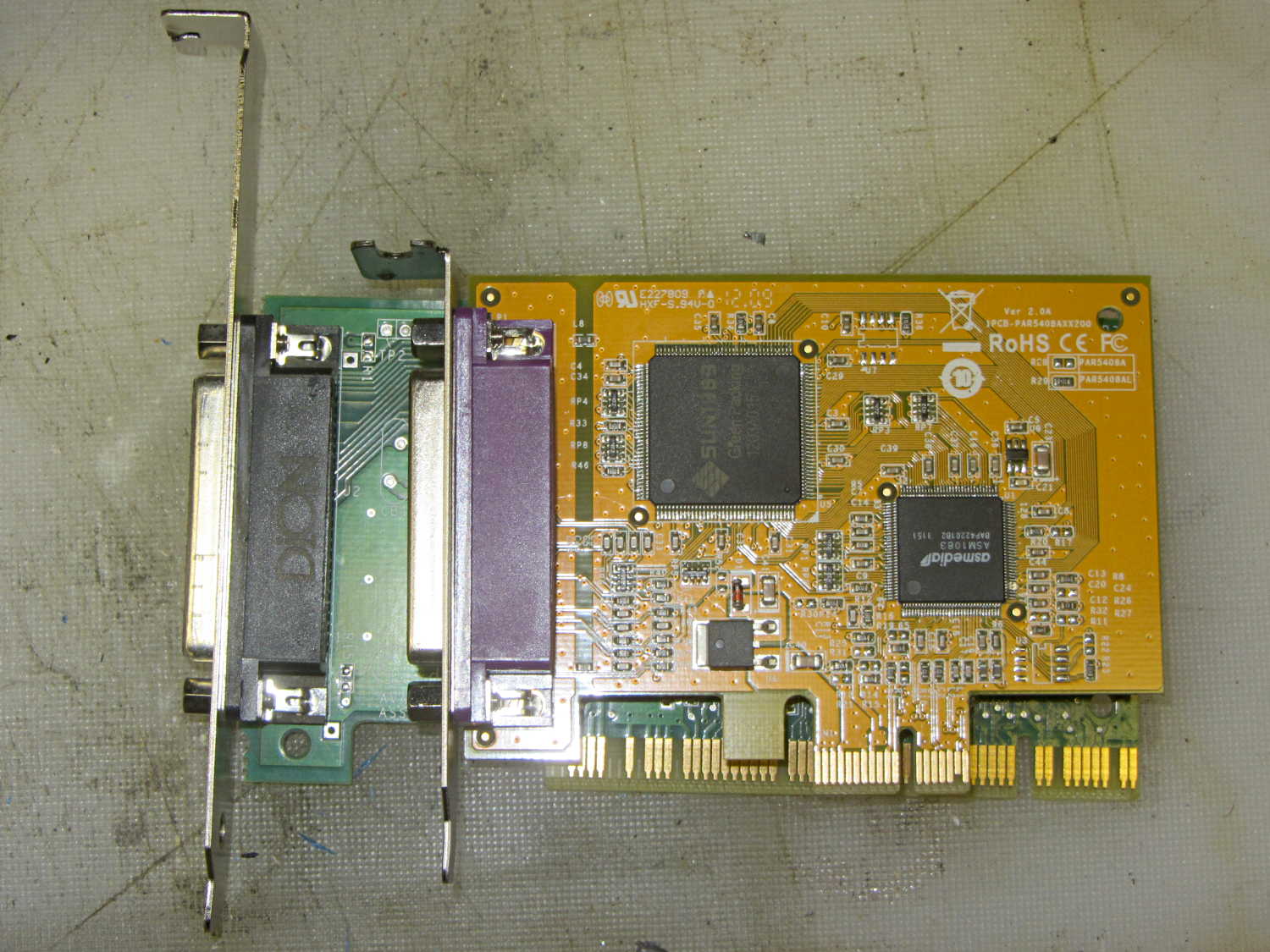
    The old-school serial port card sitting atop it (from one of the off-lease Optiplexes in the stable) has a low-profile bracket that seemed promising, so I swapped the brackets.

    Alas, the SCSI card positioned the DB-25 just a smidge higher than the serial card, putting the right-angle top of the bracket about 2 mm above the ledge, where it prevented the locking cover from engaging. I filed the bracket’s DB-25 mounting holes into ovals, using up all the slop around the connector shell, to no avail.

    So I snipped off most of the bracket’s top, grabbed it in the bench vise, smashed the corner with a drift punch, and bashed the whole affair 2 mm lower. It fit reasonably well, although there’s an air gap near the bottom of the bracket where it tapers down to the guide slot. The SCSI connector barely fit, with some persuasion, under the locking cover:

    SCSI card bracket fix - installed
    SCSI card bracket fix – installed

    Close enough for me; the scanner (looming over the SCSI connector) works fine and delivers much better image quality / color balance than the crappy HP 7400C with an auto-feeder that I’d been using.

    SCSI cables look like gas pipes in this day & age of tiny USB cables and teensy HDMI connectors