The Smell of Molten Projects in the Morning

Ed Nisley's Blog: Shop notes, electronics, firmware, machinery, 3D printing, laser cuttery, and curiosities. Contents: 100% human thinking, 0% AI slop.

Author: Ed

  • Everybody Wants to be a Star

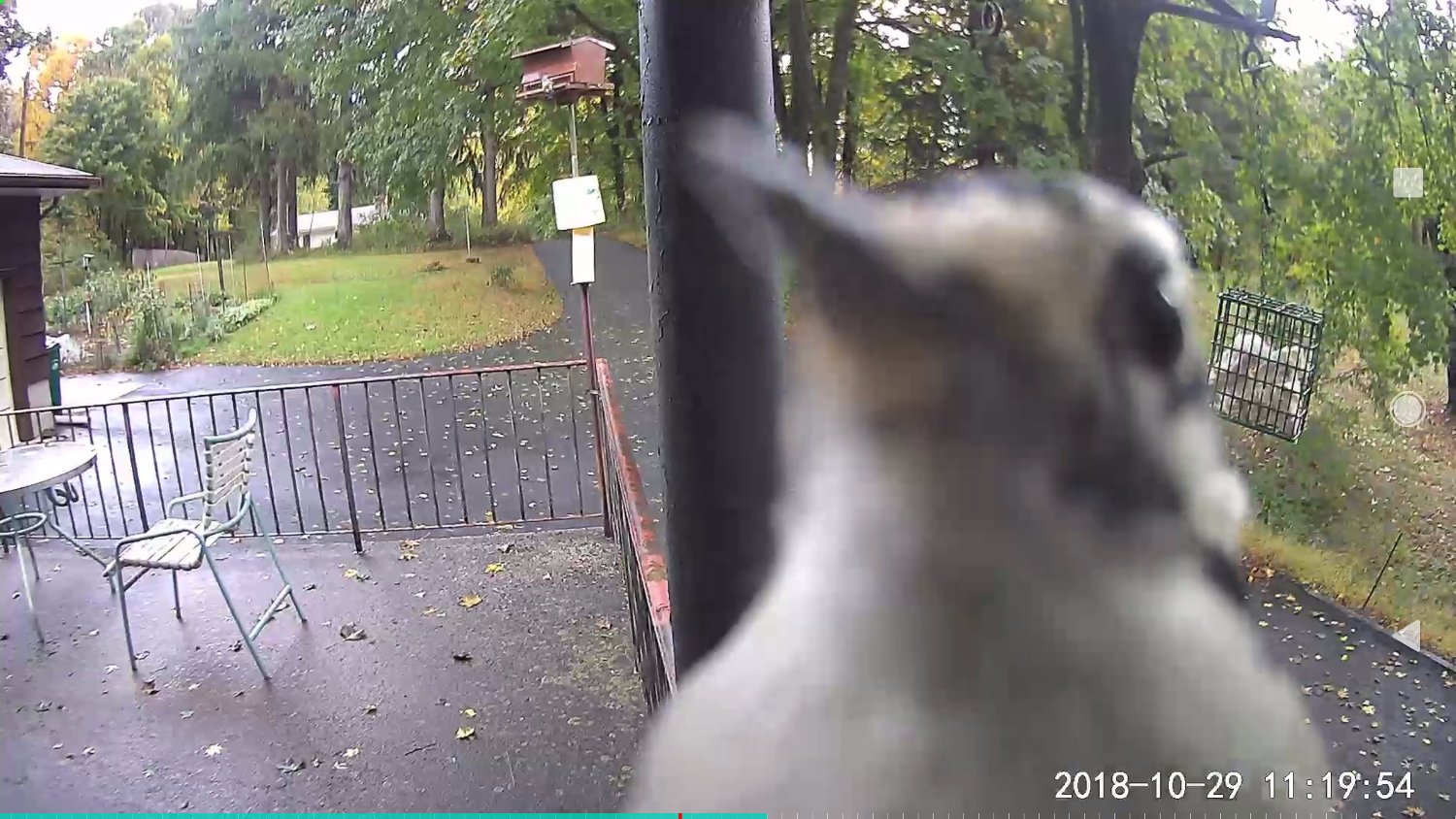
    The Wzye Pan camera overlooking the bird feeders attracted the attention of a Downy Woodpecker:
     

    Screenshot_20181029-112307 - Downy Woodpecker at the Pan
    Screenshot_20181029-112307 – Downy Woodpecker at the Pan

    The camera sits on a “guest” branch of the house network, fenced off from the rest of the devices, because Pi-Hole showed it relentlessly nattering with its Chinese servers:

    Blocked Domains - Wyze iotcplatform
    Blocked Domains – Wyze iotcplatform

    In round numbers, the Pan camera tried to reach those (blocked) iotcplatform domains every 30 seconds around the clock, using a (permitted) google.com lookup to check Internet connectivity. Pi-Hole supplied the latter from its cache and squelched the former, but enough is enough.

    I haven’t tested for traffic to hardcoded dotted-quad IP addresses not requiring DNS lookups through the Pi-Hole. Scuttlebutt suggests the camera firmware includes binary blobs from the baseline Xaiomi/Dafang cameras, so there’s no telling what’s going on in there.

    The Xiaomi-Dafang Hacks firmware doesn’t phone home to anybody, but requires router port forwarding and a compatible RTSP client on the remote end. Isolating it from the rest of the LAN must suffice until I can work out that mess; I assume the camera has already made my WiFi passwords public knowledge.

  • Badger Propel Air Fittings: DIY Cork Washers

    The tiny sandblaster turns out to be a Badger 260 with miniature Propel threaded fittings on the air line:

    Badger Propel air fitting - DIY cork washers
    Badger Propel air fitting – DIY cork washers

    Foreseeing a Propel washer getting lost in the confusion, I punched a few from a cork sheet and trimmed them to half-thickness. The little brass hole punch isn’t good for more than a few whacks, but that’s all I needed. My cork is crumblier than theirs, but I got a few decent-looking washers and, with a bit of luck, won’t need any of them.

    Maybe I should make a soft gasket from a thin plastic sheet?

  • Monthly Science: End of the Cheese Slicer Epoxy Coating

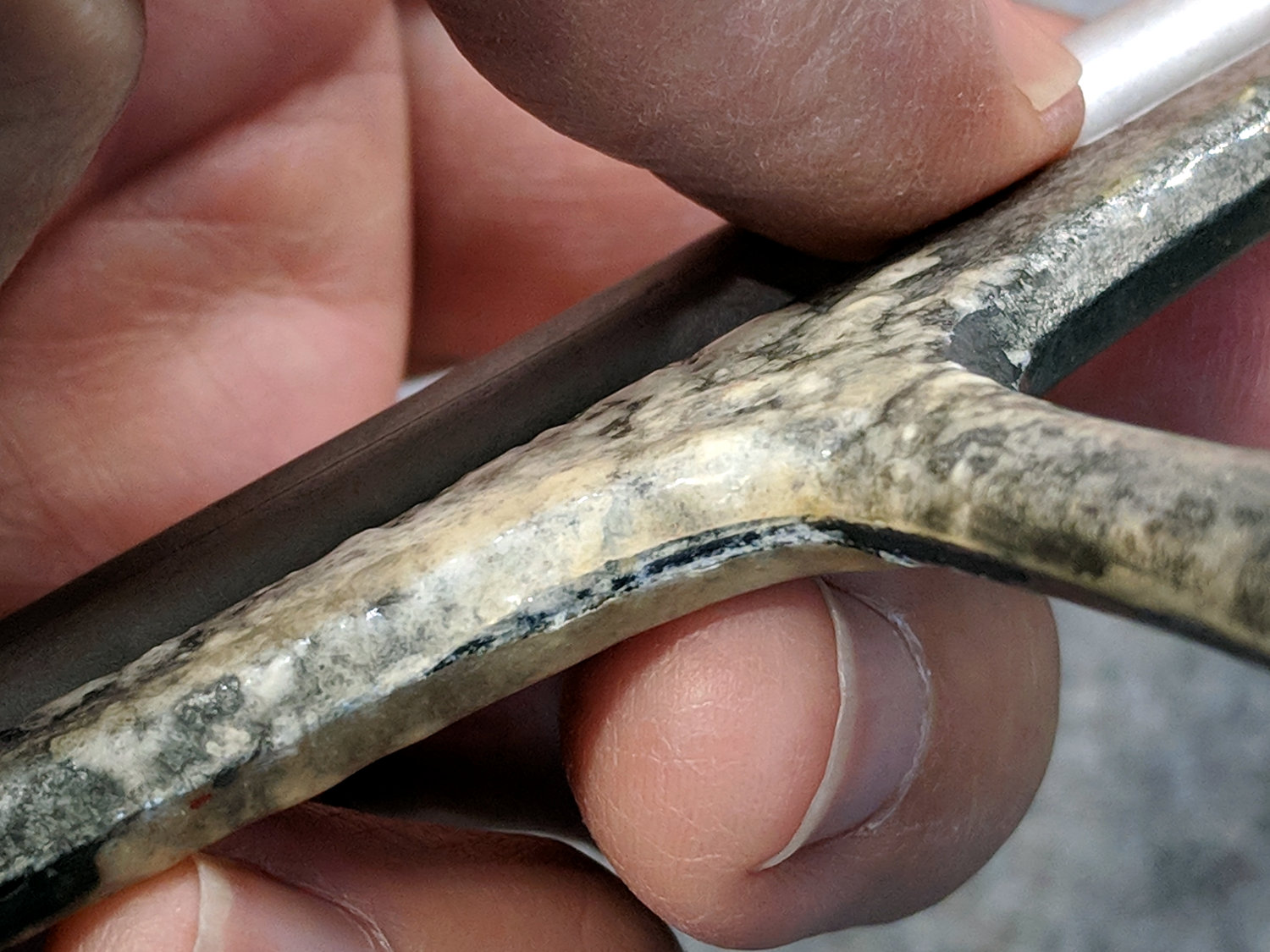
    The corrosion growing on our long-suffering cheese slicer finally ruptured its epoxy coating:

    Cheese Slicer - epoxy coating split
    Cheese Slicer – epoxy coating split

    Most of the epoxy remains in good shape, but it’s obviously not the right hammer for this job.

    Having recently spotted my tiny sandblaster, I think I can clear off the corrosion and epoxy well enough to try again with good old JB Weld epoxy. It’s not rated for underwater use, so I don’t expect long-term goodness, but it’ll be an interesting comparison.

    Bonus: the slicer will start with a uniform gray surface!


  • MPCNC Vinyl Cutting: Squidwrench Logo

    The Mighty Thor provided the new-ish Squidwrench logo in various digital formats, not including DXF, but dxf2gcode can process PDF files (and a few others), and the cutting / weeding / transfer ended well:

    MPCNC Vinyl Cutting - Squidwrench logo on mug
    MPCNC Vinyl Cutting – Squidwrench logo on mug

    That’s the same 14 mil gold vinyl you saw in the Crown test.

    Alas, I re-covered the pattern with the transfer film when I ran the mug through the dishwasher, in the mistaken belief the film would protect the vinyl. Come to find out the film adheres better to the vinyl than to the mug: it pulled loose during washing and peeled most of the logo off the mug.

    Setting the drag knife to cut hot pink 9 mil = 0.25 mm vinyl film produced another logo:

    SqWr logo - hot pink
    SqWr logo – hot pink

    It’s now survived several trips through the dishwasher with no protection, so I’ll call it a win.

    I set dxf2gcode to use a cutting depth = 1.0 mm for about 400 g of downforce, which seems to work, although the vinyl surface showed some marks from the flat nose around the drag knife blade.

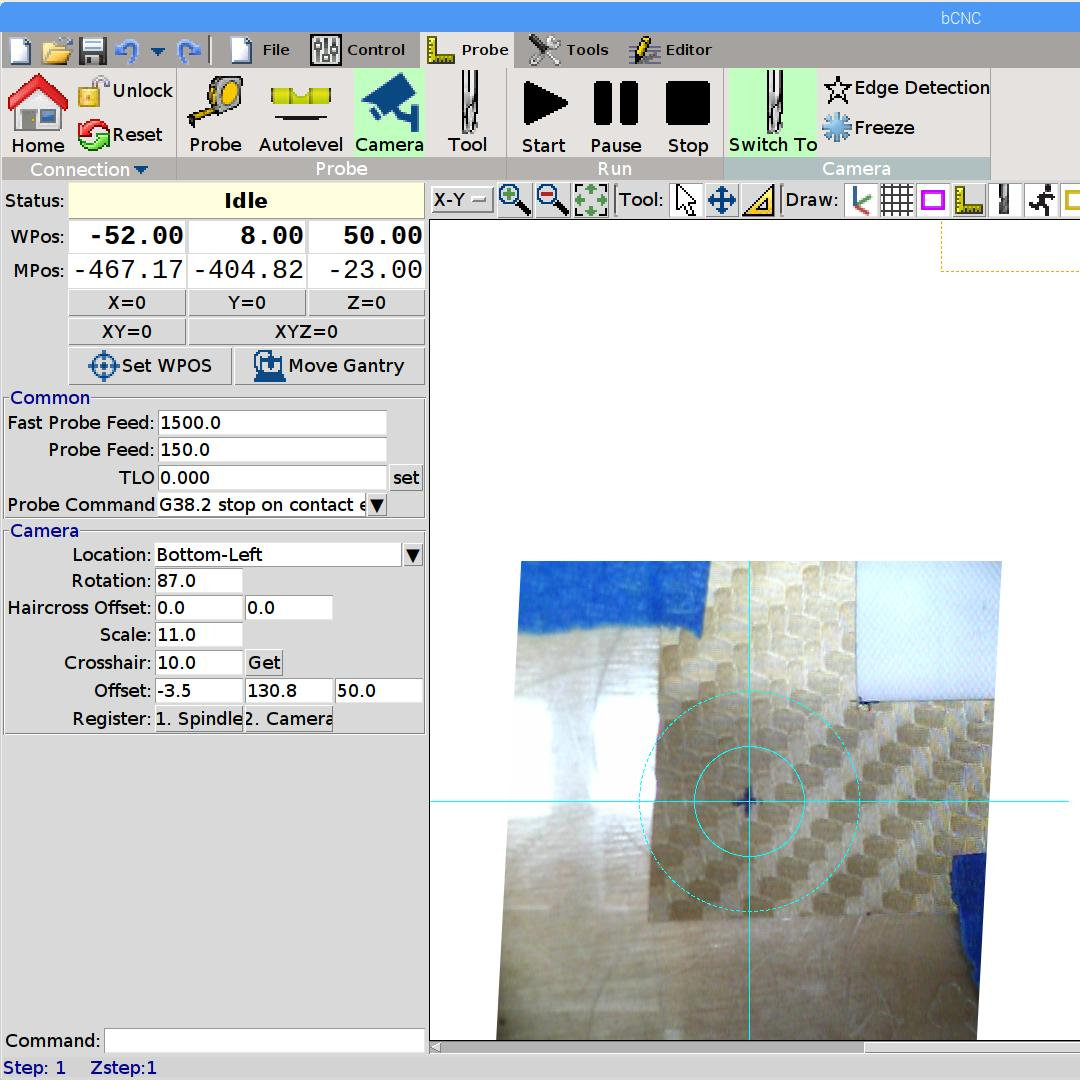
    The USB camera provides a convenient way to set the “workpiece origin” before cutting:

    bCNC - Video align
    bCNC – Video align

    Because the camera sits 130 mm beyond the blade in the +Y direction, it can’t see the swathe along the front of the MPCNC. Hard and soft limits in bCNC / GRBL keep you (well, me) from smashing the gantry into the rails, but it’s a nuisance when you forget to tape the vinyl far enough from the front.

  • MPCNC Vinyl Cutting: First Cuts

    It somehow seemed appropriate to use the standard MPCNC Crown drawing for the first vinyl cutting test:

    0102
    0102

    That’s a PNG converted from the SVG original, because WordPress regards SVG and DXF files as security risks.

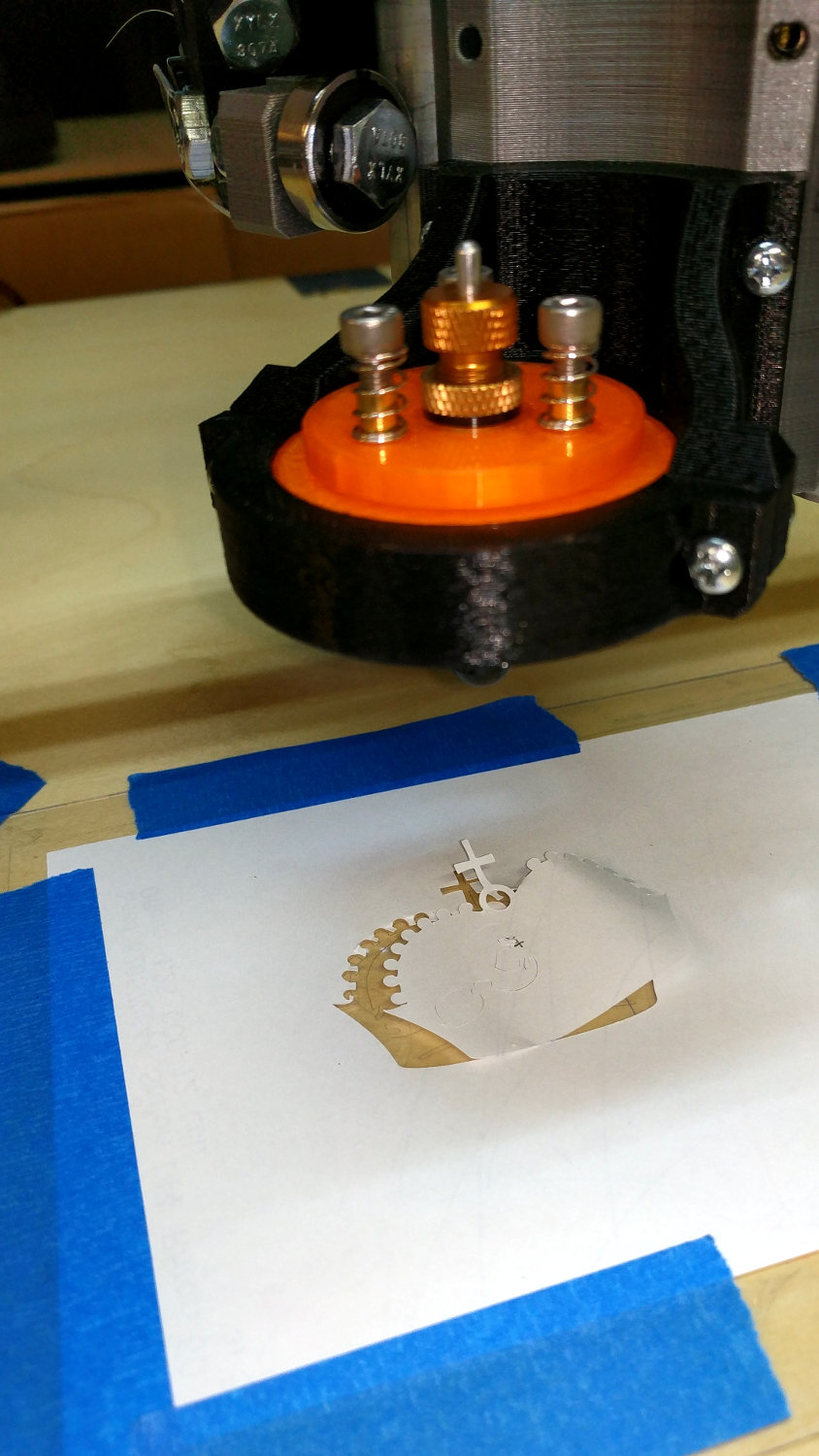
    Run the DXF through dxf2gcode (from the Ubuntu repository) to produce G-Code suitable for my MPCNC’s GRBL controller, tape a sheet of paper to a sacrificial acrylic sheet, fire up bCNC, set the origins, and run the G-Code:

    First Paper Crown - test cut
    First Paper Crown – test cut

    As expected, the cut paper pulled off the acrylic, because it’s not glued down; I have some Cricut adhesive cutting mats which are definitely in the nature of fine tuning. In any event, the paper showed I could get from a DXF image to drag knife cutting action.

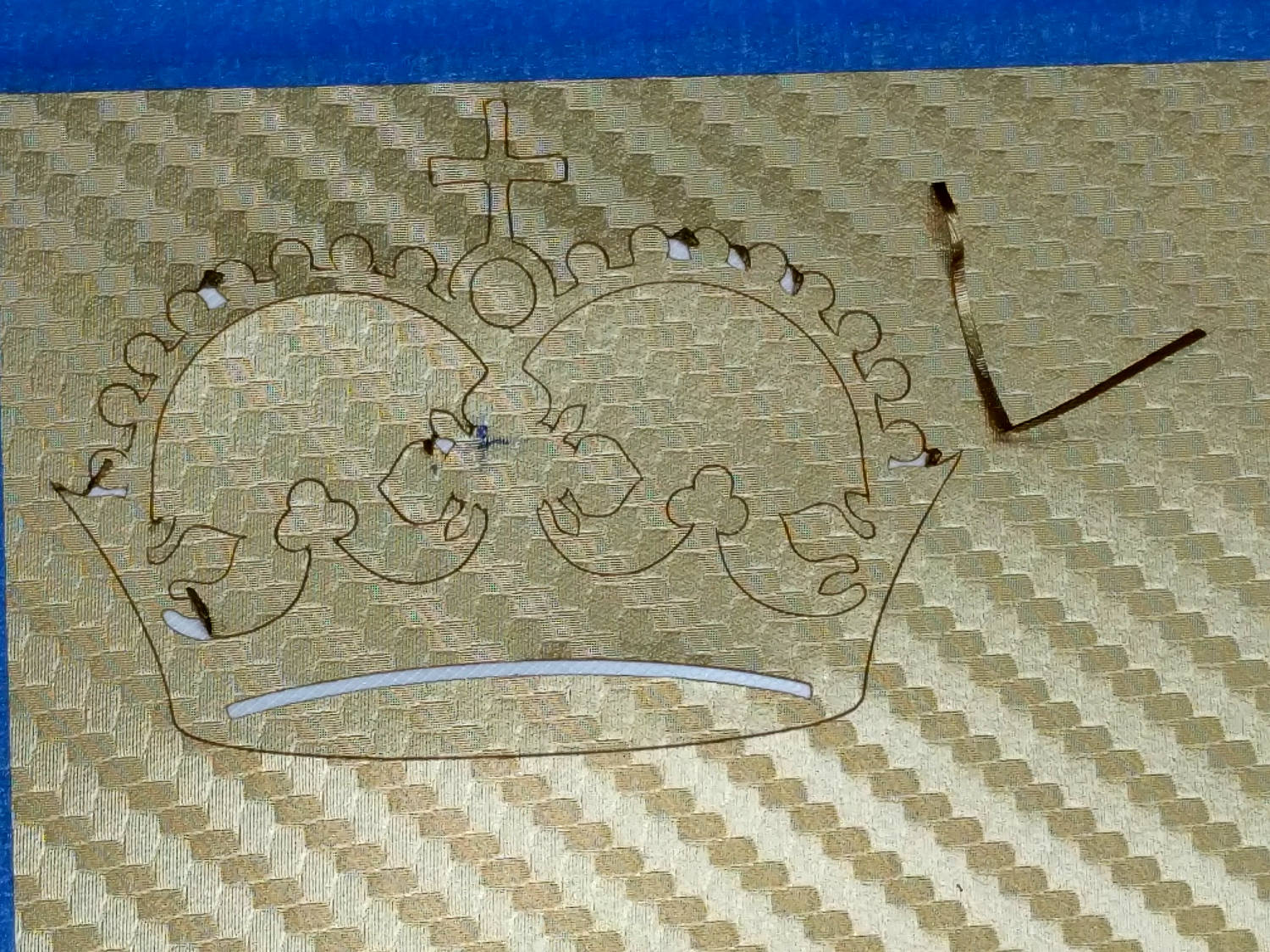
    This being a crown, gaudy gold vinyl seemed appropriate:

    First Vinyl Crown - weeding
    First Vinyl Crown – weeding

    The weeding process removes everything that’s not the crown; I used a razor knife to cut a square and remove the vinyl around the crown. A good needle-nose tweezer works wonders!

    Apply transfer film to the weeded crown and peel it from its backing paper:

    First Vinyl Crown - transfer film
    First Vinyl Crown – transfer film

    Stick it on something desperately in need of decoration and peel off the transfer film:

    MPCNC Vinyl Cutting - crown on mug
    MPCNC Vinyl Cutting – crown on mug

    The tricky part is setting the drag knife cutting depth to match the vinyl sheet thickness (14 mil = 0.36 mm), so the blade cuts the vinyl without cutting through the backing paper. This seems best done with manual trial cuts on scrap vinyl, pressing the drag knife holder down firmly by hand and tweaking the depth adjustment for a clean cut.

    The G-Code cuts at 400 mm/min = 6.7 mm/s, perhaps a bit on the slow side.

  • 2N3904 and 2N3906 Transistor Assortments: Consistency Thereof

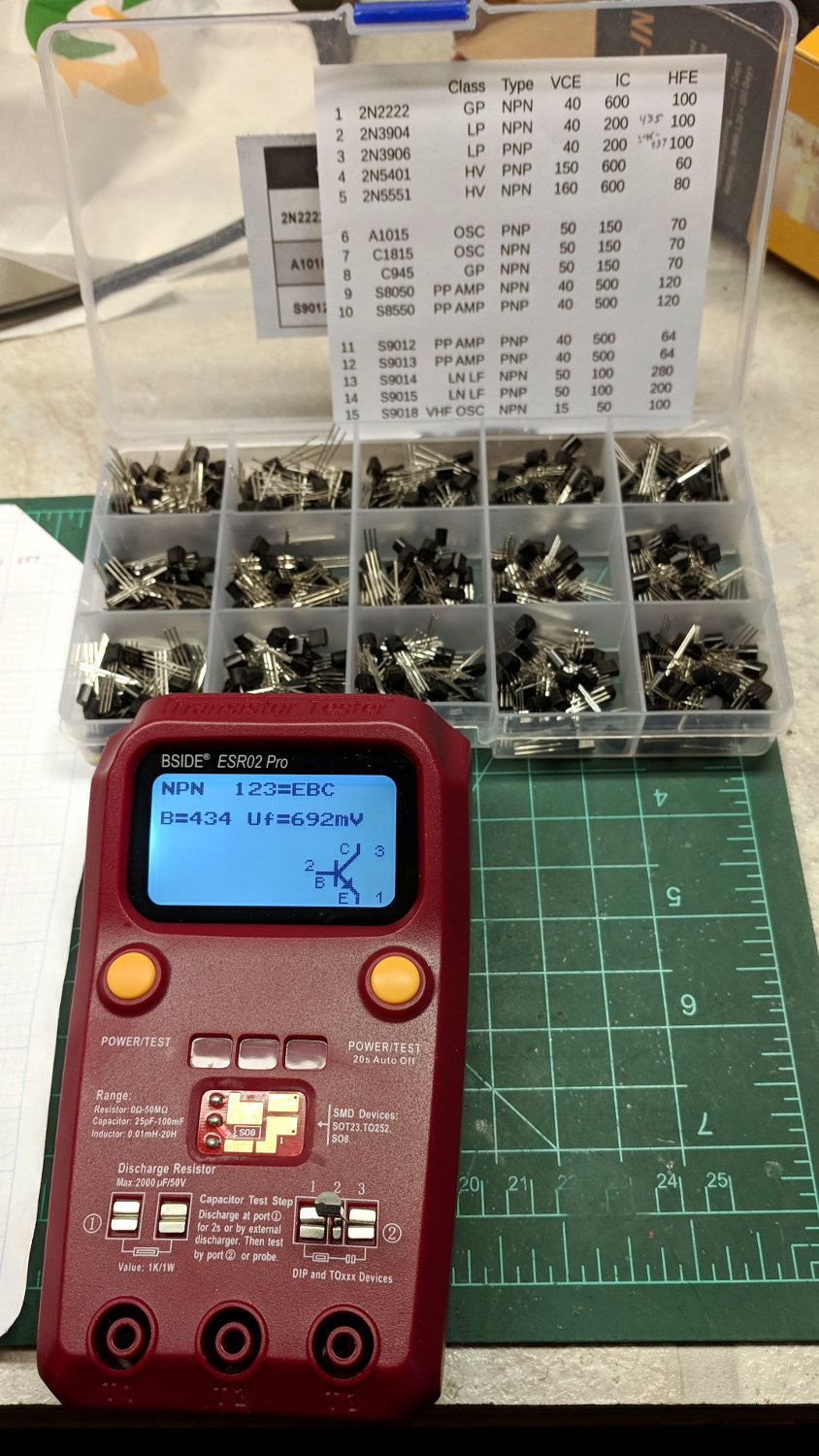
    A note about building a discrete equivalent of the classic LM3909 prompted me to measure some 2N3904 and 2N3906 transistors:

    ESR02 Tester - 2N3904 measurement
    ESR02 Tester – 2N3904 measurement

    The DC gain and VBE for each flavor look comfortingly uniform:

    Transistor measurements - 2N3904 2N3906
    Transistor measurements – 2N3904 2N3906

    Quite unlike those Hall effect sensors, indeed.

    Most of the VBE variation comes from temperature differences: re-measuring the 2N3904 transistors with VBE ≅ 672 mV put them with their compadres at 677 mV.

    The 2N3906 transistors have wider gain and VBE variations, so selecting a matched pair for the LM3909 current mirror makes sense.

    The sheet inside the lid collects some essential parameters for ease of reference:

                Class   Type   VCE     IC    HFE
    1   2N2222    GP     NPN    40    600    100
    2   2N3904    LP     NPN    40    200    100
    3   2N3906    LP     PNP    40    200    100
    4   2N5401    HV     PNP   150    600     60
    5   2N5551    HV     NPN   160    600     80
    
    6    A1015    OSC    PNP    50    150     70
    7    C1815    OSC    NPN    50    150     70
    8     C945    GP     NPN    50    150     70
    9    S8050   PP AMP  NPN    40    500    120
    10   S8550   PP AMP  PNP    40    500    120
    
    11   S9012   PP AMP  PNP    40    500     64
    12   S9013   PP AMP  NPN    40    500     64
    13   S9014   LN LF   NPN    50    100    280
    14   S9015   LN LF   PNP    50    100    200
    15   S9018   VHF OSC NPN    15     50    100
    

    You’re welcome.

  • Sharing the Road on Raymond Avenue: Squeeze Play

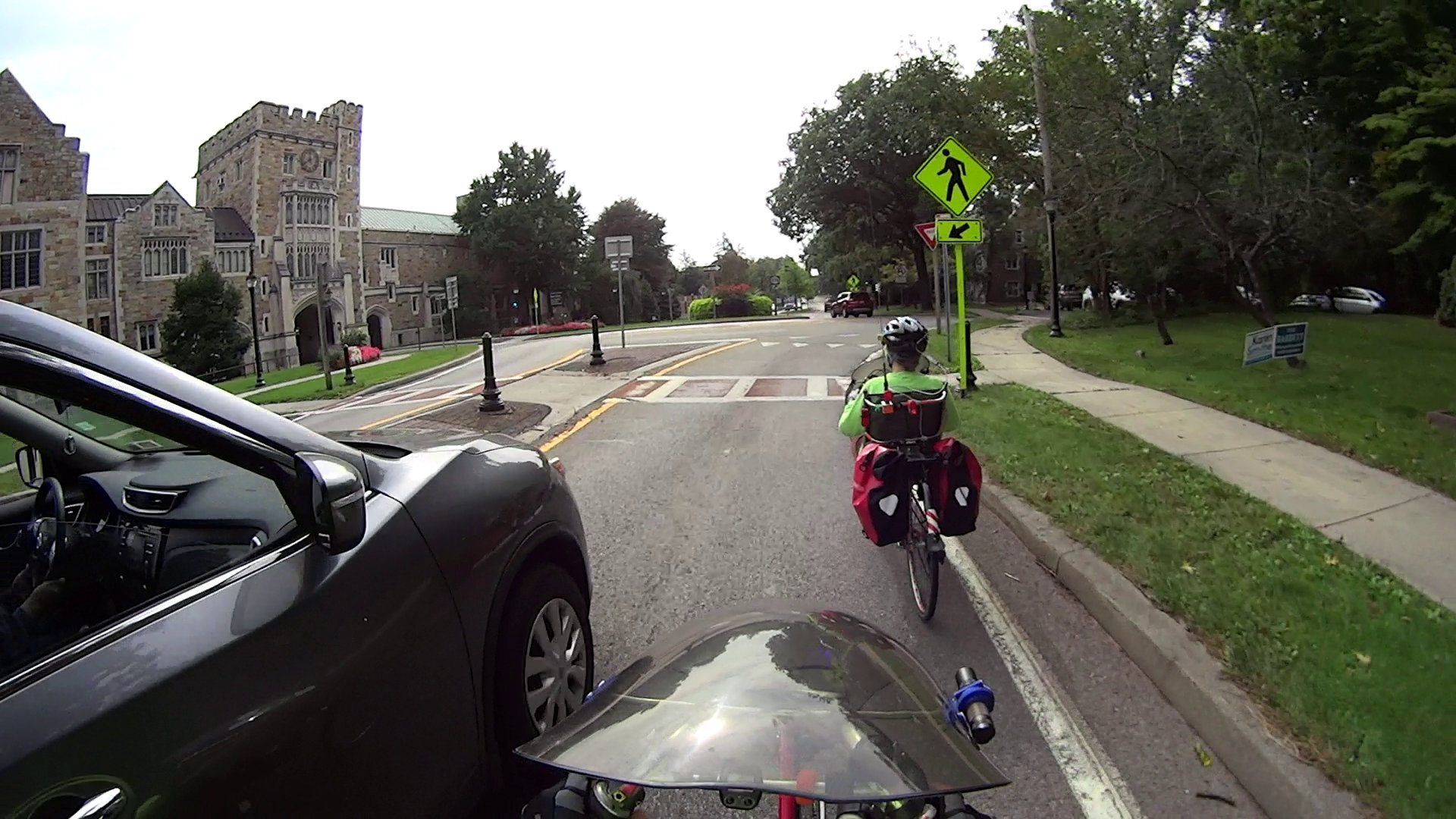
    We’re riding home with groceries along Raymond Avenue, approaching the Vassar Main Gate roundabout, and, as is my custom, I’ve been pointing to the middle of the lane for maybe five seconds as I move leftward to take the lane:

    Raymond Passing - Approach - 2018-10-04
    Raymond Passing – Approach – 2018-10-04

    The driver of HCX-1297 is having none of it:

    Raymond Passing - Near Miss - 2018-10-04
    Raymond Passing – Near Miss – 2018-10-04

    The mirror passed maybe a foot away from my shoulder; I’d reeled my arm in as the front fender passed by.

    All three traffic circles / roundabouts on Raymond neck the lane down and angle it rightward into the circle, which is supposed to “calm” traffic:

    Raymond Passing - Roundabout - 2018-10-04
    Raymond Passing – Roundabout – 2018-10-04

    The design doesn’t allow much flinch room for cyclists and certainly isn’t calming for us.

    The NYS engineer who designed the Raymond roundabouts said the whole thing was “standards compliant”, refused to go on a check ride with me to experience what it was like, and told me to detour through the Vassar campus if I felt endangered while sharing the road.

    Obviously, NYS DOT personnel do not dogfood their “share the road” bicycle standards by riding bicycles.