Ed Nisley's Blog: Shop notes, electronics, firmware, machinery, 3D printing, laser cuttery, and curiosities. Contents: 100% human thinking, 0% AI slop.
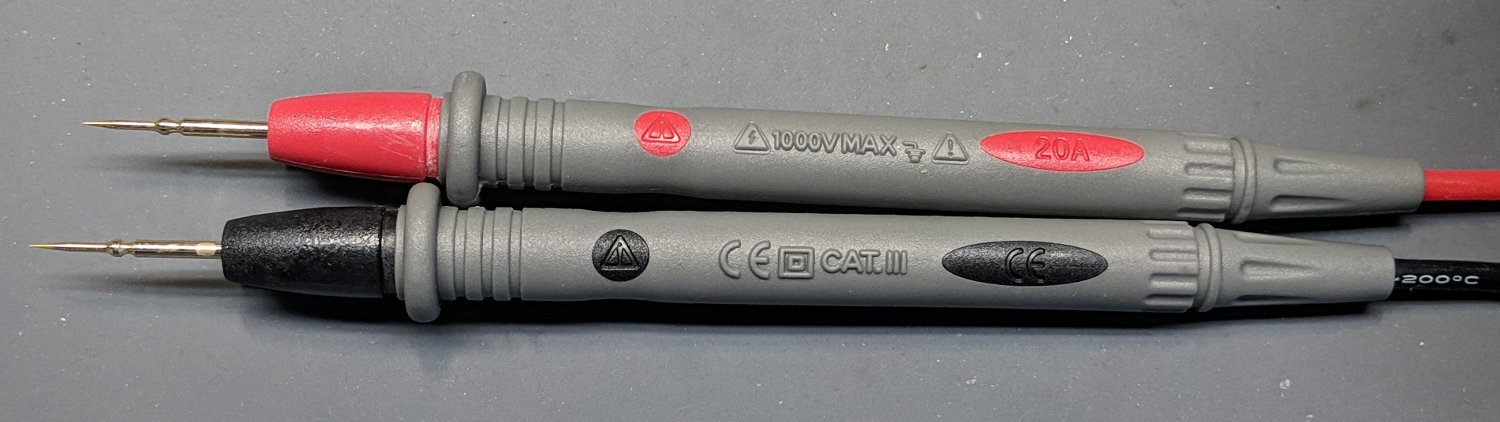
The needle-tip probes carry a 20 A current rating:
No-Name DMM probes – needle tip – 20 A
If you look out along the wire, though, you’ll find a 10 A rating:
No-Name DMM probes – needle tip – 10 A wires
Now, even though 20 AWG wire in silicone may carry a 17 A spec, the corresponding 200 °C temperature seems excessive for a test probe. Limiting the current to 10 A would reduce the power dissipation by two thirds, which should limit the temperature rise. Whether the wire actually contains 20 AWG of actual copper strands remains an open question.
The kit also had banana plug / test hooks with no particular rating, although the wire allegedly has 16 AWG conductors:
DMM Clip Leads – 16 AWG
The banana plug / alligator clip combo claims 30 A, also with 16 AWG conductors. Who knows? It could be true.
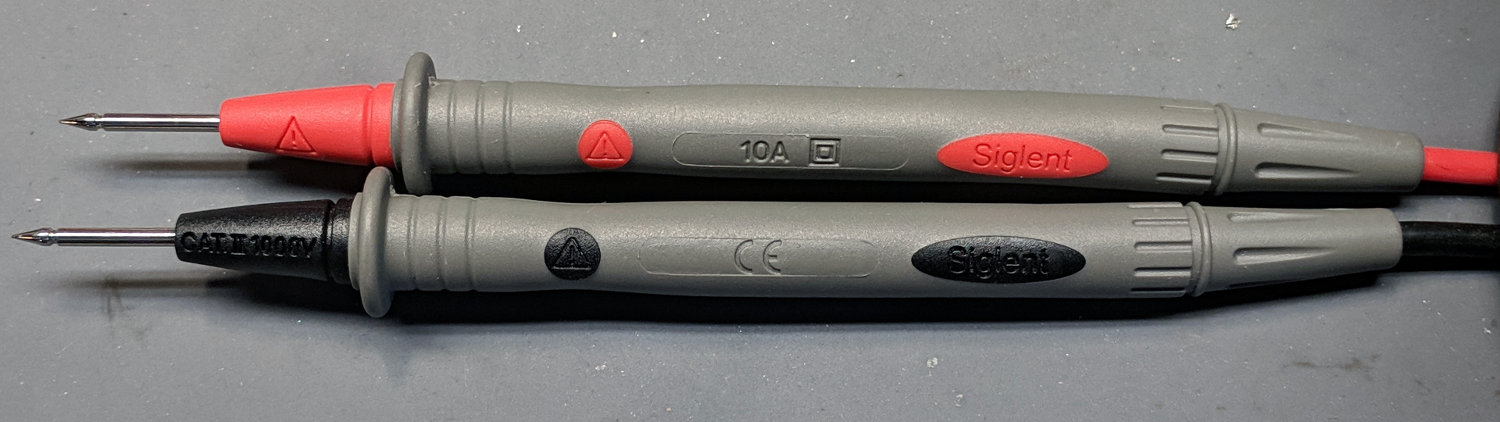
The probes carry a 10 A rating and, although the wires aren’t branded, I’ll assume they have good-enough QC to ensure the copper matches the claims. The production values seem a bit higher, too, even if they bear a striking resemblance to the cheap probes.
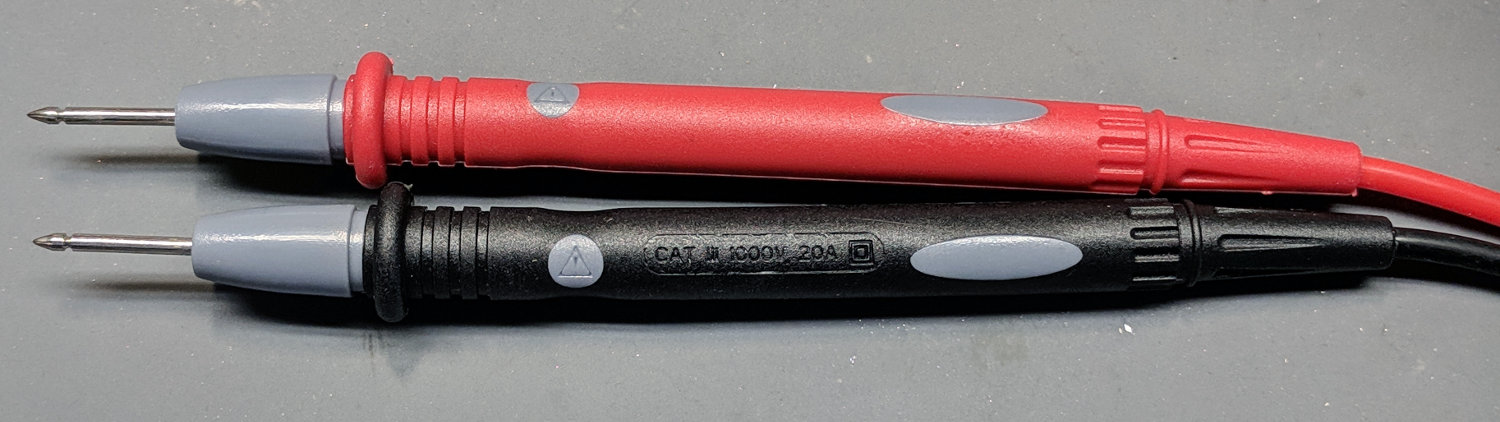
And, for reference, the probes with the cold solder joint also claim 20 A:
No-Name DMM probes – 20 A
Wouldn’t trust any of ’em for more than a few amps, tops …
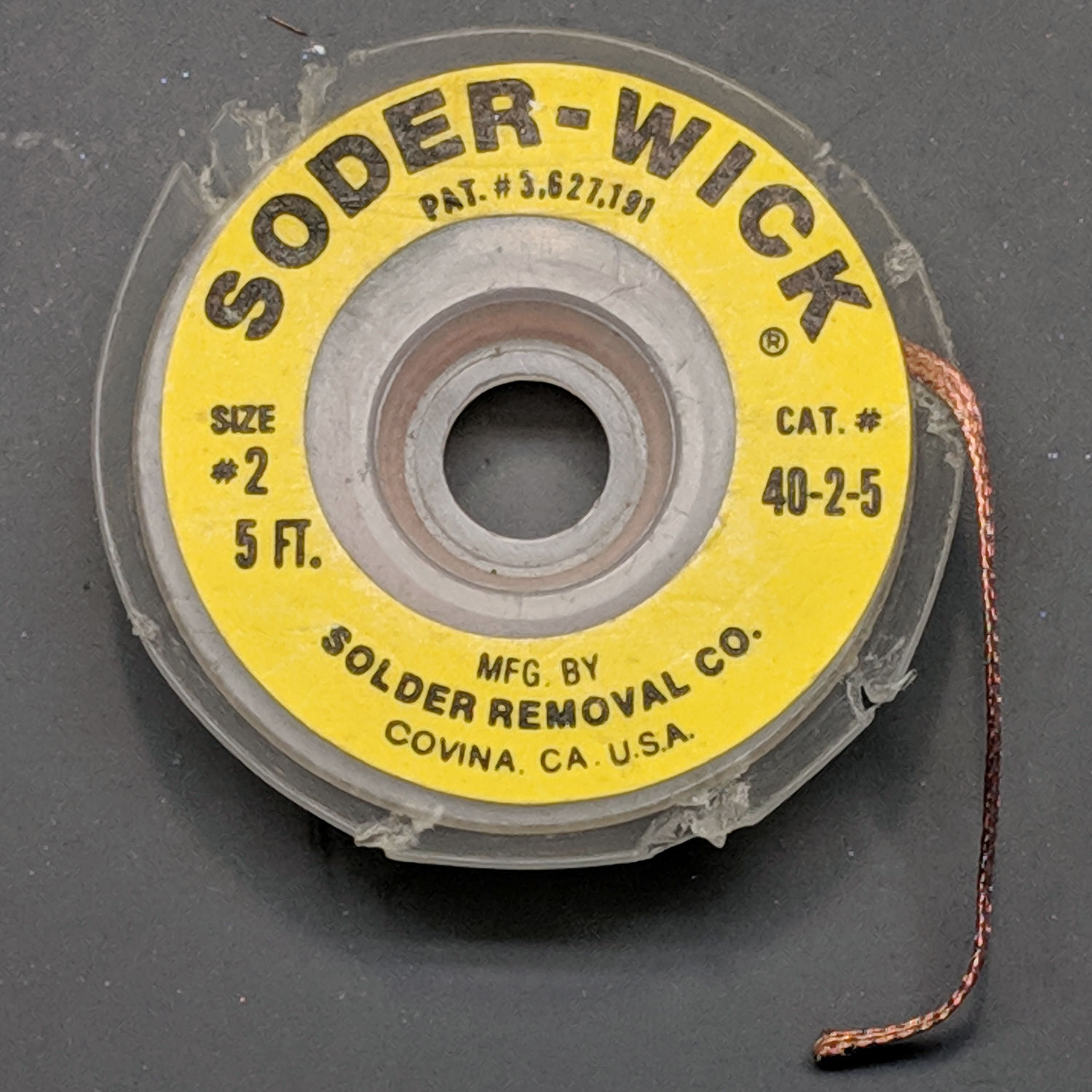
In the process of sorting out the Small Box o’ Soldering Tools, this well-used treasure emerged:
Soder-Wick – Original – Size 2
Yeah, the Genuine Article. Note the spelling and hyphenation: “Soder-Wick” is a both Registered Trademark® andpatented.
Of course, the patent having long expired, there exist knockoffs with slightly different spelling:
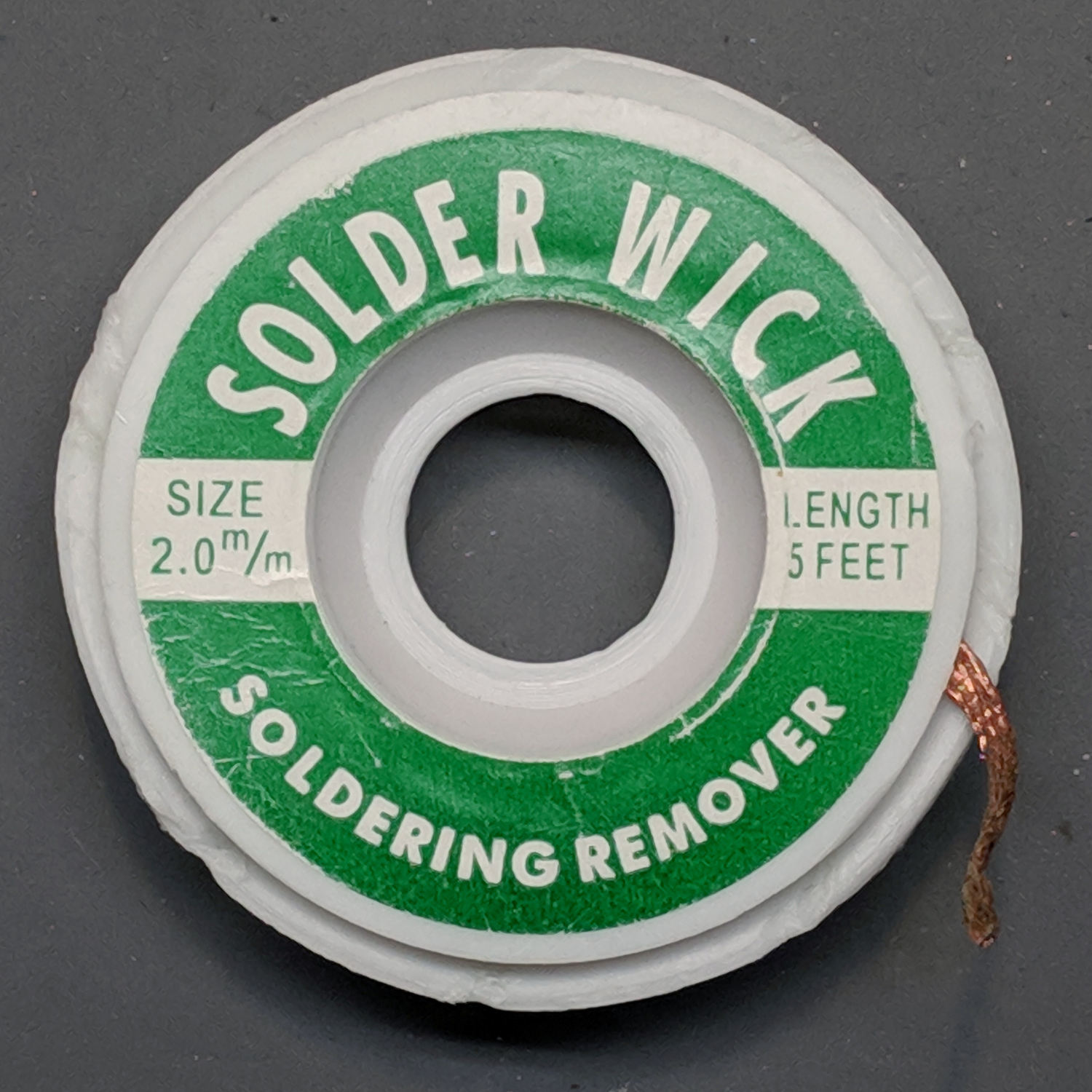
Solder Wick – Knockoff – Size 2mm
And labeling:
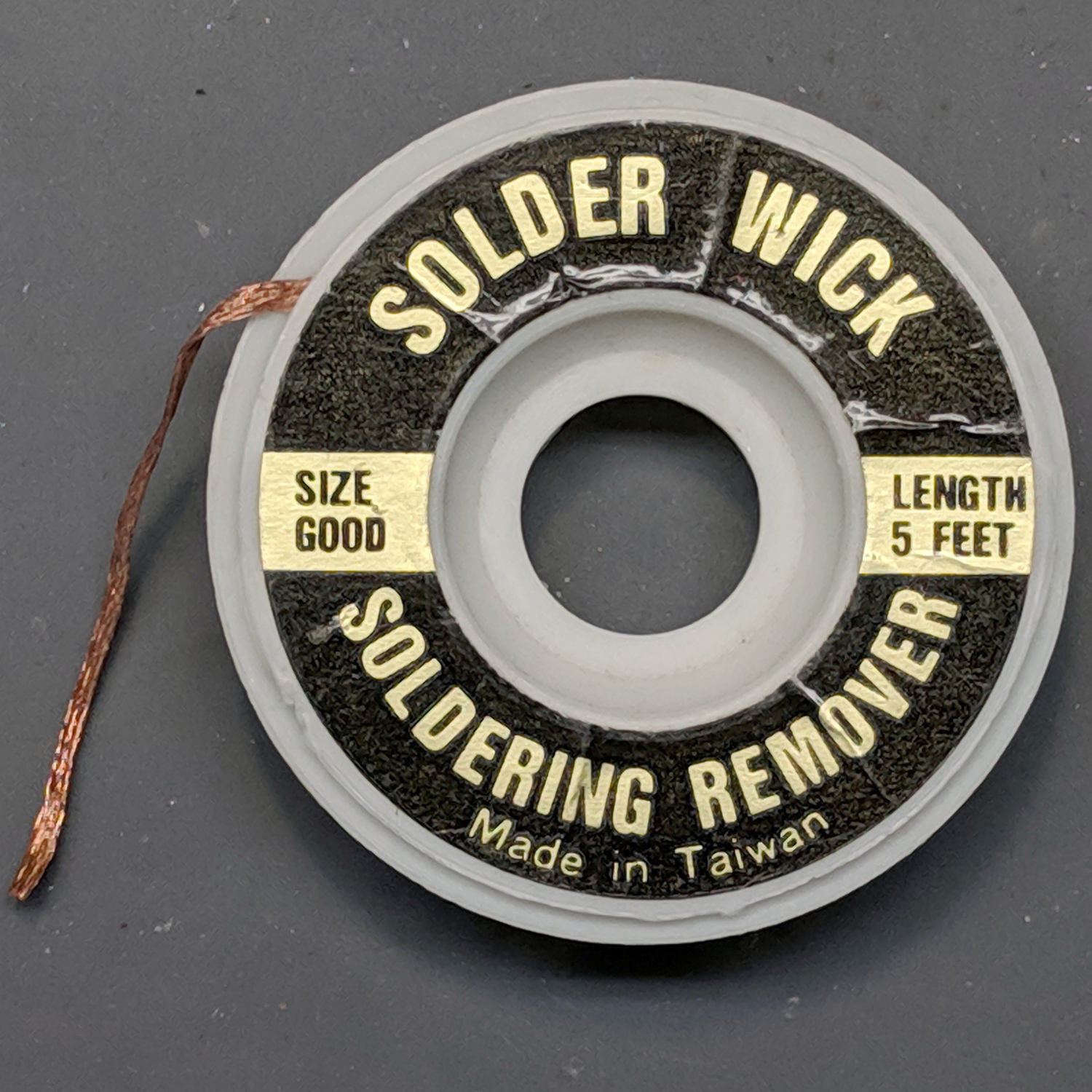
Solder Wick – Knockoff – Size Good
“Size Good”. I like that. “Made in Taiwan”, though, suggests it’s been in my collection for quite a while.
Despite the fact they’re all supposed to be coated with flux, I generally run a flux pen over whatever length I’m using, because it’s the only way to be sure.
Sony tried, they really tried, to make their proprietary Memory Stick flash memory cards catch on, but the slot in their HDR-AS30V Action / Helmet camera accepts both Memory Stick Micro and MicroSD cards. The two cards have slightly different sizes, the AS30V’s dual-purpose slot allows MicroSD cards to sit misaligned with the contacts, and the camera frequently kvetches about having no card.
The only solution seemed to be starting the camera while watching the display to ensure the card worked, but it would sometimes joggle out of position during a ride.
I cut out a tiny polypropylene rectangle(-ish) spacer to fill the Memory Stick side of the slot, sized to fit between the spring fingers holding the MicroSD card against its contacts:
Sony HDR-AS30V Camera – MicroSD card and spacer
Not the best cutting job I’ve ever done, but it was an iterative process and that’s where I stopped. If this works and I have need for another / better spacer, I promise to do better.
The spacer’s somewhat mottled appearance comes from tapeless sticky (an adhesive layer on a peel-off backing: inverse tape!) applied to the top side, which will affix it to the slot. I’d rather glue the spacer to the MicroSD card, but then the card wouldn’t fit in the USB 3.0 adapter I use to transfer the files.
The chips along the left edge of silkscreen come from my fingernail, because pressing exactly there seems to be the best way to force the damn thing into the proper alignment.
So the slot + spacer looks like this:
Sony HDR-AS30V Camera – dual-card slot with spacer
The MicroSD card fits in the far side of the slot, facing toward you with contacts downward, thusly:
Sony HDR-AS30V Camera – MicroSD card with spacer
And then It Just Works™, at least on the very few rides we’ve gotten in during December and early January.
Incidentally, the blue and exceedingly thin latch finger holding the battery in place will snap, should you drop the camera on its non-lens end from any height. Conversely, should you drop it on the lens end, you can kiss the optics goodbye. Your choice.
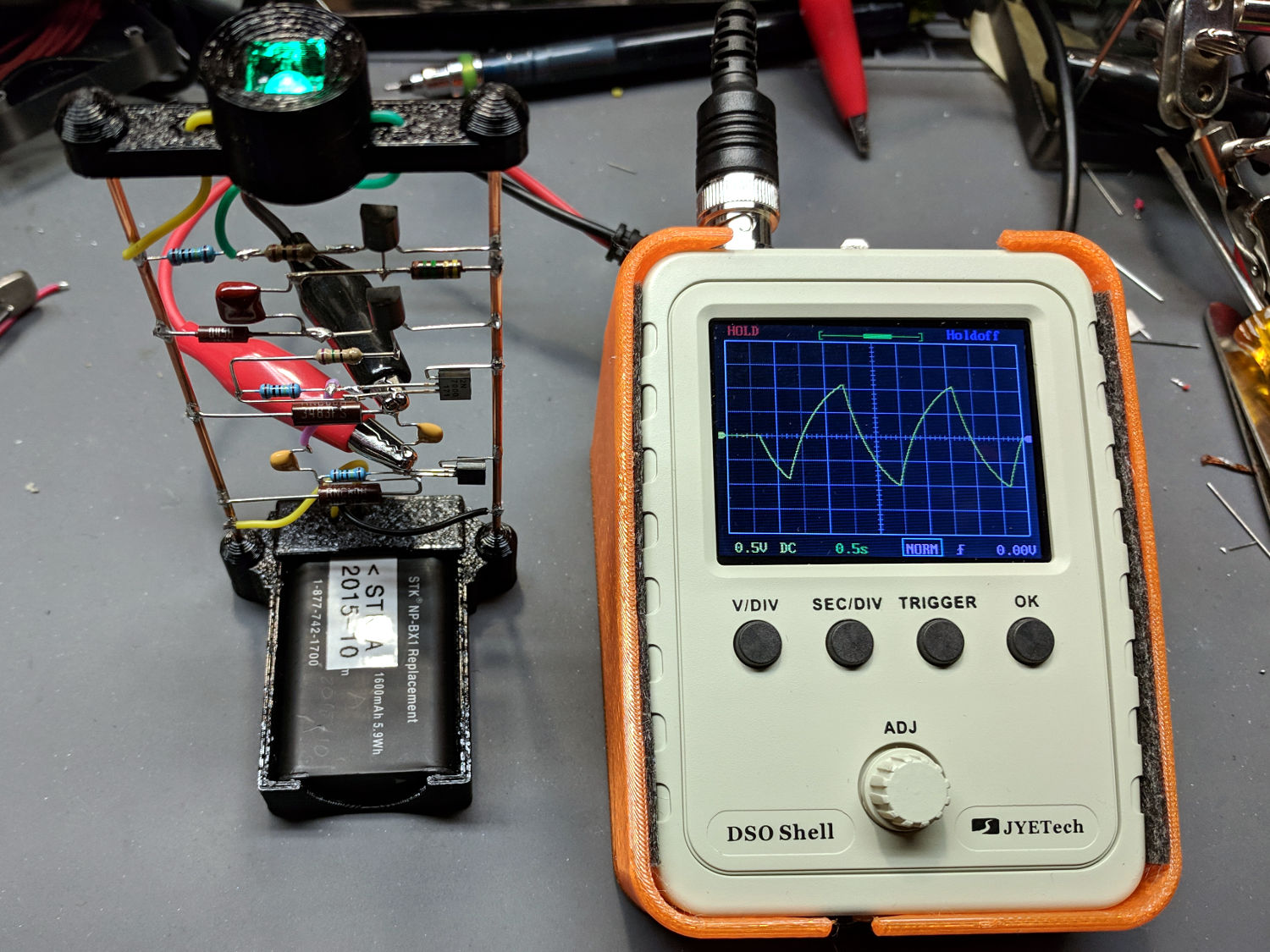
It blinks every two seconds because it uses 1 MΩ timing resistors, rather than the 2 MΩ resistors in the first version.
Because the DSO150 runs from the internal battery, you can clip it anywhere with few ill effects. The blinky runs from a battery, too, but connecting a high-impedance node to what’s basically the power line common may lead to heartache and confusion; it’s generally a Bad Habit.
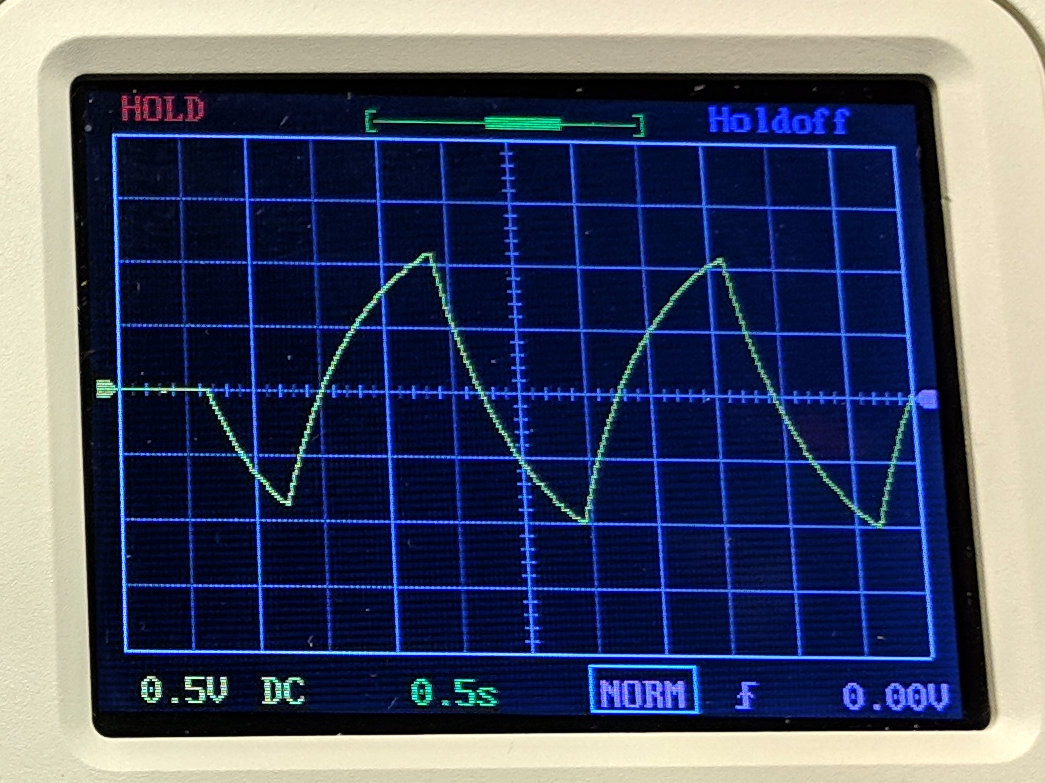
A closer look at the DSO150 screen shows the expected bipolar exponential waveform across the 1 µF timing cap:
DSO150 – 2N7000 astable cap voltage – screen detail
The scope triggering seems iffy, as the trace capture pauses every now and again for no apparent reason. This may have something to do with the very slow sweep speed; at 500 ms/div, the complete waveform takes forever to accumulate.
So this arrived from an email address similar to, yet not quite the same as, the URL of a physician’s office where I had an appointment a few days hence:
Encrypted Email Message
My email client is set to prefer plain text, disallow remote content, and not open attachments, so that’s as far as it got. Donning asbestos work gloves and face mask, I pried open the message and its attached HTML file with the appropriate tools and found, as expected, scripts doing who-know-what.
Called the office and, also as expected, was told my appointment time had been changed.
Showed up, mentioned it to the doctor, and was told the office must check off many boxes to demonstrate its HIPAA compliance.
Bottom line: HIPAA now requires patients (a.k.a., us) to open random attachments from random senders, all in the name of privacy.
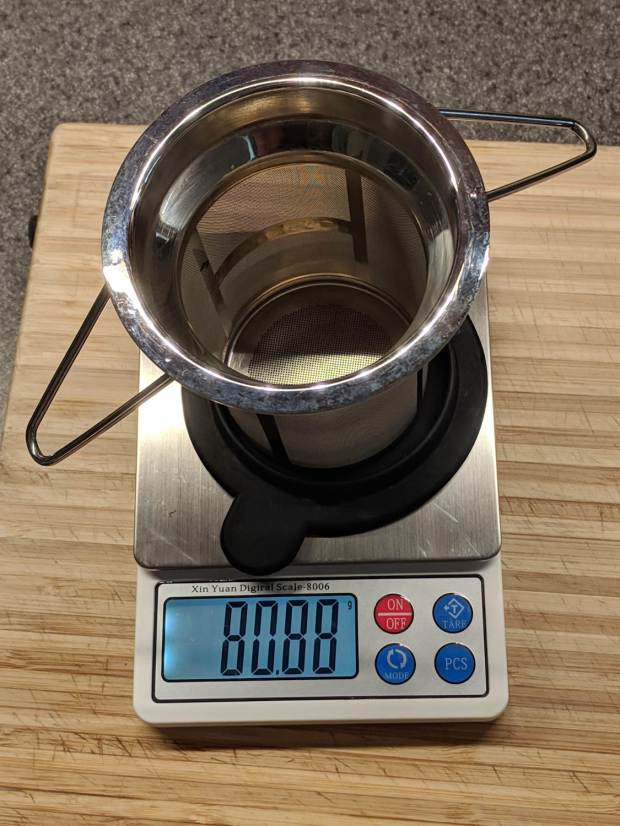
Being a responsible consumer, I carefully measure my daily green tea dosage. A laser-cut stainless steel strainer and silicone steam cap recently arrived, with a most auspicious tare weight:
Tea Strainer – 80.88 g
Before my Genuine IBM 5160 PC XT with an 8088 CPU, I scratch-built a Z80 “personal computer” and wrote a primitive multitasking OS. Plenty of electrons have flowed through the transistors since those days.
A great way to start the day; ya can’t make this stuff up!








 The Smell of Molten Projects in the Morning