The Smell of Molten Projects in the Morning

Ed Nisley's Blog: Shop notes, electronics, firmware, machinery, 3D printing, laser cuttery, and curiosities. Contents: 100% human thinking, 0% AI slop.

Author: Ed

  • Blog Theme Shuffling

    Blog Theme Shuffling

    Over the next several days, I’ll be screwing around with trying out different blog themes, because WordPress has “deprecated” the theme I’ve been using since about 2011; it no longer works well with their most recent infrastructure. There being no way to tell how any given theme will look, how difficult creating posts may be, or (in truth) anything about a theme without actually running it, I’ll be doing live-fire exercises while posting odds-n-ends projects from the shop.

    Some themes strongly suggest require a logo, so you’ll see this monstrosity until something better comes along:

    Logo - Isolated 0D3
    Logo – Isolated 0D3

    Speaking of themes, you’re looking at a “free” blog on wordpress.com, not something I’ve conjured by installing the open-source blog infrastructure from wordpress.org on a server, which means few things you (think you) know about a “WordPress blog” apply. In particular, free blogs on wordpress.com lack access to the universe of themes & plugins applicable to a DIY FOSS installation.

    (I think) I’d be perfectly happy to compose posts in Markdown (or some such) and slam them into a static site generator (Hugo / Gatsby / whatever), rather than slog through WP’s GUI editor, but I think my usual post-a-day pace conflicts with the fundamental assumptions of a “static site” generator.

    I value blog comments from real people (you all know who you are and I thank you!), but blogspam presents a clear & present danger. Right now, Akismet kills nearly all the hundreds of spam comments per day; it’s obvious any blog comment system must include robust spam filtering. The alternative of, say, running a separate email list for comments seems far more trouble than it’s worth.

    I absolutely do not want to sysop my very own blog configuration on a rented server / VPS / Digital Ocean Droplet / whatever. Things like WPengine.com would be attractive, except that this blog’s very long tail generates enough traffic to come very close to the 25 k visit/month upper limit of their “startup” plan; I’m reluctant to pay $100/month for the 100 k visit/month “growth” plan just to host my shop notes.

    If you have recommendations / experience / horror stories concerning FOSS blogging software, add a comment or send me a direct note through the form at the bottom of the misleadingly titled “About” page.

    For the next few days, remember: there is nothing wrong with your television set.

  • Monthly Science: Organ Pipe Mud Dauber Wasp Nest Disassembly

    Monthly Science: Organ Pipe Mud Dauber Wasp Nest Disassembly

    The empty Organ Pipe Mud Dauber Wasp nest popped off the wall with relatively little damage:

    Organ Pipe Wasp Nest - overview
    Organ Pipe Wasp Nest – overview

    The open cells on the back side show the wasps don’t waste any effort on putting mud where it’s not needed:

    Organ Pipe Wasp Nest - wall side
    Organ Pipe Wasp Nest – wall side

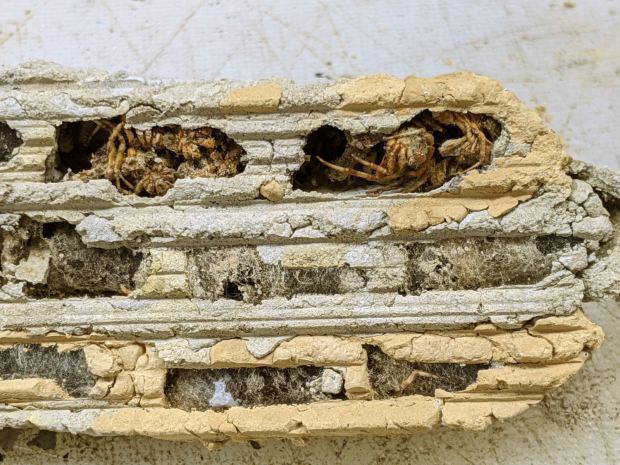
    Cracking it in half shows the rugged walls between the cell columns:

    Organ Pipe Wasp Nest - cross section
    Organ Pipe Wasp Nest – cross section

    Several cells contained three or four (thoroughly dead!) spiders apiece, evidently the result of un-hatched eggs:

    Organ Pipe Wasp Nest - failed egg - spiders
    Organ Pipe Wasp Nest – failed egg – spiders

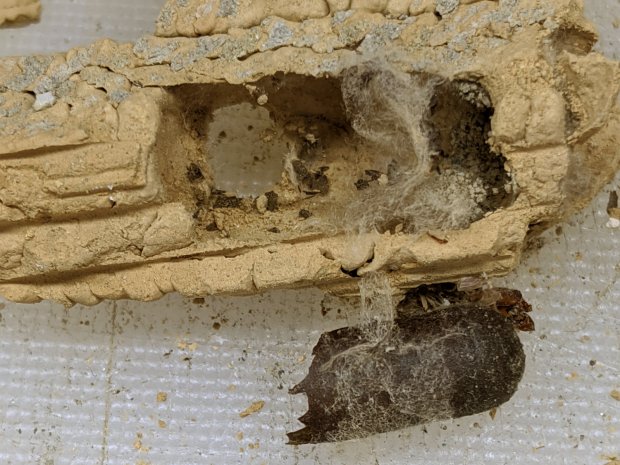
    Each successful cell contained a brittle capsule wrapped in a thin cocoon, surrounded by fragments of what used to be spiders, with an exit hole chewed in the side:

    Organ Pipe Wasp Nest - capsule detail
    Organ Pipe Wasp Nest – capsule detail

    I regret not weighing the whole affair, as all that mud represents an astonishing amount of heavy hauling and careful work by one or two little wasps!

  • Halogen H3 Bulb

    Halogen H3 Bulb

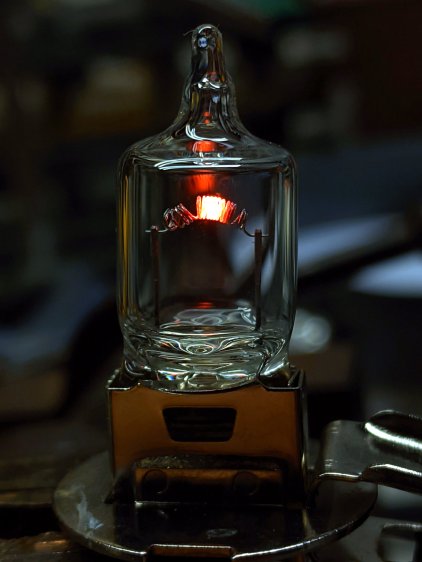
    Peering into the bulb salvaged from the Nissan fog light suggests the scuff on the lens corresponds to an impact mighty enough to disarrange the filament:

    Halogen H3 bulb - 1.5 A - light
    Halogen H3 bulb – 1.5 A – light

    No surprise, as the car completely shattered the utility pole.

    The glow draws 1.5 A from a bench supply at 1 V, just to show the filament isn’t lighting up evenly across those gaps. The bulb runs at 55 W from 12 V and would be, I’m sure, blindingly bright, although the heat concentrated in those few coils suggests it’d burn out fairly quickly.

    By LED standards, though, you don’t get much light for your 1.5 W …

    An underexposed version highlights the filament, just for pretty:

    Halogen H3 bulb - 1.5 A - dark
    Halogen H3 bulb – 1.5 A – dark

    Cropped to 9:16, it’s now a desktop background.

  • HP 10526T Logic Pulser Checkout

    HP 10526T Logic Pulser Checkout

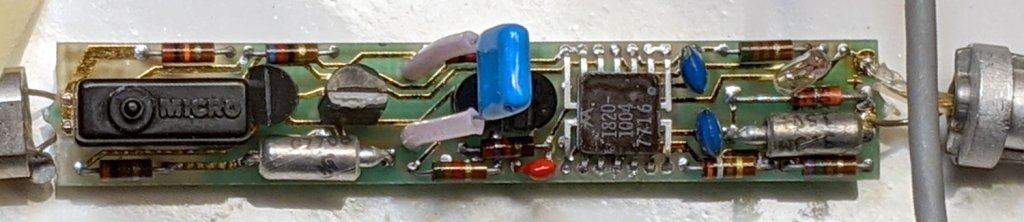
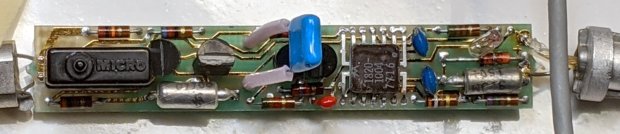
    When I re-capped the HP 10525T Logic Probe, I expected the matching HP 10526T Logic Pulser would require the same treatment. Having finally gotten a Round Tuit, I preemptively pulled it apart to see what was going on inside:

    HP 10526T Logic Pulser - PCB detail
    HP 10526T Logic Pulser – PCB detail

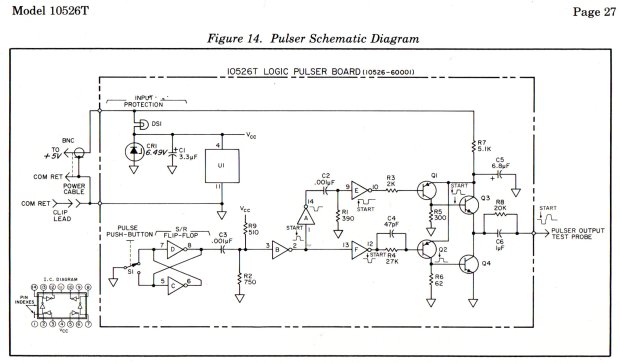
    The manual includes the schematic, of course:

    HP 10526T Logic Pulser - schematic
    HP 10526T Logic Pulser – schematic

    The IC is a Motorola SN7404 Hex Inverter sporting an HP house number in a ceramic flatpack: pin 1 in the upper right, VCC on pin 4, and common on pin 11. The 7716 datecode suggests the chip first saw daylight shortly after single-chip microcontrollers became a nontrivial thing.

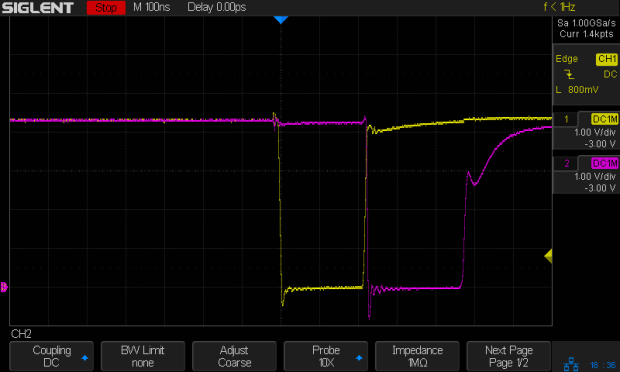
    The pushbutton switch triggers the expected pulses at pins 10 (purple) and 12 (yellow), with timings controlled by the RC networks:

    U1.12 U1.10
    U1.12 U1.10

    The collector output of Q2 is a robust 73 mA pulse through its 62 Ω resistor:

    Q2.c
    Q2.c

    Q1 dumps 15 mA into its 300 Ω resistor:

    Q1.C
    Q1.C

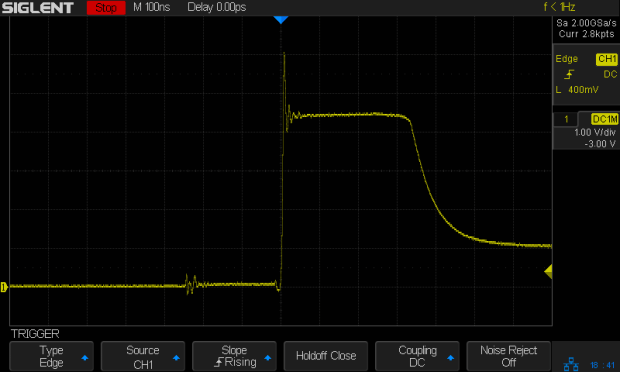
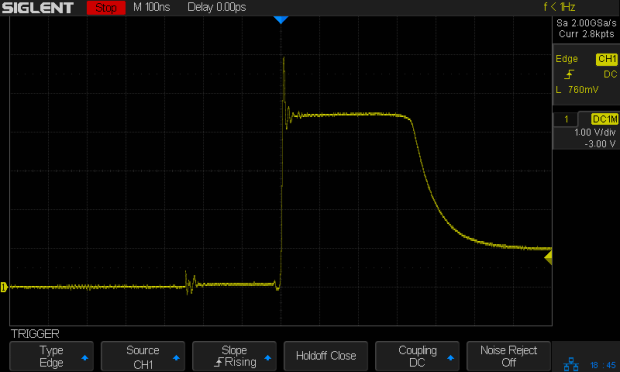
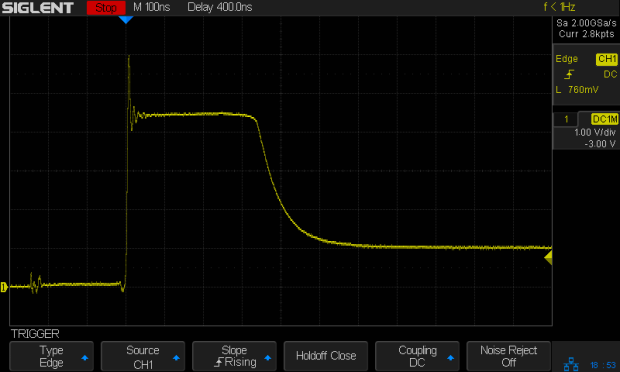
    The push-pull output at the emitter of Q3 and the collector of Q4 looks similar (albeit with some delay cranked in to show the tidy exponential tail):

    Q3.e - Q4.c
    Q3.e – Q4.c

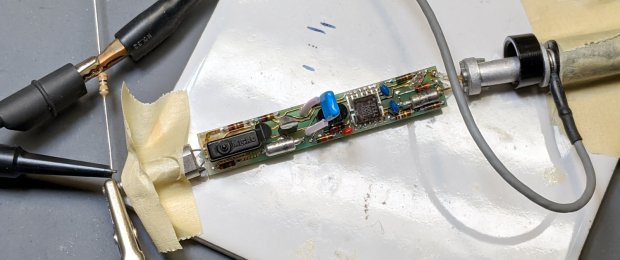
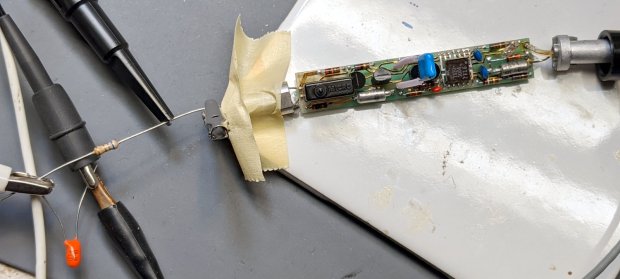
    The manual specifies a 3.0 Ω resistor to ground for Test A, thusly:

    HP 10526T Logic Pulser - Test A setup
    HP 10526T Logic Pulser – Test A setup

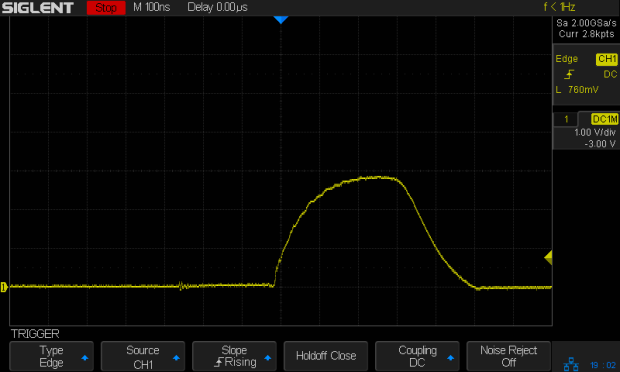
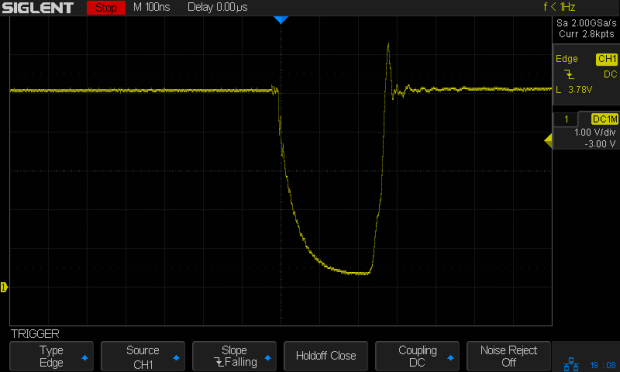
    The output peaks at nearly 3 V to drive a robust 1 A (!) pulse:

    Test A pulse
    Test A pulse

    Test B requires a 6.2 Ω resistor driven from 5 V, but a 6.8 Ω resistor came to hand:

    HP 10526T Logic Pulser - Test B setup
    HP 10526T Logic Pulser – Test B setup

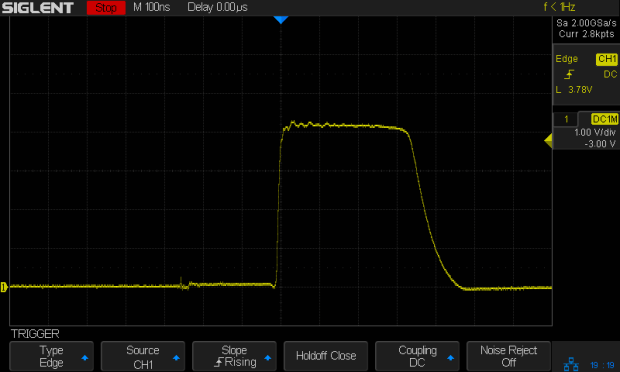
    The downward pulse doesn’t quite reach 0 V (because saturation voltage, etc), so it’s a mere 725 mA:

    Test B pulse
    Test B pulse

    HP’s formal setup for Test C requires a totalizing counter to show the pulser produces exactly one pulse for each button push. I just wired up a 47 Ω resistor and eyeballed a few pulses:

    Test C pulse - 47 ohm
    Test C pulse – 47 ohm

    The lighter 85 mA load through the resistor allows a more rectangular pulse than the 3 Ω resistor. Yup, looks clean to me.

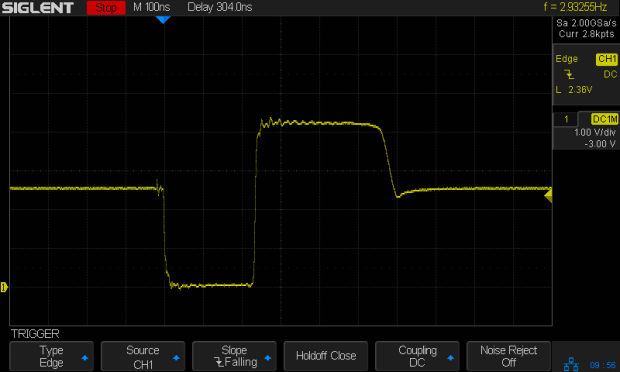
    Because the pulser drives its output both low and high with great authority, it doesn’t care what state the external net wants. Here’s what happens with the 47 Ω resistor connected to a 2.5 V supply:

    Bipolar pulse - 47 ohm 2.5 V
    Bipolar pulse – 47 ohm 2.5 V

    No matter where the logic family’s threshold might be, the net will experience one downward and one upward transition through it: with the pulser delivering nigh onto an amp, the net’s driver doesn’t stand a chance.

    However, the pulser was designed for TTL and DTL (remember DTL?) circuitry, so hammering a 3.3 V microcontroller pin probably isn’t a Good Idea. The notion of keeping a pulser around Just In Case may have reached its end times.

    Oh, and about the re-capping. Turns out HP used solid tantalum capacitors and they’re still doing fine after four decades, thankyouverymuch. I put it back together and expect it will continue working forevermore.

  • Magnifying Desk Lamp Pivot Clamp: One More

    Magnifying Desk Lamp Pivot Clamp: One More

    For reasons not relevant here, I made another clamp for a magnifying desk lamp and mailed it off in a small box. A few measurements suggested all such lamps share a common design and similar parts, so I duplicated my previous attempt, with some improvements.

    On the upside, the same scrap of aluminum plate I used for the previous clamp emerged from the stockpile and, after a session with Mr Disk Sander, sported two square & reasonably perpendicular sides:

    Magnifying Lamp Clamp - squaring stock
    Magnifying Lamp Clamp – squaring stock

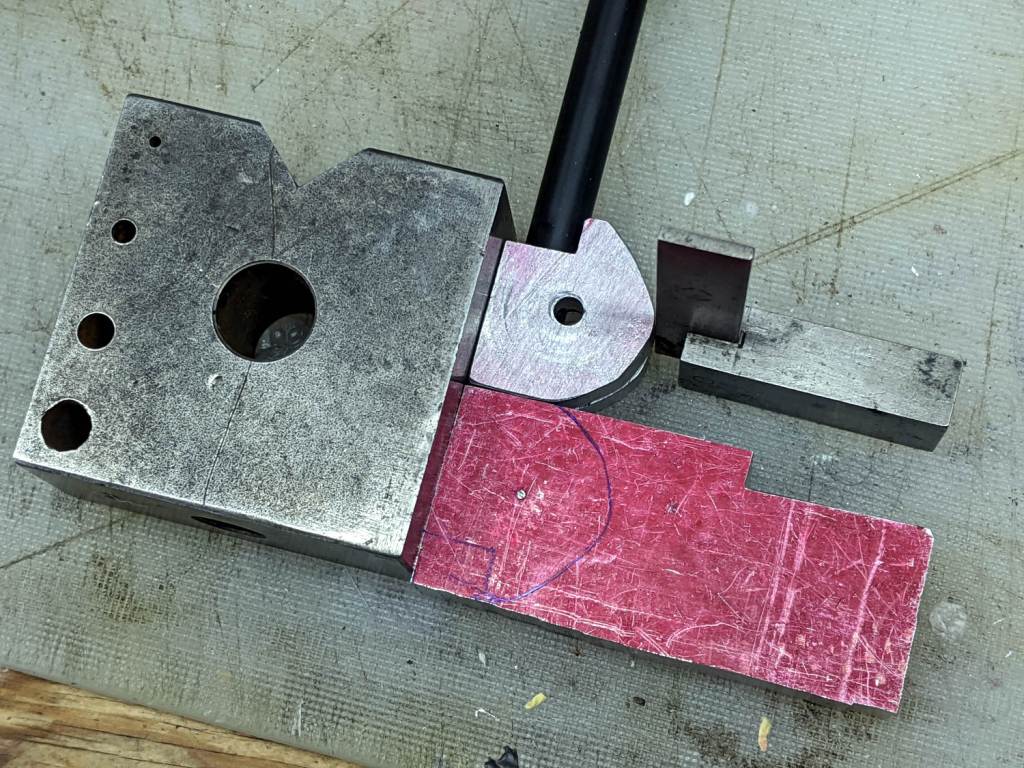
    Rather than rely on my original dimension scribble, I transfer-punched the hole location from my as-built clamp to the stock:

    Magnifying Lamp Clamp - locating stem hole
    Magnifying Lamp Clamp – locating stem hole

    That’s a reenactment based on a true story: the actual punching happened on the bench vise’s anvil surface, with too many moving pieces supported & aligned by an insufficient number of hands.

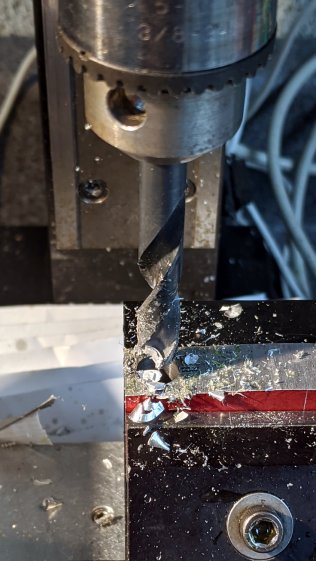
    Drilling the 5/16 inch hole required mounting the Greater Chuck on an MT1 taper adapter for the Sherline:

    Magnifying Lamp Clamp - drilling stem clamp
    Magnifying Lamp Clamp – drilling stem clamp

    It’s normally on an MT2 adapter for the mini-lathe tailstock, where it handles drills up to 3/8 inch. For the record, the Sherline’s Lesser Check tops out at 1/4 inch and the Least Chuck at 5/32 inch.

    Punch & drill the 4 mm cross hole for the clamping screw:

    Magnifying Lamp Clamp - drill cross hole
    Magnifying Lamp Clamp – drill cross hole

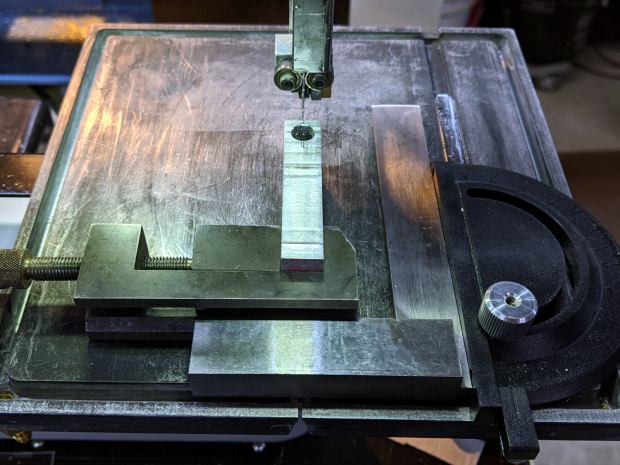
    Grab the plate in a toolmaker’s vise, set up some casual guidance, and bandsaw right down the middle:

    Magnifying Lamp Clamp - sawing clamp halves
    Magnifying Lamp Clamp – sawing clamp halves

    Bandsaw the outline to free the two halves from the stock, then clean up their perimeter:

    Magnifying Lamp Clamp - rounded
    Magnifying Lamp Clamp – rounded

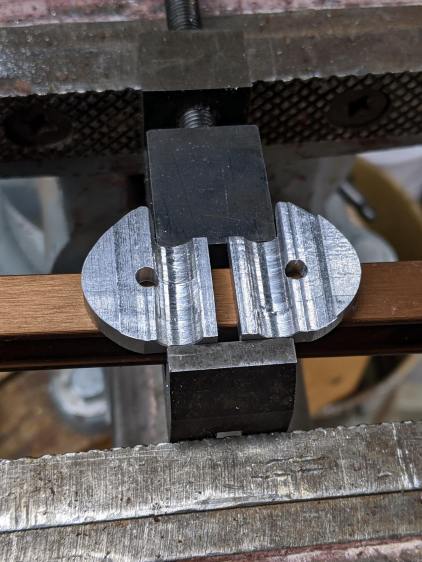
    Saw the clamp clearance almost all the way through to leave a protrusion, then file the scarred kerf more-or-less flat:

    Magnifying Lamp Clamp - filing interior
    Magnifying Lamp Clamp – filing interior

    Do a trial fit in my lamp, which lacks the fancy brushed-metal finish of the remote one:

    Magnifying Lamp Clamp - trial fit
    Magnifying Lamp Clamp – trial fit

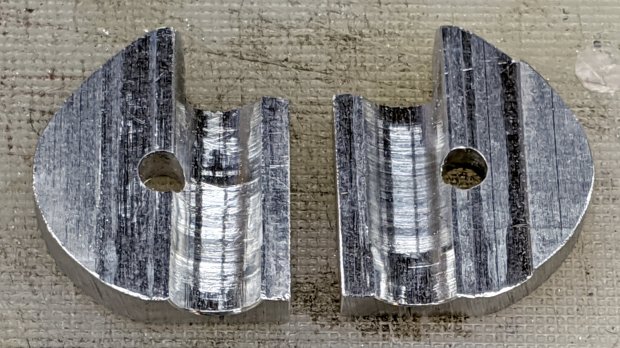
    It holds tight and rotates well, so break the edges and shine up the outside to a used-car finish (“high polish over deep scratches”):

    Magnifying Lamp Clamp - surface finish
    Magnifying Lamp Clamp – surface finish

    The inside remains gritty to improve traction on the lamp stem:

    Magnifying Lamp Clamp - interior
    Magnifying Lamp Clamp – interior

    Declare victory, box it up, and away it goes!

  • Nissan Fog Lamp: Arduino Firmware

    Nissan Fog Lamp: Arduino Firmware

    The upcycled Nissan fog lamp now has a desk stand:

    Nissan Fog Lamp - table mount
    Nissan Fog Lamp – table mount

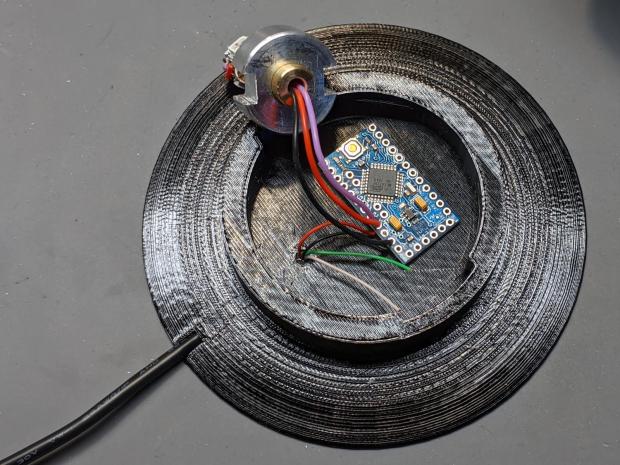
    A knockoff Arduino Pro Mini atop a strip of foam tape drives the WS2812 RGB LEDs:

    Nissan Fog Lamp - table mount interior
    Nissan Fog Lamp – table mount interior

    Next time, I’ll cut the wires another inch longer.

    The firmware is a tidied-up version of the vacuum tube code, minus cruft, plus fixes, and generally better at doing what it does. The Pro Mini lacks a USB output, so this came from the same code running on a Nano:

    14:44:04.169 -> Algorithmic Art
    14:44:04.169 ->  RGB WS2812
    14:44:04.169 -> Ed Nisley - KE4ZNU - April 2020
    14:44:04.169 -> Lamp test: flash full-on colors
    14:44:04.169 ->  color: 00ff0000
    14:44:05.165 ->  color: 0000ff00
    14:44:06.160 ->  color: 000000ff
    14:44:07.155 ->  color: 00ffffff
    14:44:08.151 ->  color: 00000000
    14:44:09.180 -> Random seed: da98f7f6
    14:44:09.180 -> Primes: 7 19 3
    14:44:09.180 ->  Super cycle length: 199500 steps
    14:44:09.180 -> Inter-pixel phase: 1 deg = 26 steps
    14:44:09.180 ->  c: 0 Steps:  3500 Init:  1538 Phase:   2 deg PWM: 255
    14:44:09.180 ->  c: 1 Steps:  9500 Init:  7623 Phase:   0 deg PWM: 255
    14:44:09.213 ->  c: 2 Steps:  1500 Init:  1299 Phase:   6 deg PWM: 255
    14:44:19.265 -> Color 2     steps 1500  at 15101    ms 50       TS 201     
    14:45:34.293 -> Color 2     steps 1500  at 90136    ms 50       TS 1701    
    14:45:43.085 -> Color 1     steps 9500  at 98940    ms 50       TS 1877    
    14:45:47.332 -> Color 0     steps 3500  at 103192   ms 50       TS 1962    
    14:46:49.324 -> Color 2     steps 1500  at 165170   ms 50       TS 3201  
    … much snippage …
    17:26:52.896 -> Color 2     steps 1500  at 9769584  ms 50       TS 195201  
    17:28:07.926 -> Color 2     steps 1500  at 9844618  ms 50       TS 196701  
    17:29:11.000 -> Color 0     steps 3500  at 9907697  ms 50       TS 197962  
    17:29:22.974 -> Color 2     steps 1500  at 9919653  ms 50       TS 198201  
    17:30:27.941 -> Supercycle end, setting new color values
    17:30:27.941 -> Primes: 17 7 3
    17:30:27.941 ->  Super cycle length: 178500 steps
    17:30:27.941 -> Inter-pixel phase: 1 deg = 23 steps
    17:30:27.941 ->  c: 0 Steps:  8500 Init:  5415 Phase:   0 deg PWM: 255
    17:30:27.974 ->  c: 1 Steps:  3500 Init:  3131 Phase:   2 deg PWM: 255
    17:30:27.974 ->  c: 2 Steps:  1500 Init:   420 Phase:   5 deg PWM: 255
    17:30:46.394 -> Color 1     steps 3500  at 10003091 ms 50       TS 369     
    17:31:21.964 -> Color 2     steps 1500  at 10038658 ms 50       TS 1080  

    The “Super cycle length” is the number of 50 ms steps until the colors start repeating, something over an hour in that sample. When the code reaches the end of the supercycle, it picks another set of three prime numbers, reinitializes the color settings, and away it goes.

    The fog light looks pretty in action:

    Nissan Fog Lamp - blue phase
    Nissan Fog Lamp – blue phase

    The four LEDs don’t produce the same light pattern as the halogen filament and they’re distinctly visible when you squint against the glare:

    Nissan Fog Lamp - reflector LED detail
    Nissan Fog Lamp – reflector LED detail

    The shadow on the right comes from the larger hood support strut, the shadow on the left is the narrower strut, and the two other gaps show the beam angle gaps between the LEDs.

    You’ll see plenty of residual sandpaper scratches on the lens: my surface (re)finishing hand is weak.

    The LED beamwidth is so broad the “bulb” position inside the reflector doesn’t make much difference, particularly as it must, at most, wash a wall and ceiling at close range:

    Nissan Fog Lamp - wall wash light
    Nissan Fog Lamp – wall wash light

    All in all, a much-needed dose of Quality Shop Time.

    The Arduino source code as a GitHub Gist:

    // Neopixel Algorithmic Art
    // W2812 RGB Neopixel version
    // Ed Nisley – KE4ZNU
    #include <Adafruit_NeoPixel.h>
    #include <Entropy.h>
    //———-
    // Pin assignments
    const byte PIN_NEO = A3; // DO – data out to first Neopixel
    const byte PIN_HEARTBEAT = 13; // DO – Arduino LED
    #define PIN_MORSE 12
    //———-
    // Constants
    // number of pixels
    #define PIXELS 4
    // lag between adjacent pixels in degrees of slowest period
    #define PIXELPHASE 1
    // update LEDs only this many ms apart (minus loop() overhead)
    #define UPDATEINTERVAL 50ul
    #define UPDATEMS (UPDATEINTERVAL – 0ul)
    // number of steps per cycle, before applying prime factors
    #define RESOLUTION 500
    //———-
    // Globals
    Adafruit_NeoPixel strip = Adafruit_NeoPixel(PIXELS, PIN_NEO, NEO_GRB + NEO_KHZ800);
    uint32_t FullWhite = strip.Color(255,255,255);
    uint32_t FullOff = strip.Color(0,0,0);
    uint32_t MorseColor;
    struct pixcolor_t {
    unsigned int Prime;
    unsigned int NumSteps;
    unsigned int Step;
    float StepSize;
    float Phase;
    byte MaxPWM;
    };
    unsigned long int TotalSteps;
    unsigned long int SuperCycleSteps;
    byte PrimeList[] = {3,5,7,11,13,17,19,29}; // small primes = faster changes
    // colors in each LED and their count
    enum pixcolors {RED, GREEN, BLUE, PIXELSIZE};
    struct pixcolor_t Pixel[PIXELSIZE]; // all the data for each pixel color intensity
    uint32_t UniColor;
    unsigned long int MillisNow;
    unsigned long int MillisThen;
    //– Select three unique primes for the color generator function
    // Then compute all the step parameters based on those values
    void SetColorGenerators(void) {
    Pixel[RED].Prime = PrimeList[random(sizeof(PrimeList))];
    do {
    Pixel[GREEN].Prime = PrimeList[random(sizeof(PrimeList))];
    } while (Pixel[RED].Prime == Pixel[GREEN].Prime);
    do {
    Pixel[BLUE].Prime = PrimeList[random(sizeof(PrimeList))];
    } while (Pixel[BLUE].Prime == Pixel[RED].Prime ||
    Pixel[BLUE].Prime == Pixel[GREEN].Prime);
    if (false) {
    Pixel[RED].Prime = 1;
    Pixel[GREEN].Prime = 3;
    Pixel[BLUE].Prime = 5;
    }
    printf("Primes: %d %d %d\r\n",Pixel[RED].Prime,Pixel[GREEN].Prime,Pixel[BLUE].Prime);
    TotalSteps = 0;
    SuperCycleSteps = RESOLUTION;
    for (byte c = 0; c < PIXELSIZE; c++) {
    SuperCycleSteps *= Pixel[c].Prime;
    }
    printf(" Super cycle length: %lu steps\r\n",SuperCycleSteps);
    Pixel[RED].MaxPWM = 255;
    Pixel[GREEN].MaxPWM = 255;
    Pixel[BLUE].MaxPWM = 255;
    unsigned int PhaseSteps = (unsigned int) ((PIXELPHASE / 360.0) *
    RESOLUTION * (unsigned int) max(max(Pixel[RED].Prime,Pixel[GREEN].Prime),Pixel[BLUE].Prime));
    printf("Inter-pixel phase: %d deg = %d steps\r\n",(int)PIXELPHASE,PhaseSteps);
    for (byte c = 0; c < PIXELSIZE; c++) {
    Pixel[c].NumSteps = RESOLUTION * Pixel[c].Prime; // steps per cycle
    Pixel[c].StepSize = TWO_PI / Pixel[c].NumSteps; // radians per step
    Pixel[c].Step = random(Pixel[c].NumSteps); // current step
    Pixel[c].Phase = PhaseSteps * Pixel[c].StepSize; // phase in radians for this color
    printf(" c: %d Steps: %5d Init: %5d Phase: %3d deg",c,Pixel[c].NumSteps,Pixel[c].Step,(int)(Pixel[c].Phase * 360.0 / TWO_PI));
    printf(" PWM: %d\r\n",Pixel[c].MaxPWM);
    }
    }
    //– Helper routine for printf()
    int s_putc(char c, FILE *t) {
    Serial.write(c);
    }
    //——————
    // Set the mood
    void setup() {
    pinMode(PIN_HEARTBEAT,OUTPUT);
    digitalWrite(PIN_HEARTBEAT,LOW); // show we arrived
    Serial.begin(57600);
    fdevopen(&s_putc,0); // set up serial output for printf()
    printf("Algorithmic Art\r\n RGB WS2812\r\nEd Nisley – KE4ZNU – April 2020\r\n");
    Entropy.initialize(); // start up entropy collector
    // set up pixels
    strip.begin();
    strip.show();
    // lamp test: a brilliant white flash
    printf("Lamp test: flash full-on colors\r\n");
    uint32_t FullRGB = strip.Color(255,255,255);
    uint32_t FullR = strip.Color(255,0,0);
    uint32_t FullG = strip.Color(0,255,0);
    uint32_t FullB = strip.Color(0,0,255);
    uint32_t FullOff = strip.Color(0,0,0);
    uint32_t TestColors[] = {FullR,FullG,FullB,FullRGB,FullOff};
    for (byte i = 0; i < sizeof(TestColors)/sizeof(uint32_t) ; i++) {
    printf(" color: %08lx\r\n",TestColors[i]);
    for (int p=0; p < strip.numPixels(); p++) {
    strip.setPixelColor(p,TestColors[i]);
    }
    strip.show();
    delay(1000);
    }
    // get an actual random number
    uint32_t rn = Entropy.random();
    printf("Random seed: %08lx\r\n",rn);
    randomSeed(rn);
    // set up the color generators
    SetColorGenerators();
    MillisNow = MillisThen = millis();
    }
    //——————
    // Run the mood
    void loop() {
    MillisNow = millis();
    if ((MillisNow – MillisThen) >= UPDATEMS) { // time for another step?
    digitalWrite(PIN_HEARTBEAT,HIGH);
    TotalSteps++;
    strip.show(); // send out precomputed colors
    for (byte c = 0; c < PIXELSIZE; c++) { // compute next increment for each color
    if (++Pixel[c].Step >= Pixel[c].NumSteps) {
    Pixel[c].Step = 0;
    printf("Color %-5d steps %-5d at %-8ld ms %-8ld TS %-8lu\r\n",
    c,Pixel[c].NumSteps,MillisNow,(MillisNow – MillisThen),TotalSteps);
    }
    }
    // If all cycles have completed, reset the color generators
    if (TotalSteps >= SuperCycleSteps) {
    printf("Supercycle end, setting new color values\r\n");
    SetColorGenerators();
    }
    for (int p = 0; p < strip.numPixels(); p++) { // for each pixel
    byte Value[PIXELSIZE];
    for (byte c=0; c < PIXELSIZE; c++) { // compute new colors
    Value[c] = (Pixel[c].MaxPWM / 2.0) * (1.0 + sin(Pixel[c].Step * Pixel[c].StepSize – p*Pixel[c].Phase));
    }
    UniColor = strip.Color(Value[RED],Value[GREEN],Value[BLUE]);
    strip.setPixelColor(p,UniColor);
    }
    MillisThen = MillisNow;
    digitalWrite(PIN_HEARTBEAT,LOW);
    }
    }
    view raw AlgoArt-RGB.ino hosted with ❤ by GitHub

  • Groundhog Activity

    Groundhog Activity

    The groundhog responsible for trimming the lawn greenery in our area has discovered the long-disused driveway salt barrel:

    Groundhog - in salt barrel
    Groundhog – in salt barrel

    There’s always another appointment on the calendar, though:

    Groundhog - trotting on driveway
    Groundhog – trotting on driveway

    A busy critter with no time to waste!