Ed Nisley's Blog: Shop notes, electronics, firmware, machinery, 3D printing, laser cuttery, and curiosities. Contents: 100% human thinking, 0% AI slop.
Posts will appear intermittently over the next week or two.
I’m still spending an inordinate amount of time studying the back of my eyelids while horizontally polarized in the lift chair. I can highly recommend not doing whatever it is that triggers a pinched lumbar nerve, but as nearly as I can tell, the proximate cause (shredding leaves) isn’t anything close to whatever the root cause might be.
It does provide plenty of time to conjure solid models from the vasty digital deep:
Wheelchair Brake Mods – solid model – build layout
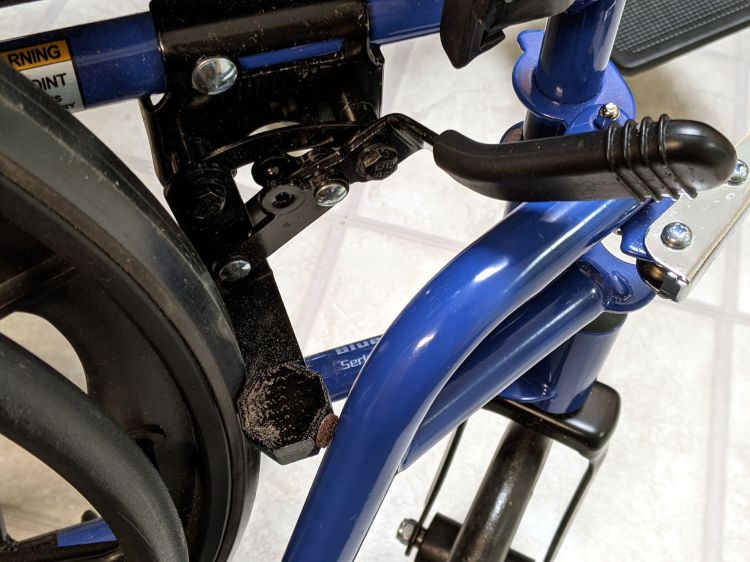
The wheelchair brake lever seems to have been designed by somebody who never actually had to shove it very often:
Because a yellow / amber LED runs at a lower voltage than blue and green LEDs, it sits atop an astable multivibrator, rather than a discrete LM3909. The battery holder has a pair of carbon-zinc “Extra-Heavy Duty” AAA cells, so corrosion and leakage pose a foreseeable hazard.
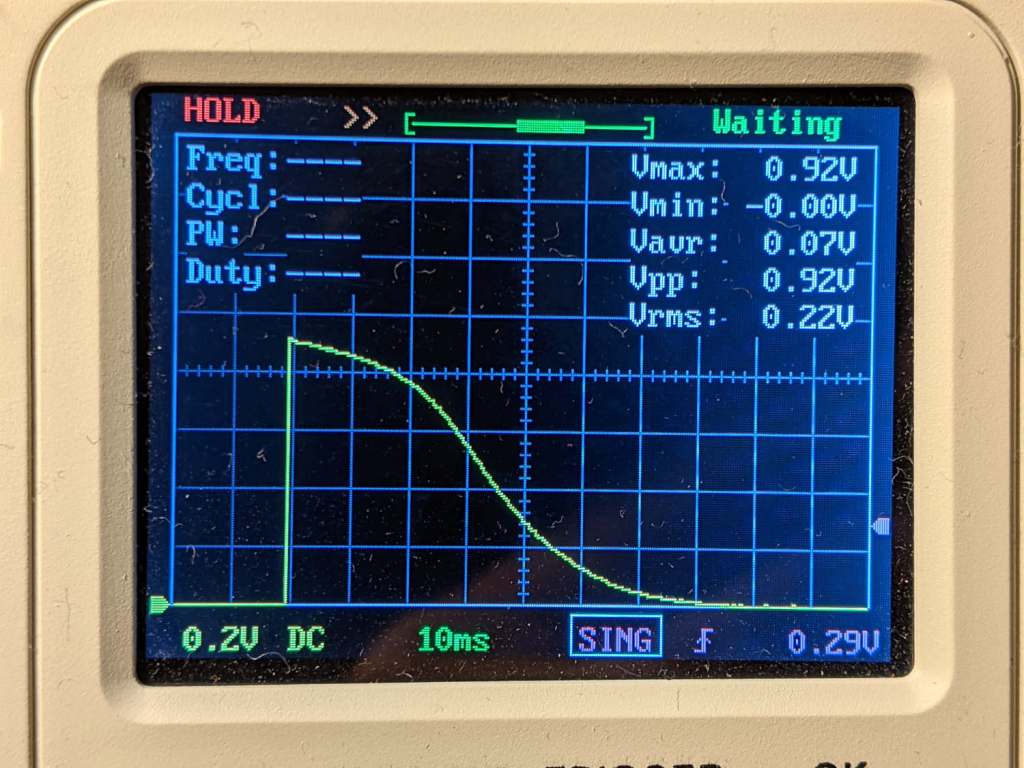
The voltage across the 100 Ω LED ballast indicates a 9 mA peak LED current, which is somewhat dim in ordinary room light:
Astable AA – Amber – LED current 100 ohm
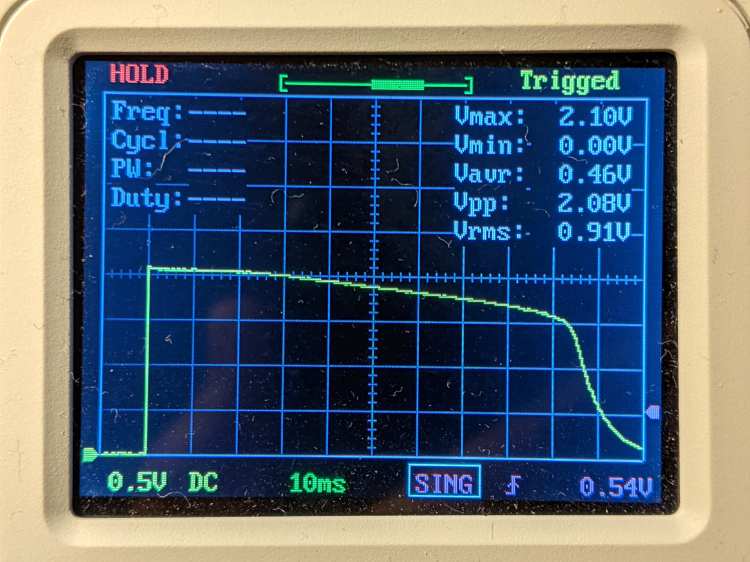
The corresponding LED voltage says the LED runs at 2.1 V for that much current:
Astable AA – Amber – LED V
Something around 39 Ω should make it more visible.
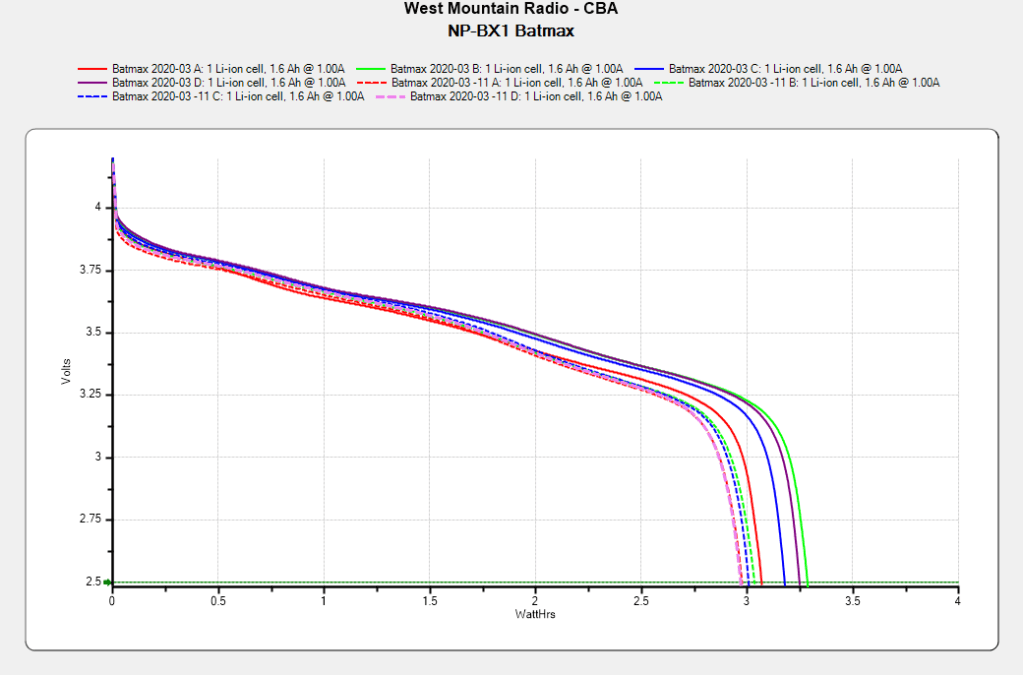
After powering my Sony HDR-AS30V helmet camera for nearly all of this year’s riding, the Batmax NP-BX1 lithium batteries still have roughly 90% of their original capacity:
Batmax NP-BX1 – 2020-11
Those are hot off the Official Batmax charger, which appears identical to other randomly named chargers available on Amazon.
They’re holding up much better after a riding season than the DOT-01 batteries I used two years ago:
Sony DOT-01 NP-BX1 – 2019-10-29
Empirically, they power the camera for about 75 minutes, barely enough for our typical rides. I should top off the battery sitting in the camera unused for a few days, although that hasn’t happened yet.
Of course, the Batmax NP-BX1 batteries I might order early next year for the new riding season have little relation to the ones you see here.
That’s the 5 mm punch, where being (at least) half a millimeter off-center matters more than it would in the 32 mm punch.
Unscrewing the painfully awkward screw in the side releases the pilot:
Neiko hole punch – punch tip debris
The debris on the back end of the pilot is a harbinger of things to come:
Neiko hole punch – damaged spring debris
Looks like whoever was on spring-cutting duty nicked the next coil with the cutoff wheel. I have no idea where the steel curl came from, as it arrived loose inside the spring.
Although it doesn’t appear here, I replaced that huge screw with a nice stainless steel grub screw that doesn’t stick out at all.
Chucking the pilot in the lathe suggested it was horribly out of true, but cleaning the burrs off the outside diameter and chamfering the edges with a file improved it mightily. Filing doesn’t remove much material, so apparently the pilot is supposed to have half a millimeter of free play in the handle:
Neiko hole punch – undersized pilot
That’s looking down at the handle, without a punch screwed onto the threads surrounding the pilot.
Wrapping a rectangle of 2 mil brass shimstock into a cylinder around the pilot removed the slop:
Neiko hole punch – cleaned tip brass shim
But chucking the handle in the lathe showed the pilot was still grossly off-center, so I set it up for boring:
Neiko hole punch – boring setup
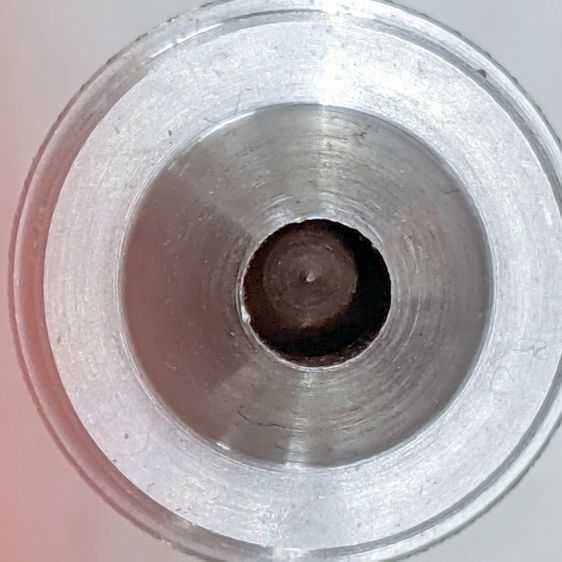
The entry of the hole was comfortingly on-axis, but the far end was way off-center. I would expect it to be drilled on a lathe and, with a hole that size, it ought to go right down the middle. I’ve drilled a few drunken holes, though.
Truing the hole enlarged it enough to require a 0.5 mm shimstock wrap, but the pilot is now pretty much dead on:
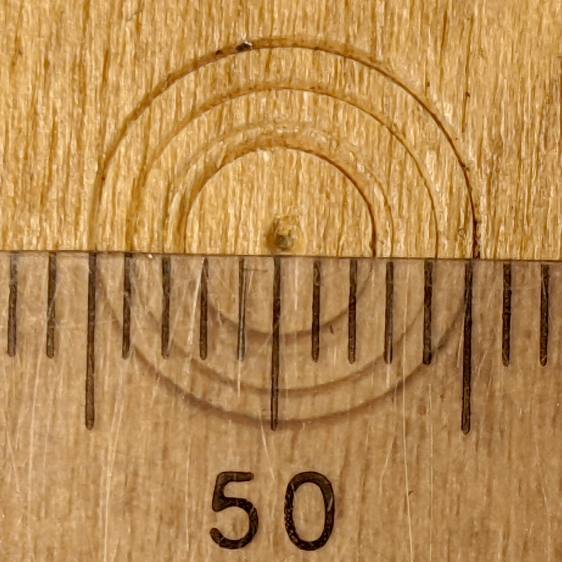
Neiko hole punch – accurized results
Those are 5, 6, 8, and 10 mm punches whacked into a plywood scrap; looks well under a quarter millimeter to me and plenty good enough for what I need.
This past summer we replaced a worn-out vegetable peeler with what was allegedly a high-quality Linden Jonas peeler. It worked quite well, which it should have, given that it cost nigh onto seven bucks, until I recently backed over it with my wheelchair (about which, more later) and smashed it flat.
World+dog having recently discovered the virtues of home-cooked meals, the replacement cost nigh onto ten bucks and, through the wonders of Amazon, came from a different seller, albeit with a letter-for-letter identical description:
Linden Jonas peeler orders
With a spare in the kitchen, I applied some shop-fu to unbend the first peeler:
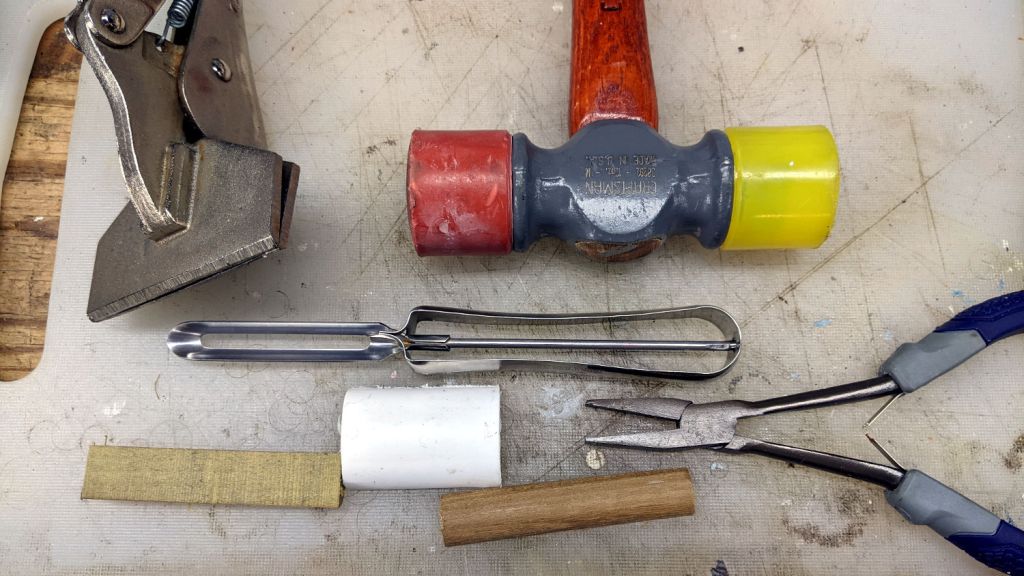
Jonas peeler – reshaping tools
Tapping the handle against the bandsawed dowel sufficed to remove the sharpest bends. The final trick involved clamping one edge of the handle to the section cut from a thread spool, resting the Vise-Grip on the bench vise, and whacking the other edge with the rubber mallet to restore the smooth curve around the main axis, repeating the process along the other side, then hand-forming the gentle curve closer to the blade. It ain’t perfect and never will be, but it’s once again comfortable in the hand.
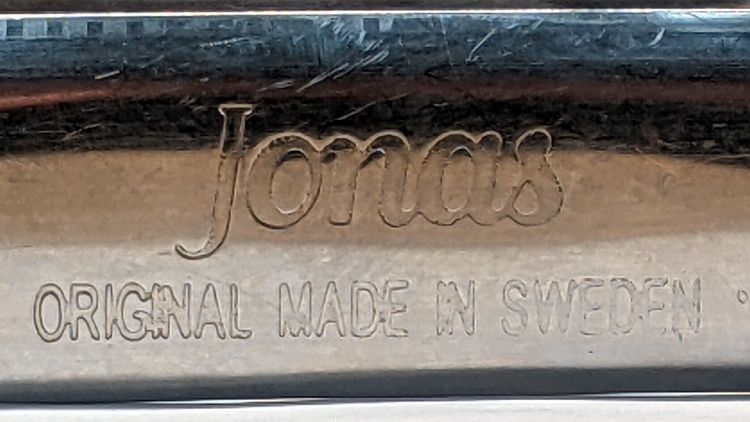
During that process I had plenty of time to admire the identification stamped into the handle:
Jonas peeler – weak emboss
Which, frankly, looks rather gritty on an allegedly high-quality product from a Swedish factory.
Compare it with the new peeler:
Jonas peeler – good emboss
Now, that’s more like it.
The genuine Linden website doesn’t provide much detail, so I can’t be absolutely sure which peeler is a counterfeit, but it sure looks like at least one fails the sniff test. Linden’s site redirects to Amazon through a Google search link (!) that, given the way Amazon works, could result in anything appearing as a valid result:
As one should expect by now, Amazon’s commingled inventory produces a fair percentage of reviews complaining about craptastic peelers stamped “Made in China” from any of the sellers unearthed by that search.
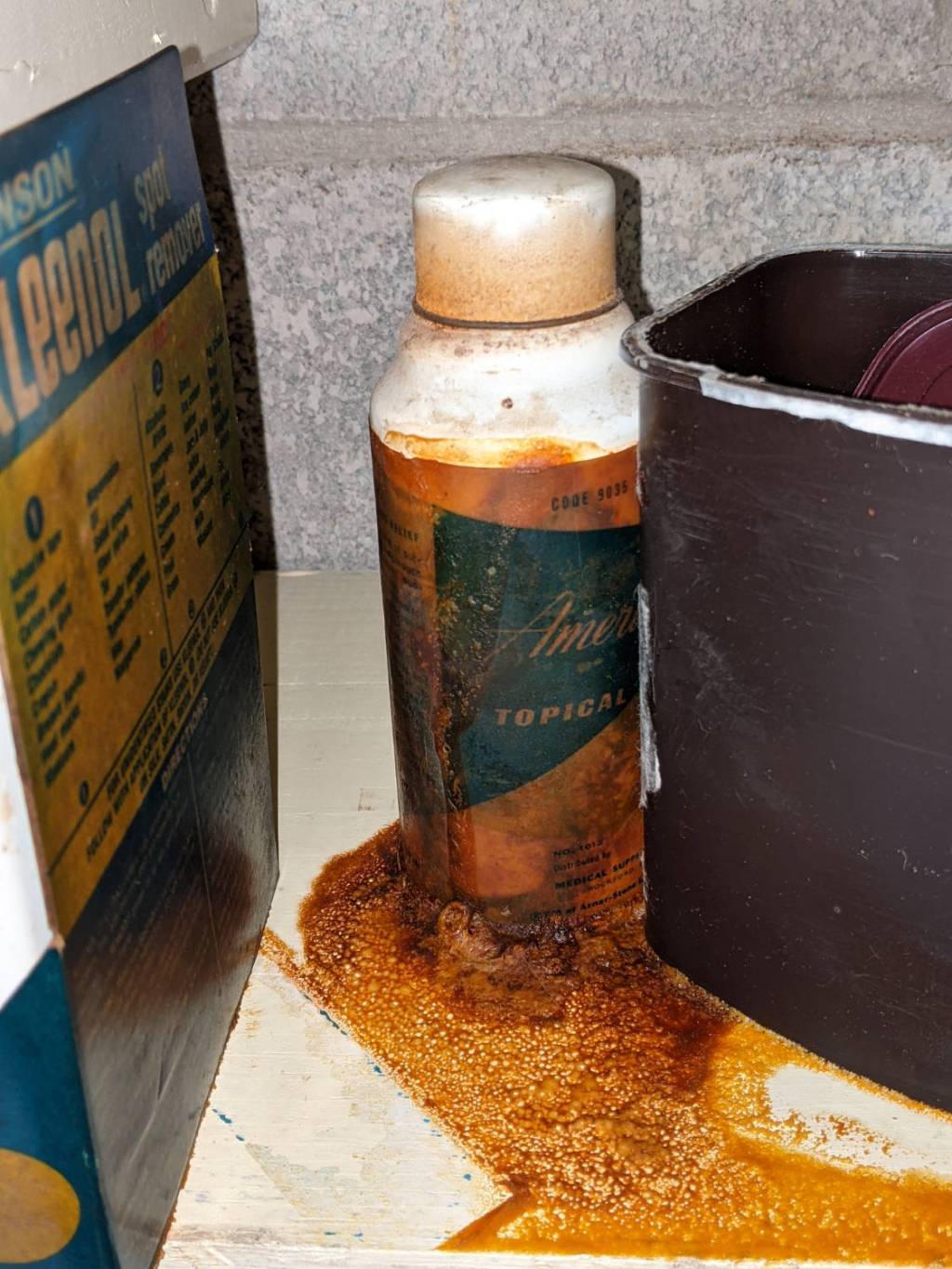
An odd smell in the Basement Laboratory Chemical Warehouse led to this discovery:
Leaking aerosol can
It’s a can of spray-on topical anesthetic That Came With The House™, so it’s almost certainly four decades old and, other than being moved to that shelf, hasn’t been touched in the last quarter century.
Surprisingly, the orange-brown goo wiped off the shelf almost completely. The similarly old box of stain remover on the left was a dead loss.












 The Smell of Molten Projects in the Morning