The Smell of Molten Projects in the Morning

Ed Nisley's Blog: Shop notes, electronics, firmware, machinery, 3D printing, laser cuttery, and curiosities. Contents: 100% human thinking, 0% AI slop.

Author: Ed

  • Walker Leg Shortening

    Walker Leg Shortening

    While looking for something else, Mary came across a walker in the attic and mentioned that, if she ever had to use it, the shortest position of the adjustable legs would put the hand grips too high for comfort. Maybe they

    Well, I can fix that:

    Walker shortening - hole indexing
    Walker shortening – hole indexing

    The holes are an inch apart, so I clamped the V blocks parallel to the X axis on the drill press, zeroed the X axis knob, slid the leg to get the drill bit into the last hole, clamp in place, crank the table an inch, then use a step drill to start the hole:

    Walker shortening - hole drilling
    Walker shortening – hole drilling

    The holes are just slightly larger than the 1/4 inch step on the drill, so the twist drill cuts them to size.

    A tubing cutter sliced an inch off all four legs and all four frame tubes:

    Walker shortening - latch relocation
    Walker shortening – latch relocation

    The white plastic fitting in the frame tube prevents the legs from rattling, but I had to drill another hole to move the latch button, too.

    With a bit of luck, we’ll never need the thing.

  • Simple Pliers Rack

    Simple Pliers Rack

    A Round Tuit™ finished this trivial project:

    Long-handle pliers rack
    Long-handle pliers rack

    Yeah, it’s just seven pairs of holes drilled with a 5/8 inch Forstner bit in a scrap 2×4, which was then introduced to Mr Belt Sander to peel off the dust of ages.

    There’s a spare set of holes in front because I’m absolutely certain that, without them, another pair of pliers would suddenly pop into existence on the bench.

  • Incandescent Bulb Lifetime: Also Better Than Average

    Incandescent Bulb Lifetime: Also Better Than Average

    This bulb spent the last seven-plus years of its life lighting the front bathroom:

    Dead incandescent bulb - 7 years
    Dead incandescent bulb – 7 years

    The green corrosion around the tip seems strange, given that we don’t use the tub or shower in that bathroom, and I’m pretty sure it wasn’t the cause of the failure.

    My stock of incandescent bulbs will eventually run out; I must figure out how to light the deaders in an attractive manner.

  • Lyme Disease, Now With Bonus Babesiosis

    Lyme Disease, Now With Bonus Babesiosis

    Two weeks of doxycycline should kill off all the Borrelia bacteria responsible for Lyme disease, but a blood test shows the antibodies:

    Lyme test - 2021-11-10
    Lyme test – 2021-11-10

    Those antibodies will gradually disappear during the next few months and, unfortunately, a past Lyme infection does not prevent future infections.

    The tick also injected Babesia parasites which do not respond to antibiotic treatment:

    Babesia test - 2021-11-10
    Babesia test – 2021-11-10

    The “titer” refers to the dilution required to produce a negative test result, with the 1:64 reference titer representing six successive 50% dilutions. My blood required ten 50% dilutions to produce a negative result for the IgG antibodies and (presumably) six 50% dilutions from a 20% base for the IgM antibodies.

    As I understand the situation, IgM antibodies appear promptly upon infection and IgG antibodies follow along later, so my reaction to the Babesia infestation was ramping up after two weeks.

    In the Bad Old Days™, quinine was the go-to treatment for parasitic infections, but it has a host of horrific side effects at the dosage required for traction against actual diseases; tonic water ain’t gonna get you where you need to go.

    The new hotness is atovaquone, arriving as 100 ml of a yellow liquid with the consistency of latex paint, (allegedly) the taste of “tutti fruitti“, and a price (modulo your drug plan) making inkjet printer ink look downright affordable. You might expect to get a 5 ml measuring spoon along the the bottle, but suffice it to say it’s an exceedingly good thing I’m well stocked for printer cartridge refilling.

    All of the diseases and drugs list “fatigue” / “drowsiness” / “malaise” as symptoms / side effects and I’m here to tell you knocking off a couple of hours in the recliner during the day does nothing at all to disturb another nine hours in the sack overnight.

    A few weeks of low productivity in the Basement Shop™ will definitely count as a successful outcome.

    Protip: We need permethrin spray. Lots permethrin spray.

  • Raymond Avenue Road Furniture Graveyard

    Raymond Avenue Road Furniture Graveyard

    Apparently the traffic calming features along Raymond Avenue sacrifice the road furniture:

    Smashed Raymond Avenue Road Furniture
    Smashed Raymond Avenue Road Furniture

    I hadn’t realized the “standards compliant” road design caused the death of so many street lights, but the dead bollard population is definitely under-represented. In round numbers, every traffic circle (“intersection”) always has at least one smashed bollard in addition to the vestigial stumps of those removed rather than being replaced.

    The upright bollard is a relic of the earliest installations, back before they realized a bollard with an eye-level light glaring into drivers’ eyes weren’t an effective design, particularly along a road lined with dead-black / non-reflective posts.

    Spotted in the Town of Poughkeepsie Highway Department compound.

  • CFL Lifetime: Better Than Average

    CFL Lifetime: Better Than Average

    Although compact fluorescent lamps have fallen out of favor, I’m burning through a box of the things donated by a friend who upgraded to LEDs and figured I could put them to good use. In general, complex electronic doodads (like CFL or even LED lamps) used in hostile situations (like an ordinary downlight fixture) seem to fail too quickly to justify the power savings; searching for “cfl fail” will produce some evidence from around here.

    One of the downlights in the Basement Office just killed this specimen:

    Dead CFL - detail
    Dead CFL – detail

    Much to my surprise, however, it survived for more than five years:

    Dead CFL - over 5 years
    Dead CFL – over 5 years

    The previous CFL bulb in that fixture lasted only two years, so their average lifetime is entirely too short.

    A taller bulb does a better job of lighting up that corner, although it started with enough power-on hours to suggest it won’t survive for another five years:

    Dead CFL - replacement
    Dead CFL – replacement

    The ghostly humps above the overexposed glare are the long CFL tubes reflected inside the Pixel’s camera optics.

    I didn’t see much point in nailing a ceiling to too-low floor joists.

  • Alpha Geek Clock: Radome Update

    Alpha Geek Clock: Radome Update

    There being nothing like a new problem to take one’s mind off all one’s old problems:

    C-Max CMMR-60 WWVB receiver - D cell display holder
    C-Max CMMR-60 WWVB receiver – D cell display holder

    It’s a variation on the camera battery and AA alkaline holders for various blinky LEDs:

    Astable Multivibrator - D cell WWVB
    Astable Multivibrator – D cell WWVB

    The little flag holding the C-Max CMMR-60 receiver PCB gets glued to the copper upright to keep it from swiveling in the breeze.

    The conical caps on the ferrite bar antenna are glued to the uprights and the antenna, in the expectation this is a one-off build-only project.

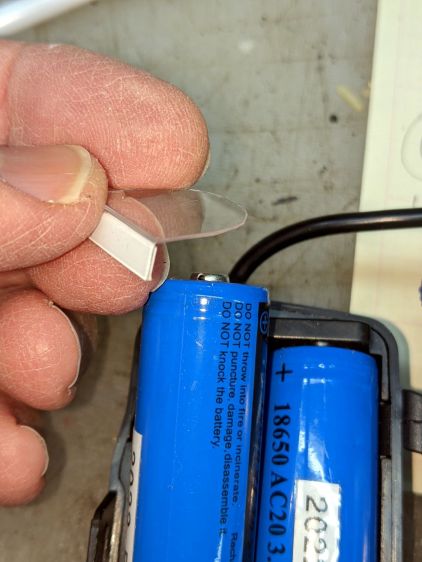
    Rather than buy specialized D-cell contacts, I used 18650 lithium cell contacts and conjured the bridge by soldering two together:

    D cell bridge contact from 18650 contacts
    D cell bridge contact from 18650 contacts

    It sits on the windowsill, blinks quietly in the dark, and flickers invisibly during the daytime.

    Those D cells came from the same batch that powered the previous version for the last five years, so they probably won’t last that long, even with a Nov 2024 date code.

    C-Max is apparently out of the WWVB biz, but you can get a similar Canaduino AM WWVB receiver.

    The far more complex EverSet ES100-MOD WWVB receiver requires a microcontroller with an I²C interface and very careful power management.

    The OpenSCAD source code as a GitHub Gist:

    // Astable Multivibrator
    // Holder for Alkaline cells
    // Ed Nisley KE4ZNU August 2020
    // 2020-09 add LED radome
    // 2020-11 add radome trim
    // 2021-11 D cells and WWVB receiver
    /* [Layout options] */
    Layout = "Build"; // [Build,Show,Lid,Spider,AntCap,RecFlag]
    CellName = "AA"; // [AA, D]
    Struts = -1; // [0:None, -1:Dual, 1:Quad]
    WWVB = true;
    /* [Hidden] */
    NumCells = 2; // [2]
    // Extrusion parameters
    /* [Hidden] */
    ThreadThick = 0.25;
    ThreadWidth = 0.40;
    HoleWindage = 0.2;
    function IntegerMultiple(Size,Unit) = Unit * ceil(Size / Unit);
    function IntegerLessMultiple(Size,Unit) = Unit * floor(Size / Unit);
    Protrusion = 0.1; // make holes end cleanly
    inch = 25.4;
    //- Basic dimensions
    WallThick = IntegerMultiple(3.0,ThreadWidth);
    CornerRadius = WallThick/2;
    FloorThick = IntegerMultiple(3.0,ThreadThick);
    TopThick = IntegerMultiple(2.0,ThreadThick);
    WireOD = 1.5; // battery & LED wiring
    WireOC = 8.0; // hole spacing in lid
    Gap = 5.0;
    // Cylindrical cell sizes
    // https://en.wikipedia.org/wiki/List_of_battery_sizes#Cylindrical_batteries
    CELL_NAME = 0;
    CELL_OD = 1;
    CELL_OAL = 2;
    // FIXME search() needs special-casing to properly find AAA and AAAA
    // Which is why CellName is limited to AA
    CellData = [
    ["AAAA",8.3,42.5],
    ["AAA",10.5,44.5],
    ["AA",14.5,50.5],
    ["C",26.2,50],
    ["D",34.2,61.5],
    ["A23",10.3,28.5],
    ["CR123A",17.0,34.5],
    ["18650",18.8,65.2], // bare 18650 with button end
    ["18650Prot",19.0,70.0], // protected 18650 = 19670 plus a bit
    ];
    CellIndex = search([CellName],CellData,1,0)[0];
    echo(str("Cell index: ",CellIndex," = ",CellData[CellIndex][CELL_NAME]));
    //- Contact dimensions
    CONTACT_NAME = 0;
    CONTACT_WIDE = 1;
    CONTACT_HIGH = 2;
    CONTACT_THICK = 3; // plate thickness
    CONTACT_TIP = 4; // tip to rear face
    CONTACT_TAB = 5; // solder tab width
    ContactData = [
    ["AA+",12.2,12.2,0.3,1.7,3.5], // pos bump
    ["AA-",12.2,12.2,0.3,5.0,3.5], // half-compressed neg spring
    ["AA+-",28.2,12.2,0.3,5.0,0], // pos-neg bridge
    ["D+",18.5,16.0,0.3,2.8,5.5],
    ["D-",18.5,16.0,0.3,6.0,5.5],
    ["D+-",50.0,19.0,0.3,7.0,0], // solder +/- tabs together
    ["Li+",18.5,16.0,0.3,2.8,5.5],
    ["Li-",18.5,16.0,0.3,6.0,5.5],
    ];
    function ConDat(name,dim) = ContactData[search([name],ContactData,1,0)[0]][dim];
    ContactRecess = 2*ConDat(str(CellName,"+"),CONTACT_THICK);
    ContactOC = CellData[CellIndex][CELL_OD];
    WireBay = 6.0; // room for wiring to contacts
    //- Wire struts
    StrutDia = 1.6; // AWG 14 = 1.6 mm
    StrutSides = 3*4;
    ID = 0;
    OD = 1;
    LENGTH = 2;
    StrutBase = [StrutDia,StrutDia + 2*5*ThreadWidth, // ID = wire, OD = buildable
    FloorThick + CellData[CellIndex][CELL_OD]]; // LENGTH = base is flush with cell top
    //- Holder dimensions
    BatterySize = [CellData[CellIndex][CELL_OAL] + // cell
    ConDat(str(CellName,"+"),CONTACT_TIP) + // pos contact
    ConDat(str(CellName,"-"),CONTACT_TIP) – // neg contact
    2*ContactRecess, // sink into wall
    NumCells*CellData[CellIndex][CELL_OD],
    CellData[CellIndex][CELL_OD]
    ];
    echo(str("Battery space: ",BatterySize));
    CaseSize = [3*WallThick + // end walls + wiring partition
    BatterySize.x + // cell
    WireBay, // wiring bay
    2*WallThick + BatterySize.y,
    FloorThick + BatterySize.z
    ];
    echo(str("CaseSize: ",CaseSize));
    BatteryOffset = (CaseSize.x – (2*WallThick +
    CellData[CellIndex][CELL_OAL] +
    ConDat(str(CellName,"-"),CONTACT_TIP))
    ) /2 ;
    ThumbRadius = 0.75 * CaseSize.z;
    StrutOC = [IntegerLessMultiple(CaseSize.x – 2*CornerRadius -2*StrutBase[OD],5.0),
    IntegerMultiple(CaseSize.y + StrutBase[OD],5.0)];
    StrutAngle = atan(StrutOC.y/StrutOC.x);
    echo(str("Strut OC: ",StrutOC));
    LidSize = [2*WallThick + WireBay + ConDat(str(CellName,"+"),CONTACT_THICK), CaseSize.y, FloorThick/2];
    LidScrew = [2.0,3.8,7.0]; // M2 pan head screw (LENGTH = threaded)
    LidScrewOC = CaseSize.y/2 – CornerRadius – LidScrew[OD]; // allow space around screw head
    //- Piranha LEDs
    PiranhaBody = [8.0,8.0,8.0]; // Z = heatsink fins + plastic body + lens
    PiranhaPin = 0.0; // trimmed pin length beyond heatsink
    PiranhaPinsOC = [5.0,5.0]; // pin XY distance
    PiranhaRecess = PiranhaBody.z + PiranhaPin/2; // minimum LED recess depth
    BallOD = 40.0; // radome sphere
    BallSides = 4*3*4; // nice smoothness
    PillarOD = norm([PiranhaBody.x,PiranhaBody.y]) + 2*WallThick;
    BallChordM = BallOD/2 – sqrt(pow(BallOD/2,2) – (pow(PillarOD,2))/4);
    echo(str("Ball chord depth: ",BallChordM));
    RadomePillar = [norm([PiranhaBody.x,PiranhaBody.y]), // ID = LED diagonal
    PillarOD,
    FloorThick + PiranhaRecess + BallChordM]; // height to top of ball chord
    echo(str("Pillar: ",RadomePillar));
    RadomeBar = [StrutBase[OD]*cos(180/StrutSides),StrutOC.y,StrutBase[OD]/2];
    Tape = [RadomePillar[ID],16.0,1.0]; // sticky tape disk, OD to match hole punch
    //- WWVB receiver hardware
    Antenna = [10.0 + 0.5,14.0,60.0 + 2.0]; // ferrite antenna bar with clearance
    AntCapSize = [Antenna[ID] + 1.0,Antenna[OD],5.0]; // LENGTH=insertion
    RecPCB = [24.0,16.0,5.0];
    //———————-
    // Useful routines
    module PolyCyl(Dia,Height,ForceSides=0) { // based on nophead's polyholes
    Sides = (ForceSides != 0) ? ForceSides : (ceil(Dia) + 2);
    FixDia = Dia / cos(180/Sides);
    cylinder(r=(FixDia + HoleWindage)/2,h=Height,$fn=Sides);
    }
    // Spider for single LED atop struts, with the ball
    module DualSpider() {
    difference() {
    union() {
    for (j=[-1,1]) {
    for (k=[-1,1])
    translate([0,j*StrutOC.y/2,k*RadomeBar.z])
    rotate(180/StrutSides)
    sphere(d=StrutBase[OD]/cos(180/StrutSides),$fn=StrutSides);
    translate([0,j*StrutOC.y/2,0])
    rotate(180/StrutSides)
    cylinder(d=StrutBase[OD],h=2*RadomeBar.z,center=true,$fn=StrutSides);
    }
    cube(RadomeBar,center=true); // connecting bar
    cylinder(d=RadomePillar[OD],h=RadomePillar[LENGTH],$fn=BallSides);
    translate([0,0,-RadomeBar.z/2])
    cylinder(d1=0.9*RadomePillar[OD],d2=RadomePillar[OD],h=RadomeBar.z/2,$fn=BallSides);
    }
    for (j=[-1,1]) // strut wires
    translate([0,j*StrutOC.y/2,-3*StrutBase[OD]/2])
    rotate(180/StrutSides)
    PolyCyl(StrutBase[ID],2*StrutBase[OD],StrutSides);
    for (k=[-1,1]) // LED wiring through bar
    translate([0,k*(StrutOC.x/2 – 2*RadomeBar.x),-RadomeBar.z])
    rotate(180/6)
    PolyCyl(StrutBase[ID],2*RadomeBar.z,6);
    translate([0,0,BallOD/2 + RadomePillar[LENGTH] – BallChordM]) // ball inset
    sphere(d=BallOD);
    translate([0,0,BallOD/2 + RadomePillar[LENGTH] – BallChordM – Tape[LENGTH]/2]) // tape inset
    intersection() {
    sphere(d=BallOD);
    cylinder(d=Tape[OD],h=2*BallOD,center=true);
    }
    translate([0,0,RadomePillar.z – PiranhaRecess + RadomePillar.z/2]) // LED inset
    cube(PiranhaBody + [HoleWindage,HoleWindage,RadomePillar.z],center=true); // XY clearance
    translate([0,0,StrutBase[OD]/4 + WireOD/2 + 0*Protrusion]) // wire channels
    cube([WireOD,RadomePillar[OD] + 2*WallThick,WireOD],center=true);
    }
    }
    //– WWVB antenna support cap
    module AntennaBar() {
    rotate([90,0,0])
    union() {
    cylinder(d=Antenna[ID],h=Antenna[LENGTH],$fn=BallSides,center=true);
    cylinder(d=2*Antenna[OD],h=Antenna[LENGTH] – 2*AntCapSize[LENGTH],$fn=BallSides,center=true);
    }
    }
    module AntennaCap() {
    rotate([90,0,0])
    intersection() {
    translate([0,-Antenna[LENGTH]/2 + AntCapSize[LENGTH],0])
    difference() {
    hull() {
    rotate([90,0,0])
    cylinder(d=AntCapSize[OD],h=Antenna[LENGTH],$fn=BallSides,center=true);
    for (j=[-1,1])
    translate([0,j*StrutOC.y/2,0])
    rotate(180/StrutSides)
    cylinder(d=StrutBase[OD],h=1*StrutBase[OD],$fn=StrutSides,center=true);
    }
    for (j=[-1,1])
    translate([0,j*StrutOC.y/2,-Antenna[OD]/2])
    rotate(180/StrutSides)
    PolyCyl(StrutBase[ID],Antenna[OD],StrutSides);
    AntennaBar();
    }
    rotate([-90,0,0])
    cylinder(d=Antenna[OD],h=Antenna[LENGTH],center=false);
    }
    }
    //– WWVB PCB support flag
    module RecFlag() {
    difference() {
    hull() {
    rotate(180/StrutSides)
    cylinder(d=StrutBase[OD],h=RecPCB.x,$fn=StrutSides);
    translate([0,RecPCB.y,0])
    rotate(180/StrutSides)
    cylinder(d=StrutBase[OD],h=RecPCB.x,$fn=StrutSides);
    }
    translate([0,0,-Protrusion])
    rotate(180/StrutSides)
    PolyCyl(StrutBase[ID],2*RecPCB.x,StrutSides);
    translate([0,StrutBase[OD]/2,-Protrusion])
    cube([StrutBase[OD],RecPCB.y,2*RecPCB.x],center=false);
    }
    }
    //– Overall case with origin at battery center
    module Case() {
    union() {
    difference() {
    union() {
    hull()
    for (i=[-1,1], j=[-1,1])
    translate([i*(CaseSize.x/2 – CornerRadius),
    j*(CaseSize.y/2 – CornerRadius),
    0])
    cylinder(r=CornerRadius/cos(180/8),h=CaseSize.z,$fn=8); // cos() fixes undersize spheres!
    if (Struts)
    for (i = (Struts == 1) ? [-1,1] : -1) { // strut bases
    hull()
    for (j=[-1,1])
    translate([i*StrutOC.x/2,j*StrutOC.y/2,0])
    rotate(180/StrutSides)
    cylinder(d=StrutBase[OD],h=StrutBase[LENGTH],$fn=StrutSides);
    translate([i*StrutOC.x/2,0,StrutBase[LENGTH]/2])
    cube([2*StrutBase[OD],StrutOC.y,StrutBase[LENGTH]],center=true); // blocks for fairing
    for (j=[-1,1]) // hemisphere caps
    translate([i*StrutOC.x/2,
    j*StrutOC.y/2,
    StrutBase[LENGTH]])
    rotate(180/StrutSides)
    sphere(d=StrutBase[OD]/cos(180/StrutSides),$fn=StrutSides);
    }
    }
    translate([BatteryOffset,0,BatterySize.z/2 + FloorThick]) // cells
    cube(BatterySize + [0,0,Protrusion],center=true);
    translate([BatterySize.x/2 + BatteryOffset + ContactRecess/2 – Protrusion/2, // contacts
    0,
    BatterySize.z/2 + FloorThick])
    cube([ContactRecess + Protrusion,
    ConDat(str(CellName,"+-"),CONTACT_WIDE),
    ConDat(str(CellName,"+-"),CONTACT_HIGH)
    ],center=true);
    translate([-(BatterySize.x/2 – BatteryOffset + ContactRecess/2 – Protrusion/2),
    ContactOC/2,
    BatterySize.z/2 + FloorThick])
    cube([ContactRecess + Protrusion,
    ConDat(str(CellName,"+"),CONTACT_WIDE),
    ConDat(str(CellName,"+"),CONTACT_HIGH)
    ],center=true);
    translate([-(BatterySize.x/2 – BatteryOffset + ContactRecess/2 – Protrusion/2),
    -ContactOC/2,
    BatterySize.z/2 + FloorThick])
    cube([ContactRecess + Protrusion,
    ConDat(str(CellName,"-"),CONTACT_WIDE),
    ConDat(str(CellName,"-"),CONTACT_HIGH)
    ],center=true);
    translate([-CaseSize.x/2 + WireBay/2 + WallThick, // wire bay with screw bosses
    0,
    BatterySize.z/2 + FloorThick + Protrusion/2])
    cube([WireBay,
    2*LidScrewOC – LidScrew[ID] – 2*4*ThreadWidth,
    BatterySize.z + Protrusion
    ],center=true);
    for (j=[-1,1]) // screw holes
    translate([-CaseSize.x/2 + WireBay/2 + WallThick,
    j*LidScrewOC,
    CaseSize.z – LidScrew[LENGTH] + Protrusion])
    PolyCyl(LidScrew[ID],LidScrew[LENGTH],6);
    for (j=[-1,1])
    translate([-(BatterySize.x/2 – BatteryOffset + WallThick/2), // contact tabs
    j*ContactOC/2,
    BatterySize.z + FloorThick – Protrusion])
    cube([2*WallThick,
    ConDat(str(CellName,"+"),CONTACT_TAB),
    (BatterySize.z – ConDat(str(CellName,"+"),CONTACT_HIGH))
    ],center=true);
    if (false)
    translate([0,0,CaseSize.z]) // finger cutout
    rotate([90,00,0])
    cylinder(r=ThumbRadius,h=2*CaseSize.y,center=true,$fn=22);
    if (Struts)
    for (i2 = (Struts == 1) ? [-1,1] : -1) { // strut wire holes and fairing
    for (j=[-1,1])
    translate([i2*StrutOC.x/2,j*StrutOC.y/2,FloorThick])
    rotate(180/StrutSides)
    PolyCyl(StrutBase[ID],2*StrutBase[LENGTH],StrutSides);
    for (i=[-1,1], j=[-1,1]) // fairing cutaways
    translate([i*StrutBase[OD] + (i2*StrutOC.x/2),
    j*StrutOC.y/2,
    -Protrusion])
    rotate(180/StrutSides)
    PolyCyl(StrutBase[OD],StrutBase[LENGTH] + 2*Protrusion,StrutSides);
    }
    translate([0,0,ThreadThick – Protrusion]) // recess around name
    cube([51.0,15,2*ThreadThick],center=true);
    }
    linear_extrude(height=2*ThreadThick + Protrusion,convexity=10) {
    translate([0,-3.5,0])
    mirror([0,1,0])
    text(text="softsolder",size=6,spacing=1.20,font="Arial:style:Bold",halign="center",valign="center");
    translate([0,3.5,0])
    mirror([0,1,0])
    text(text=".com",size=6,spacing=1.20,font="Arial:style:Bold",halign="center",valign="center");
    }
    }
    }
    module Lid() {
    difference() {
    hull()
    for (i=[-1,1], j=[-1,1], k=[-1,1])
    translate([i*(LidSize.x/2 – CornerRadius),
    j*(LidSize.y/2 – CornerRadius),
    k*(LidSize.z – CornerRadius)]) // double thickness for flat bottom
    sphere(r=CornerRadius/cos(180/8),$fn=8);
    translate([0,0,-LidSize.z]) // remove bottom
    cube([(LidSize.x + 2*Protrusion),(LidSize.y + 2*Protrusion),2*LidSize.z],center=true);
    for (j=[-1,1]) // wire holes
    translate([0,j*WireOC/2,-Protrusion])
    PolyCyl(WireOD,2*LidSize.z,6);
    for (j=[-1,1])
    translate([0,j*LidScrewOC,-Protrusion])
    PolyCyl(LidScrew[ID],2*LidSize.z,6);
    }
    }
    //——————-
    // Show & build stuff
    if (Layout == "Case")
    Case();
    if (Layout == "Lid")
    Lid();
    if (Layout == "AntCap")
    AntennaCap();
    if (Layout == "RecFlag")
    RecFlag();
    if (Layout == "Spider")
    if (Struts == -1)
    DualSpider();
    else
    cube(10,center=true);
    if (Layout == "Build") {
    rotate(90)
    Case();
    translate([0,-(CaseSize.x/2 + LidSize.x/2 + Gap),0])
    rotate(90)
    Lid();
    if (Struts == -1) {
    difference() {
    union() {
    translate([CaseSize.x/2 + RadomePillar[OD],0,0])
    DualSpider();
    translate([-(CaseSize.x/2 + RadomePillar[OD]),0,0])
    rotate([180,0,0])
    DualSpider();
    }
    translate([0,0,-2*CaseSize.z])
    rotate(90)
    cube(4*CaseSize,center=true);
    }
    }
    if (WWVB) {
    for (i=[-1,1])
    translate([i*(Antenna[LENGTH]/2 – AntCapSize[LENGTH]),CaseSize.x/2 + Antenna[OD],0])
    AntennaCap();
    translate([0,CaseSize.x/2 + Antenna[OD],0])
    RecFlag();
    }
    }
    if (Layout == "Show") {
    Case();
    for (j=[-1,1])
    color("Brown",0.3)
    translate([-StrutOC.x/2,j*StrutOC.y/2,Protrusion])
    cylinder(d=StrutDia[ID],h=3*CaseSize.z,$fn=StrutSides);
    translate([-(CaseSize.x/2 – LidSize.x/2),0,(CaseSize.z + Gap)])
    Lid();
    if (Struts == -1)
    translate([-StrutOC.x/2,0,3*CaseSize.z])
    DualSpider();
    if (WWVB) {
    for (j=[-1,1])
    translate([-StrutOC.x/2,,j*(Antenna[LENGTH]/2 – AntCapSize[LENGTH]),1.5*CaseSize.z])
    rotate([-j*90,0,0])
    AntennaCap();
    translate([-StrutOC.x/2,,-(StrutOC.y/2),2*CaseSize.z])
    RecFlag();
    }
    }