What else would you call it?

It’s a test piece with adhesive sheets between acrylic layers:

From top to bottom:
- Acrylic 4.3 mm – sidewall to corral the junk
- Acrylic 1.5 mm – top plate
- Acrylic 2.4 mm – two layers
- Acrylic mirror 3 mm
- Cork 2 mm – PSA backing
The pair of 2.4 mm layers add up to just an itsy more than the 4.8 mm thickness of the shattered glass atop the mirror. Unlike previous epoxy sealed coasters, the glass sits on a sheet of 3M LSE adhesive film to keep the pieces together, with the top 1.5 mm acrylic layer containing any slivers. Because there’s no epoxy involved, the project is finished with no muss, no fuss, no curing time, and no drippy edges.
The geometry comes from a scan of the glass piece:

That’s the GIMP Quick Mask result of manually drawing around the perimeter with the center of a 25 pixel diameter pencil, thus creating a 12 pixel gap to ensure the glass will fit inside the cut shape: at 300 dpi, the 12 pixel gap is about 40 mil = 1 mm wide. Slightly less would work as well, although I’ve discovered some of the glass cuboids have non-vertical walls sticking out to the side above the scanner’s depth of field.
Scribbling over the interior with a bigger pencil clears it out and a few fill operations produce a binary mask perfectly suited for LightBurn’s Image Trace tool:
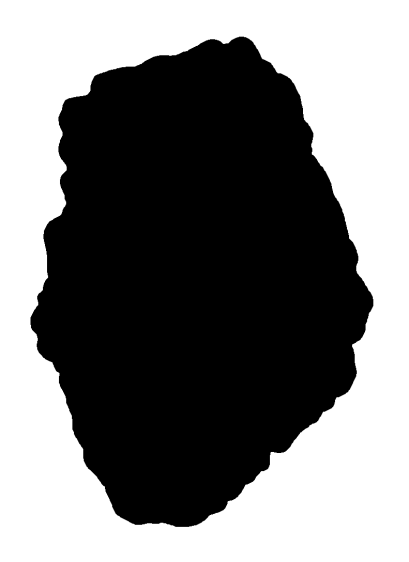
Trace that outline into vectors, throw away the mask, and use the outline for a conformal cut.
The rings of acrylic and adhesive are 3 mm wide, generated from the outline by offsetting it 3 mm outward:

The tooling circle around the perimeter simplifies drag-and-drop alignment, because the geometric center of the perimeter shape isn’t quite in the middle of where you’d (well, I’d) want to align it. Grouping the outline with the circle keeps the center snap point where it should be.
Narrow rings of adhesive sheet turned out to be even more unmanageable than I expected. Perhaps a better way:
- Cut the ring with tabs holding it to the center area
- Stick the ring + center to vinyl transfer tape
- Peel the protective paper off the adhesive ring
- Stick the acrylic ring atop the adhesive ring
- Sever the tabs to release the adhesive ring
- Peel the transfer tape off the ring
The “adhesive tape sheets for craft” are paper-based, rather than a plastic film, and are neither transparent nor durable. I used it mostly to get an idea of how well it sticks to acrylic, as it’s primarily intended for paper crafts.
The 3M LSE backing layer is plastic and the sheet becomes nearly transparent as the glass squishes down, although you wouldn’t want it on a mirror where you cared about the optical quality of the reflection. Underneath a chunk of smashed glass, it’s just fine.
All in all, it turned out well.
Next: how long does that craft adhesive last in abnormal conditions?
 The Smell of Molten Projects in the Morning
Comments
2 responses to “Layered Acrylic Smashed Glass Junk Collector”
[…] Pretty much as expected, the cheap craft adhesive sheet turned out to be inadequate to the task of holding the thin upper border ring onto the clutter collector: […]
[…] to see what happens, I tried cutting a shape from a scrap […]