Converting craft sticks into plant markers should be a mass-production process, which means a fixture is in order:

Admittedly, making ten markers at once barely qualifies as “mass production”, but you (well, I) can think of it a proof of concept.
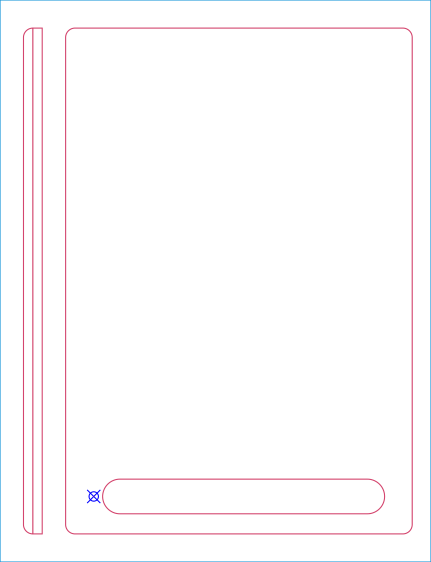
The basic shape comes from a 0.25 mm outset around the measured size of a craft stick (150×18 mm), plus an alignment target:
A good rule of thumb says never do any more work than absolutely necessary, so the rest of the fixture comes from linear arrays replicating the stick slots and targets:

The two strips over on the left (with a common cut down the middle) get glued to the underside of the fixture:
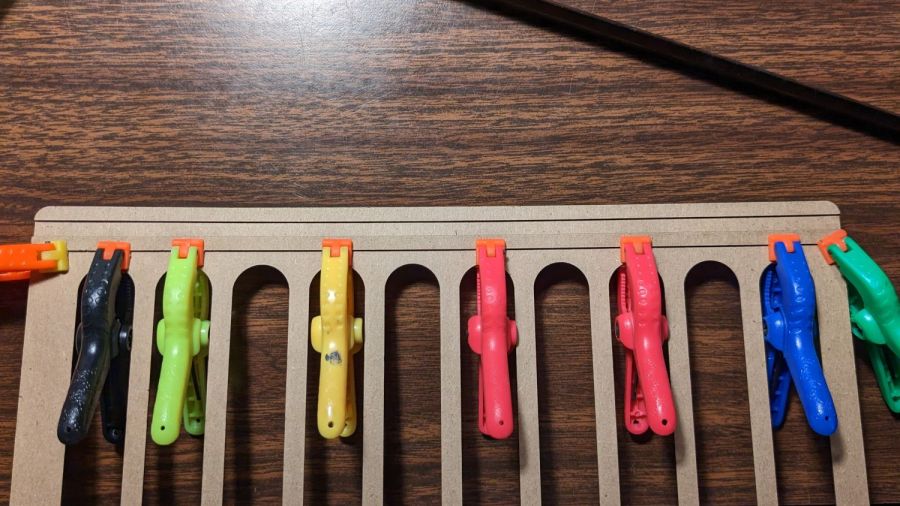
They’re exactly 5 mm apart to bracket one of the knife-edge bars supporting the fixture. The bar is upside-down to put its flat side upward:
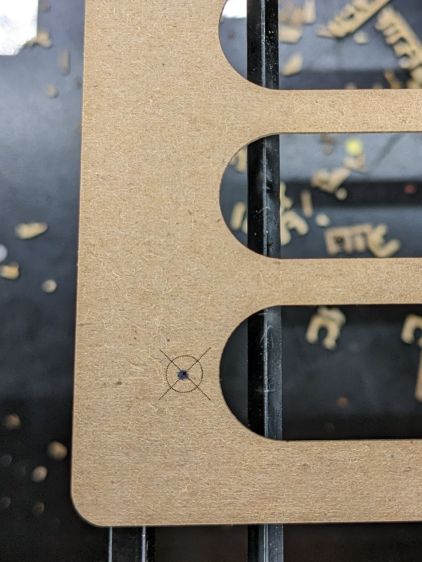
Yes, the fixture is made of chipboard, mostly because it’s about the same thickness as a craft stick and it’s cheap & readily available. Each target gets an ink blot to make it more conspicuous; there is also a tiny hole burned through the chipboard at the center to mark the other side for the strips.
Two knife-edge bars (sharp side up) support the sticks near their ends, well out of the cutting path, to prevent scorch marks:
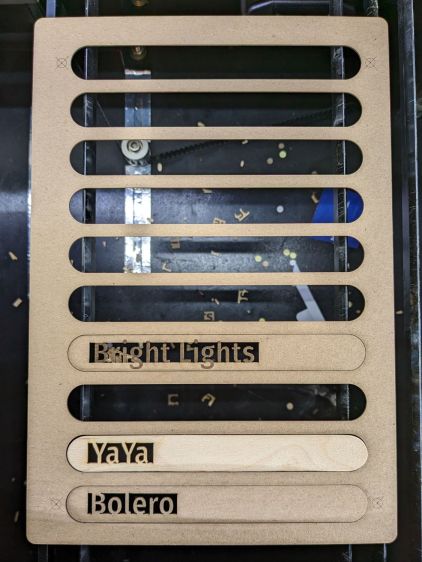
It’s worth noting the knife-edge bars are 5 mm wide and the platform spaces them on 3/8 inch = 9.525 mm centers. Not 10 mm, not 9.5 mm, exactly 3/8 inch. Kinda like the platform leadscrews: a 4 mm lead thread driven by a belt with 0.2 inch pitch. Only in America.
This doodle captures the key dimensions down there in the corner to work out where the strips should go:

Now, to convert names from a garden map into plant markers …
 The Smell of Molten Projects in the Morning
Comments
8 responses to “Craft Stick Plant Markers: Laser Fixture”
… why not just lay down a solid sheet of stickstoff and cut out the perimeter of each marker at the same time?
Craft sticks are probably a lot cheaper than sheets of the wood…
FWIW, much of my semiconductor days had to deal with mixed metric and ANSI measurements. Chip sizes were frequently millimeters in X and Y, and mils in thickness.
It was fairly early on (mid 1970s) that IC geometry dimensions went from fractions of a mil to microns (about the time that rubylith went obsolete–Thank You CAD people).
Because our Young Engineer left a couple of bags of craft sticks behind and these are way too big for mixing epoxy. :grin:
I’ve been more at peace with inches since I learned : “Since 1959 the inch has been defined officially as 2.54 cm.”
So when you use inches, you are really using metric anyway
Ah, but I loves me those integer sizes!
[…] the entire fixture layout onto a tool layer produces a template to align the text on the […]
[…] fixture has the same layout as the craft stick version, sized to fit the smaller sticks. They’re a bit thicker than the chipboard sheet, but match […]
[…] get glued on the bottom, spaced to align along one of the aluminum knife blade rails, as with the craft stick fixture. With that lined up, any two of the four targets will serve to align the template with the fixture […]