Before doing another spring constant test with the old Harbor Freight scale, I found deployed my cheap calibration weight sets to verify it displayed the right numbers:
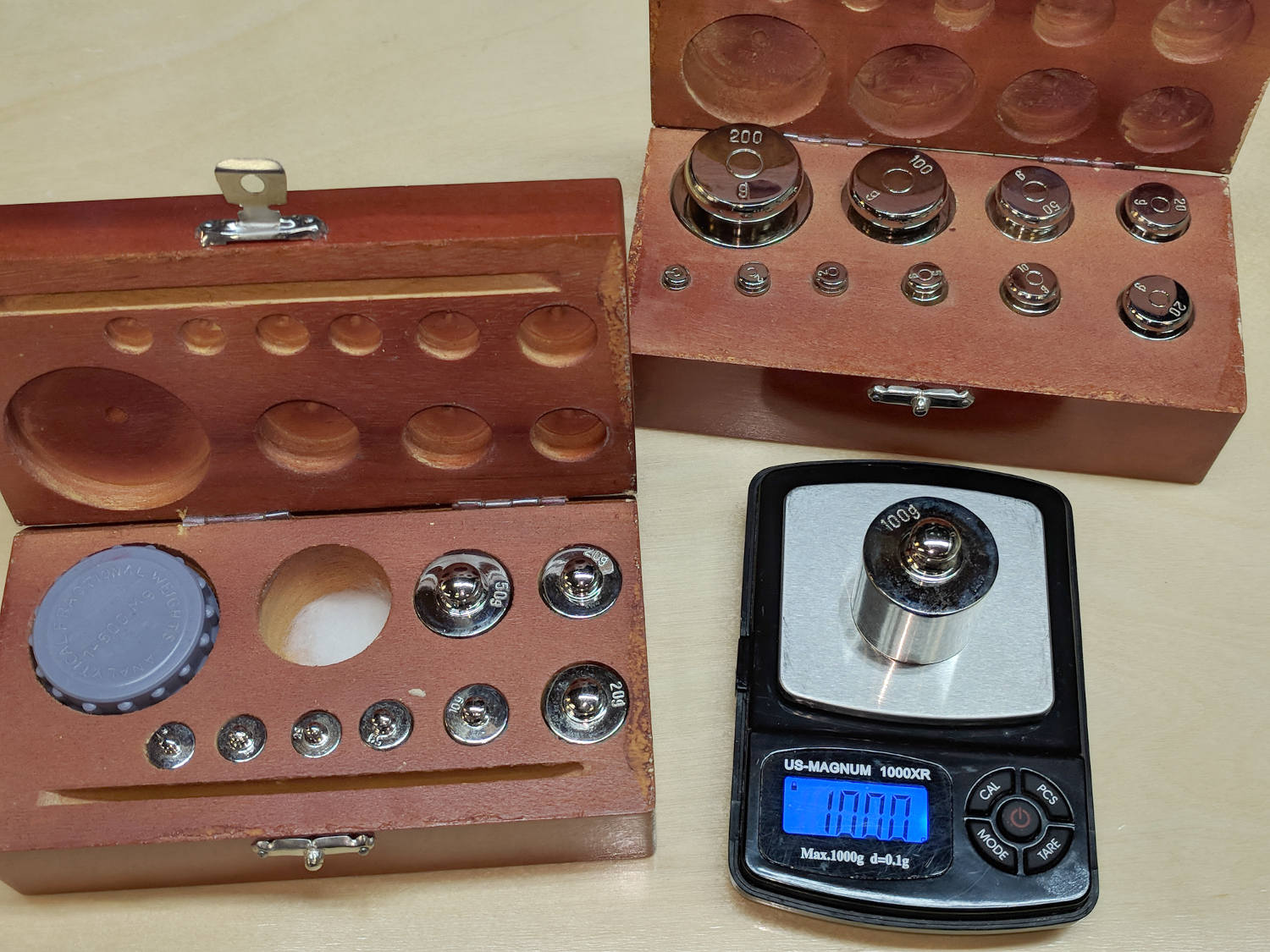
It’s spot on for all weights above 1 g, although I must tap the pan to settle on the reading from above for it get the last 0.1 g right.
Below 1 g, it’s the wrong hammer for the job; I expected no better from it.
 The Smell of Molten Projects in the Morning
Comments
6 responses to “Cheap Scale Calibration Check”
If you need accurate values below 1 gm, a powder scale would do the job. I haven’t hand loaded in ages, but the beam type was good below 1 grain (approx 1/15 gram), and there are electronic scales from the usual suspects. No idea if they’d have SI units, or if you’d be stuck with grains.
There’s a balance-beam powder scale in the heap, but it’s nowhere near convenient enough for anything other than powder!
Should I ever need a scale in that range, I’ll get something electronic with a flat pan instead of a hanging basket.
RCBS has a flat-pan electronic one for about $150. Grams and grains, and two 50gm calibration weights are included. They also have a set of calibrated weights. Batteries or wall-wart power supply. I noticed it has a 15-20 minute warmup time. Makes sense for such a small weight.
I have the beam powder scale, but when I was doing pistol, I’d use a fixed-cavity powder measure (the RCBS Little Dandy). It was wonderfully repeatable.
Measuring by fixed volumes has a lot to recommend it, particularly for granular material. Electronic strain-gauge balances seem to update in discrete (and sometimes nonlinear) increments while a (slow) stream adds to the pile.
I gotta get back into punching paper …
I have a 300g max, 0.01g cheapie that seem to do the job just fine. I keep it in g of course, but it does other units, including pcs for counting stuff like M3 nuts in bulk. I regularly mix 1g epoxy batches – yes I’m that frugal or maybe I could sell it as environmentally conscious :)
This one can count, too, but has trouble with units weighing less than a few grams. Cutting the range down from 1 kg and increasing the resolution would definitely help.
And, yeah, mixing small batches of epoxy by weight is the only way to get it right!