Obviously, the good folks at Park Tool never anticipated a three-cross spoke pattern on a 20 inch wheel:

It’s my trusty Park Tool TM-1 Spoke Tension Meter, unchanged since shortly after the turn of the millennium.
For future reference, the rebuilt wheel spoke tensions came out around 25, slightly lower than the 27-ish I measured on Mary’s bike; it didn’t occur to me to measure the tension until after I’d relaxed the spokes. I’ll ride it for a while before doing any tweakage.
The spoke pattern is pretty close to four-cross, due to the large-flange Phil Wood hubs:
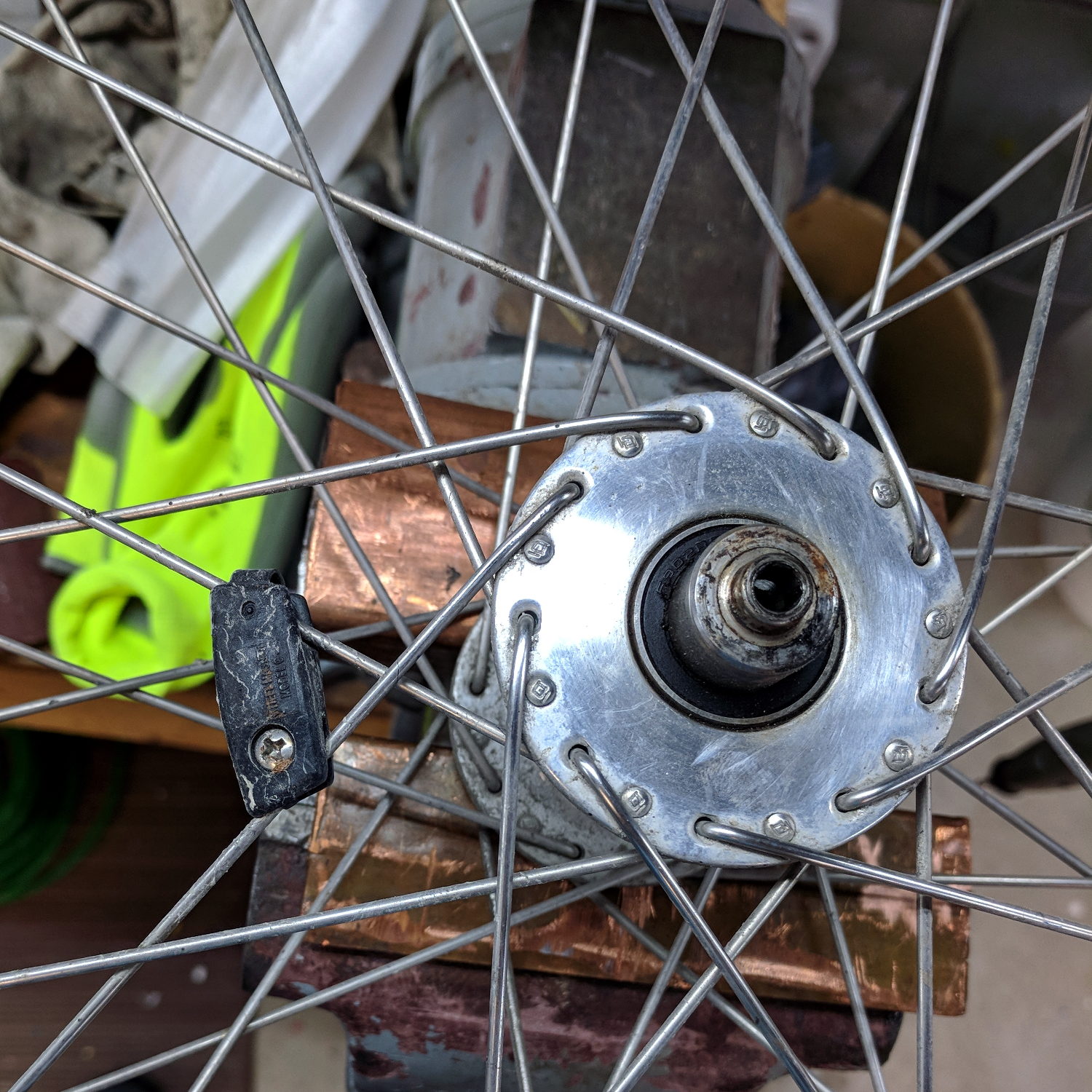
Which makes for a hella-strong wheel, particularly seeing as how it’s very lightly loaded. The Tour Easy we got for our lass came with a radially spoked rim around a Phil hub.
I transferred the hub and laced spokes intact to the new rim by the simple expedient of duct-taping the spokes into platters, removing the nipples, stacking the rims, sliding the spokes across into their new homes, reinstalling the nipples, then tightening as usual.
 The Smell of Molten Projects in the Morning
Comments
3 responses to “Park Spoke Tension Meter vs. 20 inch Wheel Spokes”
Question about tensioning spokes: when the tension is matched does the tone when you strike (or pluck) them match? Could you use that to balance the tension if you lacked a meter?
In theory, yes, but (in practice) I’m tone-deaf … [sigh]
I’ve never finished at equal tension all around, even with the wheel true / round / dished within a fractional millimeter. Without measuring every spoke, they’re maybe 22 to 27 and none sound particularly stressed or slack. After riding it for a few days, I expect it’ll be about the same, whereupon I’ll declare victory and move on.
When I built wheels (circa 1995), I’d do uniform tensioning, then rough-true the wheel. I’d measure tension at a couple of places, then finish truing. Seemed to work well with 26 and 27″/700cm wheels. The 20″ wheels in the Zephyr trike used custom hubs with flanges bigger than Phil Woods. I left them alone… OTOH, I didn’t ride the trike much; it was A Bad Idea to buy the prototype. Some bugs weren’t fixable. [yikes]