The Barbie-themed microscope light I built from an angel eye LED ring worked fine for the last six years (!), but a much brighter ring with 60 aimed 5 mm LEDs for $17 delivered from a US seller caught my eye:
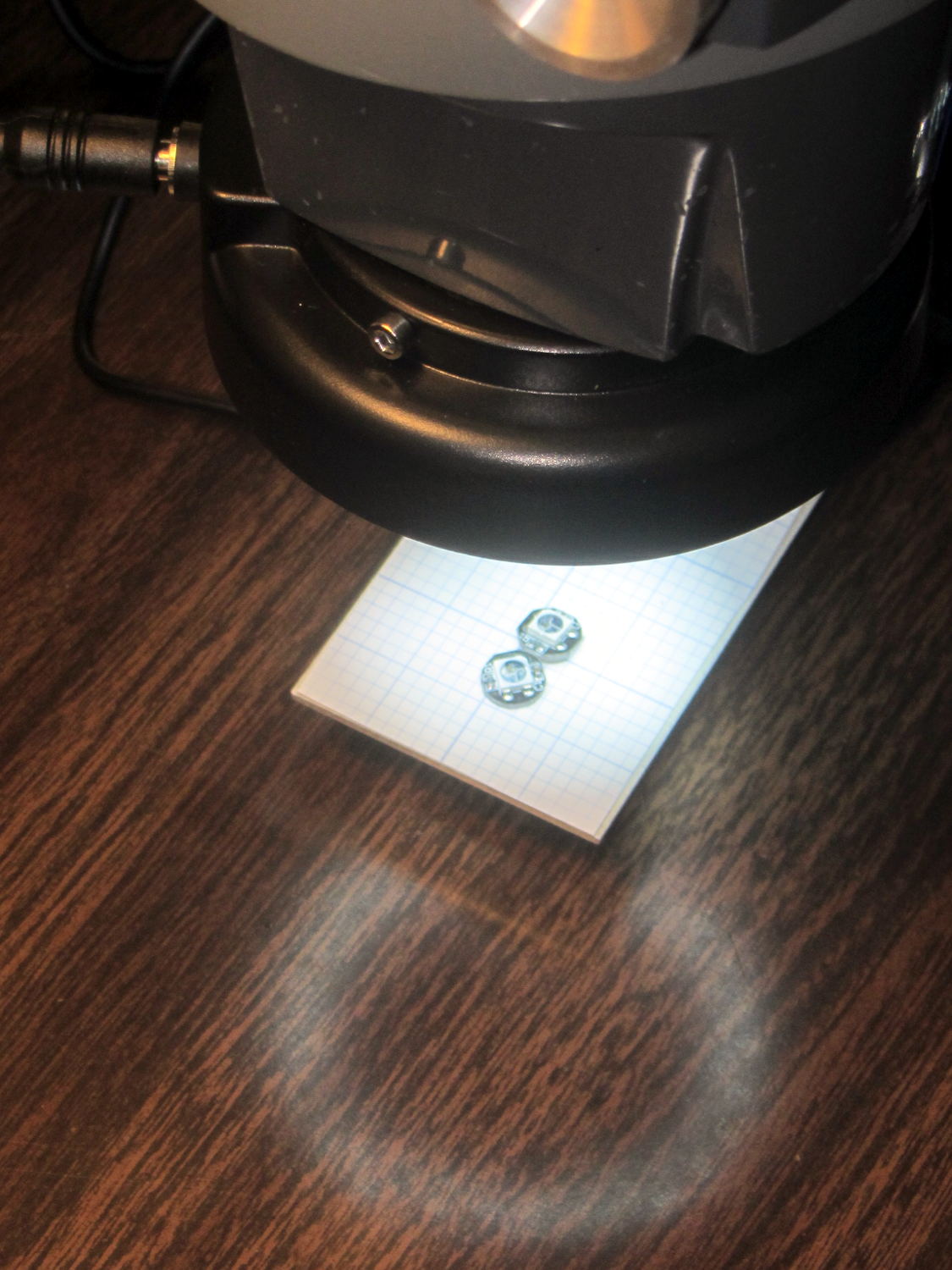
Although this ring looks much more professional, it didn’t quite fit the microscope, being designed for a round snout rather than a squarish one. This snout has a 47-ish mm threaded ring intended for filters & suchlike, so I built an adapter between that and the 60 mm ID of the LED ring:

The ring came with three long knurled screws which I replaced with much tidier M3 socket-head screws going into those holes:

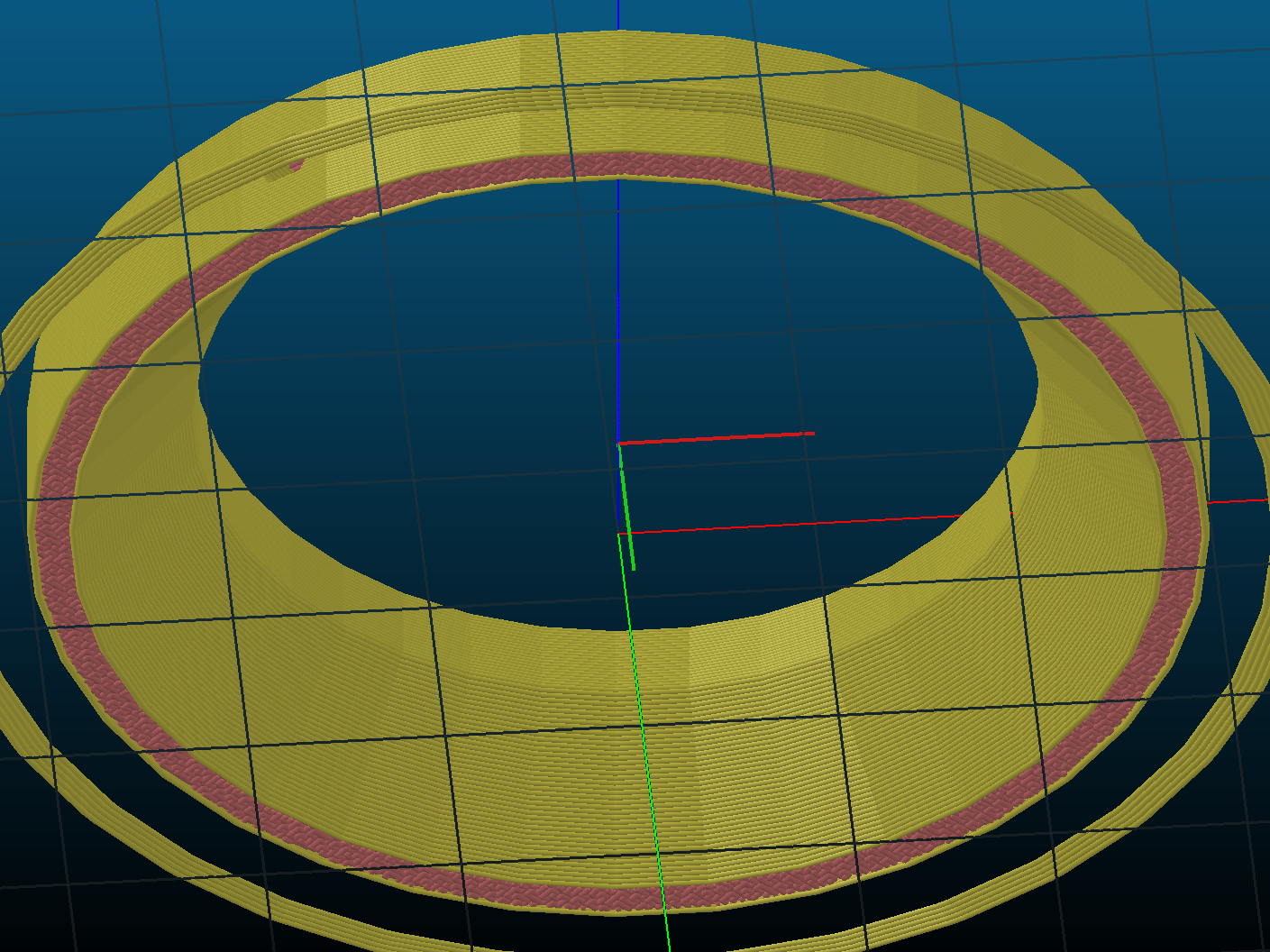
The part going into the snout threads is deliberately (honest!) a bit small, so I could wrap it with soft tape for a good friction fit. The Barbie Ring didn’t weigh anything and I wound up using squares of double-sticky foam tape; it could come to that for this ring, too.
The adapter features a taper on the bottom for no particularly good reason, as the field-of-view tapers inward, not outward:
Seen from the bug’s POV, it’s a rather impressive spectacle:
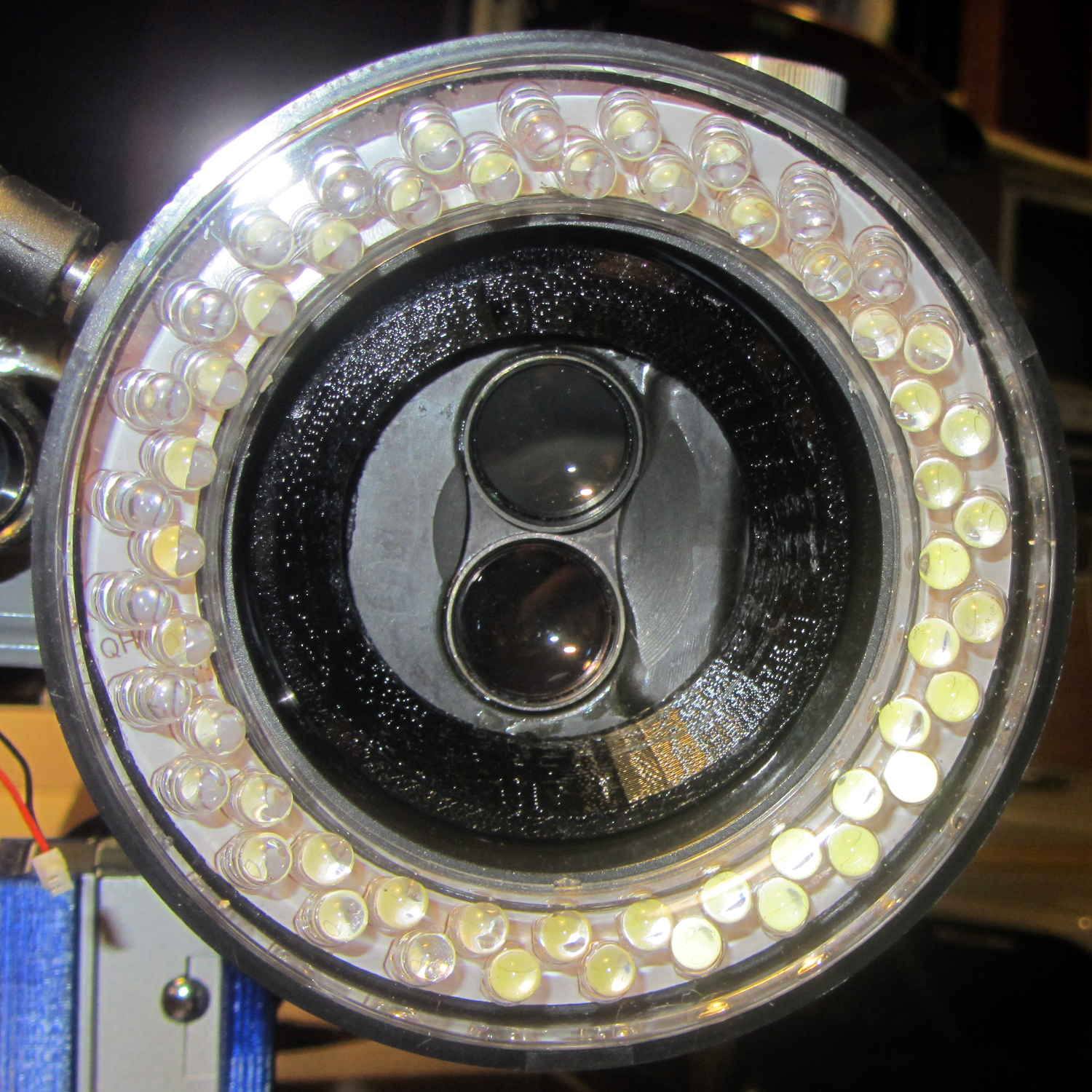
The control box sports a power switch and a brightness knob. Come to find out the ring is actually too bright at full throttle; a nice problem to have.
That was easy!
The OpenSCAD source code as a GitHub Gist:
| // LED Ring Light Mount – 60 mm ID ring | |
| // Ed Nisley KE4ZNU April 2017 | |
| //- Extrusion parameters must match reality! | |
| ThreadThick = 0.25; | |
| ThreadWidth = 0.40; | |
| HoleWindage = 0.2; | |
| Protrusion = 0.1; // make holes end cleanly | |
| inch = 25.4; | |
| function IntegerMultiple(Size,Unit) = Unit * ceil(Size / Unit); | |
| //———————- | |
| // Dimensions | |
| ID = 0; | |
| OD = 1; | |
| LENGTH = 2; | |
| ScopeThread = [43.0,46.5,4.0]; // scope snout thread, ID = minimum invisible | |
| LEDRing = [ScopeThread[ID],60.0,8.0]; | |
| LEDScrewOffset = 4.0; | |
| LEDScrewOD = 3.0; | |
| LEDScrews = 3; | |
| OAH = ScopeThread[LENGTH] + LEDRing[LENGTH]; | |
| NumSides = 3*4*LEDScrews; // get symmetry for screws | |
| //———————- | |
| // Useful routines | |
| module PolyCyl(Dia,Height,ForceSides=0) { // based on nophead's polyholes | |
| Sides = (ForceSides != 0) ? ForceSides : (ceil(Dia) + 2); | |
| FixDia = Dia / cos(180/Sides); | |
| cylinder(r=(FixDia + HoleWindage)/2,h=Height,$fn=Sides); | |
| } | |
| //———————- | |
| // Build it | |
| difference() { | |
| rotate(180/NumSides) | |
| union() { | |
| cylinder(d=ScopeThread[OD],h=OAH,$fn=NumSides); | |
| cylinder(d=LEDRing[OD],h=LEDRing[LENGTH],$fn=NumSides); | |
| } | |
| translate([0,0,-Protrusion]) | |
| rotate(180/NumSides) | |
| cylinder(d=ScopeThread[ID],h=OAH + 2*Protrusion,$fn=NumSides); | |
| translate([0,0,-Protrusion]) | |
| rotate(180/NumSides) | |
| cylinder(d1=LEDRing[OD] – 2*6*ThreadWidth, | |
| d2=ScopeThread[ID], | |
| h=LEDRing[LENGTH] + Protrusion,$fn=NumSides); | |
| for (i=[0:LEDScrews-1]) | |
| rotate(i*360/LEDScrews) | |
| translate([LEDRing[OD]/2 – LEDScrewOD,0,LEDRing[LENGTH] – LEDScrewOffset]) | |
| rotate([0,90,0]) rotate(180/6) | |
| cylinder(d=LEDScrewOD,h=LEDScrewOD + Protrusion,$fn=6); | |
| } |
 The Smell of Molten Projects in the Morning
Comments
5 responses to “Microscope 60 LED Ring Light Adapter”
Having just done an angel eye hack version myself, can you expand on sourcing for this €17 version? Also, how are they switching the leds, correctly with current limiting resistors, or simply series and hope for the best (angel eye, at least the one I ended up with!;-)).
A few years ago, Elektor had a lovely design of a ring light with smd or aimed leds that you could switch in patterns. I think they had quarters, 50%, and half half. All with a switched PMM. Unfortunately I missed the cutoff to order their kit and haven’t spent the time to design my own. Or better said, the cheap hack and existing equipment suffice, thus far.
I added the eBay search to the post where it should have been all along; scroll down past the direct-from-China suppliers.
Judging from the label on the bottom of the power brick, it’s a 10-12 VDC variable output supply, probably with the usual ballast resistors in the ring. No flicker = fine with me!
Don’t know if this helps but we used some of these from eBay for a device concept (links are dead by now anyway so use search string). As far as I know non craped out yet and they cost about 5-6$:)
5050 16-Bit RGB LED Ring WS2812 Round Decoration Bulb Perfect For Arduino OE
5050 12-Bit RGB LED Ring WS2812 Round Decoration Bulb Perfect For Arduino F5
I wondered what “12 bit” and “16 bit” meant in the context of a controller with 3 × 8 bits of RGB color, until I counted the LED packages … you can get “8 bit” and “24 bit” rings, too!
Ripping the Open Source Hardware logo finishes it off. [sigh]
I could make rotating eye rings to fill the Forester’s empty fog light bezels!
[…] tiny lip holding the new LED ring light into the microscope snout lacked enough traction and deposited the ring light on the desk. Having picked up a roll of Scotch […]