These blocky brackets hold a pair of LED light strips in the recess under our 1955-era kitchen cabinets, to let the light cover the entire counter:
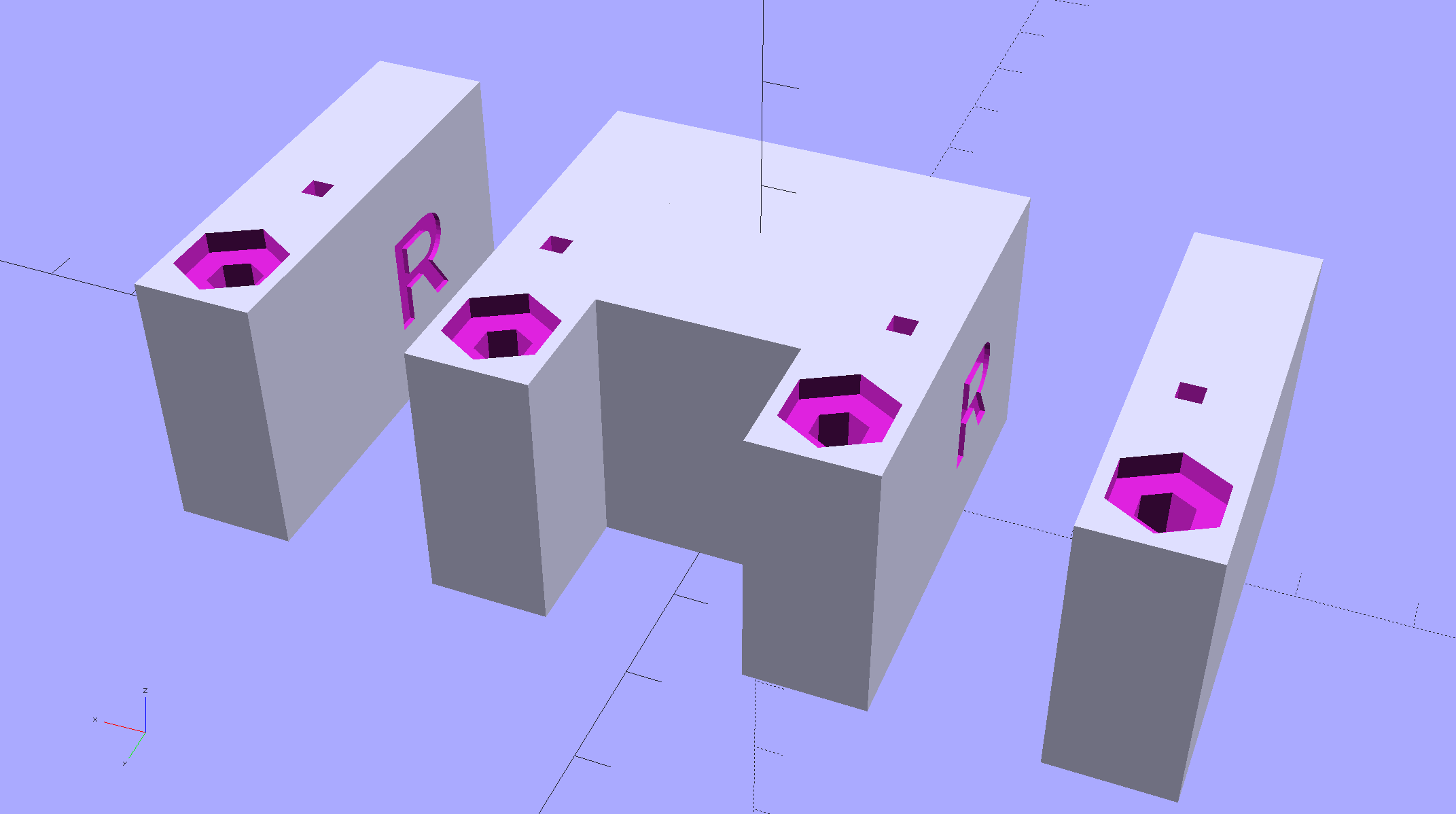
The large holes are for drywall screws into the cabinet, the smaller ones for 2.5 mm SHCS holding the strips to the brackets. I drilled those little holes out and installed 4-40 brass inserts; this being a one-off installation, the source code doesn’t include that change.
There’s not much to see after they’re installed:

I’d hoped to swap the ends of the strip to power it from the right end, but the guts aren’t symmetric and you can’t just flip it end-for-end:

That’s an add-on unit without the IR proximity sensor circuitry and power switch, but with the same overall layout. You take it apart by pressing the obvious latch on one of the endcaps, then gently prying the plastic away from the aluminum extrusion, taking care not to wreck the coaxial socket. Reassemble in reverse order.
The OpenSCAD source code as a GitHub Gist:
This file contains hidden or bidirectional Unicode text that may be interpreted or compiled differently than what appears below. To review, open the file in an editor that reveals hidden Unicode characters.
Learn more about bidirectional Unicode characters
| // Mounting brackets for eShine under-counter LED lights | |
| // Ed Nisley KE4ZNU December 2016 | |
| //- Extrusion parameters must match reality! | |
| ThreadThick = 0.25; | |
| ThreadWidth = 0.40; | |
| HoleWindage = 0.2; | |
| Protrusion = 0.1; // make holes end cleanly | |
| inch = 25.4; | |
| function IntegerMultiple(Size,Unit) = Unit * ceil(Size / Unit); | |
| //———- | |
| // Dimensions | |
| MountHeight = (1 + 3/16) * inch – 5.0; // under-cab space – base thickness | |
| THREADOD = 0; | |
| HEADOD = 1; | |
| LENGTH = 2; | |
| WoodScrew = [4.0,8.3,41]; // 8×1-5/8 Deck screw | |
| WoodScrewRecess = 2.0; | |
| LEDScrew = [2.0,4.5,8.0]; // M2.5×10 SHCS | |
| LEDScrewOffset = [1.0,8.2,0]; // hole offset from center point | |
| JoinerLength = 18.1; // joiner between strips | |
| EndBlock = [11.0,28.5,MountHeight]; // mounting block size for ends | |
| //———————- | |
| // Useful routines | |
| module PolyCyl(Dia,Height,ForceSides=0) { // based on nophead's polyholes | |
| Sides = (ForceSides != 0) ? ForceSides : (ceil(Dia) + 2); | |
| FixDia = Dia / cos(180/Sides); | |
| cylinder(d=(FixDia + HoleWindage),h=Height,$fn=Sides); | |
| } | |
| // End mounting block with proper hole offsets | |
| module EndMount(Side = "L") { | |
| LSO = [((Side == "L") ? 1 : -1)*LEDScrewOffset[0],LEDScrewOffset[1],LEDScrewOffset[2]]; | |
| difference() { | |
| union() { | |
| cube(EndBlock,center=true); | |
| translate([0,1.5*WoodScrew[1],0]) | |
| cube(EndBlock,center=true); | |
| } | |
| translate(LSO + [0,0,-EndBlock[2]]) | |
| rotate(180/4) | |
| PolyCyl(LEDScrew[THREADOD],2*EndBlock[2],4); | |
| translate([0,(EndBlock[1] + 1.5*WoodScrew[1])/2,-EndBlock[2]]) | |
| rotate(180/6) | |
| PolyCyl(WoodScrew[THREADOD],2*EndBlock[2],6); | |
| translate([0,(EndBlock[1] + 1.5*WoodScrew[1])/2,(EndBlock[2]/2 – WoodScrewRecess)]) | |
| rotate(180/6) | |
| PolyCyl(WoodScrew[HEADOD],WoodScrewRecess + Protrusion,6); | |
| translate([((Side == "L") ? 1 : -1)*EndBlock[0]/2,0,0]) | |
| rotate([90,0,((Side == "L") ? 1 : -1)*90]) | |
| translate([0,0,-2*ThreadThick]) | |
| linear_extrude(height=4*ThreadThick,convexity=3) | |
| text(Side,font=":style=bold",valign="center",halign="center"); | |
| } | |
| } | |
| module MidMount() { | |
| XOffset = (JoinerLength + EndBlock[0])/2; | |
| union() { | |
| translate([XOffset,0,0]) | |
| EndMount("L"); | |
| cube([JoinerLength,EndBlock[1],EndBlock[2]] + [2*Protrusion,0,0],center=true); | |
| translate([-XOffset,0,0]) | |
| EndMount("R"); | |
| } | |
| } | |
| //———- | |
| // Build them | |
| translate([0,0,EndBlock[2]/2]) { | |
| translate([-(JoinerLength + 2*EndBlock[0]),0,0]) | |
| EndMount("L"); | |
| MidMount(); | |
| translate([(JoinerLength + 2*EndBlock[0]),0,0]) | |
| EndMount("R"); | |
| } |
 The Smell of Molten Projects in the Morning