I stuck some old 12 V 7 A·h batteries in my homebrew power supply for the HP 3801A GPS Time / Frequency Standard, fired it up, put the antenna where it could see a good chunk of the sky, gave it a day to warm up / settle out, and it’s perfectly happy:
------------------------------- Receiver Status -------------------------------

SYNCHRONIZATION ............................................. [ Outputs Valid ]
SmartClock Mode ___________________________   Reference Outputs _______________
>> Locked to GPS                              TFOM     3             FFOM     0
   Recovery                                   1PPS TI -38.3 ns relative to GPS
   Holdover                                   HOLD THR 1.000 us
   Power-up                                   Holdover Uncertainty ____________
                                              Predict  366.2 us/initial 24 hrs

ACQUISITION ............................................ [ GPS 1PPS CLK Valid ]
Satellite Status __________________________   Time _____ +1 leap second pending
Tracking: 4        Not Tracking: 6            UTC      18:22:19     22 Jul 2016
PRN  El  Az   SS   PRN  El  Az                1PPS CLK Synchronized to UTC
  3  34 104   48   * 1  36  48                ANT DLY  0 ns
 17  62 308  103     6  27 220                Position ________________________
 19  39 281   50    11  21  58                MODE     Hold
 28  80 133   64   *22  Acq .
                    24  12 319                LAT      N  41:39:32.328
                    30  15 191                LON      W  73:52:26.733
ELEV MASK 10 deg   *attempting to track       HGT               +82.87 m  (MSL)
HEALTH MONITOR ......................................................... [ OK ]
Self Test: OK    Int Pwr: OK   Oven Pwr: OK   OCXO: OK   EFC: OK   GPS Rcv: OK
scpi >
The FFOM 0 entry says the Frequency Figure Of Merit is “within specifications” of 10-9, averaged over one day. That means the actual frequency should be within 0.010 Hz of 10 MHz.
Feeding the 10 MHz frequency reference into the (equally warmed up) HP 8591E spectrum analyzer and selecting an absurdly narrow span produces a comforting sight:

Given the horizontal resolution, that’s dead on 10 MHz.
So, yeah, that signal at 57-ish kHz really isn’t at 60.000 kHz:
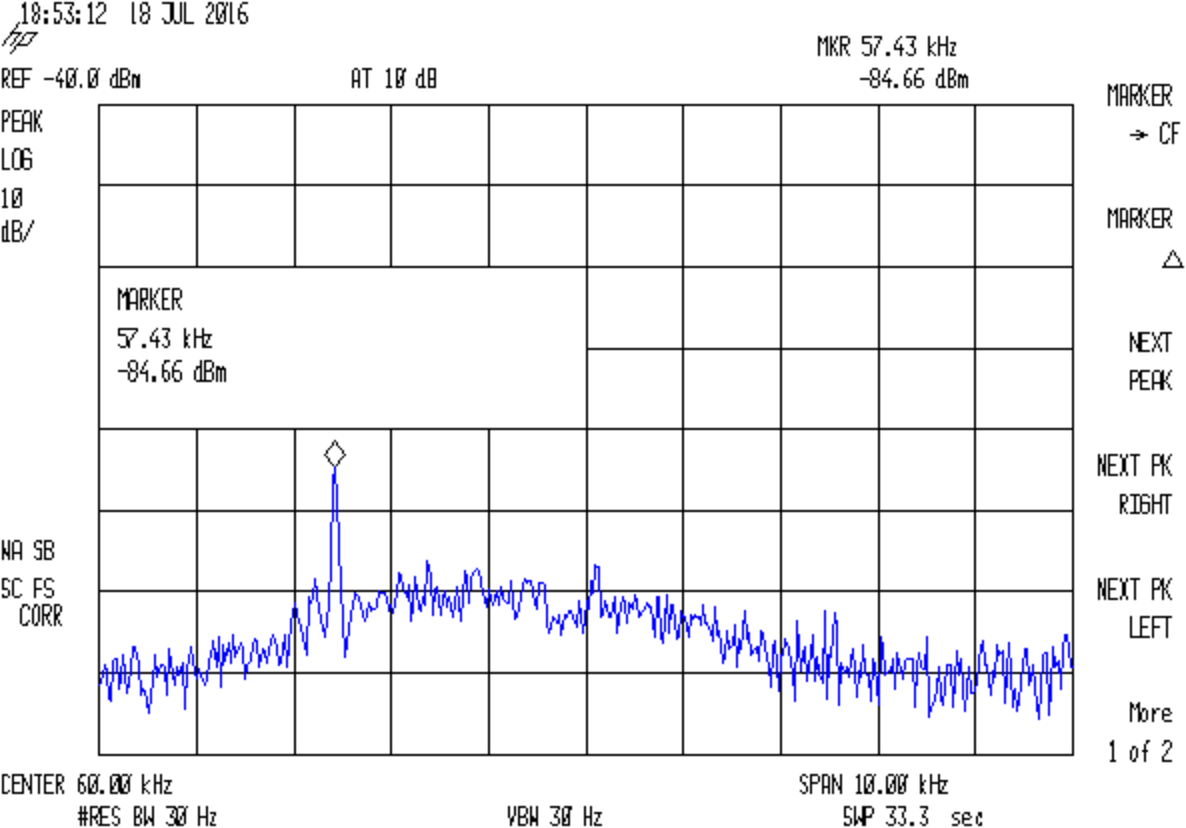
Which is good to know …
 The Smell of Molten Projects in the Morning
Comments
2 responses to “LF Loop Antenna: GPS Frequency Check”
For an afternoon project, why not make a tripler for the GPS 10 MHz output, then add a couple of chips to divide it down by 500 and get a GSPDO-derived 60.000 000 kHz reference?
Wenzel has an interesting two-diode tripler that could be a starting point…http://www.wenzel.com/documents/2diomult.html
“Afternoon project” indeed! [sigh]