After doing the second batch of quilting pin caps, I dropped the newly opened silicone caulk tube into a jar with some desiccant, which worked wonderfully well. Unlike the usual situation where the caulk under the cap hardens into a plug after a few weeks, the tube emerged in perfect condition. In fact, even the caulk in the middle of the conical nozzle was in good shape, with just a small cured plug on either end; it had been sitting inside a cloth wrap with no sealing at all.
Here’s what it looked like after finishing the last of the most recent caps:
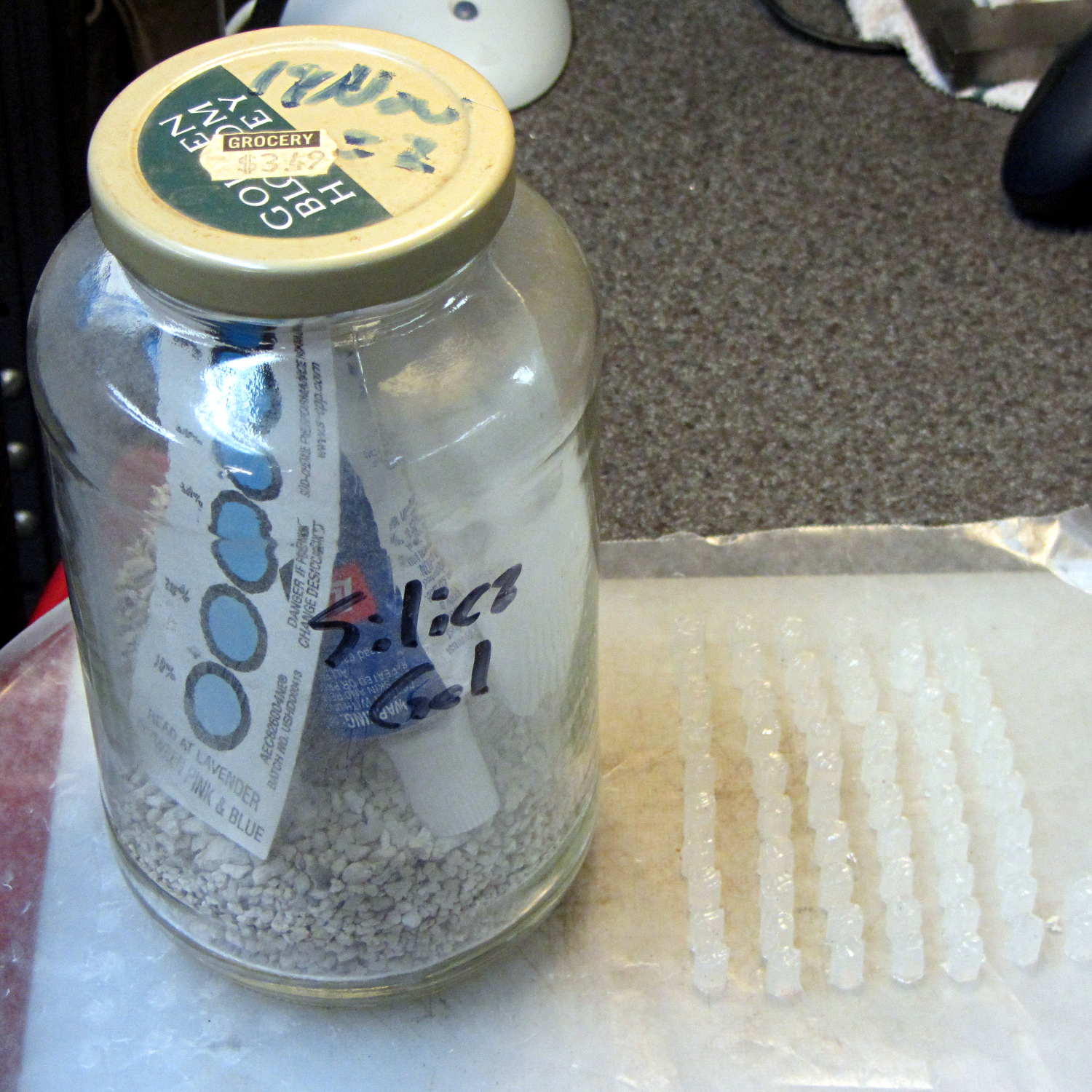
The indicator card says the humidity remains under 10%, low enough to keep the caulk happy and uncured. Well worth the nuisance of having a big jar on the top shelf instead of a little tube next to the epoxy.
Although I thought the desiccant was silica gel, it’s most likely one of the clay or calcium desiccants.
 The Smell of Molten Projects in the Morning
Comments
8 responses to “Silicone Caulk + Desiccant = Win!”
For what it’s worth, I’ve read that baked gypsum (sheetrock innards) makes for a tolerable desiccant. Never tried it, but the stuff is decidedly cheap. (Hat tip to Dean Ing, from a 1980s story about surviving a nuclear attack. It was part of the design of a quick-and-dirty fallout sensor developed at Oak Ridge during the Manhattan project.) A web search shows you need 400F bakeout.
Well, I have a sheet of drywall that’s perfectly equilibrated to 50% RH…
I vaguely recall that gypsum desiccants release water as the temperature goes up, even well below the restoration temperature, so you can have water condensing on the inside walls of your sealed container full of desiccant.
Have you heard of/tried “oogoo”? In an attempt to replicate some of the properties of Sugru, someone came up with the idea of adding corn starch to silicone caulk, which introduces moisture uniformly and speeds curing time to minutes/hours instead of days depending on the ratio of starch added.
I’ve read of oogoo, but never tried it… perhaps my lifestyle doesn’t require fast curing? [grin]
That said, I like the idea of Sugru. Alas, it seems far too expensive and comes with a painfully short shelf life.
your ‘silica gel’ looks a bit like Drierite to me (exhausted if it’s the indicating variety)…that may be because the other types of dessicant I use then to come as cylindrical pellets or spherical granules. Anyway thanks for the idea – now I can take my various tubes of RTV’s out of the freezer and store them with the rest of my crap in a de-humidified BDH container. As a bonus I should be able to score a few brownie points with she-who-must-be-obeyed…
It’s definitely non-indicating: looks exactly like dirt, no matter what!
The new spherical silica gel beads definitely look better and produce fewer comments when they go in the oven for regeneration…
Molecular sieves are available as pretty beads and pellets but regeneration requires temperatures beyond the capabilities of most domestic ovens and would normally be done under vacuum or while purging with dry nitrogen. All in all, better to stick to the silica gel …
One of my nominations for “coolest name ever” … [grin]