I use a blender to mix up the pancake batter every few days. Over the last week or so, the rotary switch Pulse position wasn’t returning to Off all by itself. After having replaced the impeller bearings, I couldn’t just ditch the mumble thing without at least trying to fix it…
A search for replacement parts reveals that Farberware kitchen appliances are disposable crap: they’re so cheap nobody stocks repair parts. IIRC, this blender was maybe ten or twenty bucks after rebate, which gets you through the shipping charge for the repair part. I would love to believe that paying more for kitchen appliances actually bought better quality.

As you’d expect, the four silicone rubber feet pop off to reveal machine screws that hold the plastic base to the metal body. This picture shows the wire connections to the switch:
- L = brown
- 1 = orange
- 2 = no connection
- 3 = red
I couldn’t pull the switch knob off the shaft, so I dismantled enough of the motor mount to ease it to one side, apply a right-angle screwdriver to the switch body screws, and loosen the switch. That gave me enough room to jam a screwdriver between the switch and the mounting bracket to pry the knob off. It’s a plastic-on-plastic friction fit.
After the fact, it turns out that two screws behind the knob secure the mounting bracket to the bezel. Remove those screws, the bracket comes off, and it’s trivially easy to remove the switch screws.
The wires attach through those horrible spring-loaded push-and-pray connections: jam the wires in, pull back, and it’s supposed to be a gas-tight joint forever. I don’t believe a word of it. Remove the wires by poking a small screwdriver into the opening and forcing the brass tab away from the wire. Yuch!

The switch body parts are, of course, bonded firmly together: no user serviceable parts inside. I deployed a slitting saw on the Sherline mill, grabbed the switch in the vise, and sliced 2.5 mm deep along the line between the two body parts.
The switch is some sort of engineering plastic, so I ran the saw at about 2000 rpm, cut at 100 mm/min, and dribbled water on the blade to keep it cool. You can see the grayish-brown residue under the switch.
The thing came apart easily enough after that…
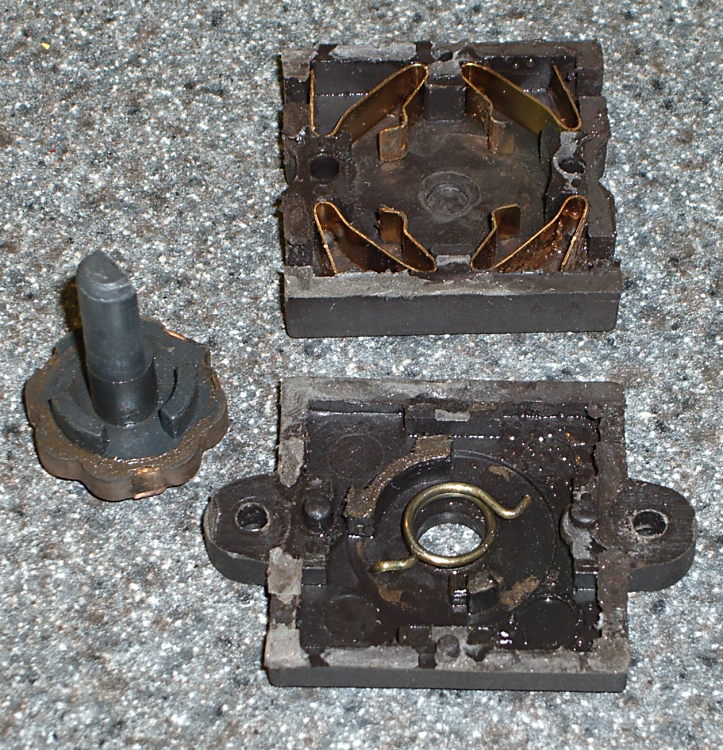
These pics show the switch components. Note how the spring fits in the body and the four cunningly folded brass strips that simultaneously attach the wires, make the switch contacts, and spring-load the rotary detents.
I took the liberty of bending the strips to restore the clamping force on the wires; poking the tabs with a screwdriver tends to bend them a bit.
So it goes.
There wasn’t anything obviously wrong inside, but after a bit of puzzling, I discovered the problem residing in the coil spring that returns the switch to Off…

The spring wire is 1 mm diameter. A bit of rummaging in Small Spring Box Number Two disgorged a bag of spring-clip thingies with the proper wire size and just about the right coil diameter, too.
The right way to make a spring is to start with straight music wire, anneal it, make a mandrel, bend up a spring, then heat-treat the spring to make it just the right hardness and toughness for the job.
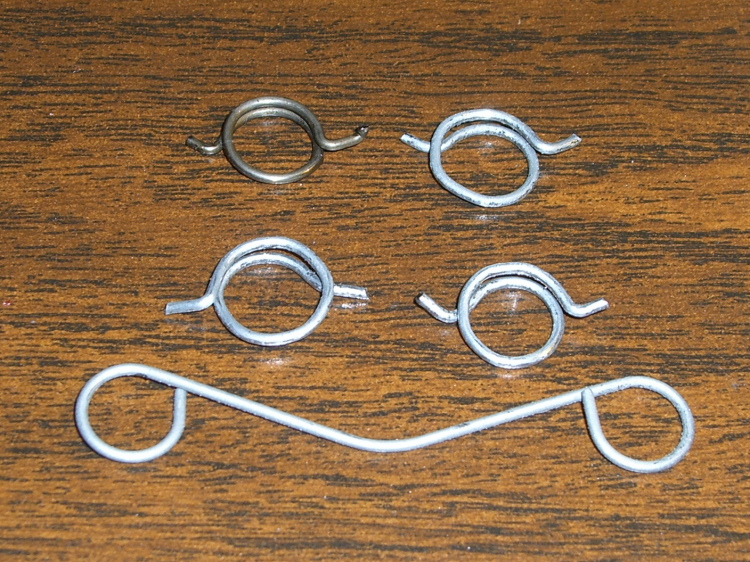
I deployed my wire-bending pliers, made a few trial runs (well, OK, they weren’t trial runs when I started…), and got close enough by the third attempt (lower right).
Yup, cold-bending spring steel. It is to shudder, huh?
I bent the wire just off straight and worked my way around the coil about 0.5 mm per bend to produce a rather lumpy coil spring. This is definitely the wrong way to go, because the wire’s much too hard for that treatment: it wants to stay straight and doesn’t like those right-angle bends to form the end tabs. I think this will work well enough for long enough, though.
The spring’s chirality turns out to be important; the coil wants to tighten around the shaft when the knob’s in the Pulse position. The spring-clip thing has two ends; only one produces the correct result, which is perfectly obvious in retrospect.

The spring fits on the rotor like this, but with a whole lot more preload tension than you’d expect. The end result was a somewhat smaller coil diameter than I started with; I shrank the coil, re-bent a new tab on one end, chopped off about 4 mm of wire, and it was all good.
I also backed off the ramp on the notches that engage the brass contacts in the Pulse position so the switch wasn’t so prone to hang up. That was what motivated me to fix the thing: one morning I manged to leave the switch in Pulse because it didn’t quite snap back to Off, took the lid off the bowl, and the blender started up again. Fortunately, the batter is too thick to jump out of the bowl, but it was a near thing.
Here are the four switch positions and their contacts, in order from Pulse (most counterclockwise) to Speed 2 (most clockwise). You could, I suppose, conjure up a replacement switch if you puzzled out the connections; all the rotor tabs are connected together.


Notice that, although switch contact 2 is unused, it is connected when the switch is in the Off position.
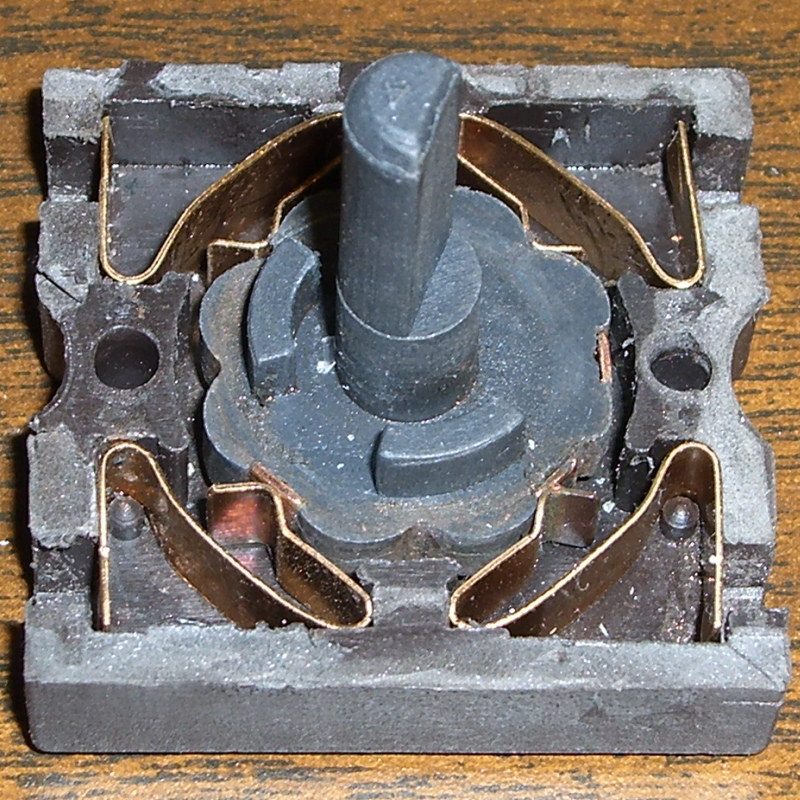

The back of the switch body takes pressure on the switch knob, as well as engaging the end of the rotor to hold it in the middle of the body. I wasn’t comfortable just gluing the body together again, because I suspect none of my adhesives will actually bond to the plastic.
So I chopped off a length of aluminum U-channel, poked two holes it in, shortened a pair of salvaged screws, and made a clamp for the switch body’s back. The body has three locating pins, so the two parts aren’t shifting with respect to each other, and the clamp holds the back firmly in position.

Reassembly is in reverse order, paying a bit of attention to securing the wires in those crappy push-and-pray contacts and keeping everything away from the cooling fan as the bottom snaps into place.
Done!
The economics of this sort of repair make absolutely no sense at all, but I hate throwing stuff away just because some cheap part failed. In this case, I’d be happy to replace the switch… let me know where you can find one with the requisite contacts and spring arrangement!
 The Smell of Molten Projects in the Morning
Comments
10 responses to “Farberware Blender Switch Repair”
Thank you for thorough write up of your fix. It was a nice read and somewhat justifies my various junk boxes.
A Fundamental Rule: Ya gotta have stuff.
And, of course, ya gotta enjoy fixing cheap consumer junk…
Glad to help!
It’s stuff like this, that helps me to justify my own willingness to put 10x the value of an item into fixing a broken part on the item. I’m glad you wrote this up. (I especially liked the “well, OK, they weren’t trial runs when I started” moment.
Last week I fixed a friend’s hatstand. The bit that attached the upright to the base was a zamak casting, internally and externally threaded, which broke, so I cut a new one out of steel. It will last forever, and my friend really loves her hatstand so I’m glad she doesn’t have to throw it away. Yesterday I got a discarded brand-new Avid BB5 disc caliper that has a mis-threaded piston to set the pad pressure, and that should be an easy fix. None of these are economically reasonable, but they prevent a lot of stuff going in the garbage dumps.
my friend really loves her hatstand so I’m glad she doesn’t have to throw it away
I wish I could figure out how to make a living just fixing stuff. Sort of like that broken shutter button on Tee’s DSC-H1 camera: everybody came out happy, but the economics just didn’t make any sense.
It’s always cheaper to throw a broken thing out and buy another one, no matter how much history the gadget might have behind it.
It keeps me off the streets at night, anyway.
Keep on fixin’ em…
(“Zamac”. Huh: learn something new every day. I always thought it was just “pot metal”… and junk, besides.)
On my lathe, most of the gears are zamak. Under certain conditions it’s a really super alloy: it can be die-cast and come out in finished, ready-to-use form. Likewise, if cast in a circumstance where it’ll be in continuous compression, it’s as strong as steel. But it does require at least a bit of care in design. I think you at one point posted about a repair that illustrated the dangers of using computer-aided design and finite element analysis to build something with the minimum material, and then later doing an engineering change that removes a bit of that material, leaving the end user with a part that breaks repeatedly.
I can imagine a situation in which this sort of repair could make sense, if you had a CNC machine that included automatic toolchanging and materials loading, and a parts library that had enough AI that you could type in a description of what you wanted (in the hatstand case, “steel, 5/8″ thick, with internal 1/2″ x 18tpi, external 1 1/8″ x 14tpi”) and it would build the thing. But then the amortization costs of the machine are just as awful as the labor costs of doing it yourself. *sigh*
Yesterday we bought my gf a new recumbent, and in talking to the guy at the shop, he mentioned that his mechanic has a lathe (same model as mine, weirdly.) They got a shipment of HPVelotechnic trikes in from Germany, all missing the nuts that retain the front wheel spindles in the frames because of damaged packaging. It took three hours for the mechanic to make a new set, rather than two weeks to order a new set out of Germany, so THEY both were completely convinced about the economic viability of small antique lathes under some specific circumstances.
It took three hours for the mechanic to make a new set
Just wait until the lawyers get a-hold of him!
I just saw a note about mounting a RepRap extruder in place of the spindle head on a Sherline; basically, you get an additive “milling machine” driven by EMC. I might just have to do it… then I can build positive masters, make negative molds, and cast crappy pot-metal parts. Wheeee!
ED:
YOU ARE NUTS !…….JUST LIKE ME…THE BIRD WITH A BROKEN WING…
DAVE LONG
[…] slitting saw repair is there… Leave a […]
All y’all — you are my people. (snif) I can’t STAND tossing something that I just know needs a little part. (Hooray for Shapelok thermoplastic, JB Weld and Fasteel putty, my CNC Sherline, and a zillion parts of disassembled printers, blenders, and other sundry Dead But Not Useless Consumer Goods.) I feel like I’ve finally connected with my own long-lost species, reading these posts.
I am attaining nirvana, this week. After much back-and-forth with my soon-to-be-sainted wife, as of (hopefully) tomorrow, I’ll be leasing a little unit in a light-industrial park nearby. 2 little offices, bathroom, and a 600 ft2 warehouse area with high ceiling and roll-up door. I’m moving my mill, lathe, woodshop, and lab, and my myriad shelves and bins of “stuff” down there (thank gawd for the cargo space in my Honda Odyssey Daddy-Van). Best of all – it’s literally walking distance from Home Depot, and 3 blocks from a very-well-stocked hardware store. Oh, and a buddy of mine, with an MSEE from MIT, wants to set up a corner tinkering-station for electronic inventing in exchange for helping me whenever I need anything ‘lectric, or just to hash stuff out, or just a drinkin’-and-a-tinkerin’ buddy. Gotta buy me a mini-fridge.
If this whole life thing is a video game, I think I just set a high score.
Wow: toys, a place, and a friend to play with! Can’t be beat…
Welcome aboard; I hope you’ll find some pointers and let me know when I’ve done something really absurd!
But… ShapeLok. Ahem. Why have I not been informed of this?