The Smell of Molten Projects in the Morning

Ed Nisley's Blog: Shop notes, electronics, firmware, machinery, 3D printing, laser cuttery, and curiosities. Contents: 100% human thinking, 0% AI slop.
Tag: Wildlife

Other creatures in our world

  • Red Oaks Mill Eagle

    Red Oaks Mill Eagle

    We spotted a large bird on a walk to the Red Oaks Mill dam:

    Red Oaks Mill Eagle - A
    Red Oaks Mill Eagle – A

    Despite the crappy image (Google Pixel 6a, digitally zoomed as tight as it’ll go), it’s a second-year juvenile Bald Eagle. It followed ahead of us along Rt 376, landing atop successive utility poles as we walked toward the intersection:

    Red Oaks Mill Eagle - B
    Red Oaks Mill Eagle – B

    It sometimes perched on the (presumably) live primary wires, so a few kV of electric field doesn’t ruffle its feathers enough to worry about.

    Its duties included keeping an eye on us down by the creek:

    Red Oaks Mill Eagle - C
    Red Oaks Mill Eagle – C

    It eventually decided we needed no further supervision:

    Red Oaks Mill Eagle - D
    Red Oaks Mill Eagle – D

    Earlier this year it swooped along our driveway and landed atop a utility pole in our yard, causing great concern among the songbirds and rodents.

    Having an eagle in the neighborhood seems like a good sign …

  • Tree Frog Season

    Tree Frog Season

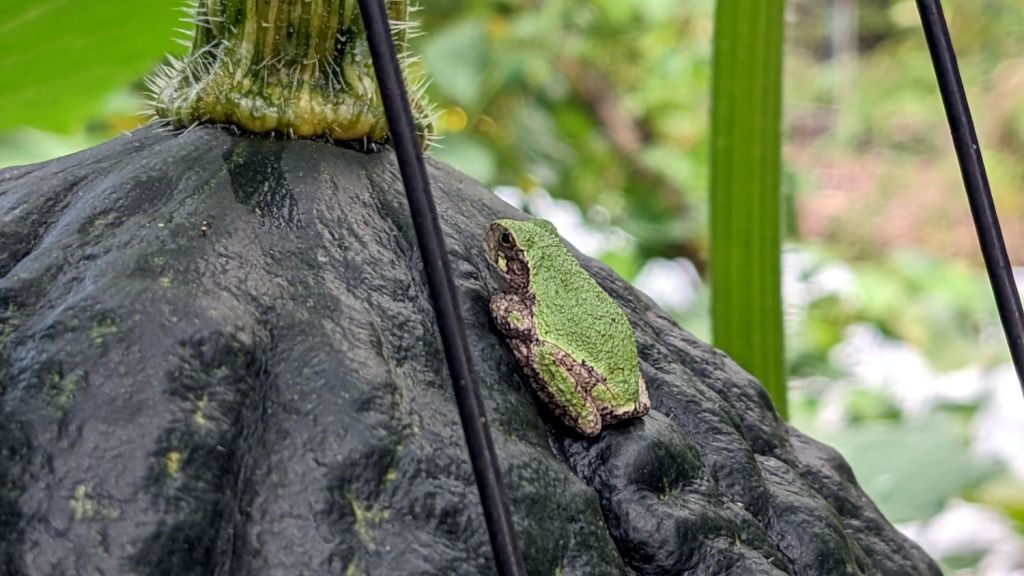
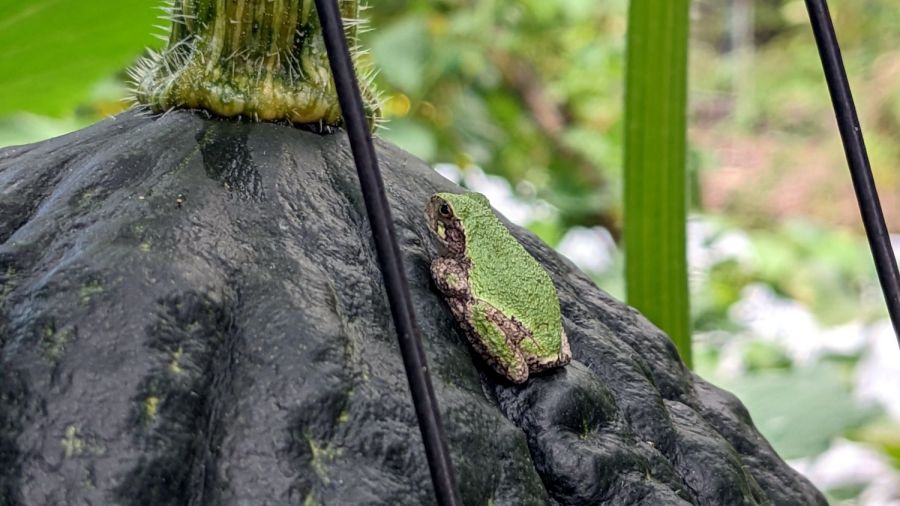
    This year brings an abundance of tree frogs:

    Tree frog - on dahlia stem
    Tree frog – on dahlia stem

    Despite the snappy green color, they’re Gray Treefrogs:

    Tree frog - on patio step
    Tree frog – on patio step

    Their camouflage works better in the wild than atop a trash can lid:

    Tree frog - on trash can lid
    Tree frog – on trash can lid

    They are much smaller than you’d expect from their voices in the night:

    Tree frog - on trash can lid - thumb for scale
    Tree frog – on trash can lid – thumb for scale

    We think the drought brings them closer to the house in search of water, as Mary collects rainwater in the trash cans where the frogs easily walk up & down the inside surfaces.

  • Onion Maggot Flies vs. Sticky Traps: Round 2

    Onion Maggot Flies vs. Sticky Traps: Round 2

    Mary decided the second round of sticky traps had collected enough Onion Maggot Flies (and other detritus) to warrant replacement, so this season will have three sets of cards.

    The two sides of each card after about a month in the garden:

    • VCCG Onion Card A - 2022-07-17
    • VCCG Onion Card B - 2022-07-17
    • VCCG Onion Card C - 2022-07-17
    • VCCG Onion Card D - 2022-07-17
    • VCCG Onion Card E - 2022-07-17
    • VCCG Onion Card F - 2022-07-17

    There are many flies that look (to me) like Onion Maggot Flies, in contrast with the first round of cards which had far fewer flies after about six weeks in the bed.

    Some could be Cabbage Maggot Flies, but my fly ID hand is weak.

    One of the frames screwed to a fence post suffered a non-fatal mishap, so I made and deployed a seventh trap. We’re pretty sure the garden has enough flies to go around.

  • Lawn Chair Re-strapping: Countdown Hold

    Lawn Chair Re-strapping: Countdown Hold

    I planned to replace the vinyl straps on our set of (salvaged) lawn / patio chairs and made a pair of rivets for one long-missing strap:

    Lawn chair strap rivets
    Lawn chair strap rivets

    The overall project is on indefinite hold, as a Steel-blue Cricket Hunter (*) has decided at least one of the chairs is an ideal place to start a family:

    Lawn chair - wasp nest under construction
    Lawn chair – wasp nest under construction

    The patio under the chair is littered with blades of grass and twigs that didn’t quite fit through the 5 mm vent hole in the tube, but that long stem went in just fine:

    Lawn chair - wasp nest grass stem
    Lawn chair – wasp nest grass stem

    We have seen the wasp airlifting crickets near the chair, so provisioning has begun. The cricket seemed not only larger than the hole, but also larger than the wasp; we assume the wasp knows what she’s doing.

    The new wasp will hatch this year, pupate over the winter, then hatch and emerge next summer, but I plan to replace the straps after the construction season ends.

    I have no idea how to clean out whatever’s accumulating in there …

    (*) I learned them as Steel-blue Cricket Killer, but the crickets are just paralyzed, not completely dead.

  • Onion Maggot Flies vs. Sticky Traps: Round 1

    Onion Maggot Flies vs. Sticky Traps: Round 1

    We deployed six sticky traps in the onion patch immediately after planting in late April and replaced the cards in mid-June. The first set of cards collected a considerable number of what resemble, to my untrained eye, onion maggot flies and the onion plants remain healthy:

    • VCCG Onion Card A
    • VCCG Onion Card B
    • VCCG Onion Card C
    • VCCG Onion Card D
    • VCCG Onion Card E
    • VCCG Onion Card F

    Each image shows both sides of a single card.

    The cards sit a foot above the shredded leaf mulch and I managed to drop at least one of the cards while extracting it from the cage, but they all have plenty of onion maggot flies in addition to the random debris.

    The cards inside their cages have not accumulated larger insects like honeybees / moths / butterflies, although the tiniest specks are definitely mini-critters along the beetle / gnat / aphid / mosquito axis.

    Unlike last year, the second set of cards will remain in place until harvest to maintain continuous pressure on the fly population.

    If you’re really interested, the dozen original camera images have more detail.

  • Paracord Hot Knife

    Paracord Hot Knife

    An upcoming project calls for cutting dozens of lengths from a spool of 550 (pound tensile strength) all-nylon paracord, which means I must also heat-seal the ends. Cold-cutting paracord always produces wildly fraying ends, so I got primal on an old soldering iron tip:

    Paracord cutting - flattened soldering iron tip
    Paracord cutting – flattened soldering iron tip

    Bashed into a flattish blade, it does a Good Enough job of hot-cutting paracord and sealing the end in one operation:

    Paracord cutting - results
    Paracord cutting – results

    Setting the iron to 425 °C = 800 °F quickly produces reasonably clean and thoroughly sealed cut ends.

    Obviously, I need more practice.

    Yes, I tried laser cutting the paracord. Yes, it works great, makes a perfectly flat cut, and heat-seals both ends, but it also makes no sense whatsoever without a fixture holding a dozen or so premeasured lengths in a straight line. No, I’m not doing that.

  • Please Close The Gate Signage

    Please Close The Gate Signage

    Making signs for the gates surrounding the Vassar Community Gardens provided an opportunity to test laser engraving power on MDF:

    Please Close The Gate - 60 to 20 pct engraving - raw
    Please Close The Gate – 60 to 20 pct engraving – raw

    The alert reader will observe MDF is totally the wrong material for outdoor signage, which is correct. I’ll be producing different signs as these disintegrate, with an emphasis on engraving different materials and applying different finishes along the way; nobody pays attention to signs, anyway.

    With that in mind, the engraving power ranged from 60% on the top sign to 20% at the bottom, perhaps 40 W to 10 W, with a scanning speed of 500 mm/s. The highest power punched the engraving about 0.5 mm below the surface:

    Please Close The Gate - 60 pct depth
    Please Close The Gate – 60 pct depth

    They’re engraved on both sides, so those MDF locating pins came in handy:

    Please Close The Gate - engraved
    Please Close The Gate – engraved

    Alignment was obviously not critical.

    Slathering the signs with polyurethane finish rated for indoor use improved the contrast on the deeper engraving:

    Please Close The Gate - 60 to 20 pct engraving - finished
    Please Close The Gate – 60 to 20 pct engraving – finished

    The bare sign (upper right) went on a distant / locked / rarely-used vehicle gate, where it will serve as an exposure control while turning into mush.

    The small acrylic sign, a prototype for amusement value, clearly shows the need for offset correction at such high scan speeds:

    Please Close The Gate - acrylic test piece
    Please Close The Gate – acrylic test piece

    The MDF signs fit inside one vertical space of the “four inch” wire mesh on the gates, where they rest on the lower wire, and span three wires horizontally, so I could attempt to control the inevitable warping:

    VCCG perimeter gate wire mesh
    VCCG perimeter gate wire mesh

    The mesh wire spacing is not mmmm a closely controlled manufacturing parameter, so the next iteration must be a few millimeters shorter to fit the smallest openings.