Ed Nisley's Blog: Shop notes, electronics, firmware, machinery, 3D printing, laser cuttery, and curiosities. Contents: 100% human thinking, 0% AI slop.
The trail camera uses two parallel banks of four series AA cells to get enough oomph for its IR floodlight. I’m not convinced using bucked lithium AA cells in that configuration is a Good Idea, but it’s worth investigating.
These are labeled HW, rather than Fuvaly, because it seems one cannot swim twice in the same river:
HW bucked Li AA cells
In any event, they come close to their claimed 2.8 W·hr capacity:
HW bucked Li AA – 2023-05
The lower pair of traces (red & black) are single cells at 2.7-ish W·hr, the blue trace is a pair at 5.4 W·hr, and the green trace is a quartet at 9.8 W·hr. Surprisingly close, given some previous results in this field.
Recharging the cells after those tests shows they all take 3 hours ± a few minutes to soak up 730 mA·hr ± a few mA·hr, so they’re decently matched.
Measuring the terminal voltage with a 10 mA load after that charge lets me match a pair of quartets to 1 mV, which is obviously absurd:
HW bucked Li cells – initial charge 2023-05-05
The numbers in the upper left corner show the initial charge of four cells at a time required the same time within a minute and the same energy within 4%.
Sticking them in the trail camera must await using up the current set of alkaline AA cells.
Bonus: a lithium fire in a trail camera won’t burn down the house.
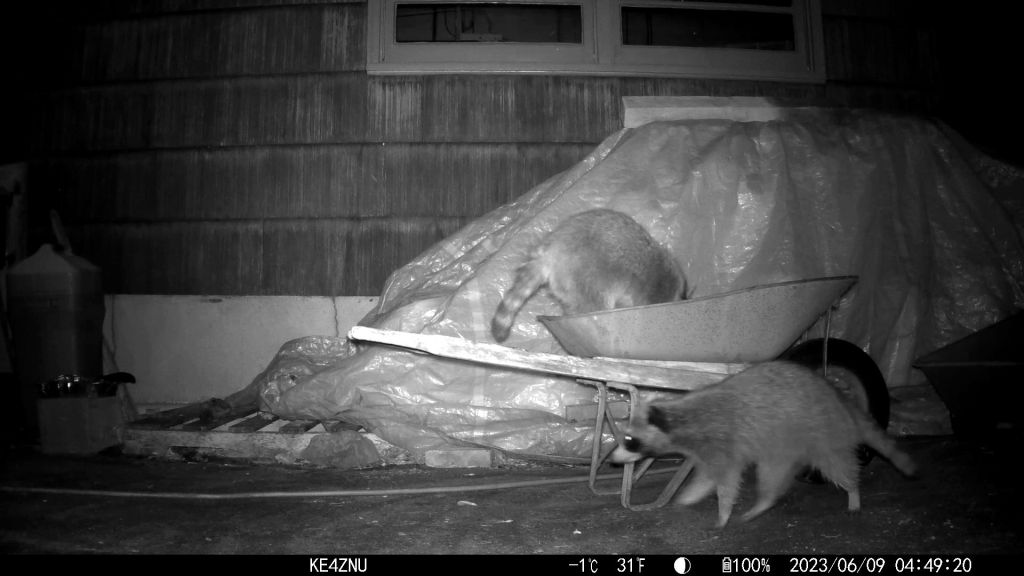
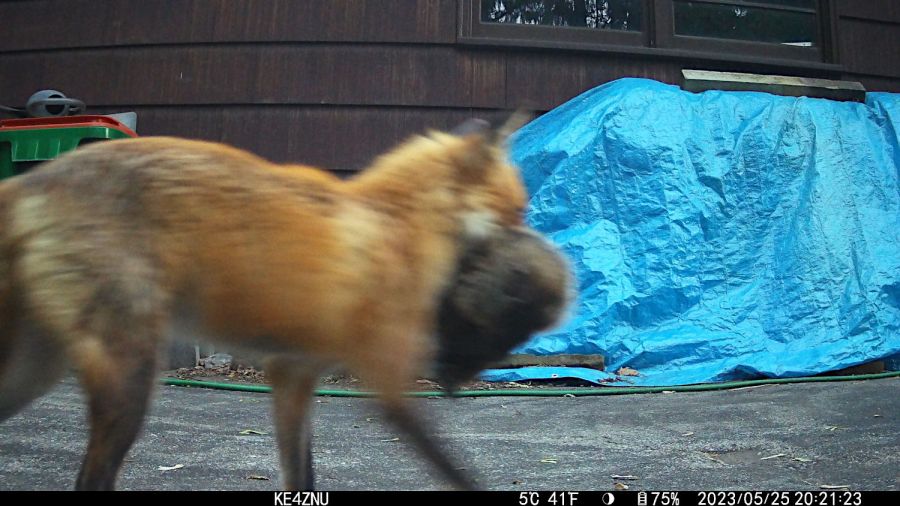
After all, pictures like this are definitely worth the hassle:
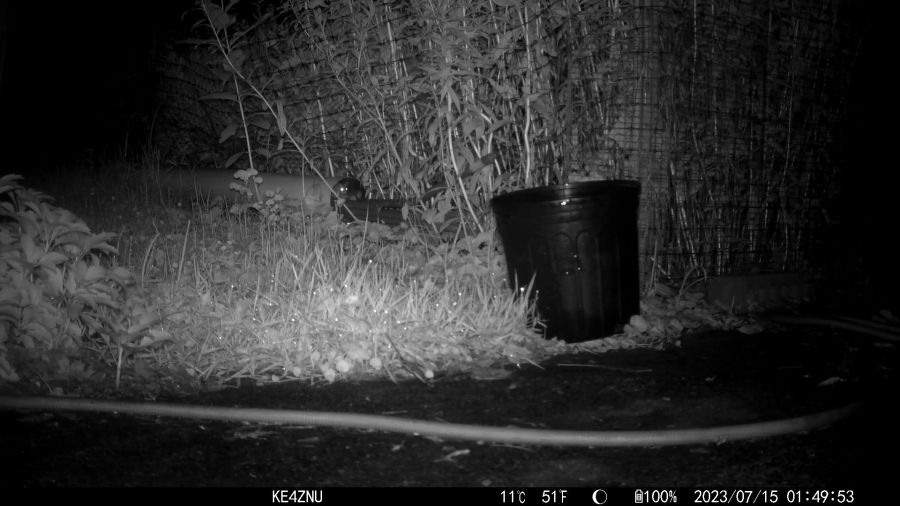
We’ve never seen a skunk by day, so this was a bit of a surprise:
Skunk by night
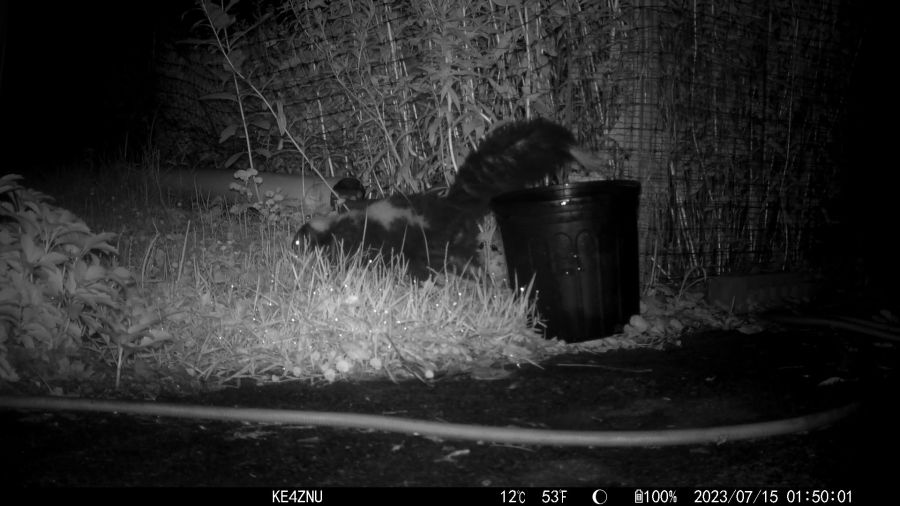
We occasionally smell a skunk by night, but this critter seems peaceable enough:
Skunk by night – detail
Skunks usually have a striped back, so this one’s pure white fur will be easy to identify should we meet again, ideally at a mutually respectful distance.
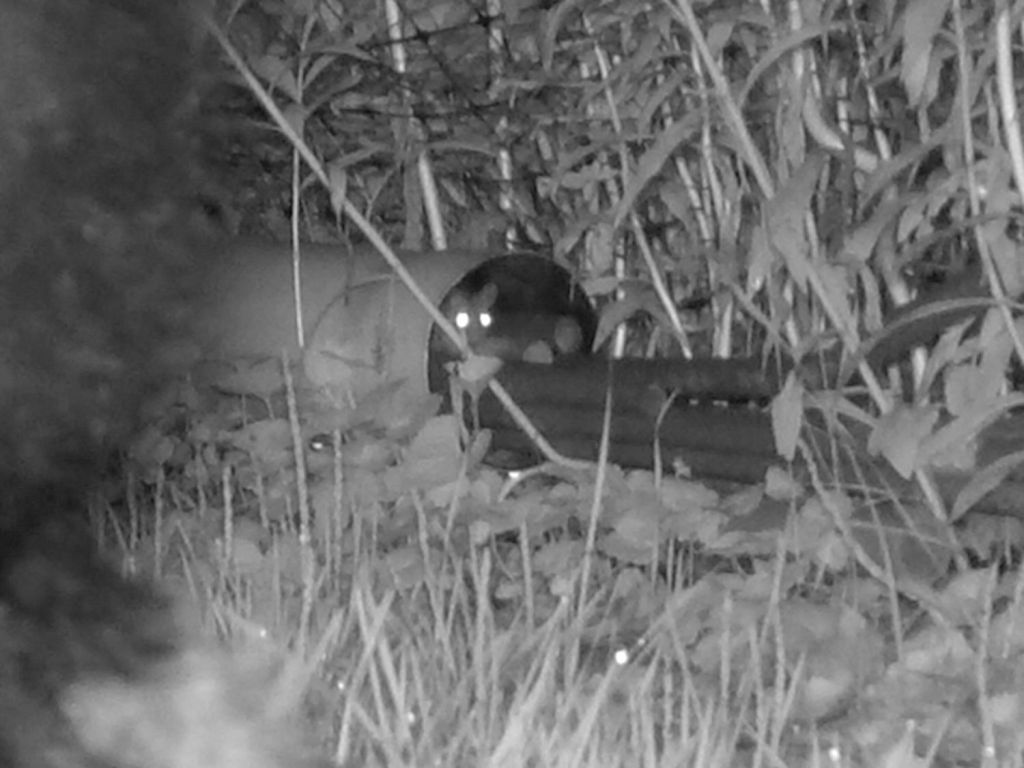
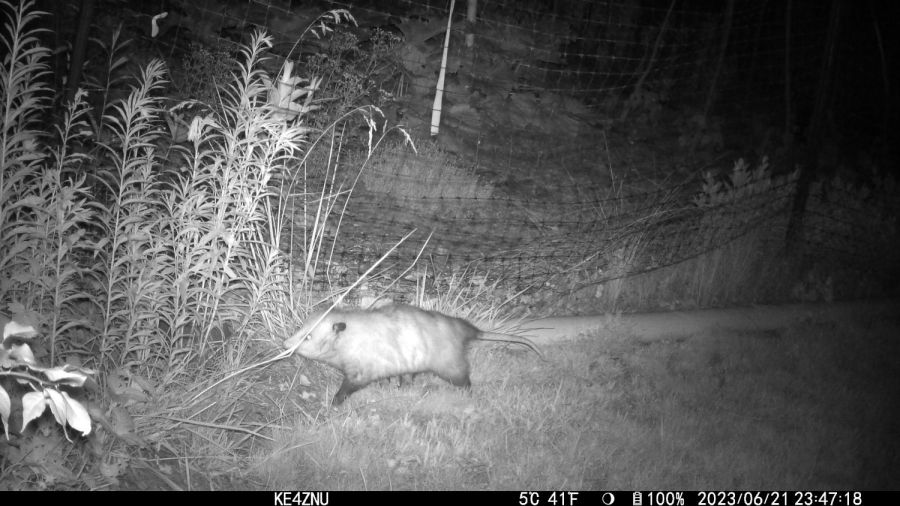
Having just deployed a trail camera to see what might be skulking about in the middle of the night, this appeared just before the (not fresh) batteries died:
The Early Opossum
It’s hard to tell with possums, but I’d say that critter is on a mission!
I’m still figuring out proper distances; the possum is about two feet away, which is obviously much too close. Great focus on the water barrels standing by the garage, though.
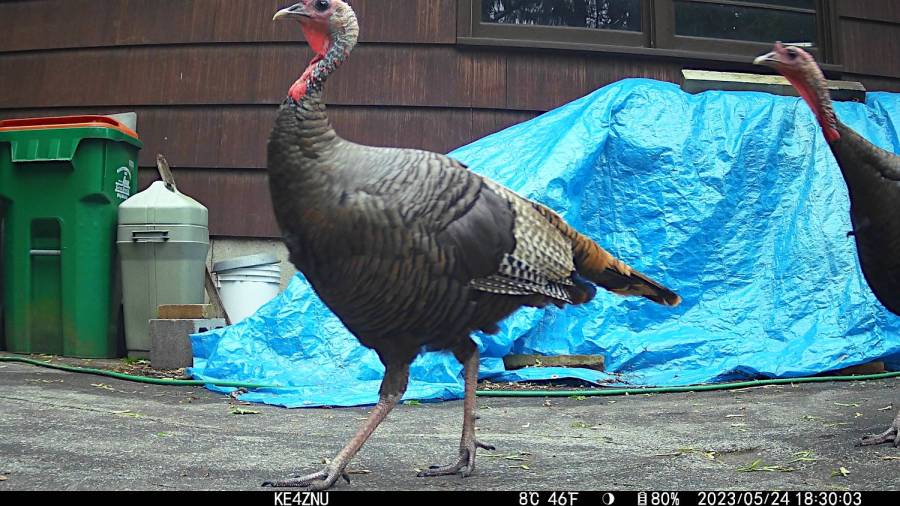
Jake, our affectionate term for whichever turkey is having trouble, eventually walked from right to left closest to the house, down the patio steps, and rejoined the flock. The tip of his “arrow” tracks aims backwards, because all three toes point forward.
It turns out turkeys panic when they’re behind a barrier and see the rest of their flock moving away. A panicked turkey makes a lot of noise while rushing back and forth, the rest of the flock contributes what must be advice, and the resulting tumult suffices to wake the dead.
That would be me, in the bedroom off to the left, but my cold-boot sequence takes long enough that I missed the action.
Some years ago, we discovered how distressed a trapped turkey can get when the flock descended from trees in an adjacent yard, with (a different) Jake landing in the garden, on the other side of the fence from the flock. Over the course of the next several hours, Jake ran back and forth along the fence while the rest of the flock alternated between sympathetic honking and disinterested feeding, until eventually he remembered his wings and managed a short-field takeoff over the fence.
The final garden harvest included several carrots minus their leafy tops:
Rodent-approved Carrot
I sliced that top from a rather rotund carrot and the broad tooth marks suggest a large rodent. Mary found and blocked a tunnel under the fence, so we think it was a groundhog, rather than a rabbit, but we’ll never know the rest of the story.
The rest of the carrot was fine, so the unknown critter had mmmm good taste. Unfortunately, it sampled far too many root crops as it toured the buffet, leaving Mary’s root-cellared stockpile unusually low for our winter meals.
Mary persuaded the squash vine to run along the top of the garden fence, where it would get good sun, stay out from underfoot, and produce what we call aerosquash: