Ed Nisley's Blog: Shop notes, electronics, firmware, machinery, 3D printing, laser cuttery, and curiosities. Contents: 100% human thinking, 0% AI slop.
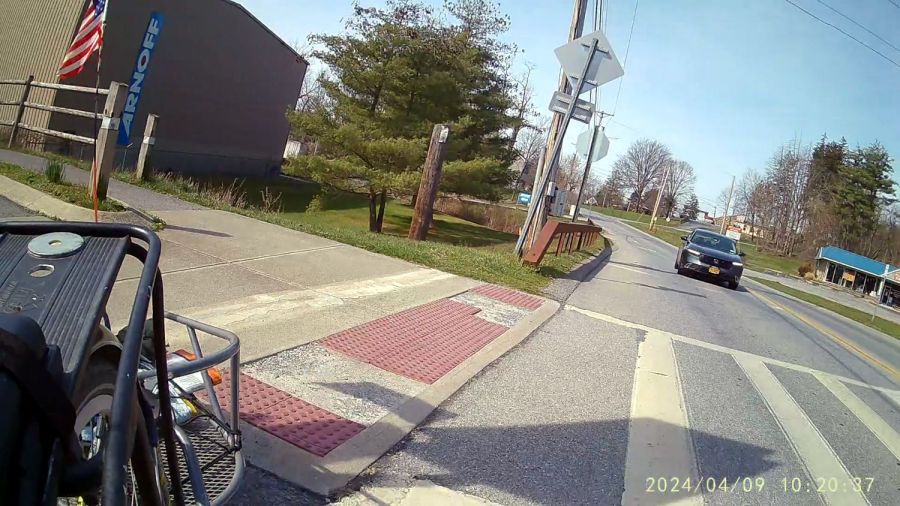
The decaying ADA bump (a.k.a. detectable warning) strips at the Dutchess Rail Trail’s Overocker Road Trailhead require cyclists to carefully pick their line. We’re on our way for groceries, so I’m towing the BOB Yak trailer and have just jounced over the edge of the concrete “ramp” while making a right-angle turn to the right:
Rollover 2024-04-09 – 0020
The four-digit frame numbers tick along at 60 FPS.
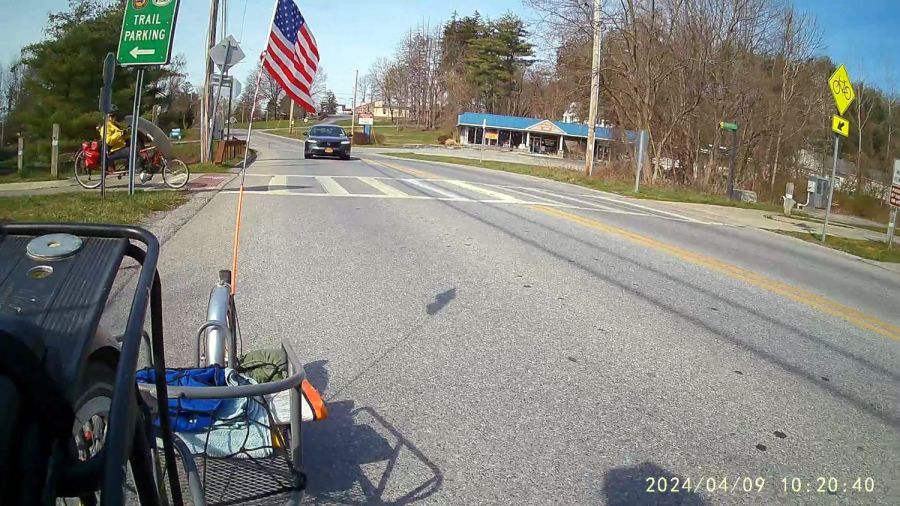
The car remained stopped at the crossing during this whole affair.
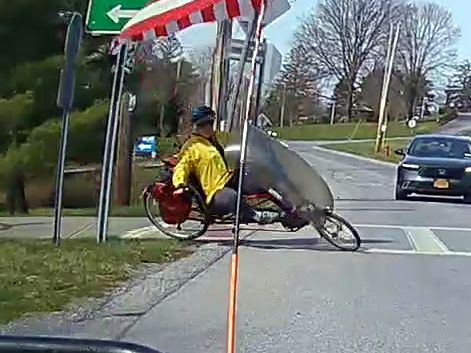
Mary is approaching along the same line with the same intent:
Rollover 2024-04-09 – 0198
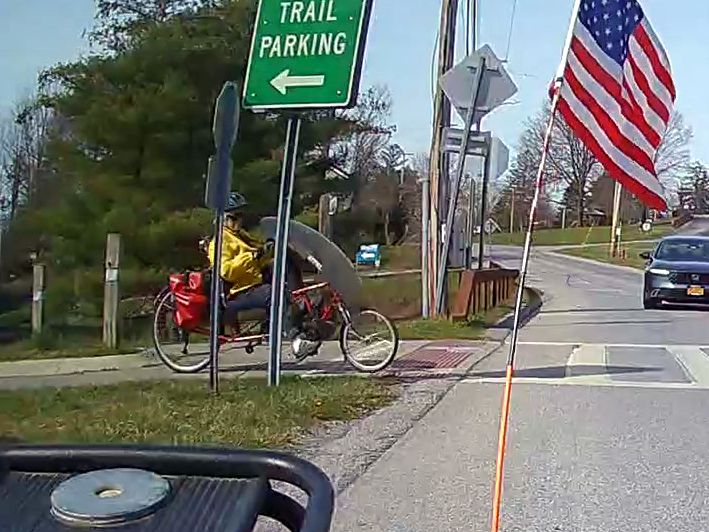
A closer look shows her front wheel is parallel to the edge of the concrete ramp:
Rollover 2024-04-09 – 0198 detail
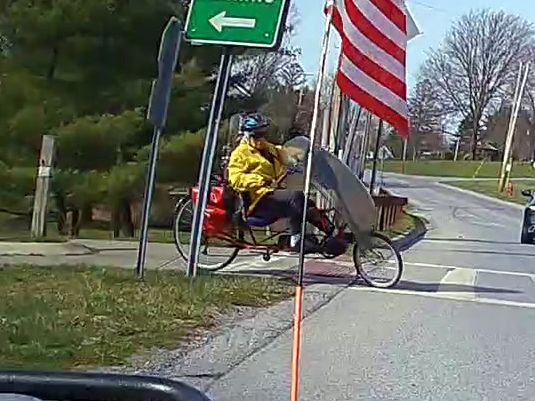
We think her wheel slipped off the edge of the concrete and, with the edge preventing her from steering left to counterbalance the sudden tilt, she knows she’s going to fall:
Rollover 2024-04-09 – 0228
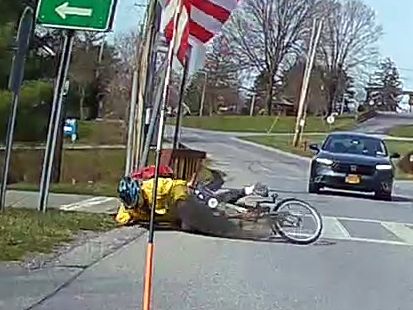
Whereupon Newton took control and left no way out:
Rollover 2024-04-09 – 0250
Fortunately, this is at about zero miles per hour:
Rollover 2024-04-09 – 0276
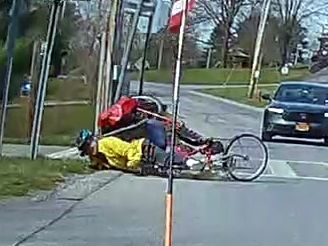
She collected a nasty bruise on her starboard ham, plus a few scuffs here and there as the bike basically rolled over her:
Rollover 2024-04-09 – 0306
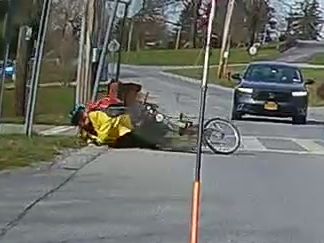
And back down again:
Rollover 2024-04-09 – 0330
Elapsed time: 100 frames = 1.7 seconds.
The drivers of vehicles in both directions rushed to assist Mary, but, apart from a few bruises and scrapes, she was in good shape.
The fairing incurred fatal cracks, but held together as we completed the mission. No surprise: after nearly a quarter-century of sunlight exposure, polycarbonate loses a lot of its durability.
Now, to be honest, we both ignored the Dismount before crossing road sign at the intersection. Over the years, I have seen a few cyclists stop and dismount before walking through the trail’s at-grade road crossings, but they are most certainly the rare exception; we all stop while waiting for traffic to recognize our presence, then ride through.
Rail trail maintenance has always been a low priority and the County’s “Vision Statements” over the decades have been largely irrelevant to what actually happens out on the pavement. ADA strips at trail crossings have been decaying for years and I expect that to continue for many more.
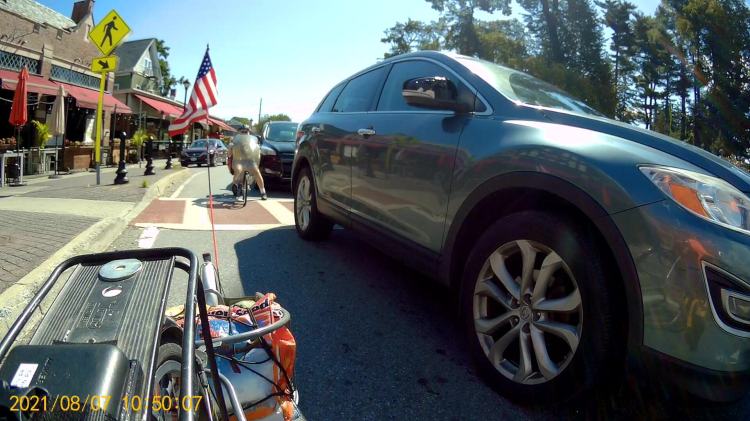
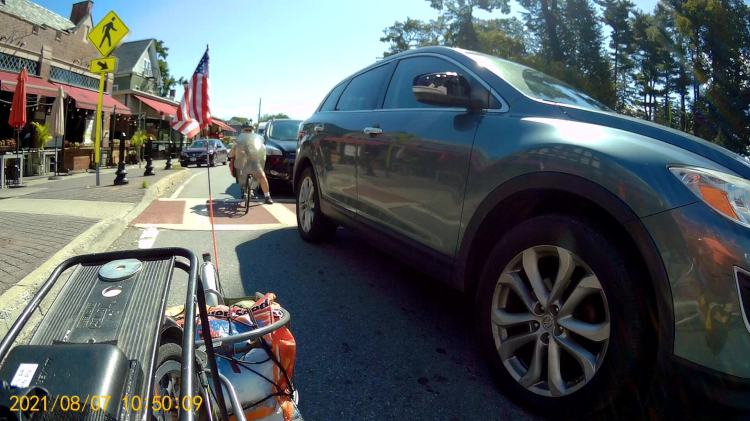
We’re bicycling on Collegeview Avenue, approaching the eastern traffic circle (of three) along Raymond Avenue. I’m in the lead, hauling a trailer with the week’s groceries:
Zero Clearance – Ed Front – 2021-09-07 – 0497
The four digit frame numbers tick along at 60 fps for my helmet camera and 30 fps for the rear cameras.
Note the “splitter” (a.k.a. “pedestrian refuge”) on the left, intended to separate Collegeview’s incoming and outgoing traffic. It formerly had one non-reflective black bollard on each side of the ladder crosswalk, but errant drivers destroyed so many bollards along Raymond that they’re now WONTFIX remnants. The flush concrete disk in the lower left of this picture will become relevant in a few seconds of real time:
Zero Clearance – Ed Front – 2021-09-07 – 0593
Collegeview has the same deteriorating pavement as found along Raymond Avenue, so we must maneuver beside the potholes:
All of us are slowing to stop at the traffic circle, with Mary behind the car that will eventually stop beside me:
Zero Clearance – Ed Rear – 2021-09-07 – 1522
Mary could see the car behind her in her helmet mirror, but she’s slowing to stall speed with no time for sightseeing and no room for maneuvering. The view from the camera on the seat frame behind her left shoulder:
Zero Clearance – Mary – 2021-09-07 – 0957
Two seconds later:
Zero Clearance – Mary – 2021-09-07 – 1078
One second:
Zero Clearance – Mary – 2021-09-07 – 1110
Two more seconds:
Zero Clearance – Mary – 2021-09-07 – 1182
Mary has stopped, as shown by the parked car’s unchanging position in the frame over on the left in the next images. The driver, however, continues creeping slowly forward; there can be no doubt she sees Mary at this distance.
After three more seconds:
Zero Clearance – Mary – 2021-09-07 – 1270
One second later, the front wheel is exactly at Mary’s left foot:
Zero Clearance – Mary – 2021-09-07 – 1308
The same events, viewed from the camera on my bike, start less than one second from the 1522 image above. I’m stopped, while the driver next to me continues to roll forward.
Mary is extending her left leg in preparation for a complete stop, at about the same time as the 1078 image:
Zero Clearance – Ed Rear – 2021-09-07 – 1542
Three seconds later her toe touches the pavement, while both she and the driver continue moving forward very slowly:
Zero Clearance – Ed Rear – 2021-09-07 – 1634
Five seconds later, she is stopped with her foot firmly planted:
Zero Clearance – Ed Rear – 2021-09-07 – 1773
And the driver continues moving:
Zero Clearance – Mary – 2021-09-07 – 1333
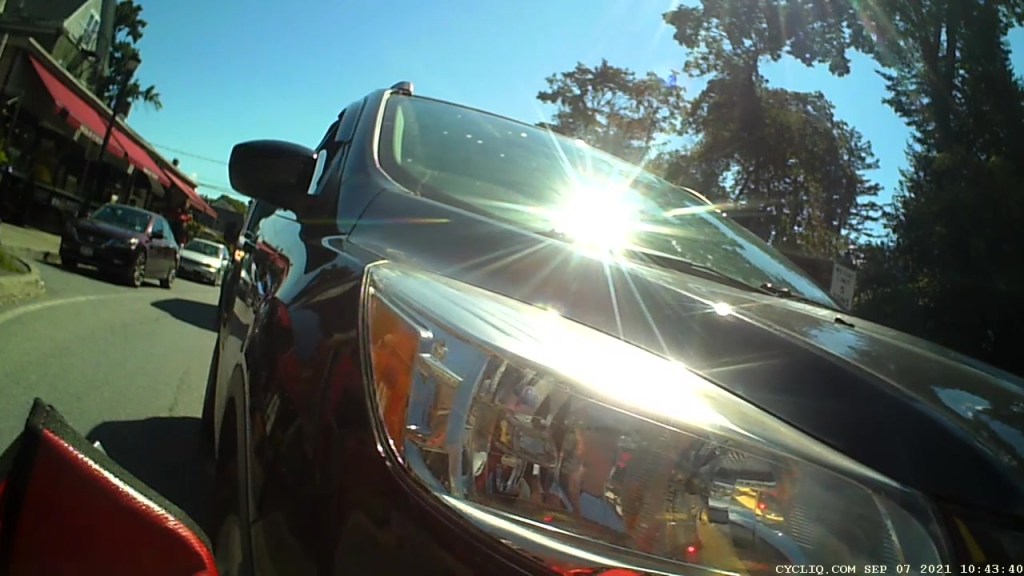
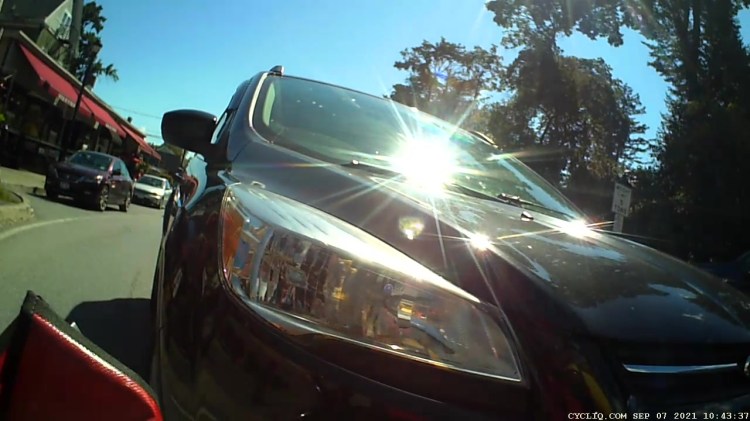
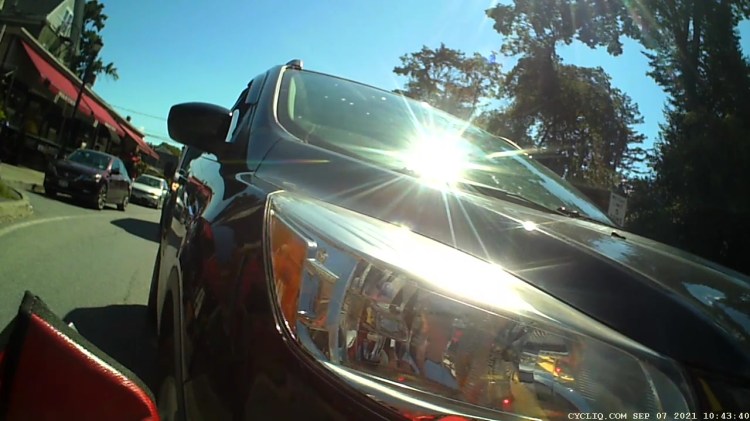
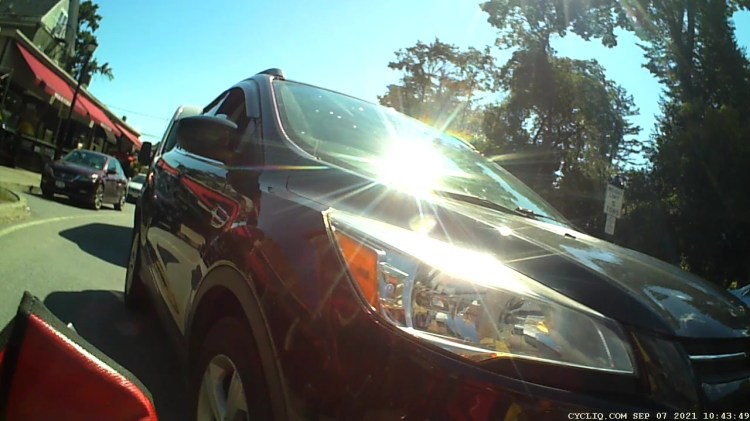
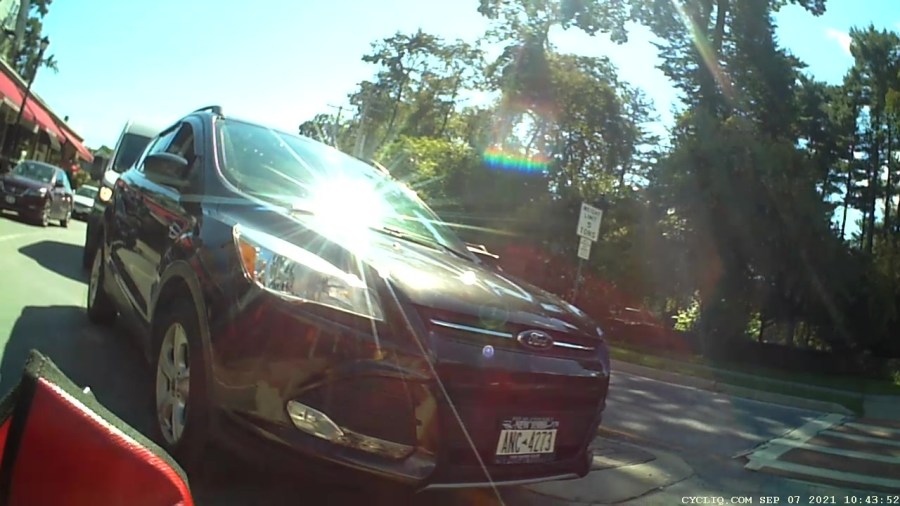
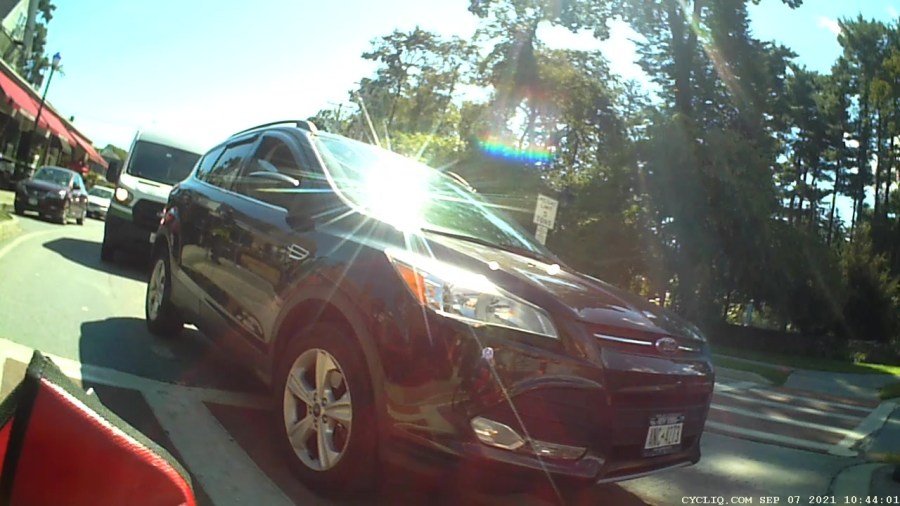
Another five seconds and the sidewall bulge of the car’s radial tire is pressing her foot to the pavement:
Zero Clearance – Ed Rear – 2021-09-07 – 1934
A closer look:
Zero Clearance – Ed Rear – 2021-09-07 – 1946 detail
She yanks her foot away:
Zero Clearance – Ed Rear – 2021-09-07 – 1953
While the driver continues to creep forward:
Zero Clearance – Mary – 2021-09-07 – 1397
Sometimes, it’s the only way to get some attention:
Zero Clearance – Ed Rear – 2021-09-07 – 2026
Mary is now off-balance, leaning on the car door, explaining what just happened:
Zero Clearance – Ed Rear – 2021-09-07 – 2152
Mary regains her balance as the driver backs cautiously away:
Zero Clearance – Mary – 2021-09-07 – 1546
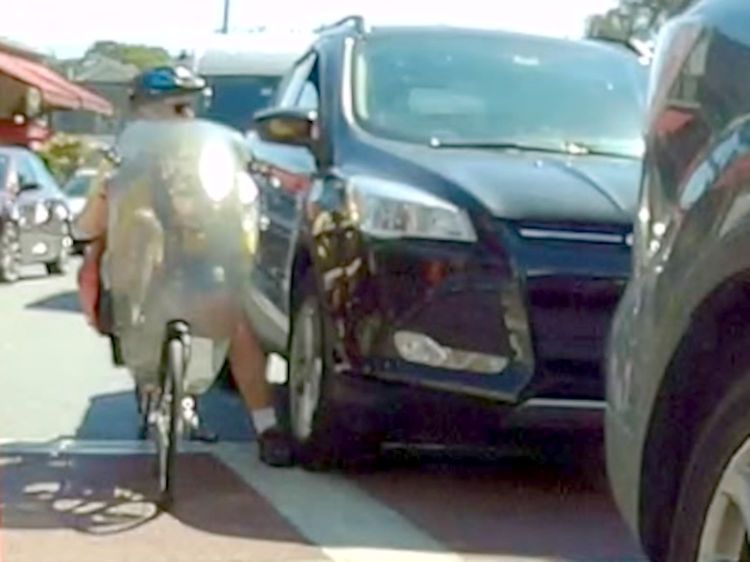
Were the bollard still atop that sad concrete foundation, the driver might not have driven up on the splitter to get around Mary, if only to avoid scuffing a fender:
Zero Clearance – Ed Rear – 2021-09-07 – 2479
Compare this clearance with what you saw earlier in the 0957 image:
Zero Clearance – Mary – 2021-09-07 – 1627
Mary can’t get far enough away, but this must suffice:
Zero Clearance – Ed Rear – 2021-09-07 – 2761
Now the driver can pass her again with more clearance:
Zero Clearance – Mary – 2021-09-07 – 1891
I pointed to the car, then to the circle, and shouted “GO!” because neither of us wanted to be in front of that particular driver:
Zero Clearance – Ed Front – 2021-09-07 – 2540
We’ll surely meet her again, ideally with more clearance.
The North Residency of NYS DOT Region 8 normally does a pretty good job of clearing roadside brush, but they’re apparently daunted by the prospect of trimming shrubbery and hedges encroaching on the right of way:
Rt 376 at Red Oaks Mill – Bike Route vs ped facilitie
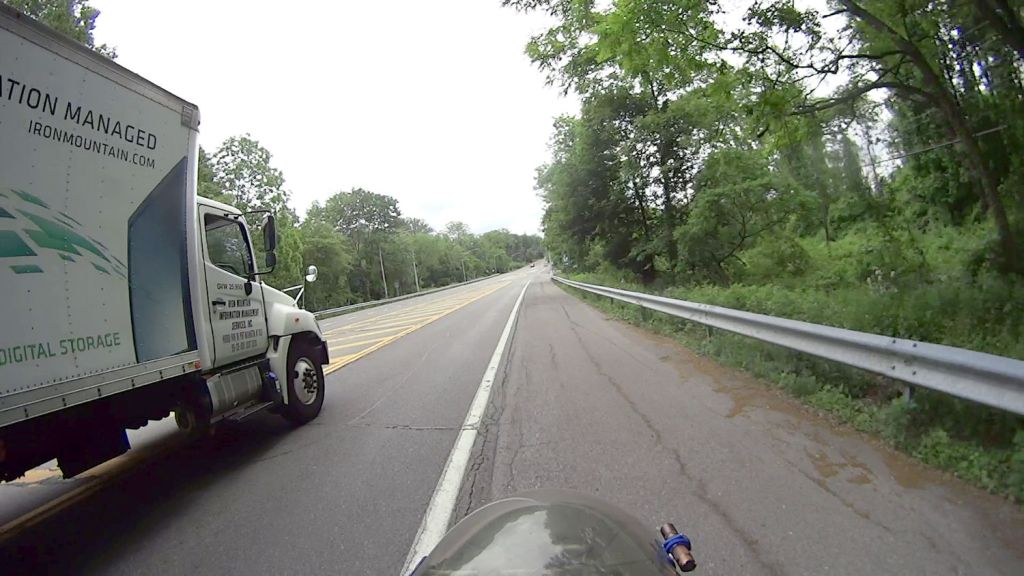
Truck traffic crops the overhanging branches, but the lower greenery forces pedestrians (who have nowhere else to walk) into the middle of the lane. A DOT staffer once said they didn’t design sidewalks into a project unless a clear path showed in the grass along a road.
The Red Oaks Mill intersection has no pedestrian facilities at all, although nowadays we see more walkers than ever before, and bicyclists no longer expect anything other than Bike Route markers.
This time, however, what I know (and the driver apparently doesn’t) is that Zack’s Way has been closed for two days while a film crew does something to create The White House Plumbers along that stretch of road, with barricades and City of Poughkeepsie police cars across the entrance to prevent bystanders from wandering in.
At least I’ll have witnesses …
NYS DOT installed a pair of Variable Message Signs showing ZACK'S WAY | CLOSED | Thursday & Friday on either side of the intersection:
Rt 376 at Zacks Way – Closure VMS – 2021-06-04
Fortunately, the driver figured it out before our paths crossed:
Rt 376 at Zacks Way – Right Hook Miss – 2021-06-04
But, hey, those signs are easy to overlook, too …
I have typed “Zach’s Way”, rather than the correct “Zack’s Way”, on several posts.
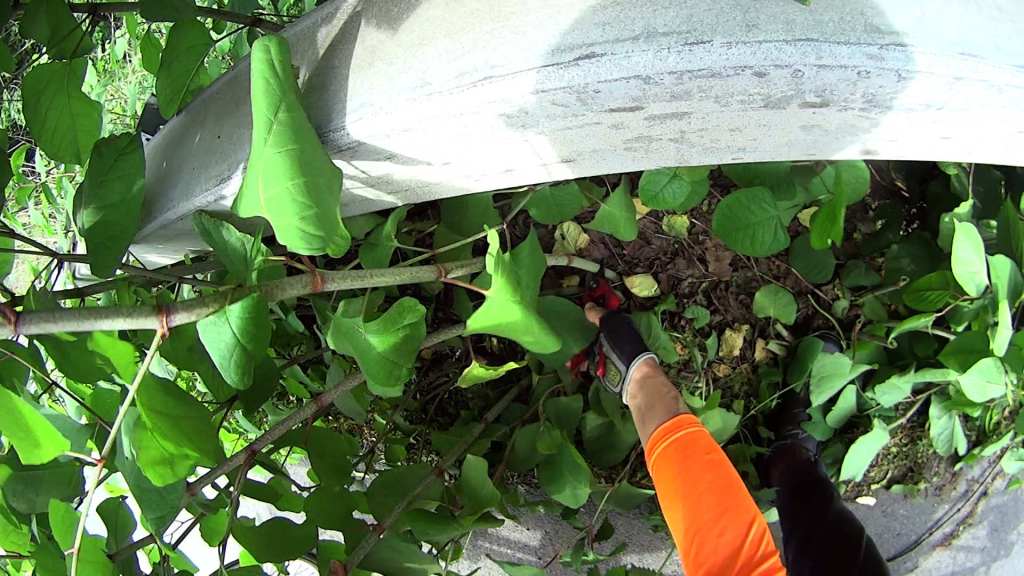
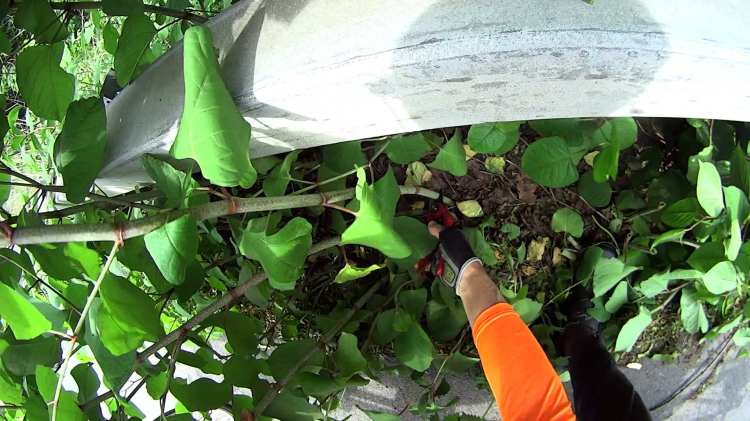
I’ll do my part, inadequate though my pruners may be:
Rt 376 Knotweed – Knotweed trimming – 2021-05-23
I got most of the growth in front of the guide rail extending across the shoulder, but must wait for another weekend morning to hack back the main stems.
Unfortunately, Knotweed control requires nearly continuous clearcutting and defoliation to prevent new growth.
We have just started rolling from Overocker Road and the traffic signal on Burnett Blvd at Rt 55 (on the far left) has just turned green for the single car on the sensor loop:
Burnett Blvd Rt 55 – 2021-05-23 – 0 s
Much to our surprise, 17 s later the signal is still green:
Burnett Blvd Rt 55 – 2021-05-23 – 17 s
As usual, the unmarked sensor loop doesn’t detect bicycles and the control doesn’t take our clearing time into account, so the signal turns yellow 5 s later (after 22 s from turning green) while we’re still in the intersection:
After another 6 s, though, we’re through the intersection and lined up on the right side of Rt 55, just as the Rt 55 signal turns green:
Burnett Blvd Rt 55 – 2021-05-23 – 28 s
Note that the Burnett Blvd signal remained green for 22 s, much longer than in bygone years, and the green-to-green time is now 28 s. We got through the intersection without any difficulty, although the green-to-red clearance time remains scanty.
Mary recently discovered a reason why NYS DOT may have suddenly changed the signal timing at the Burnett intersection after all those years:
During the incident, a black Nissan Titan, driven by a 51-year-old male resident of Lagrangeville, collided with a bicycle, ridden by a 58-year-old male resident of Poughkeepsie, in the area of the crosswalk on the southeast portion of the intersection, said the Town of Poughkeepsie Police.
The bicyclist sustained serious injuries and was transported to MidHudson Regional Hospital.
The crosswalk mentioned in the article appears in the last picture.
The cyclist died of his injuries shortly after that article went live.
Mary knew him. He was one of the gardeners near her plot in the Vassar Community Garden who lived in the apartments a few hundred yards from that intersection, didn’t own a car, and, for years, rode through that intersection to the grocery store at the far end of Burnett Blvd (across another of DOT’s intersections). Everyone knew him as a nice, considerate guy.
Death is the only thing that will convince NYS DOT’s engineers to change the signal timing at an intersection.
As far as I can tell, all of the other intersections along our usual routes still have the same inadequate clearance times. Evidently, the bicyclist death toll isn’t high enough to get their attention and evidence here doesn’t matter there, because motor vehicle traffic cannot be delayed, even for a few seconds, merely to protect the most vulnerable “users” of their facilities.
We’ve been bicycling all our adult lives and haven’t been killed yet, despite NYS DOT’s complete lack of attention. Our experiences justify my cynicism and bitterness.
I eventually figured out why no NYS DOT staffer will accompany me on bike trips along their “safe for all users” roads. If they did, they’d be unable to deny knowing how hazardous their engineering designs & maintenance practices are in real life, should the question come up in a court of law.
If you think that’s not the case, then let’s go riding together …
Road design, build quality, and attention to details matter, even though drivers and, yes, cyclists share some of the blame.
The NYS DOT has been improving the pedestrian crossings at the Burnett – Rt 55 intersection. I expect this will be a bullet item in their Complete Streets compliance document, with favorable job reviews for all parties. The situation for bicyclists using the intersection, which provides the only access from Poughkeepsie to the Dutchess Rail Trail, hasn’t changed in the slightest. No signal timing adjustments, no bike-capable sensor loops, no lane markings, no shoulders, no nothing.
Here’s what NYS DOT’s Complete Streets program looks like from our perspective, with the four-digit frame numbers ticking along at 60 frame/sec.
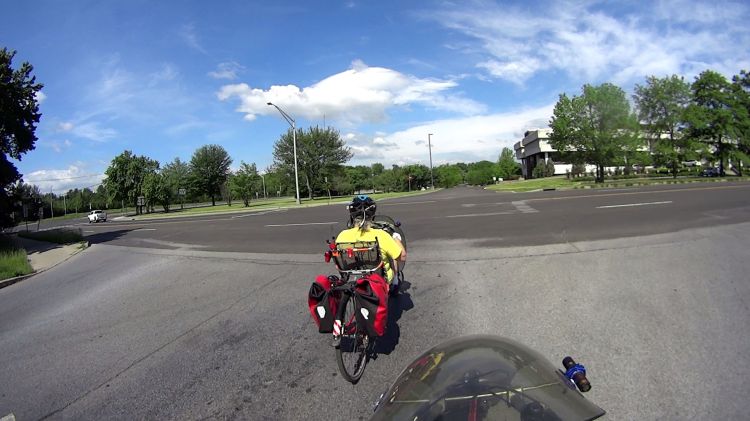
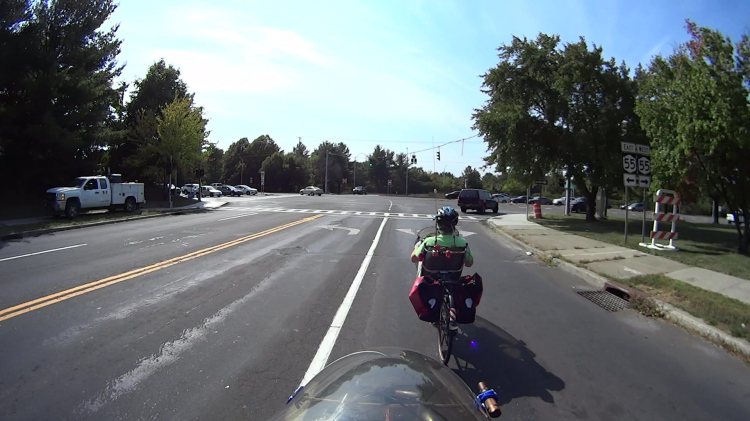
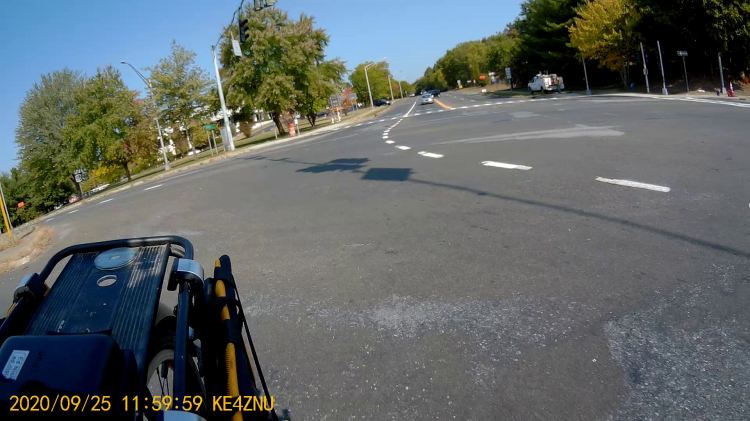
We’re waiting on Overocker Rd for Burnett traffic to clear enough to cross three lanes from a cold start:
Burnett Signal – 2020-09-25 – front 0006
That building over there across Burnett is the NYS DOT Region 8 Headquarters, so we’re not in the hinterlands where nobody ever goes.
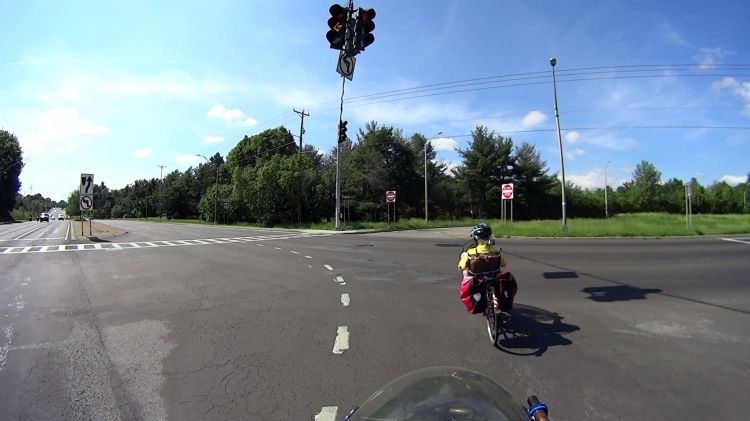
About 1.5 seconds later, the vehicles have started moving and we’re lining up for the left side of the right-hand lane:
Burnett Signal – 2020-09-25 – front 0752
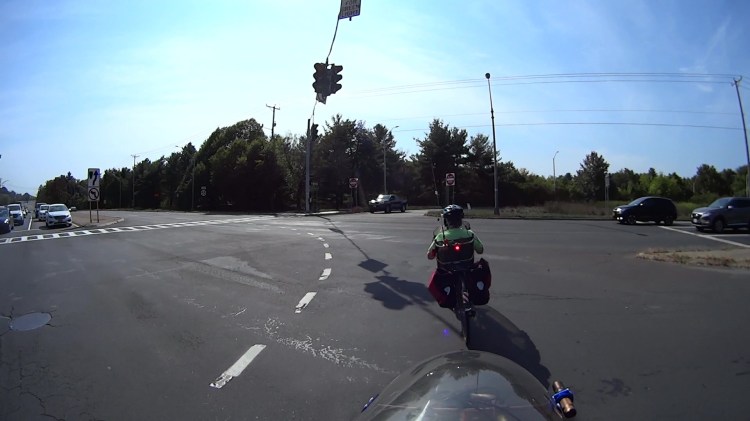
There’s no traffic behind us, so we can ride a little more to the right than we usually do, in the hopes of triggering the signal’s unmarked sensor loop:
Burnett Signal – 2020-09-25 – front 1178
We didn’t expect anything different:
Burnett Signal – 2020-09-25 – front 1333
We’re rolling at about 12 mph and it’s unreasonable to expect us to jam to a stop whenever the signal turns yellow. Oh, did you notice the truck parked in the sidewalk over on the left?
As usual, 4.3 seconds later, the Burnett signals turn red, so we’re now riding in the “intersection clearing” delay:
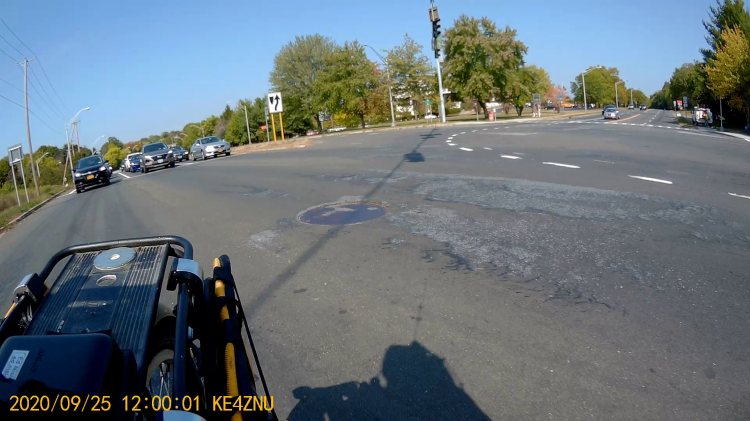
One second later, we’re still proceeding through the intersection, clearing the lethally smooth manhole cover by a few inches, and approaching the far side:
Burnett Signal – 2020-09-25 – front 1771
Here’s what the intersection looks like behind me:
Burnett Signal – 2020-09-25 – rear 1
Another second goes by and we’re pretty much into the far right lane , with the westbound traffic beginning to move:
Burnett Signal – 2020-09-25 – front 1831
The pedestrian crossing ladder has fresh new paint. They milled off the old paint while reconstructing the crossing, so the scarred asphalt will deteriorate into potholes after a few freeze-thaw cycles. Not their problem, it seems.
Although it’s been three seconds since Rt 55 got a green signal, the eastbound drivers remain stunned by our presence:
Burnett Signal – 2020-09-25 – rear 2
After another second, we’re almost where we need to be:
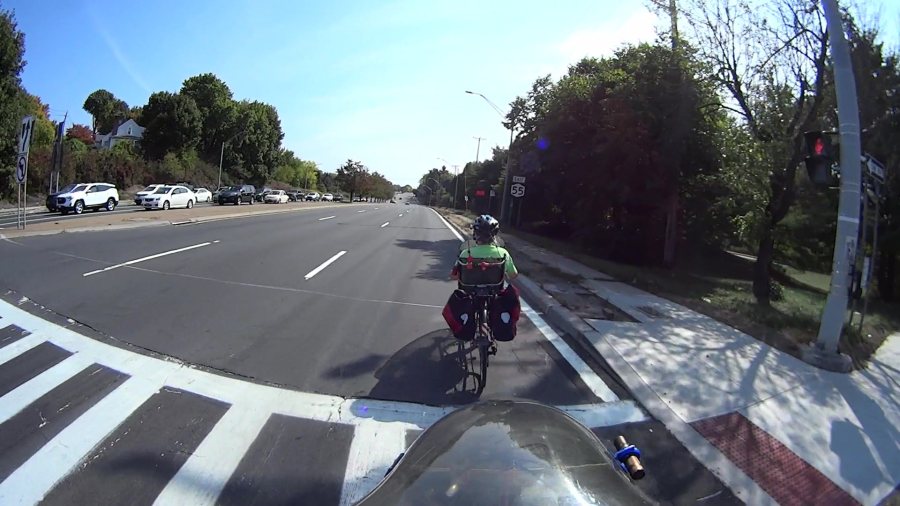
Burnett Signal – 2020-09-25 – front 1891
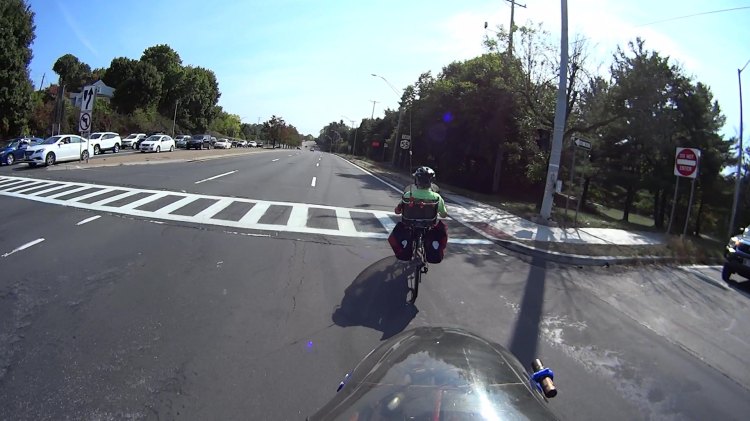
There’s a new concrete sidewalk on the right, with a wheelchair-accessible signal button I can now hit with my elbow when we’re headed in the other direction. It’s worth noting there is no way to reach Overocker by bicycle, other than riding the sidewalk; there’s only one “complete” direction for vehicular cyclists.
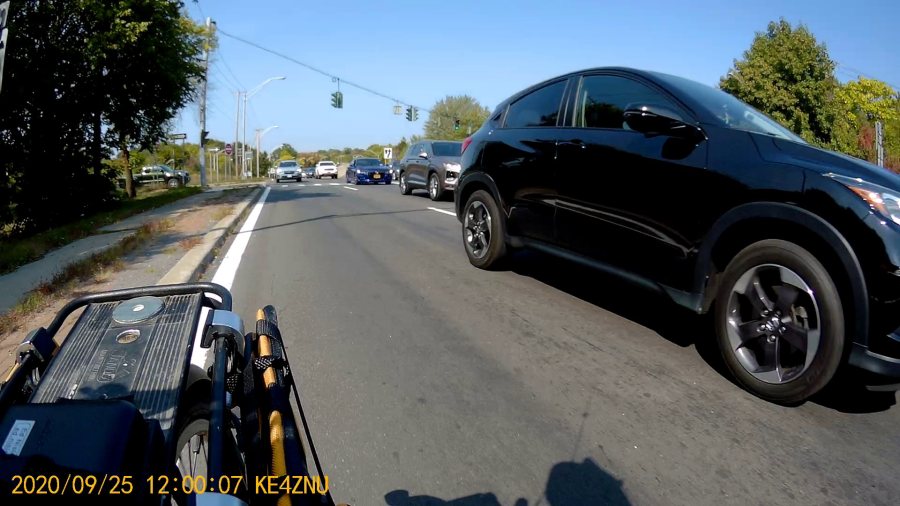
One second later puts us as far to the right as we can get, given all the gravel / debris / deteriorated asphalt along the fog line near the curb:
Burnett Signal – 2020-09-25 – front 1957
Which is good, because four seconds after the green signal for Rt 55, the pack has overtaken us:
Burnett Signal – 2020-09-25 – rear 3
If you were the driver of the grayish car in the middle lane, directly behind the black one giving us plenty of room, you might be surprised at the abrupt lane change in front of you. Maybe not, because you had a front-row seat while we went through the intersection.
Elapsed time from the green signal on Burnett: 25 seconds. My point is that another few seconds of all-red intersection clearing time wouldn’t materially affect anybody’s day and would go a long way toward improving bicycle safety.
Unlike the pedestrian crossing upgrade, NYS DOT could fix this with zero capital expenditure: one engineer with keys to the control box, a screwdriver or keyboard (depending on the age of the controls), and the ability to do the right thing could fix it before lunch tomorrow.

























 The Smell of Molten Projects in the Morning