Ed Nisley's Blog: Shop notes, electronics, firmware, machinery, 3D printing, laser cuttery, and curiosities. Contents: 100% human thinking, 0% AI slop.
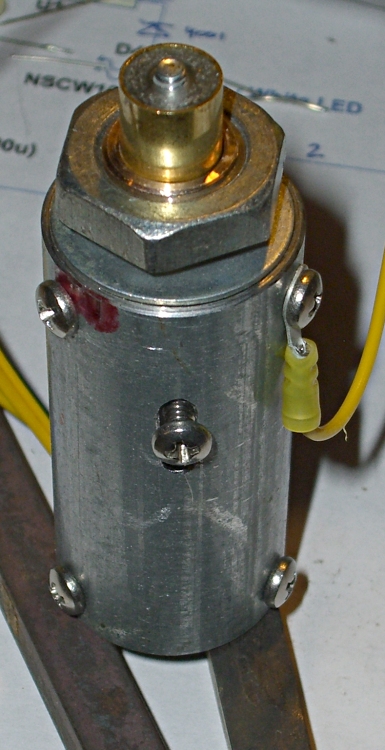
This is a chunk of EMT (Electrical Metallic Tubing) with 4-40 clearance holes that attach it to the panel mounting bolt, hold the base disk in place, and keep the central contact assembly from rotating. The overall view gives you a good idea what’s involved.
The nominal EMT size is 3/4″, which (of course) means the ID is about 0.8″ and the OD is a bit over 0.9″. There’s a weld seam running the length of the tube that I cleaned up on the lathe, so the actual ID is slightly enlarged. While it’s in the lathe, face off both ends to whatever length suits the spring you’ll eventually use.
There’s nothing tricky about this, other than getting the three holes on each end lined up properly with their mating parts. Once again, manual CNC comes in handy: grab it in the 3-jaw on the rotary table, use G81 to drill the hole and G0 A120 and G0 A240 to index the locations. Make sure you retract the drill bit far enough to clear the chuck jaws!
The two sets of holes need not be perfectly aligned with each other.
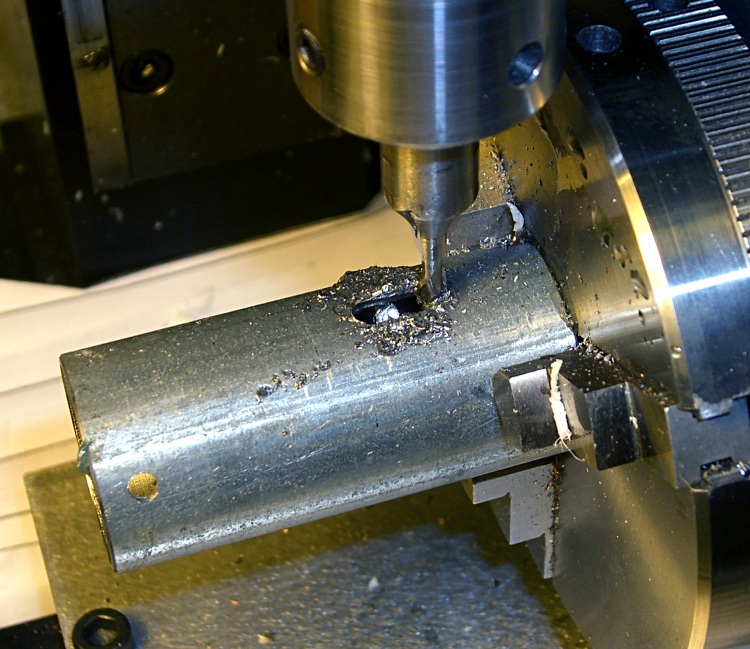
Milling rotation stop slot in shell
The photo shows that I milled the rotation stop slot after drilling the holes. It’d be easier to do that without removing the cylinder from the chuck, but this was one of those incremental designs where I was checking the fit as I built it.
The slot should be long enough to allow the contact assembly to slide almost completely into the pedestal. That prevents you from crunching the dosimeter’s innards when you’re pressing it down on the spring.
The clearance from tool holder to chuck isn’t all that large; you might want to put the slot at the far end of the cylinder… but then I’d have to conjure up a pipe center for the Sherline tailstock and figure out how to mount it high enough to match the rotary table’s axis.
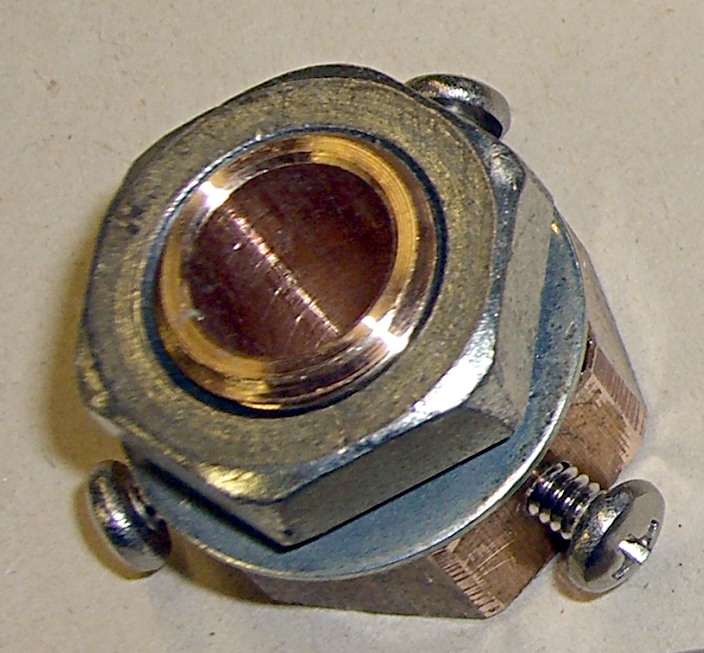
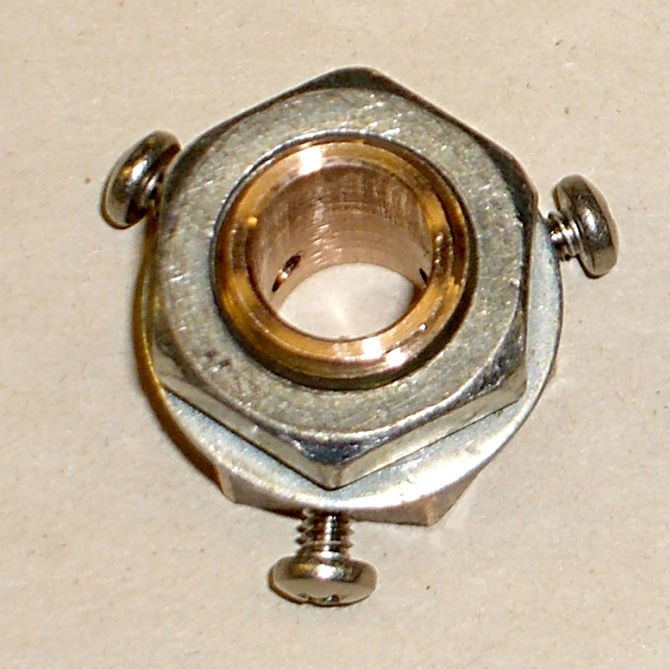
The original V-750 pedestal is a threaded bushing around the cylinder that contacts the dosimeter. Hard to make from scratch, but it’s basically a bolt with hole in the middle. I can do that…
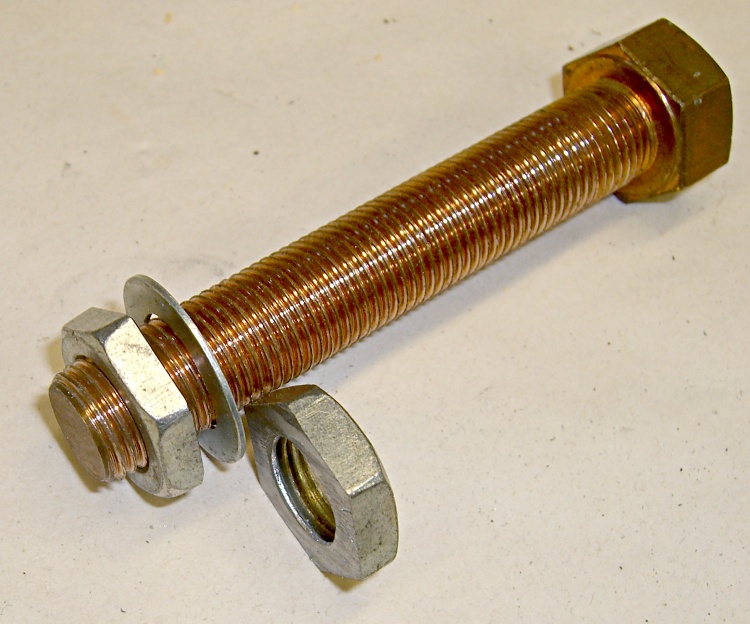
A foray into the parts heap produced a copper bolt threaded 1/2″-20 and a matching steel nut. I bandsawed the nut in half, doing a surprisingly good job of cutting it parallel to the surfaces, and filed off the obvious blems. The thin washer fit a 7/16″ bolt until I filed the hole out; the OD is a bit undersized for a 1/2″ head and looks much better in this application.
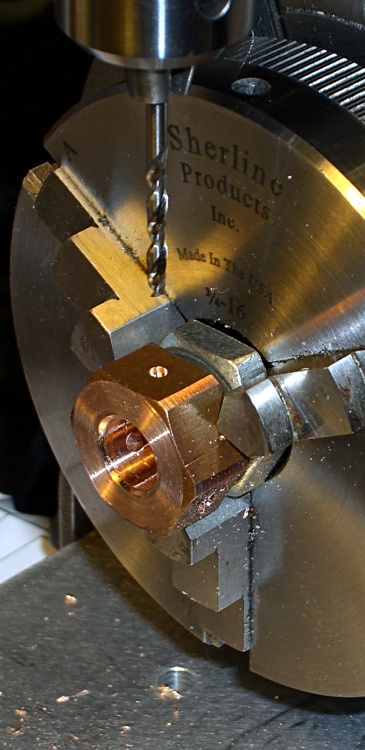
I grabbed the bolt threads in the lathe and turned down the head for a slip fit in the EMT. Turns out the head wasn’t exactly concentric with the threads, but now the rounded-off hexagon tips are. Drill out the middle for a slip fit around the 11/32″ brass tubing, break the edges, and it’s all good.
Drilling EMT mounting holes in bolt head
The bolt threads need to be barely long enough to go through the aluminum box I’ll eventually mount this thing in and pass through the nut, so I sawed the bolt off to 3/8″, more or less, and cleaned up the end in the lathe.
I thought about soldering the bolt to the EMT shell, but, fortunately, came to my senses before doing any damage. Instead, I drilled & tapped three 4-40 holes in the head that will match with similar clearance holes in the EMT. This is the sort of thing that works really well with “manual” CNC: get the first side lined up, then just type G0 A120 and you’re at the next face. A manual G83 peck drill cycle pokes the hole exactly where it’s needed.
Manual tapping, a bit more edge breaking, some cleanup, and the thing looks pretty good.
Pedestal mount – oblique viewPedestal mount – top view
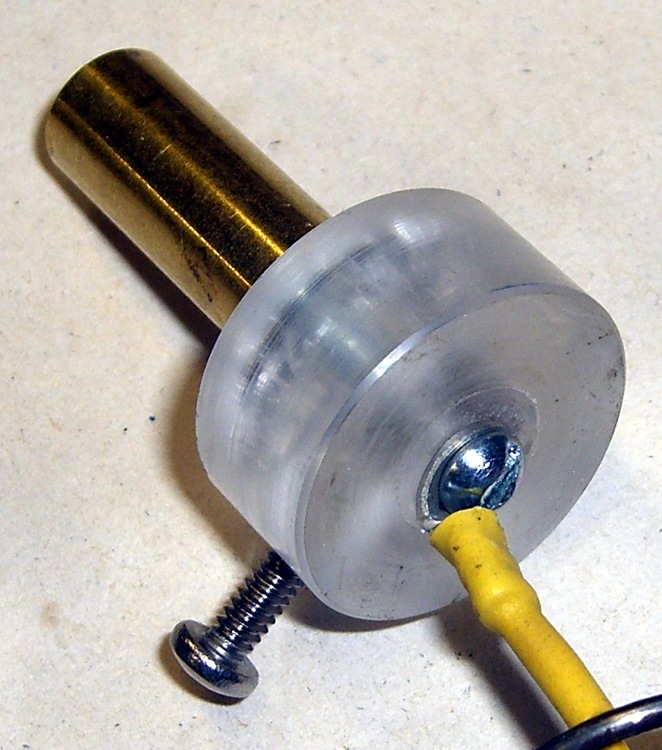
The cylindrical center of the pedestal must conduct light into the dosimeter, conduct a positive charge into the contact pin, and push that pin hard enough to make contact inside the dosimeter.
The general notion is to turn an acrylic rod to a slip fit inside an 11/32″ telescoping brass tube, glue a wider acrylic disk to the bottom to take up the spring pressure, and run a 4-40 machine screw right down the axis to carry the current. There’s also a screw in the side to prevent the shaft from rotating.
Although the bulk of screw and solderless lug looks like it should block much of the central shaft’s view of the LED in the base, enough light gets around to illuminate the dosimeter’s scale. The acrylic doesn’t need an optically perfect finish, either, as diffuse light works fine.
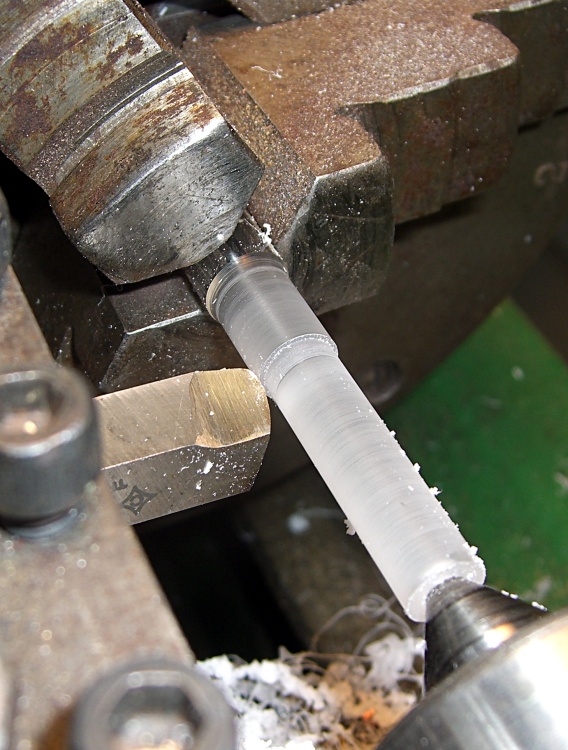
Turning contact base ringTurning central contact post
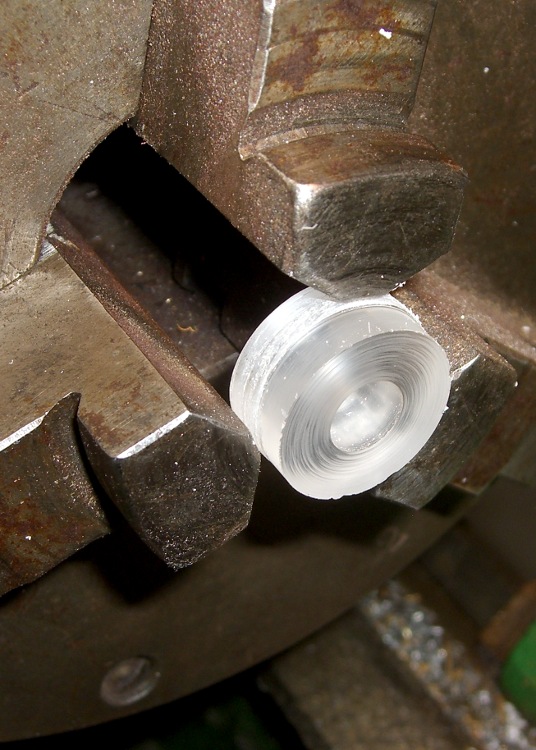
I used a hole saw to extract a disk from a piece of acrylic that used to contain one of those crappy desk clocks they give out as awards when money’s too tight to mention. The diameter should be a bit larger than the EMT’s ID so you can turn it to a slip fit.
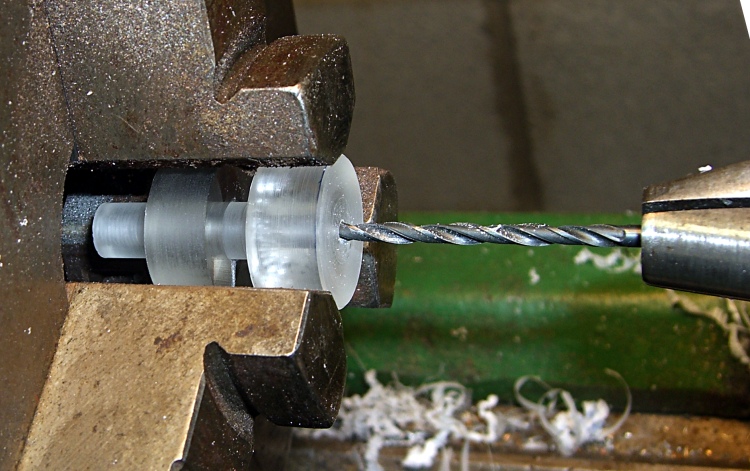
Chuck the disk up reasonably square and drill out the center to a bit over 11/32″, so the tubing will bear against the rod rather than the base.
The acrylic rod has two slip fits: into the brass tubing and into the disk. Neither will be particularly fussy, so don’t lose much sleep over perfection here. Apply some good solvent adhesive to the rod’s large end and slide it into the disk. Pause for a day while it cures: it’s a big joint.
After it’s cured, chuck up the rod and turn the disk so it’s nice & square & neatly finished.
You’ll need two more disks: one for the pedestal base and another to act as a collet. I made them from 3/8″ polycarbonate sheet, of which I have what may turn out to be a lifetime supply. The base disk will be another slip fit in the EMT, the collet must match the actual OD you just turned on the contact disk. Saw a slot in the collet disk to convert it into a (crude) collet.
Drilling 4-40 clearance hole
The original V-750 pedestal has a nice stamped rod running the length of the central post, but I figured a long 4-40 screw would work as well. However, there’s no reason to thread the entire length of the post, so drill out a 4-40 clearance hole from the disk to within about 1 cm of the other end. This is where the collet disk comes in handy; you can see the saw slit at the bottom, between two jaws.
Take the rod out out and thread the end.
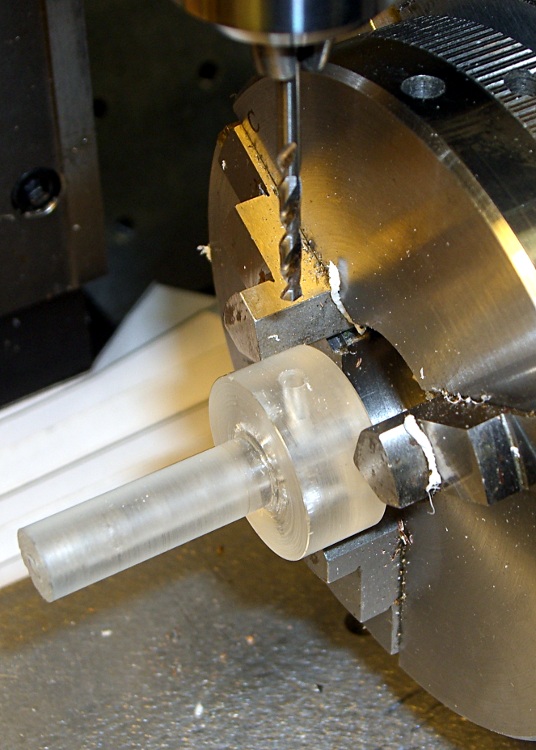
Drilling rotation stop hole
The last step is drilling & tapping a 4-40 hole in the side for the rotation stop screw. This will fit into a corresponding slot in the EMT shell to prevent you from twisting the contact wire off.
Put everything together, with a dab of cyanoacrylate adhesive to keep the brass tubing in place, and you’re done with this part.
With the epoxy cured overnight, I fired up the Sherline CNC mill to poke screw holes in the brass hinge splice.
The first step was to mill a flat-bottomed hole in the lower surface of the thin brass to expose the threaded hole in the remaining hinge plate. I crunched the end of the frame in a machinist’s clamp, then grabbed that in the Sherline milling machine vise; the frame is upside-down in the picture.
The brass stock was 0.015 inches, so I milled downward 0.020 inches to get through the epoxy. I’d love to say that worked perfectly, but I had to fiddle around a bit and eventually put a slight divot in the hinge plate.
That alignment was by pure eyeballometric guesstimation, but poking a small epoxy disk out of the threaded hole revealed that the 2 mm milled hole was centered on the hinge hole. Pretty close. Kinda-sorta. Good enough for my purposes, anyway.
Laser alignment to hinge hole
I aligned the spindle to the actual hinge hole with my laser aligner, a process that turned out to be surprisingly easy: note where the red dot vanishes on each side of the hole, split the difference, repeat for the Y axis, and you’re done.
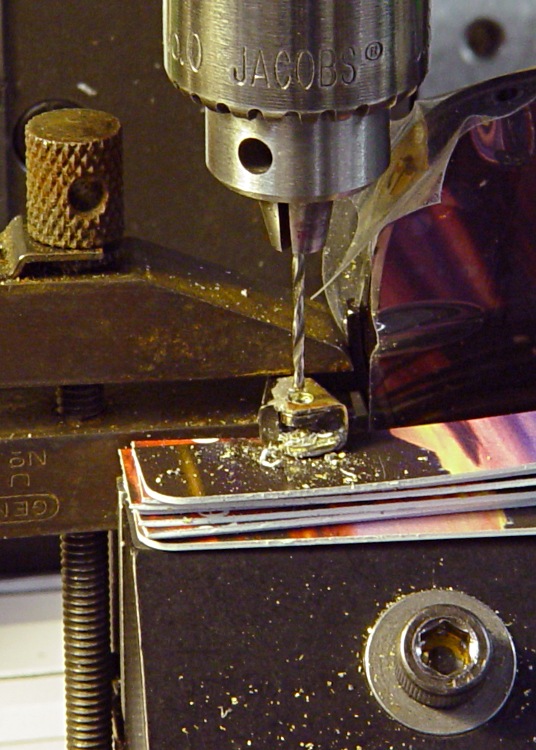
Through-drilling top hole
With the spindle centered, I ran a #60 drill through the threaded hole (which it just barely cleared) and poked a hole in the thicker top plate (which is on the bottom here, remember). The packing under the hinge is a cut-up credit card; a handy source of thin sheets of stiff plastic.
Then I flipped the frame over and drilled out the top hole with a #54 drill to clear the threads on a 00-90 machine screw. I’d like to say I did a precision alignment job, but what I actually did was chuck that little bitty drill up in my big drill press, run it on the slowest spindle speed (maybe 400 rpm), brace my arms on the table, and feed the frame onto the drill by hand. Works perfectly… if only because I’m enlarging the hole by, what, 7 thou on each side.
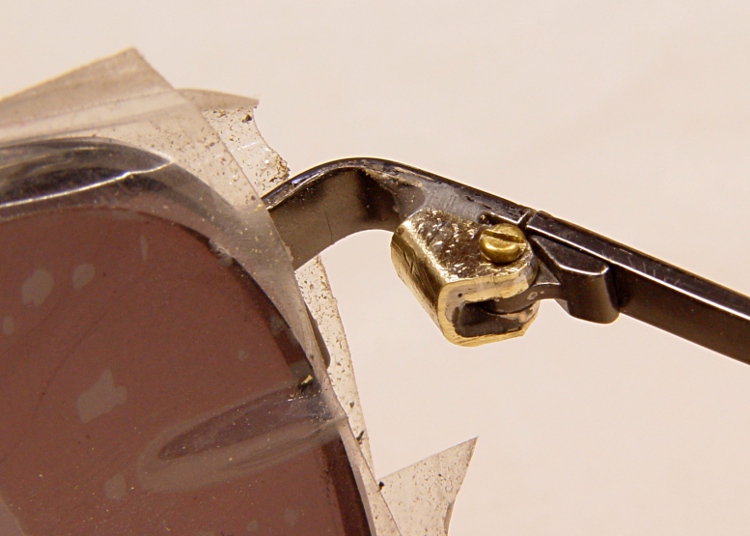
Finished hinge – top view
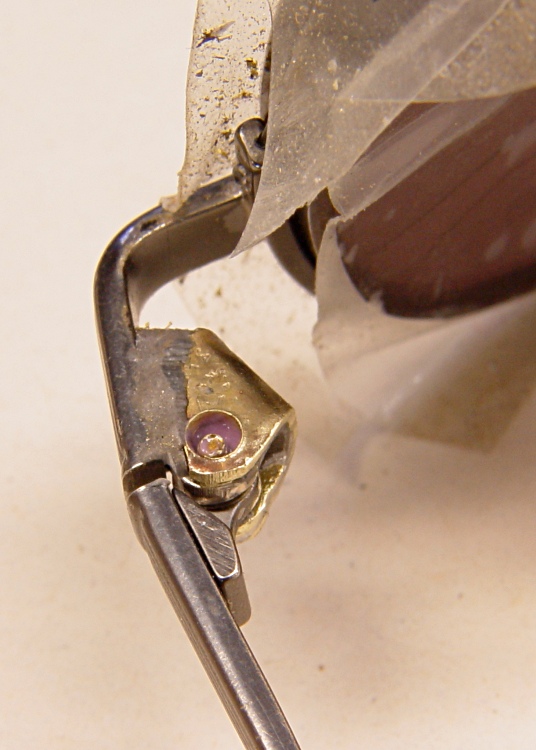
A bit of filing cleaned up the drill chaff inside the hinge so I could mount the earpiece on the frame and screw it in place. I don’t have a 00-90 tap and wouldn’t use it in a titanium frame anyway, so you can tell this isn’t going to have a happy outcome, but, by and large, the undoubtedly metric threads in the frame did a pretty good job of re-forming the 00-90 brass threads. Ugly, but serviceable.
Some Dremel-tool work with an itsy grinding wheel on the flexy shaft eroded the back side of the U-shaped brass and new hinge plate to clear the earpiece; I think it only took half a dozen trial fittings & tiny grindings before the earpiece folded properly.
A dab of low-strength purple Loctite in the threads and I’d say that screw is in there for life!
Finished hinge – side viewFinished hinge – bottom view
Then I cleaned it up with a miniature wire wheel and, hey, it’s got a certain geeky charm, doesn’t it?
I have my doubts about how well the epoxy affixes itself to the brass, so I suspect I’ll be drilling a hole or two to mechanically lock it in place with some urethane adhesive when it falls off.
If the remaining hinge plate fractures, however, then the frame is toast.
Until I get around to having the optical shop dye up another pair, these should suffice for my simple needs.
Trivia:
The plastic film on the lenses comes from a big roll of the stuff they use to protect CRT monitors in shipping. Works great for shop projects and, back in the day, I used it when I was hauling monitors around. I think it’d suck the front right off an LCD panel, so I haven’t used much of it lately.
If you’re following the pictures, you’ll notice that the dsc* numbering series resets right in the middle of the story. That’s where my Sony camera gagged while writing an image and explains why I don’t have pix of the first drilling steps.
The color balance is weird on the milling machine pix because the shop lights are much cooler than the warm compact fluorescent bulb hovering over the table.
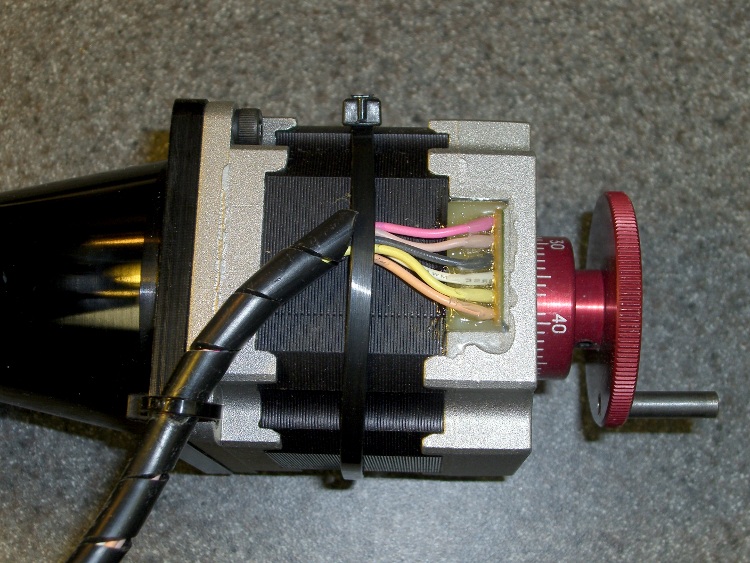
The wires coming out of Sherline CNC milling machine stepper motors, as with most small stepper motors, emerge from an epoxy-filled opening. As a result, whenever the motor or wires move, all the stress concentrates right at that epoxy surface.
Which is exactly where the wires will break…
There’s no good way to add strain relief to that point (more adhesive isn’t helpful), but you can anchor the cable to the motor frame so that the individual wires do not move relative to the motor.
Cable ties will suffice. Add one around the entire motor to hold the wires in place, then lash the spiral sheath to one of the unused mounting holes in the motor frame.
Pull those ties until they squeak! You can grab the tabs with flush-cutting diagonal cutters to get some traction, then rotate the cutters against the ratchet housing to pull another notch past the ratchet. When it’s so tight you’re stretching the tie, then it’s tight enough; clip the end off with the cutters.
To cross-check, wiggle the connector end of the cable. If the wires move at the epoxy, then you haven’t done a sufficiently good job. Repeat until satisfied.
This works for the milling machine and, as shown in the picture, the rotary table. Just do it!
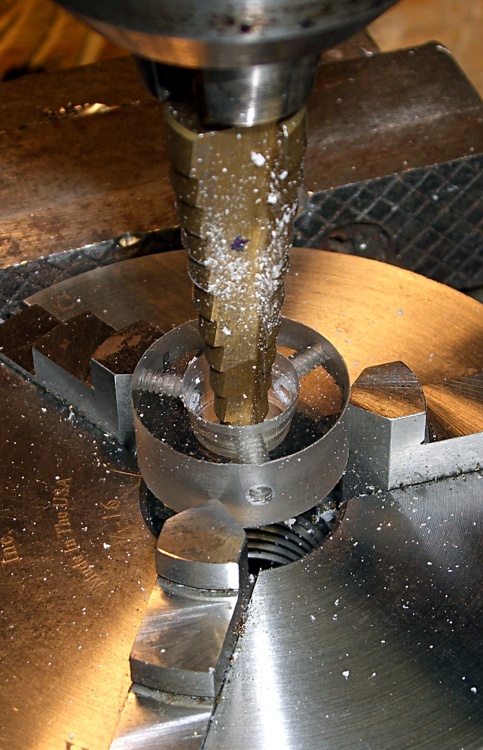
I needed a shoulder around the inside of a hole, upon which to mount a big fat 10-mm white LED. The intent was that the LED leads go through the hole, the edge of its case sits on the shoulder, and a blob of hot-melt glue (epoxy for the final version) holds everything in place.
I was all set for some CNC milling when it occurred to me that there was an easier way.
The bottom flange on the LED case was scant of 11 mm, so a 13/32″ bit would be just just slightly too small and a 7/16″ bit would be just slightly too large. One of my step bits has 1/32″ increments in that range, sooo…
I grabbed the part in a Sherline 3-jaw chuck (I’d just drilled & tapped the three radial holes using that chuck), centered it in the drill press using a 5/16″ drill that just fit the existing center hole, crunched the chuck (lightly!) in the vise with the hole over the gap in the middle of the vise body (thus leaving room for the step bit), and drilled the hole 7/16″ about 1 mm down.
(It’s not that I’ve never drilled right into the vise body, but I try to avoid doing that sort of thing more often than absolutely necessary.)
The LED flange sat on 13/32″ annulus like I’d bored it to the exact measurements, with the leads passing through the hole as if I intended it to be that way.
It doesn’t always work out this neatly…
The Sherline chuck is resting on a pair of 5/16″ lathe bits that hold it up off the vise body, because its threaded hub isn’t quite large enough to make a stable base. Similarly, I used a pair of 1/4″ bits to space that plastic ring up from the chuck and get it level, but removed them lest I chew up the step bit. Yes, I took the drilling slow & easy.
Those little Sherline chucks come in handy around the shop, not just on the Sherline mill, for little jobs like this!
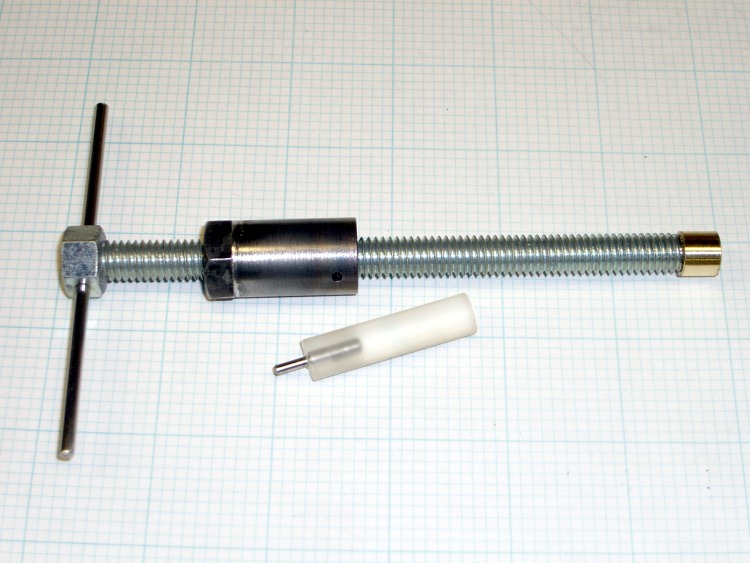
After a while you realize that whacking the drawbolt to extract a tapered tool or collet can’t possibly be a Good Thing for the spindle bearings, particularly on the 10k rpm head. So you need one of these, a low-effort / low-skill version of the beauty described in Sherline’s Tip 15.
It’s basically a length of all-thread rod with a nut epoxied on the top, a nut soldered to a sleeve that locks to the spindle, and a brass tip epoxied on the bottom to push the taper out.
Drill a suitable hole in the nut for a steel rod, add heatshrink tubing on both sides so it doesn’t fall out. If you’re clever, you’ll make the rod short enough that it fits in your tool tray along with all the other itsy-bitsy tools and parts.
Bore out a steel cylinder to clear the top of the Sherline spindle and drill a small hole to exactly match the hole in the side of the spindle. Turn down the end of another nut to fit inside the cylinder and silver-solder them together. Maybe epoxy would work here, too.
Find or make a steel locking pin that fits the small holes, make a cute handle for it, press in place. Take some care that the handle radius clears the headstock pulley. It’s a very good idea to have a much better fitting pin than I started with; a too-small pin will goober the top edge of the spindle hole. Ask me how I know…
Turn the end of the all-thread down to a little post, drill a slightly larger hole in the brass tip which you turned to fit down the spindle bore, goosh together with epoxy. Hint: spin the cylinder on the all-thread before epoxying the tip in place.
To use:
Remove drawbolt
Spin cylinder up the all-thread a bit
Insert extractor in the spindle
Line up small holes, insert locking pin
Insert tommy bar in spindle
Turn the extractor handle & hold the tommy bar: don’t torque the locking pin!
Cup your hand under the cutter to catch it before it hits the part / table
… profit!
This goes a lot faster than it sounds and feels much nicer than beating the crap out of my precious Sherline head.



 The Smell of Molten Projects in the Morning