Ed Nisley's Blog: Shop notes, electronics, firmware, machinery, 3D printing, laser cuttery, and curiosities. Contents: 100% human thinking, 0% AI slop.
After five years, I figured it’d be a Good Idea™ to replace the Forester’s wiper blades. Being in the Walmart at the time, I tried to use their helpful Wiper Selector gadget:
Walmart Wiper Selector
You’d think whoever is responsible for updating / replacing such things would have done so several times during the last eight years.
Well, all I can say is it seemed like a good idea at the time.
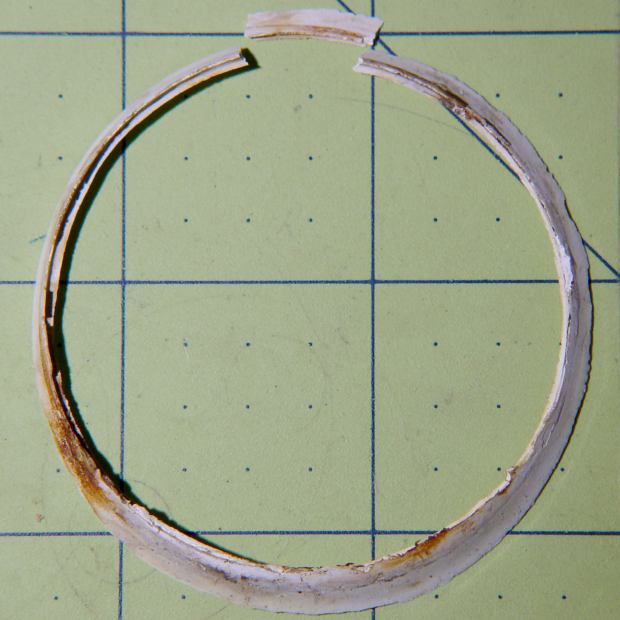
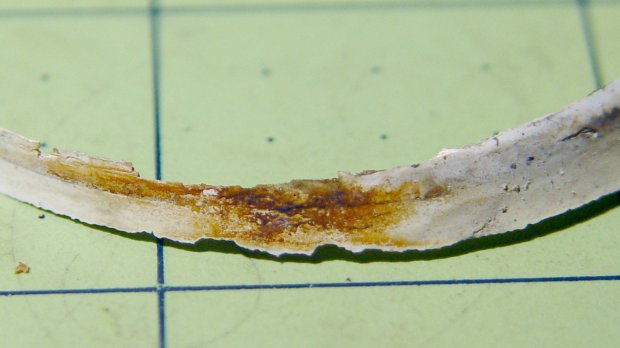
Alas, even the newly exposed fiber didn’t make much of a mark on the paper and, as you’d expect, the ragged ceramic tip dragged painfully across the paper. I assume the fiber had filled with fossilized dry ink.
A New Old Stock bag of fiber-tip pens emerged from the Big Box o’ Pens while I was flailing around:
HP 7475A Plotter – NOS Green pen package
I think the “812” in the lower right corner is a date code, most likely early in 1988, so the pens started their lifetime countdown at least three decades ago. They still work, though:
The battery pack on my ancient Dell E1405 laptop finally died, so I tore it apart to see what horrors might lurk within:
Dell UG679 Lithium Battery – teardown
The case snaps apart without too much effort, although the delicate single-use latches won’t survive the operation. These certainly didn’t, which didn’t bother me at all, as I already had a replacement battery on order.
One of the cells (in the front) seems to have leaked ever so slightly inside its wrapper:
Dell UG679 Lithium Battery – leaky cell
The three cells in that 3P section seem to have failed open: they pass no current at all.
The other pair of 3P slices, charged at 4.2 V with a 700 mA current limit until the current dropped under 10 mA, still have some life:
Dell UG679 3P sections
Perhaps recycling individual cells into LED glowies would be nice, as they have enough capacity remaining to run an Arduino for quite a while, and a 1S USB charger would make for a self-contained package.
The clamp tightening screw is made from butter-soft Chinese steel with a swaged hex socket. As you’d expect, the hex wrench eventually (as in, after a few dozen adjustments, tops) rips the guts right out of the socket.
The screw has a M6×1.0 mm threads, but the thread around the hex recess is left-handed. While I could, in principle, print a 127 tooth change gear, rebuild the lathe’s banjo to accommodate it, then single-point a backassward M6 thread, it’s easier to just use a standard socket head cap screw:
Lathe Cutoff Tool – rebuilt screw
The clamp screw passes through the block at an angle:
Lathe Cutoff Tool – blade view
Fortunately, the screw is perpendicular to the angled side over on the left, making it easy to clamp in the Sherline’s vise:
Lathe Cutoff Tool – aligning to screw
Using the laser aligner seemed like a good idea at the time, but the top of the screw wasn’t particularly well-centered on the hole’s axis. I couldn’t screw the left-hand part (with the socket) in from the bottom and center the block near its surface, because then I couldn’t extract the screw before proceeding.
I used a diamond burr to grind out a flat for the screw head:
Lathe Cutoff Tool – clearing screw recess
The flat came from about twenty manual G2 I-2.5 full-circle passes, stepping down through the hard steel block 0.1 mm per pass, at a too-slow 4000 RPM and a too-fast 30 mm/min feed, with plenty of water squirted from one side into a shop vac snout on the other. The doodle in the background of the first picture shows a first pass at the layout, with the burr centered at X=-2.5; I actually did the grinding from X=+2.5 so most of the passes started in thin air.
The screw head started just shy of 10 mm OD and the burr just over 5.2 mm, so the ensuing 5 mm circles created a flat barely large enough. If the flat were perfectly centered on the screw axis, I wouldn’t have had to grind out another millimeter on the left side (toward the bottom of the tool holder body), but it worked out OK:
Lathe Cutoff Tool – 6 mm SHCS test fit
The trial fitting also showed the head stuck out ever so slightly beyond the far side of the block, where it would interfere with the blade, so I turned off 0.4 mm off its OD.
If I had a 50 mm SHCS in hand, I’d have used it. Instead, I extended the threads of a 75 mm screw, then lopped off the end to the proper length. I’ll spare you the ordeal, including the moment when I reached for the cutoff tool to shorten the screw. A bag of such screws will arrive shortly, in preparation for future need.
Now the [deleted] cut-off holder works the way it should have from the beginning.
I’m sure the hard stop loosened the tolerances along the shaft, but the mower fired right up (with that new blade!) and has no more vibration than usual, despite the seriously bent blade mount.
I no longer have a deep emotional attachment to lawn mowers, which is apparently common, as the label advises me there’s no need to change the oil:
The ancient utility pole on the north side of our property fell over a few hours after a thunderstorm rolled through:
Fallen Utility Pole – end view
Fortunately, the wire clamps were upward and it just lay there without sparks or excitement. It feeds the vacant house out back, so restoring power wasn’t urgent.
Unfortunately, the lines neatly bisected Mary’s garden:
Fallen Utility Pole – garden view
The utility crew arrived a few hours later, disconnected the triplex at the fallen pole, rolled it up, secured it to the source pole out front, and promised a different crew would replace the pole in a while:
Central Hudson truck – 2019-06-27
We agreed restoring service to other folks who needed it should take priority.
Mary’s been ducking the various cable TV / phone / FiOS cables ever since.
The pole has been God’s own toothpick for quite some time, as shown by this picture from 2001:
CHGE pole – rear – top
Fortunately for us, its pole tag hadn’t fallen off in all those years:
CHGE Pole Tag – mid-north
That little tag may save us ten large during this exquisite little inconvenience …