Ed Nisley's Blog: Shop notes, electronics, firmware, machinery, 3D printing, laser cuttery, and curiosities. Contents: 100% human thinking, 0% AI slop.
We used Diamond K540KM truck mirror-bracket antenna mounts clamped to the top seatback rail on our Tour Easy recumbents for several years, but they weren’t entirely satisfactory. The vibration from our ordinary on-road bike rides (a TE isn’t an off-road bike!) fractured the stamped-steel base after four years.
Antenna Bracket Repair
I fixed that by screwing a steel plate across the crack. It became obvious that these mounts weren’t suited to the application when the second mount failed shortly thereafter.
Broken Diamond K540KM Antenna Mount
But we kept using them and, as you might expect, Mary’s mount failed in the middle of a 350-mile bike ride when the die-cast support dingus broke. The fresh granular metal fracture looks dead white in the picture.
I lashed the pieces together with a multitude of cable ties and we completed the mission. When I rolled our bikes into the Basement Laboratory Bike Repair Wing after returning home, the mount on my bike failed.
These mounts aren’t intended for “high vibration” applications and, it seems, bicycles produce much higher vibration than trucks. I’m certain that the frequency range is higher, although I’m not sure about the amplitude.
Obviously, it was time for something better… which meant some quality shop time. More on that tomorrow.
Mary dropped a pair of her sunglasses that disintegrated on impact: both earpieces broke off. She has trouble finding sunglasses that fit, so this is not to be taken lightly…
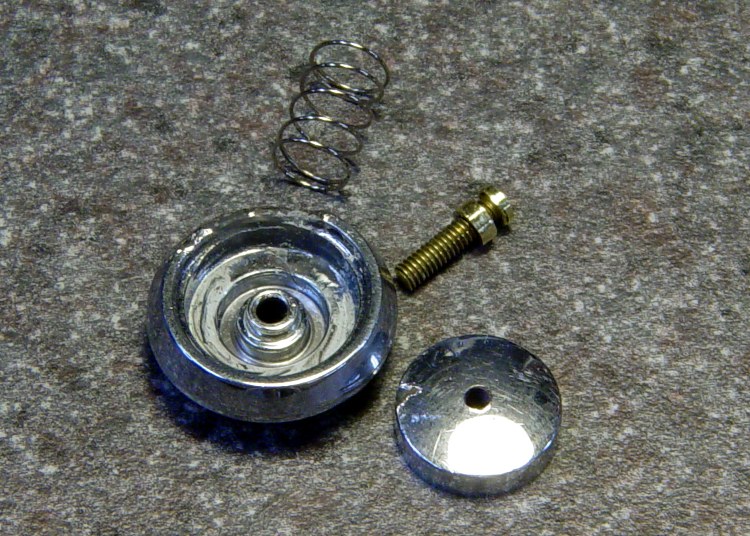
The sunglasses had interchangeable lenses, a feature which she’d never used, and the lower of the two tabs that snapped into the earpieces had broken off — on both sides, simultaneously. These weren’t high-snoot items, but they were name-brand: Rudy Project from, IIRC, nashbar.com.
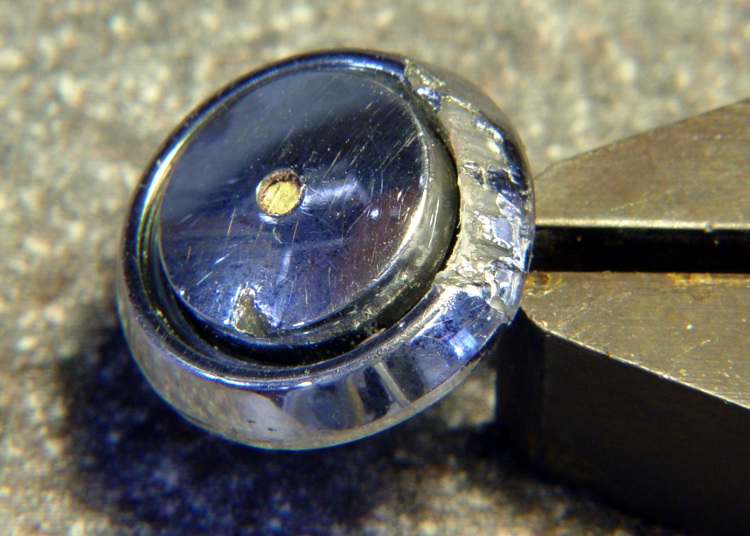
Peering through the microscope, it turns out that the lens material may have been pretty good optically, but wasn’t up to the mechanical task: the two remaining tabs had deep stress cracks. The right-side picture shows the lens upside-down, as that was the easiest way to set up the shot.
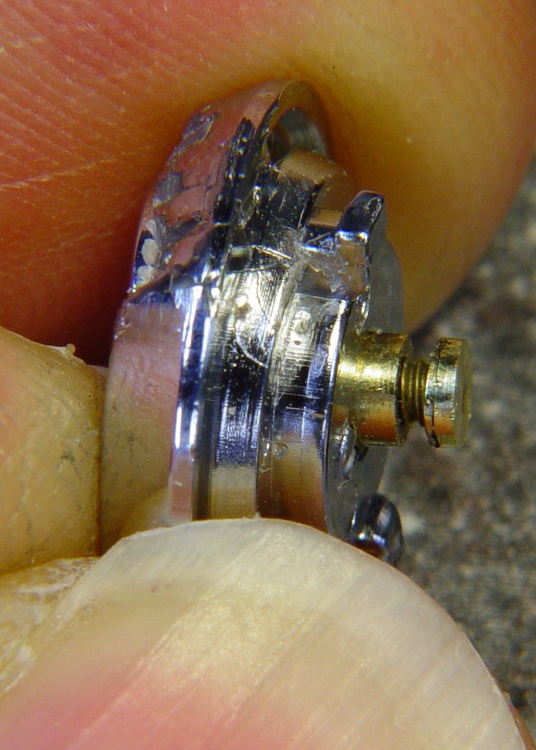
Notice the many, many cracks that penetrate nearly all the way through the tabs. The tabs didn’t break because she dropped the glasses on the floor, they broke because there was barely anything left holding the tabs in place.
Mind you, she’d never removed the lenses from the earpieces, so this isn’t a case of failure-from-overuse, either. They’re about a year old, more or less, and have been used in stressful tasks like gardening and the occasional bike ride.
Urethane adhesive foam-in-place
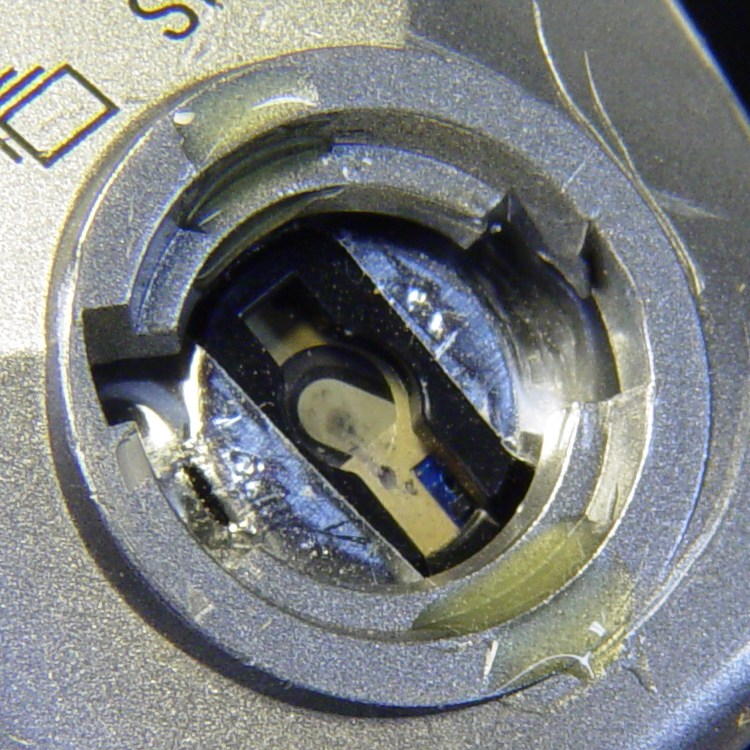
I slobbered urethane glue into the ends of the earpieces to mechanically lock the remaining tabs in place and fill all the voids. It looks rather ugly here, but the excess adhesive simply snaps off because it doesn’t chemically bond with either of the other two plastics.
Rudy sunglasses stress cracking – center
After screwing everything back together again, I noticed that there’s another stress crack growing in the middle of the lens, just over the nosepiece. These sunglasses are not long for this world: that failure will be an end-of-life event.
The frames claim “Designed in Italy” which doesn’t win any points with me; the design is fundamentally flawed.
Yo, Rudy, how about designing some sunglasses with a high-tech feature like durability… rather than style?
Oh, yeah, I suppose this repair voids the Warranty. Perhaps buying from Nashbar on sale triggers this clause: “Buying Rudy Project sunglasses, goggles or helmets from an online retailer at a price below the suggested retail price (MSRP) voids your warranty.” The expense of sending them in negates any possible benefit, which I’m sure they realize, too.
Our daughter has been helping a friend learn to ride a bike (at age 15: it’s never too late!) and we’ve been rehabilitating a new-to-her bike in the process. It’s an inexpensive Ross bike, perfect for the task at hand, and is providing a good introduction to machine-shop work.
The fact that it’s much older than she is makes not a whit of difference. Nay, verily, I rode a bike pretty much like this one for hundreds & hundreds of miles back in the day. I got better ones when I could afford them and she will, too; maybe we’ll tempt her into a recumbent bike some day…
Anyhow, the seat tended to spin around even with the clamp cranked dangerously tight. Taking a look down the tube showed that they used welded-seam tubing (it really was an inexpensive bike) and didn’t bother to clean up the internal seam. As a result, the chromed steel seat post rested on maybe three small patches of metal that didn’t provide much friction at all.
I wrapped a neodymium magnet in a rag and stuffed it down the tube to catch the filings, then applied a coarse cylindrical file (a rat-tail would work as well) to the seam. When it was nearly flush, I switched to a finer file to smooth it and the other high spots. The picture shows the improved seam, ready for the seat post. Ugly, but rough is actually a Good Thing in this situation.
Seat Clamp Swaging
The seat tube has a nominal 1-inch OD, so I clamped a random round from the heap in the vise, tapped the clamp around it, and massaged it lightly with a hammer to persuade it into a more cylindrical shape. It’s still not perfect, but at least the bolt lugs engage the seat tube around the slit somewhat better.
With all that in hand, the seat post is now perfectly secure.
On her first “I can ride!” parking-lot outing, she experimentally determined that a bicycle wheel’s lowest-energy state resembles the edge of a potato chip. Fortunately, it was the front wheel and, after a bit more shop derring-do than one might wish, we swapped in another wheel that’s been hanging on the garage wall for a decade, ready for just such an occasion.
Remember how independent your first bike made you feel? It’s working that way for those two, just like it did for us. Life is full of bumps and they’ll get hurt every now and then, but there’s no other way to get through it; they’re just about ready to ride over the horizon.
Happy Independence Day for those of us in the USA!
A friend brought over a broken toy (well, an Argent GPS tracker) with a peculiar problem: everything worked, but after a few minutes the front-panel LEDs would get intermittent. The LEDs are hand-soldered to the board with leads that extend maybe 7 mm from the surface.
After a bit of poking around, I stuck the gadget under the microscope, at which point the problems became obvious.
See that distinct line where the solder meniscus ends at the lead? Yup, that’s the teltale sign of a cold solder joint. The lead never got hot enough to bond properly with the solder, so the failure extends all the way down through the board. The only electrical contact is at a random point where the flux layer is thin enough to pass current; as the joint heats up, that point Goes Away.
Worse, do you see (click on the pix for bigger images) the small discontinuity about 1/3 of the way down the solder cone? My buddy Eks alerted me to that failure: that’s where the solder joint fractures from repeated heat stress.
Solder Thermal Stress
Here’s the quick sketch he drew on the canonical back-of-the-envelope. I added the red oval as a replacement for his emphatic gestures; with any luck, you’ll never forget it, either.
In this case the LED is anchored in a front-panel hole and the lead is mechanically locked to the board. As the lead heats & cools, it expands & contracts (duh) at a slightly different rate than the solder. After a while, the solder cracks; it’s much less ductile than copper.
Joint 2 – clear fracture
I’m not convinced that’s what happened here, as the LED leads have a bend in the middle that should relieve the stress, but it’s at exactly the spot where he sketched the failure he’s found in many, many gadgets. Power transistors standing above boards with their backs screwed to heatsinks seem particularly prone to this failure, as they have short leads stressed by the differential expansion between copper and aluminum.
Here’s another LED lead from the same gadget. A random out-of-focus fiber enters from the right and exits around to the left rear, but you can clearly see the bad joint at the top of the solder cone and the fracture line just below the fiber.
A touch of the soldering iron generally solves the problem, although you might want to suck the old solder out so the new solder can re-flux the joint.
Arduino Pro USB (cold) Solder Pads
This doesn’t happen only to hand-soldered joints. The USB header fell right off an Arduino Pro board while I was debugging something else. I had to re-heat the joints and the header separately, add flux, and then solder ’em together. Notice the bubbles in the solder layer? That header just never got up to the proper temperature. The current version of that board uses a through-hole header, which is more rugged than this surface-mount equivalent.
TinyTrak3 cold-solder joints
And a TinyTrak3+ board had few cold joints, too, where the leads just didn’t bond at all.
In both of those cases, the vendors did a quick check and didn’t find similar problems with their stock, so the boards I got seem like random failures on the soldering line.
Now, if I’d never made a cold solder joint in my life, I’d be in a position to get all snooty. That’s just not the case: it happens to everybody, once in a while, and you just learn to live with it.
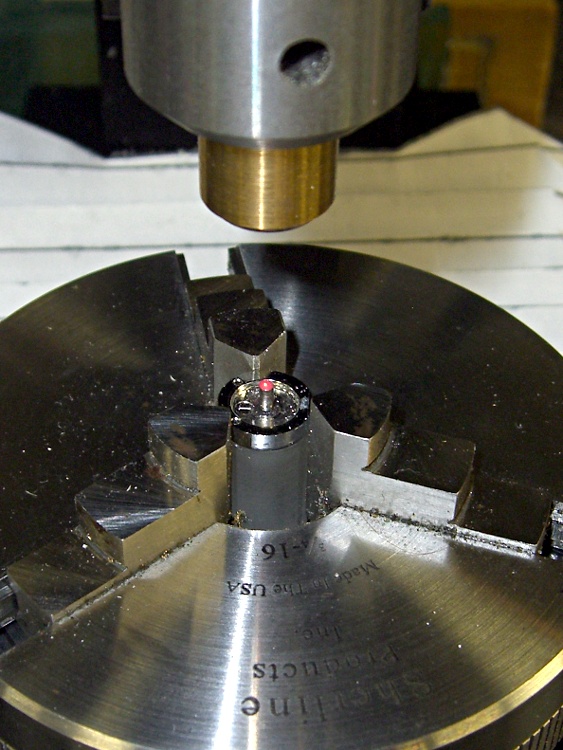
I managed to jam the 3-jaw chuck on my lathe by turning the lathe on without the formality of snugging the chuck against the spindle first; IIRC, there was maybe 1/8″ clearance. The resounding thunk when the irresistible force hit the immovable object was the prelude to about a year of increasingly desperate attempts to remove the chuck, punctuated by long periods of despair.
The absurd derring-do with clamping the 4-jaw Sherline chuck in the 3-jaw lathe chuck described there finally prompted me to ask my buddy Eks for advice, which is what I should have done in the first place. He suggested removing the chuck body from its backplate, building a lever that bolted to the backplate with the same six bolts as the chuck, blocking the spindle with wedges under the belt pulley, and wailing on the lever with a lead hammer.
We wondered if a hard hammer would be better than the lead hammer, perhaps because the impact would be less squishy, but that was in the nature of fine tuning.
The key idea is that removing the chuck body also removes a tremendous amount of rotational inertia, so that wailing on the lever arm actually transfers force / impact directly to the backplate, rather than trying to spin the body. The somewhat risky part is that there’s a pin connecting the spindle with the drive pulley (it’s disengaged when using the back gears), so that it’s entirely possible to break the pin rather than unstick the chuck. But it was still a better idea than any I’d had so far.
Stuck backplate
Making note of the witness marks on the backplate and chuck body, I removed the body. Fortunately, there was just enough clearance between the front bearing journal and the backplate that I could get the bolts out without dismantling anything else.
That left me with the rather grody and still firmly stuck backplate. The bolt disk was brazed onto the threaded cylinder with a keyway. Although the chuck body had a key slot, it looks like the matching key had been machined off of the cylinder, so the bolts were taking all the cutting torque. Worked OK for both the previous owner and for me, so I suspect it’ll continue to work just fine for the next owner, too.
Bicycle handlebar stem in spindle
Peering through the spindle reminded me of some recent bike repairs and it occurred to me that maybe, just maybe, a old-skool split-wedge handlebar stem would get enough traction inside the spindle to hold it in place. Some rummaging in the Bike Junk box produced just such a stem and it fit exactly into the spindle bore. Now the spindle is fixed in place by its ID and there’s no risk of breaking the locking pin or (shudder) the back gear.
Even better, the lumber pile emitted a chunk of 1×4 (actual dimensions!) wood that was precisely the correct length to reach from the floor to the stem. I like it when projects work like that; finding exactly the right stuff in the pile is sort of an omen that things are going well.
Fundamental rule: always start with a hunk of something that looks a lot like what you want to end up with.
Corollary: ya gotta have stuff!
Coordinate-drilling the lever arm
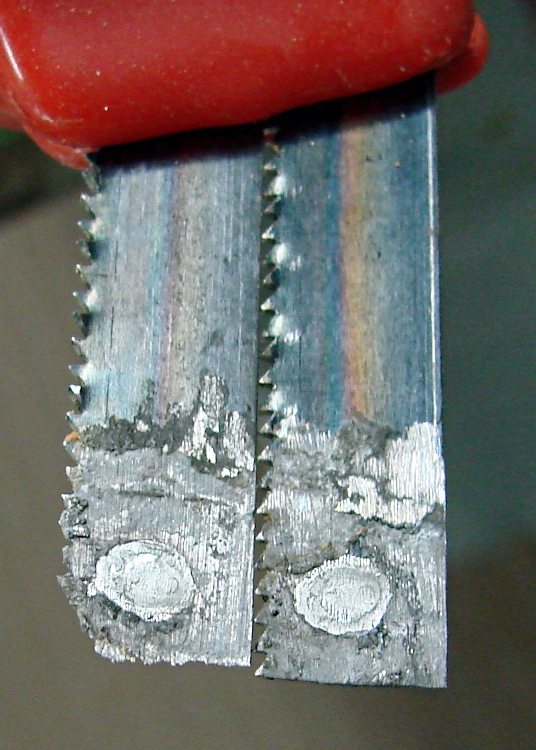
Some rummaging in the parts heap turned up several feet of nice “angle iron”, so I bandsawed off a hunk. I should have realized something was wrong when a foot of teeth stripped right off the saw blade, but I ascribed that to, oh, maybe weakening a few teeth when I soldered up the blade.
I had our daughter run the trig to generate coordinates for the six holes, then lay out the center bore and bolt holes on the plate for practice. Drilling the first hole prompted me to resharpen the drill, but poking the remaining five holes into that plate produced vast clouds of wood smoke from the sacrificial plate underneath, despite boiling copious quantities of cutting fluid off the top.
I finally admitted defeat when the “angle iron” rubbed the teeth right off a 2-inch hole saw.
As nearly as I can tell, that plate is un-machinable stainless steel, hand-forged by the Devil himself specifically to taunt me, and is good for nothing. Obviously, I hadn’t used it for anything in the years it had been in my pile and, perhaps as an omen, it didn’t have any other holes in it from anybody else’s efforts. I’ll keep the pieces around just to sneer at them; won’t get fooled again.
So, at this point, I am out a bandsaw blade, a drill bit, and a hole saw. We won’t discuss the circle cutter or my abortive attempt to lash the damn thing down to the Sherline and perform helix-milling upon it.
Unstuck backplate with beating bolt
While licking my wounds, I wondered if the bolt circle on the backplate would provide enough lever arm to make any difference. I tightened a sacrificial bolt & nut with one face of the bolt aligned along a radius from the spindle center, then deployed a big drift punch and the two-pound ball-peen hammer (a.k.a., The BFH).
A half-dozen good shots later, the backplate spun free. Notice the very small gap between spindle and backplate… that’s all it takes!
I added a closed-cell foam washer to fill the gap between the backplate nose and the butt end of the chuck; there was a remarkable amount of crud built up in there.
I am so happy that it even makes up for the death toll among the tools…
It’s worth noting that the headstock has two honkin’ big bronze spindle bearings, no delicate balls, and a few mighty thwacks didn’t do them a bit of harm.
While replacing the rear derailleur on Mary’s Tour Easy, I rediscovered that I have two different cable sizes in my stash: large brake cables and small derailleur cables.
The large ferrules are 0.235 inches in diameter, the smaller 0.187 inches. The brazed-on cable-stop sockets are obviously sized for the larger ferrules, which makes perfect sense.
If you put a small ferrule in a large stop, it tends to cant whichever way the cable pulls it. That results in the cable sawing into the edge of the ferrule… and that results in excess friction and sometimes a broken cable.
In the past I’ve snipped out little brass shimstock rectangles, wrapped them around mandrels, and generally spent a lot of time fiddling around. This time I remembered to rummage in my collection of brass tubing cutoffs, which yielded a pair of very-nearly-perfect slip fit pieces that neatly adapted the small ferrules to the large stops.
Rear shift cable with modified ferrules
Life is good…
I have no idea what the cables look like on weight-weenie exotic-frame bikes. For sure, this isn’t a trick for hydraulic disk brakes.
Incidentally, the cable housing length worked out to 130 mm. Neither of the charts in the SRAM X.7 instructions matched the TE’s butt end; the seat stay angle is halfway between what’s normal for diamond-frame bikes. So we picked a reasonable length and it seems to be OK.
The radio on Mary’s bike has been misbehaving over the last few months: the PTT button on the handlebars occasionally had no effect. Debugging this sort of intermittent problem is quite difficult, as it would sometimes fail and repair itself before we could get stopped in a safe place where I could poke around in the wiring.
After months of this nonsense, I narrowed the failure down to the short cable from the HT’s mic jack to the interface board: by positioning the cable just so, the radio would work fine for days or weeks at a time. I taped the thing in position and all was well, at least for a few days or weeks at a time.
These two pictures show what the interface looked like back in 2001 when I put it together (modified from another version I did in 1997!) and what it looks like today. The most significant change is in the plugs connecting the whole affair to the HT: a CNC-machined plate holds them perfectly parallel at the proper spacing and an epoxy-putty turd fuses them into a rigid mass. More on that sub-project tomorrow…
Loose plugs, it turns out, vibrate the HT’s jacks right off the circuit board in short order and those jacks are a major pain to replace. Ask me how I know…
The wire break seemed to be precisely where the mic cable exits the epoxy turd. You’d expect a fatigue fracture to occur at that spot, so I wasn’t particularly surprised, although I was amazed that the thing hadn’t failed completely over the months I spend fiddling with it. I finally resolved to fix this once and for all, which meant either flaying the cable and patching the wire in situ or rebuilding the whole connector assembly. Either choice requires enough fiddly work to discourage even me.
Sooo, disconnect everything & haul it to the Basement Laboratory, Electronics Workbench Division…
Before cutting into the cable, I measured the mic voltage on the PCB and tried to make the thing fail on the bench. The HT (an ancient ICOM IC-Z1A) normally presents 3.5 V DC on the mic wire and the external PTT switch pulls it to ground through a 22 kΩ (or 33 kΩ or thereabouts) resistor. The mic audio is a small AC signal riding a volt or so of DC bias with the PTT active.
The wire measured maybe 0.25 volts and the PTT dragged it flat dead to ground. Yup, through that honkin’ big resistor. Well, maybe the last conductor in that mic wire had finally broken, right there on the bench?
Measured from the 2.5 mm plug tip conductor (tip = mic, ring = 3.5 V DC, sleeve = mic common) to the PCB pad on the PC, the mic wire stubbornly read 0.0 Ω, regardless of any wiggling & jiggling I applied to the cable. But no voltage got through from the radio to the board…
Sticking a bare 2.5 mm plug into the HT mic jack produced a steady 3.5 V on the tip lug. Reinstalling my epoxy-turd plug assembly produced either 0.25 or 3.5 V, depending on whether I twisted the thing this way or that way.
Ah-ha! Gotcha!
Pulled out my lifetime supply of Caig DeoxIT Red, applied a minute drop to the end of the mic plug, rammed it home & yanked it out several times, wiped off the residue, and the PTT now works perfectly. Did the same thing to the adjacent speaker plug, just on general principles, and I suspect that’ll be all good, too.
Diagnosis: oxidation or accumulated crud on the mic jack inside the radio.
Now, to try it out on the bike and see how long this fix lasts. Anything will work fine on the bench, but very few things survive for long on a bicycle.
Memo to Self: It’s always the connectors. Unless it’s the wires.
Here’s the schematic, just in case you’re wondering. I wouldn’t do it this way today, but that’s because I’ve learned a bit over the last decade or so…