Ed Nisley's Blog: Shop notes, electronics, firmware, machinery, 3D printing, laser cuttery, and curiosities. Contents: 100% human thinking, 0% AI slop.
The driver gave us plenty of room, which is always nice:
Tire tracks at Maloney Trailhead – DCWWA SUV on Maloney 2018-08-20
But then the SUV turned into the Maloney Rd entrance to the Dutchess Rail Trail:
Tire tracks at Maloney Trailhead – DCWWA SUV entering – 2018-08-20
Which was specifically designed to exclude motor vehicles:
Tire tracks at Maloney Trailhead – DCWWA SUV tracks – 2018-08-20
Later, I was told it’s an “allowable access” for Water Authority vehicles and, in any event, because their SUV didn’t leave the biggest ruts and tracks, they think it’s all good:
Tire tracks at Maloney Trailhead – 2018-08-20
The ramp joins the trail at an acute angle, so the SUV required some backing & filling to get around:
Then it’s an easy drive to the water meter about 2500 feet down the trail:
Tire tracks at Maloney Trailhead – Dutchess Water Authority SUV – 2018-08-20
There’s an Official Vehicle Access gate one mile south of the Maloney ramp that’s about 3800 feet from the water meter. I’m told they use the Maloney ramp to reduce the distance they drive on the rail trail; evidently, destroying the entrance Just Doesn’t Matter.
I’m trying to develop an attitude between Zen and apathy, with just enough indifference to not care when somebody tells me how wonderful things will be in the future.
One might expect the NYS Department of Transportation to maintain New York State Bike Route 9, a.k.a. NYS Rt 376 from Poughkeepsie to Red Oaks Mill, in a bicycle-aware manner.
One would be mistaken.
The most recent patch strip very carefully avoids the deteriorated shoulder, all the way around the curve:
The crew chief said they were there because “somebody wrote a letter” describing the conditions. I suppose that would be me, although after half a year it’s hard to establish causation, let alone correlation.
He also says no details of the letter reached him, which explains why they laid the patches in the travel lane, rather than repairing the conditions I described. He was adamant they were doing the best they could with the inadequate manpower, materials, and time available for the projects.
There are absolutely no requirements to consider bicyclist safety in their repairs, so laying asphalt over the shoulder never happens.
NYS DOT’s Bicycling FAQ says I should “take the lane” around that curve, due to the deteriorated shoulder, to ensure motorists pass only when it’s safe.
Whenever I offer to take a NYS DOT bureaucrat on an inspection ride along their roads, they never have the time. Of course, they don’t “work” on weekends, so they’re unwilling to join me on a pleasant ride around the area some Saturday or Sunday morning.
Just another day of bicycling along NYS DOT’s “complete streets” …
For the record, a 5/8 inch socket works fine. One could surely use a 16 mm socket in a pinch.
Wear leather gloves to prevent a nasty gash from the stamped-steel muffler shroud as you pull the sparkle plug cap to avoid an absolutely impossible engine startup while you’re wrenching under the deck.
That’s what all dog owners say when their dog lunges at you:
Dog Lunge – DCRT 2017-05-13
We sounded our usual bike bell dings while approaching and moved as far to the left as we could. The group compressed to the right, which was unusually courteous, we said nothing, and they said nothing while their dog barked and lunged at both of us.
Perhaps we are easily startled, but we do not regard lunging and barking as friendly or sociable gestures. Even as pedestrians, we do not want our crotches explored, our hands licked, or our chests pawed.
AFAICT the only reason Mary didn’t get knocked over and gnawed was a good grip on a thin leash. Maybe the dog would just lick her to death, but it’s still unwanted aggression.
From what I’ve read, dog shoulders operate as front-to-back rotating pivots, rather than all-direction ball joints. Disabling an attacking dog thus requires grabbing its front legs and spreading them as far apart as possible, which is feasible because human arms are much stronger laterally than dog legs. While the process brings one’s head entirely too close to the dog’s jaws, it apparently breaks most of the dog’s ribs, collapses its lungs, and instantly puts it out of action.
I devoutly hope I need never test that maneuver under field conditions, as I can see serious repercussions. If it’s in Mary’s face, however, I will not err on the side of generosity.
Protip: if your dog isn’t well-trained enough to completely ignore strangers, don’t bring it near strangers who may not be dog people.
Anybody capable of fogging a mirror knows how this scam works:
TCU 100 – Giveaway teaser
The copious fine print says you can only see the actual fine print by traveling to Arizona:
TCU 100 – Giveaway fine print
I’m nowhere near hungry enough to like the odds, even for a $100 Walmart gift card.
An Auto-V.I.N Gauge (their choice of punctuation) must improve the response rate:
TCU 100 – Auto-VIN Gauge – activated
Is it any surprise the numbers match?
TCU 100 – scratch-off number
No. No, it’s not.
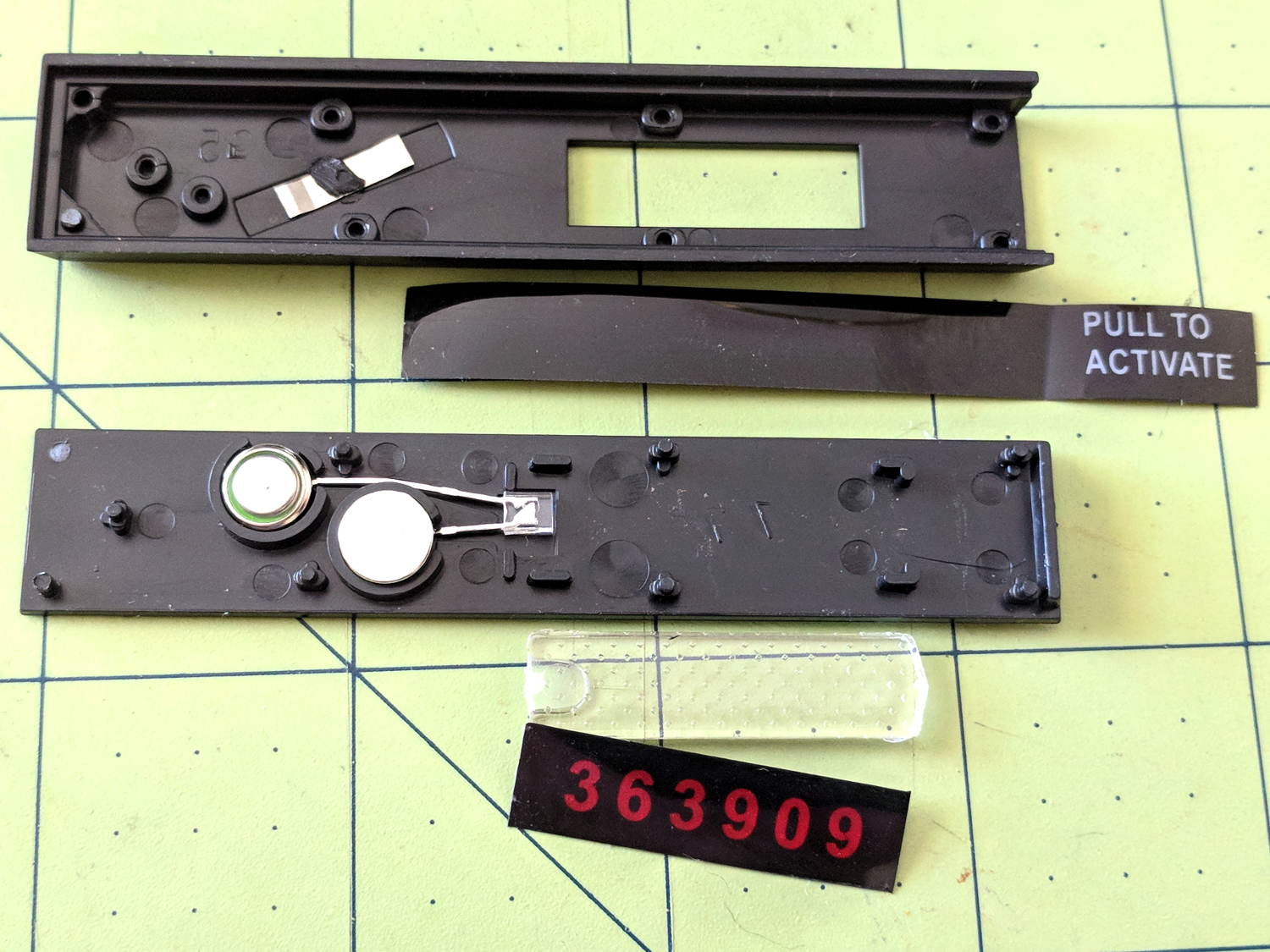
The “Gauge” actually contains parts, although fewer than IMO they want you to believe:
TCU 100 – Auto-VIN Gauge – components
It’ll serve to produce measurable current & voltage for an upcoming Squidwrench Electronics Workshop and, because it need not survive the experience, we will take considerable liberties with it.
I have often kvetched about Amazon’s casual approach to packaging, so this took me completely by surprise:
Amazon packaging – 16 mm linear motion rod
There’s a 500 mm length of 16 mm round linear motion rod / shaft inside the small blue-and-white box. Previous shipments of similar rod have arrived in a lightly padded envelope or rattling loose in a box of other stuff.
The small blue-and-white corrugated cardboard box contains a bag protecting the well-oiled shaft, with padded end caps preventing the shaft from escaping or whacking against anything.
The middle box is made from two U-shaped sheets of molded (not corrugated) fiberboard, with one rigid U stapled into those wood end caps, the other U fitting over the assembly, and plenty of packing tape securing the two. Enough bubble wrap fills the cavity to surround and completely immobilize the inner box.
FedEx carried the armored box from Thomson to an Amazon warehouse in February, so it wasn’t packed specifically for me.
The upper box is a standard Amazon corrugated carton, with slightly more than a token amount of paper packed around the fiberboard box. The paper didn’t completely immobilize the middle box, but did serve to keep it from rattling loose.
I paid twenty bucks for the rod, with “free” Amazon Prime shipping, and UPS delivered it in the usual two days.
The whole affair weighs 7 pounds. If I were to reship it to somebody using UPS 2nd Day, they’d charge me $39 just for the shipping.
I felt unworthy …
On the other paw, Amazon recently sent a dozen LED lights with a casual disregard for protection:
Amazon packaging – shredded LED lamp carton
Both ends of the carton were shredded, although all of the cardboard tubes and LED lamps remained still inside. Not all the tube end caps completed the journey, however.
The carton didn’t sport the usual Box Certificate mark found on all Amazon cartons and was made of brittle Chinese cardboard, so it was intended for protected shipping, perhaps inside a freight container, not as a business-to-consumer shipping box.
Somewhat to my surprise, all the LED lights worked, including several that shrugged off their tube caps, as in the upper right, or broke their white cardboard end plates, as in the rest. The plastic protectors on the LED pins served their purpose!
Amazon provided a partial refund when I filed Package Feedback, so they’re paying attention to damages.
Five pounds of granular erythritol fared better, with a token air pillow contributing nothing:
The idea behind this gadget surfaced while I was looking for something else and, although the front panel makes my skin crawl, it’s just an adjustable DC power supply:
Let’s say it has the potential to be a DC power supply, although we might quibble about the “Precision” part.
As delivered, it’s a deathtrap. Of course, it’s not UL listed and I didn’t expect it to be.
How many lethal problems do you see?
Tattoo power supply – original AC wiring
For starters, it has a three-wire AC line cord with the green-and-yellow conductor chopped off flush with the outer insulation inside the heatshrink tubing just behind the transformer:
Tattoo power supply – ungrounded AC line
The blue wire is AC neutral, but it really shouldn’t be connected to the finger-reachable outer fuse terminal.
The brown wire is AC line, which goes directly to one power switch terminal. In the event of a hot wiring fault, an unfused conductor touching the case will test the GFI you should have on your bench wiring.
The AC line cord uses some mysterious copper-colored metallic substance that’s about as stiff as music wire:
Tattoo power supply – stiff AC wire
The strands cannot be twisted together like ordinary copper wire, although they can be soldered. They may be copper-plated aluminum, because a magnet ignores them.
After soldering the strands together, they snap when bent:
Tattoo power supply – soldered broken AC wire
Generous strain relief is not just a good idea, it’s mandatory.
After some Quality Shop Time, the ground wire now connects to the case through the transformer’s rear mounting screw, the neutral AC wire connects to the transformer, the hot AC wire goes to the tip of the line fuse, and the fuse cap terminal goes to the switch:
Tattoo power supply – AC line rewiring
I relocated the white LED to the middle of the meter, where it looks a bit less weird:
Tattoo power supply – revised front panel
I have no idea what “Porket indicate” might mean. Perhaps “Precision indicator”?
The right 1/4 inch jack, labeled “Foot”, normally goes to a foot switch you don’t need for a bench power supply, so I converted a length of drill rod into a dummy plug to short the jack contacts:
Tattoo power supply – dummy switch plug
The tip comes from a bit of lathe and file work and the white cap comes from a bag of wire shelf hardware.
A genuine hologram sticker (!) on the back panel proclaims “1.5 – 15 VDC 2 A”, which seemed optimistic. Some fiddling with power resistors suggests tattoo liners (I learned a new word!) don’t draw much current:
4 V @ 1 A
8 V @ 800 mA
10 V @ 600 mA
It can reach a bit over 18 V (pegging the meter) at lower current, so it’s Good Enough for small projects with un-fussy power requirements.