Ed Nisley's Blog: Shop notes, electronics, firmware, machinery, 3D printing, laser cuttery, and curiosities. Contents: 100% human thinking, 0% AI slop.
Follow the money: being a bank / credit card / fintech company, it’s safe to assume they sell your sensitive bits and have zero incentive to let you limit their actions in any way.
A week later, that part of their site remains broken, presumably as intended.
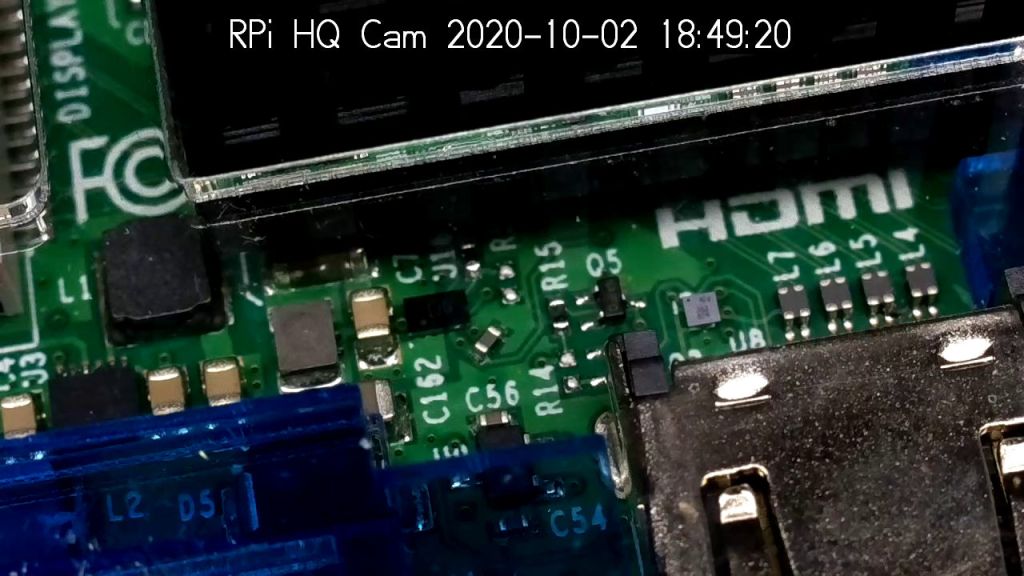
It Would Be Nice to turn the various Raspberry Pi camera boxen around here into more-or-less full-automatic IP streaming cameras, perhaps using RTSP, so as to avoid having to start everything manually, then restart the machinery after a trivial interruption. I naively thought video streaming was a solved problem, especially on an RPi, particularly with an Official RPi Camera, given the number of solutions found by casual searching with the obvious keywords.
As far as I can tell, however, all of the recommended setups fail in glorious / amusing / tragic ways. Some failures may be due to old configurations no longer applicable to new software, but I’m nowhere near expert experienced enough to figure out what’s broken and how to fix anything in particular.
Doing RTSP evidently requires the live555.com Streaming Media libraries & test suite. Compiling requires adding -DNO_SSL=1 to the COMPILE_OPTS line in the Makefile, then letting it bake it for a while.
The v4l2rtspserver code fetches & cleanly compiles its version of the live555 code, then emits various buffer overflow errors while streaming; the partial buffers clearly show how the compression works on small blocks in successive lines. Increasing various buffer sizes from 60 kB to 100 kB to 300 kB had little effect. This may have to do with the stream’s encoding / compression methods / bit rates, none of which seem amenable to random futzing.
Another straightforward configuration compiled fine, but VLC failed to actually show the stream, perhaps due to differences between the old version of Raspbian (“Stretch”) and the new version of Raspberry Pi OS (“Buster”).
Running the RPi camera through the Video4Linux2 interface to create a /dev/video0 device seems to work, but controlling the camera’s exposure (and suchlike) with v4l2_ctl behaves erratically. Obvious effects, like rotation & flipping, work fine, but not the fine details along the lines of auto exposure and color modes.
Attempting to fire raspivid through cvlc to produce an RTSP stream required installing VLC on a headless Raspberry Pi, plus enough co-requisite packages to outfit world+dog+kitchenSink. After all the huffing & puffing wound down, the recommended VLC parameters failed to produce an output stream. The VLC doc regarding streaming is, to me, impenetrable, so I have no idea how to improve the situation; I assume RTSP streaming is possible, just not by me.
Whenever any of those lashups produced any video whatsoever, the images suffered from tens-of-seconds latency, dropped frames, out-of-order video updates, and generally poor behavior. Some maladies certainly came from the aforementioned inappropriate encoding / compression methods / bit rates.
The least horrible alternative seems to be some variation on the original theme of using raspivid to directly create a tcp stream or firing raspivid into netcat to the same effect, then re-encoding it on a beefier PC as needed. I’m sure systemd can automagically restart raspivid (or, surely, a script with all the parameters) after it shuts down.
So far, this has been an … unsatisfactory … experience, but now I can close a dozen browser tabs.
The NYS DOT has been improving the pedestrian crossings at the Burnett – Rt 55 intersection. I expect this will be a bullet item in their Complete Streets compliance document, with favorable job reviews for all parties. The situation for bicyclists using the intersection, which provides the only access from Poughkeepsie to the Dutchess Rail Trail, hasn’t changed in the slightest. No signal timing adjustments, no bike-capable sensor loops, no lane markings, no shoulders, no nothing.
Here’s what NYS DOT’s Complete Streets program looks like from our perspective, with the four-digit frame numbers ticking along at 60 frame/sec.
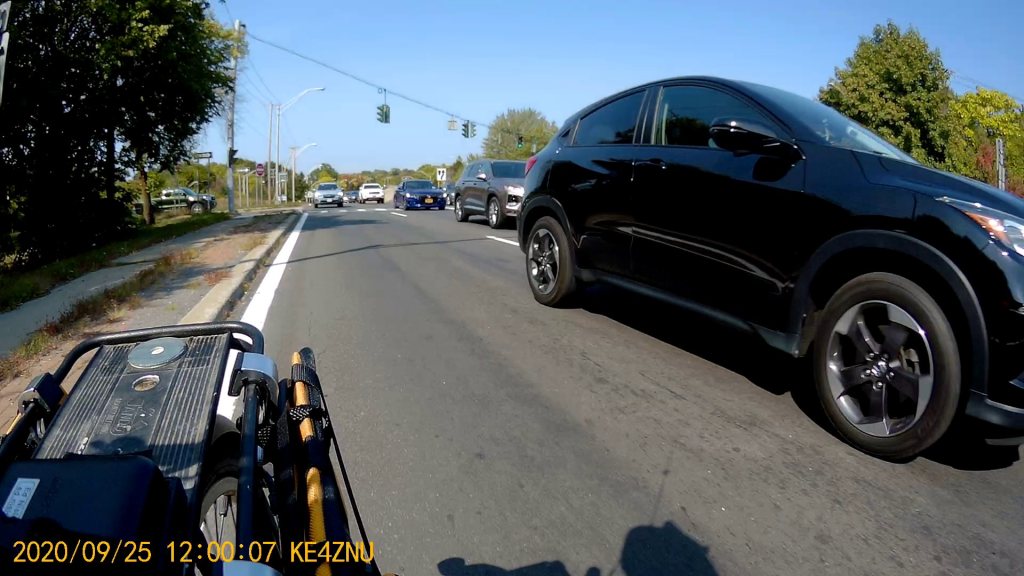
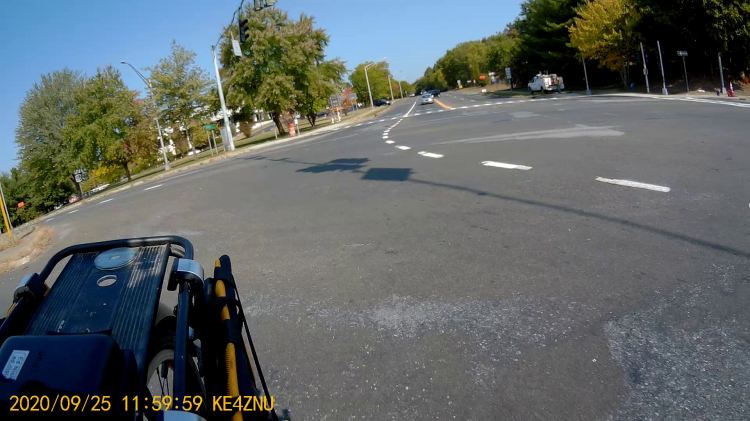
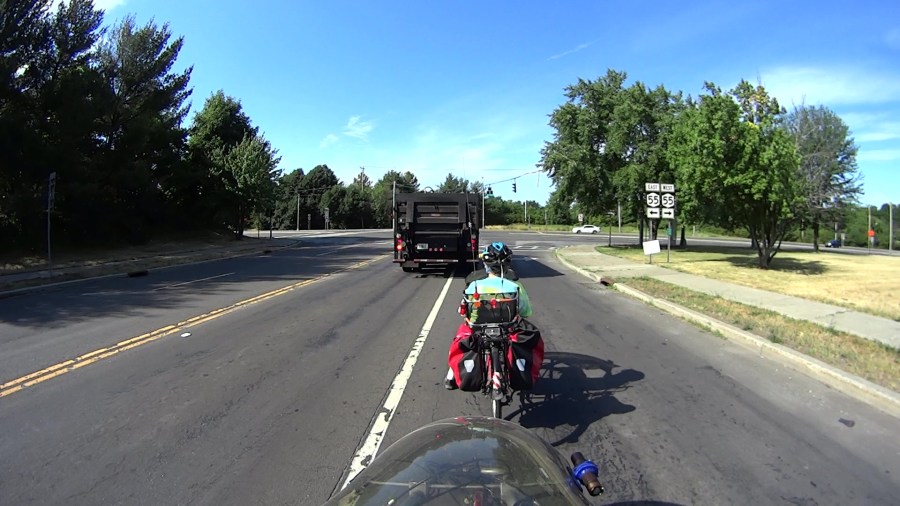
We’re waiting on Overocker Rd for Burnett traffic to clear enough to cross three lanes from a cold start:
Burnett Signal – 2020-09-25 – front 0006
That building over there across Burnett is the NYS DOT Region 8 Headquarters, so we’re not in the hinterlands where nobody ever goes.
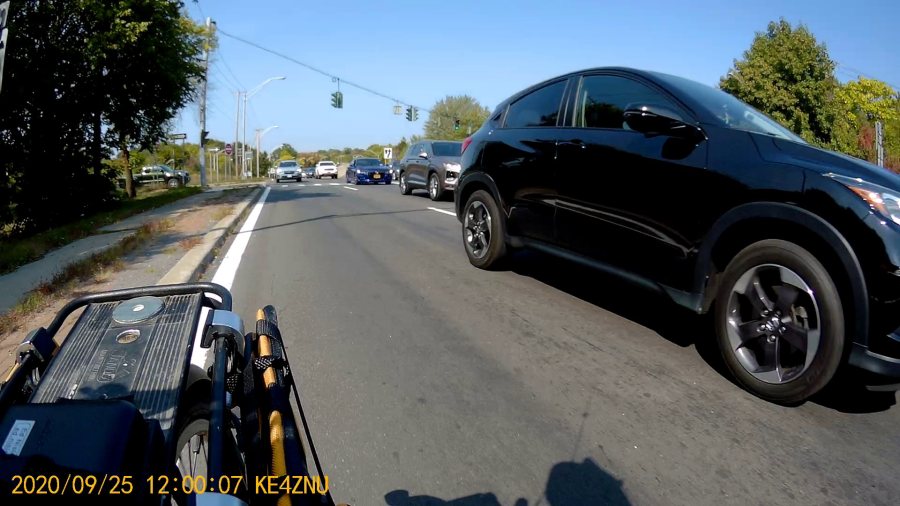
About 1.5 seconds later, the vehicles have started moving and we’re lining up for the left side of the right-hand lane:
Burnett Signal – 2020-09-25 – front 0752
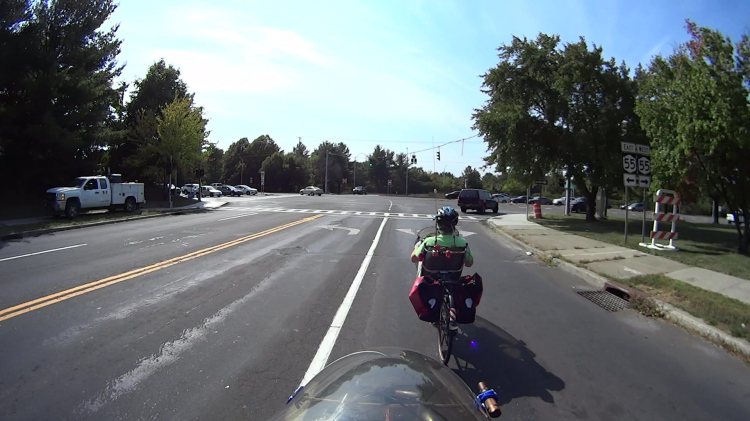
There’s no traffic behind us, so we can ride a little more to the right than we usually do, in the hopes of triggering the signal’s unmarked sensor loop:
Burnett Signal – 2020-09-25 – front 1178
We didn’t expect anything different:
Burnett Signal – 2020-09-25 – front 1333
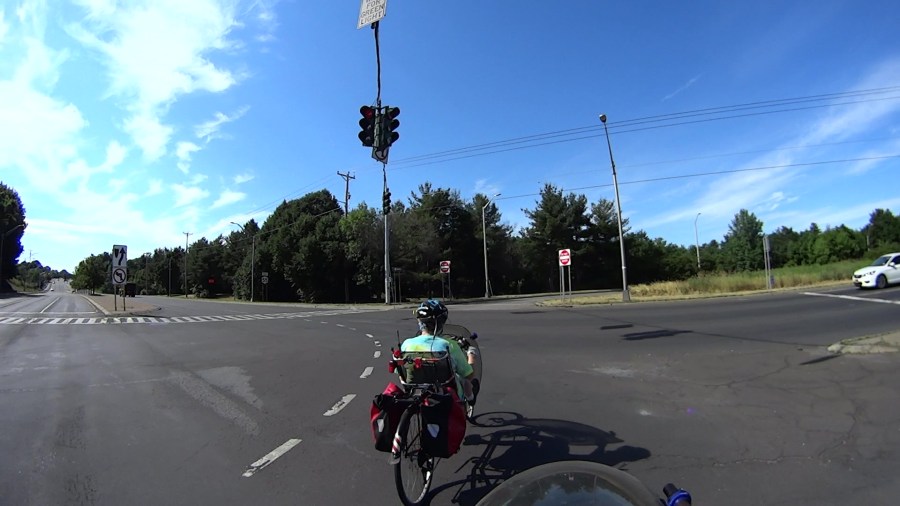
We’re rolling at about 12 mph and it’s unreasonable to expect us to jam to a stop whenever the signal turns yellow. Oh, did you notice the truck parked in the sidewalk over on the left?
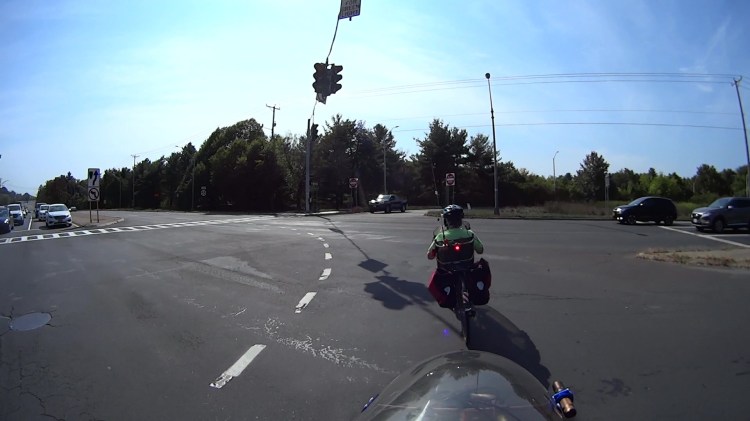
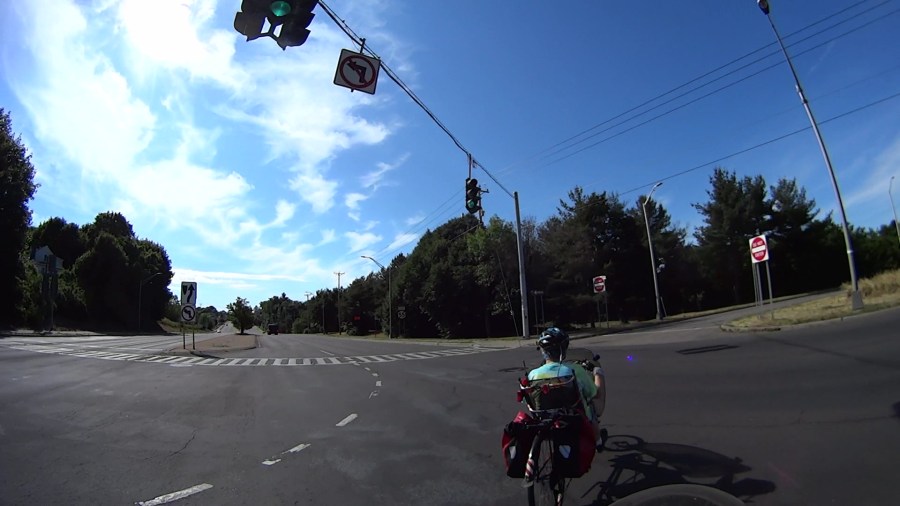
As usual, 4.3 seconds later, the Burnett signals turn red, so we’re now riding in the “intersection clearing” delay:
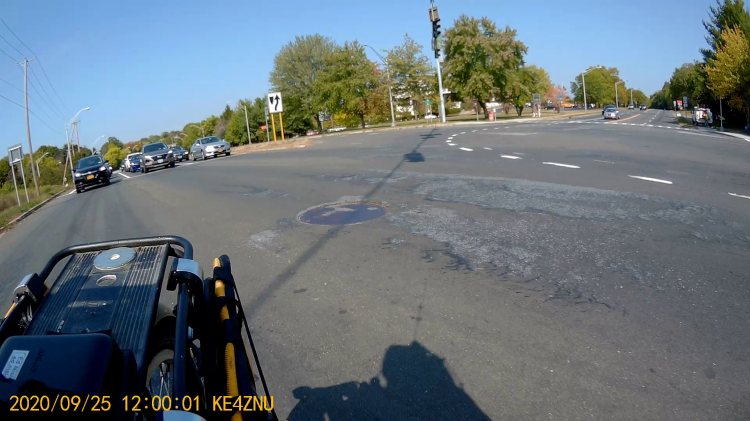
One second later, we’re still proceeding through the intersection, clearing the lethally smooth manhole cover by a few inches, and approaching the far side:
Burnett Signal – 2020-09-25 – front 1771
Here’s what the intersection looks like behind me:
Burnett Signal – 2020-09-25 – rear 1
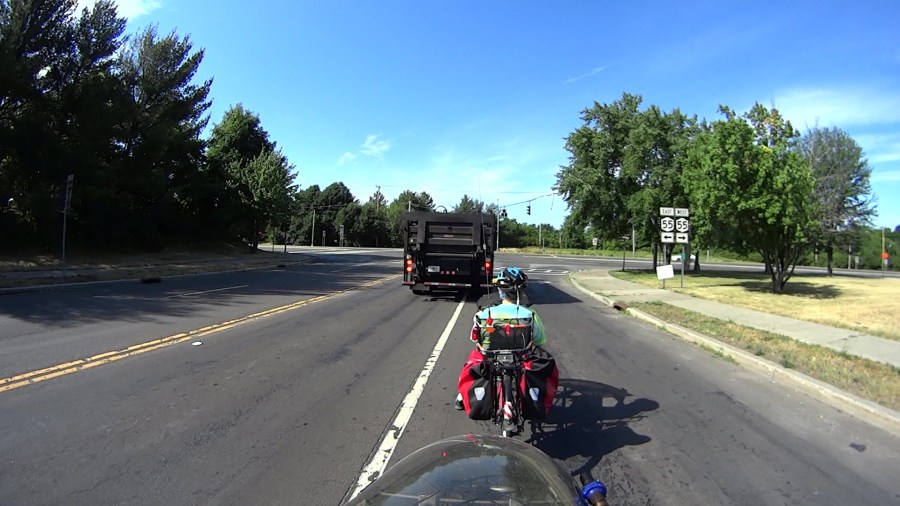
Another second goes by and we’re pretty much into the far right lane , with the westbound traffic beginning to move:
Burnett Signal – 2020-09-25 – front 1831
The pedestrian crossing ladder has fresh new paint. They milled off the old paint while reconstructing the crossing, so the scarred asphalt will deteriorate into potholes after a few freeze-thaw cycles. Not their problem, it seems.
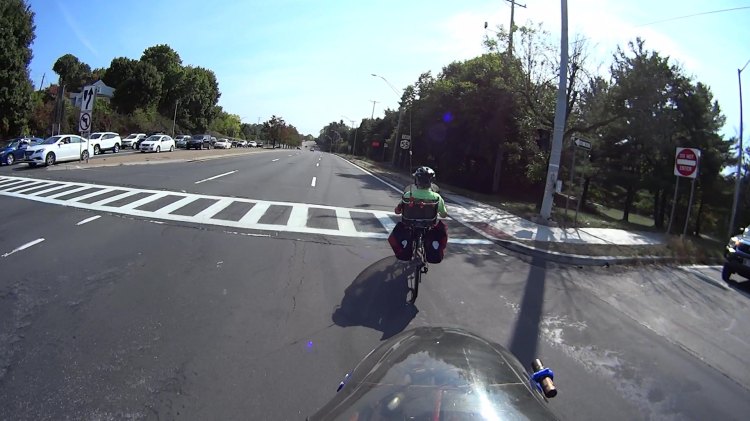
Although it’s been three seconds since Rt 55 got a green signal, the eastbound drivers remain stunned by our presence:
Burnett Signal – 2020-09-25 – rear 2
After another second, we’re almost where we need to be:
Burnett Signal – 2020-09-25 – front 1891
There’s a new concrete sidewalk on the right, with a wheelchair-accessible signal button I can now hit with my elbow when we’re headed in the other direction. It’s worth noting there is no way to reach Overocker by bicycle, other than riding the sidewalk; there’s only one “complete” direction for vehicular cyclists.
One second later puts us as far to the right as we can get, given all the gravel / debris / deteriorated asphalt along the fog line near the curb:
Burnett Signal – 2020-09-25 – front 1957
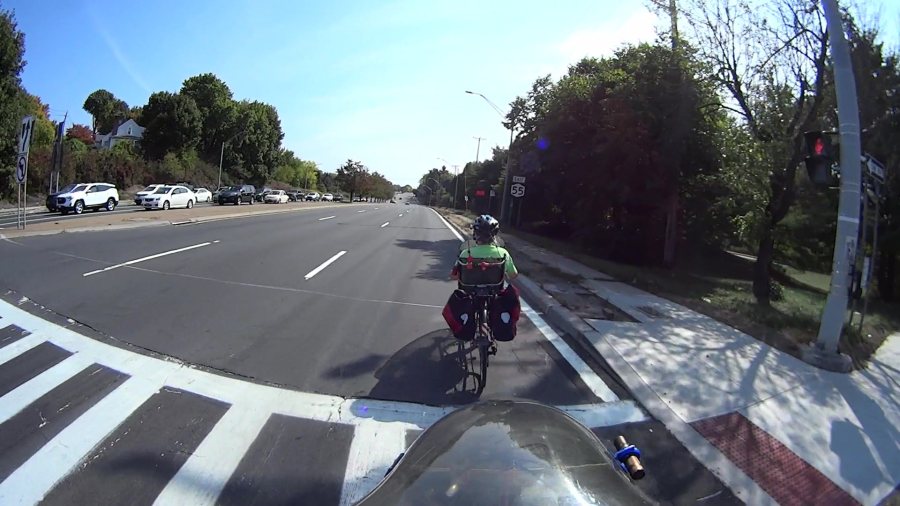
Which is good, because four seconds after the green signal for Rt 55, the pack has overtaken us:
Burnett Signal – 2020-09-25 – rear 3
If you were the driver of the grayish car in the middle lane, directly behind the black one giving us plenty of room, you might be surprised at the abrupt lane change in front of you. Maybe not, because you had a front-row seat while we went through the intersection.
Elapsed time from the green signal on Burnett: 25 seconds. My point is that another few seconds of all-red intersection clearing time wouldn’t materially affect anybody’s day and would go a long way toward improving bicycle safety.
Unlike the pedestrian crossing upgrade, NYS DOT could fix this with zero capital expenditure: one engineer with keys to the control box, a screwdriver or keyboard (depending on the age of the controls), and the ability to do the right thing could fix it before lunch tomorrow.
Of late, the blog has been getting 500 hits per day, with 60-ish on the main page and 30-ish on the post of the day. The “Hot Topics” posts (over in the right column, down a bit) account for a scant hundred more hits, with the remaining 300 hits distributed in onesies and twosies along the very, very long tail of 4200 posts.
Then this happened:
Spam Attack – Page Hits
It seems a spammer noticed my posting activity and unleashed either a script or, more dismally, a stable of low-wage third-world workers to make a comment on every single post in the blog.
The Akismet scanner flagged three dozen comments made on the most recent posts, with the remaining 4500 (!) page views producing zero comments, because, some years back, I had disabled comments on posts older than a few dozen days. I disliked doing so, because I value comments from folks who contribute to the discussion, but …
The IP addresses seem to point back to compromised servers and pwned Windows boxes in the US, with very few foreign sources. The comments themselves consist of the usual gibberish, often run through a thesaurus (known as “spinning”) to improve the odds of evading the detectors. The payload seems to be the URLs attached to the random user names, all pointing to sites touting Vietnamese (!) scams, Russian pharmaceutical sources, online gambling dens, and the like.
And then, after two days, it was over.
Which is why I really really do not want to manage my own blog infrastructure, infuriating as WordPress-dot-com’s editor might be.
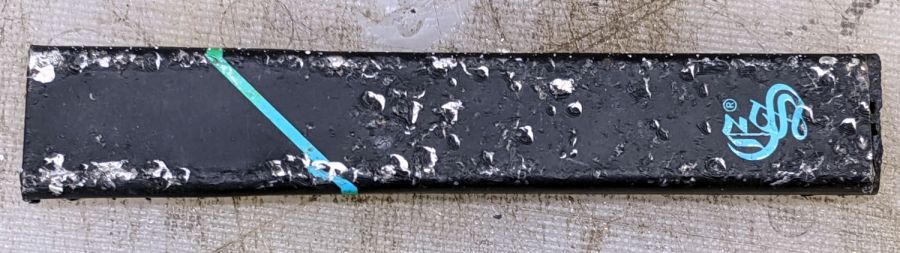
Being the type of guy who uses metal bits & pieces, I thought this might be a useful aluminum rod:
EonSmoke vape stick
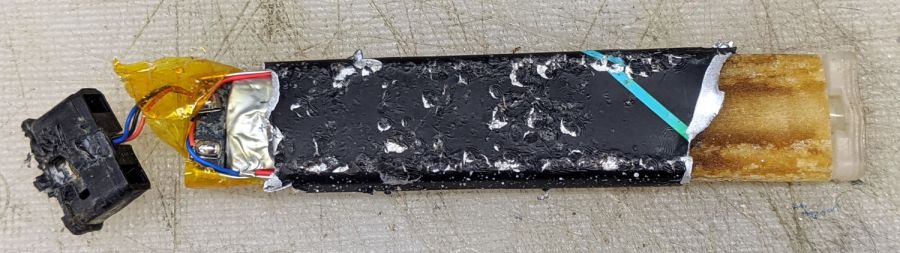
It turns out to be an aluminum tube holding a lithium cell and a reservoir of oily brown juice:
EonSmoke – peeled open
The black plastic cap read “EonSmoke”, which led to a defunct website at the obvious URL. Apparently, EonSmoke went toes-up earlier this year after ten years of poisoning their customers, most likely due to “competitor litigation”.
The black cap held what looks like a pressure switch:
EonSmoke – switch
Suck on the icky end of the tube to activate the switch, pull air past the battery (?), pick up some toxic vapor around the heater, and carry it into your lungs:
EonSmoke – reservoir heater
Maybe there’s a missing mouthpiece letting you suck on the icky end, activate the switch, pull vapor through the heater, and plate your lungs with toxic compounds. I admit certain aspects of my education have been sadly neglected.
The lithium cell was down to 1.0 V, with no overdischarge protection and no provision for charging, so it’s a single-use item. I’m sure the instructions tell you to recycle the lithium cell according to local and state regulations, not toss it out the window of your car.
Rt 376 SB Marker 1110 – Near Miss – oncoming bicyclist and wide trailer – 2020-07-07
On the northbound side, another cyclist rides the sliver of pavement between the fog line and the gravel ridge built up from the deteriorating patches, being overtaken by a huge pickup towing a full-width quad-wheel trailer full of lawn maintenance equipment. The driver has eased about as far toward the yellow line as possible to give the cyclist barely enough clearance:
Rt 376 SB Marker 1110 – Near Miss – oncoming trailer – 2020-07-07
I am not “taking the lane”, because I’m towing a trailer of groceries and there’s always overtaking traffic coming around the blind curve behind me:
Rt 376 SB Marker 1110 – Near Miss – horn – 2020-07-07
You can’t hear the car’s horn, but it’s right in my ear.
The white patches beside and behind the trailer are the fog line paint on the original asphalt surface showing through the disintegrating scab patch. Cyclists cannot ride safely on broken pavement with half-inch discontinuities, which is why I’m to the right of the fog line, mostly off the edge of the patch. If I “took the lane” as expected by NYS DOT, I would be riding about two feet into the lane, in line with the car’s right headlight, to avoid the wheel-grabbing longitudinal fissures showing through the scab patch.
Back in the day, John Forester’s Effective Cycling defined how vehicular bicycling should be done; our now-fragile comb-bound 1980 Third Printing of the 1978 Third Edition still has a place of honor on our bookshelves. I recently discovered his analysis of how traffic signal timing should work online, which says I’ve drawn the wrong conclusions from my observations of the absurdly short green / yellow / red cycle on Burnett Blvd at Rt 55, just in front of NYS DOT’s Region 8 headquarters.
The phasing sequence that is required by current traffic law is as follows:
1. Green, which may be very short when only one vehicle is waiting
2. Yellow, of only sufficient duration to allow a stop from maximum legal speed before entering the intersection
3. Red (a 4-way red), for sufficient additional time for traffic to clear the intersection before the conflicting green appears.
With that in mind, here’s how his analysis stacks up against one of our recent trips through the intersection. The four-digit number in the picture titles gives the time in frames at 60 frame/sec.
We’re stopped one car length behind a long trailer of paving equipment sporting an Iowa license plate. The driver has stopped with the trailer straddling the lane divider line, so we cannot determine which way he will turn. Because we no longer trust turn signals, despite the trailer’s blinking left signal, we will not pull up beside it in the right lane.
Frame 0127, T = 0 s, Δt = 0 s: The signal has just turned green:
Burnett Opposing Green – AS30V – 2020-06-26 – 0127
Frame 0264, T = 2.28 s, Δt = 2.28 s: The trailer has started moving and Mary is rolling behind it, with her foot just coming off the ground:
Burnett Opposing Green – AS30V – 2020-06-26 – 0264
Frame 0721, T = 9.9 s, Δt = 7.6 s: The signal turns yellow, after DOT’s additional five seconds of green; previously, we had five seconds and would have been able to stop. We’re accelerating as hard as we can, but Mary has barely passed the stop line:
Burnett Opposing Green – AS30V – 2020-06-26 – 0721
Of course, entering an intersection on a stale yellow is undoubtedly unwise. It is not so unwise for someone traveling fast, because that person may well clear the intersection before the conflicting traffic starts. It is much more unwise for someone traveling slowly, but it is done and it is lawful.
Forester, ibid.
We’ve traveled about three car lengths in the seven seconds since the trailer started moving. Our bikes will sometimes trigger the signal if we’ve stopped in exactly the right spot over the unmarked sensor loops, but we have never observed our bikes retriggering the signal to lengthen the green or yellow phases as we ride through the intersection.
NYS DOT apparently expects us to stop abruptly when the signal goes yellow, wherever we may be with respect to the stop line and regardless of how fast we may be moving. In fact, given what you’re about to see, we’re expected stop on green to ensure we can start from the stop line during the next green signal.
Frame 0983, T = 14.2 s, Δt = 4.4 s: The signal turns red. The trailer is visible on the left, beyond the median signage, but we haven’t reached the middle of the intersection. I’m lined up with the rightmost lane of westbound Rt 55 and Mary is about in the center lane. The white car on our right is stopped, the black car is slowing to a stop:
Burnett Opposing Green – AS30V – 2020-06-26 – 0983
Frame 1101, T = 16.2 s, Δt = 2.0 s: The opposing signal goes green for Rt 55 traffic, while we’ve barely reached the middle of the intersection:
Burnett Opposing Green – AS30V – 2020-06-26 – 1101
Frame 1205, T = 18.0 s, Δt = 1.8 s: I’m lined up with the median, Mary’s in the center lane of eastbound Rt 55, putting us squarely in front of drivers who may be unable to see us through the stopped cars. The drivers to our left are, fortunately, waiting, unlike a previous crossing:
Burnett Opposing Green – AS30V – 2020-06-26 – 1205
Frame 1440, T = 21.9 s, Δt = 5.7 s: After 22 seconds, we’ve cleared the intersection and are proceeding eastbound on Rt 55:
Burnett Opposing Green – AS30V – 2020-06-26 – 1440
Forester observes the all-red phase must be lengthened to allow cyclists to clear the intersection. Right now, two seconds isn’t enough. Ten seconds would suffice for a pair of reasonably fit, albeit aging, cyclists.
This system fails to provide the required safety in the case of bicycles for three opposite reasons.
1. Bicycles are small and are harder to see. In particular, the most visually impressive part of the bicycle and rider is low down where it is easily shielded from view by the hoods of motor vehicles. Sometimes the only part of the cyclist that can be seen by drivers waiting at the stop line with other vehicles on their left is the head of the cyclist.
2. The cyclist crossing a typical intersection is close to the fronts of the line of cars waiting at the stop line on the cyclist’s right. This is not good judgement on the part of the cyclist, but so much emphasis has been put on staying far right that this position is typical.
3. The cyclist who is traveling slowly, or, more importantly, is starting from a minimum-duration green, is barely into a wide intersection when the conflicting green appears.
The result is a car-bike collision as one of the vehicles in the lanes nearest the curb starts up, or speeds up, and hits the cyclist who suddenly appears in front of it.
Forester, ibid.
I’ve had a DOT engineer tell me, sneeringly, that they don’t design facilities for “professional cyclists”, which commuting to work evidently made me; he was not, however, a “professional driver” even though he used a car for a similar purpose. It’s obvious DOT doesn’t design facilities for “ordinary” cyclists, either, and the evidence suggests they don’t design facilities for cyclists, period, full stop.
I still want someone from NYS DOT to explain how this “makes our highway systems safe and functional for all users“, perhaps by bicycling with us through the intersection a few times, but I’ve never gotten a response, let alone an answer, to anything I’ve ever sent their way.