The Smell of Molten Projects in the Morning

Ed Nisley's Blog: Shop notes, electronics, firmware, machinery, 3D printing, laser cuttery, and curiosities. Contents: 100% human thinking, 0% AI slop.

Tag: MK4

Prusa Mk 4 3D printer with MMU3 feeder

  • Baseboard Radiator Sleds

    Baseboard Radiator Sleds

    Cleaning the baseboard radiator fins before moving the houseplants back to their winter abode by the living room window made sense, so I took the trim covers off and vacuumed a remarkable accumulation of fuzz off the top and out from between the fins. The covers had an equally remarkable accumulation of sawdust along their bottom edge, apparently deposited when the previous owners had the floor sanded before they moved in a decade ago.

    If you happen to live in a house with baseboard radiators, I’m guessing you never looked inside, because nobody (else) does.

    Anyhow, the radiator fins should rest on plastic carriers atop the bent-metal struts also supporting the trim covers, so that they slide noiselessly when the copper pipe expands & contracts during the heating cycle. Over the last six decades, however, the plastic deteriorated and most of the carriers were either missing or broken to the point of uselessness:

    Baseboard Radiator Sled - old vs new
    Baseboard Radiator Sled – old vs new

    The shapes on the bottom are replacements made with a 3D printed base (“sled”) and a chipboard wrap around the radiator preventing the fins from contacting the strut:

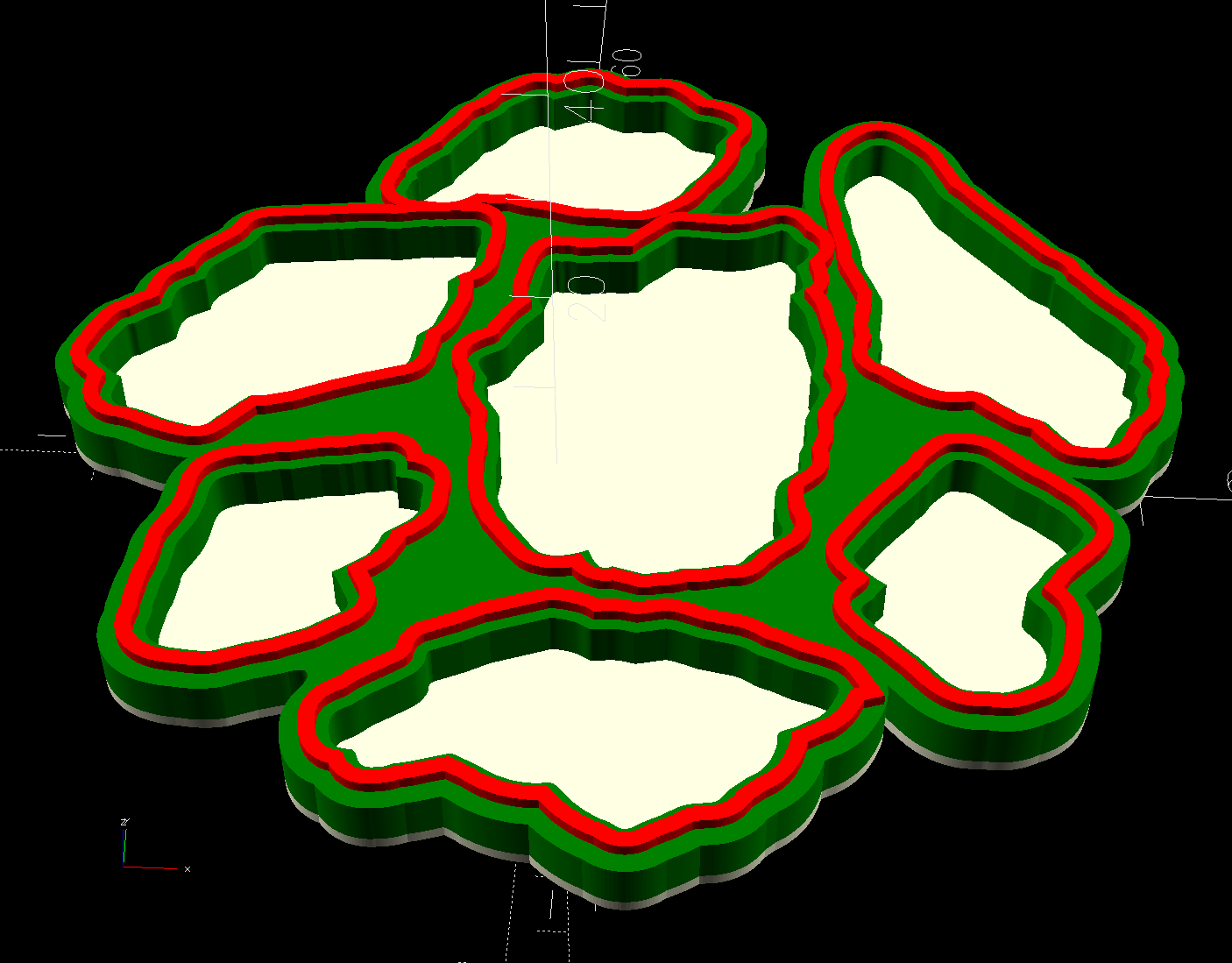
    Baseboard Radiator Sled - OpenSCAD show
    Baseboard Radiator Sled – OpenSCAD show

    Although it was tempting to 3D print the whole thing, because plastic, I figured there was little point in finesse: chipboard would work just as well, was much faster to produce, and I need not orient the shapes to keep the printed threads in the right direction.

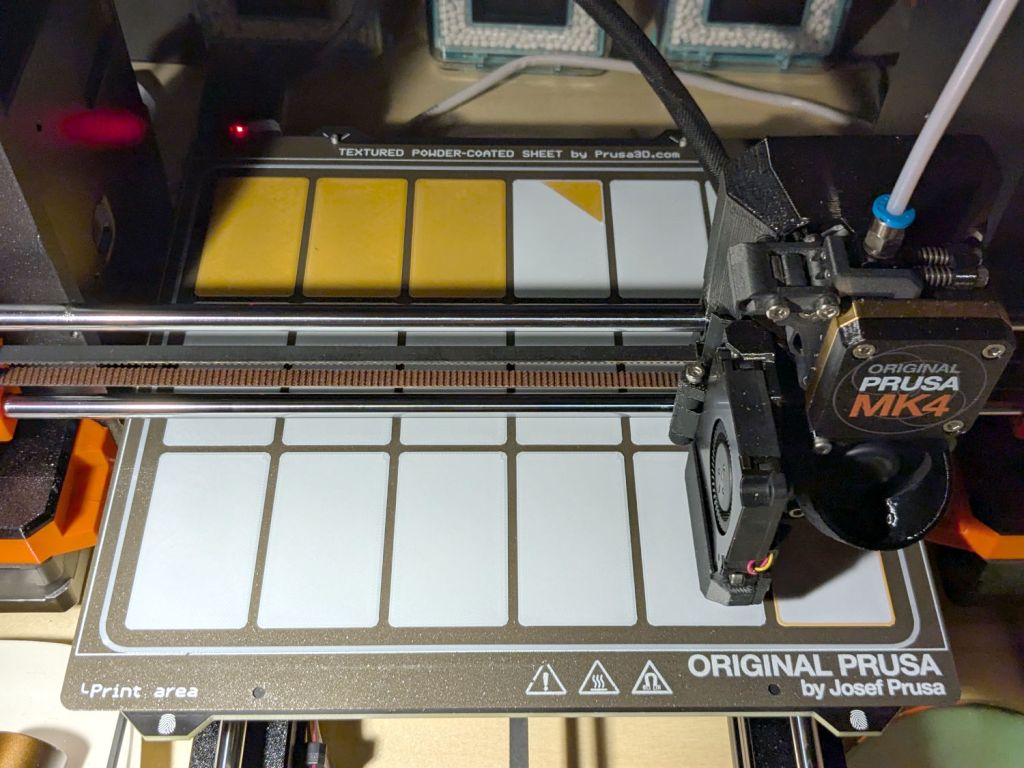
    The Prusa MK4 platform was just big enough for the number of sleds I needed:

    Baseboard Radiator Sled - printed
    Baseboard Radiator Sled – printed

    The sleds along the left and right edges lost traction as the printing progressed, but everything came out all right.

    The OpenSCAD program also produces 2D SVG shapes for the chipboard wraps and adhesive rectangles sticking them to the sleds:

    Baseboard Radiator Sled - OpenSCAD SVGs
    Baseboard Radiator Sled – OpenSCAD SVGs

    Import those into LightBurn, duplicate using the Grid Array, Fire The Laser, then assemble:

    Baseboard Radiator Sled - assembly
    Baseboard Radiator Sled – assembly

    The slits encourage the chipboard to bend in the right direction at the right place, so I didn’t need any fancy tooling to get a decent result.

    A few rather unpleasant hours crawling around on the floor got the struts bent back into shape and the sleds installed under the fins:

    Baseboard Radiator Sled - installed
    Baseboard Radiator Sled – installed

    Protip: Gloves aren’t just a good idea, they’re essential.

    The trim cover presses the angled chipboard where it should go against the fins. The covers carry shadows of the plastic carriers, suggesting the clearance was tighter than it should have been and thermal cycling put more stress on the plastic than expected. We’ll never know.

    Although I’ll make more for the other baseboards as the occasion arises, I hope to never see these again …

    The OpenSCAD source code as a GitHub Gist:

    // Baseboard radiator sled
    // Ed Nisley – KE4ZNU
    // 2025-10-11
    include <BOSL2/std.scad>
    Layout = "Sled"; // [Show,Build3D,Build2D,Sled,Wrap,Glue]
    /* [Hidden] */
    HoleWindage = 0.2;
    Protrusion = 0.1;
    Gap = 5.0;
    Radiator = [25.0,62.0,50.0]; // X = support base, YZ = radiator element
    SledBase = [Radiator.x + 10.0,Radiator.y,1.0]; // support under wrap
    Runner = [SledBase.x – 2.0,3.0,1.6]; // bars contacting radiator support
    GlueOA = [SledBase.x,SledBase.y] – [2.0,2.0]; // glue sheet
    Wrap = [SledBase.x,Radiator.y + 1.0,Radiator.z + 1.0]; // chipboard wrap around radiator
    WrapFlat = [Wrap.x,Wrap.y + 2*Wrap.z];
    WrapThick = 1.2;
    WrapSlit = 0.4;
    //—–
    // Sled base
    module Sled() {
    cuboid(SledBase,rounding=2.0,edges="Z",anchor=BOTTOM)
    position(TOP)
    for (j=[-1,1])
    fwd(j*SledBase.y/3)
    cuboid(Runner,rounding=Runner.z/2,edges="Z",anchor=BOTTOM);
    }
    //—–
    // Glue sheet
    // Export as SVG for laser cutting
    module Glue() {
    rect(GlueOA,rounding=2.0);
    }
    //—–
    // Radiator wrap
    // Export as SVG for laser cutting
    module Wrap() {
    difference() {
    rect(WrapFlat,rounding=2.0);
    for (j=[-1,1])
    fwd(j*Wrap.y/2)
    rect([Wrap.x/2,WrapSlit]);
    }
    }
    //—–
    // Build things
    if (Layout == "Sled")
    Sled();
    if (Layout == "Glue")
    Glue();
    if (Layout == "Wrap")
    Wrap();
    if (Layout == "Show") {
    xrot(180)
    Sled();
    color("Yellow",0.6)
    Glue();
    up(1)
    color("Brown") {
    cuboid([Wrap.x,Wrap.y,WrapThick],anchor=BOTTOM);
    for (j=[-1,1])
    fwd(j*Wrap.y/2)
    cuboid([Wrap.x,WrapThick,Wrap.z],anchor=BOTTOM);
    }
    }
    if (Layout == "Build3D") {
    Sled();
    }
    if (Layout == "Build2D") {
    left(GlueOA.x/2 + Gap/2)
    Glue();
    right(Wrap.x/2 + Gap/2)
    Wrap();
    }
  • Dryer Vent Filter Snout

    Dryer Vent Filter Snout

    The first step in adding a filter bag to the dryer vent requires a convenient way to attach it. Because we live in the future, a couple of hours of 3D printing produced something that might work:

    Clothes Dryer Vent Filter Snout - installed
    Clothes Dryer Vent Filter Snout – installed

    It’s made of TPU, which is bendy enough to ease two tabs into the two outermost slots you can see and a corresponding pair of tabs into slots on the wall side.

    The solid model shows the part snapped inside the vent:

    Clothes Dryer Vent Filter Snout - OpenSCAD show
    Clothes Dryer Vent Filter Snout – OpenSCAD show

    The flared bottom takes something like three hours to print (TPU likes slooow extrusion), so I did the top ring first to verify the tab fit:

    Clothes Dryer Vent Filter Snout - OpenSCAD build
    Clothes Dryer Vent Filter Snout – OpenSCAD build

    Both parts come from hull() surfaces wrapped around quartets of thin circles at the proper positions; the difference() of two slightly different hulls produces thin shells.

    A thin layer of JB PlasticBonder urethane adhesive, which bonds TPU like glue, holds the two parts together. I used the tan variant and, while it’s not a perfect match, it definitely looks better than black. Not that it matters in this case.

    Mary will sew up a bag with a drawstring holding it to the snout. If everything survives the performance tests, printing the whole snout in one four-hour job will both make sense and eliminate an uneven joint that’s sure to be a lint-catcher.

    The OpenSCAD source code as a GitHub Gist:

    // Clothes dryer vent filter snout
    // Ed Nisley – KE4ZNU
    // 2025-10-07
    include <BOSL2/std.scad>
    Layout = "Ring"; // [Show,Build,Ring,Taper]
    /* [Hidden] */
    ID = 0;
    OD = 1;
    LENGTH = 2;
    HoleWindage = 0.2;
    Protrusion = 0.1;
    NumSides = 4*3*2*4;
    $fn=NumSides;
    Gap = 5.0;
    // Centers of corner rounding circles
    InnerWidth = 3.0; // wall inside snout
    InnerRadius = 6.0; // inner corner rounding
    RR = [130.0/2 – InnerRadius,91.0/2 – InnerRadius]; // right rear corner
    RF = [112.0/2 – InnerRadius,-(91.0/2 – InnerRadius)]; // right front corner
    CornerCtrs = [[RR.x,RR.y],[RF.x,RF.y],[-RF.x,RF.y],[-RR.x,RR.y]]; // clockwise from RR
    InsertHeight = 7.0; // overall height inside the snout
    TabOC = [73.0,91.0]; // tabs locking into snout
    TabCtrs = [[TabOC.x/2,TabOC.y/2],[TabOC.x/2,-TabOC.y/2],[-TabOC.x/2,-TabOC.y/2],[-TabOC.x/2,TabOC.y/2]];
    TabRadius = 5.0;
    TabHeight = 3.0;
    TaperHeight = 20.0; // Taper holding filter bag
    TaperRadius = 10.0; // outward to capture bag string
    TaperWidth = 2.0; // wall width
    TaperCtrs = CornerCtrs + [[0,-(TaperRadius – InnerWidth)],[0,0],[0,0],[0,-(TaperRadius – InnerWidth)]];
    //—–
    // Clear inside vent opening as 2D shape
    module Opening() {
    hull()
    for (p = CornerCtrs)
    translate(p)
    circle(r=InnerRadius);
    }
    //—–
    // Insert ring locking into vent snout
    module Ring() {
    difference() {
    union() {
    linear_extrude(h=InsertHeight)
    offset(delta=InnerWidth)
    hull()
    for (p = CornerCtrs)
    translate(p)
    circle(r=InnerRadius);
    up(InsertHeight – TabHeight)
    linear_extrude(h=TabHeight)
    for (p = TabCtrs)
    translate(p)
    circle(r=TabRadius);
    }
    down(Protrusion)
    linear_extrude(h=2*InsertHeight)
    Opening();
    }
    }
    //—–
    // Taper glued to ring
    module Taper() {
    difference() {
    hull() {
    up(TaperHeight)
    linear_extrude(h=Protrusion)
    offset(delta=InnerWidth)
    hull()
    for (p = CornerCtrs)
    translate(p)
    circle(r=InnerRadius);
    linear_extrude(h=Protrusion)
    offset(delta=TaperRadius)
    hull()
    for (p = TaperCtrs)
    translate(p)
    circle(r=TaperRadius);
    }
    hull() {
    up(TaperHeight)
    linear_extrude(h=2*Protrusion)
    offset(delta=InnerWidth)
    hull()
    for (p = CornerCtrs)
    translate(p)
    circle(r=InnerRadius – InnerWidth);
    down(Protrusion)
    linear_extrude(h=2*Protrusion)
    offset(delta=TaperRadius – TaperWidth)
    hull()
    for (p = TaperCtrs)
    translate(p)
    circle(r=TaperRadius);
    }
    }
    }
    //—–
    // Build things
    if (Layout == "Ring")
    Ring();
    if (Layout == "Taper")
    Taper();
    if (Layout == "Show") {
    up(TaperHeight)
    Ring();
    Taper();
    }
    if (Layout == "Build") {
    back(55)
    up(InsertHeight)
    yrot(180)
    Ring();
    fwd(55)
    up(TaperHeight)
    yrot(180)
    Taper();
    }
  • Polydryer Humidity: October

    Polydryer Humidity: October

    Another month of data from all those Polydryer boxes:

    7 Oct 20258 Oct
    Filament%RHWeight – gWt gain – g%RH
    PETG White2826.61.619
    PETG Black2526.61.620
    PETG Orange2926.61.621
    PETG Blue2326.71.715
    PETG-CF Blue2626.61.623
    PETG-CF Black2326.41.420
    PETG-CF Gray3026.51.526
    TPU2826.31.327
    Empty 1 → White3526.71.737
    Empty 23627.12.124

    The “PETG White” spool in the top line is nearly empty, so I loaded a new spool into the “Empty 1” box.

    The “Empty 1” 35% value on 7 Oct matches the other empty box, the desiccant having pulled the humidity down from the 51% basement level. The weight of the water pulled out seems low compared to “Empty 2”, as they both started with a fresh batch of basement air while changing the desiccant in September.

    They’re again filled with 25 g of alumina beads, although I’m beginning to think silica gel does a better job.

    A picture of the boxes, thus avoiding WordPress reminding me pictures improve SEO:

    PolyDryer PC4 Fitting - Prusa MMU3 setup
    PolyDryer PC4 Fitting – Prusa MMU3 setup
  • Polydryer Humidity: Another Month of Data

    Polydryer Humidity: Another Month of Data

    The 25 g of silica gel in each Polydryer box produced these results after a month:

    8 Sept 202511 Sept23 Sept
    Filament%RHWt – gWt gain – g%RH%RH
    PETG White2527.62.61521
    PETG Black2227.32.31520
    PETG Orange2127.22.22123
    PETG Blue1927.32.31415
    PETG-CF Blue2427.42.42122
    PETG-CF Black2127.32.31519
    PETG-CF Gray2727.12.12426
    TPU2527.42.42224
    Empty 151no geln/a2730
    Empty 23527.92.91928

    The humidity levels seem higher than before, with a bit under 10% weight gain.

    The two “Empty” boxes show the difference between ambient basement humidity and letting 25 g of silica gel work on the box for a month. Comparing the latter’s weight gain with the other boxes shows occupying (much of) the interior with (relatively) dry filament reduces the desiccant’s workload.

    The beads in the “Empty 2” box were definitely darker after soaking up an entire box full of 50 %RH air:

    Polydryer - 37%RH meter - empty
    Polydryer – 37%RH meter – empty

    The meter reads 37%, rather than 35%, due to being out of the box for a few minutes.

    They’re the darker swirl in the pan of beads:

    Silica Gel regeneration - starting bead colors
    Silica Gel regeneration – starting bead colors

    That’s an accumulation of beads from a few months, not just what you see in the table.

    I used an induction cooktop to heat the cast-iron pan. Some fiddling with the cooktop’s constant-temperature mode got the beads to 200 °F with a 460 °F setting in about an hour. Setting the cooktop to 50% in constant-power mode worked better, as the beads reached 220 °F in an hour and 230 °F after another hour.

    The bead weights at various stages:

    • Start = 531 g
    • +1 hr at constant temperature = 491 g
    • + 1 hr at 50% constant power = 483 g
    • + 1 hr ditto = 480 g

    The 41 g weight loss is 8.5% of the dry weight, roughly what you’d expect from the humidity readings.

    After reloading the meters with 25 g of alumina beads, the 11 Sept humidity readings are slightly lower and the 23 Sept readings are roughly comparable.

  • Fitbit Charge 5 Charging Stand

    Fitbit Charge 5 Charging Stand

    My Fitbit Charge 5 has become fussy about its exact position while snapped to its magnetic charger, so I thought elevating it above the usual clutter might improve its disposition:

    FitBit Charge 5 stand - installed
    FitBit Charge 5 stand – installed

    The Charge 5 now snaps firmly onto its charger, the two power pins make solid contact, and it charges just like it used to.

    The solid model comes from Printables, modified to have a neodymium ring magnet screwed into its base:

    Fitbit Charge 5 stand - solid model section
    Fitbit Charge 5 stand – solid model section

    Which looks about like you’d expect;

    FitBit Charge 5 stand - added magnet
    FitBit Charge 5 stand – added magnet

    A layer of cork covers the bottom and it sits neatly atop the USB charger.

    The OpenSCAD source code punches the recesses and produces the bottom outline so LightBurn can cut the cork:

    // FitBit Charge 5 Stand - base magnet
    // Ed Nisley - KE4ZNU
    // 2025-09-05
    
    include <BOSL2/std.scad>
    
    Layout = "Build";       // [Build, Base, Section]
    
    module Stand() {
      difference() {
        left(38/2) back(65/2)
          import("Fitbit Charge 5 Stand.stl",convexity=10);
    
          down(0.05)
            cylinder(d=12.5,h=5.05,$fn=12);
          up(5.2)
            cylinder(d=3.0,h=10.0,$fn=6);
      }
    }
    
    //-----
    // Build things
    
    if (Layout == "Build")
      Stand();
    
    if (Layout == "Base")
      projection(cut = false)
        Stand();
    
    if (Layout == "Section")
      difference() {
        Stand();
        down(0.05) fwd(50)
          cube(100,center=false);
    }


  • Smashed Glass: 3D Printed Coaster Epoxy Fill

    Smashed Glass: 3D Printed Coaster Epoxy Fill

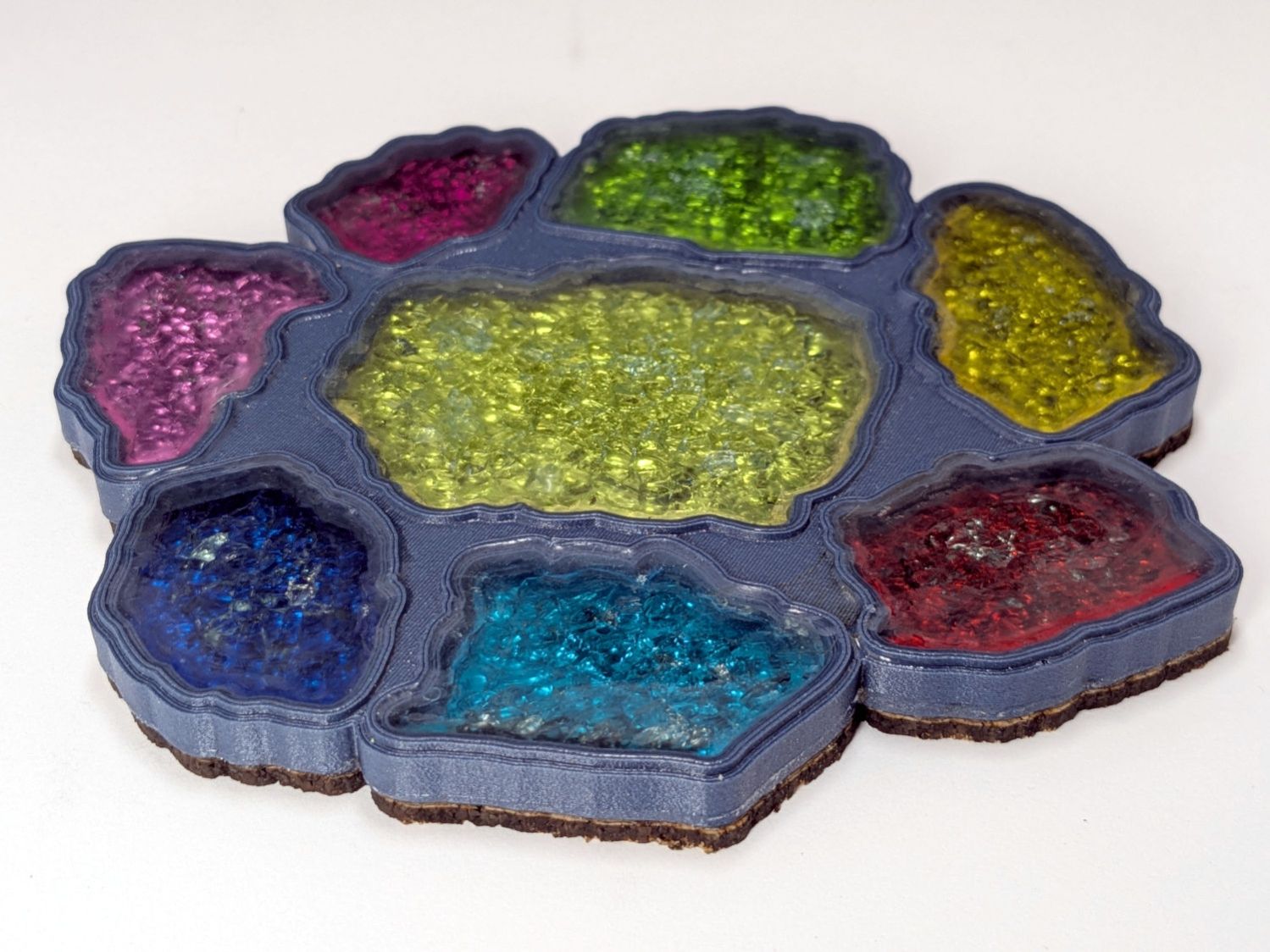
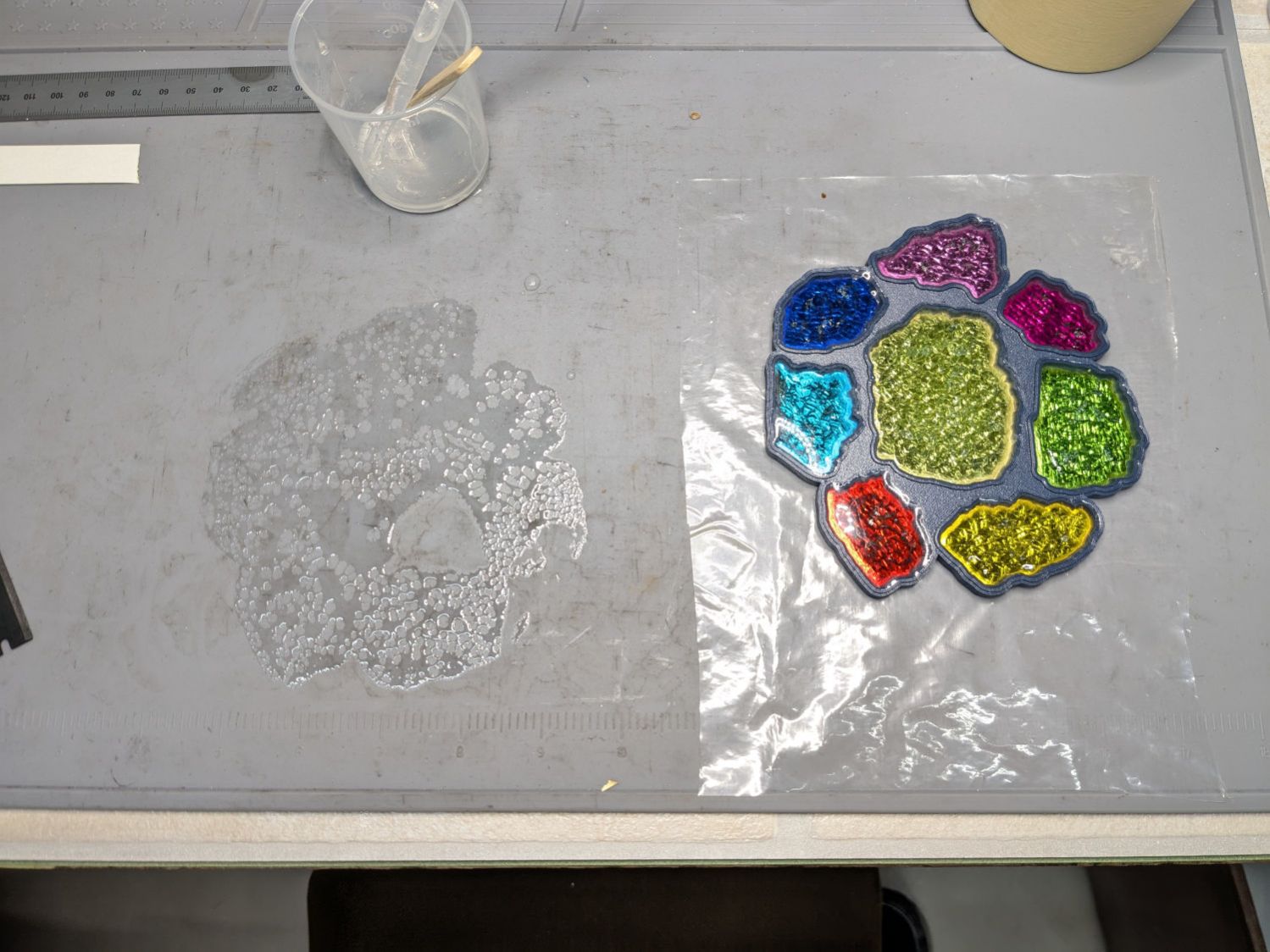
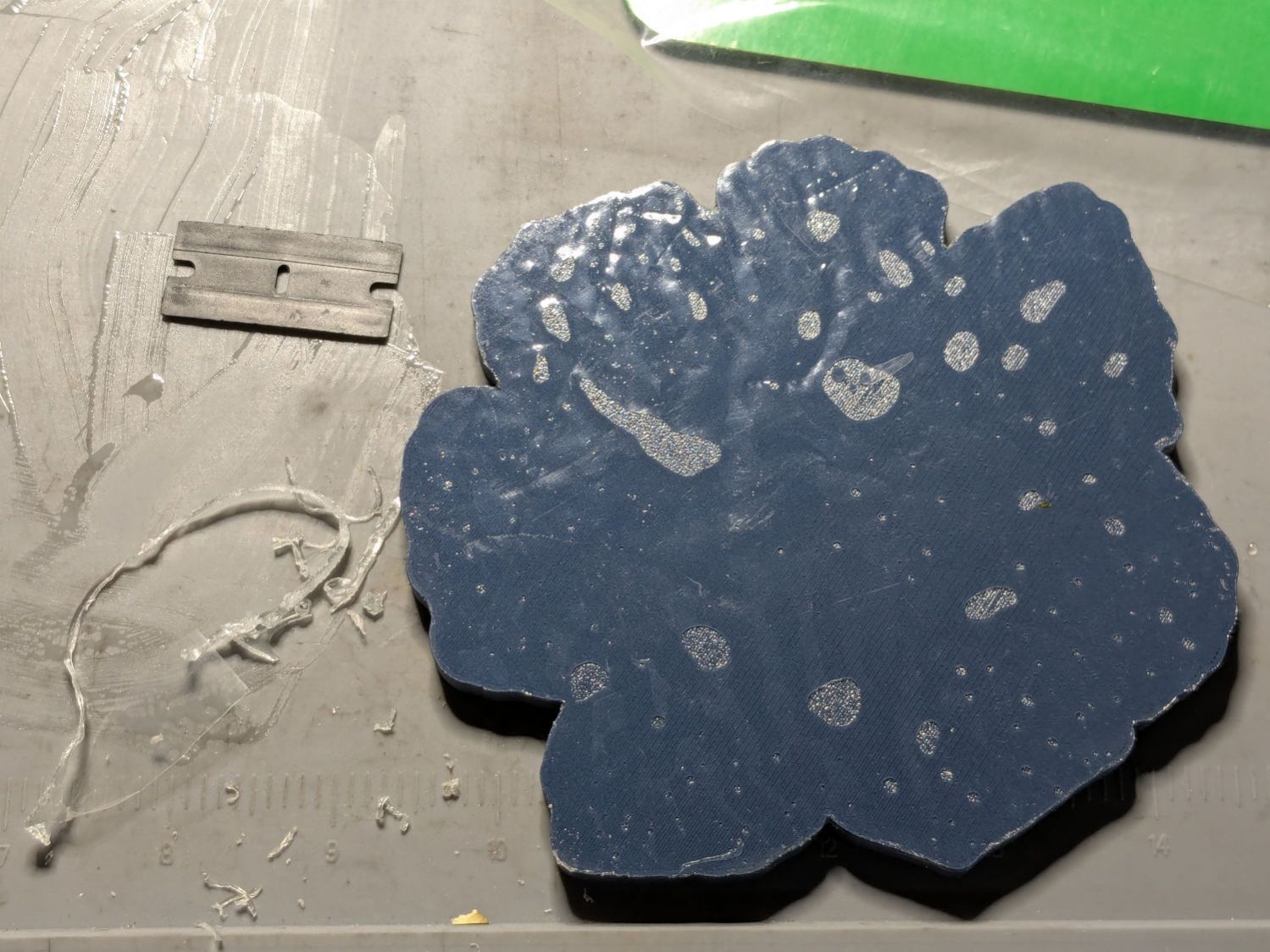
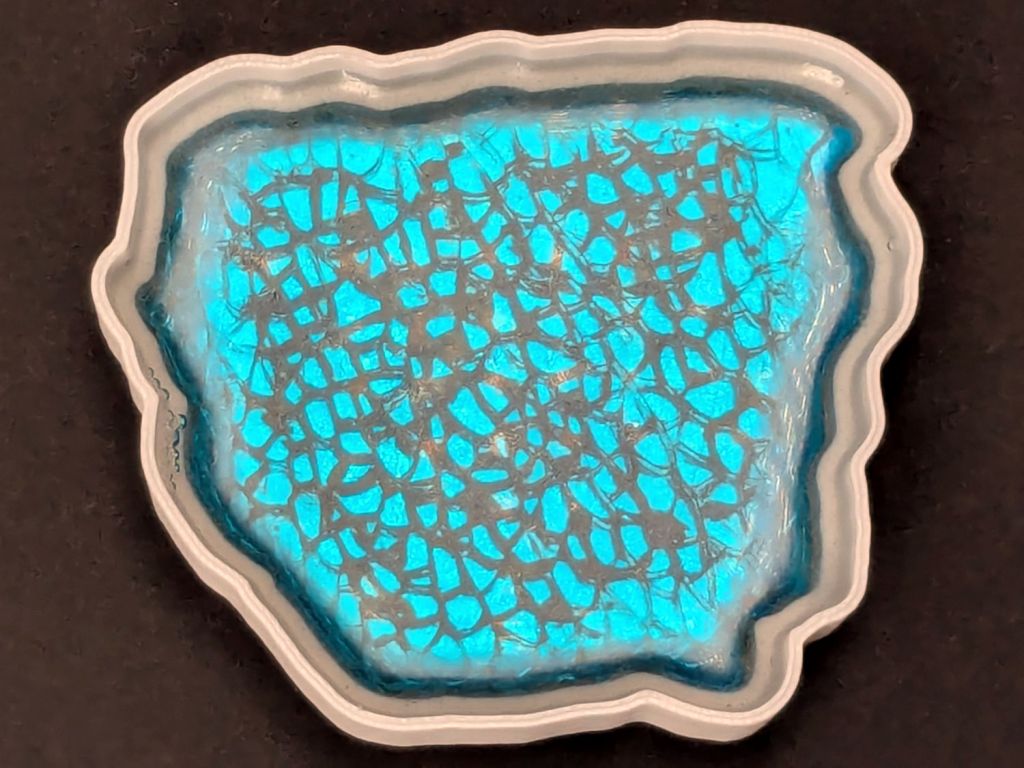
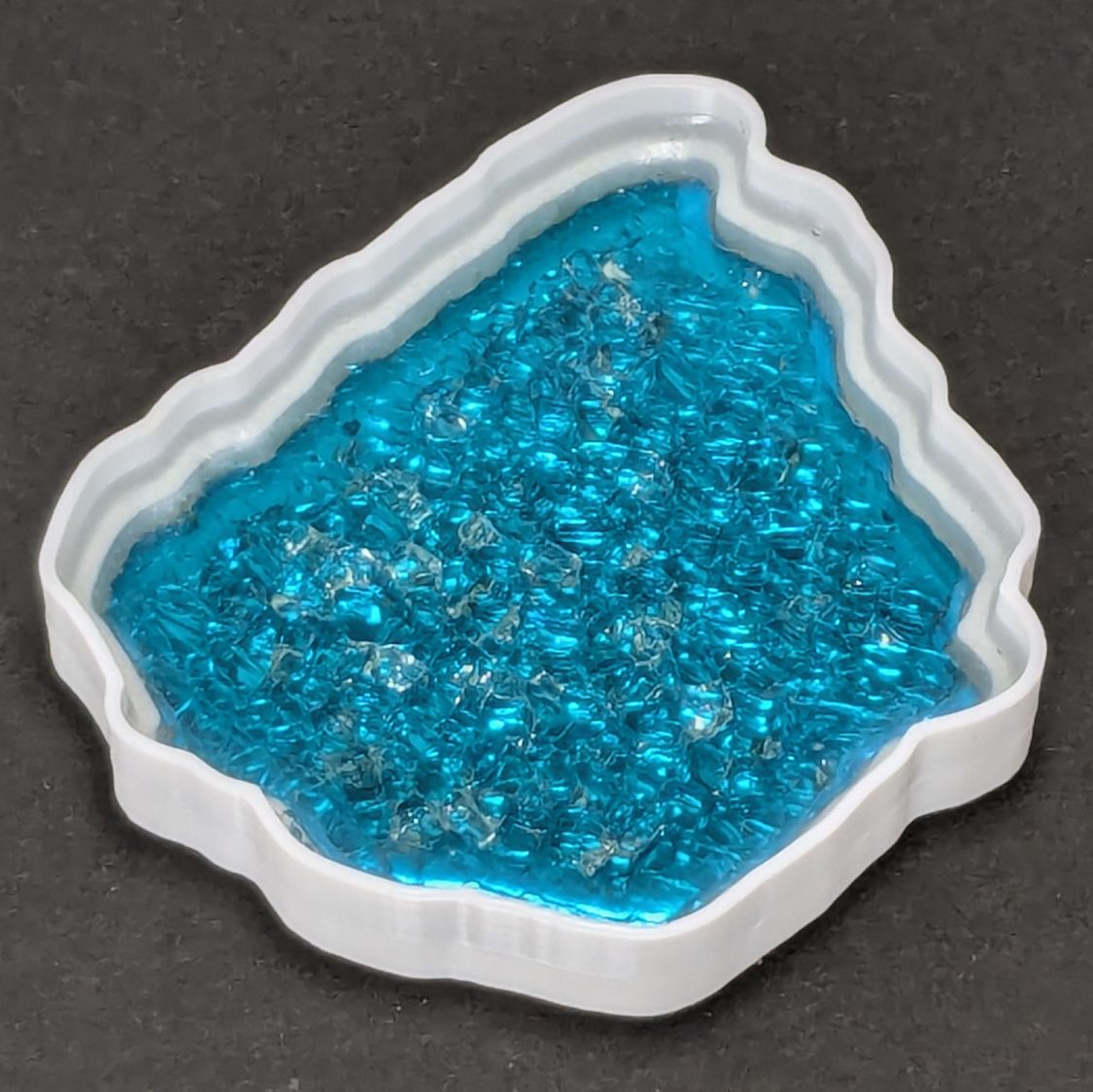
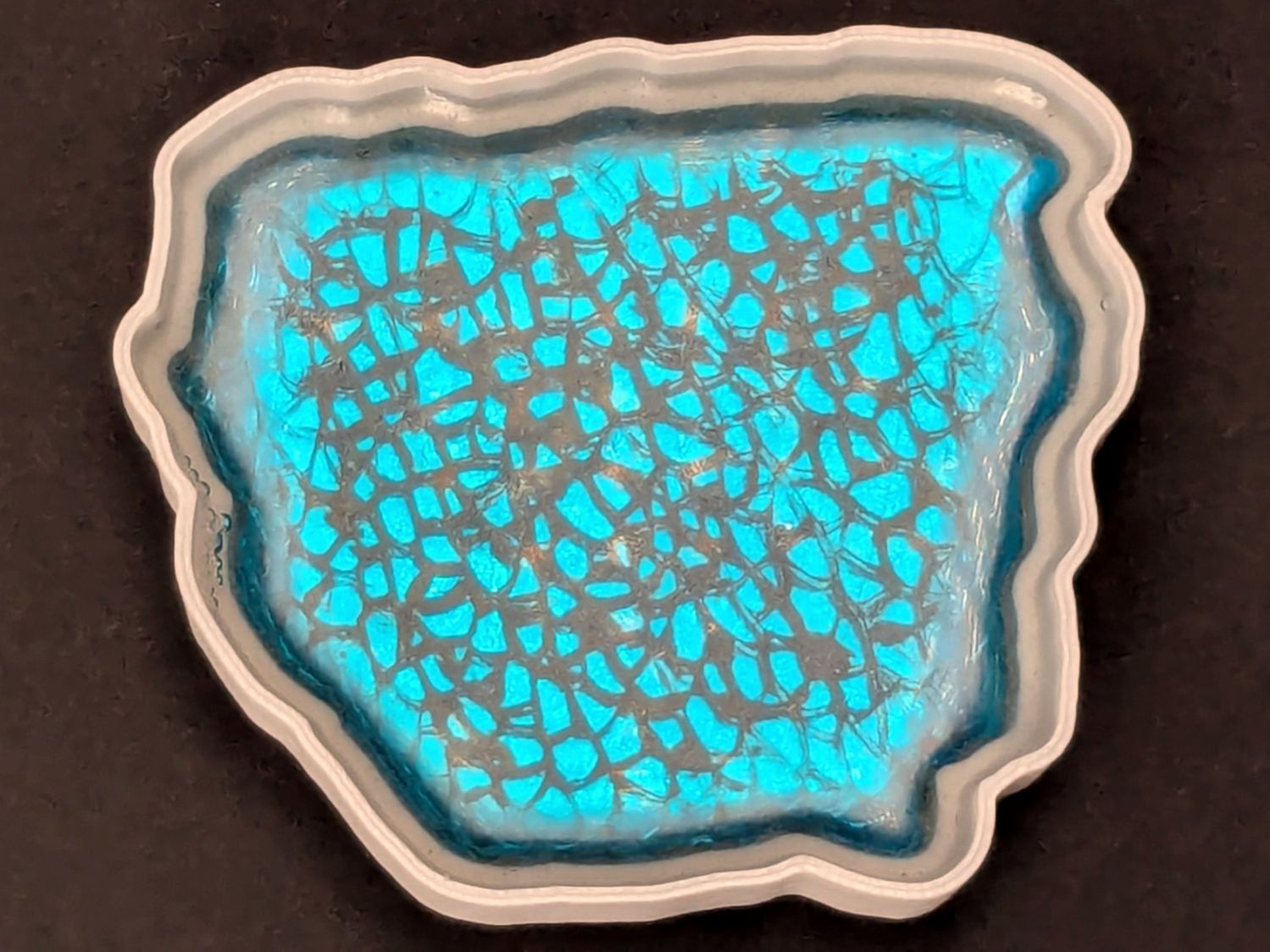
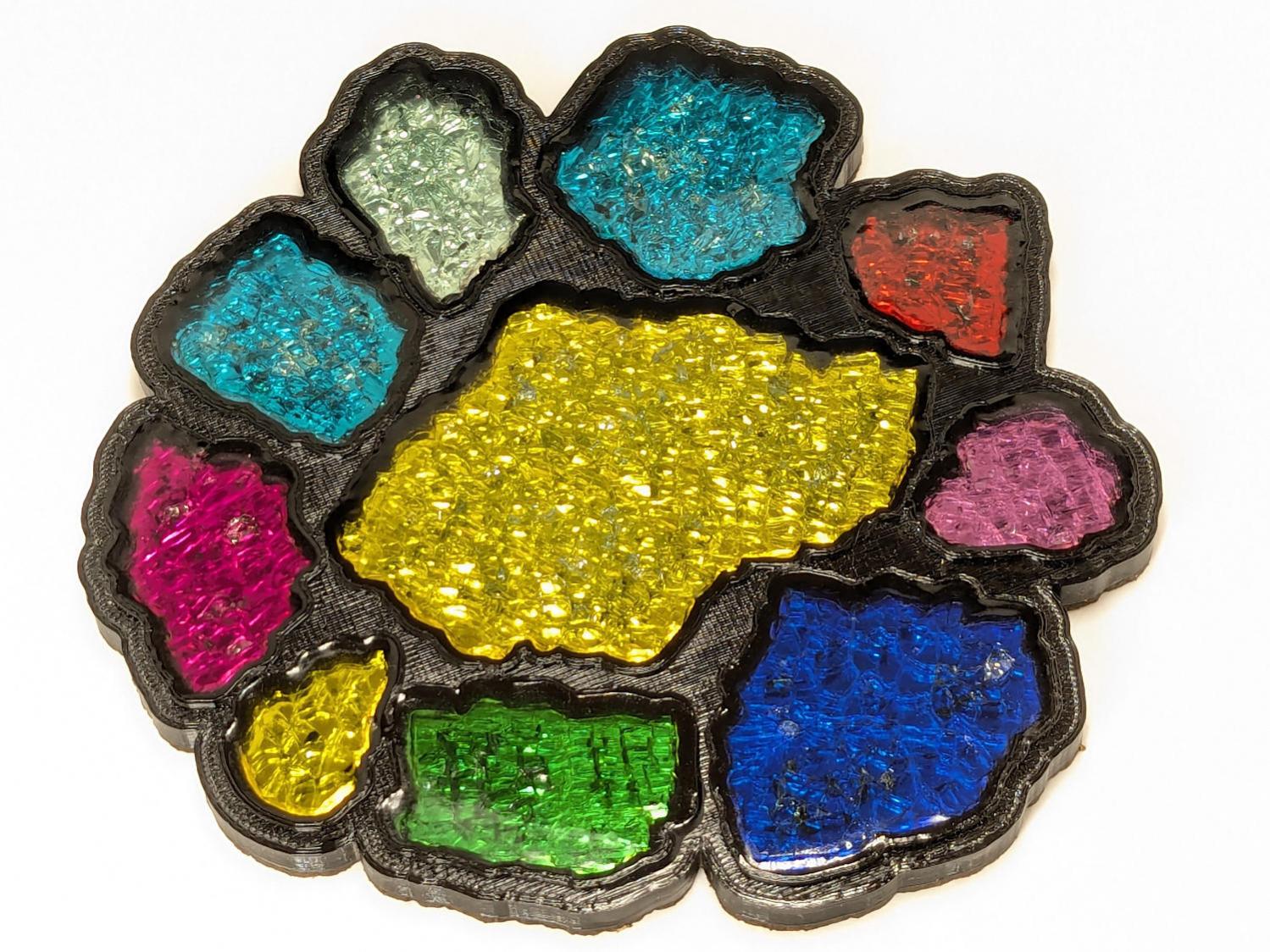
    After positioning the smashed glass fragments atop reflective metalized paper in the 3D printed coaster base, I poured epoxy over everything and, after popping some bubbles, left it to cure:

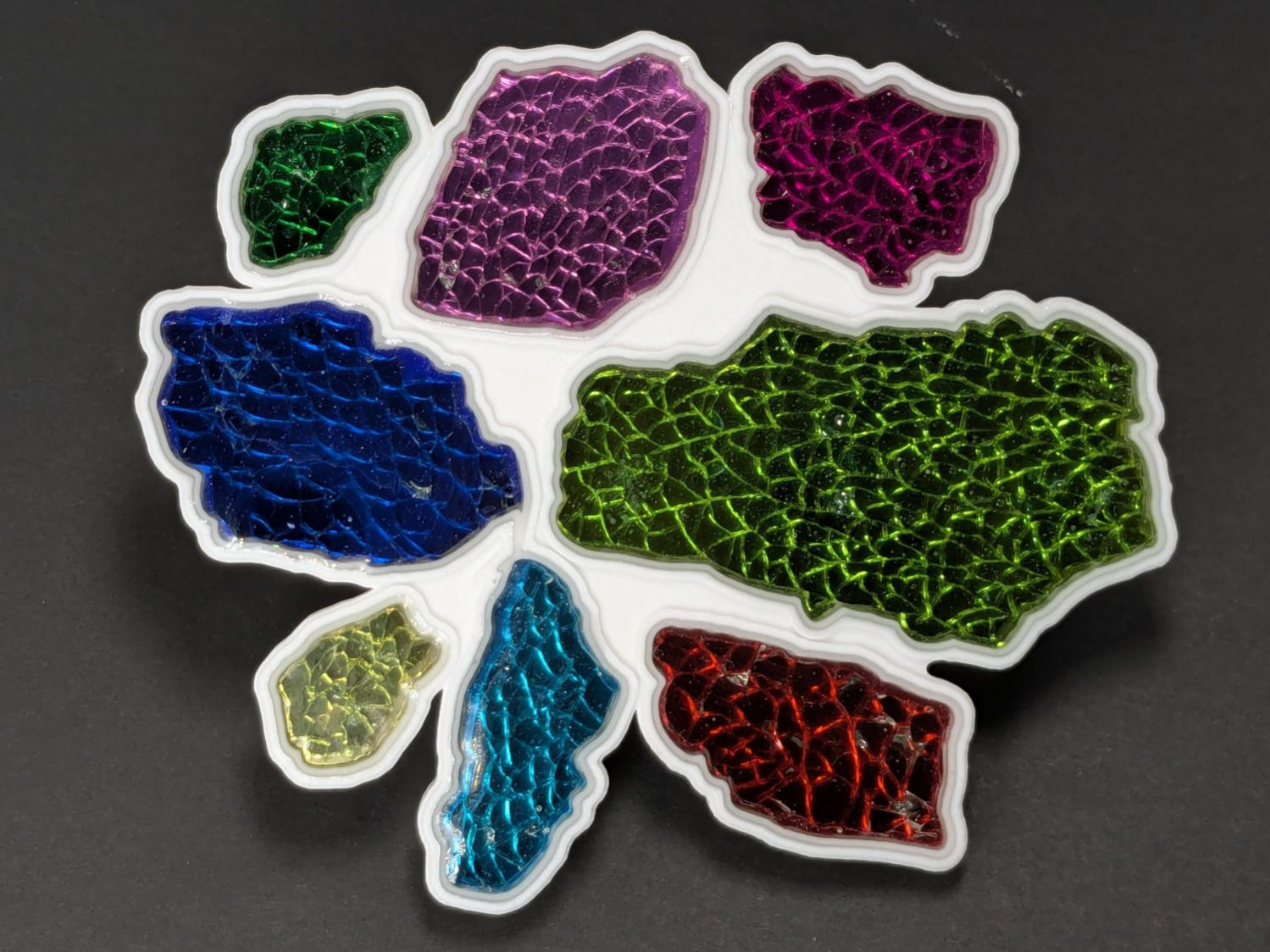
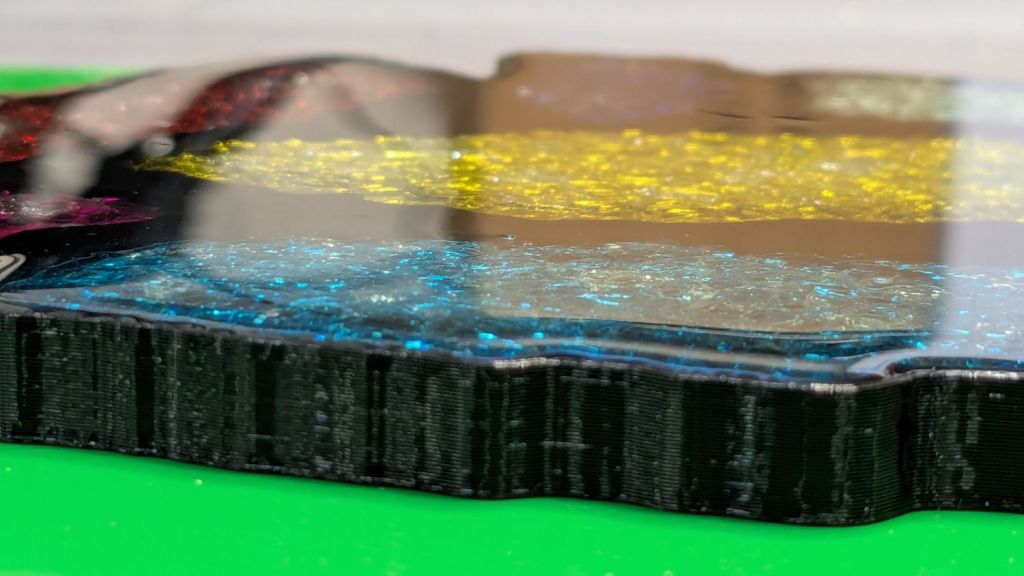
    Smashed glass printed coaster - detail
    Smashed glass printed coaster – detail

    I sprayed the white-ish fragments (on the left) with satin-finish clear rattlecan “paint” in the hopes it would keep epoxy out of the cracks between the glass cuboids and leave the highly reflective air gaps. While it did a reasonable job of sealing, it bonded poorly with the epoxy and produced a dull surface finish.

    The unsprayed fragments (on the right) turned out better, although the one in the upper right has a thin air bubble / layer on top. The unsealed cracks between the cuboids show well against the reflective layers, so I think spraying the fragments isn’t worth the effort.

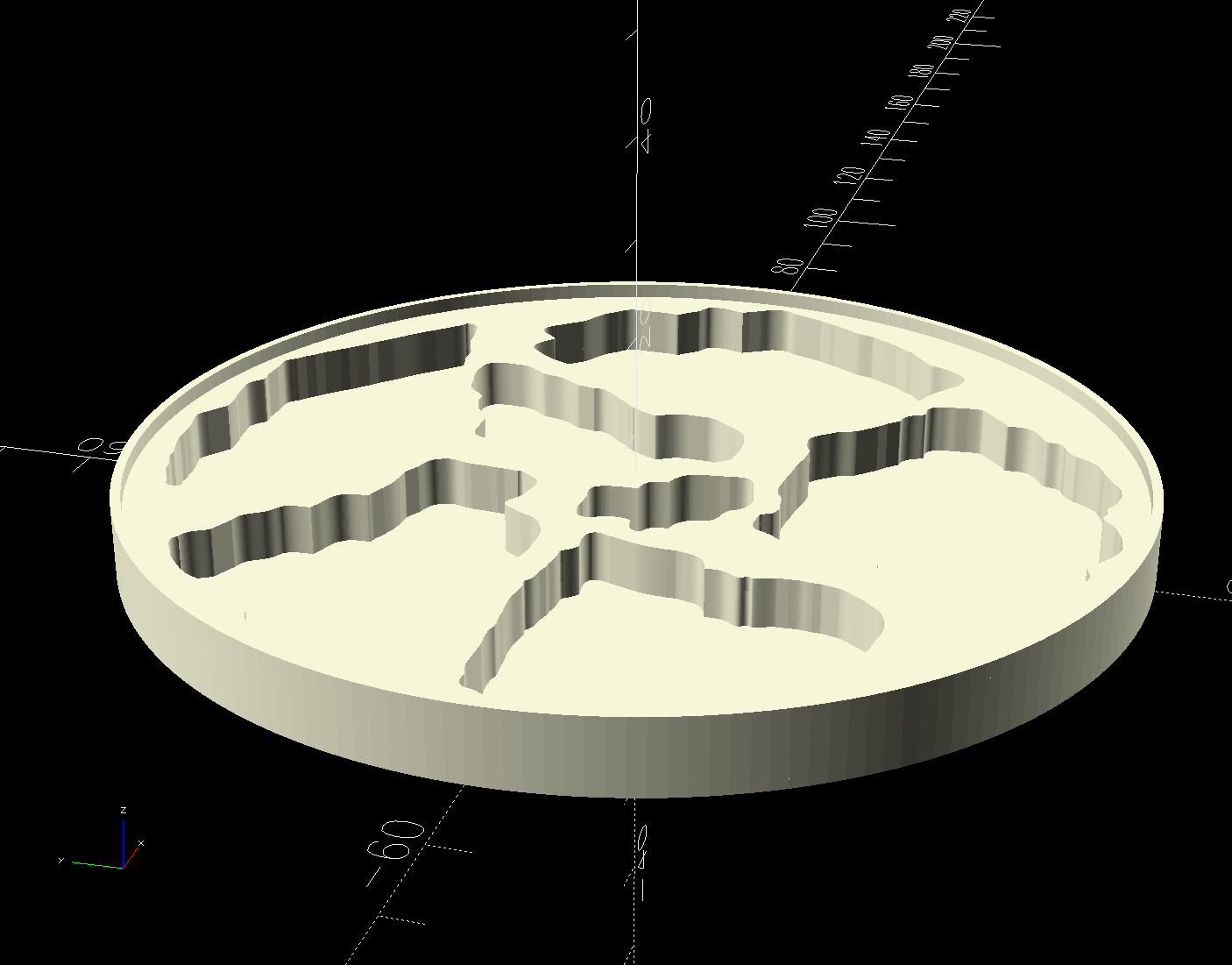
    The printed base has a 1 mm tall rim to retain the epoxy:

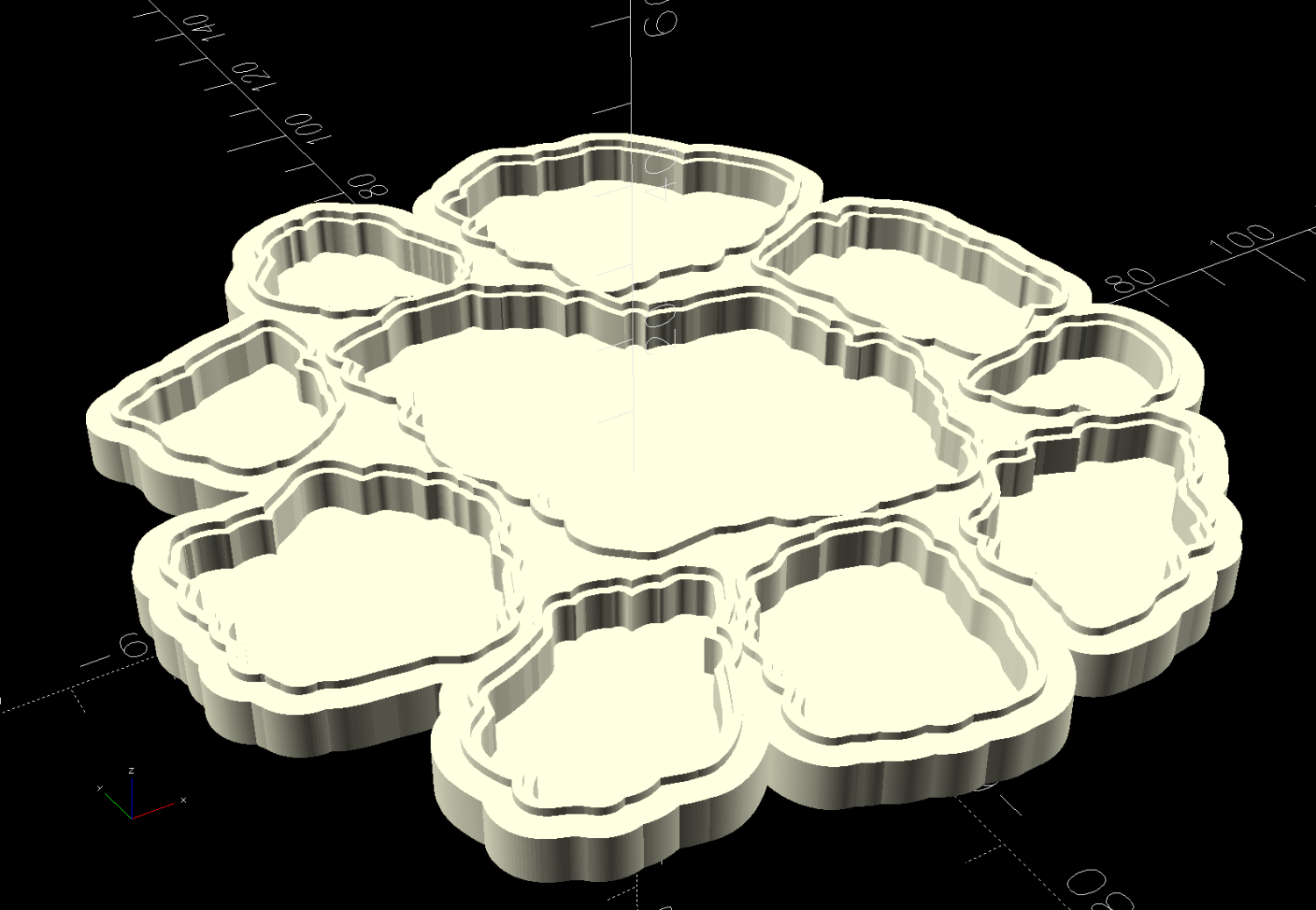
    Printed Coaster Layout - solid model
    Printed Coaster Layout – solid model

    I mixed enough epoxy to fill half the volume of a disk with the same overall OD and depth (V = h × π × d²/4), which turned out to be barely enough produce a level surface at the rim. There didn’t seem that much epoxy left on the various measuring / mixing cups, but next time I’ll round upward.

    Many of the bubbles emerged from below the metalized paper, as well as between the glass and paper, so next time:

    • Set up a level platform with a sacrificial cover
    • Omit the adhesive sheet under the metallized paper
    • Pour a little epoxy into the recesses
    • Squish the metallized paper into place
    • Pour more epoxy to cover the paper
    • Gently squish the glass fragments into place
    • Ease more epoxy around the fragments
    • Chivvy the bubbles away
    • Fill to the rim

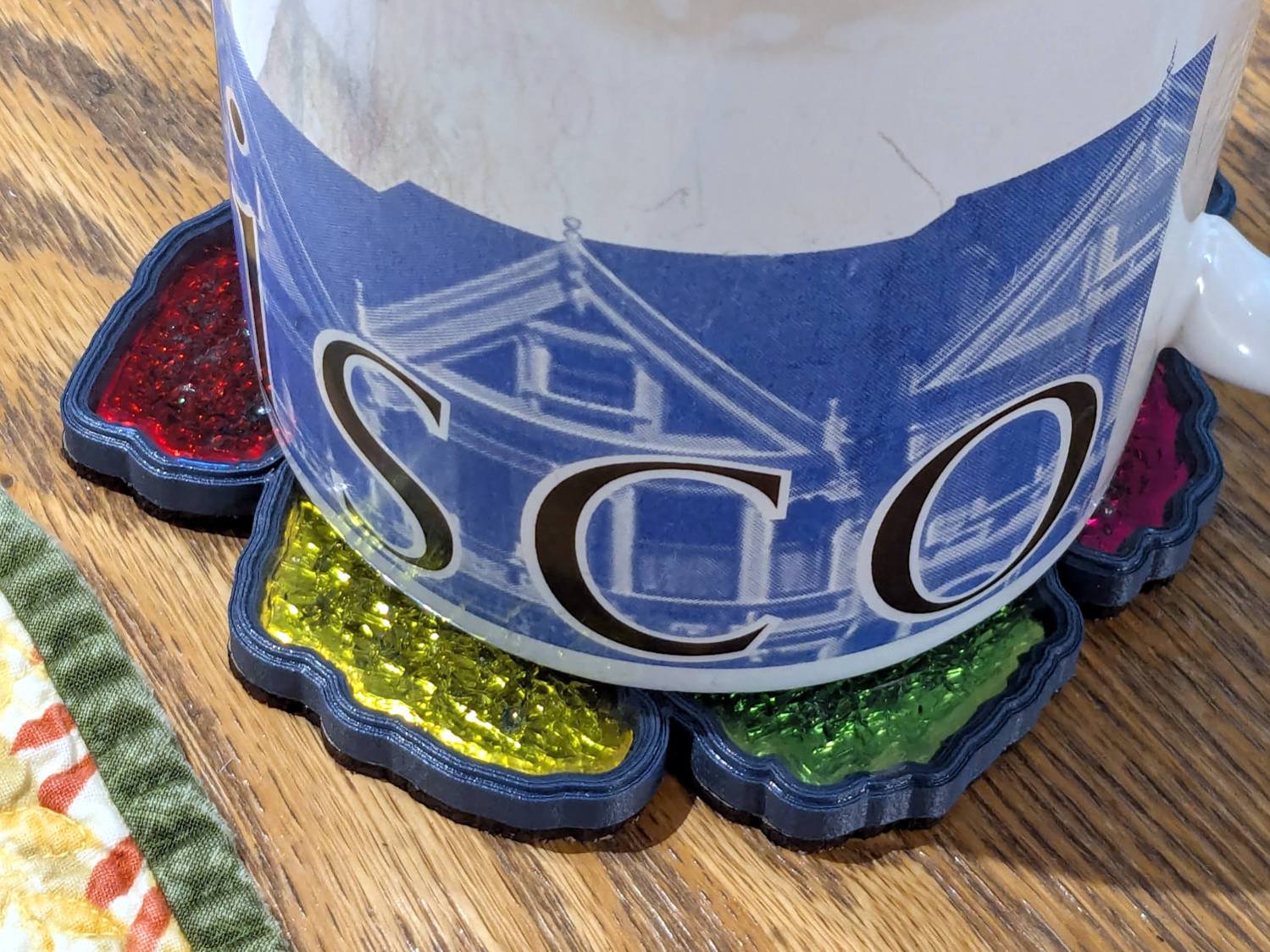
    The top isn’t exactly flat and has some dull areas, so at some point I want to make it flat with 220 grit sandpaper, work up to some 3000 grit paper I’ve been saving for a special occasion, then finish it off with Novus polish. Which seems like enough hassle to keep the coaster under my sippy cup for a while.

  • Smashed Glass: 3D Printed Coaster Base & Metallized Paper Reflectors

    Smashed Glass: 3D Printed Coaster Base & Metallized Paper Reflectors

    The motivation for making Yet Another Coaster was to see if combining a few techniques I’ve recently learned would produce a nicer result.

    Spoiler: Yup, with more to be learned and practiced.

    This is a somewhat nonlinear narrative reminding me of things to do and not do in the future, so don’t treat it as a direct how-to set of instructions.

    Thus far, the best way to highlight fragments of smashed glass has been to put them atop an acrylic mirror:

    Smashed Glass Coaster 2 - fragment detail
    Smashed Glass Coaster 2 – fragment detail

    But a 3 mm acrylic mirror layer makes for a rather thick coaster:

    Smashed Glass Coaster 5 - edge alignment A
    Smashed Glass Coaster 5 – edge alignment A

    The glass fragments sit inside holes in the next two (or three or whatever) acrylic layers, which must have a total thicknesses slightly more than the glass thickness and remain properly aligned while assembling the whole stack:

    Smashed Glass Coaster 5 - alignment pin
    Smashed Glass Coaster 5 – alignment pin

    Bonus: all that cutting generates an absurd amount of acrylic scrap. I eventually put much of it to good use, but not producing it in the first place would be a Good Thing …

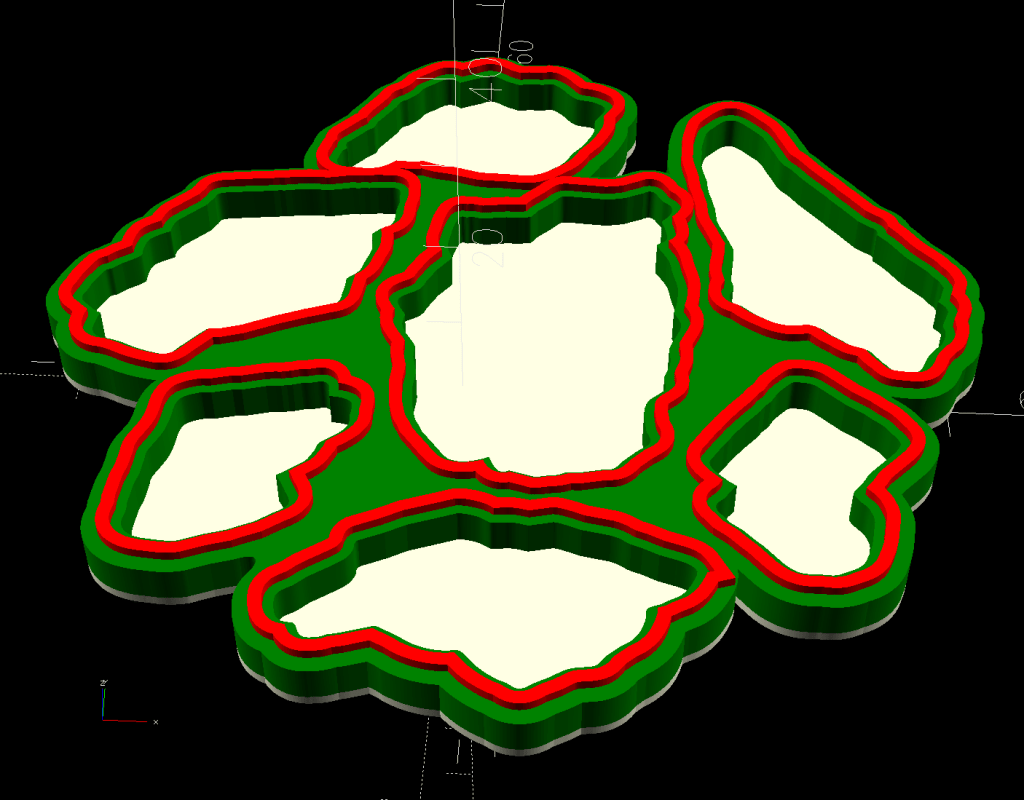
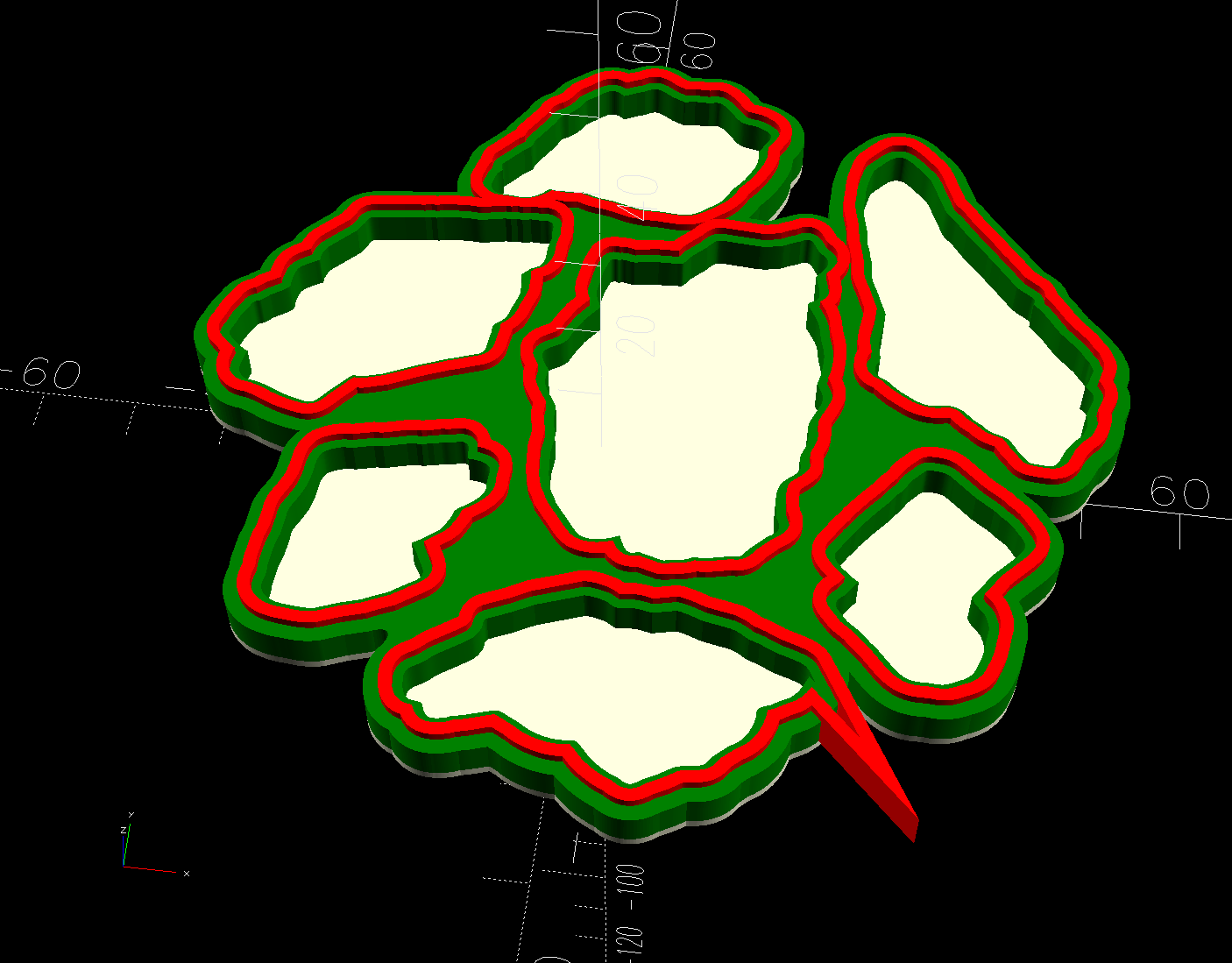
    So 3D print the entire base, which requires generating a solid model with recesses for the fragments:

    Printed Coaster Layout - solid model
    Printed Coaster Layout – solid model

    Because there’s no real justification for an optical-quality mirror under smashed glass, use reflective metallized paper in the recesses as reflectors:

    Smashed glass printed coaster - metallized paper assembly
    Smashed glass printed coaster – metallized paper assembly

    The glass is more-or-less greenish-blueish, so I used a strip of green metallized paper that made the glass fragments green. Obviously there’s some room for choice down there.

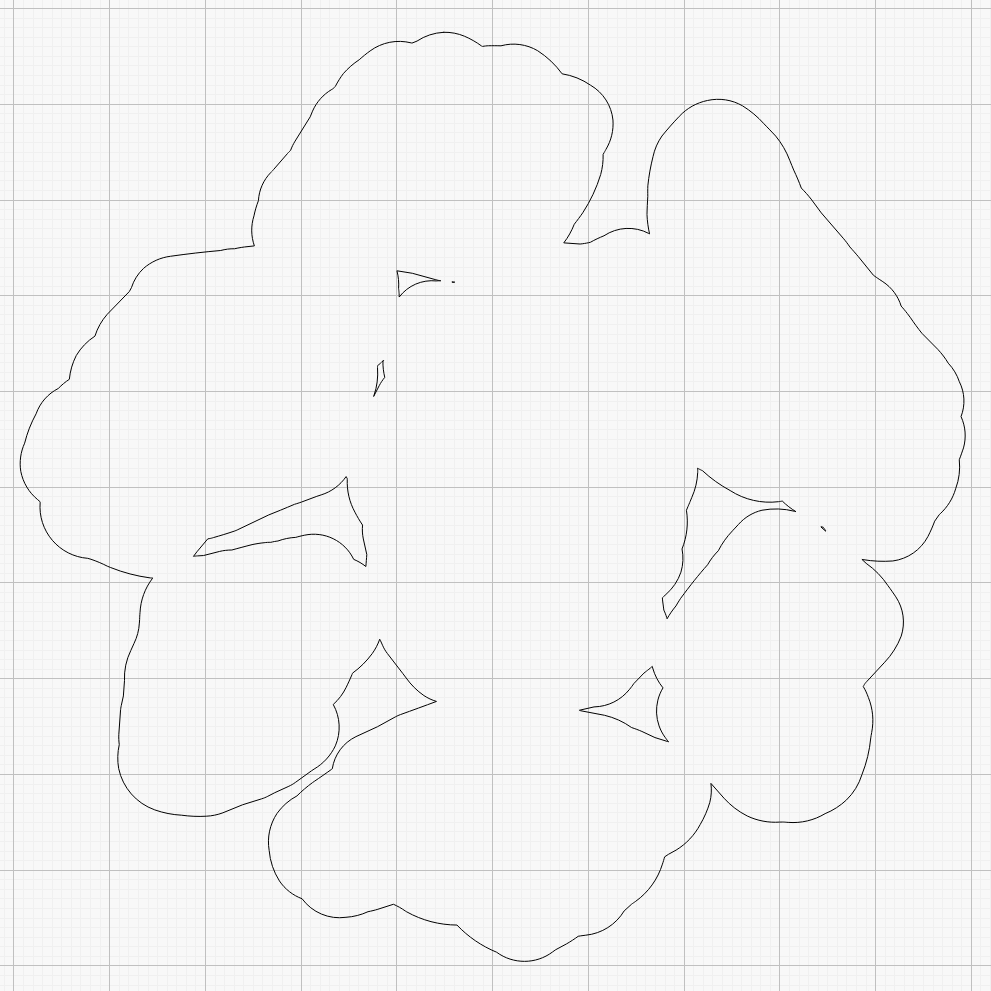
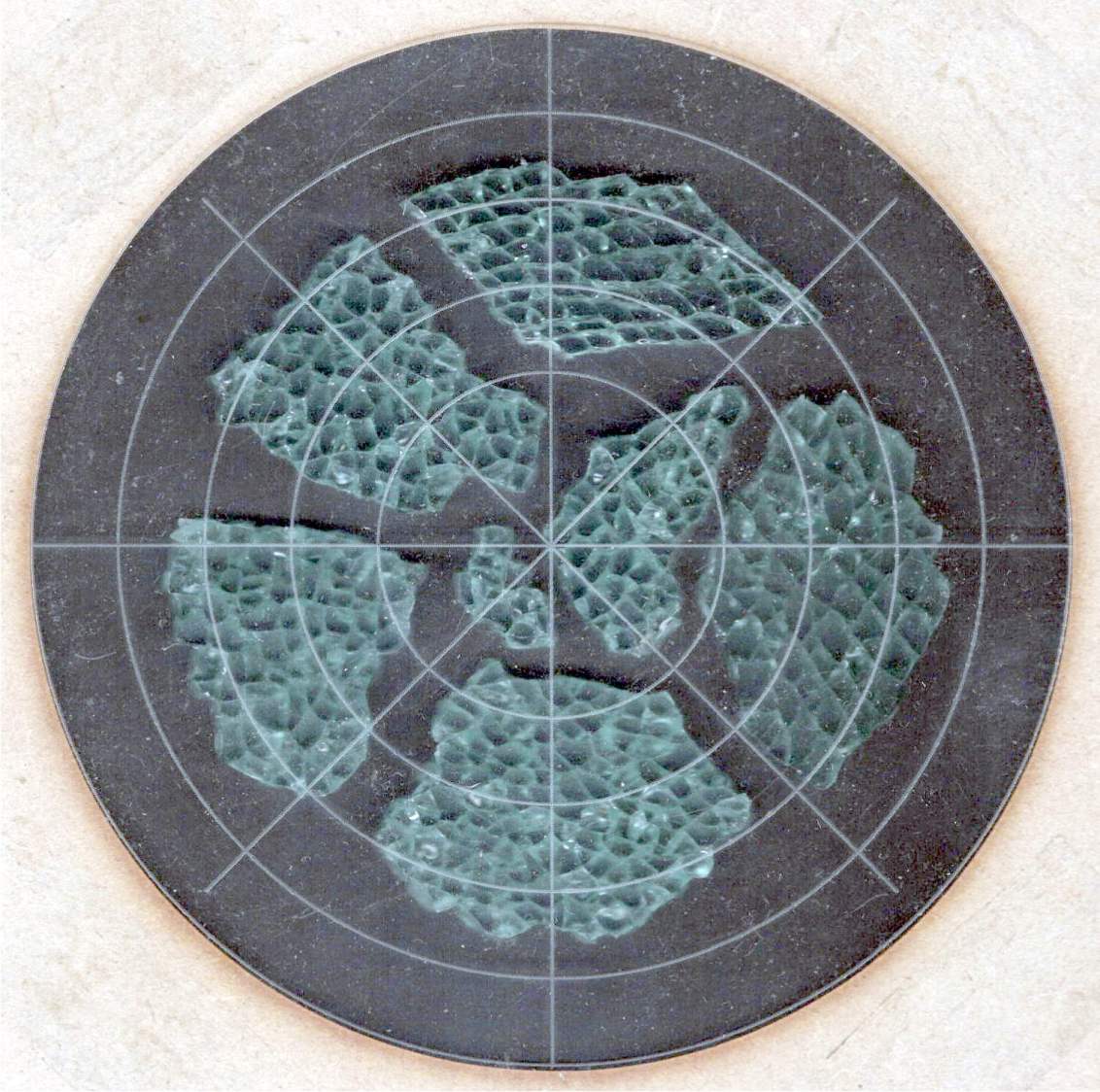
    Both the base and the reflectors use outlines of the fragments, so I started with a scan of the approximate layout in GIMP:

    Smashed Glass - 4in - group A - tweaked
    Smashed Glass – 4in – group A – tweaked

    I traced the outline of each fragment using the Scissors Select Tool, which lays line segments along the sharpest gradient between clicked points, then switched into Quick Mask mode to adjust & smooth the results:

    Smashed Glass paths - quick mask
    Smashed Glass paths – quick mask

    That’s the result after sketching & saving all the paths as separate SVG files to allow importing them individually into InkScape, OpenSCAD, and LightBurn.

    Which turned out to be suboptimal, as it let me write an off-by-one blooper omitting the last file from the OpenSCAD model:

    fn = "Fragment layout - 4in.svg";
    fp = ["A","B","C","D","E","F"];
    <snippage>
            for (p = fp)
              import(fn,id=str("Fragment ",p));


    A better choice puts all the paths into a single named group, saved as a single SVG file, then importing that group from the file using its name, along these lines:

    fn = "Fragment layout - 4in.svg";
    fg = ["Fragments"];
    <snippage>
            import(fn,id=fg);
    

    It’s not clear if I can do that directly from GIMP by saving all the paths in a single file, then importing that lump into Inkscape as a group, but it’ll go something like that.

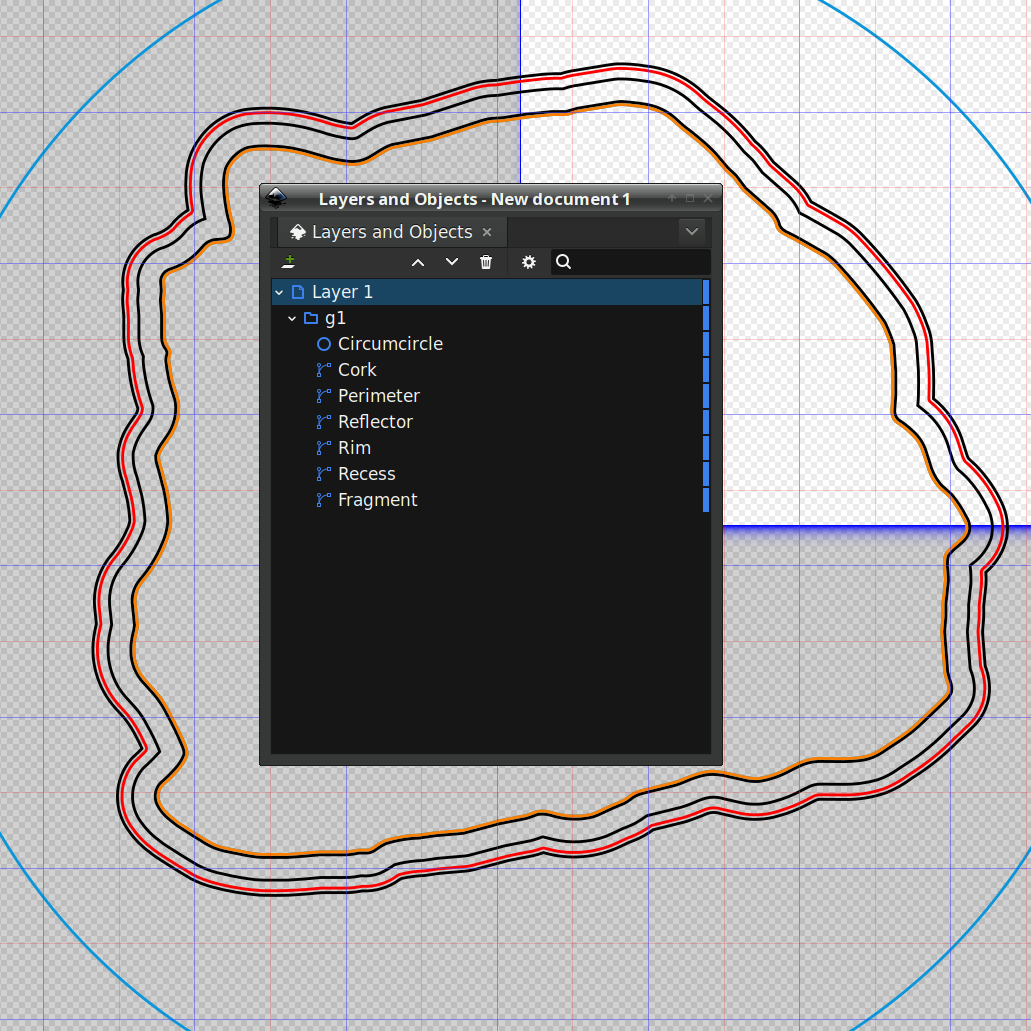
    After getting the fragment paths into Inkscape, add a 0.5 mm offset to each path to clear any non-vertical edges. This will be checked with the template cut using LightBurn as described below.

    Add a 1 mm rim around the outside, with the 4 inch OD matching the usual PSA cork base:

    Fragment layout - 4in
    Fragment layout – 4in

    Now’s the time to nudge / rotate the outlines so they have at least a millimeter of clearance on all sides / ends, because that’s about as thin a section of printed plastic as you want.

    Locating the center of the OD (and, thus, everything inside) at the lower-left corner of the Inkscape page will put them at the OpenSCAD origin. I have set Inkscape to have its origin at the lower left, rather than the default upper left, so your origin may vary.

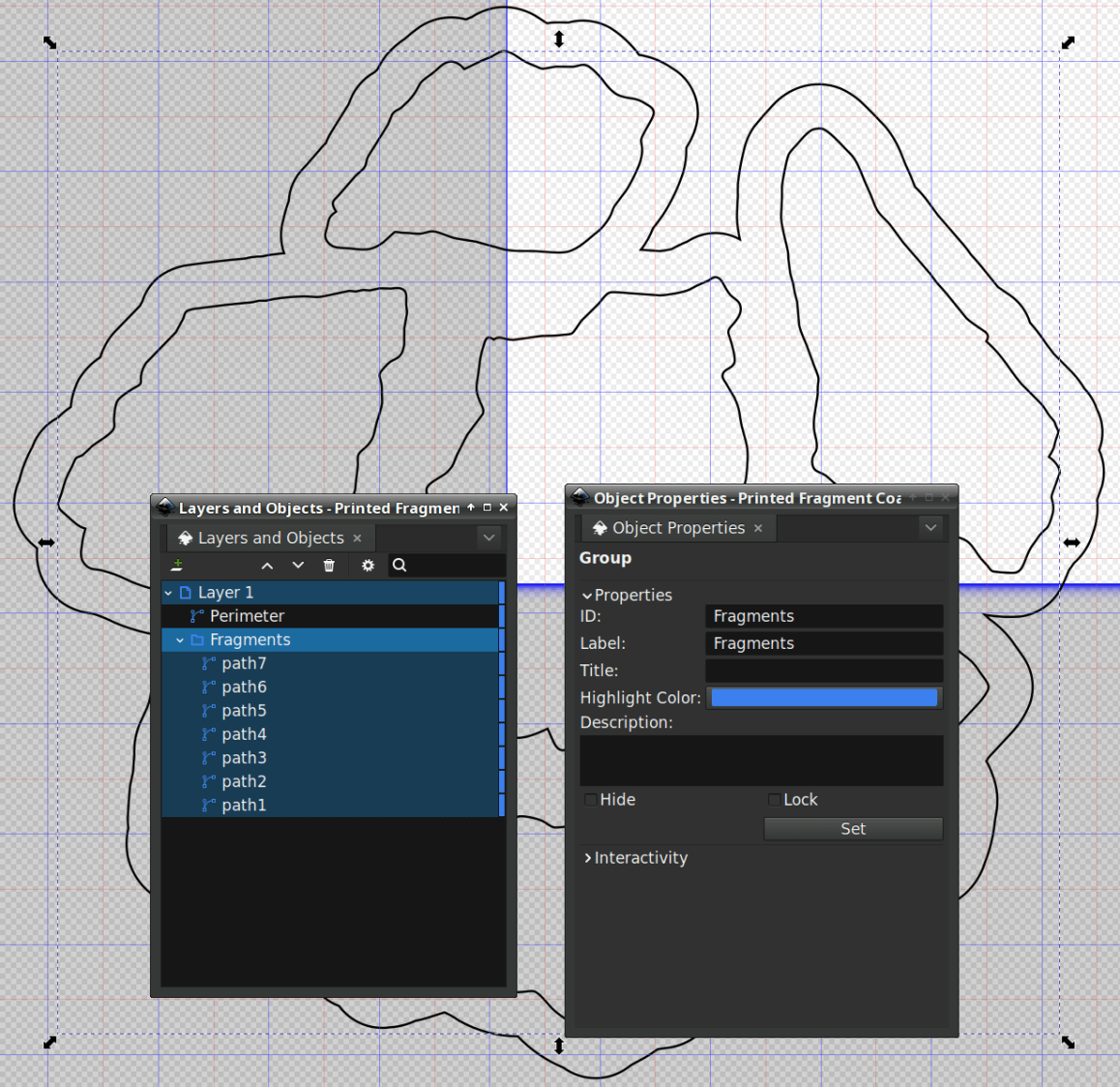
    Select one of the paths:

    Fragment layout - Inkscape A
    Fragment layout – Inkscape A

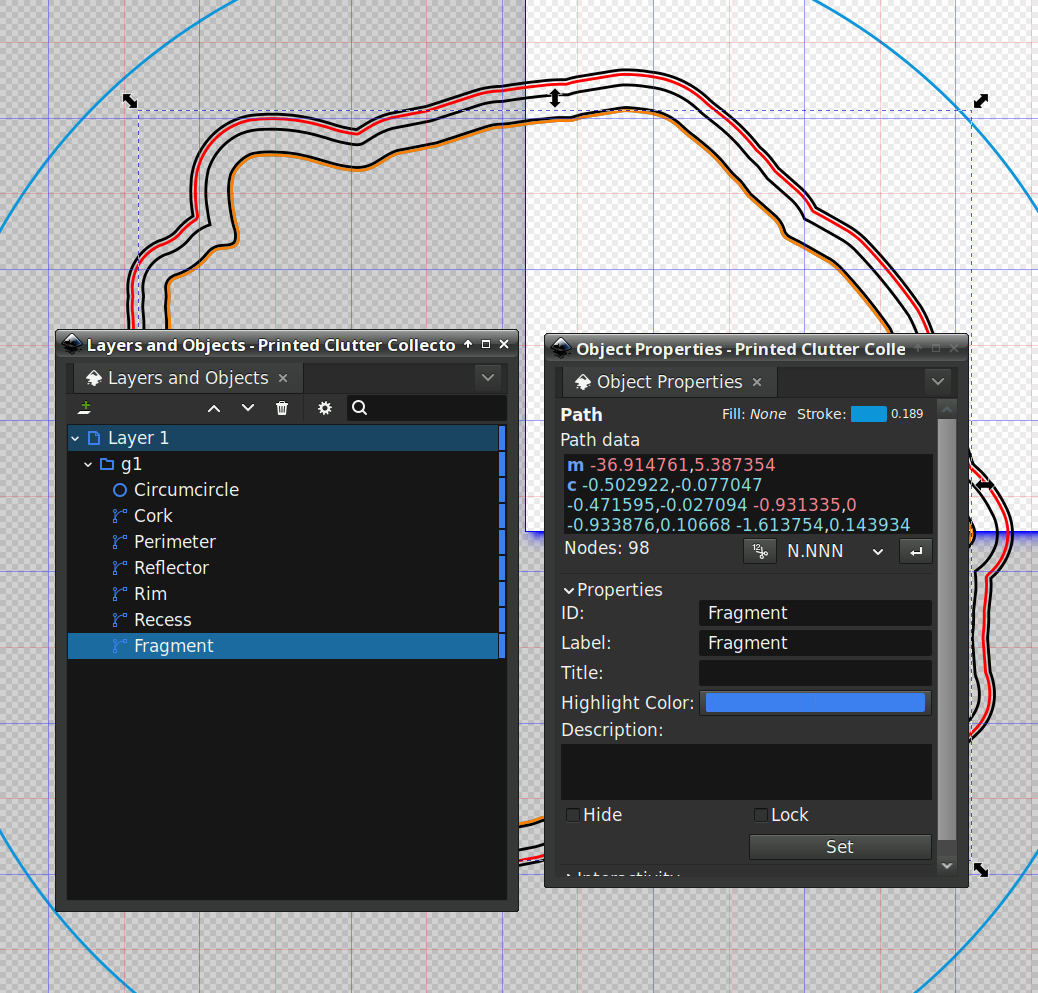
    Then set the ID in its Object Properties:

    Fragment layout - Inkscape A - properties
    Fragment layout – Inkscape A – properties

    There is an interaction between the name over in the Layers and Objects window, which apparently comes from the GIMP path name for the imported fragments, and the resulting ID and Label in the Object Properties window. However, renaming an object on the left, as for the Rim and Perimeter circles, does not set their ID or Label on the right. Obviously, I have more learning to do before this goes smoothly.

    With everything laid out and named and saved in an SVG file, the OpenSCAD program is straightforward (and now imports all the fragments):

    include <BOSL2/std.scad>
    
    NumSides = 4*4*3*4;
    
    fn = "Fragment layout - 4in.svg";
    fp = ["A","B","C","D","E","F","G"];
    
    FragmentThick = 5.0;
    
    BaseThick = 1.0;
    RimHeight = 1.5;
    
    union() {
      linear_extrude(h=BaseThick)
        import(fn,id="Perimeter",$fn=NumSides);
      linear_extrude(h=BaseThick + FragmentThick + RimHeight)
        difference() {
          import(fn,id="Perimeter",$fn=NumSides);
          import(fn,id="Rim",$fn=NumSides);
      }
      up(BaseThick - 0.05)
        linear_extrude(h=FragmentThick)
          difference() {
            import(fn,id="Perimeter",$fn=NumSides);
            for (p = fp)
              import(fn,id=str("Fragment ",p));
          }
    }


    Which squirts out the solid model appearing above.

    Feeding it into PrusaSlicer turns the model into something printable:

    Printed Coaster Layout - slicer
    Printed Coaster Layout – slicer

    And after supper I had one in my hands.

    Before doing that, however, import the same SVG file into LightBurn, as on the left:

    Printed Coaster Layout - LightBurn
    Printed Coaster Layout – LightBurn

    On the right, duplicate it, put the inner Rim on a tool layer, put the rest on a layer set to cut chipboard, and make a template to verify those holes fit around the fragments:

    Smashed glass printed coaster - fragment test fit
    Smashed glass printed coaster – fragment test fit

    Which a few didn’t, explaining why I go to all that trouble. Iterate through GIMP → paths → SVG → Inkscape → LightBurn until it’s all good. Obviously, you do this before you get too far into OpenSCAD, but they all derive from the Inkscape layout, so there’s not a lot of wasted motion.

    The middle LightBurn layout insets the fragment outlines by 0.25 mm to ensure the paper fits easily and puts them on a layer set to cut metallized paper. Those fragments then get duplicated and rearranged within the rectangle on the top to fit a strip of metallized paper from the scrap box. Fire The Laser to cut them out and stick them to the bottom of their corresponding 3D printed recesses with leftover snippets of craft adhesive sheet as shown above.

    I had originally intended to cover the bottom of the entire sheet of metallized paper with an adhesive sheet, but realized the whole affair was going to be submerged in epoxy, so just making sure the paper didn’t float away would suffice.

    Next, mix up some epoxy …