The Smell of Molten Projects in the Morning

Ed Nisley's Blog: Shop notes, electronics, firmware, machinery, 3D printing, laser cuttery, and curiosities. Contents: 100% human thinking, 0% AI slop.

Tag: Laser Cutter

  • High Impact Art: Coaster 5

    High Impact Art: Coaster 5

    This came out all glittery:

    Smashed Glass Coaster 5 - top view
    Smashed Glass Coaster 5 – top view

    Epoxy tinted with transparent black dye does a pretty good job of not obliterating the cracks between the cuboids. In person, the cracks seem less conspicuous around the borders of the glass pieces, but they’re visible enough for this ahem use case.

    Under the proper lighting, a few bubbles appear along and above the black layer:

    Smashed Glass Coaster 5 - oblique view
    Smashed Glass Coaster 5 – oblique view

    The new thing this time around were three pins holding the layers in alignment while the epoxy cured:

    Smashed Glass Coaster 5 - alignment pin
    Smashed Glass Coaster 5 – alignment pin

    The conical end comes from grabbing an 8 mm snippet of 3/64 inch steel rod in a pin vise and twirling it against Mr Bench Grinder for a few seconds.

    The pins pretty much dropped into 1.1 mm holes created while cutting the sheets. The tiny circles mark the laser path around the pin holes:

    Coaster 5 - layers
    Coaster 5 – layers

    The “holes” in the top sheet (upper middle) are in the Tool 2 layer so they’re not cut, because it was easier to match-drill holes halfway into the top sheet with the drill press than to figure out how to convince the laser to not punch all the way through. Engraving (along the lines of the earring borders) might work, but I’m not sure how well a high-aspect-ratio hole will engrave.

    The mirror sheet is reversed left-to-right in order to cut it from the back of the reflective layer. I’m not certain this is necessary, because acrylic is basically opaque to 10.6 µm IR light and any doubly attenuated reflected light will diverge strongly from the focus point at the top surface, but it’s the recommended procedure and easy enough to do.

    The cork cuts with its adhesive layer up and blue tape on the bottom to prevent soot from accumulating in all the surface crevices.

    The alignment pins worked surprisingly well:

    Smashed Glass Coaster 5 - edge alignment A
    Smashed Glass Coaster 5 – edge alignment A

    The top sheet sticks out 0.3 mm on one side:

    Smashed Glass Coaster 5 - edge alignment B
    Smashed Glass Coaster 5 – edge alignment B

    Oddly, there’s no place where the top sheet is indented by any noticeable amount, so there may be slight size differences depending on all the colors and ages in that stack of plastic sheets.

    I’ll cure the next one top-side down, giving the bubbles an opportunity to rise toward the mirror layer and maybe become less conspicuous:

    Smashed Glass Coaster 5 - curing
    Smashed Glass Coaster 5 – curing

    The tricky part: finding and arranging glass chunks within a 100 mm circle!

    Avoiding narrow gaps and acute angles in the perimeter, as the notch on the left side, should simplify draining the epoxy.

  • Smashed Glass Coaster: Conformal Perimeter

    Smashed Glass Coaster: Conformal Perimeter

    Snugging the perimeter around the smashed glass fragments definitely improves the result:

    Smashed glass coaster - top view A
    Smashed glass coaster – top view A

    It’s just under 100 mm = 4 inch across the longest dimension and surprisingly glittery:

    Smashed glass coaster - top view B
    Smashed glass coaster – top view B

    The coaster is a five-layer sandwich half an inch thick:

    Smashed glass coaster - edge view
    Smashed glass coaster – edge view

    From the top:

    • Clear acrylic: 1.5 mm = 1/16 inch
    • Black acrylic: 1.5 mm = 1/16 inch
    • Clear acrylic: 3.2 mm = 1/8 inch
    • Mirror acrylic: 2.7 mm
    • Cork: 2.7 mm cut from a standard round coaster base

    The smashed glass pieces sit atop the mirror, so the trick is making the layers around it add up to the same thickness. This is not possible by adding the nominal dimensions, because cast acrylic sheet thickness isn’t well controlled; I’ve finally written the actual (metric!) thickness on the sheets so I can select which 1/8 Inch sheet has the proper thickness.

    A chipboard template (seen atop the finished coaster) verified the glass pieces fit easily within their openings:

    Smashed glass coaster - top view - fit template
    Smashed glass coaster – top view – fit template

    I laid the clear frame on the mirror, poured generous epoxy puddles along the middle of the fragment openings, eased the glass in place, and gently pressed the slabs down to get a uniform epoxy layer, with the excess oozing under the frame all around. Then lay the black frame around the glass atop the clear, squirt more epoxy along the gaps around the glass, pour more epoxy atop the fragments, ease the top sheet in place paying considerable attention to coaxing the bubbles along to the edge, align the sides, and wait.

    The epoxy cured while stuck atop a styrofoam pillar to let it drain smoothly off the edges:

    Smashed glass coaster - epoxy curing
    Smashed glass coaster – epoxy curing

    I encouraged the epoxy out of the acute corners, as shown by the larger puddles, over the next few hours until the epoxy stiffened up. Those puddles also show the transparent black tint, to the tune of four drops in 8 ml of epoxy, which turned out to just barely suffice for the job. The whole assembly sat level while curing, but the layers didn’t remain aligned even after gently shoving them around while the stack cured.

    The black epoxy joins nicely with the black frame layer to conceal most of the remaining bubbles. A different color frame with matching epoxy might looks less ominous, but colors more transparent than dark gray would likely reveal the bubbles.

    It Would Be Nice™ if the acrylic sheet on the top had a transparent plastic film cover, but it arrived with brown paper on both sides. Despite that, I spattered only a few tiny drops on the bare surface and managed to scrape most of them off without further damage.

    Overall, I think the conformal perimeter looks much better than the polygonal outline smashed glass coasters.

  • Smashed Glass Earrings: Sample Set

    Smashed Glass Earrings: Sample Set

    The POC earrings had a pair of 1.5 mm acrylic disks epoxied around the glass fragment, with the “gold” ring captured in a rebate around the rims. That process was both tedious and messy, so I tried laser-engraving a deeper rebate into a 3 mm sheet, then epoxying the fragment and the ring in place:

    Earrings - epoxy curing
    Earrings – epoxy curing

    They’re stuck to a strip of Kapton tape to keep the epoxy off the bottom surface of the glass, while aligning it with the surrounding disk.

    Peeling the protective film / plastic off reveals the acrylic disk:

    Earrings - 25 20 16 12 mm first look
    Earrings – 25 20 16 12 mm first look

    They all required more effort to remove the epoxy remaining around the ring, but it worked out better than I expected.

    A lighter background shows off their internal structure:

    Earrings - 25 20 16 12 mm set
    Earrings – 25 20 16 12 mm set

    A closer look at the pairs:

    • Earrings - 25 mm pair
    • Earrings - 20 mm pair
    • Earrings - 16 mm pair
    • Earrings - 12 mm pair

    As always, glooping clear epoxy around the edges fills many of the internal cracks and reduces the glittery aspect of all those glass-to-air-to-glass interfaces, but I don’t see another good way to keep the fragments under control.

    The results may not be up to a “fine jewelry” standard, whatever that may be, but a slipcase box definitely improves the presentation:

    Earrings - presentation case
    Earrings – presentation case

    If I had the courage of my convictions, I’d go for the Mr Clean look myself, but …

  • Layered Paper Coaster: GCMC Test

    Layered Paper Coaster: GCMC Test

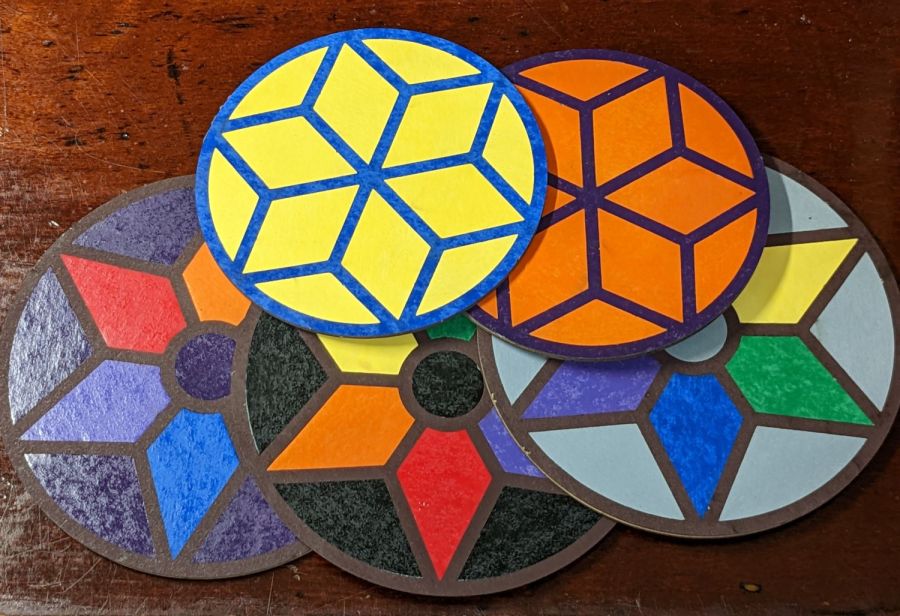
    A few more attempts at layered paper construction, done with plain white Art Paper of various vintages:

    Layered paper coasters
    Layered paper coasters

    The middle one comes from a version of the original GCMC marquetry shape generator, tweaked to produce just the frame SVG, called by a Bash script to change the sash width, and imported into LightBurn for laser control:

    LightBurn - Marq-6-0.6-0.0mm
    LightBurn – Marq-6-0.6-0.0mm

    I generated the plain disk for the bottom by deleting all the inner shapes.

    The left and right coasters use LightBurn’s Offset tool to reduce the size of the interior holes on successive layers:

    LightBurn - Marq-8-0.40-20.0mm-Layers
    LightBurn – Marq-8-0.40-20.0mm-Layers

    Although the GCMC version turned out OK, you’ll note it lacks the central disk, as I was unwilling to tweak the code enough to make the disk diameter vary with the kerf width.

    Applying the LB Offset tool requires selecting only the inner shapes (it has an option to ignore the inner shapes) and applying the appropriate offset. Because the tool remembers its previous settings, it’s straightforward to step the offset from 1.0 mm to 7.0 mm on successive patterns.

    Applying glue (from a glue stick!) to the bottom of each disk, aligning them atop each other, and pressing them together becomes tedious in short order. If I had to do a lot of these, I’d be tempted to add three wings (not at 120° angles!) around the perimeter with holes for pegs, then stacking the layers in a fixture to ensure good alignment. A polygonal perimeter would simplify trimming the tabs.

    Spray adhesive might be faster, but each layer would have sticky edges and the finished coaster would become a dust collector par excellence.

    I like the overall effect, but …

    The OpenSCAD source code as a GitHub Gist:

    #!/bin/bash
    # Layering paper cutouts
    # Ed Nisley KE4ZNU – 2022-08-21
    Flags='-P 4 –pedantic' # quote to avoid leading hyphen gotcha
    SVGFlags='–svg –svg-no-movelayer –svg-opacity=1.0 –svg-toolwidth=0.2'
    # Set these to match your file layout
    ProjPath='/mnt/bulkdata/Project Files/Laser Cutter/Coasters/Source Code'
    LibPath='/opt/gcmc/library'
    ScriptPath=$ProjPath
    Script='Marquetry Layers.gcmc'
    [ -z "$1" ] && leaves="6" || leaves="$1"
    [ -z "$2" ] && aspect="0.50" || aspect="$2"
    [ -z "$3" ] && center="0.0mm" || center="$3"
    numlayers=8
    sashmin=2.0
    sashstep=2.0
    sashmax=$(echo "$sashmin+$sashstep*($numlayers-1)" | bc)
    echo min: $sashmin step: $sashstep max: $sashmax
    for sash in $(seq $sashmin $sashstep $sashmax) ; do
    fn=Marq-$leaves-$aspect-$center-S$sash.svg
    echo Output: $fn
    gcmc $Flags $SVGFlags –include "$LibPath" \
    -D "NumLeaves=$leaves" -D "LeafAspect=$aspect" -D "CenterDia=$center" \
    -D "Sash=${sash}mm" \
    "$ScriptPath"/"$Script" > "$fn"
    done
    view raw layers.sh hosted with ❤ by GitHub
    // Marquetry Layers
    // Ed Nisley KE4ZNU
    // 2022-08-21 layered paper test piece
    layerstack("Frame","Leaves","Rim","Base","Center","Tool1"); // SVG layers map to LightBurn colors
    //—–
    // Library routines
    include("tracepath.inc.gcmc");
    include("varcs.inc.gcmc");
    FALSE = 0;
    TRUE = !FALSE;
    //—–
    // Command line parameters
    // -D various useful tidbits
    // add unit to speeds and depths: 2000mm / -3.00mm / etc
    if (!isdefined("OuterDia")) {
    OuterDia = 120.0mm;
    }
    if (!isdefined("CenterDia")) {
    CenterDia = 20.0mm;
    }
    if (!isdefined("NumLeaves")) {
    NumLeaves = 8;
    }
    if (!isdefined("Sash")) {
    Sash = 4.0mm;
    }
    if (!isdefined("LeafAspect")) {
    LeafAspect = 0.50;
    }
    // Leaf values
    LeafStemAngle = 360.0deg/NumLeaves; // subtended by inner sides
    LeafStemHA = LeafStemAngle/2;
    LeafOAL = OuterDia/2 – Sash – (Sash/2)/sin(LeafStemHA);
    LeafWidth = LeafAspect*LeafOAL;
    L1 = (LeafWidth/2)/tan(LeafStemHA);
    L2 = LeafOAL – L1;
    // message("Len: ",LeafOAL," L1: ",L1," L2: ",L2);
    LeafTipHA = to_deg(atan(LeafWidth/2,L2)); // subtended by outer sides
    LeafTipAngle = 2*LeafTipHA;
    // message("Width: ",LeafWidth);
    // message("Tip HA: ",LeafTipHA);
    LeafID = CenterDia + 2*Sash;
    LeafOD = LeafID + LeafOAL;
    // message("ID: ",LeafID," OD: ",LeafOD);
    // Find leaf and rim vertices
    P0 = [(Sash/2) / sin(LeafStemHA),0.0mm];
    m = tan(LeafStemHA);
    y0 = -(Sash/2) / cos(LeafStemHA);
    if (CenterDia) { // one sash width around center spot
    a = 1 + pow(m,2);
    b = 2 * m * y0;
    c = pow(y0,2) – pow(LeafID/2,2);
    xp = (-b + sqrt(pow(b,2) – 4*a*c))/(2*a);
    xn = (-b – sqrt(pow(b,2) – 4*a*c))/(2*a);
    y = xp*tan(LeafStemHA) – (Sash/2) / cos(LeafStemHA);
    P1 = [xp,y];
    if (FALSE) {
    message("a: ",a);
    message("b: ",b);
    message("c: ",c);
    message("p: ",xp," n: ",xn," y: ",y);
    }
    }
    else { // force sharp point without center spot
    P1 = P0;
    }
    P2 = P0 + [L1,LeafWidth/2];
    P3 = P0 + [LeafOAL,0mm];
    P4 = P3 + [Sash/sin(LeafTipHA),0.0mm];
    P5r = P4.x * sin(LeafTipHA) / sin(180deg – LeafStemHA – LeafTipHA);
    P5 = rotate_xy([P5r,0.0mm],LeafStemHA);
    P6 = rotate_xy(P4,LeafStemAngle);
    t2 = pow(tan(-LeafTipHA),2);
    a = 1 + t2;
    b = -2 * t2 * P4.x;
    c = t2 * pow(P4.x,2) – pow(P3.x,2);
    xp = (-b + sqrt(pow(b,2) – 4*a*c))/(2*a);
    xn = (-b – sqrt(pow(b,2) – 4*a*c))/(2*a);
    y = (xp – P4.x)*tan(-LeafTipHA);
    // message("p: ",xp," n: ",xn," y: ",y);
    P4a = [xp,y];
    P6a = rotate_xy(P4a,LeafStemAngle – 2*atan(P4a.y,P4a.x));
    if (FALSE) {
    message("P0: ",P0);
    message("P1: ",P1);
    message("P2: ",P2);
    message("P3: ",P3);
    message("P4: ",P4);
    message("P4a: ",P4a);
    message("P5: ",P5);
    message("P6: ",P6);
    message("P6a: ",P6a);
    }
    // Construct paths
    LeafPoints = {P1,P2,P3,[P2.x,-P2.y],[P1.x,-P1.y]};
    if (P0 != P1) {
    StemArc = varc_ccw(P1 – [P1.x,-P1.y],LeafID/2);
    StemArc += [P1.x,-P1.y];
    LeafPoints += StemArc;
    }
    RimChord = length(P4a – P6a);
    RimThick = OuterDia/2 – Sash – length(P5);
    RimPoints = {P4a,P5,P6a};
    RimArc = varc_cw(P4a – P6a,P4a.x);
    RimArc += P6a;
    RimPoints += RimArc;
    //— Lay out the frame
    linecolor(0xff0000);
    layer("Frame");
    if (CenterDia) {
    goto([CenterDia/2,0mm]);
    circle_cw([0mm,0mm]);
    }
    repeat(NumLeaves;i) {
    a = (i-1)*LeafStemAngle;
    tracepath(rotate_xy(LeafPoints,a));
    }
    repeat(NumLeaves;i) {
    a = (i-1)*LeafStemAngle;
    tracepath(rotate_xy(RimPoints,a));
    }
    linecolor(0xff0000);
    goto([OuterDia/2,0]);
    circle_cw([0mm,0mm]);
  • Acrylic Coasters: Edge Finishing, Round 4

    Acrylic Coasters: Edge Finishing, Round 4

    Lacking a 4-jaw chuck for the lathe, this should suffice:

    Coaster Epoxy Rim - chuck-in-chuck setup
    Coaster Epoxy Rim – chuck-in-chuck setup

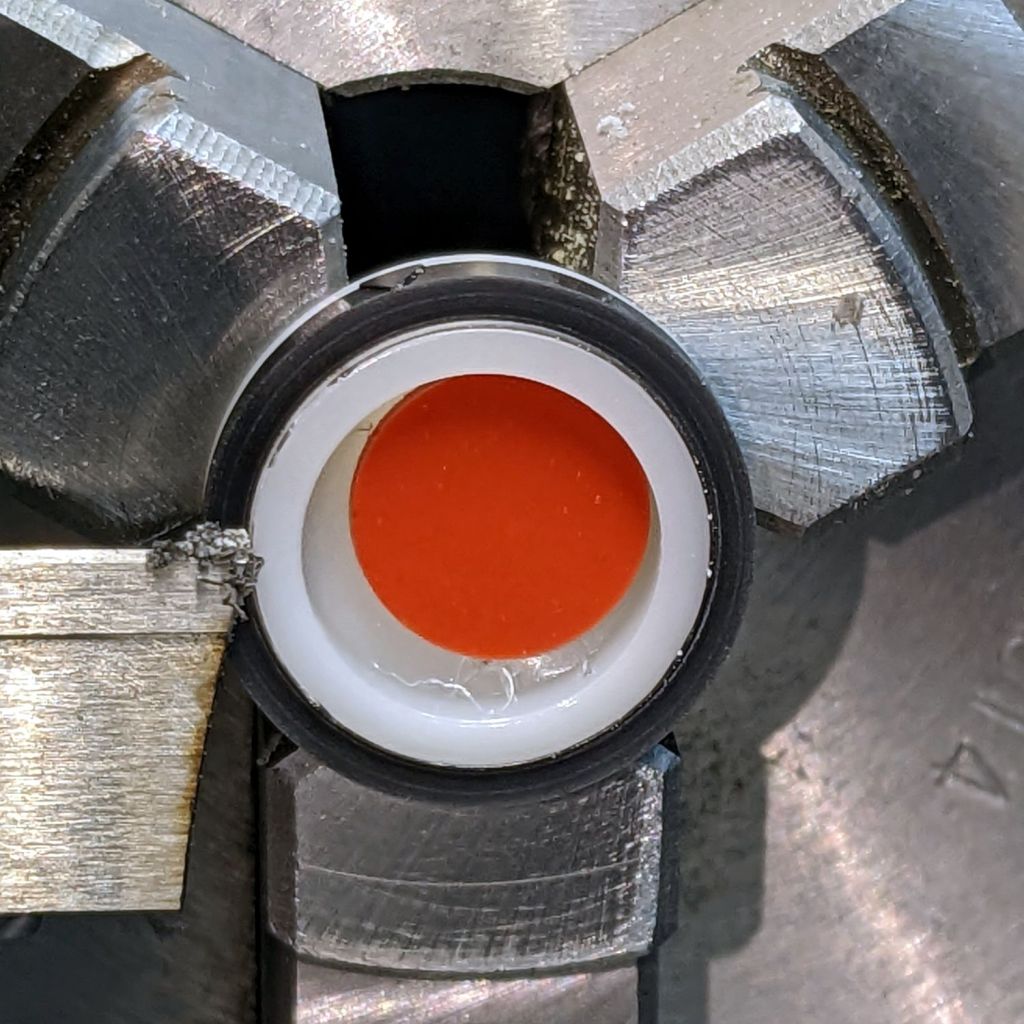
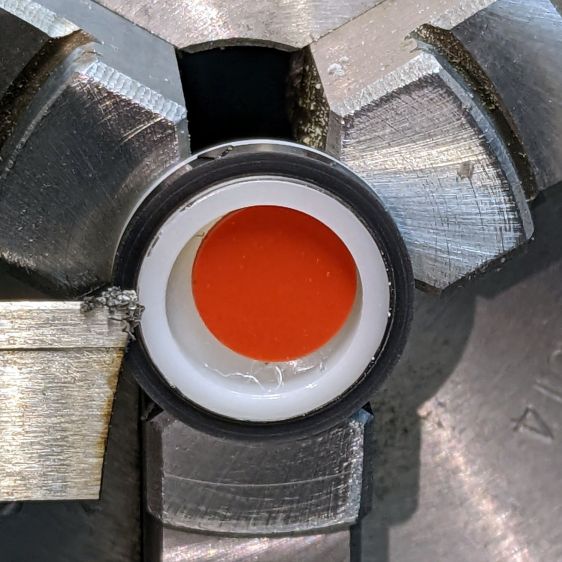
    Which is just the Sherline 4-jaw chuck chucked in the lathe’s 3-jaw chuck, with both chuck Jaw 1 positions lined up and marked on the acrylic disk fixture. The picture is a recreation set up after the fact, because I lack a good picture of the overall scene.

    Now it’s easy enough to center the fixture, stick the coaster in place with reasonable accuracy, then tweak the Sherline chuck to center the coaster:

    Coaster Epoxy Rim - turning setup
    Coaster Epoxy Rim – turning setup

    Because the bottom layer is a laser-cut disk, eyeballometrically aligning its edge to a simple pointer worked surprisingly well:

    Coaster Epoxy Rim - locating mirror edge
    Coaster Epoxy Rim – locating mirror edge

    Turning the OD down to match the bottom disk meant I could finally get decent results with zero drama:

    Coaster Epoxy Rim - turned samples
    Coaster Epoxy Rim – turned samples

    From the bottom, this one has a 3 mm mirror, the 3 mm fluorescent green frame + petals, and a 1.6 mm top sheet:

    Coaster Epoxy Rim - turned 6 petal mirror
    Coaster Epoxy Rim – turned 6 petal mirror

    This one has a 3M double-sided tape with low-surface-energy adhesive layers between the mirror and the fluorescent blue frame + petal, with epoxy between the top layer and the frame.

    Coaster Epoxy Rim - turned 4 petal
    Coaster Epoxy Rim – turned 4 petal

    If I never tell anybody, they’ll think the slightly granular look of the tape was deliberate; it looks OK to me.

    And, for completeness, the crash test dummy from the start of this adventure:

    Coaster Epoxy Rim - turned 6 petal black
    Coaster Epoxy Rim – turned 6 petal black

    I don’t know how to avoid the bubbles, as the usual torch-the-top and pull-a-vacuum techniques pop bubbles at the epoxy-air interface. These bubbles are trapped under the top acrylic sheet, even though I was rather painstaking about easing the layer down from one side to the other while chasing bubbles along.

    Maybe I can define bubbles as Part of the Art?

    Definitely fancier than chipboard, although not nearly as absorbent.

  • Acrylic Coasters: Edge Finishing, Round 3

    Acrylic Coasters: Edge Finishing, Round 3

    Although I could turn the coaster fixture’s OD, the lathe jaws are slightly longer than the fixture is thick:

    Coaster Epoxy Rim - turning fixture rim
    Coaster Epoxy Rim – turning fixture rim

    So the fixture needs a spacer:

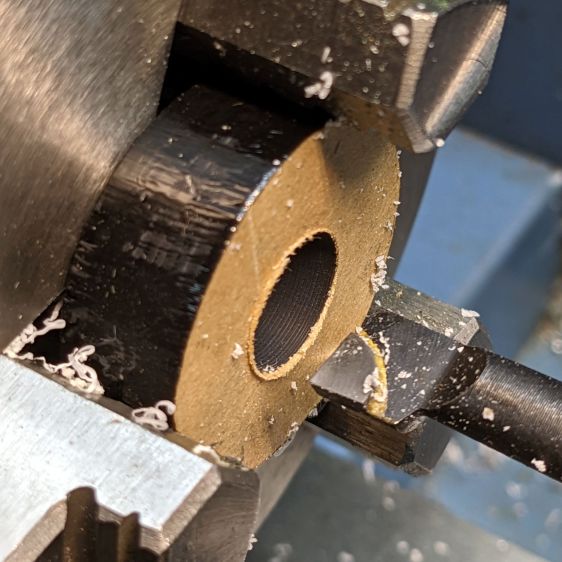
    Coaster Epoxy Rim - cutting chuck spacer
    Coaster Epoxy Rim – cutting chuck spacer

    The ID is bigger and the OD is smaller than the fixture, so it won’t get in the way of further proceedings:

    Coaster Epoxy Rim - 3-jaw lathe setup
    Coaster Epoxy Rim – 3-jaw lathe setup

    The pad on the live center came from the cookie cut from the fixture, with a just slightly off-center 3 mm hole poked into it to hold the point away from the coaster.

    A ring of carpet tape on the fixture provides traction holding the coaster in place:

    Coaster Epoxy Rim - carpet tape
    Coaster Epoxy Rim – carpet tape

    That turned out to be more trouble than it was worth; scissoring a pair of strips to fit the OD works just fine.

    In any event, the live center applies enough pressure to keep the adhesive happy.

    The fixture disk is sacrificial, so it now has a notch around its front face where the cutter cleared the coaster.

    Although I intended to shim the fixture against the chuck jaws to center the coaster, my first attempt at manually centering the thing on the fixture was Close Enough™ that I just turned the OD to see how well the whole process worked:

    Coaster Epoxy Rim - turned 6 petal black
    Coaster Epoxy Rim – turned 6 petal black

    The edge finish is arguably not Good Enough™, but it looks much better in person. In particular, the difference between the transparent acrylic top layer and the black acrylic frame around the petals is much more prominent in the photo, perhaps due to scatter from the overhead desk light.

    This was the original crash test dummy acrylic coaster, so more care will be in order for the next set. In particular, shimming the fixture requires removing and replacing it for each adjustment, which can easily become a non-converging process.

    Next up: I like little chucks

  • Acrylic Coasters: Edge Finishing, Round 2

    Acrylic Coasters: Edge Finishing, Round 2

    Because the Sherline mill can’t cut all the way around a 4 inch OD coaster clamped to its table, I set up the 4-jaw chuck on the rotary table and centered the nicely round fixture:

    Coaster Epoxy Rim - centering fixture plate
    Coaster Epoxy Rim – centering fixture plate

    Admittedly, the centering need not be so precise, but practice makes perfect.

    A few strips of double-stick tape affixed the test coaster, with too many clamps applied to settle it in place:

    Coaster Epoxy Rim - Sherline clamp setup
    Coaster Epoxy Rim – Sherline clamp setup

    A few sissy cuts demonstrated the tape lacked sufficient stickiness to hold the coaster in place against the milling cutter’s uplift. I managed to mill most of the perimeter with those clamps in place, moving each one from just ahead of the cutter to just behind the cutter.

    That way lies both madness and organic damage.

    There are better tapes and better adhesives, all trading off a really sticky fixture against difficulty extracting an undamaged part.

    A more complex circular fixture with built-in mechanical edge clamps extending around a major part of the perimeter seems like entirely too much of a diversion for a couple of obscene-gerund coasters.

    A live center in a lathe tailstock applies pressure in exactly the right place to hold a circular object against a fixture while slicing off the entire perimeter, with the only problem being centering the object.

    Maybe shimming the fixture against one chuck jaw will suffice?