Ed Nisley's Blog: Shop notes, electronics, firmware, machinery, 3D printing, laser cuttery, and curiosities. Contents: 100% human thinking, 0% AI slop.
Tag: Improvements
Making the world a better place, one piece at a time
I just figured out how to use the WordPress “sourcecode” formatting and applied it to my software-related posts. It produces much nicer results than the manual formatting I was using, mostly by preventing long lines from jamming into the right column.
The catch: WordPress imposes a round trip from my original text to the screen encoding and back, which sometimes randomly mangles special symbols. Angle brackets and double-quotes, in particular, take serious damage.
If you happen to remember a favorite chunk of code in a previous post, please take a look at it and see if I missed any of the obvious text-replacement errors. Trawling through the Software category should turn up most of the posts.
As is always the case with program listings, the errors will be really obvious to everyone except me.
Just refilled the continuous-flow ink tanks on my Epson R380 for the first time this year.
In milliliters:
Yellow 35
Light Magenta 40
Magenta 40
Light Cyan 40
Cyan 40
Black 50
Done in that order, the whole process requires only three syringe cleanings.
I haven’t checked lately, but the last time I worked it out, printer ink cost $1.80/ml. Let’s call it $2 nowadays, which means I just squirted nigh onto 500 bucks worth of ink into those tanks.
Much of that seems to go into head cleaning, as I don’t print that many photo-quality images on it. Nevertheless, they don’t charge you any less for ink that winds up in the diaper inside the printer.
I don’t keep track of the ink going into the refillable tanks on my Canon S630, but it’s the same order of magnitude. I have four trios of color tanks and six black tanks for that printer and refill them all when the last set runs low. I’ve been doing that for years with no printhead issues.
Sooo, for not spending a kilobuck a year on ink cartridges, I’m willing to spend 100 bucks for bulk ink, undergo some hassle, and endure the occasional oddly colored thumb…
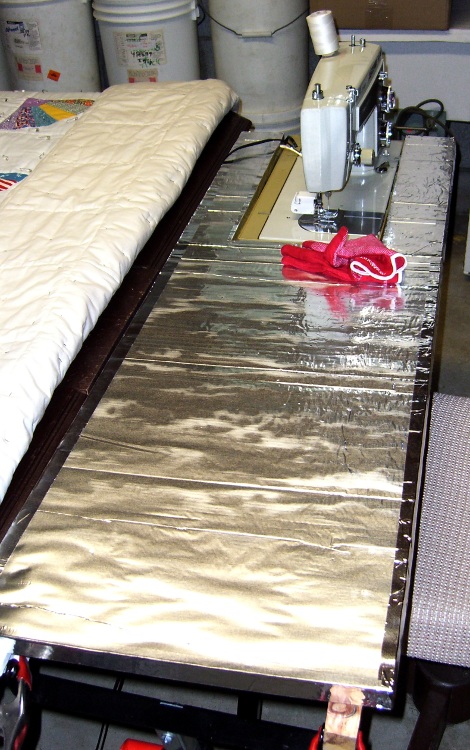
Mary has been quilting up a storm lately and wanted a larger surface to handle a bed-sized quilt. A table in the basement was big enough, but she wanted a larger flat surface around the sewing machine adjacent to the table.
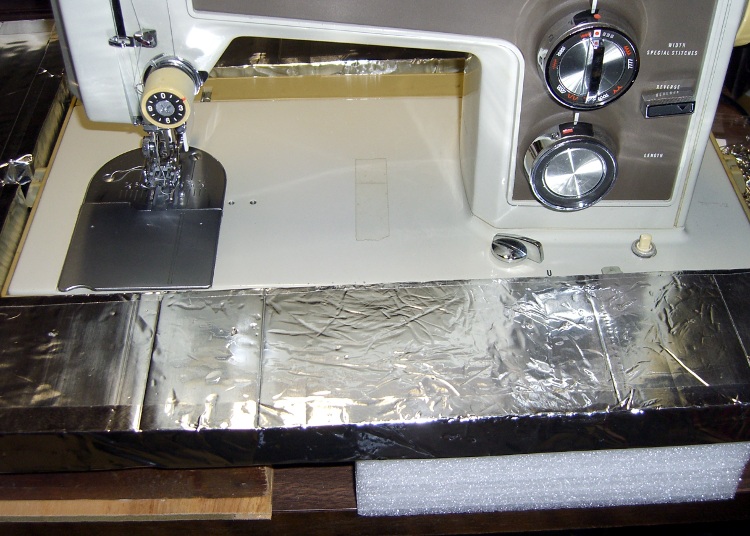
I converted the typing return (*) from her upstairs desk into a table, then cut a piece of aluminum-clad 1-inch foam insulation board to fit. It’s 4 feet long, a convenient length to cut from the 4×8-foot insulation board, and slightly narrower than the typing return. Cutting it required a long X-Acto knife blade, but a really sharp utility knife would work as well.
Some stainless-steel tape finished off the edges. The tape itself is lethally sharp-edged, but it’s perfectly harmless if you do a good job of smoothing it against the foam board…
A pair of closed-cell rigid foam blocks held one end of the board at the proper height around the sewing machine, while a pair of cutoffs from the wood pile were just the right thickness & length to extend under the other end. It turns out that precise height isn’t nearly as vital as we expected; close enough is fine.
I cannibalized a pair of table-saw feed roller stands for this project; they had just the right height adjustment and shape to support the typing return and the foam board.
The end result aligns the surface of the sewing machine with both the top of the table and the surface of the foam board. The quilt slides easily over the whole affair and doesn’t bunch up like it did before. Success!
Foam support blocks
(*) A “typing return” is the little table that sticks out from a desk, upon which you put a typewriter, back in the day when typewriters ruled the land. Nowadays, she uses it for her sewing machine, which normally lives at her desk, because there’s no practical way to type at right angles to one’s desk.
That’s the sort of item you can’t do web searches for, because all the terms are so heavily overloaded. Give it a try; you’ll find one or two useful hits. There’s a difference between syntax and semantics; we’re not in the semantic web yet by long yardage.
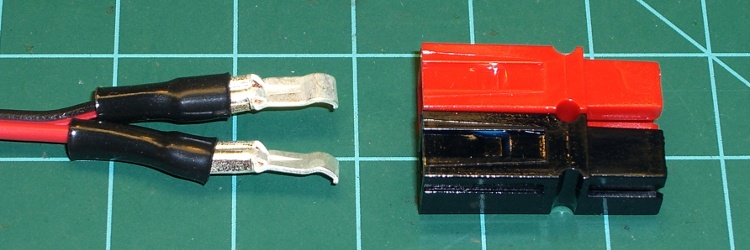
This is quick & easy. When you’re making a Powerpole connector, shrink a length of small heatshrink tubing over the end of the terminal after crimping.
Heatshrink tubing stress relief for Anderson Powerpole terminals
You can’t cover the entire crimped region, lest the terminal not snap into the housing, but halfway seems to work fine.
The goal is to keep the wires from flexing right at the end of the terminal, which is exactly where they’ll break.
I’ve also wrapped a length of self-vulcanizing rubber tape around the entire connector housing and the wire, which is appropriate for high-stress applications. Looks hideous, though, not that that matters much.
A new fast NiMH pack charger that uses a thermistor to detect the abrupt temperature rise at full charge just arrived on my Electronics Workbench. The instructions say to tape (“Use rubberized fabric …”) the thermistor to a cell in the middle of the pack, a process which loses its charm fairly quickly.
The intent is to have the thermistor bead in intimate thermal contact with the cell, but air is a rather crappy thermal conductor. We can do better than that.
Sooo, off to the Basement Laboratory Adhesives Division we go…
NiMH cells have a steel shell, so holding the sensor in place with a magnet makes at least some sense. I used a pair of teeny rare-earth magnets (Electronic Goldmine G16913) bridged by a snippet of steel strap. One magnet points up, the other points down, the strap provides a magnetic path, and the whole assembly sticks to the cell like glue.
First epoxy setup
I trimmed the heatshrink tubing surrounding the thermistor back a bit, then applied enough epoxy to secure the magnets to the strap and smooth out the edges, leaving the thermistor sticking out in mid-air.
Although it looks risky, the epoxy doesn’t bond well to the (sacrificial, dead) cell. Doing it this way produces a nearly perfect AA-cell-shaped contour in the epoxy on the bottom of the magnets.
It’s JB-Kwik fast-curing epoxy, not quite so runny as its slower-setting and much stronger JB-Weld relative.
Epoxy covering thermistor
After the epoxy cured, I bent the thermistor down to contact the cell and dabbed epoxy over the bead. This puts the thermistor in good thermal contact with the cell. Epoxy isn’t a great thermal conductor, but it’s a lot better than air.
The alert reader will note that I wrapped a layer of masking tape around the cell for this operation. I wasn’t convinced I could pop the epoxy off the cell without cracking the thermistor leads, but that turned out not to be a problem.
Trimming the edges of the epoxy around the bead gave it a certain geeky charm.
And it works like a champ: get the assembly close to a cell and it snaps right in place. I align the thermistor more-or-less in the middle of the cell, although I suspect the temperature gradient from the middle to either end isn’t all that large.
Magnetically attached thermal sensor
Now, one could argue that this lump increases the thermal mass surrounding the thermistor, thus slowing the charger’s reaction time. That might be true, but the pack’s end-of-charge temperature rise seems considerably subdued now; the charger used to cook the living piss right out of the cells (with the thermistor taped down): I couldn’t hold them in my hand, so they were well over 150 °F.
Now they become just uncomfortably warm, which says they’re closer to 130 °F.
The charger’s single page instructions (two pages if you count the sheet illustrating the rubberized fabric taping thing) cautions “Stop charging when [the cell’s surface temperature] is over 70C or it feels very hot”.
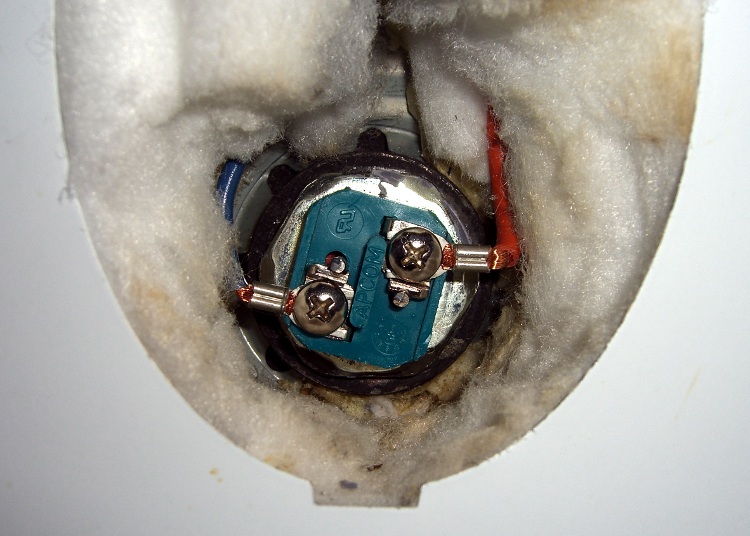
Removing a water heater element is no big deal: apply the appropriate socket (1-1/2 inch for this heater) to the hex head and turn it out. The trouble comes during installation, when you must hold that long rod exactly horizontal inside the tank, gripping the electrical fittings inside a narrow access port amid all the insulation.
My fingers can’t hold the element horizontal and twist it at the same time, so I made a tool: cross-threading the heating element and goobering the threads in the tank port is not an option!
Improvised heating element installation tool
A 32 mm socket just cleared the square blue electrical insulation block and butted against the 1-1/2 inch hex head. Because the block is square and the socket is hex, it was a pretty loose fit, but this was the right general idea.
I put a layer of masking tape on the inside of the socket and covered the electrical connections on the element.
Then I mixed up a batch of Bondo auto-body repair epoxy, buttered up the end of the heating element, and gooshed it into the socket. The Bondo filled in the gaps between hex and square, turning the wrench into a custom-fit tool that firmly gripped the heating element.
Reinstalled heating element
A brief pause for Bondo curing, pop an extension into the socket to use as a handle, return to the water heater, and screw that sucker right in place. Worked like a charm!
There’s a flexible gasket sealing the element to the tank port and I gave the element a few degrees more twist when I tightened it up, so the insulation block isn’t neatly aligned.
Getting the socket off wasn’t too difficult: twist to the side, pull, and the Bondo pops off the masking tape. Peel the tape off the element and it looks pretty much like it did before. The Bondo fell out of the socket when the element came out, so that was easy enough.
I was busy getting the water heat back in action and didn’t take any detailed pix, but I think you get the idea…
For obscure reasons, I have a pair of headsets attached to the PC: one USB that’s used for phone calls and one plugged into a sound card for everything else.
They’ve been cluttering up the corner of the desk for far too long, so I bent up a rack from a surplus coat hanger. Nothing critical, as long as it’s tall enough to hold the mics off the desk and wide enough they don’t clunk together.
The trick is to just drill a hole in the top of the desk and poke the end of the rod into it. That works because my desk has a notch along the edge just exactly the right width to hide the hole!
Hanger Mounted Under Desk
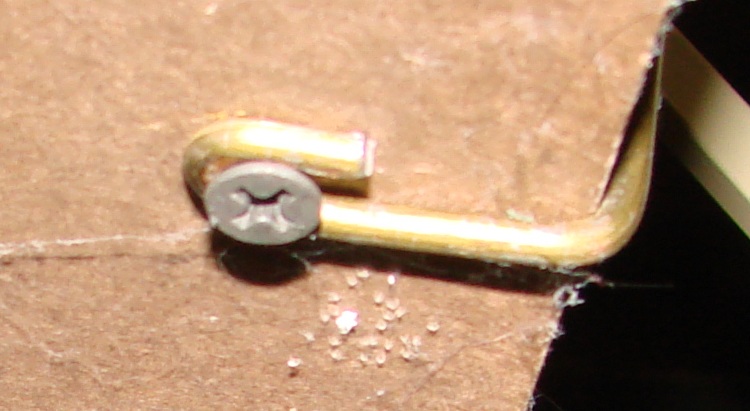
Maybe you don’t want to do this to the top of your desk, in which case maybe you can bend the hanger around the edge and put a screw in the bottom or the desktop. If you don’t look under there very often, the spiders will take over; this one is from the basement desk that I haven’t used for far too long.
Details of the hanger, not that you can’t figure it out on your own:




 The Smell of Molten Projects in the Morning