The Smell of Molten Projects in the Morning

Ed Nisley's Blog: Shop notes, electronics, firmware, machinery, 3D printing, laser cuttery, and curiosities. Contents: 100% human thinking, 0% AI slop.

Tag: Improvements

Making the world a better place, one piece at a time

  • Optiplex 9010: Xsetwacom vs. Dual Monitors

    Having replaced the Dell Optiplex 980 (running from an eBay NOS power supply) with an off-lease Optiplex 9010, I was mildly surprised to find two Displayport outputs from the built-in Intel graphics chipset. Not being a gamer, I don’t care much about graphic performance, but plugging two 2560×1440 monitors into the jacks and having them Just Work was delightful. Indeed, Dell even managed to fix work around the error in the U2711  firmware requiring me to power-cycle the damned thing before booting the PC; now I can just turn the PC on and It Just Works.

    Mysteriously, the incantation required to limit the Wacom tablet to the left-hand landscape monitor now uses DP1 instead of HEAD-0:

    xsetwacom --verbose set "Wacom Graphire3 6x8 stylus" MapToOutput "DP1"
    xsetwacom --verbose set "Wacom Graphire3 6x8 eraser" MapToOutput "DP1"
    #xsetwacom --verbose set "Wacom Graphire3 6x8 Pen stylus" MapToOutput "HEAD-0"
    #xsetwacom --verbose set "Wacom Graphire3 6x8 Pen eraser" MapToOutput "HEAD-0"
    

    I’ll leave the “HEAD-0 incantations as comments, so as to have a hint the next time …

  • Raspberry Pi vs. Music via NFS

    Every now & again, streaming music from distant servers fails, for no reason I can determine. In that situation, it would be nice to have a local source and, as mplayer works just fine when aimed at an MP3 file, I tried to set up a USB stick on the ASUS router.

    That requires getting their version of SAMBA working with the Raspbian Lite installed on the streaming players. After screwing around for far too long, I finally admitted defeat, popped the USB stick into the Raspberry Pi running the APRS iGate in the attic stairwell, and configured it as an NFS server.

    To slightly complicate the discussion, there’s also a file server in the basement which turns itself off after its nightly backup. The local music files must be available when it’s off, so the always-up iGate machine gets the job.

    On the NFS server:

    Install rpcbind and nfs-common, both of which should already be included in stock Raspbian Lite, and nfs-kernel-server, which isn’t. There were problems with earlier Raspbian versions involving the startup order which should be history by now; this post may remind me what’s needed in the event the iGate NFS server wakes up dead after the next power blink.

    Set up /etc/exports to share the mount point:

    /mnt/music	*(ro,async,insecure,no_subtree_check)
    # blank line so you can see the underscores in the previous one
    

    Plug in the USB stick, mount, copy various music directories from the file server’s pile o’ music to the stick’s root directory.

    Create a playlist from the directory entries and maybe edit it a bit:

    ls -1 /mnt/part/The_Music_Directory > playlist.tmp
    sed 's/this/that/' < playlist.tmp > playlist.txt
    rm playlist.tmp
    

    Tuck the playlist into the Playlists directory on the basement file server, from whence the streamer’s /etc/rc.local will copy the file to its local directory during the next boot.

    On every streamer, create the /mnt/music mountpoint and edit /etc/rc.local to mount the directory:

    nfs_music=192.168.1.110
    <<< snippage >>>
    mount -v -o ro $nfs_music:/mnt/music /mnt/music
    # blank line so you can see the underscores in the previous one 

    In the Python streaming program on the file server, associate the new “station” with a button:

             'KEY_KP8'   : ['Newname',False,['mplayer','-shuffle','-playlist','/home/pi/Playlists/playlist.txt']],
    

    The startup script also fetches the latest copy of the Python program whenever the file server is up, so the new version should Just Work.

    I set the numeric keypad button associated with that program as the fallback in case of stream failures, so when the Interwebs go down, we still have music. Life is good …

  • Vacuum Tube LEDs: Mogul Bulb Side Light

    The knockoff Neopixel on the 500 W mogul-base bulb failed in the usual way, so I rebuilt it with an SK6812 RGBW LED in a round cap:

    Mogul lamp socket - SK6812 LED side cap
    Mogul lamp socket – SK6812 LED side cap

    The nice 1-¼ inch stainless socket-head cap screws replace the 1 inch pan-head screws that engaged maybe one thread due to the additional spacer between the USB port and the upper hard drive platter I added for good looks.

    I tried a few iterations of an aluminized Mylar (*) disk with various sized pinholes over the RGB trio to crisp up the filament shadow, because the SK6812 LED casts a more diffuse light than the W2812 LEDs:

    Aluminized Mylar pinholes for SK6812 RGBW LED
    Aluminized Mylar pinholes for SK6812 RGBW LED

    Even the ⅛ inch pinhole made the bulb too dim, so I settled for a fuzzy shadow:

    500 W Mogul bulb - SK6812 RGBW LED - no pinhole - green phase
    500 W Mogul bulb – SK6812 RGBW LED – no pinhole – green phase

    The firmware has a tweak forcing the white LED to PWM=0, because this bulb looks better in saturated colors.

    (*) Here on earth, aluminized Mylar is nonconductive.

  • Tour Easy Daytime Running Light

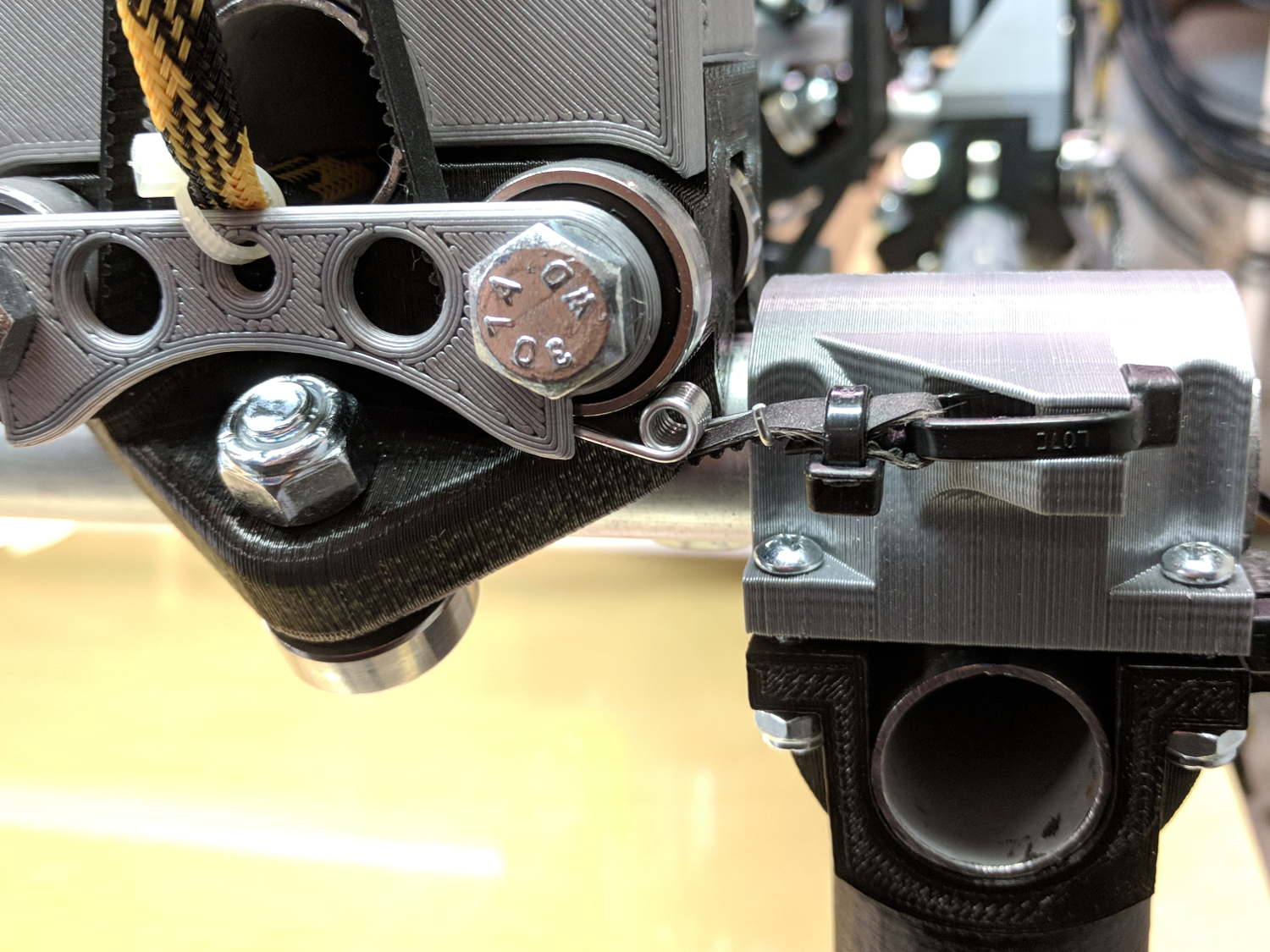
    Pending more test rides, the flashlight fairing mount works well:

    Tour Easy Fairing Flashlight Mount - front overview
    Tour Easy Fairing Flashlight Mount – front overview

    Despite all my fussing with three rotational angles, simply tilting the mount upward by 20° with respect to the fairing clamp aims the flashlight straight ahead, with the ball nearly centered in the clamp:

    Tour Easy Fairing Flashlight Mount - front detail
    Tour Easy Fairing Flashlight Mount – front detail

    That obviously depends on the handlebar angle and the fairing length (which affects the strut rotation), but it’s close enough to make me think a simpler mount will suffice: clamp the flashlight into a cylinder with a slight offset angle, maybe 2°, then mount the cylinder into a much thinner ring clamp at the 20° tilt. Rotating the cylinder would give you some aim-ability, minus the bulk of a ball mount.

    Or dispense with the separate cylinder, build the entire mount at the (now known) aim angle, clamp the flashlight directly into the mount, then affix mount to fairing strut. Rapid prototyping FTW!

    For now, it’s great riding weather …

    The OpenSCAD source code as a GitHub Gist:

    // Tour Easy Fairing Flashlight Mount
    // Ed Nisley KE4ZNU – July 2017
    /* [Build Options] */
    FlashName = "AnkerLC40"; // [AnkerLC40,AnkerLC90,J5TactV2,InnovaX5]
    Component = "Mount"; // [Ball, BallClamp, Mount, Plates, Bracket]
    Layout = "Show"; // [Build, Show]
    Support = false;
    MountSupport = true;
    /* [Extrusion] */
    ThreadThick = 0.25; // [0.20, 0.25]
    ThreadWidth = 0.40; // [0.40]
    function IntegerMultiple(Size,Unit) = Unit * ceil(Size / Unit);
    Protrusion = 0.01; // [0.01, 0.1]
    HoleWindage = 0.2;
    /* [Fairing Mount] */
    ToeIn = 0; // inward from ahead
    Tilt = 20; // upward from forward
    Roll = 0; // outward from top
    Shift = -5; // realign to plate center
    //- Screws *c
    /* [Hidden] */
    ID = 0;
    OD = 1;
    LENGTH = 2;
    /* [Screws and Inserts] */
    BallInsert = [2.0,3.5,4.0];
    BallScrew = [2.0,3.5,2.0];
    ClampInsert = [3.0,4.2,8.0];
    ClampScrew = [3.0,5.9,50.0]; // thread dia, head OD, screw length
    ClampScrewWasher = [3.0,6.75,0.5];
    ClampScrewNut = [3.0,6.1,4.0]; // nyloc nut
    /* [Hidden] */
    F_NAME = 0;
    F_GRIPOD = 1;
    F_GRIPLEN = 2;
    LightBodies = [
    ["AnkerLC90",26.6,48.0],
    ["AnkerLC40",26.6,55.0],
    ["J5TactV2",25.0,30.0],
    ["InnovaX5",22.0,55.0]
    ];
    NumSides = 8*4;
    echo(str("Flashlight: ",FlashName));
    FlashIndex = search([FlashName],LightBodies,1,0)[F_NAME];
    BallThick = IntegerMultiple(5.0,ThreadWidth); // thickness of ball wall
    echo(str("Ball wall: ",BallThick));
    BallOD = max(45,IntegerMultiple(LightBodies[FlashIndex][F_GRIPOD] + 2*(BallThick + BallInsert[OD]),2.0));
    echo(str(" OD: ",BallOD));
    BallScrewOC = BallOD – BallThick – BallInsert[OD]; // from OD to allow different body diameters
    echo(str(" screw OC: ",BallScrewOC));
    BallLength = min(sqrt(pow(BallOD,2) – pow(LightBodies[FlashIndex][F_GRIPOD],2)),
    LightBodies[FlashIndex][F_GRIPLEN]);
    echo(str(" hole len: ",BallLength));
    ClampThick = 2*ClampInsert[OD];
    echo(str("Clamp wall: ",ClampThick));
    ClampOD = BallOD + 2*ClampThick;
    echo(str(" OD: ",ClampOD));
    ClampScrewOC = BallOD + 2*ClampInsert[OD];
    echo(str(" screw OC: ",ClampScrewOC));
    ClampLength = 0.70 * BallLength;
    echo(str(" length: ",ClampLength));
    //- Adjust hole diameter to make the size come out right
    module PolyCyl(Dia,Height,ForceSides=0) { // based on nophead's polyholes
    Sides = (ForceSides != 0) ? ForceSides : (ceil(Dia) + 2);
    FixDia = Dia / cos(180/Sides);
    cylinder(r=(FixDia + HoleWindage)/2,h=Height,$fn=Sides);
    }
    //- Ball around flashlight
    // Must print two!
    module BodyBall() {
    difference() {
    intersection() {
    sphere(d=BallOD,$fn=2*NumSides); // basic ball
    cube([BallLength,2*BallOD,2*BallOD],center=true); // max of flashlight grip length
    }
    translate([-LightBodies[FlashIndex][F_GRIPOD],0,0])
    rotate([0,90,0]) rotate(180/NumSides)
    PolyCyl(LightBodies[FlashIndex][F_GRIPOD],2*BallOD,NumSides); // flashlight body
    for (j=[-1,1])
    translate([0,j*BallScrewOC/2,0]) // commmon screw offset
    translate([0,0,-BallOD])
    PolyCyl(BallInsert[ID],2*BallOD,6); // punch screw shaft through everything
    translate([0,BallScrewOC/2,-Protrusion])
    PolyCyl(BallInsert[OD],(BallInsert[LENGTH] + 3*ThreadThick + Protrusion),6); // threaded insert
    translate([0,-BallScrewOC/2,BallThick])
    PolyCyl(BallScrew[OD],BallOD,6); // screw head clearance
    translate([0,0,-BallOD/2]) // remove bottom half
    cube(BallOD,center=true);
    translate([0,0,BallOD – BallThick/2]) // slice off top = bottom for E-Z build
    cube(BallOD,center=true);
    }
    if (Support) {
    NumRibs = 24;
    RibHeight = (BallOD – LightBodies[FlashIndex][F_GRIPOD]/cos(180/NumSides) – BallThick) / 2;
    ChordC = 2*sqrt(BallThick*BallOD/2 – pow(BallThick/2,2));
    intersection() {
    cube([BallLength,2*BallOD,2*BallOD],center=true); // max of flashlight grip length
    translate([0,0,BallOD/2 – BallThick/2])
    for (i=[0:NumRibs – 1])
    rotate(i*360/NumRibs + 180/NumRibs) // avoid screw holes
    translate([ChordC/2 + BallOD/8,0,-RibHeight/2])
    cube([BallOD/4,2*ThreadWidth,RibHeight],center=true);
    }
    }
    }
    //- Fairing Bracket
    // Magic numbers taken from the actual fairing mount
    // Centered on screw hole
    /* [Hidden] */
    inch = 25.4;
    BracketHoleOD = 0.25 * inch; // 1/4-20 bolt holes
    BracketHoleOC = 1.0 * inch; // fairing hole spacing
    // usually 1 inch, but 15/16 on one fairing
    Bracket = [48.0,16.3,3.6 – 0.6]; // fairing bracket end plate overall size
    BracketHoleOffset = (3/8) * inch; // end to hole center
    BracketM = 3.0; // endcap arc height
    BracketR = (pow(BracketM,2) + pow(Bracket[1],2)/4) / (2*BracketM); // … radius
    module Bracket() {
    linear_extrude(height=Bracket[2],convexity=2)
    difference() {
    translate([(Bracket[0]/2 – BracketHoleOffset),0,0])
    offset(delta=ThreadWidth)
    intersection() {
    square([Bracket[0],Bracket[1]],center=true);
    union() {
    for (i=[-1,0,1]) // middle circle fills gap
    translate([i*(Bracket[0]/2 – BracketR),0])
    circle(r=BracketR);
    }
    }
    circle(d=BracketHoleOD/cos(180/8),$fn=8); // dead center at the origin
    }
    }
    //- General plate shape
    // Centered on the hole for the fairing bracket
    Plate = [100.0,30.0,6*ThreadThick + Bracket[2]];
    PlateRad = Plate[1]/4;
    echo(str("Base plate thick: ",Plate[2]));
    module PlateBlank() {
    difference() {
    translate([BracketHoleOC,0,0])
    intersection() {
    translate([0,0,Plate[2]/2]) // select upper half of spheres
    cube(Plate,center=true);
    hull()
    for (i=[-1,1], j=[-1,1])
    translate([i*(Plate[0]/2 – PlateRad),j*(Plate[1]/2 – PlateRad),0])
    resize([2*PlateRad,2*PlateRad,2*Plate[2]])
    sphere(r=PlateRad); // nice rounded corners!
    }
    translate([2*BracketHoleOC,0,-Protrusion]) // screw holes
    PolyCyl(BracketHoleOD,2*Plate[2],8);
    translate([0,0,-Protrusion])
    PolyCyl(BracketHoleOD,2*Plate[2],8);
    }
    }
    //- Inner plate
    module InnerPlate() {
    difference() {
    PlateBlank();
    translate([0,0,Plate[2] – Bracket[2] + Protrusion]) // punch out fairing bracket
    Bracket();
    }
    }
    //- Clamp around flashlight ball
    module BallClamp() {
    BossLength = ClampScrew[LENGTH] – ClampScrewNut[LENGTH] – 2*ClampScrewWasher[LENGTH] – 4*ThreadThick;
    difference() {
    union() {
    intersection() {
    sphere(d=ClampOD,$fn=NumSides); // exterior ball blamp
    cube([ClampLength,2*ClampOD,2*ClampOD],center=true); // aiming allowance
    }
    for (i=[0])
    hull() {
    for (j=[-1,1])
    translate([i*(ClampLength/2 – ClampScrew[OD]),j*ClampScrewOC/2,-BossLength/2])
    rotate(180/8)
    cylinder(d=(ClampScrewWasher[OD] + 2*ThreadWidth),h=BossLength,$fn=8);
    }
    }
    sphere(d=(BallOD + 1*ThreadThick),$fn=NumSides); // interior ball
    for (i=[0] , j=[-1,1]) {
    translate([i*(ClampLength/2 – ClampScrew[OD]),j*ClampScrewOC/2,-ClampOD]) // screw clearance
    rotate(180/8)
    PolyCyl(ClampScrew[ID],2*ClampOD,8);
    }
    }
    color("Yellow")
    if (Support) { // ad-hoc supports for top half
    NumRibs = 6;
    RibLength = 0.5 * BallOD;
    RibWidth = 1.9*ThreadWidth;
    SupportOC = ClampLength / NumRibs;
    cube([ClampLength,RibLength,4*ThreadThick],center=true); // base plate for adhesion
    intersection() {
    sphere(d=BallOD – 0*ThreadWidth); // cut at inner sphere OD
    cube([ClampLength + 2*ThreadWidth,RibLength,BallOD],center=true);
    union() { // ribs for E-Z build
    for (j=[-1,0,1])
    translate([0,j*SupportOC,0])
    cube([ClampLength,RibWidth,1.0*BallOD],center=true);
    for (i=[0:NumRibs]) // allow +1 to fill the far end
    translate([i*SupportOC – ClampLength/2,0,0])
    rotate([0,90,0])
    cylinder(d=BallOD – 2*ThreadThick,
    h=RibWidth,$fn=NumSides,center=true);
    }
    }
    }
    }
    //- Mount between fairing plate and flashlight ball
    module Mount() {
    translate([-BracketHoleOC,0,0])
    PlateBlank();
    translate([Shift,0,ClampOD/2])
    rotate([-Roll,ToeIn,Tilt])
    intersection() {
    translate([0,0,-ClampOD/2])
    cube([2*ClampOD,2*ClampOD,ClampOD],center=true);
    BallClamp();
    }
    if (MountSupport) { // anchor outer corners during worst overhang
    RibWidth = 1.9*ThreadWidth;
    SupportOC = 0.1 * ClampLength;
    difference() {
    rotate([0,0,Tilt])
    translate([Shift + 0.3,0,0])
    for (i=[-4.5,-2.5,0,2.0,4.5])
    translate([i*SupportOC – 0.0,0,(ClampThick + Plate[2])/2])
    cube([RibWidth,0.8*ClampOD,(ClampThick + Plate[2])],center=true);
    # translate([Shift,0,ClampOD/2])
    rotate([-Roll,ToeIn,Tilt])
    sphere(d=ClampOD – 2*ThreadWidth,$fn=NumSides);
    }
    }
    }
    //- Build things
    if (Component == "Ball")
    if (Layout == "Show")
    BodyBall();
    else if (Layout == "Build") {
    translate([0,+1*(BallOD/2 + BallThick/2),0])
    translate([0,0,BallOD/2 – BallThick/2])
    rotate([180,0,0])
    BodyBall();
    translate([0,-1*(BallOD/2 + BallThick/2),0])
    translate([0,0,BallOD/2 – BallThick/2])
    rotate([180,0,0])
    BodyBall();
    }
    if (Component == "BallClamp")
    if (Layout == "Show")
    BallClamp();
    else if (Layout == "Build") {
    Both = false;
    difference() {
    union() {
    translate([Both ? ClampLength : 0,0,0])
    BallClamp();
    if (Both)
    translate([-ClampLength,0,0])
    rotate([180,0,0])
    BallClamp();
    }
    translate([0,0,-ClampOD/2])
    cube([2*ClampOD,2*ClampOD,ClampOD],center=true);
    }
    }
    if (Component == "Mount")
    Mount();
    if (Component == "Plates") {
    translate([0,0.7*Plate[1],0])
    InnerPlate();
    translate([0,-0.7*Plate[1],0])
    PlateBlank();
    }
    if (Component == "Bracket")
    Bracket();
  • Tour Easy Daytime Running Light: Fairing Clamp Plates

    For reasons obvious to any cyclist, we must improve the forward conspicuity of our Tour Easy recumbents with a white daytime running light; a near-miss boosted this to the front of the project queue. While you can outfit a standard bike with a handlebar-mounted headlight (*), at any price from the sublime to the ridiculous, the smooth snout of a fully faired recumbent covers all the usual attachment points.

    A small LED flashlight tacked onto the fairing support bracket seems workable enough to make up for a significant case of ugly:

    Tour Easy - J5 Tactical V2 - front
    Tour Easy – J5 Tactical V2 – front

    That’s a J5 Tactical V2 flashlight on my bike.

    Mary’s bike has a tidier Anker LC40 in an earlier mount version:

    Tour Easy - Anker LC40 - front
    Tour Easy – Anker LC40 – front

    The Anker required an adapter to hold an 18650 cell in its 3xAAA-size body. The J5 V2 is resolutely 18650-only, which is fine with me.

    The intent here is to find out whether this works, figure out the proper aiming point(s), then de-bulk the mount.

    The next few posts will cover various bits & pieces of the design, because I must remember why I did things the way they turned out: sometimes the obvious choices didn’t work.

    The Zzipper fairing originally mounted to the strut across the handlebars with a single 1/4-20 nylon screw on each side. Even with a nylon washer on the outside, the stress concentration cracked the polycarbonate sheet around the screws and brackets, so I designed & printed flat ABS plates to spread the stress over a larger area:

    Fairing mount - inside
    Fairing mount – inside

    The tapered edges were supposed to be flexible, but the foam sheets sandwiched on both sides of the fairing actually provided most of the compliance. There’s another screw in the open hole binding the inner & outer plates together.

    The mounts worked perfectly, even as they faded over the years. The fairings became quite scuffed during the course of our near-daily rides, but, heck, we’re also a bit scuffed and it’s still all good.

    The new PETG inner plates seat on the bracket to nearly its full thickness:

    Tour Easy - Zipper fairing plate - inside
    Tour Easy – Zipper fairing plate – inside

    The flashlight on the outer plate applies torque around the bolt which (I hope) the sides of the recess can resist. This is the absolutely key part of the design and, I’m somewhat ashamed to admit, took me far too long to figure out. What you don’t want: weird & fragile gimcrackery clamped onto the strut extending under the fairing’s edge, with the flashlight hanging far off to the side.

    I modeled the fairing strut’s aluminum bracket as a 2D rectangle, plus a pair of chords, embiggened by a thread around the outside edge, minus the hole, then extruded to the proper height:

    //- Fairing Bracket
    // Magic numbers taken from the actual fairing mount
    // Centered on screw hole
    /* [Hidden] */
    inch = 25.4;
    BracketHoleOD = 0.25 * inch; // 1/4-20 bolt holes
    BracketHoleOC = 1.0 * inch; // fairing hole spacing
    // usually 1 inch, but 15/16 on one fairing
    Bracket = [48.0,16.3,3.6 – 0.6]; // fairing bracket end plate overall size
    BracketHoleOffset = (3/8) * inch; // end to hole center
    BracketM = 3.0; // endcap arc height
    BracketR = (pow(BracketM,2) + pow(Bracket[1],2)/4) / (2*BracketM); // … radius
    module Bracket() {
    linear_extrude(height=Bracket[2],convexity=2)
    difference() {
    translate([(Bracket[0]/2 – BracketHoleOffset),0,0])
    offset(delta=ThreadWidth)
    intersection() {
    square([Bracket[0],Bracket[1]],center=true);
    union() {
    for (i=[-1,0,1]) // middle circle fills gap
    translate([i*(Bracket[0]/2 – BracketR),0])
    circle(r=BracketR);
    }
    }
    circle(d=BracketHoleOD/cos(180/8),$fn=8); // dead center at the origin
    }
    }

    The hole isn’t strictly necessary, as I punch out both screw holes as part of the plate assemblies.

    The overall plate shape comes from the top half of a hull() wrapped around four squashed spheres:

    //- General plate shape
    // Centered on the hole for the fairing bracket
    Plate = [100.0,30.0,6*ThreadThick + Bracket[2]];
    PlateRad = Plate[1]/4;
    echo(str("Base plate thick: ",Plate[2]));
    module PlateBlank() {
    difference() {
    translate([BracketHoleOC,0,0])
    intersection() {
    translate([0,0,Plate[2]/2]) // select upper half of spheres
    cube(Plate,center=true);
    hull()
    for (i=[-1,1], j=[-1,1])
    translate([i*(Plate[0]/2 – PlateRad),j*(Plate[1]/2 – PlateRad),0])
    resize([2*PlateRad,2*PlateRad,2*Plate[2]])
    sphere(r=PlateRad); // nice rounded corners!
    }
    translate([2*BracketHoleOC,0,-Protrusion]) // screw holes
    PolyCyl(BracketHoleOD,2*Plate[2],8);
    translate([0,0,-Protrusion])
    PolyCyl(BracketHoleOD,2*Plate[2],8);
    }
    }

    Then the inner plate is just a plate blank stamped with the bracket:

    //- Inner plate
    module InnerPlate() {
    difference() {
    PlateBlank();
    translate([0,0,Plate[2] – Bracket[2] + Protrusion]) // punch out fairing bracket
    Bracket();
    }
    }

    You’ll need a set for the side of the fairing without the running light:

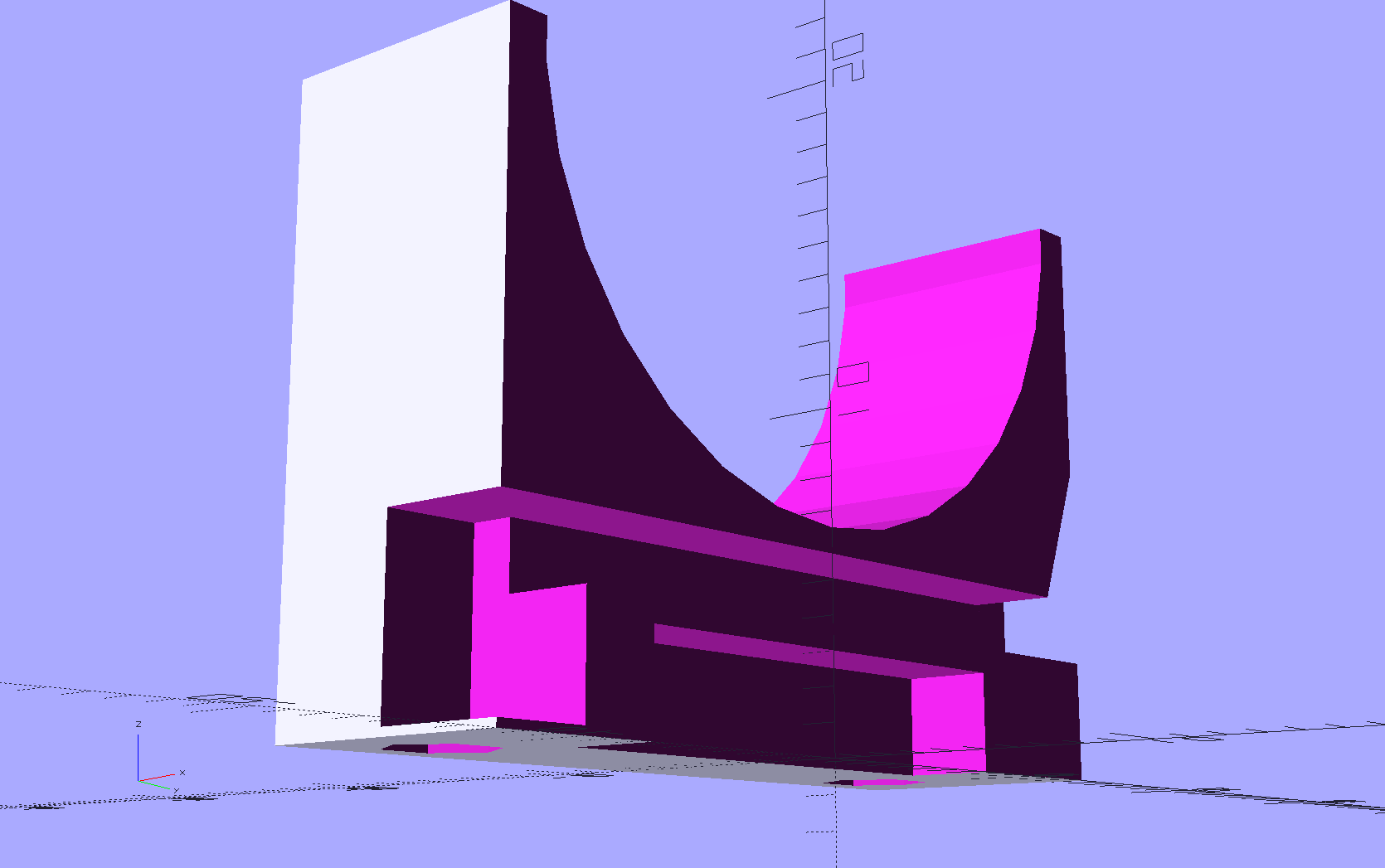
    Fairing Flashlight Mount - Plates - solid model
    Fairing Flashlight Mount – Plates – solid model

    The outer plate looks reasonably sleek in real life, although that’s not the primary consideration:

    Tour Easy - Zipper fairing plate - outside
    Tour Easy – Zipper fairing plate – outside

    You could replace the squared-off ends with simple half-circles, maybe stretched into stylin’ ellipse shapes, without too much effort.

    I got out the screws, set up to cut them with a pull saw and miter box, then realized they are plastic. Put away the saw, got out the utility knife, and cut them to length with one firm push. No distorted threads, no dust, no muss, no fuss.

    (*) Opinion: any headlight with non-replaceable, USB-chargeable cells is a toy. I can replace a discharged (or failed) 18650 cell in the middle of a ride, where a dead battery inside a spendy headlight would leave me in the dark. Might not matter for a DRL, but seems absolutely critical on night rides. ‘Nuff said.

  • Layout Pen For Black Objects

    This worked surprisingly well to lay out black foam gaskets for new fairing mounting plates:

    Black foam layout with ceramic fabric pen
    Black foam layout with ceramic fabric pen

    Mary uses the Fons & Porter Mechanical Pencil to mark quilting patterns on fabric. It has, they say, a “strong ceramic 0.9MM white lead” with “water-soluble dyes” capable of both laying down a durable mark and washing out without leaving a trace. I don’t care about the latter, of course, but it did brush off reasonably well.

    The next step involved running an X-Acto knife around the perimeter of the plate and punching the holes.

    You can get colored ceramic leads (for small values of color) for use on other backgrounds.

  • HP 7475A Plotter: Rebuilt Carousel Drive

    A followup to the saga of the HP 7475A plotter with a broken carousel drive:

    With the information you shared, we were able to successfully model and reconstruct the drive wheel in only a couple of days.

    One useful thing we discovered is there’s a lot of room for error – so long as the pin catches and the wheel isn’t slipping on the motor shaft, the mechanism will work. The grooves and the interior radius of the original part aren’t critical.

    Because of your heads up about Geneva wheels, I found this excellent website – https://newgottland.com/2012/01/08/make-geneva-wheels-of-any-size/ – which includes a link to a Geneva wheel calculator. With the measurements you sent and a measurement off of the pen carousel, the calculator generated near perfect dimensions for a replacement. There was a little sanding and rounding to fit but it was certainly within tolerance.

    Interestingly, the pieces of the drive wheel that I pulled out of the case revealed a small hidden detail. On the underside, there’s a collar around the motor shaft that gives the cam an extra ~.03″ thickness. Presumably this is to help reduce friction during travel. Our prototype doesn’t take this detail into consideration – we’ve had no issues with friction, and we compensated for the thickness by making the pin a little longer – but it’s meaningful to note.

    HP7475A Carousel Drive - cam1
    HP7475A Carousel Drive – cam1

    The broken pieces also confirmed the thicknesses and radii of the original part, and so my partner was able to build an accurate technical drawing of the drive wheel for future fabrication.

    While we intend to make a better replacement, our prototype was built with dense 1/8″ mat board, PVA glue, binder clips, and a short piece of wooden dowel from our bits box. Basically just stuff we had kicking around the studio. It’s held up shockingly well. A little dented around the edges from hitting the carousel, but there’s no slippage. I’m thinking I’ll use it until it falls apart, just to see how long it takes.

    HP7475A Carousel Drive - repaired - cam2
    HP7475A Carousel Drive – repaired – cam2

    Attached, find a technical drawing comparing the original drawing to our prototype (measured in good old fashioned 1980s inches); a photo of the retrieved piece, showing the collar on the reverse side; and a photo of the prototype in place. Feel free to share these – everyone deserves a working plotter!

    7475a drive wheel
    7475a drive wheel

    Once the carousel was working, my roommate – an electrical engineer – hooked me up with a custom serial cable, a Raspberry Pi, and a crash course in Python, so now that I can communicate with the plotter, the possibilities are staggering. I’m thrilled to add this machine to my print studio arsenal!

    I love a happy ending …

    For anyone with a new-to-you plotter, search the blog for 74754A to find info on replacing failed electrolytic capacitors, adapting Sakura Micron pens, refilling old plotter pens, building a serial cable, hacking Chiplotle to actually use hardware handshaking, and plotting Superformulas. Let me know how you got your plotter working!