The Smell of Molten Projects in the Morning

Ed Nisley's Blog: Shop notes, electronics, firmware, machinery, 3D printing, laser cuttery, and curiosities. Contents: 100% human thinking, 0% AI slop.

Tag: Gardening

Growing and sometimes fixing

  • Pixel 6a Camera Protector vs. Leaf Shredder Chaff

    Pixel 6a Camera Protector vs. Leaf Shredder Chaff

    Much of my exercise of late has come from blowing leaves into piles and shredding them:

    Leaf Shredding - GPS track
    Leaf Shredding – GPS track

    My GPS drawing hand is weak.

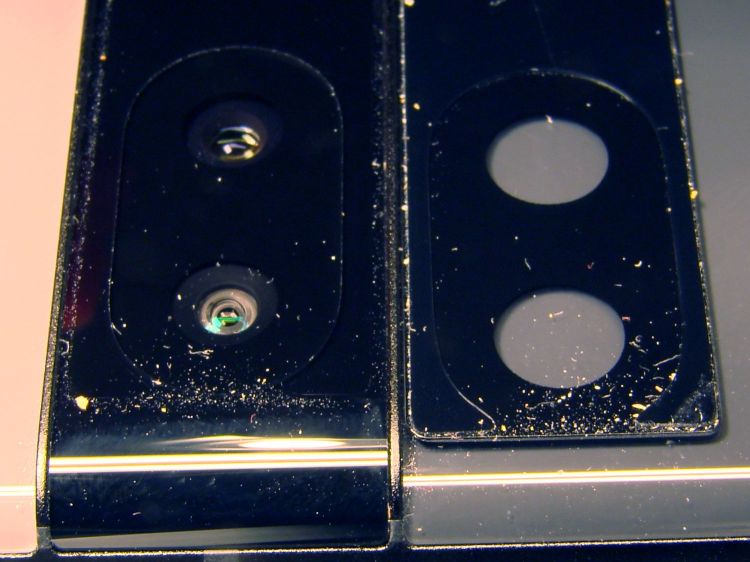
    I wear 30 dB over-the-ear protectors with a pair of Bluetooth earbuds tucked inside for a rhythm track. I had been carrying my Pixel 6a in a side pocket, until I noticed a remarkable amount of crud inside the glass protector over the camera lens:

    Pixel 6a camera protector dirt
    Pixel 6a camera protector dirt

    How crud could get inside (what I thought should be) a sealed compartment inside the phone’s armor case became obvious after peeling the protector off:

    Pixel 6a camera protector dirt - overview
    Pixel 6a camera protector dirt – overview

    Come to find out the protector’s adhesive layer has an opening near the edge of the camera, leaving a slot allowing the howling chaff storm onto the camera glass. Random pocket fuzz certainly contributed some particles, but the entire phone case had a surprising amount of yellow-brown dust tucked inside.

    So I left the protector off, dumped the music files into my old Pixel 3a (which never had a camera protector), and will henceforth leave the 6a indoors during similar adventures.

    The bagged leaves will become next year’s garden veggies, so the whole project isn’t a total waste of time.

  • Dripworks Mainline Puncture: In A Good Cause

    Dripworks Mainline Puncture: In A Good Cause

    Mary poked a garden fork tine into the mainline pipe of the garden irrigation plumbIng:

    Mainline pipe puncture
    Mainline pipe puncture

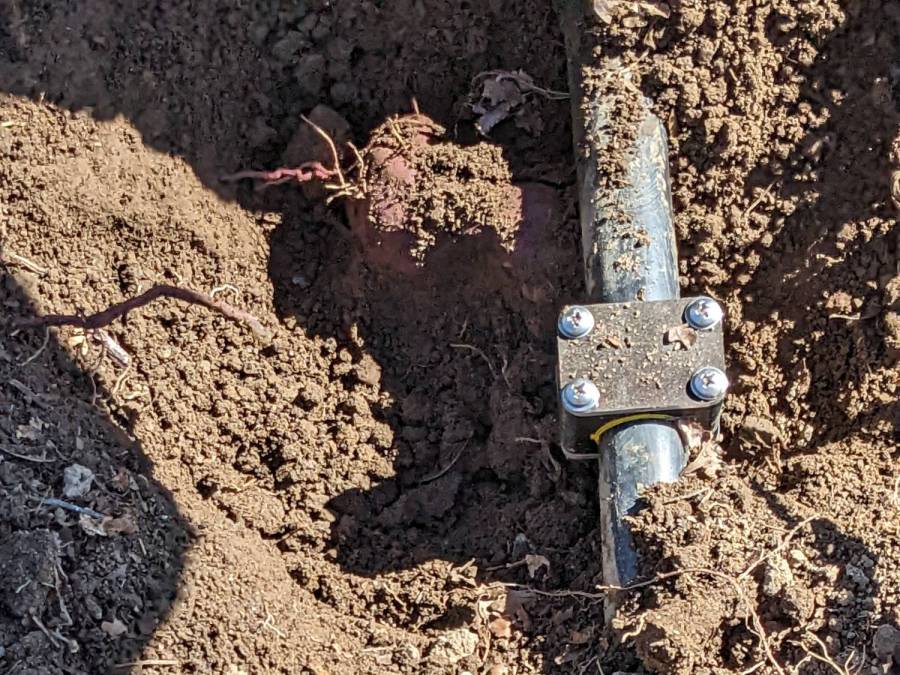
    Fortunately, I have a pipe clamp for just such occasions:

    Mainline pipe puncture - repaired - with cause
    Mainline pipe puncture – repaired – with cause

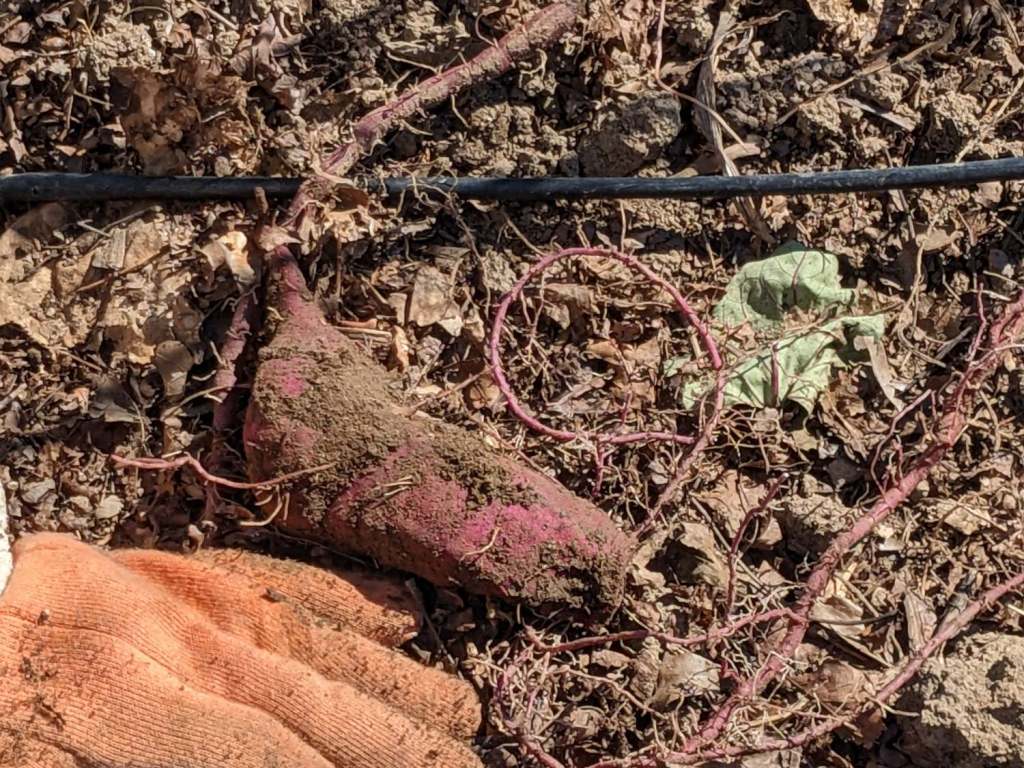
    After installing the clamp, we excavated the reddish lump just beyond it:

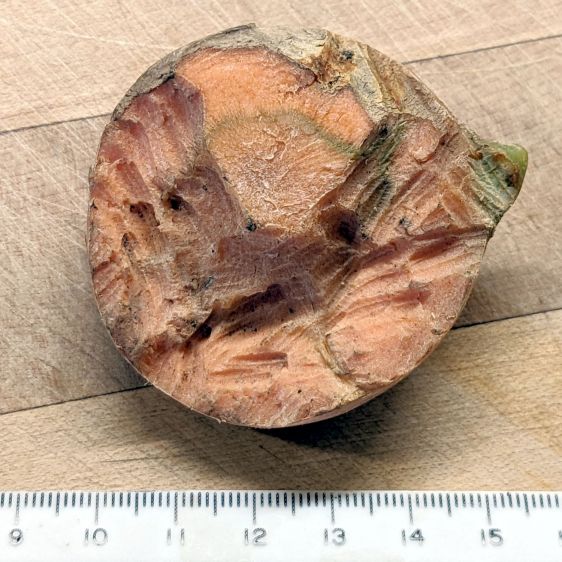
    Mainline pipe puncture - excavated sweet potato
    Mainline pipe puncture – excavated sweet potato

    It’s a purple sweet potato, one of several that had escaped from their assigned plot, grown beyond the pipe, and burrowed under the path.

    Her garden is as neat and tidy as a garden can be, but digging in the soil to find the crops isn’t an exact process!

  • Squash Frog

    Squash Frog

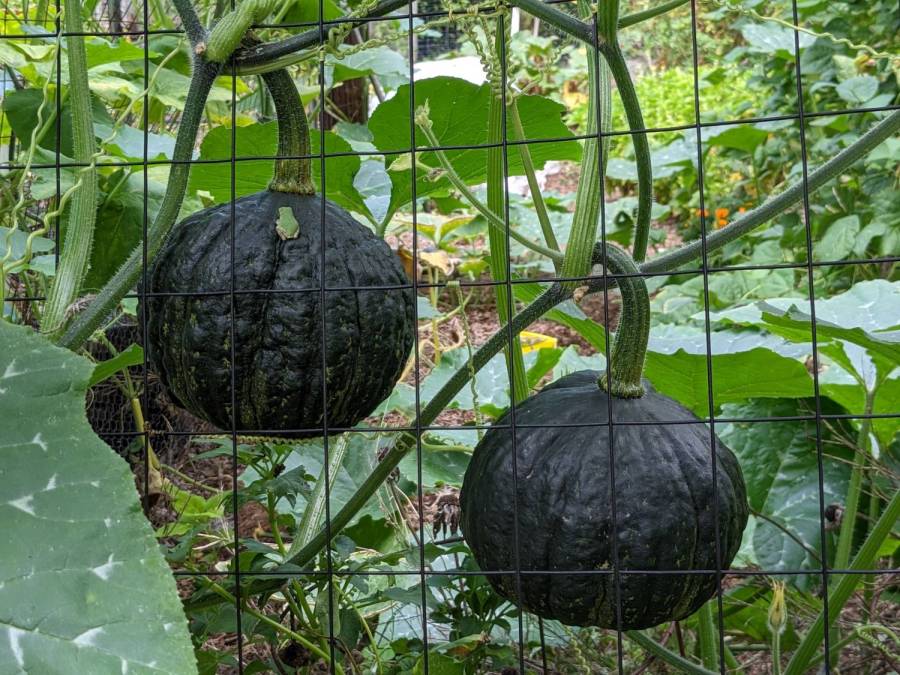
    Mary persuaded the squash vine to run along the top of the garden fence, where it would get good sun, stay out from underfoot, and produce what we call aerosquash:

    Tree frog on squash - overview
    Tree frog on squash – overview

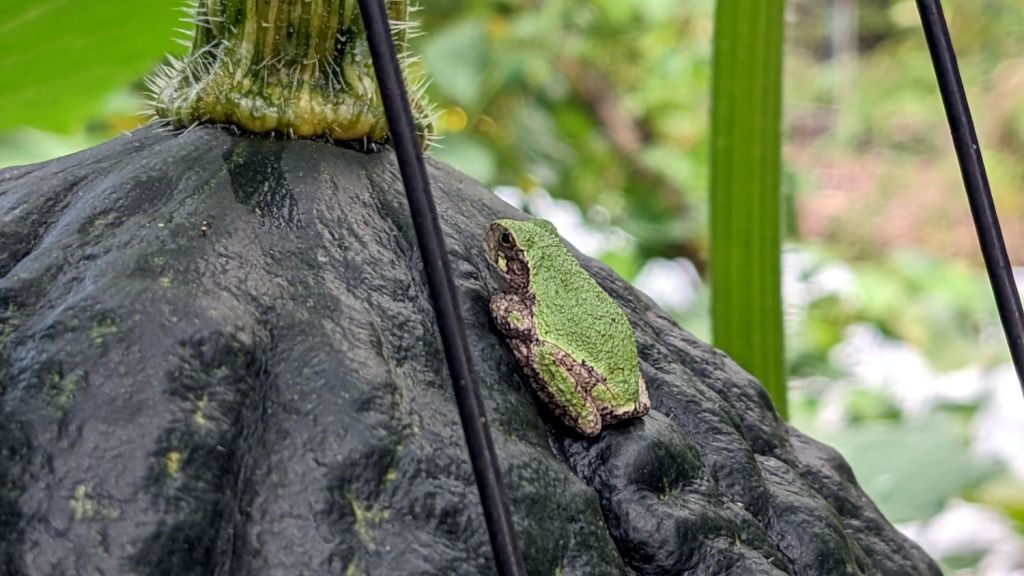
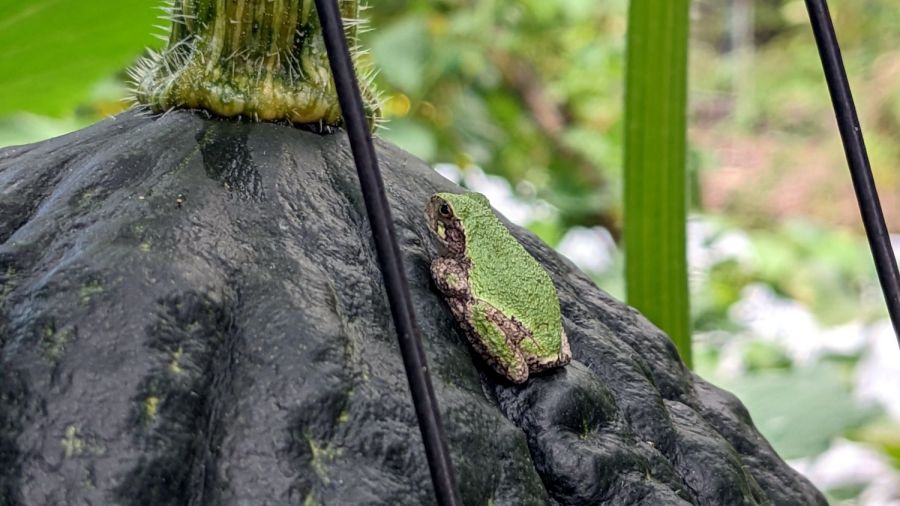
    That bright green spot is a misplaced tree frog:

    Tree frog on squash - detail
    Tree frog on squash – detail

    Well, maybe it’s the same frog we’ve seen elsewhere; it’s hard to tell with tree frogs.

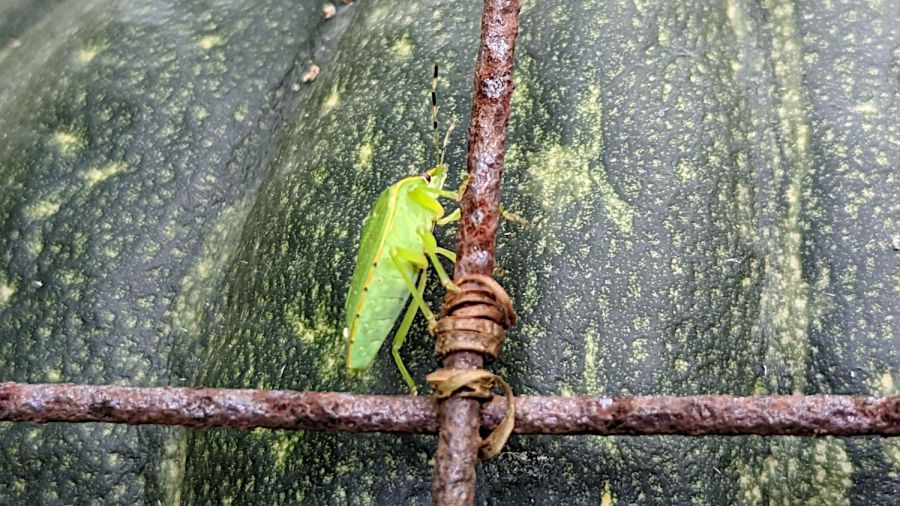
    Not everything green is froglike, though:

    Green stink bug on squash
    Green stink bug on squash

    That one got dealt with … harshly.

  • Champion Hose Nozzle

    Champion Hose Nozzle

    An old brass hose nozzle emerged from my garden hydraulics toolbox when a much newer plastic nozzle failed. Unfortunately, this one leaked a bit too much to serve as a replacement, so I grabbed it in the vise while pondering how to disassemble it:

    Champion brass hose nozzle - disassembly
    Champion brass hose nozzle – disassembly

    It turns out the knurled ring is threaded into the nozzle and, even at this late date, responds well to gentle persuasion with a Vise-Grip:

    Champion brass hose nozzle - parts
    Champion brass hose nozzle – parts

    The washer is a lost cause, but I managed to find an O-ring that fit perfectly in the space available. Clearing some crud around the nozzle hole and buffing up the matching conical section improved its sealing ability, so I’ll call it a win.

    The word ITALY stamped opposite CHAMPION suggests this thing might be as old as I am; it’s been a while since either brass or Italy was competitive in the world of cheap manufactured goods.

  • Onion Maggot Flies vs. Sticky Traps: Round 2

    Onion Maggot Flies vs. Sticky Traps: Round 2

    Mary decided the second round of sticky traps had collected enough Onion Maggot Flies (and other detritus) to warrant replacement, so this season will have three sets of cards.

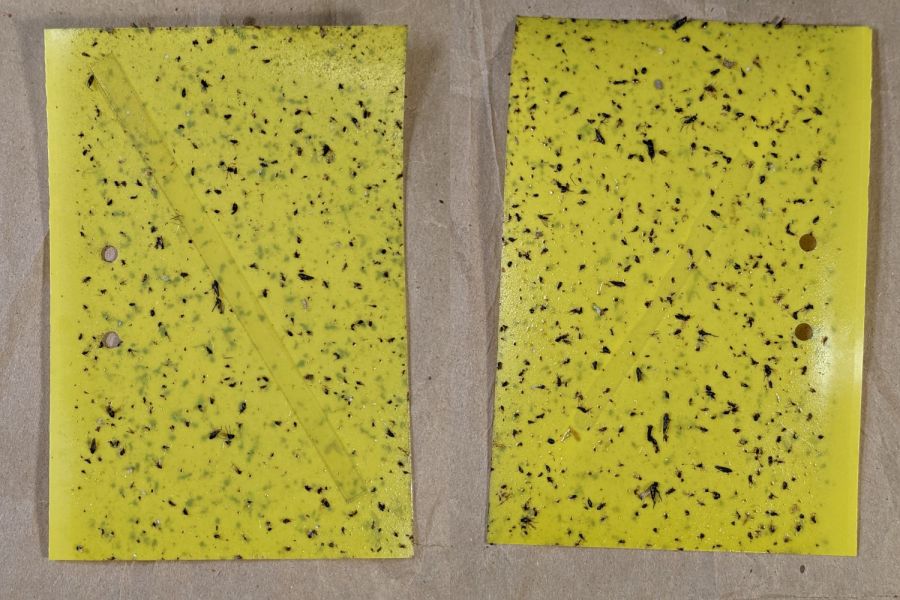
    The two sides of each card after about a month in the garden:

    • VCCG Onion Card A - 2022-07-17
    • VCCG Onion Card B - 2022-07-17
    • VCCG Onion Card C - 2022-07-17
    • VCCG Onion Card D - 2022-07-17
    • VCCG Onion Card E - 2022-07-17
    • VCCG Onion Card F - 2022-07-17

    There are many flies that look (to me) like Onion Maggot Flies, in contrast with the first round of cards which had far fewer flies after about six weeks in the bed.

    Some could be Cabbage Maggot Flies, but my fly ID hand is weak.

    One of the frames screwed to a fence post suffered a non-fatal mishap, so I made and deployed a seventh trap. We’re pretty sure the garden has enough flies to go around.

  • Please Close The Gate Signage: Painted

    Please Close The Gate Signage: Painted

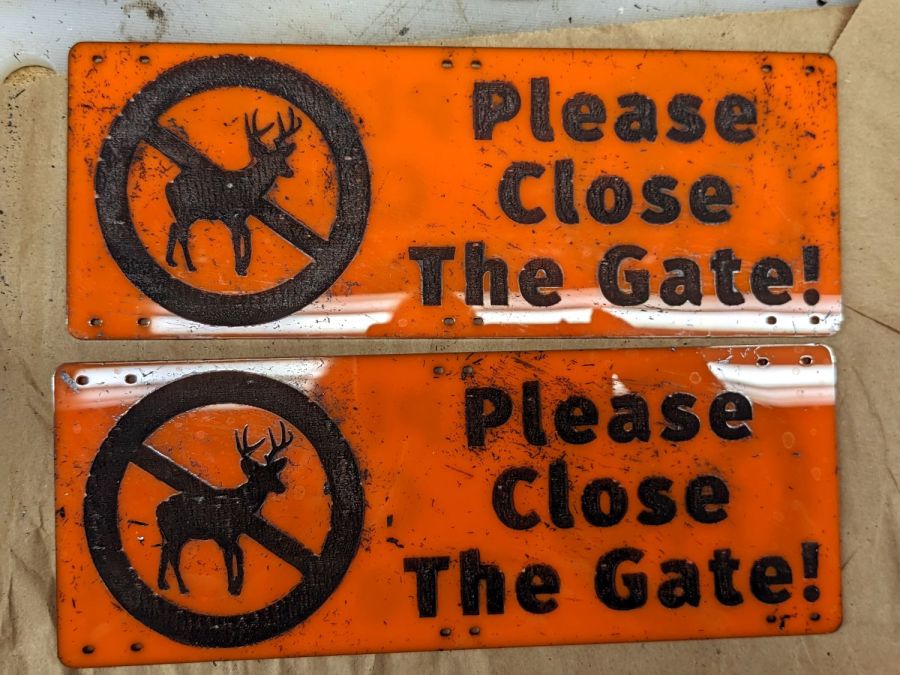
    It seems two months of sunlight will fade laser charred MDF down to its original state:

    Please Close The Gate - unpainted faded
    Please Close The Gate – unpainted faded

    That’s through a thick layer of indoor urethane sealant slathered over MDF without any surface prep. Obviously, not removing the char had no effect on the outcome. On the upside, the urethane did a great job of protecting the MDF from rainfall.

    So. Back to the shop.

    Lacking wider masking tape, two strips of tape laid along a cut-to-suit slab of fresh MDF will serve as a paint mask:

    Please Close The Gate - masked engraving
    Please Close The Gate – masked engraving

    Belatedly I Learned: cut the tape close to the edge, then fold it under so the autofocus pen can’t possibly snag it en passant.

    Shoot the entire surface with a couple of black enamel rattlecan coats:

    Please Close The Gate - masked paint
    Please Close The Gate – masked paint

    Yes, the engraved areas look reddish, most likely due to another complete lack of surface prep. Perhaps brushing / vacuuming / washing would remove some of the char, but let’s see how it behaves with no further attention.

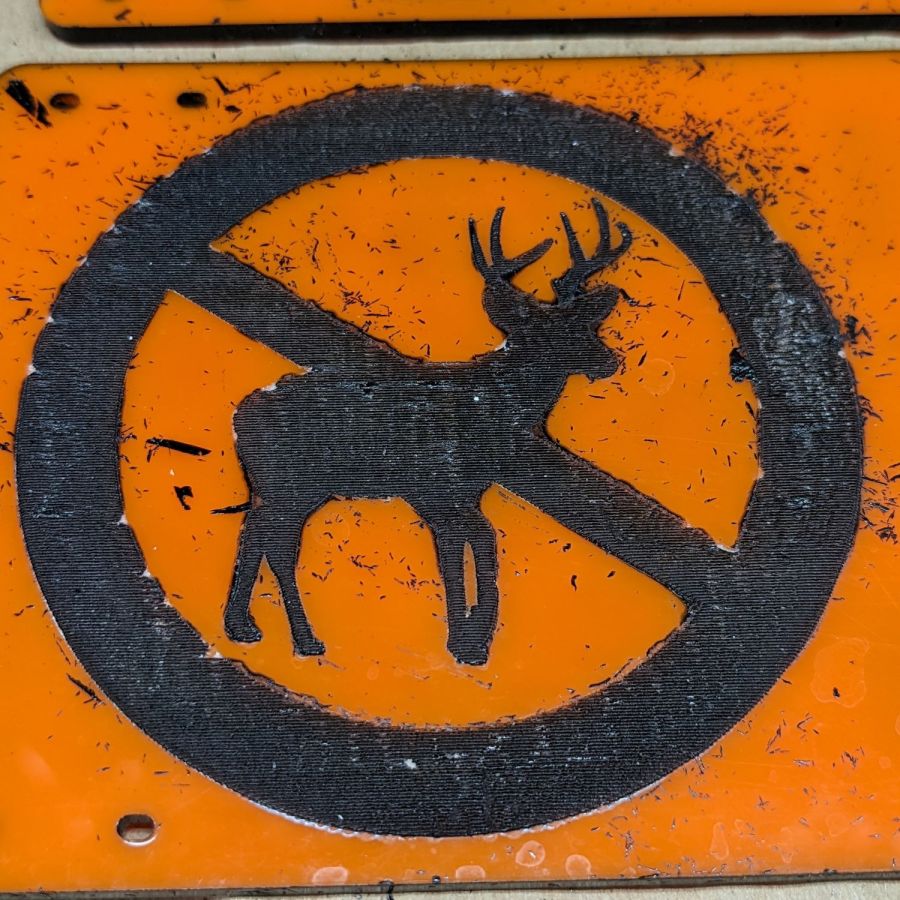
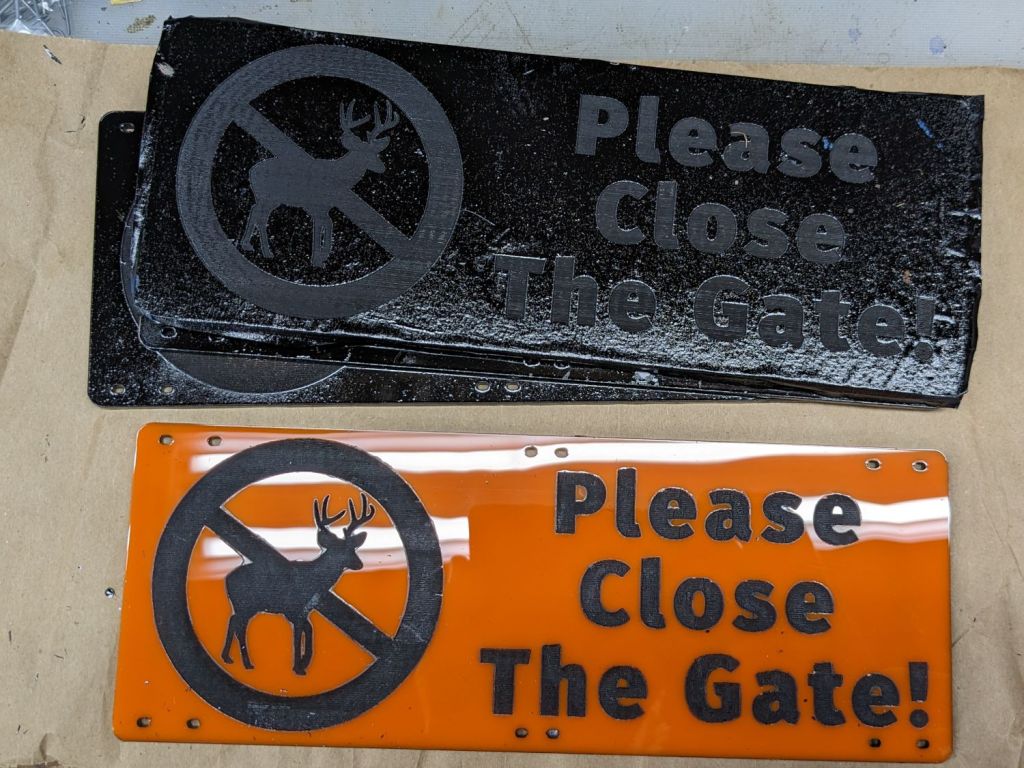
    Peel the tape, weed the letters / antlers, slather on a coat of urethane, and it looks downright bold:

    Please Close The Gate - sealed
    Please Close The Gate – sealed

    Of course, if those two tape strips don’t exactly abut, the paint produces a nasty line:

    Please Close The Gate - mask gap
    Please Close The Gate – mask gap

    Should you overlap the strips a wee bit to ensure cleanliness, the engraved surface will then have a noticeable (in person, anyhow) discontinuity due to the laser losing energy in two tape layers, which wouldn’t matter in this application. We defined the few paint lines as Good Enough™ for the purpose; a strip of absurdly wide masking tape is now on hand in anticipation of future need.

    Burnishing the tape might have prevented paint bleed around the engraved areas:

    Please Close The Gate - paint creep
    Please Close The Gate – paint creep

    But, given that I was painting raw / unfinished MDF with an unsmooth surface, burnishing probably wouldn’t produce a significantly better outcome.

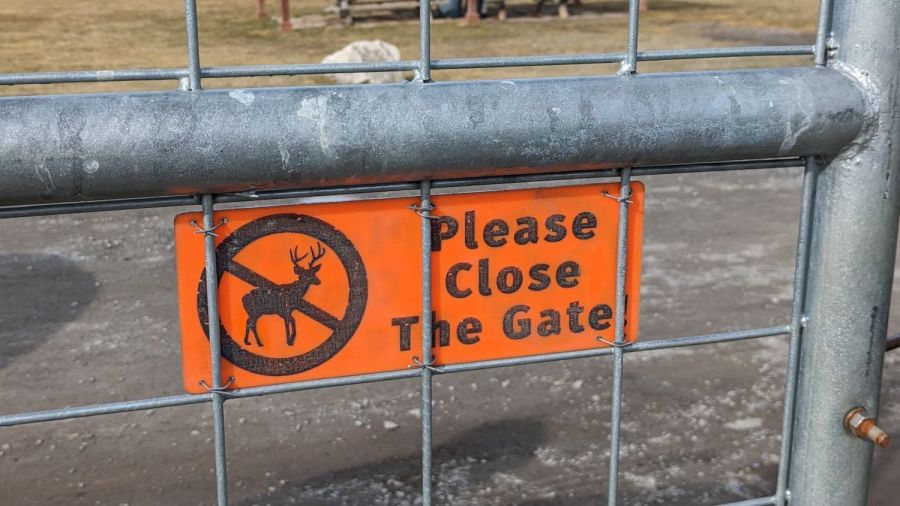
    By popular request, the new signs sit a few grids lower on the gates:

    Please Close The Gate - fresh painted
    Please Close The Gate – fresh painted

    Perhaps these will outlast the garden season …

  • DripWorks Valve Fracture

    DripWorks Valve Fracture

    Early in the irrigation season, Mary turned on a DripWorks Micro-Flow Valve, only to have the knob + stem pop out and release a stream of water in the wrong place. Mary jammed it back in place until I could chop out the offending valve and install a known-clear replacement.

    The knob broke off the stem when I tried to pry it out of the valve body:

    Failed Dripworks valve - parts
    Failed Dripworks valve – parts

    The lip around the inside of the cap snaps over the top of the body, which is why I wrecked the stem, but the chip broke off the cap while Mary was turning it just before the stem popped out. Her fingers are barely strong enough to turn the valve, which means something had gone wrong before she started turning.

    A look straight into the valve body:

    Failed Dripworks valve - top view
    Failed Dripworks valve – top view

    The stem has swarf left over from drilling out the mold flash last year:

    Failed Dripworks valve - stem
    Failed Dripworks valve – stem

    All in all, the Dripworks drip irrigation system works well, but their overall attention to QC leaves something to be desired.