The Smell of Molten Projects in the Morning

Ed Nisley's Blog: Shop notes, electronics, firmware, machinery, 3D printing, laser cuttery, and curiosities. Contents: 100% human thinking, 0% AI slop.

Tag: Arduino

All things Arduino

  • RAMPS 1.4: LCD Board QC FAIL

    When I plugged the LCD into the RAMPS board, the USB current jumped from 70-ish mA to about 700 mA, which seemed odd. Eventually the problem followed the “Smart Adapter Board”, which has no active components and simply rearranges two pin headers into two ribbon cables, so what could go wrong?

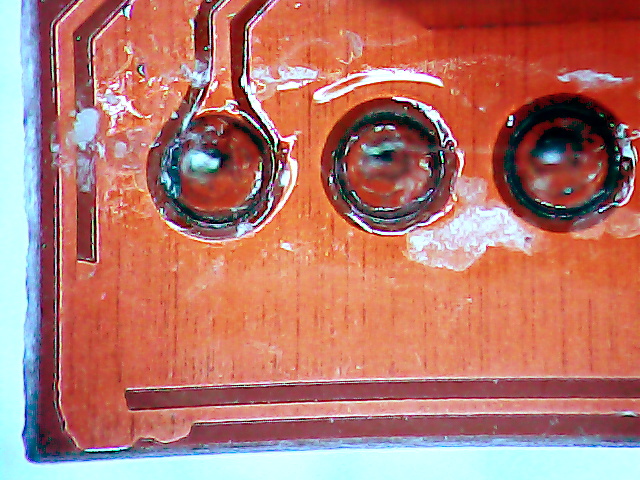
    This stared me in the face for a while until I recognized it:

    RAMPS 1.4 - Smart Adapter - solder mask failure
    RAMPS 1.4 – Smart Adapter – solder mask failure

    Yup, that trace is supposed to run around the corner without merging into the ground plane and, of course, it carries the +5 V power supply to the LCD board. Just another production goof and, I’m certain, the boards don’t get any testing because they’re so simple.

    Two cuts, a bit of scraping, a snippet of Wire-Wrap wire, and it’s all good:

    RAMPS 1.4 - LCD panel
    RAMPS 1.4 – LCD panel

    The white-on-blue display is reasonably legible in person, even if it’s nearly invisible here. Might have something to do with polarization vs. the Pixel’s camera.

    Everything else on the LCD board works fine. I set the beep to 50 ms and the tone to 700 Hz, which suit my deflicted ears better than the defaults.

    Phew!

  • RAMPS 1.4: Configuration for Generic Motor Control

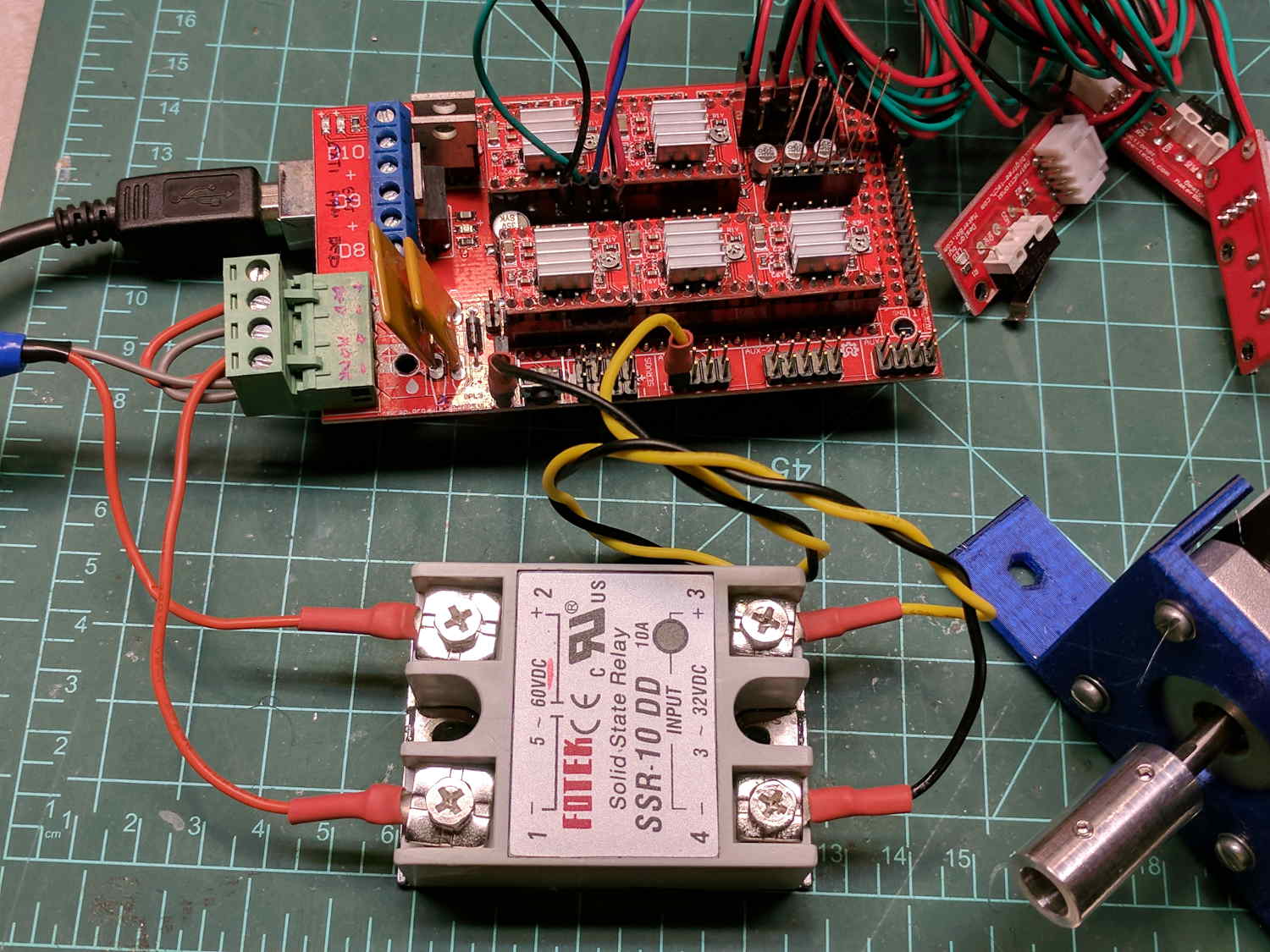
    Configuring the knockoff RAMPS 1.4 board went reasonably smoothly:

    RAMPS 1.4 - First Light
    RAMPS 1.4 – First Light

    The DC (n.b., not an AC) solid state relay in the foreground switches the 20 V laptop supply brick to the RAMPS shield atop the knockoff Arduino Mega 2560, controlled by the PS_ON pin (black wire), with +5 V from a pin in the AUX header (yellow wire). The SSR includes a ballast resistor limiting the current to 12 mA, with an inconspicuous red LED behind the black dot showing when the output is turned on.

    Because it’s a DC SSR, polarity matters: the supply goes to the + terminal, the RAMPS power inputs to the – terminal.

    I haven’t applied much of a load to to the SSR, but it works as expected. Define POWER_SUPPLY 1 and PS_DEFAULT_OFF so the boards starts up with the SSR turned off, then use M80 / M81 to turn it on / off as needed.

    Remove D1 on the RAMPS board to isolate the Mega power from the +20 V supply. Stuffed as shown, the Mega draws 70 mA from the USB port, although an external 8 V (-ish) supply is always a good idea.

    The stepper is a random NEMA 17 from the heap in a mount intended for a DIY plotter. I adjusted the tiny trimpots on all the boards for 400 mA peak = 250 mA RMS into the windings, after finding 250 mApk didn’t produce nearly enough mojo, even for a demonstration:

    X Axis Stepper Drive
    X Axis Stepper Drive

    Just to get it running, I used DEFAULT_AXIS_STEPS_PER_UNIT = 100 step/mm, MAX_FEEDRATE 100 mm/s, and (for lack of anything better)
    DEFAULT_*_ACCELERATION 1000. Those all depend the torque produced by the motor current, which is still way too low.

    The endstops require X_???_ENDSTOP_INVERTING true.

    I set the ?_BED_SIZE parameters to a generous 2000, with ?_MIN_POS equal to -SIZE/2 to put the origin in the middle where I prefer it, with a similar setting for the Z axis. Obviously, those numbers don’t correspond to any physical reality.

    Three little 100 kΩ thermistors sprout from their header and produce reasonable temperatures, although (being cheap eBay parts) they may not match the Type 4 curve. I don’t have any heaters connected. All the over / under temperature lockouts are disabled, because I don’t care right now.

    The G-Code parser wants uppercase command letters, which means I get to press the Caps Lock key for the first time in nearly forever!

    The header along the right edge of the board connects to the LCD control board, which is another story.

    The diffs for the Configuration.h and Configuration_adv.h files as a GitHub Gist:

    77c77
    < #define STRING_CONFIG_H_AUTHOR "(none, default config)" // Who made the changes.
    > #define STRING_CONFIG_H_AUTHOR "(Ed Nisley – KE4ZNU)" // Who made the changes.
    113c113
    < #define BAUDRATE 250000
    > #define BAUDRATE 115200
    126c126
    < //#define CUSTOM_MACHINE_NAME "3D Printer"
    > #define CUSTOM_MACHINE_NAME "Not a 3D Printer"
    130c130
    < //#define MACHINE_UUID "00000000-0000-0000-0000-000000000000"
    > #define MACHINE_UUID "89647f7b-2575-4809-bc90-5396f4376e02"
    225c225
    < #define POWER_SUPPLY 0
    > #define POWER_SUPPLY 1
    230c230
    < //#define PS_DEFAULT_OFF
    > #define PS_DEFAULT_OFF
    285c285
    < #define TEMP_SENSOR_0 1
    > #define TEMP_SENSOR_0 4
    290c290
    < #define TEMP_SENSOR_BED 0
    > #define TEMP_SENSOR_BED 4
    304c304
    < #define TEMP_WINDOW 1 // (degC) Window around target to start the residency timer x degC early.
    > #define TEMP_WINDOW 2 // (degC) Window around target to start the residency timer x degC early.
    309c309
    < #define TEMP_BED_WINDOW 1 // (degC) Window around target to start the residency timer x degC early.
    > #define TEMP_BED_WINDOW 2 // (degC) Window around target to start the residency timer x degC early.
    324,325c324,325
    < #define HEATER_0_MAXTEMP 275
    < #define HEATER_1_MAXTEMP 275
    > #define HEATER_0_MAXTEMP 75
    > #define HEATER_1_MAXTEMP 75
    329c329
    < #define BED_MAXTEMP 150
    > #define BED_MAXTEMP 75
    417,418c417,418
    < #define PREVENT_COLD_EXTRUSION
    < #define EXTRUDE_MINTEMP 170
    > //#define PREVENT_COLD_EXTRUSION
    > #define EXTRUDE_MINTEMP 50
    422c422
    < #define PREVENT_LENGTHY_EXTRUDE
    > //#define PREVENT_LENGTHY_EXTRUDE
    441,442c441,442
    < #define THERMAL_PROTECTION_HOTENDS // Enable thermal protection for all extruders
    < #define THERMAL_PROTECTION_BED // Enable thermal protection for the heated bed
    > //#define THERMAL_PROTECTION_HOTENDS // Enable thermal protection for all extruders
    > //#define THERMAL_PROTECTION_BED // Enable thermal protection for the heated bed
    476c476
    < #define ENDSTOPPULLUPS // Comment this out (using // at the start of the line) to disable the endstop pullup resistors
    > //#define ENDSTOPPULLUPS // Comment this out (using // at the start of the line) to disable the endstop pullup resistors
    490,495c490,495
    < #define X_MIN_ENDSTOP_INVERTING false // set to true to invert the logic of the endstop.
    < #define Y_MIN_ENDSTOP_INVERTING false // set to true to invert the logic of the endstop.
    < #define Z_MIN_ENDSTOP_INVERTING false // set to true to invert the logic of the endstop.
    < #define X_MAX_ENDSTOP_INVERTING false // set to true to invert the logic of the endstop.
    < #define Y_MAX_ENDSTOP_INVERTING false // set to true to invert the logic of the endstop.
    < #define Z_MAX_ENDSTOP_INVERTING false // set to true to invert the logic of the endstop.
    > #define X_MIN_ENDSTOP_INVERTING true // set to true to invert the logic of the endstop.
    > #define Y_MIN_ENDSTOP_INVERTING true // set to true to invert the logic of the endstop.
    > #define Z_MIN_ENDSTOP_INVERTING true // set to true to invert the logic of the endstop.
    > #define X_MAX_ENDSTOP_INVERTING true // set to true to invert the logic of the endstop.
    > #define Y_MAX_ENDSTOP_INVERTING true // set to true to invert the logic of the endstop.
    > #define Z_MAX_ENDSTOP_INVERTING true // set to true to invert the logic of the endstop.
    527c527
    < #define DEFAULT_AXIS_STEPS_PER_UNIT { 80, 80, 4000, 500 }
    > #define DEFAULT_AXIS_STEPS_PER_UNIT { 100, 100, 100, 100 }
    534c534
    < #define DEFAULT_MAX_FEEDRATE { 300, 300, 5, 25 }
    > #define DEFAULT_MAX_FEEDRATE { 100, 100, 100, 100 }
    542c542
    < #define DEFAULT_MAX_ACCELERATION { 3000, 3000, 100, 10000 }
    > #define DEFAULT_MAX_ACCELERATION { 1000, 1000, 1000, 1000 }
    552,554c552,554
    < #define DEFAULT_ACCELERATION 3000 // X, Y, Z and E acceleration for printing moves
    < #define DEFAULT_RETRACT_ACCELERATION 3000 // E acceleration for retracts
    < #define DEFAULT_TRAVEL_ACCELERATION 3000 // X, Y, Z acceleration for travel (non printing) moves
    > #define DEFAULT_ACCELERATION 1000 // X, Y, Z and E acceleration for printing moves
    > #define DEFAULT_RETRACT_ACCELERATION 1000 // E acceleration for retracts
    > #define DEFAULT_TRAVEL_ACCELERATION 1000 // X, Y, Z acceleration for travel (non printing) moves
    566,567c566,567
    < #define DEFAULT_ZJERK 0.4
    < #define DEFAULT_EJERK 5.0
    > #define DEFAULT_ZJERK 20.0
    > #define DEFAULT_EJERK 20.0
    744c744
    < #define INVERT_X_DIR false
    > #define INVERT_X_DIR true
    746c746
    < #define INVERT_Z_DIR false
    > #define INVERT_Z_DIR true
    774,775c774,775
    < #define X_BED_SIZE 200
    < #define Y_BED_SIZE 200
    > #define X_BED_SIZE 2000
    > #define Y_BED_SIZE 2000
    778,783c778,783
    < #define X_MIN_POS 0
    < #define Y_MIN_POS 0
    < #define Z_MIN_POS 0
    < #define X_MAX_POS X_BED_SIZE
    < #define Y_MAX_POS Y_BED_SIZE
    < #define Z_MAX_POS 200
    > #define X_MIN_POS -X_BED_SIZE/2
    > #define Y_MIN_POS -Y_BED_SIZE/2
    > #define Z_MIN_POS -1000
    > #define X_MAX_POS X_BED_SIZE/2
    > #define Y_MAX_POS Y_BED_SIZE/2
    > #define Z_MAX_POS 1000
    1013c1013
    < //#define EEPROM_SETTINGS // Enable for M500 and M501 commands
    > #define EEPROM_SETTINGS // Enable for M500 and M501 commands
    1023c1023
    < #define HOST_KEEPALIVE_FEATURE // Disable this if your host doesn't like keepalive messages
    > //#define HOST_KEEPALIVE_FEATURE // Disable this if your host doesn't like keepalive messages
    1046,1047c1046,1047
    < #define PREHEAT_1_TEMP_BED 70
    < #define PREHEAT_1_FAN_SPEED 0 // Value from 0 to 255
    > #define PREHEAT_1_TEMP_BED 60
    > #define PREHEAT_1_FAN_SPEED 255 // Value from 0 to 255
    1050,1051c1050,1051
    < #define PREHEAT_2_TEMP_BED 110
    < #define PREHEAT_2_FAN_SPEED 0 // Value from 0 to 255
    > #define PREHEAT_2_TEMP_BED 90
    > #define PREHEAT_2_FAN_SPEED 255 // Value from 0 to 255
    1275c1275
    < //#define REVERSE_ENCODER_DIRECTION
    > #define REVERSE_ENCODER_DIRECTION
    1290c1290
    < //#define INDIVIDUAL_AXIS_HOMING_MENU
    > #define INDIVIDUAL_AXIS_HOMING_MENU
    1307,1308c1307,1308
    < //#define LCD_FEEDBACK_FREQUENCY_DURATION_MS 100
    < //#define LCD_FEEDBACK_FREQUENCY_HZ 1000
    > #define LCD_FEEDBACK_FREQUENCY_DURATION_MS 50
    > #define LCD_FEEDBACK_FREQUENCY_HZ 700
    1379c1379
    < //#define REPRAP_DISCOUNT_FULL_GRAPHIC_SMART_CONTROLLER
    > #define REPRAP_DISCOUNT_FULL_GRAPHIC_SMART_CONTROLLER
    65,66c65,66
    < #define THERMAL_PROTECTION_PERIOD 40 // Seconds
    < #define THERMAL_PROTECTION_HYSTERESIS 4 // Degrees Celsius
    > #define THERMAL_PROTECTION_PERIOD 100 // Seconds
    > #define THERMAL_PROTECTION_HYSTERESIS 5 // Degrees Celsius
    77c77
    < #define WATCH_TEMP_PERIOD 20 // Seconds
    > #define WATCH_TEMP_PERIOD 60 // Seconds
    85c85
    < #define THERMAL_PROTECTION_BED_PERIOD 20 // Seconds
    > #define THERMAL_PROTECTION_BED_PERIOD 120 // Seconds
    97c97
    < #define WATCH_BED_TEMP_PERIOD 60 // Seconds
    > #define WATCH_BED_TEMP_PERIOD 120 // Seconds
    225c225
    < *
    > *
    352c352
    < #define HOMING_BUMP_DIVISOR {2, 2, 4} // Re-Bump Speed Divisor (Divides the Homing Feedrate)
    > #define HOMING_BUMP_DIVISOR {4, 4, 4} // Re-Bump Speed Divisor (Divides the Homing Feedrate)
    374c374
    < #define DEFAULT_STEPPER_DEACTIVE_TIME 120
    > #define DEFAULT_STEPPER_DEACTIVE_TIME 0
    458c458
    < //#define LCD_INFO_MENU
    > #define LCD_INFO_MENU
    461c461
    < //#define STATUS_MESSAGE_SCROLLING
    > #define STATUS_MESSAGE_SCROLLING
    464c464
    < //#define LCD_DECIMAL_SMALL_XY
    > #define LCD_DECIMAL_SMALL_XY
    467c467
    < //#define LCD_TIMEOUT_TO_STATUS 15000
    > #define LCD_TIMEOUT_TO_STATUS 10000
    562c562
    < #define XYZ_HOLLOW_FRAME
    > //#define XYZ_HOLLOW_FRAME
    565c565
    < #define MENU_HOLLOW_FRAME
    > //#define MENU_HOLLOW_FRAME
    573c573
    < //#define USE_SMALL_INFOFONT
    > #define USE_SMALL_INFOFONT
    752c752
    < #define TX_BUFFER_SIZE 0
    > #define TX_BUFFER_SIZE 128
  • Glass vs. Epoxy: Divot!

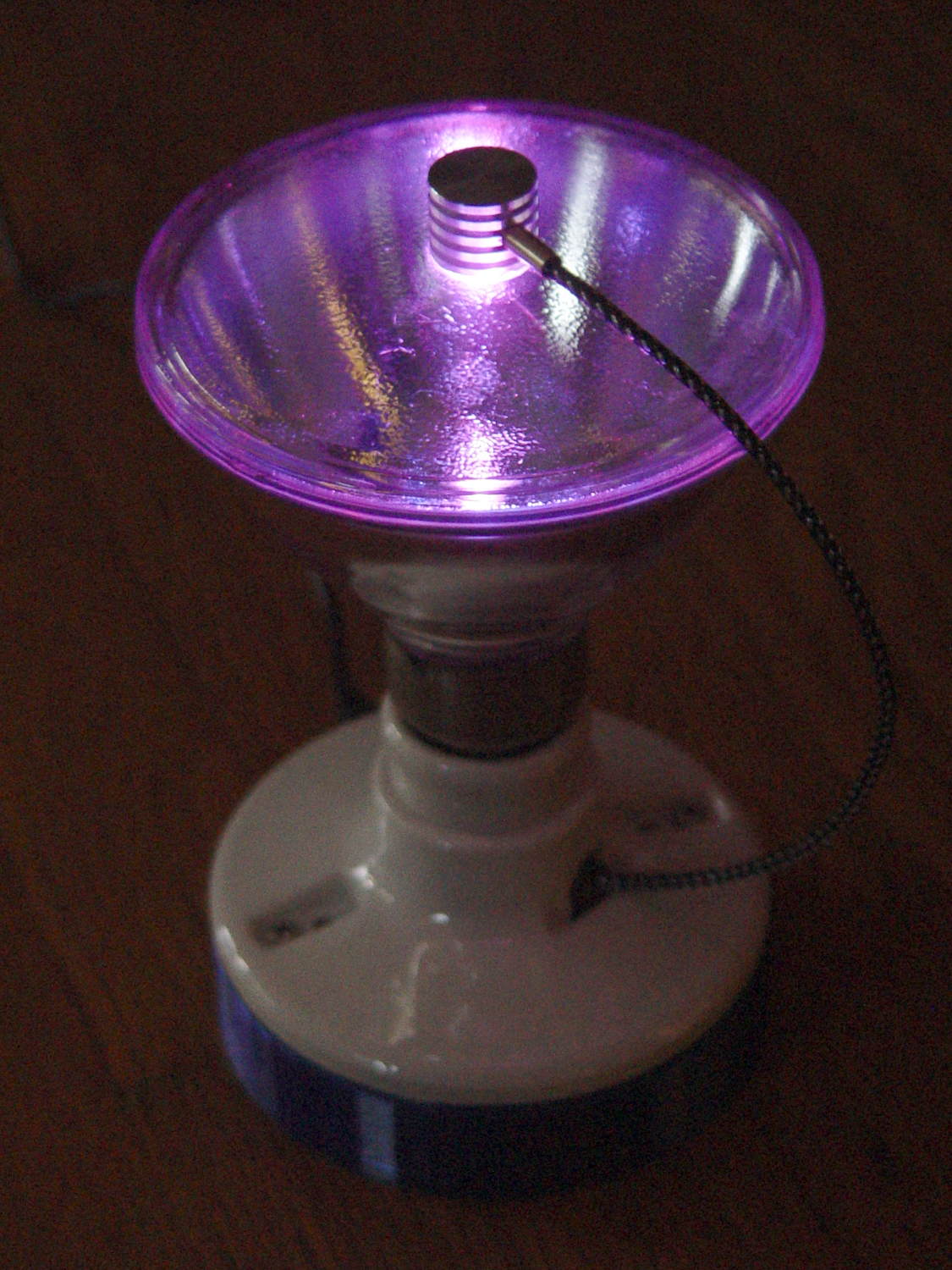
    The WS2812 RGB LED atop the Bowl of Fire Floodlight

    Reflector floodlight - purple phase
    Reflector floodlight – purple phase

    failed in the usual way after a bit over a year of constant use.

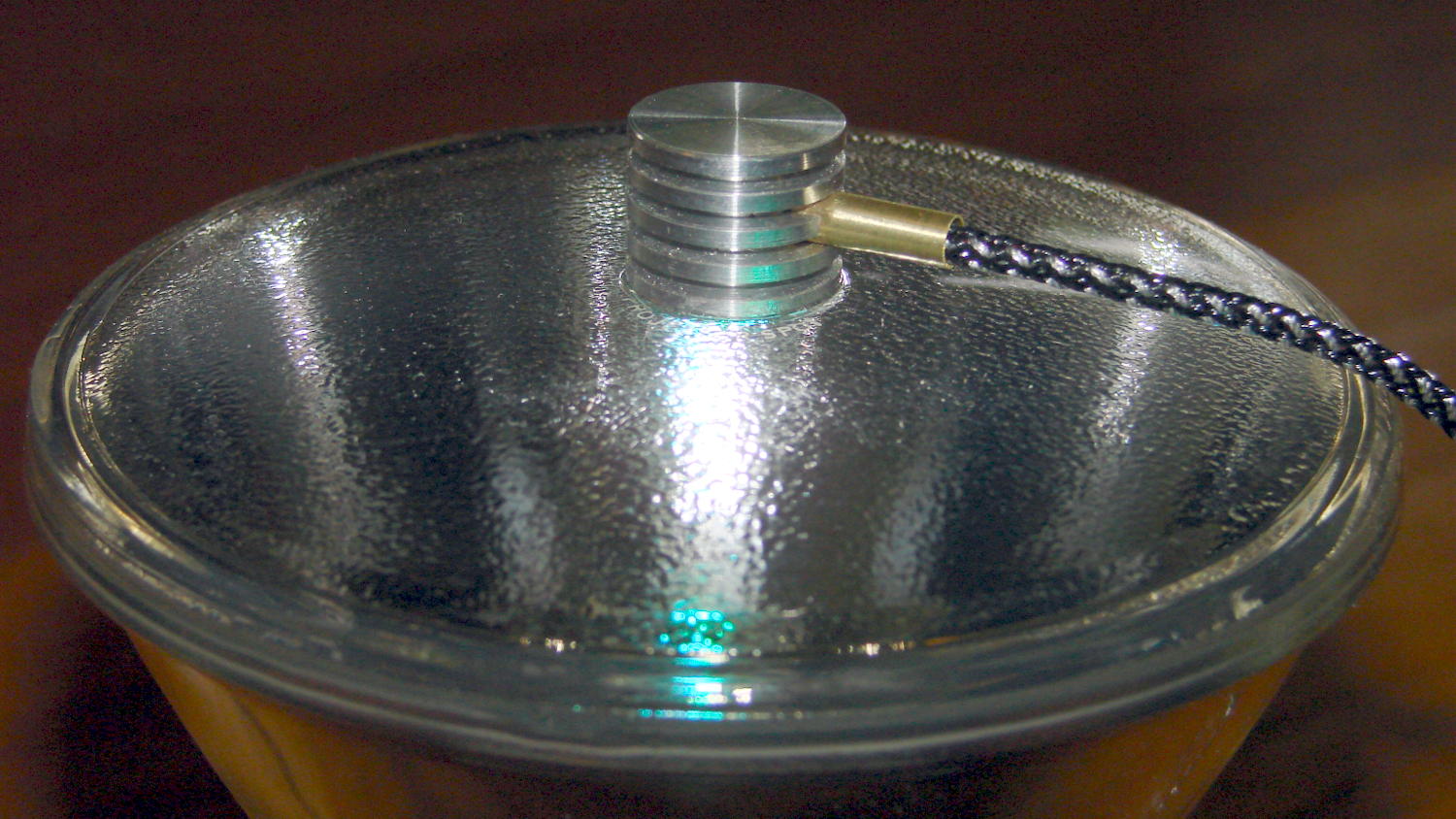
    I’d done an unusually good job of epoxying the ersatz heatsink in place:

    Reflector floodlight - finned LED holder
    Reflector floodlight – finned LED holder

    I wrapped the bulb in a towel with only the heatsink sticking out, whacked the side of the heatsink parallel to the glass with a plastic-face hammer, and it popped right off:

    Epoxy vs glass - divot
    Epoxy vs glass – divot

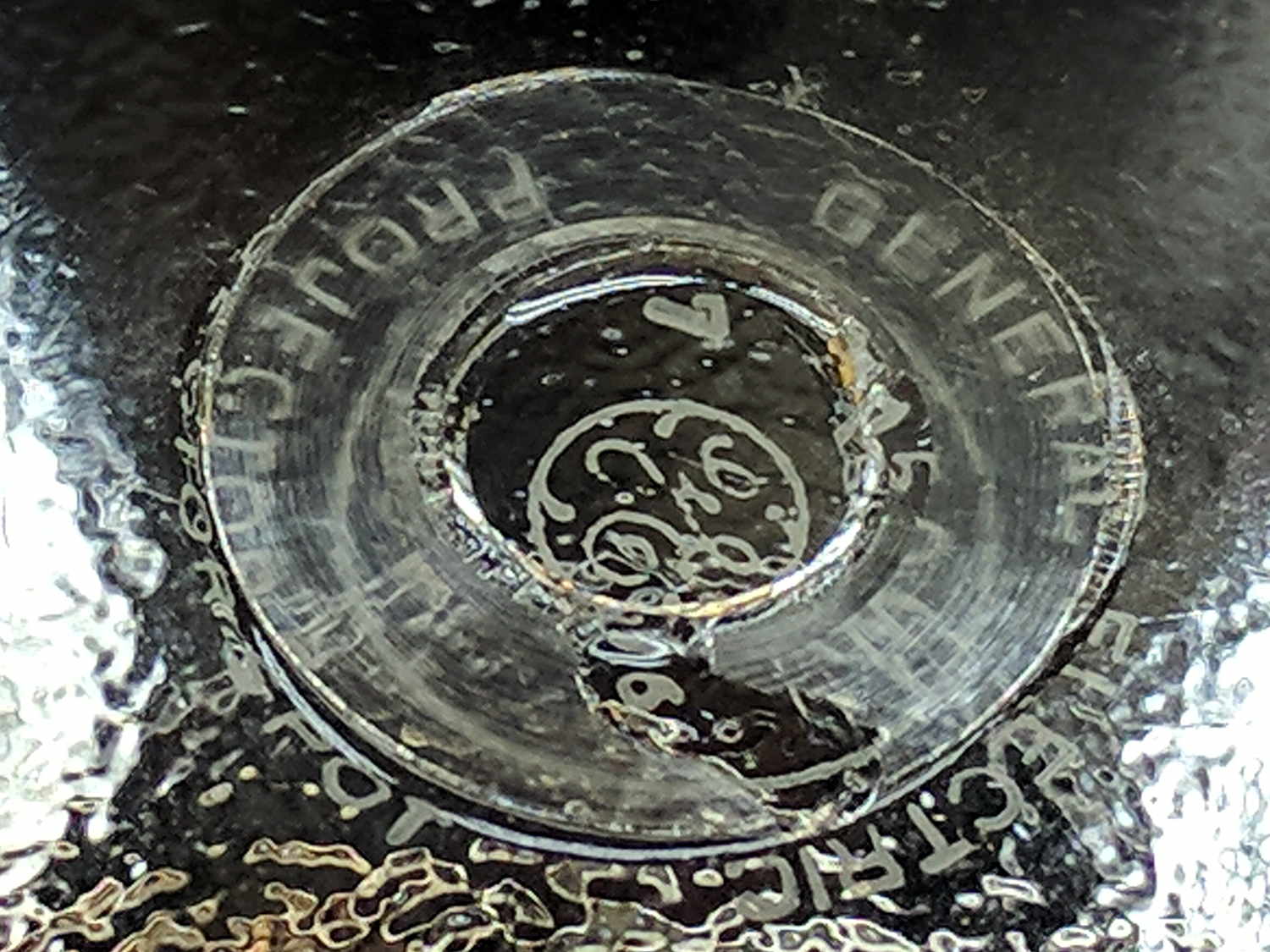
    The missing piece of the epoxy ring turned out to be a divot ripped out of the glass, which I didn’t notice until I’d chipped the fragment off the aluminum, so no pictures.

    Given the relative strengths of epoxy and glass, pulling a divot seems impossible, but folks doing 3D printing on glass platforms have been reporting exactly that failure for years. The prevailing theory seems to involve small scratches and defects in the glass surface, with subsequent weakening, and stresses applied to the epoxy perpendicular to the glass surface pulling the cracks apart.

    Replacing the RGB LED will require drilling it out and probably a complete rewiring, because I seem to have made liberal use of epoxy inside the heatsink and brass tube.

  • 60 kHz Quartz Tuning Fork Resonator Data

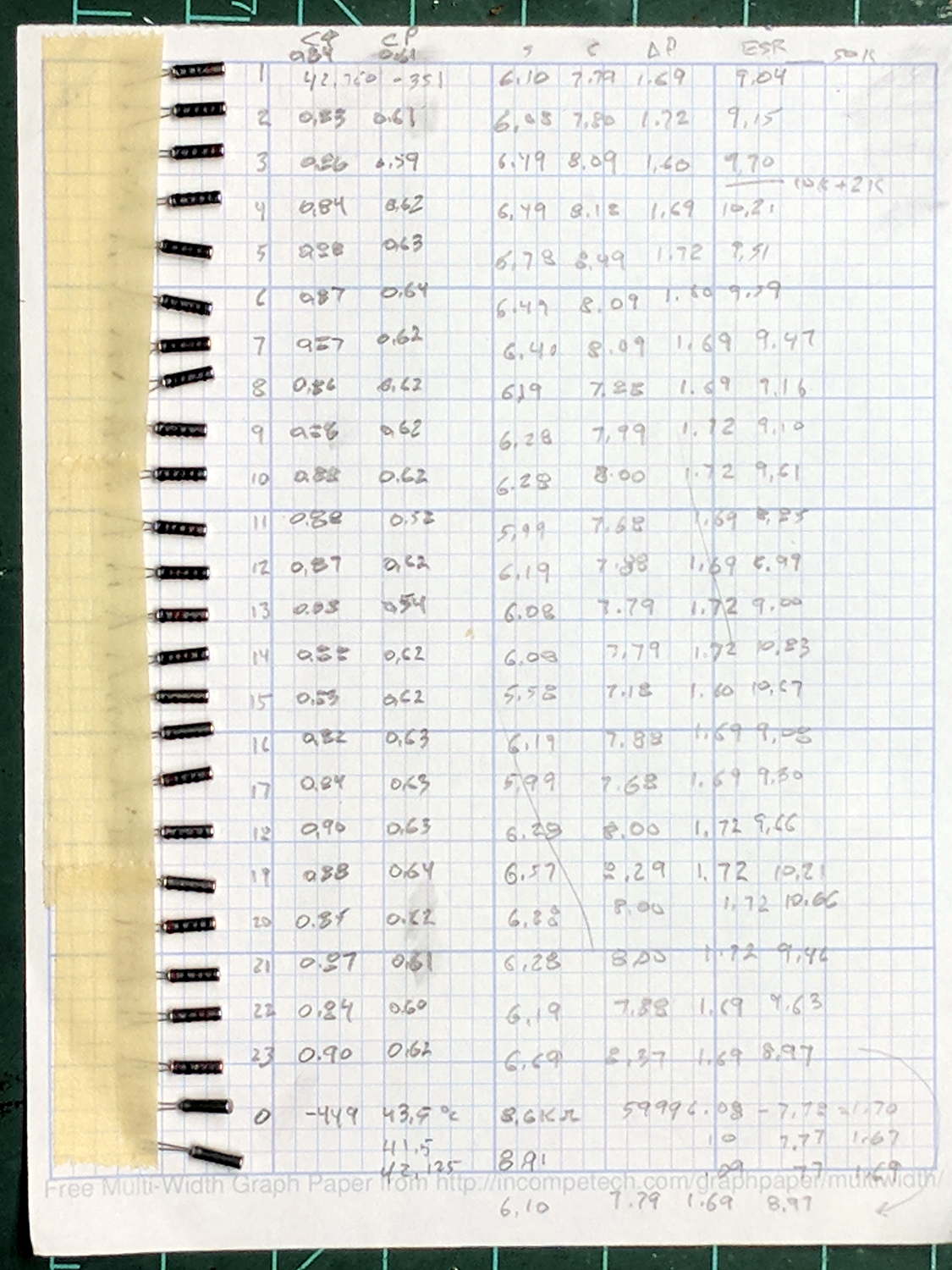
    The first batch of 25 resonators:

    60 kHz TF26 resonators - Batch 1 data
    60 kHz TF26 resonators – Batch 1 data

    The second batch from the same eBay source arrived a few months later and I finally got around to measuring them:

    60 kHz TF26 resonators - Batch 2 data
    60 kHz TF26 resonators – Batch 2 data

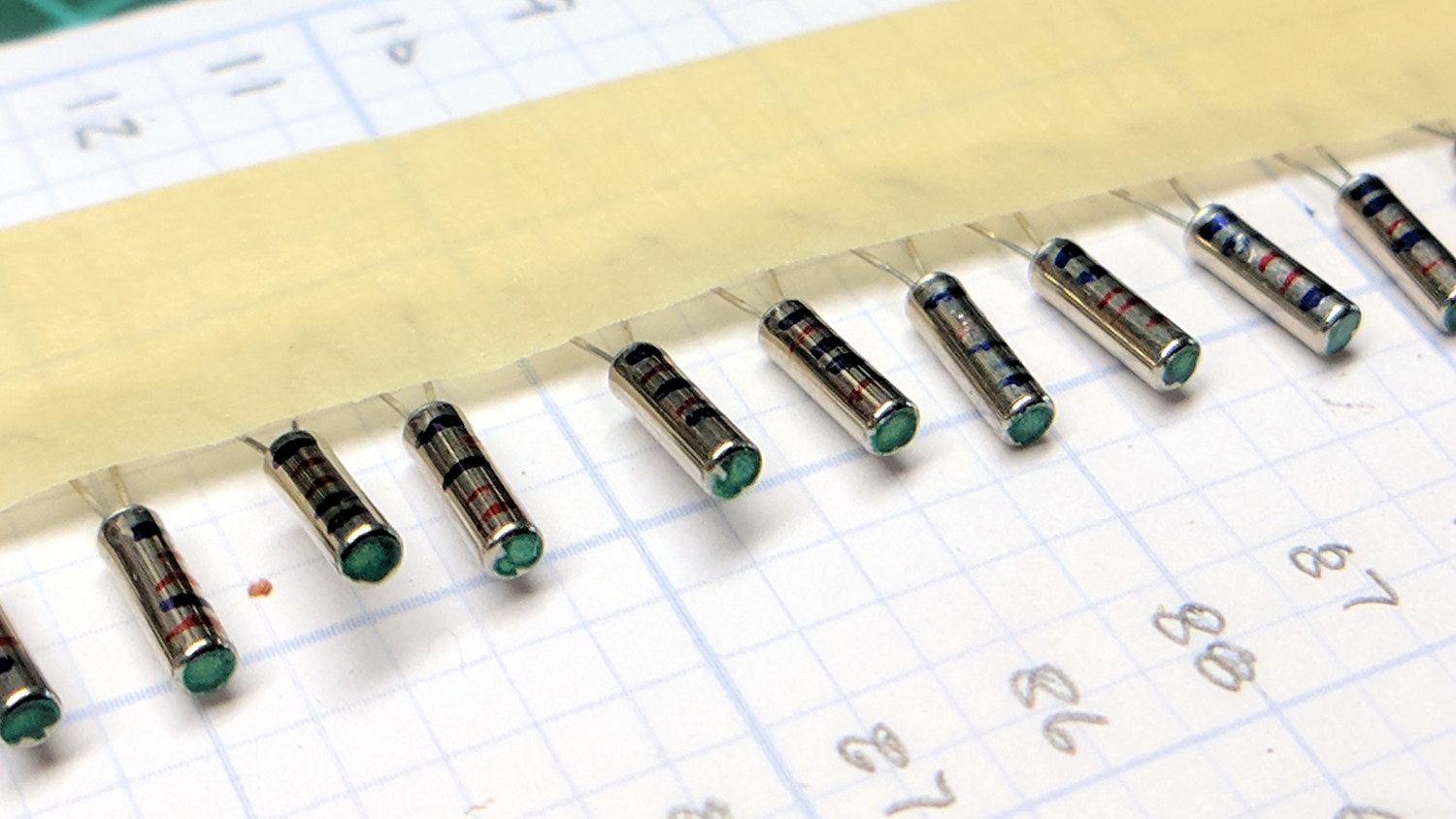
    A dot of green Sharpie on the AT26 cans identifies the second batch:

    60 kHz TF26 resonators - Batch 2 marking
    60 kHz TF26 resonators – Batch 2 marking

    The alert reader will notice an un-measured 25th resonator at the bottom of the first batch. I dropped one from the second batch under the Electronics Workbench, found it, then also found its long-missing brother; now I have a genuine it’s-never-been-used resonator, just in case the need arises.

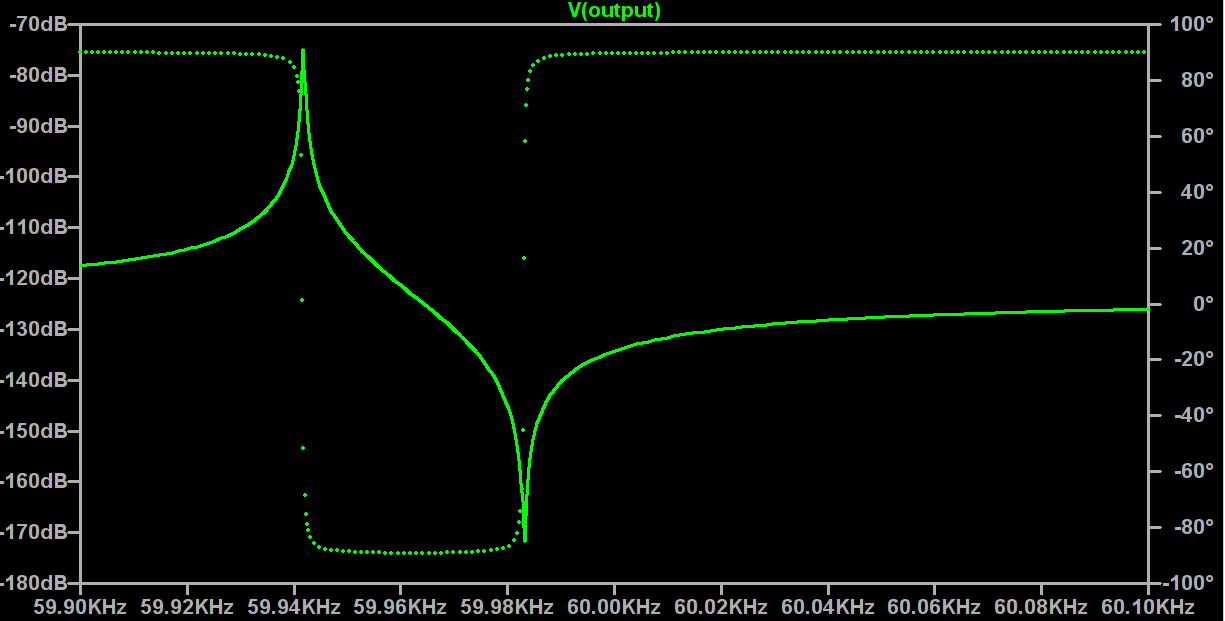
    A quick-and-dirty simulation shows the series and parallel resonant peaks come out close, but not dead on, the actual measurements:

    Simulation - 60 kHz resonator
    Simulation – 60 kHz resonator

    The model obviously doesn’t exactly match reality, which isn’t too surprising. However, I don’t understand something about tuning fork resonators, because the parallel resonance shouldn’t shift upward with the series resonant peak when the circuit gains a 24 pF series capacitance:

    Resonator 0 Spectrum
    Resonator 0 Spectrum

    Suffice it to say that doesn’t happen with the simulation.

    More study is needed, as the saying goes.

  • RAMPS 1.4 Heatsinking

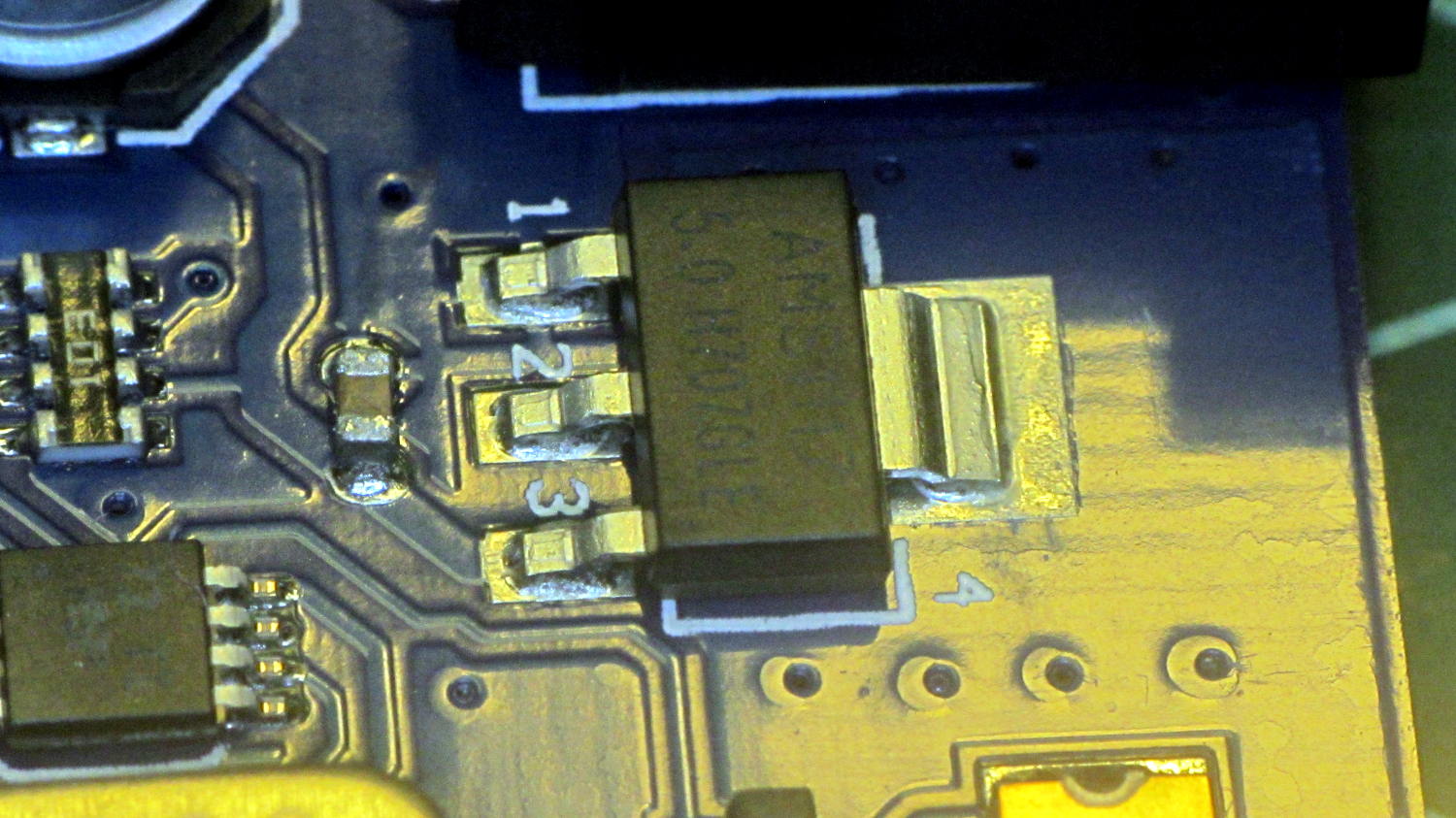
    The knockoff Arduino Mega board actually has eight thermal vias on the copper pour around the regulator:

    RAMPS Mega - regulator - thermal vias
    RAMPS Mega – regulator – thermal vias

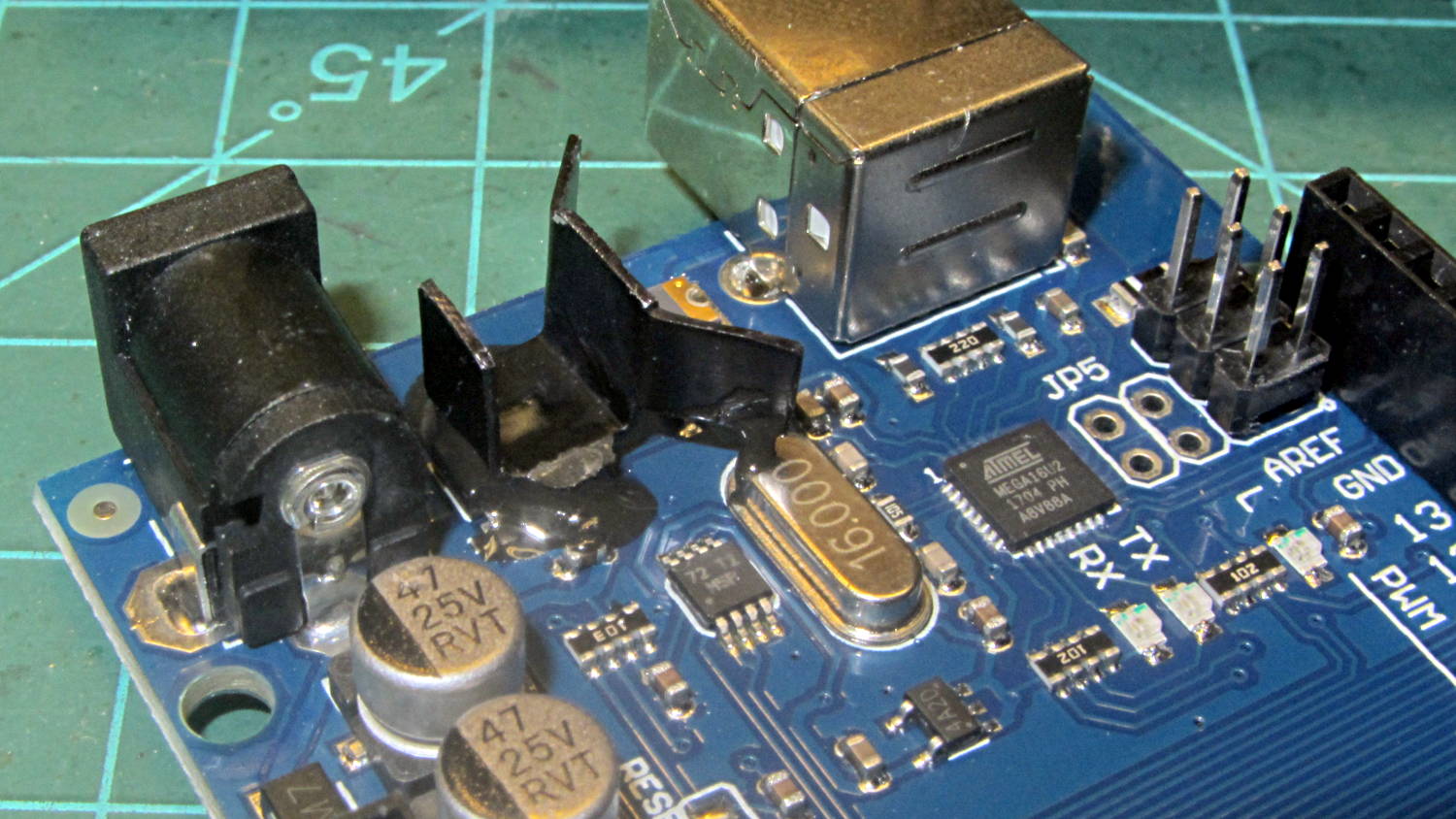
    I sawed up a clip-on heatsink originally intended for a 14 pin DIP, bent it a bit, and epoxied it atop the regulator with enough of a blob to contact the copper pour:

    RAMPS Mega - regulator heatsink - clamping
    RAMPS Mega – regulator heatsink – clamping

    That’s metal-filled JB Weld for good thermal conductivity and electrical insulation:

    RAMPS Mega - regulator heatsink
    RAMPS Mega – regulator heatsink

    The blob affixing the heatsink to the crystal can was an oopsie, but won’t do any harm. It’s not clear the heatsink will do any good in that confined space, but those regulators lead a rough life and need all the help they can get.

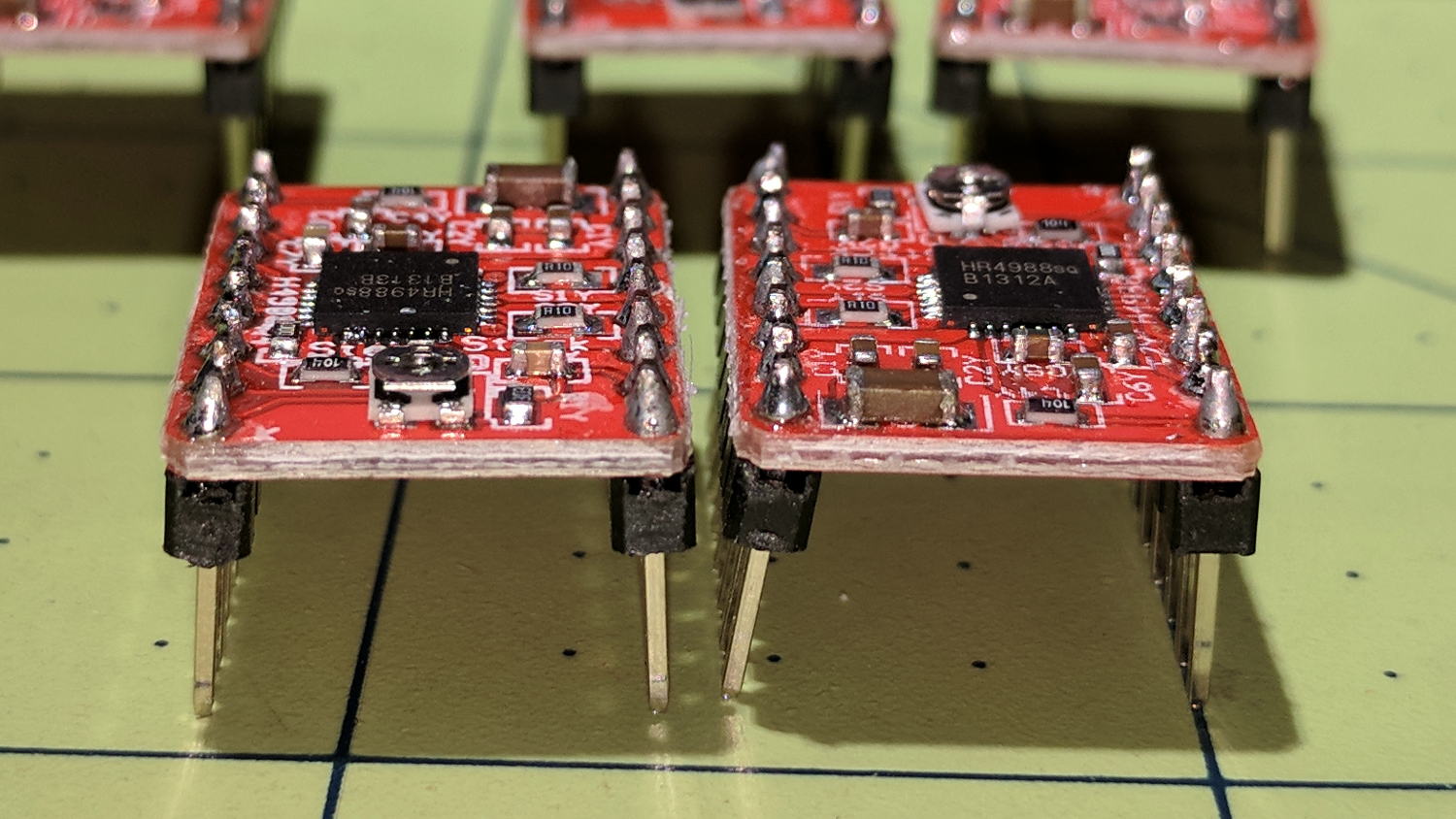
    The five stepper drivers sport HR4988SQ chips, rather than Allegro A4988 chips:

    RAMPS - stepper driver - HR4988 chip
    RAMPS – stepper driver – HR4988 chip

    I’d rather see a knockoff than a counterfeit, although by now there’s really no way to tell if it’s a counterfeit knockoff. The Kynix datasheet looks like a direct rip from Allegro.

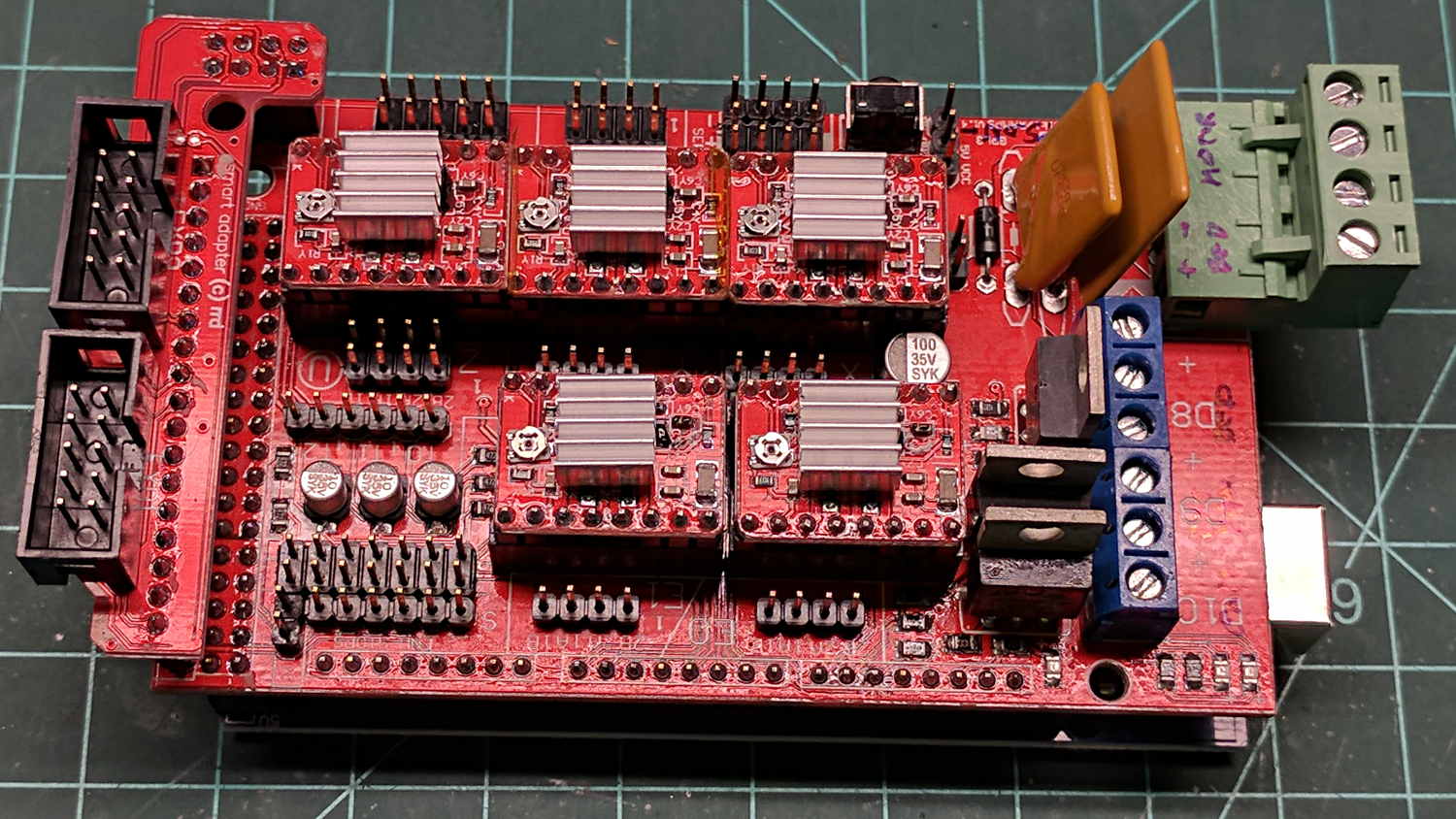
    They now sport cute little heatsinks, which, for all I know, might help a bit:

    RAMPS shield - stepper heatsinks
    RAMPS shield – stepper heatsinks

    The driver boards are slightly longer than the spacing mandated by the continuous socket strips under the three-in-a-row layout:

    RAMPS - stepper driver board fit
    RAMPS – stepper driver board fit

    Introducing them to Mr Disk Sander (turned by hand) knocked off just enough to make ’em fit.

  • Knockoff RAMPS 1.4 Printer Controller Hardware Kit

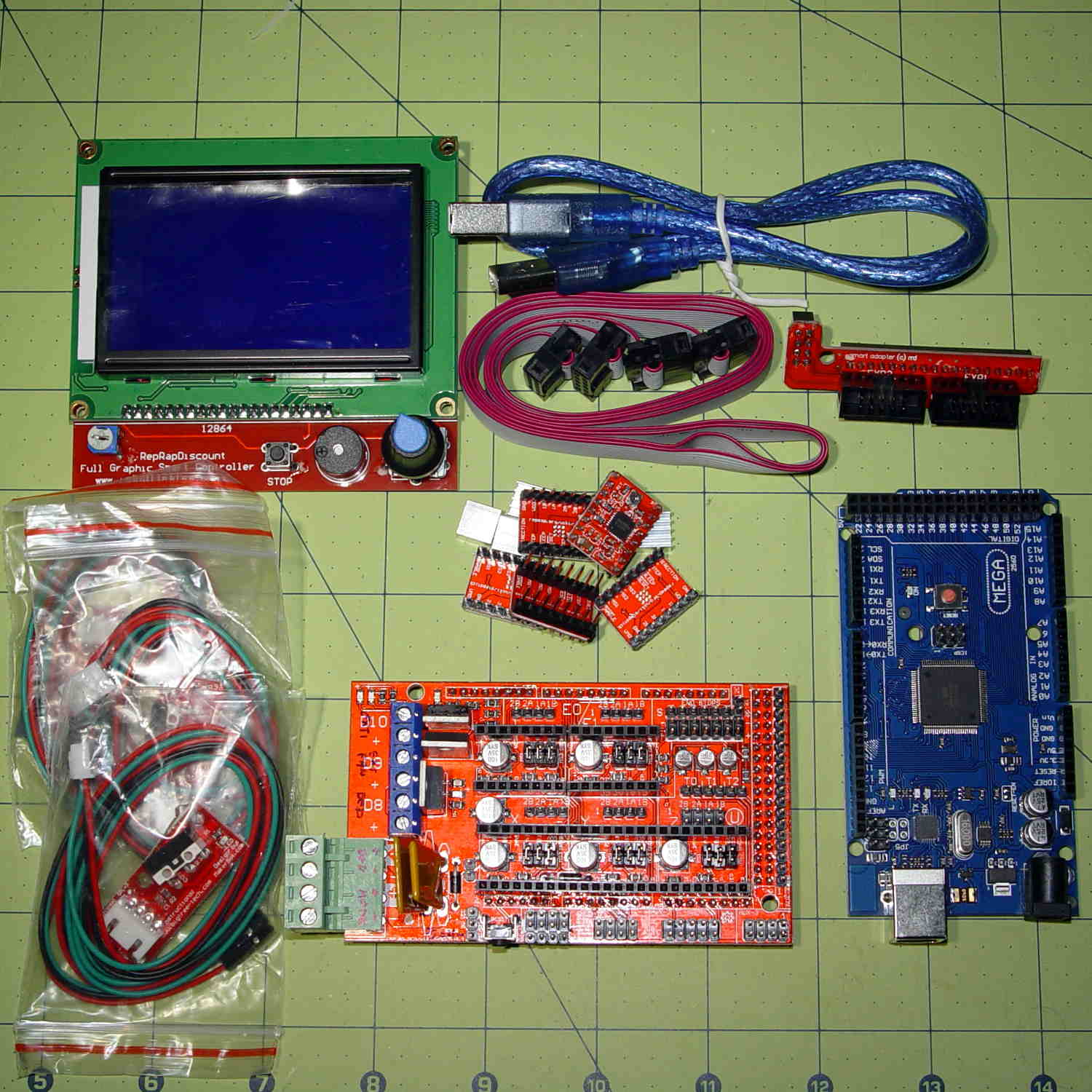
    For 36 bucks delivered halfway around the planet, you can get a remarkable pile of gadgetry:

    RAMPS 1.4 - eBay parts
    RAMPS 1.4 – eBay parts

    With a bit of persuasion, it can become a 3D printer controller based on a RepRap RAMPS 1.4 shield or serve as a generic stepper / servo motor driver with three honkin’ MOSFET power switches, two thermistor inputs, a variety of I/O bits from the Arduino Mega PCB, and a monochrome LCD with a knob.

    The persuasion includes un-bending various header pins:

    RAMPS shield - bent pin
    RAMPS shield – bent pin

    Correcting bowlegged pin strips:

    And clipping offending pins:

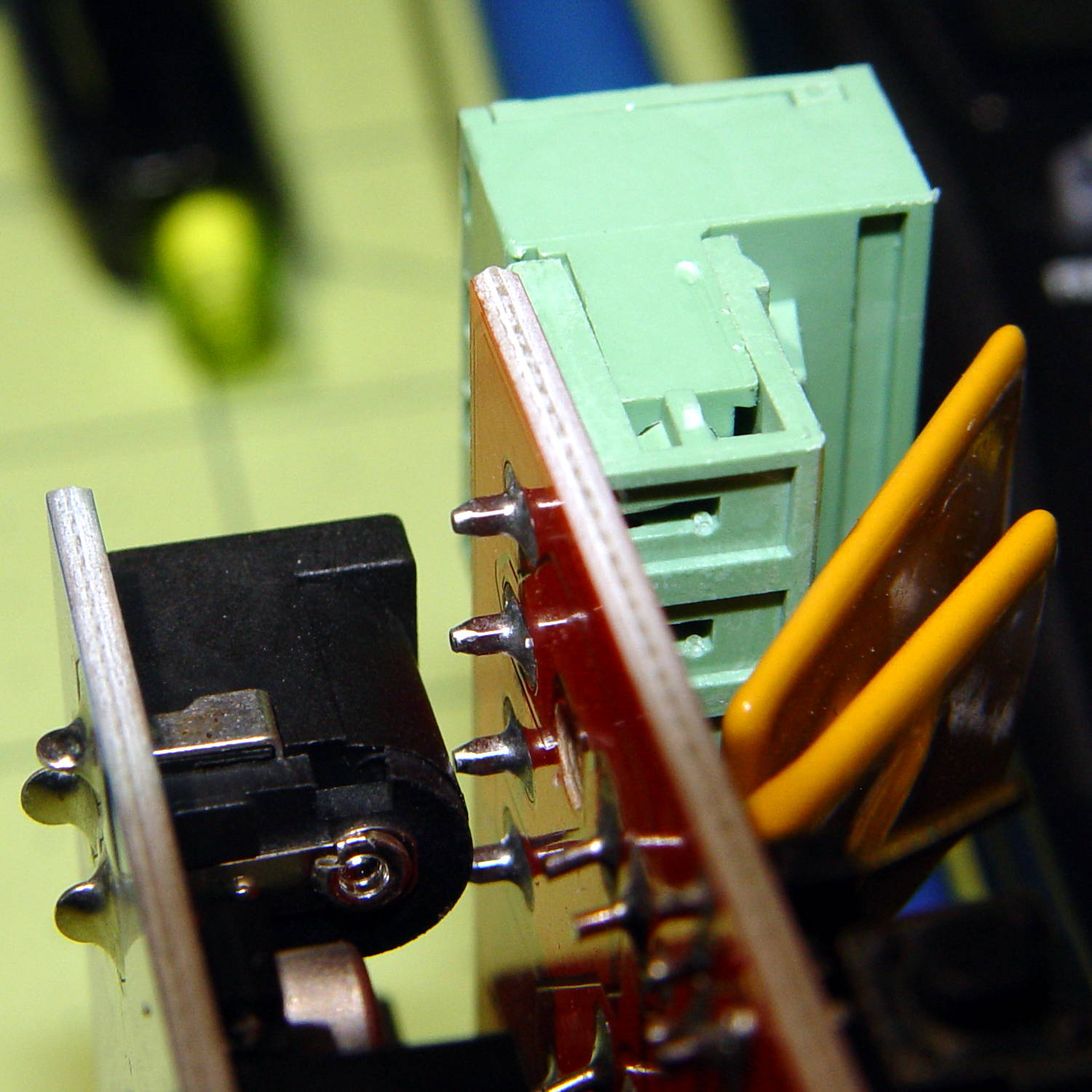
    The interference between the bottom of the RAMPS power connector pin and the top of the Arduino Mega coaxial power jack seems baked right into the original PCB layout, which is puzzling. If you don’t trim the pins, this is as close as the boards will get:

    Well, of course, you could just jam all those headers together and bend the RAMPS PCB.

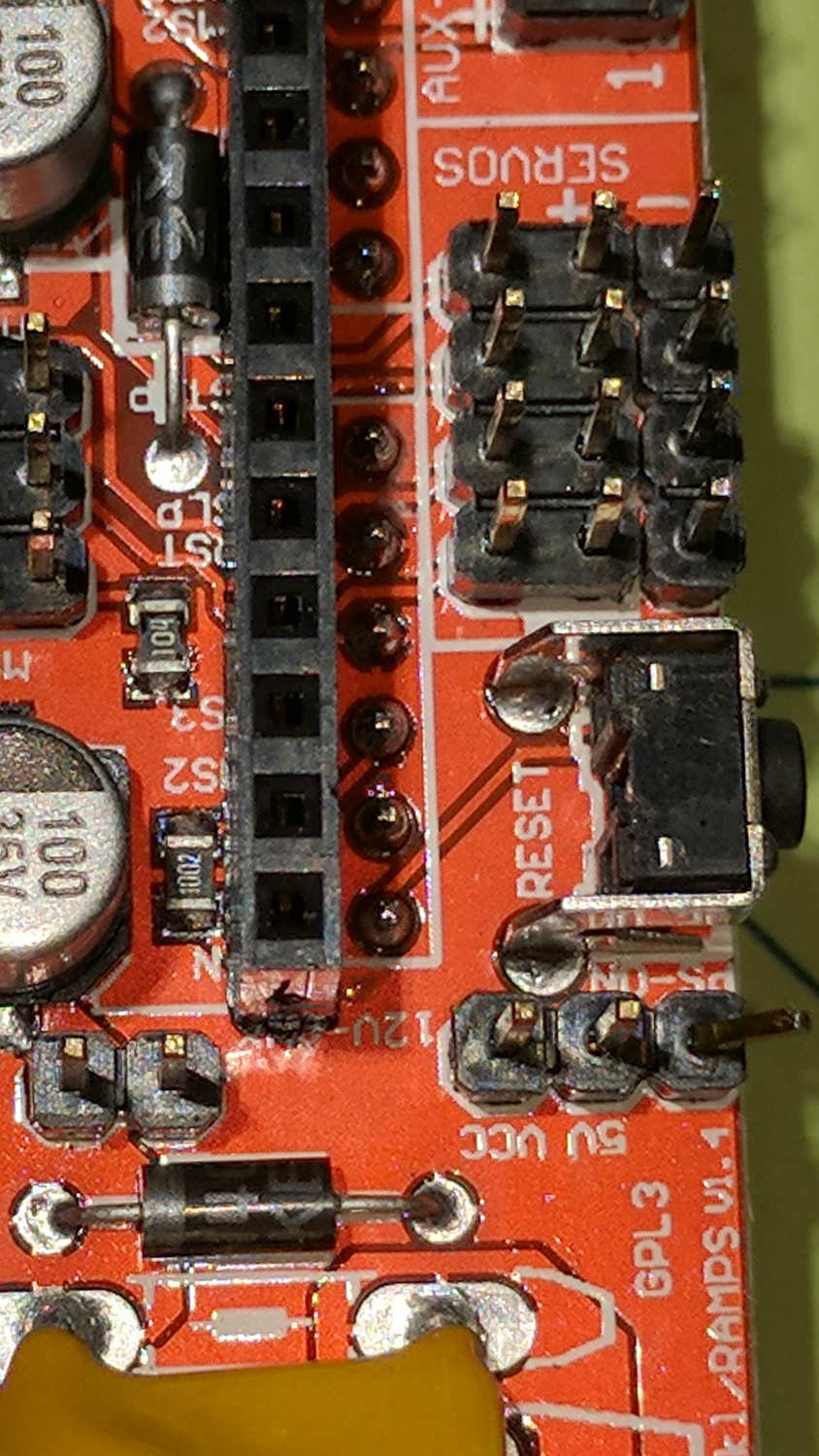
    The bent pin near the Reset button connects to the PS_ON output used to enable ATX-style power supplies. You connect the supply’s 5V_SBY always-on output to the VCC pin, which powers the Mega and most of the logic, but not the stepper motor outputs or the heaters.

    To make that work, remove D1 from the board where it’s snuggled along the header strip:

     RAMPS shield - D1 D2 locations
    RAMPS shield – D1 D2 locations

    D2, next to the fuse near the bottom of the picture, provides reverse-polarity protection for the RAMPS board.

    The servo motor power comes from the 5V pin. If you don’t need the PS_ON output and 5V_SBY input, then jumper the VCC and 5V pins together. Otherwise, you could solder-blob those pins on the bottom of the board, which means the servos are always powered.

    Configuring the latest 1.1.x version of Marlin should be straightforward …

  • Quartz Resonator Test Fixture: Cleanup

    Isolating the USB port from the laptop eliminated a nasty ground loop, turning off the OLED while making measurements stifled a huge noise source, and averaging a few ADC readings produced this pleasing plot:

    Resonator 0 Spectrum
    Resonator 0 Spectrum

    Those nice smooth curves suggest the tester isn’t just measuring random junk.

    The OLED summarizes the results after the test sequence:

    LF Crystal Tester - OLED test summary - Resonator 0
    LF Crystal Tester – OLED test summary – Resonator 0

    Collecting all the numbers for that resonator in one place:

    • C0 = 1.0 pF
    • Rm = 9.0 kΩ
    • fs = 59996.10 Hz
    • fc = 59997.79 Hz
    • fc – fs = 1.69 Hz
    • Cx = 24 pF

    Turning the crank:

    CC 2017-11 - Resonator 0 Calculations
    CC 2017-11 – Resonator 0 Calculations

    I ripped that nice layout directly from my November Circuit Cellar column, because I’m absolutely not even going to try to recreate those equations here.

    Another two dozen resonators to go …