The Smell of Molten Projects in the Morning

Ed Nisley's Blog: Shop notes, electronics, firmware, machinery, 3D printing, laser cuttery, and curiosities. Contents: 100% human thinking, 0% AI slop.

Category: Science

If you measure something often enough, it becomes science

  • Bird Encounter

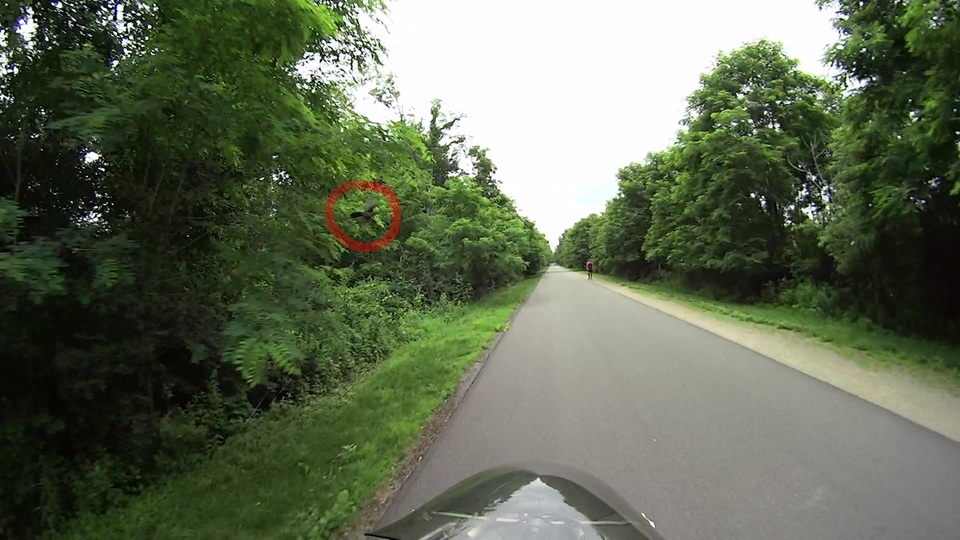
    At this instant, neither of us realized the other was present:

    Starling-0145
    Starling-0145

    Despite what it looks like, the blackbird (maybe a starling) passed just beyond arm’s reach directly ahead of the bike at eye level:

    Starling-0167
    Starling-0167

    And away!

    Starling-0173
    Starling-0173

    At 60 frames per second, that’s 466 ms of elapsed time.

    Stepping through the video, frame by frame, the bird’s wings flap at a consistent three frames per stroke = 50 ms/stroke = 20 stroke/s = 1200 stroke/min. A bit of rummaging produces a study suggesting a starling’s normal rate is 10 stroke/s, so the critter had the throttles firewalled at war emergency power.

    It makes my pedal pushing seem downright inconsequential…

  • Electrometer Amp: Darlington NPN

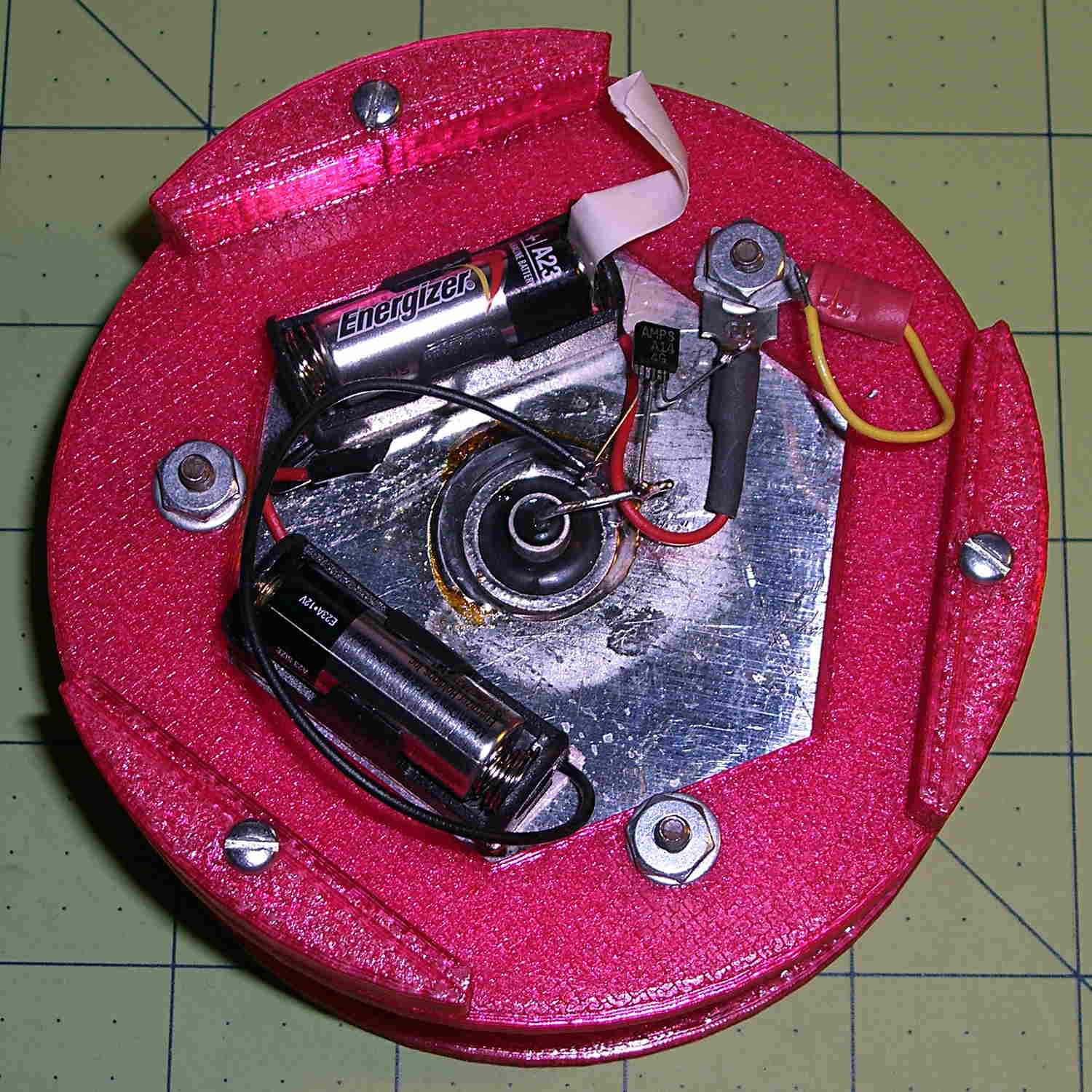
    I soldered up the simplest possible “electrometer amplifier” at Squidwrench, based on Charles Wenzel’s writeup:

    Electrometer Amp - MPSA14 NPN Darlington
    Electrometer Amp – MPSA14 NPN Darlington

    It’s an MPSA14 NPN Darlington transistor, with the base soldered directly to the Victoreen 710-104 ionization chamber collector pin. The flying leads connect to an ordinary digital voltmeter set to read voltage, rather than current, so that you see the voltage created by the transistor’s collector current through the meter’s input resistance.

    The MPSA14 data sheet specifies DC current gain hFE > 10 k for low collector currents, with a graph suggesting it might be somewhat larger. Alas, all those are for “ordinary” currents, not the countably finite number of electrons coming from an ionization chamber, but let’s assume 10 k is close.

    I used a Radio Shack 22-805 DMM, set to auto-ranging DC volts. The specs say the input “impedance” is 10 MΩ for all voltage ranges, so let’s run with that, too.

    With 24 V (actually 24.6 V) applied to both the chamber (through the red wire) and the DMM (through the yellow wire), it read 250 mV: a mere 25 nA through the 10 MΩ meter resistance.

    Assuming a transistor gain of 10 k, that’s a chamber current of 2.5 pA.

    The ionization chamber specs say it produces 5 pA at 0.5 röentgen/hour → 100 mR/h produces 1 pA.

    No, I do not believe the Squidwrench Operating Table is bathed in gamma radiation at 250 mR/h.

    I should wipe down the transistor to see if that reduces the external leakage, then try a few others, but obviously the signal will remain lost in the noise.

    We replaced the DMM with an oscilloscope and 10 MΩ probe, which conclusively demonstrated that unshielded high-impedance circuits make excellent 60 Hz receivers.

  • Monthly Science: Mystery Chip

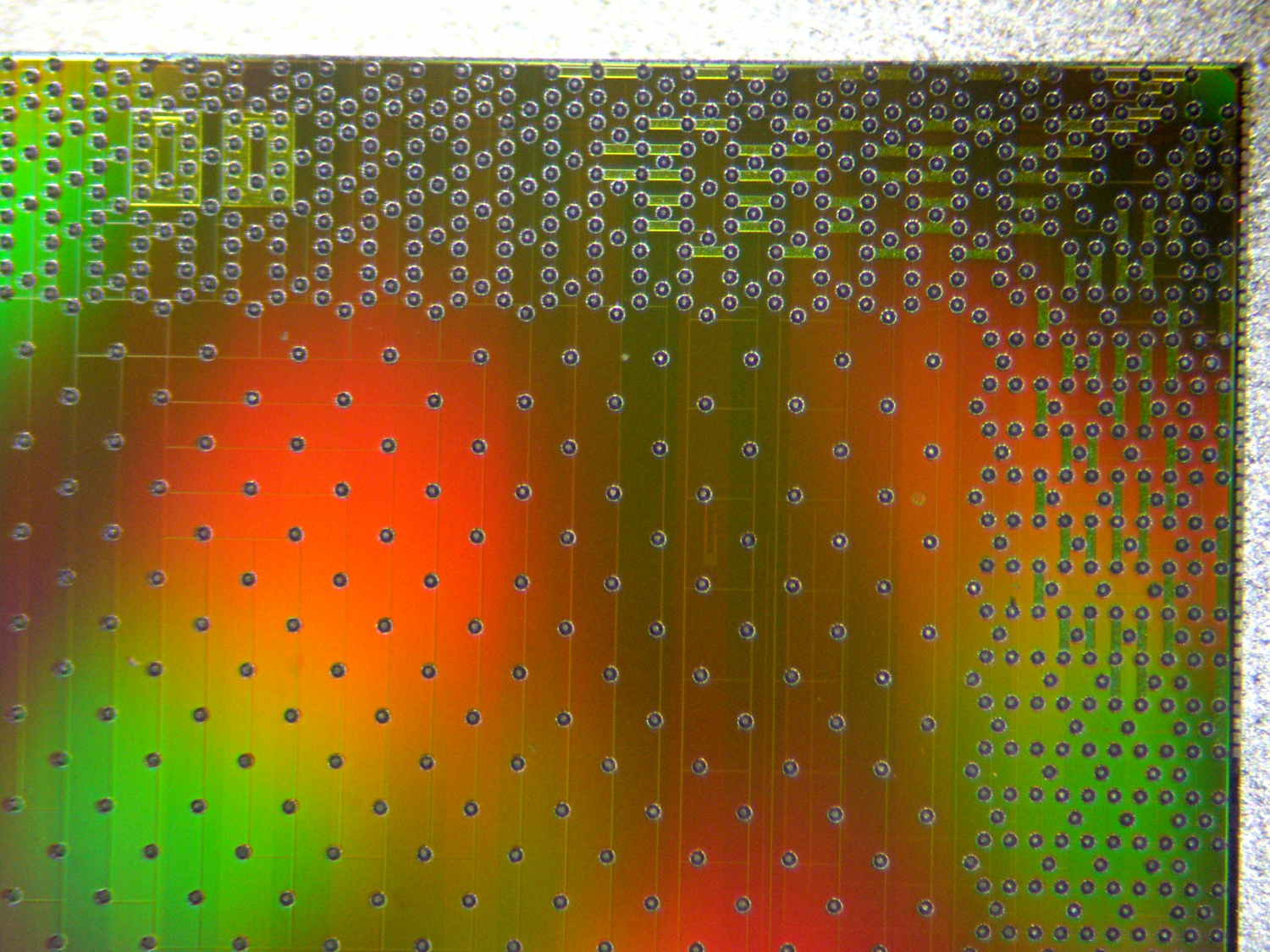
    Dragorn of Kismet gave me a handful of identical mystery chips that might date back to the 1980s. They’re surprisingly large and covered with contacts:

    Mystery IC - overview
    Mystery IC – overview

    There are no logos or identification anywhere on the chip. The back side is blank silicon.

    The visible patterns don’t suggest anything obvious:

    Mystery IC - detail 1
    Mystery IC – detail 1

    The metallization layers aren’t particularly intricate:

    Mystery IC - detail 2
    Mystery IC – detail 2

    Surely there’s something tucked under the top metallization; I have neither the materials nor inclination to dissolve the thing one layer at a time.

    I gave a sampling to our Larval Engineer, who says she may turn them into fancy jewelry. I’m sure the solder bumps contain lead, but …

  • Victoreen 710-104 Ionization Chamber

    Using radiation to generate random numbers reminded me of some Victoreen 710-104 ionization chambers that have been in the pile basically forever:

    Victoreen 710-104 Ionization Chamber
    Victoreen 710-104 Ionization Chamber

    The central contact seems to be double-insulated from the chamber with glass (?) seals in a soldered-in-place assembly:

    Victoreen 710-104 Ionization Chamber - terminal detail
    Victoreen 710-104 Ionization Chamber – terminal detail

    That might be rosin left over from soldering, but you’d think they would have rinsed it off to reduce the leakage. Some cleaning will be in order.

    A picture in The Fine Manual for the CD-V-710 Model 5 Radiation Survey Meter showed that the circuit board used point-to-point wiring, with the range switch soldered directly to that bent metal contact:

    Victoreen CD-V-710 Model 5 Manual - Page 10 - circuit layout
    Victoreen CD-V-710 Model 5 Manual – Page 10 – circuit layout

    Another page gave some useful values and a simplified schematic:

    Victoreen CD-V-710 Model 5 Manual - Page 5
    Victoreen CD-V-710 Model 5 Manual – Page 5

    Never fear, the manual also has the full schematic; they don’t write manuals like that any more.

    The chamber bias voltage was +22.5, from one carbon-zinc battery available back in the 1950s. You can still get 22.5 V batteries at about ten bucks a pop, but 24 V from a pair of cheap & readily available 12 V A23 alkaline batteries should be close enough. There’s no current drain, so the batteries should last their entire shelf life.

    The “HI-MEG” resistor represents a trio of glass-body resistors selected by the range switch:

    • R5 = 100 GΩ → 0.5 R/h
    • R6 = 10 GΩ→ 5 R/h
    • R7 = 1 GΩ→ 50 R/h

    As the saying goes, if you must select R7 in an actual emergency, you should sit down, put your head between your legs, and kiss your ass goodbye.

    The steel-wall chamber responds only to gamma radiation, with a nominal current of 5 pA at 0.5 R/h. However, given an op amp like the LMC6081 with 10 fA bias current, maybe building an electrometer-style amplifier that can respond to background gamma radiation or maybe secondary gamma rays from cosmic ray air showers would be feasible; I haven’t done anything like that in a while and even a faceplant would be interesting.

    Alas, radium-226 and its progeny, including radon-222 decay through alpha and beta emission that’s specifically excluded by the can.

    This is not a new idea, by any means, as shown by some extensive discussion and well-done circuitry. Any amplifier that works with the Victoreen can will certainly work with a homebrew ionization chamber.

  • Fly6 Video Compression: Blur to Sharpen?

    So I stuck a snippet of ordinary “transparent” (it’s actually translucent) adhesive tape across the top of the Cycliq Fly6 camera lens:

    Cycliq Fly6 Camera - blur tape
    Cycliq Fly6 Camera – blur tape

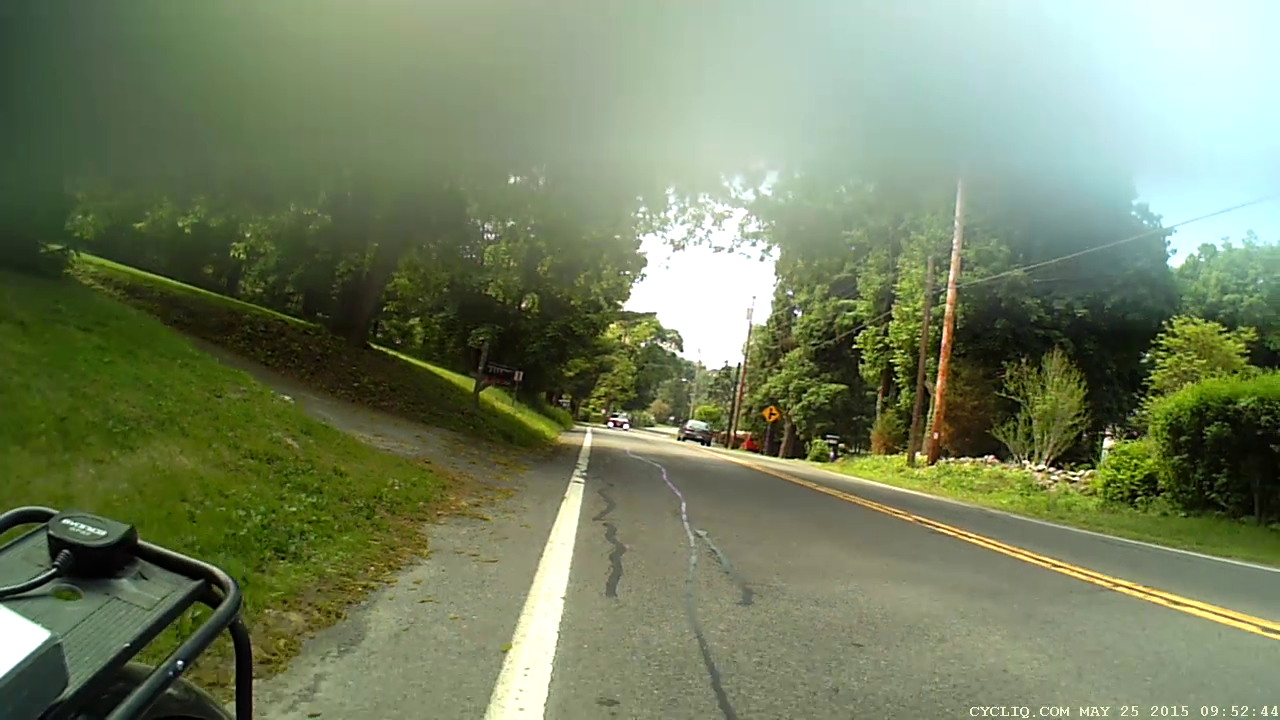
    That smoothly blurs the top third of the frame:

    Fly6 - Tape-blurred frame
    Fly6 – Tape-blurred frame

    The motivation for using translucent tape: it should maintain roughly the same brightness and color balance across the whole image. Opaque tape would burn out the remaining image as the camera desperately tries to maintain an average gray level.

    Fast-forwarding VLC with the video stopped forces it to display the inter-frame compression blocks spanning several seconds of video:

    Fly6 - Forced compression artifacts
    Fly6 – Forced compression artifacts

    The upper third of the frame has big, simple blocks that pegged the files at a uniform 475 MB per ten minute file, somewhat lower than the un-blurred 500 to 700 MB. So the compression definitely isn’t working nearly as hard.

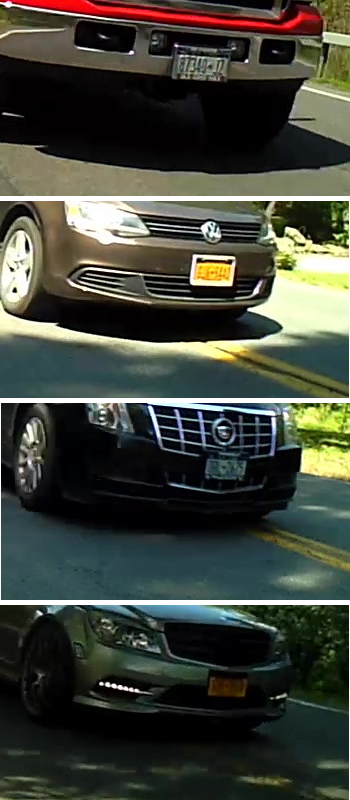
    I hoped that simplifying the uninteresting part of the image would leave more bits for license plates and other interesting details, which might be the case. New York has two main licence plate color schemes (the obsolete high-contrast blue-on-white and the current low-contrast blue-on-orange “Empire Gold”) and both the Fly6 and the Sony AS30V cameras do much better with white plates in full sun.

    Some samples at full size:

    Fly6 - License Plates
    Fly6 – License Plates

    Those were chosen based on:

    • Similar range / angle: just over the center line
    • Same-size crop box: 350 x 197
    • Sun vs. shade

    I think those are somewhat sharper than the plates from un-blurred frames, but it’s not like the camera suddenly woke up smarter and started paying attention to the important stuff.

    Time for more riding, minus the tape…

  • Monthly Science: Well Pit Temperature

    With more data, those February lows really stand out:

    Well Pit Air Temperature - 2014-10 to 2015-05-31
    Well Pit Air Temperature – 2014-10 to 2015-05-31

    The February daily record shows more detail:

    Well Pit - 2015-02-25
    Well Pit – 2015-02-25

    I’d say the air temperature in the pit got close to freezing, but surely a stream of cold air falling through the vent hole would wash over the logger and depress the results.

    Should I get powerfully motivated, I’ll strap the logger onto one of the pipes, wrap insulation around it, and have it take data from early December through late March in one session; lifting the concrete slab requires enough effort that I’m not going to do it, ah, lightly during the snow season.


  • Squirrel Pup Rescue

    We recently watched a gray squirrel drag a completely limp and unresponsive companion across the driveway, stopping every few yards to rest. We often see pairs of squirrels frisking / chasing / tussling in the yard, but this was something new.

    After 100 feet of dragging, with pauses every few yards, the squirrel had hauled her companion to the fence at the far side of the yard. I leaped to the conclusion that the limp squirrel was dead:

    Mother squirrel and pup - 1
    Mother squirrel and pup – 1

    But, after perhaps a minute, the “dead” squirrel gradually awoke and both critters slowly clambered up the fence. The squirrel on the right had been doing the dragging and is unquestionably female, the one on the left is much smaller and likely a new pup:

    Mother squirrel and pup - 2
    Mother squirrel and pup – 2

    So apparently the mother squirrel had hauled one of her pups away from something. Perhaps it was stunned after falling out of a tree or the sole survivor of a hawk attack? We’ll never know The Rest of The Story.

    Forgive the anthropomorphism, but if this isn’t motherly love & comfort, then give me another word for it:

    Mother squirrel and pup - 3
    Mother squirrel and pup – 3

    Taken through two layers of wavy 1955 window glass with the Sony DSC-H5.