The Smell of Molten Projects in the Morning

Ed Nisley's Blog: Shop notes, electronics, firmware, machinery, 3D printing, laser cuttery, and curiosities. Contents: 100% human thinking, 0% AI slop.

Category: Science

If you measure something often enough, it becomes science

  • 2N3904 and 2N3906 Transistor Assortments: Consistency Thereof

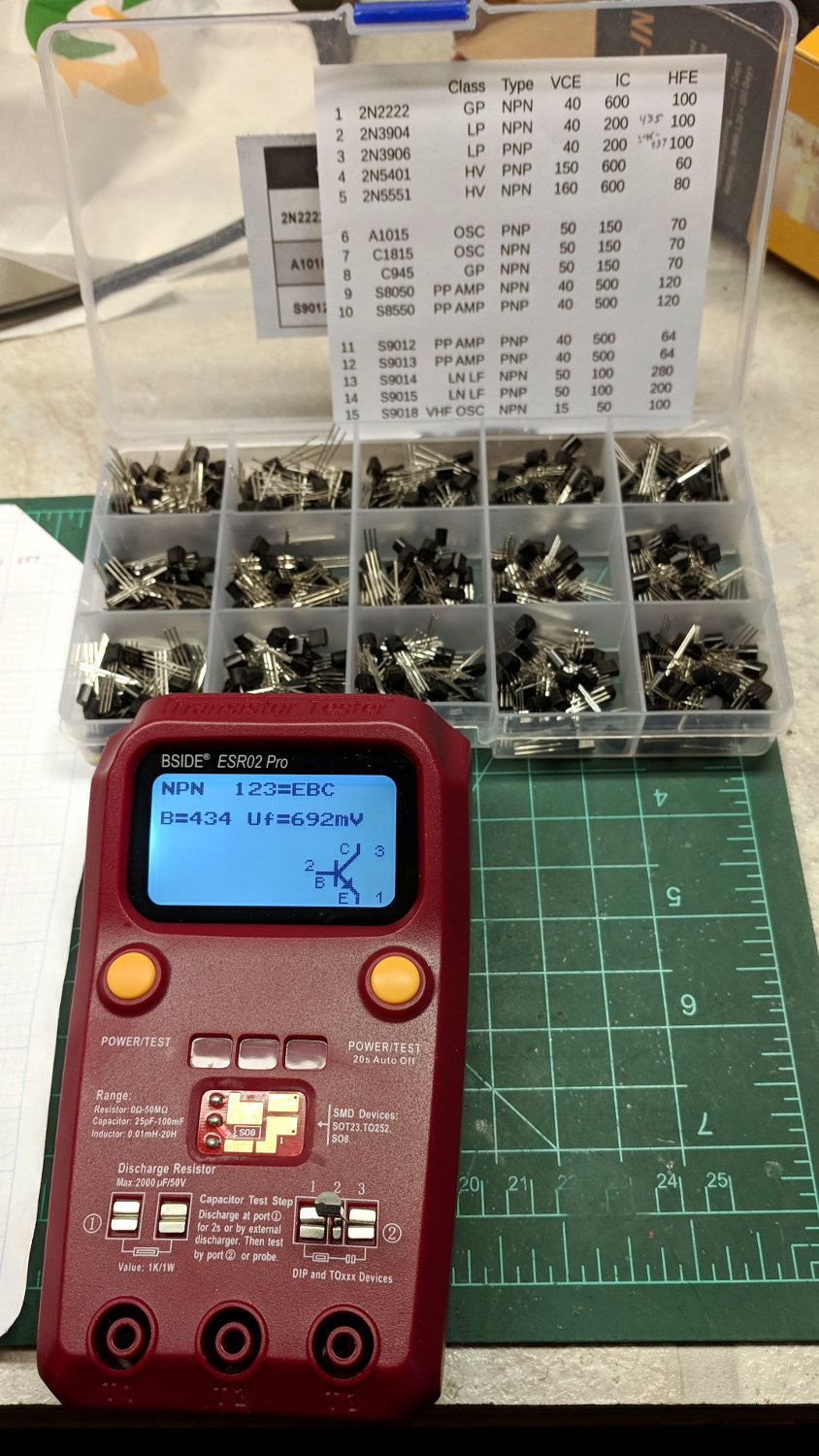
    A note about building a discrete equivalent of the classic LM3909 prompted me to measure some 2N3904 and 2N3906 transistors:

    ESR02 Tester - 2N3904 measurement
    ESR02 Tester – 2N3904 measurement

    The DC gain and VBE for each flavor look comfortingly uniform:

    Transistor measurements - 2N3904 2N3906
    Transistor measurements – 2N3904 2N3906

    Quite unlike those Hall effect sensors, indeed.

    Most of the VBE variation comes from temperature differences: re-measuring the 2N3904 transistors with VBE ≅ 672 mV put them with their compadres at 677 mV.

    The 2N3906 transistors have wider gain and VBE variations, so selecting a matched pair for the LM3909 current mirror makes sense.

    The sheet inside the lid collects some essential parameters for ease of reference:

                Class   Type   VCE     IC    HFE
    1   2N2222    GP     NPN    40    600    100
    2   2N3904    LP     NPN    40    200    100
    3   2N3906    LP     PNP    40    200    100
    4   2N5401    HV     PNP   150    600     60
    5   2N5551    HV     NPN   160    600     80
    
    6    A1015    OSC    PNP    50    150     70
    7    C1815    OSC    NPN    50    150     70
    8     C945    GP     NPN    50    150     70
    9    S8050   PP AMP  NPN    40    500    120
    10   S8550   PP AMP  PNP    40    500    120
    
    11   S9012   PP AMP  PNP    40    500     64
    12   S9013   PP AMP  NPN    40    500     64
    13   S9014   LN LF   NPN    50    100    280
    14   S9015   LN LF   PNP    50    100    200
    15   S9018   VHF OSC NPN    15     50    100
    

    You’re welcome.

  • MPCNC: Drag Knife Holder Spring Constant vs. Stiction

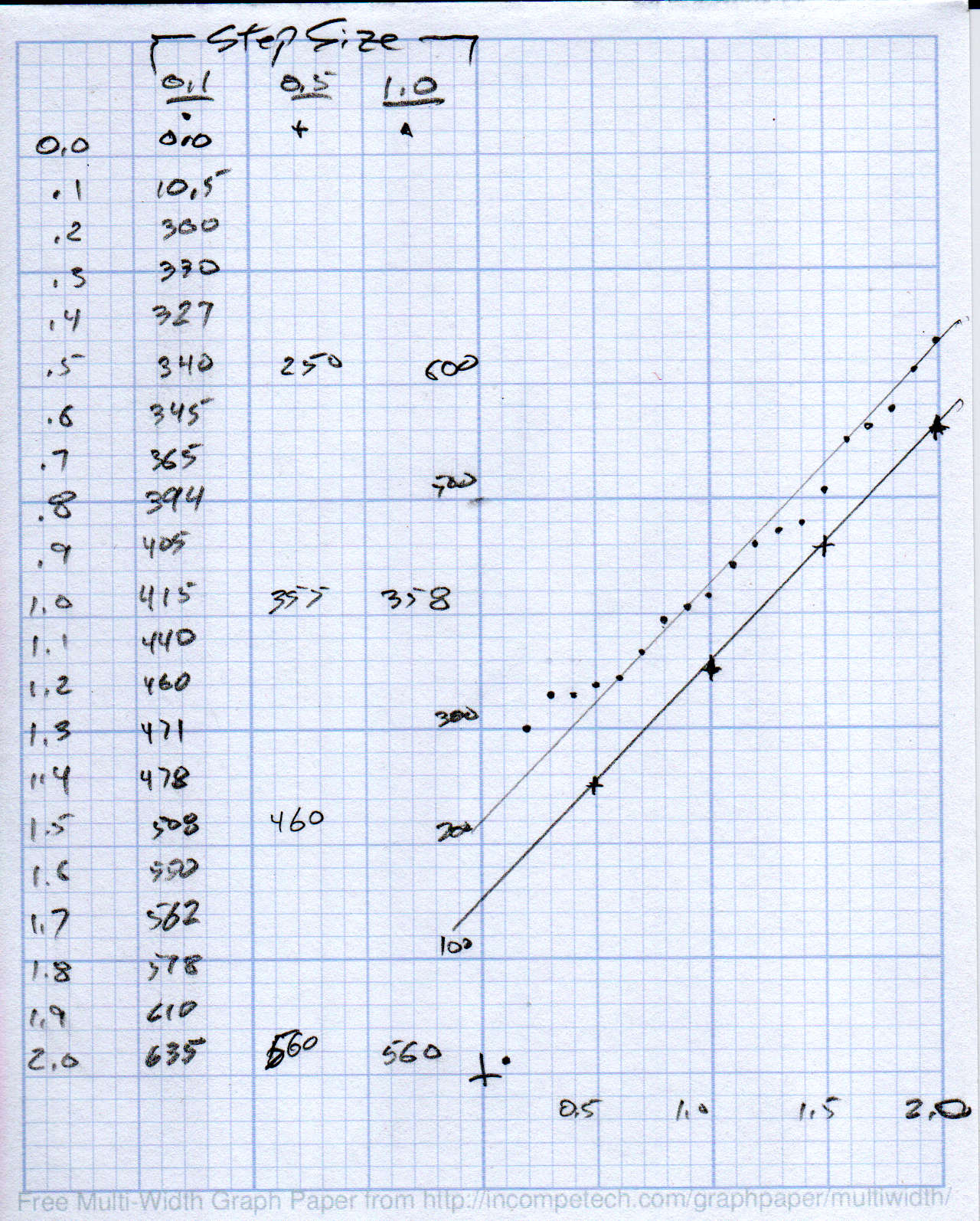
    Sliding a drag knife body in a PETG holder, even after boring the plastic to fit, shows plenty of stiction along 2 mm of travel:

    MPCNC - Drag Knife Holder - spring constant
    MPCNC – Drag Knife Holder – spring constant

    Punching the Z axis downward in 0.5 or 1.0 mm steps produced the lower line at 210 g/mm. Dividing by three springs, each one has a 70 g/mm spring constant, which may come in handy later.

    The wavy upper line shows the stiction as the Z axis drops in 0.1 mm steps. The line is eyeballometrically fit to be parallel to the “good” line, but it’s obvious you can’t depend on the Z axis value to put a repeatable force on the knife.

    I cranked about a turn onto the three screws to preload the springs and ensure the disk with the knife body settles onto the bottom of the holder:

    MPCNC - DW660 adapter drag knife holder - spring loaded
    MPCNC – DW660 adapter drag knife holder – spring loaded

    The screws are M4×0.7, so one turn should apply about 140 g of preload force to the pen holder. Re-taking a few data points with a 0.5 mm step and more attention to an accurate zero position puts the intercept at 200 g, so the screws may have been slightly tighter than I expected. Close enough, anyway.

    The stiction is exquisitely sensitive to the tightness of the two DW660 mount clamp screws (on the black ring), so the orange plastic disk isn’t a rigid body. No surprise there, either.

    Loosening the bored slip fit would allow more lateral motion at the tip. Perhaps top-and-bottom Delrin bushings (in a taller mount) would improve the situation? A full-on linear bearing seems excessive, even to me, particularly because I don’t want to bore out a 16 mm shaft for the blade holder.

    It’s certainly Good Enough™ as-is for the purpose, as I can set the cut depth to, say, 0.5 mm to apply around 250-ish g of downforce or 1.0 mm for 350-ish g. The key point is having enough Z axis compliance to soak up small  table height variations without needing to scan and apply compensation.

  • Squidwrench Electronics Workshop: Session 5 Whiteboards

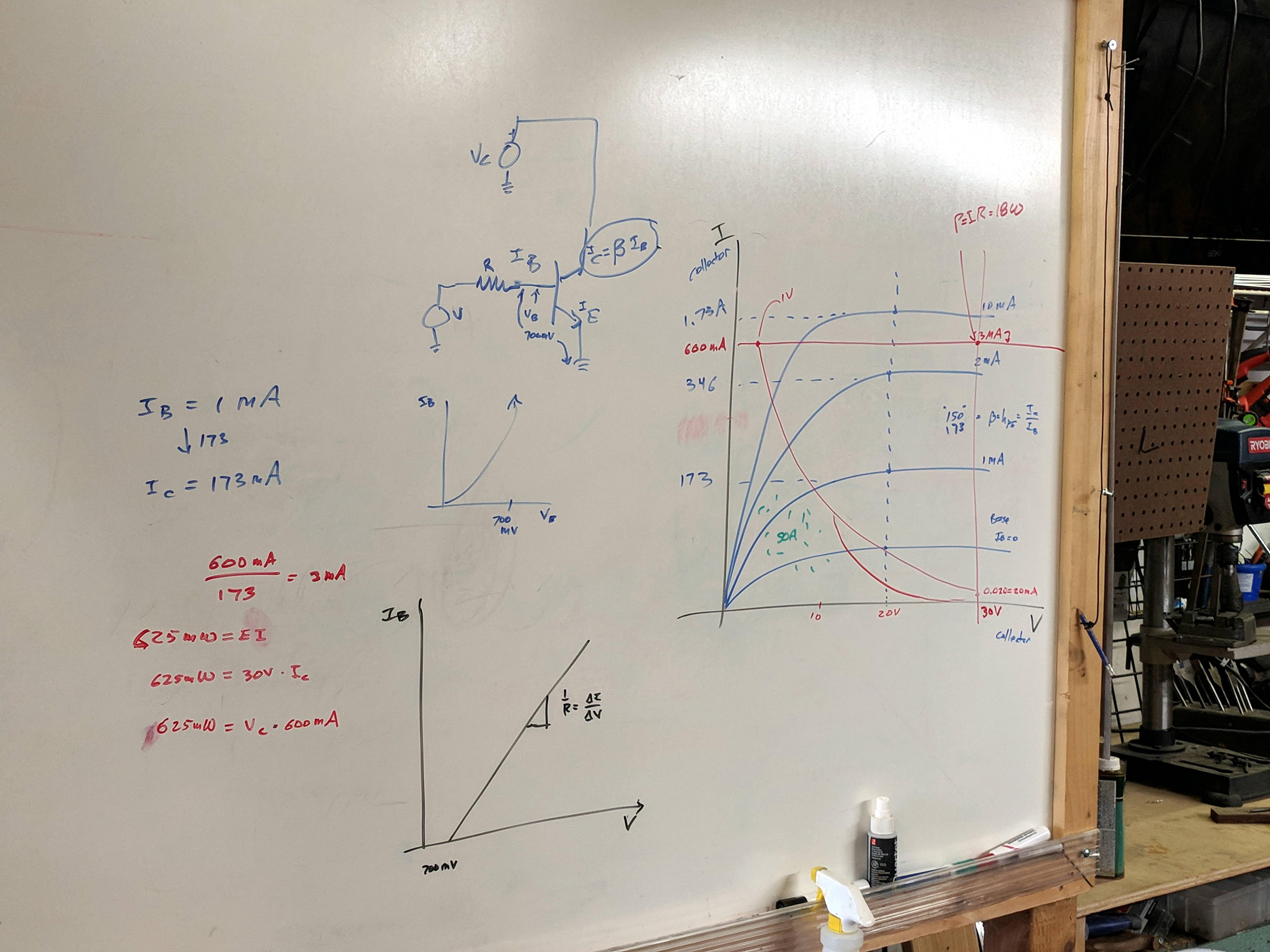
    Whiteboards from the SqWr Electronics Session 5, covering transistors as switches …

    Reviewing I vs V plots, starting with a resistor and then a transistor as a current amplifier:

    SqWr Electronics 5 - whiteboard 1
    SqWr Electronics 5 – whiteboard 1

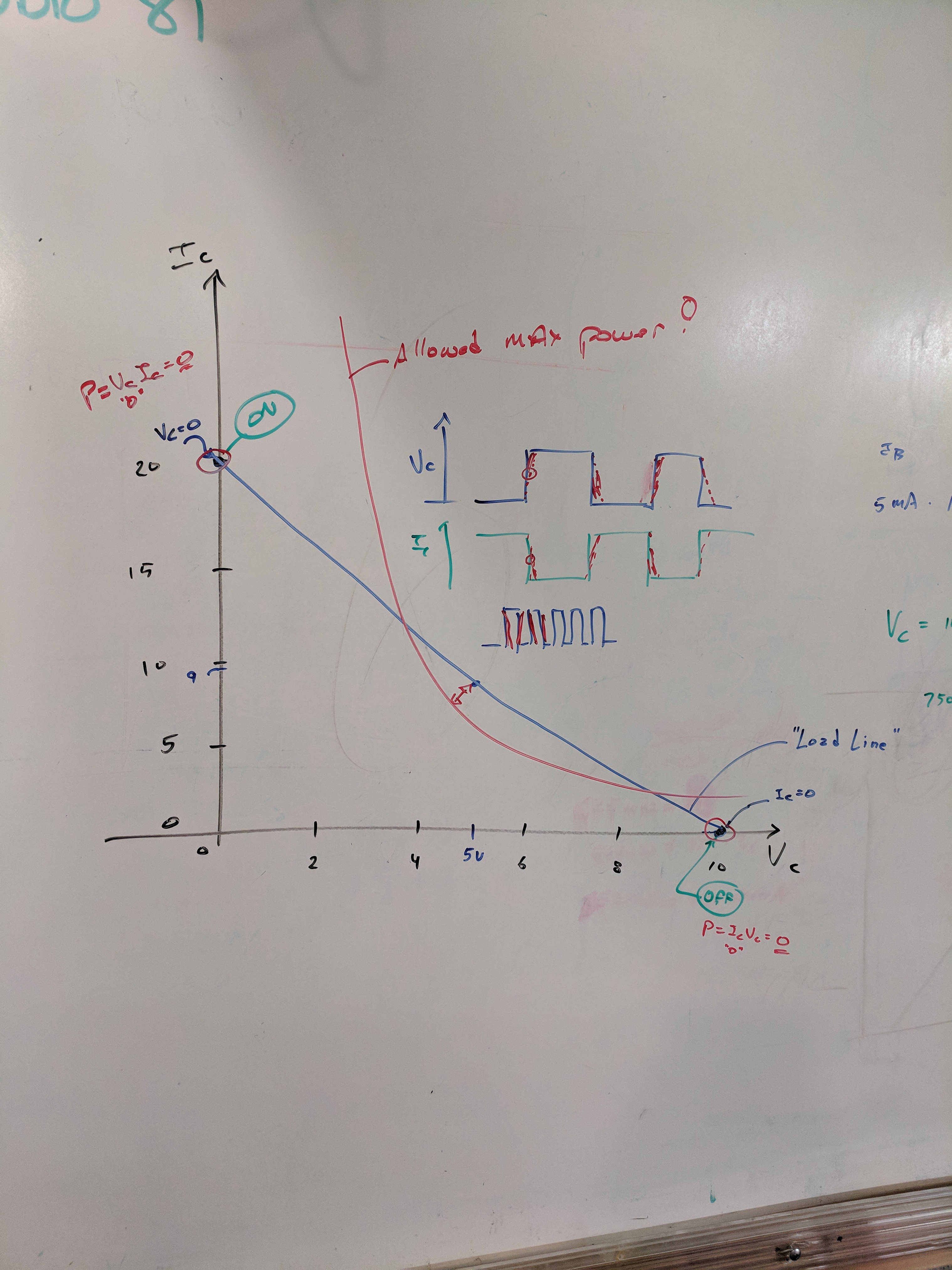
    Reminder of why you can’t run a transistor at its maximum voltage and current at the same time:

    SqWr Electronics 5 - whiteboard 2
    SqWr Electronics 5 – whiteboard 2

    A resistor load line, with power calculation at the switch on and off coordinates:

    SqWr Electronics 5 - whiteboard 3
    SqWr Electronics 5 – whiteboard 3

    Detail of the power calculations, along with a diagram of the current and voltage when you actually switch the poor thing:

    SqWr Electronics 5 - whiteboard 3 detail
    SqWr Electronics 5 – whiteboard 3 detail

    Oversimplification: most of the power happens in the middle, but as long as the switching frequency isn’t too high, it’s all good.

    Schematic of the simplest possible switched LED circuit, along with a familiar mechanical switch equivalent:

    SqWr Electronics 5 - whiteboard 4
    SqWr Electronics 5 – whiteboard 4

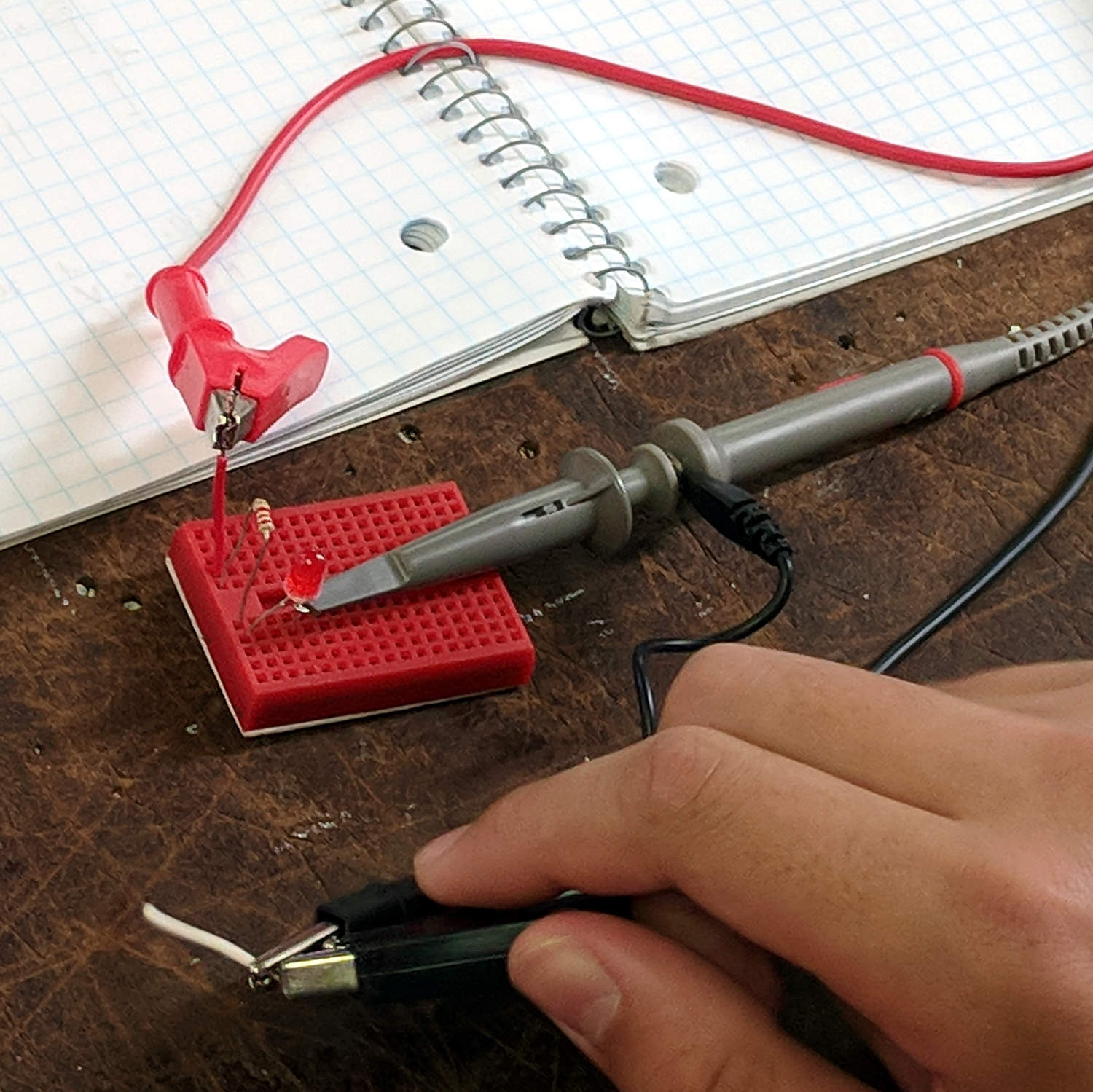
    We started with the “mechanical switch” to verify the connections:

    SqWr Session 5 - Switched LED breadboard
    SqWr Session 5 – Switched LED breadboard

    Building the circuitry wasn’t too difficult, but covering the function generator and oscilloscope hookup took far more time than I expected.

    My old analog Tek 2215 scope was a crowd-pleaser; there’s something visceral about watching a live CRT display you just don’t get from the annotated display on an LCD panel.

    I’d planned to introduce capacitors, but just the cap show-n-tell went well into overtime. We’ll get into those in Session 6, plus exploring RC circuitry with function generators and oscilloscopes.
  • MPCNC: Modified Drag Knife Adapter Spring Constant

    The bars on the original MPCNC drag knife / plotter pen adapter had a 100 g/mm spring constant:

    MPCNC - Plotter pen force test
    MPCNC – Plotter pen force test

    Making the bars slightly thicker improved their print-ability:

    MPCNC knife adapter mods - OpenSCAD model
    MPCNC knife adapter mods – OpenSCAD model

    The reddish tint marks the new bars, with their location carefully tweaked to be coincident with the stock STL.

    Shoving the pen into the scale with 0.1 mm steps produces another unnervingly linear plot:

    Modified MPCNC pen adapter - Spring Constant data
    Modified MPCNC pen adapter – Spring Constant data

    Real plotter pens want about 20 g of force, so this isn’t the holder you’re looking for.

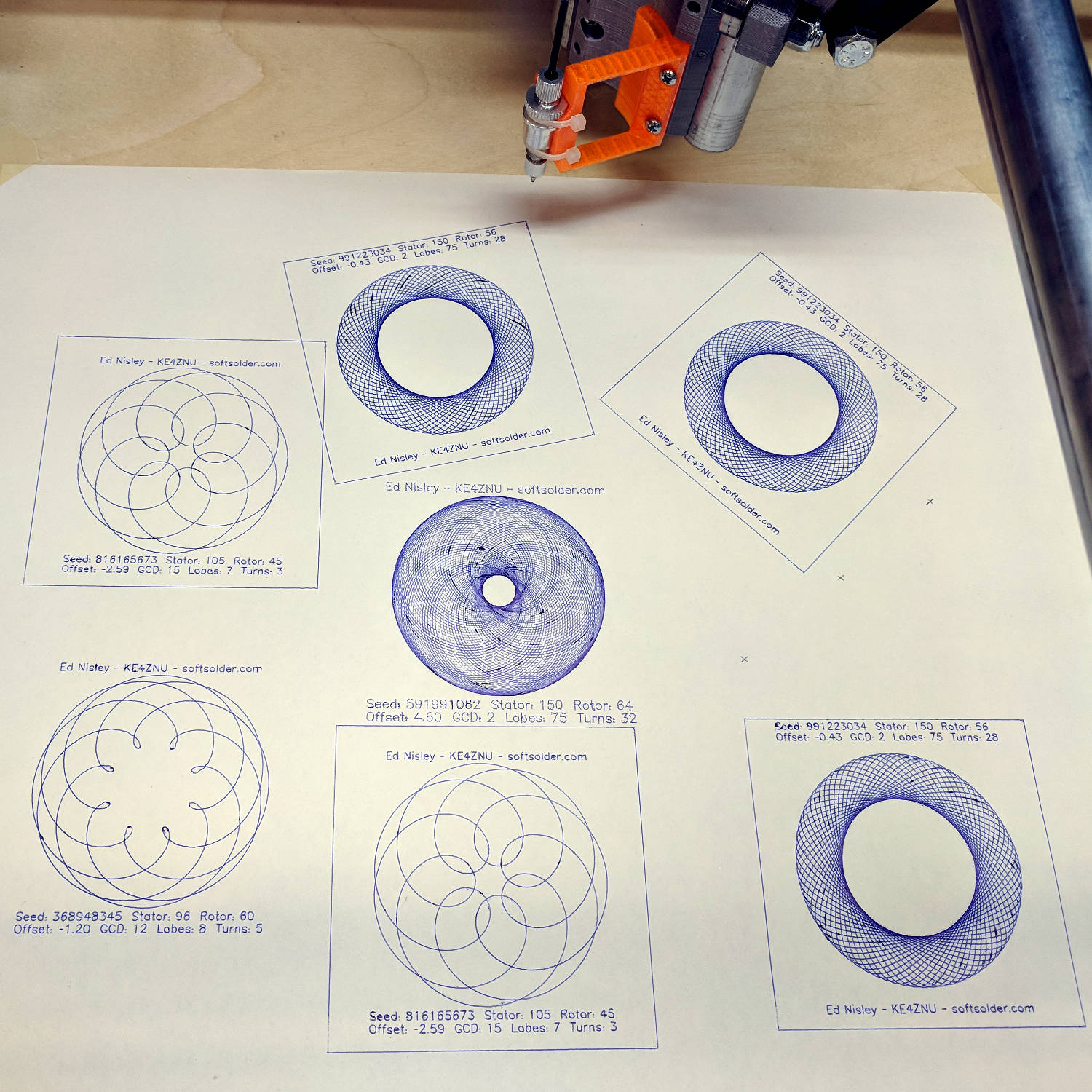
    A bunch of plots at Z=-1.0 mm turned out well with the ballpoint pen insert, though:

    MPCNC Modifed pen adapter - first plots
    MPCNC Modifed pen adapter – first plots

    The globs apparently come from plotting too fast for conditions; reducing the speed to 1500 mm/min works better.

  • Long-lived CFL Bulb

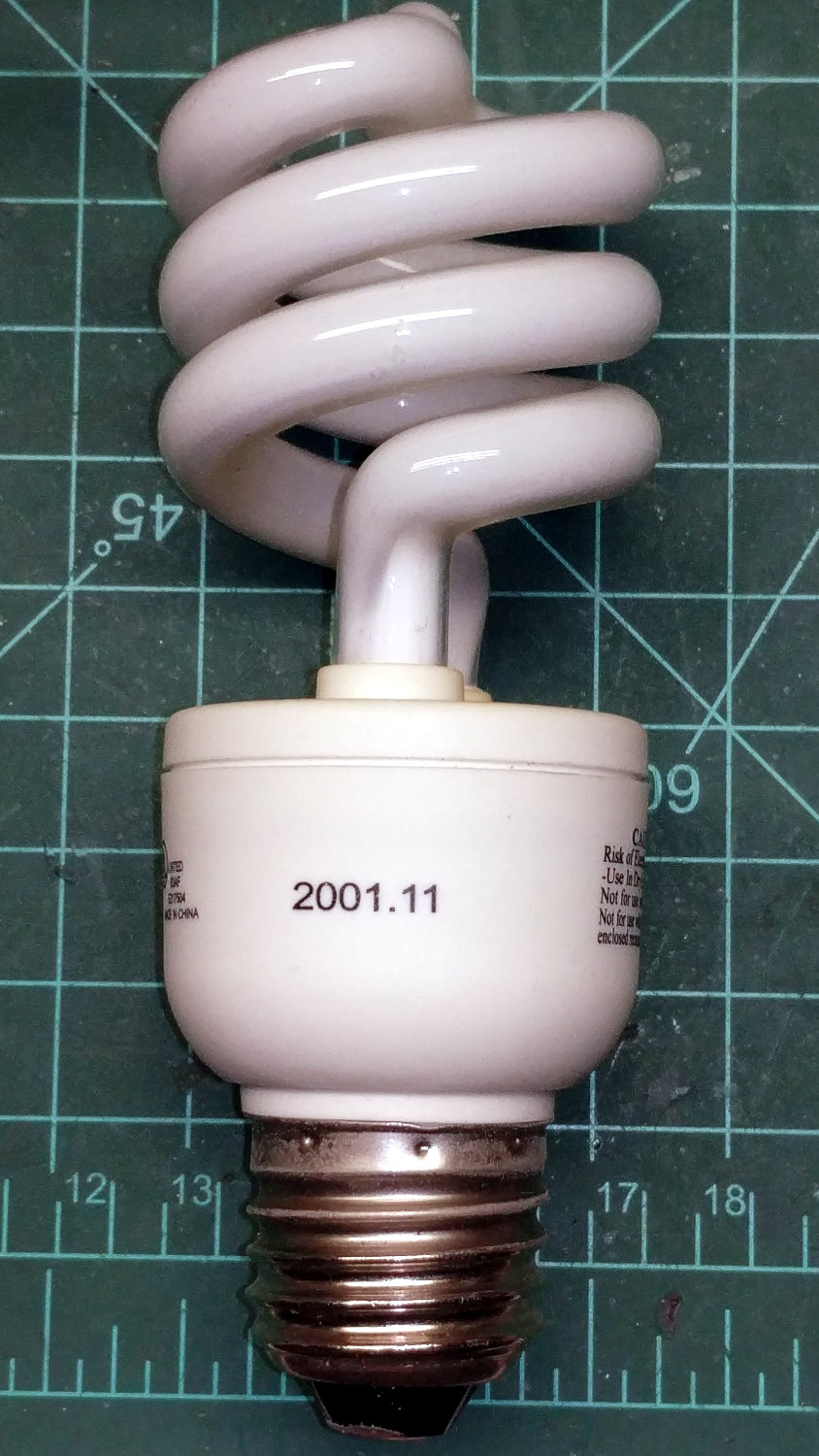
    This compact fluorescent lamp seems to have survived nearly two decades of use in a desk lamp:

    Desk Lamp - long lived CFL
    Desk Lamp – long lived CFL

    It had plenty of starts, although maybe not so many total hours, as the other CFLs you’ll find mentioned around here.

    I swapped in a similar CFL and we’ll see what happens.

  • Monthly Science: Cheese Slicer Epoxy vs. Water, Continuing

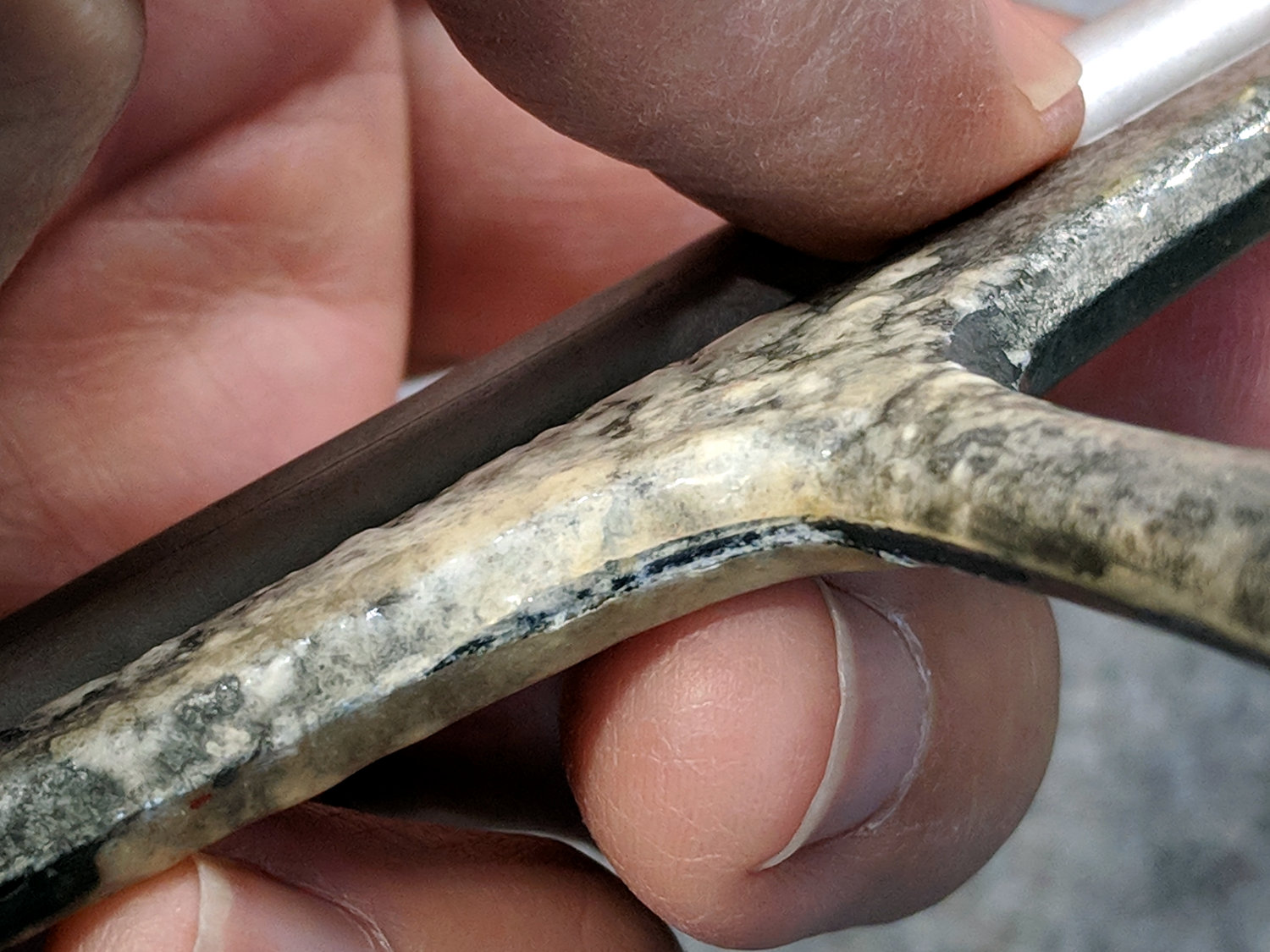
    The epoxy coating on our cheap aluminum (?) cheese slicer continues to corrode (clicky for more dots):

    Cheese slicer - epoxy failure - front
    Cheese slicer – epoxy failure – front

    The back side:

    Cheese slicer - epoxy failure - rear
    Cheese slicer – epoxy failure – rear

    The epoxy coating remains intact, although I expect it’ll break through as the corrosion products swell underneath.

    For whatever it’s worth, I applied the epoxy almost exactly one year ago.

  • Maximum Strength Homeopathic HGH: Not

    Spotted at an exhibition for Olde Fartes:

    Somaderm homeopathic HGH
    Somaderm homeopathic HGH

    I think they just blew up the bottle label to human size, with no attention to the resulting pixelation.

    One can find Somaderm on the Interwebs, which leads to the “Active Ingredients” list:

    Somaderm homeopathic HGH - Active Ingredients
    Somaderm homeopathic HGH – Active Ingredients

    Looking up their NDC number helps translate the bullshit Latinesque nomenclature:

    • Glandula Suprarenalis Suis = boar adrenal glands
    • Thyroidinum = cow thyroid glands
    • Somatropin = human growth hormone

    They’re exceedingly proud of that NDC number, touting “SOMADERM Gel is the only transdermal, FDA registered product”. Indeed, it’s registered, about which the FDC has this to say:

    Assigned NDC numbers are not in any way an indication of FDA approval of the product.

    and

    Marketing Category UNAPPROVED HOMEOPATHIC

    With that in mind, consider the dilutions:

    • Glandula Suprarenalis Suis = 1 part per million
    • Thyroidinum = 10 part per billion
    • Somatropin = 1×10-30 = there are no words

    Homeopathic “drugs” never list the starting concentration or amounts in the product, but diluting something by a factor of ten-to-the-thirty ensures not one single molecule of the original compound will make it into the bottle. This, of course, means the HGH is at “maximum strength”, in the homeopathic way of magical thinking.

    You’ll surely find some molecules of pig brain and maybe even a few molecules of cow glands, but I suspect they’re not buying the “active” ingredients in shipping container lots. In round numbers, one pig adrenal, one cow thyroid, and one drop of actual HGH would supply their needs well into the future.

    I would like to see how they dilute those ingredients, because I doubt they have legions of trained homeopaths succussing bottles against elastic surfaces.

    Of course, such dilution requires careful attention to detail, lest a stray molecule make its way into the final product, which surely justifies the punch line:

    Somaderm homeopathic HGH - Price
    Somaderm homeopathic HGH – Price

    There is also a $150 “Membership Price”, suggesting a multi-level marketing scam running in parallel. Some rummaging on their website reveals cryptic phrases confirming the suspicion: “Be the change that will inspire others to follow” and “Information on how to become a distributor“.

    Ya gotta admire ’em for not even blinking.

    A note on commenting: there is zero evidence of efficacy¸ so don’t even try to advocate homeopathy. If it worked, it’d be medicine, not a MLM scam.