The Smell of Molten Projects in the Morning

Ed Nisley's Blog: Shop notes, electronics, firmware, machinery, 3D printing, laser cuttery, and curiosities. Contents: 100% human thinking, 0% AI slop.

Category: Science

If you measure something often enough, it becomes science

  • Monthly Image: AMP Plug Board

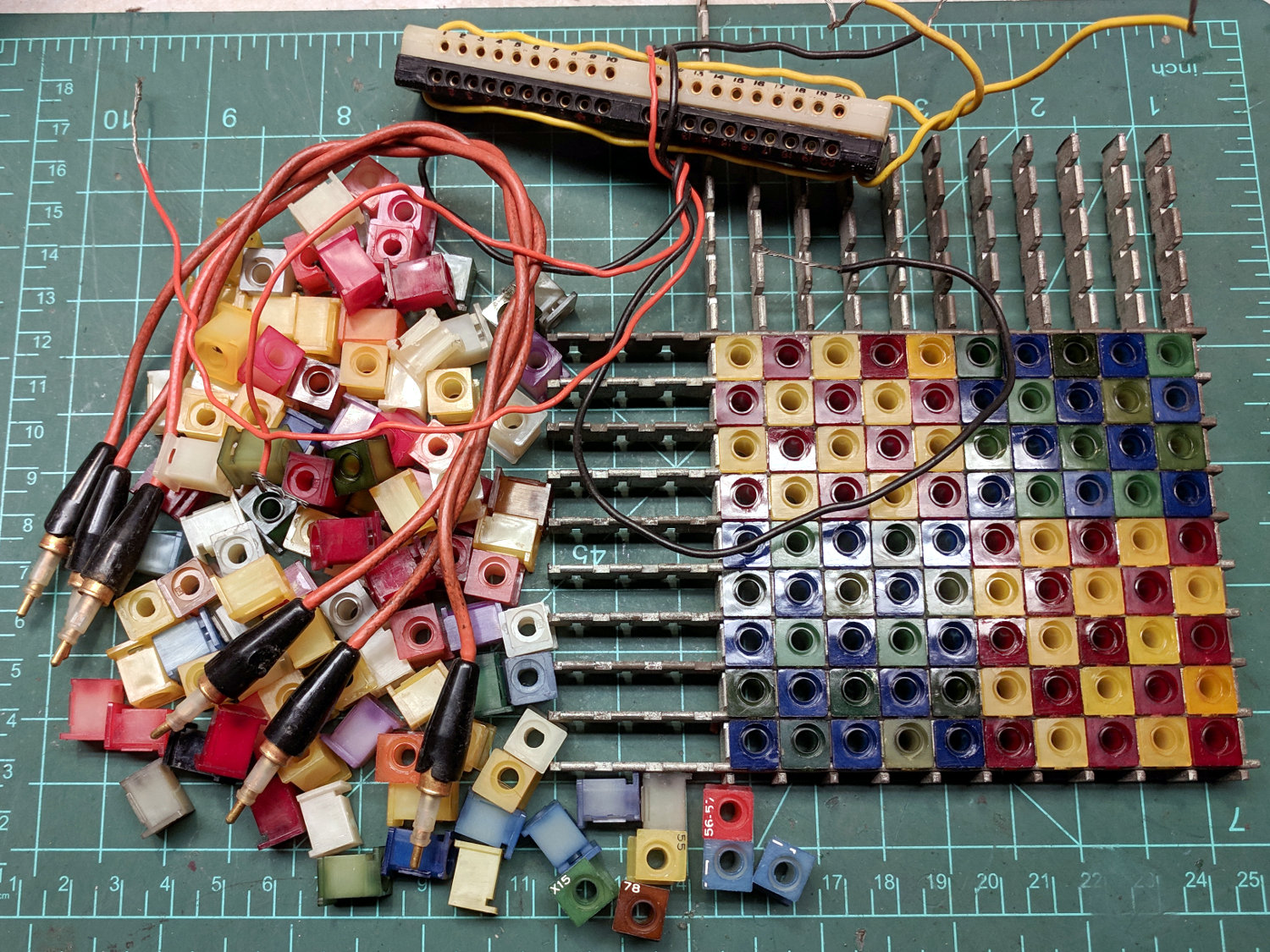
    Around 1960, somebody my father knew at the Harrisburg AMP factory gave me a chunk of plugboard bandsawed from a scrapped computer or industrial controller, because he knew I’d enjoy it:

    AMP Plug Board
    AMP Plug Board

    He was right.

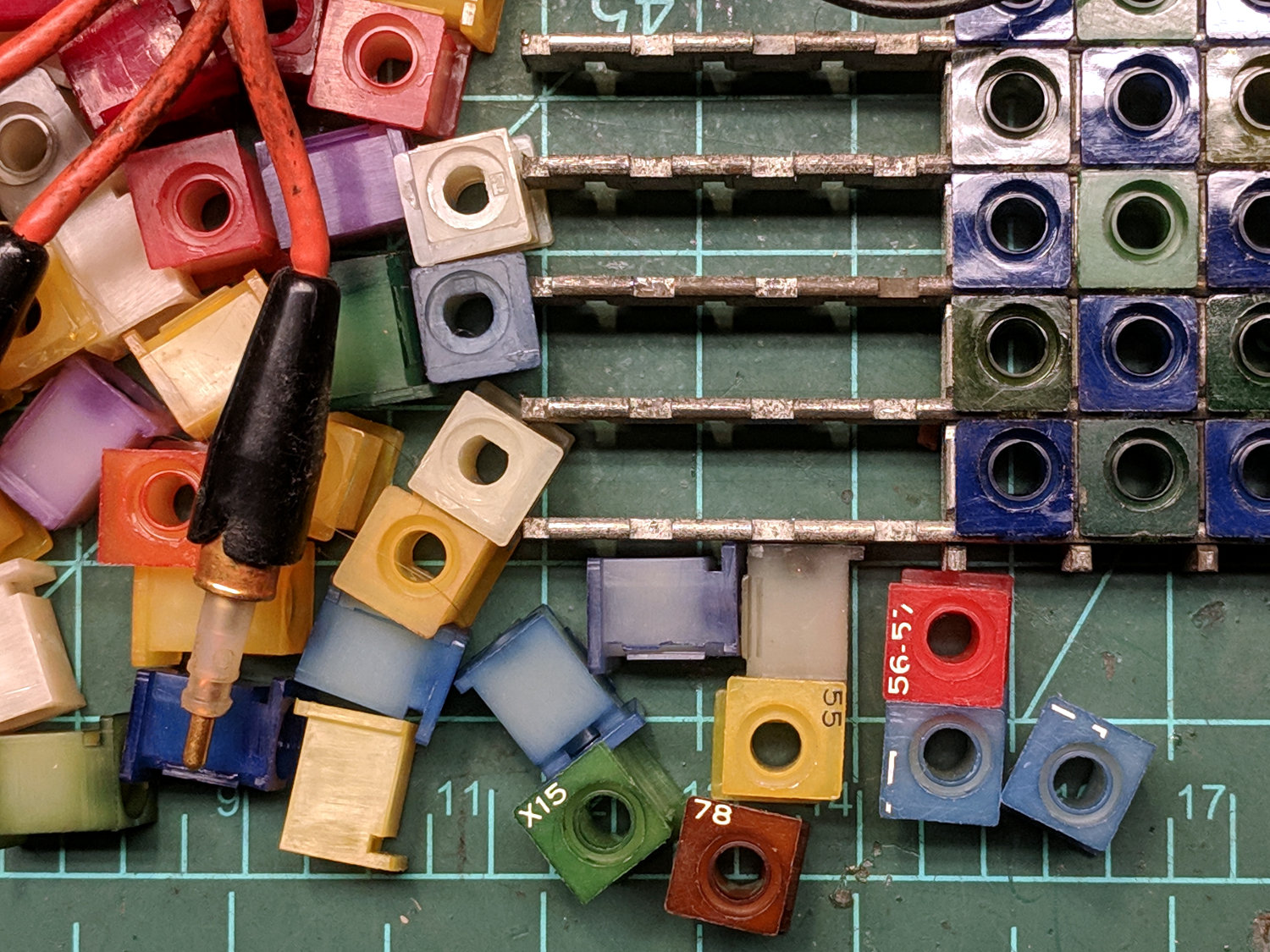
    I spent months rearranging those little cubes (some with cryptic legends!) into meaningful (to me) patterns, plugging cables between vital spots, and imagining how the whole thing worked:

    AMP Plug Board - detail
    AMP Plug Board – detail

    Long springs ran through the notches under the top of the blocks to connect the plug shells to circuit ground. The ends of the steel rails (still!) have raw bandsaw cuts, some of the blocks were sliced in two, the tip contact array behind the panel wasn’t included, and none of that mattered in the least.

    Only a fraction of the original treasure trove survives. It was absolutely my favorite “toy” ever.

    Quite some years ago, our Larval Engineer assembled the pattern you see; the hardware still had some attraction.

    I’ve asked Mary to toss it in the hole with whatever’s left of me, when that day arrives …

  • Bird Feeder Unbending

    At some point in its history, the left rail holding the wood perch on our industrial-strength “squirrel proof” seed feeder took a hit, most likely from being dropped:

    Squirrel on bird feeder
    Squirrel on bird feeder

    I finally got a Round Tuit and un-bent the poor thing:

    Bird feeder - rail un-bending
    Bird feeder – rail un-bending

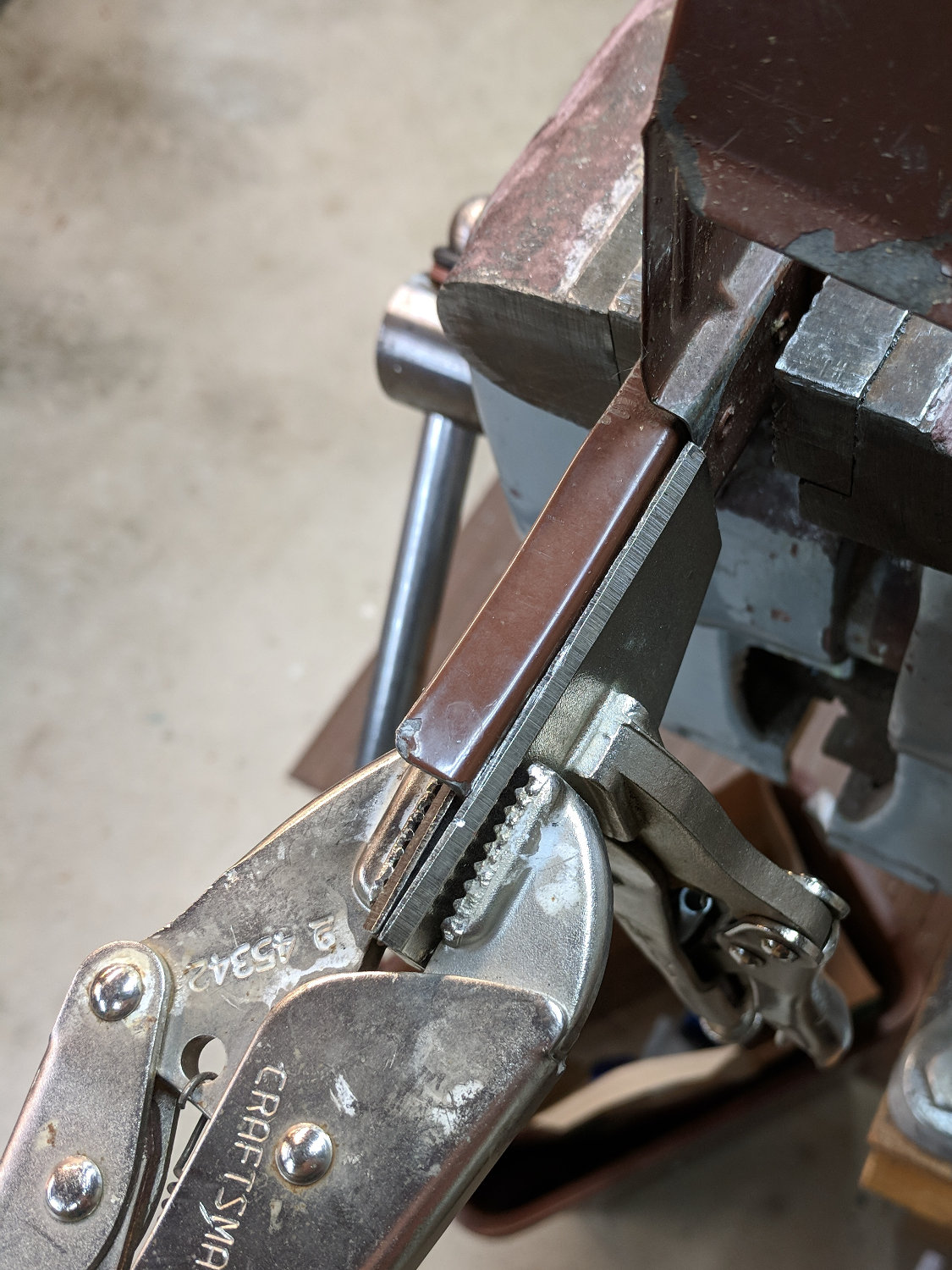
    Because the bend happened at the base of the vertical strut holding the shutter, I clamped a Genuine Vise-Grip sheet metal pliers along the straight section. The Craftsman knock-off Vise-Grip then applied torque at the bend, rather than just making things worse, and some two-axis tweakage lined up the rail pretty well.

    With the bend taken care of, I clamped the rail in the bench vise with some scrap wood around the strut:

    Bird feeder - warped rail
    Bird feeder – warped rail

    A percussive adjustment jam session flattened the top flange, leaving both sections as flat as they’re gonna get.

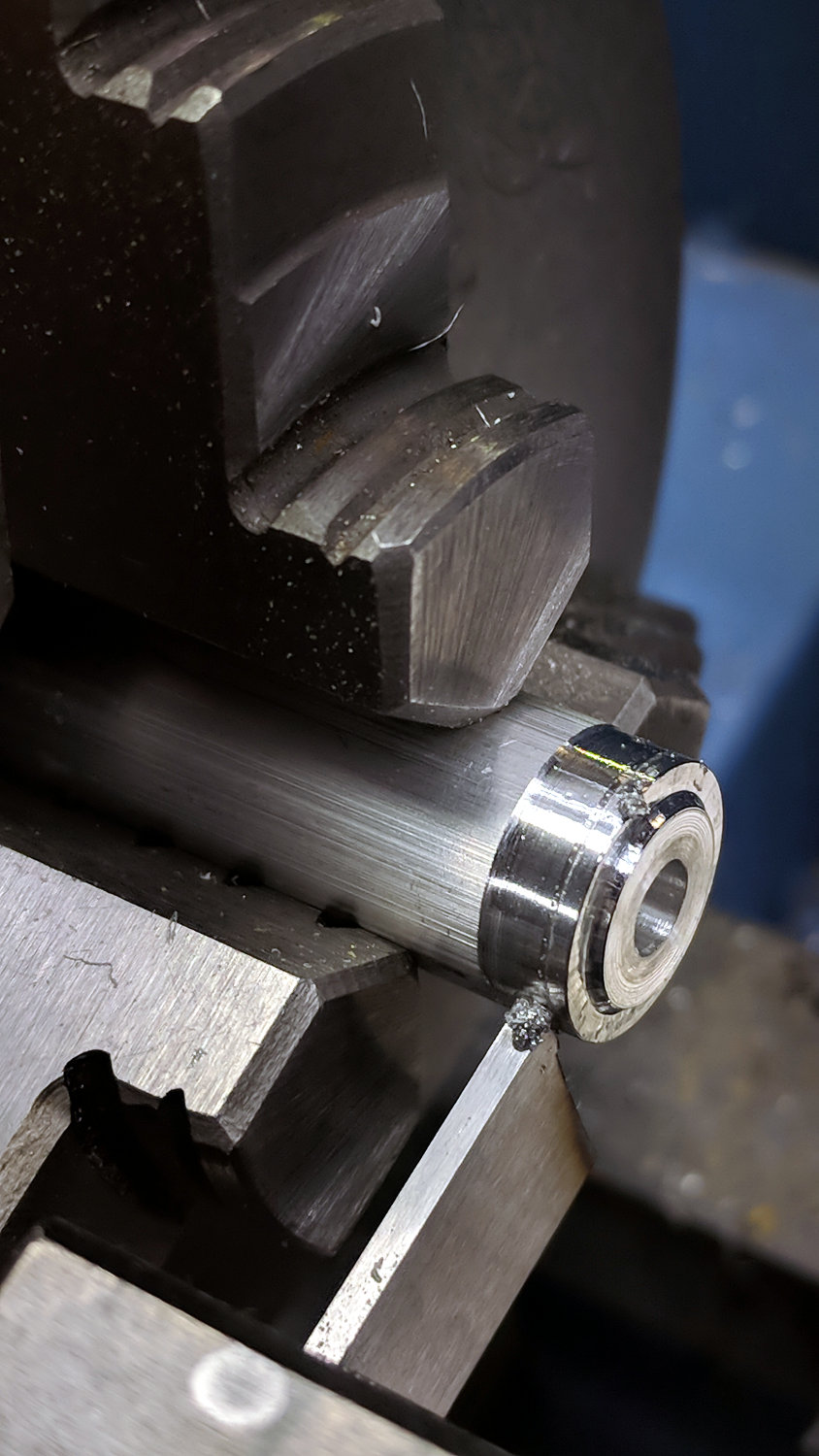
    While I was at it, I turned a pair of stepped aluminum washers for the new wood rod:

    Bird feeder - parting off washer
    Bird feeder – parting off washer

    Which looked about like you’d expect, including a little chatter from the cut off tool:

    Bird feeder - perch hardware
    Bird feeder – perch hardware

    Yeah, I drilled the wood rod on the lathe, too; I loves me some simple lathe action.

    Reassemble in reverse order and it’s all good:

    Bird feeder - perch installed
    Bird feeder – perch installed

    We’re supposed to bleach the feeder every week to kill off the bacteria causing House Finch Eye Disease and, while I can’t promise a weekly schedule, we’ll (try to) reduce the amount of crud on the feeder this year.

    If you’ve got a feeder, sign up for Project Feederwatch and do some citizen science!

  • MPCNC: Diamond Drag Engraver vs. Acrylic

    Drawn at Z=-0.1 mm on scrap acrylic with the diamond engraver in the modified collet holder:

    MPCNC - Diamond point - acrylic 0.1mm
    MPCNC – Diamond point – acrylic 0.1mm

    The badly rounded corner comes from a Z touch off in facepalm mode; the poor diamond must have been trying to dig a 2 mm trench through the acrylic.

    Then again at Z=-0.5 mm:

    MPCNC - Diamond point - acrylic 0.5mm
    MPCNC – Diamond point – acrylic 0.5mm

    At half a millimeter, the holder applies well over 100 g of downforce. There’s no way to know how much lateral force the tip applies to the holder, but it’s obvious the parallel beams on the MPCNC drag knife adapter lack lateral stability:

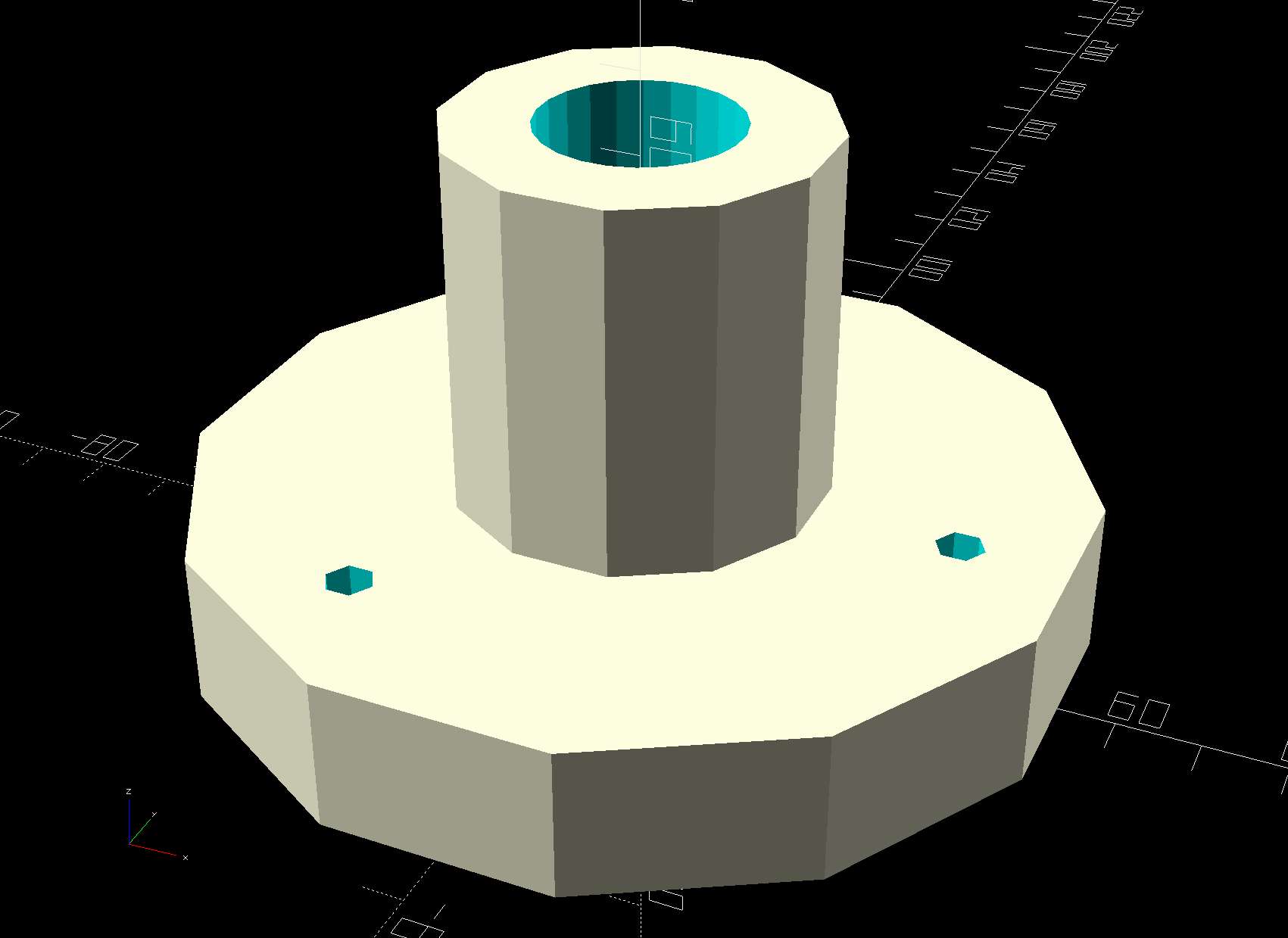
    MPCNC knife adapter mods - OpenSCAD model
    MPCNC knife adapter mods – OpenSCAD model

    Bending beams still seem much better than a linear bearing, though.

  • Monthly Science: End of the Cheese Slicer Epoxy Coating

    The corrosion growing on our long-suffering cheese slicer finally ruptured its epoxy coating:

    Cheese Slicer - epoxy coating split
    Cheese Slicer – epoxy coating split

    Most of the epoxy remains in good shape, but it’s obviously not the right hammer for this job.

    Having recently spotted my tiny sandblaster, I think I can clear off the corrosion and epoxy well enough to try again with good old JB Weld epoxy. It’s not rated for underwater use, so I don’t expect long-term goodness, but it’ll be an interesting comparison.

    Bonus: the slicer will start with a uniform gray surface!


  • 2N3904 and 2N3906 Transistor Assortments: Consistency Thereof

    A note about building a discrete equivalent of the classic LM3909 prompted me to measure some 2N3904 and 2N3906 transistors:

    ESR02 Tester - 2N3904 measurement
    ESR02 Tester – 2N3904 measurement

    The DC gain and VBE for each flavor look comfortingly uniform:

    Transistor measurements - 2N3904 2N3906
    Transistor measurements – 2N3904 2N3906

    Quite unlike those Hall effect sensors, indeed.

    Most of the VBE variation comes from temperature differences: re-measuring the 2N3904 transistors with VBE ≅ 672 mV put them with their compadres at 677 mV.

    The 2N3906 transistors have wider gain and VBE variations, so selecting a matched pair for the LM3909 current mirror makes sense.

    The sheet inside the lid collects some essential parameters for ease of reference:

                Class   Type   VCE     IC    HFE
    1   2N2222    GP     NPN    40    600    100
    2   2N3904    LP     NPN    40    200    100
    3   2N3906    LP     PNP    40    200    100
    4   2N5401    HV     PNP   150    600     60
    5   2N5551    HV     NPN   160    600     80
    
    6    A1015    OSC    PNP    50    150     70
    7    C1815    OSC    NPN    50    150     70
    8     C945    GP     NPN    50    150     70
    9    S8050   PP AMP  NPN    40    500    120
    10   S8550   PP AMP  PNP    40    500    120
    
    11   S9012   PP AMP  PNP    40    500     64
    12   S9013   PP AMP  NPN    40    500     64
    13   S9014   LN LF   NPN    50    100    280
    14   S9015   LN LF   PNP    50    100    200
    15   S9018   VHF OSC NPN    15     50    100
    

    You’re welcome.

  • MPCNC: Drag Knife Holder Spring Constant vs. Stiction

    Sliding a drag knife body in a PETG holder, even after boring the plastic to fit, shows plenty of stiction along 2 mm of travel:

    MPCNC - Drag Knife Holder - spring constant
    MPCNC – Drag Knife Holder – spring constant

    Punching the Z axis downward in 0.5 or 1.0 mm steps produced the lower line at 210 g/mm. Dividing by three springs, each one has a 70 g/mm spring constant, which may come in handy later.

    The wavy upper line shows the stiction as the Z axis drops in 0.1 mm steps. The line is eyeballometrically fit to be parallel to the “good” line, but it’s obvious you can’t depend on the Z axis value to put a repeatable force on the knife.

    I cranked about a turn onto the three screws to preload the springs and ensure the disk with the knife body settles onto the bottom of the holder:

    MPCNC - DW660 adapter drag knife holder - spring loaded
    MPCNC – DW660 adapter drag knife holder – spring loaded

    The screws are M4×0.7, so one turn should apply about 140 g of preload force to the pen holder. Re-taking a few data points with a 0.5 mm step and more attention to an accurate zero position puts the intercept at 200 g, so the screws may have been slightly tighter than I expected. Close enough, anyway.

    The stiction is exquisitely sensitive to the tightness of the two DW660 mount clamp screws (on the black ring), so the orange plastic disk isn’t a rigid body. No surprise there, either.

    Loosening the bored slip fit would allow more lateral motion at the tip. Perhaps top-and-bottom Delrin bushings (in a taller mount) would improve the situation? A full-on linear bearing seems excessive, even to me, particularly because I don’t want to bore out a 16 mm shaft for the blade holder.

    It’s certainly Good Enough™ as-is for the purpose, as I can set the cut depth to, say, 0.5 mm to apply around 250-ish g of downforce or 1.0 mm for 350-ish g. The key point is having enough Z axis compliance to soak up small  table height variations without needing to scan and apply compensation.

  • Squidwrench Electronics Workshop: Session 5 Whiteboards

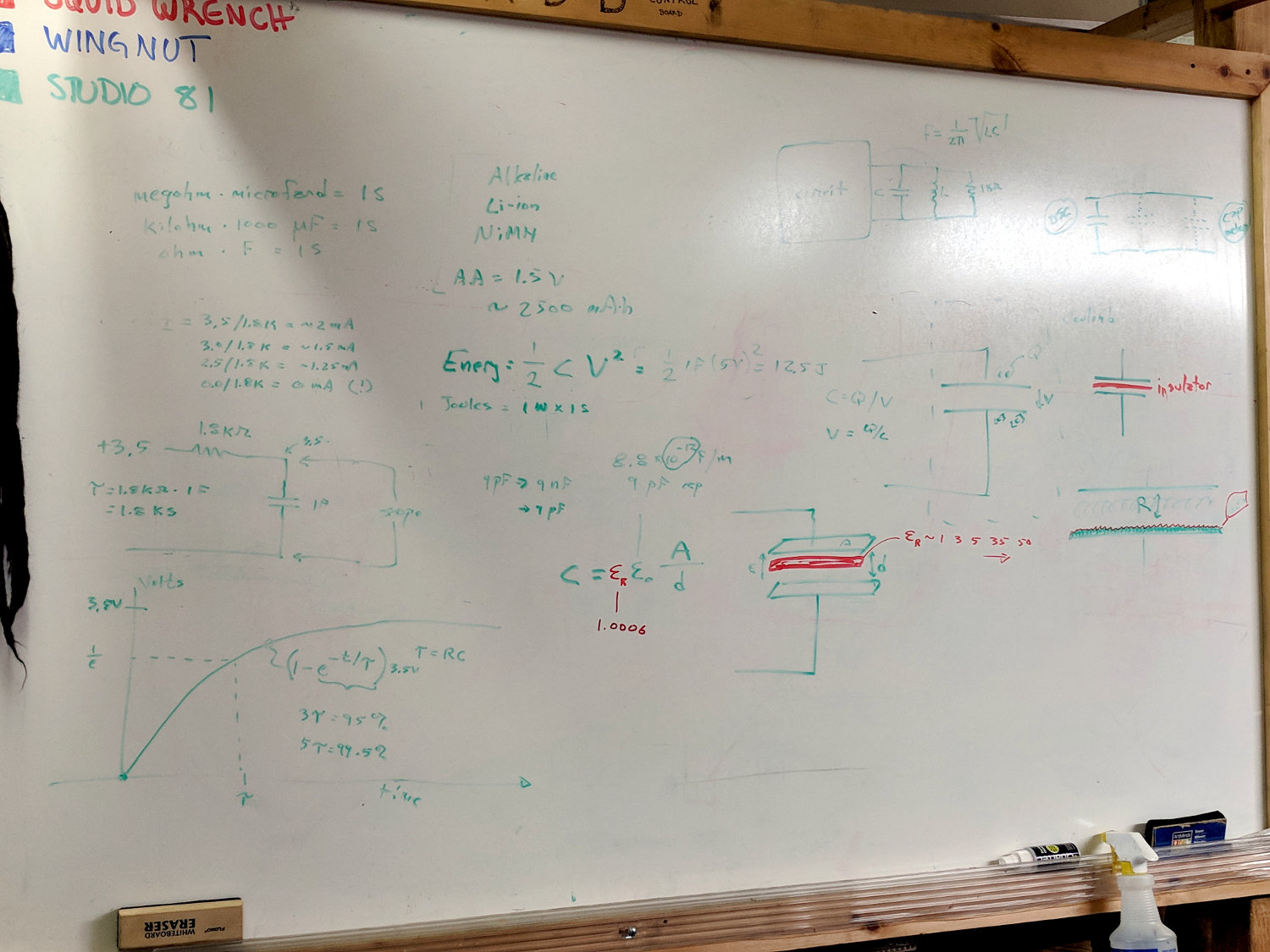
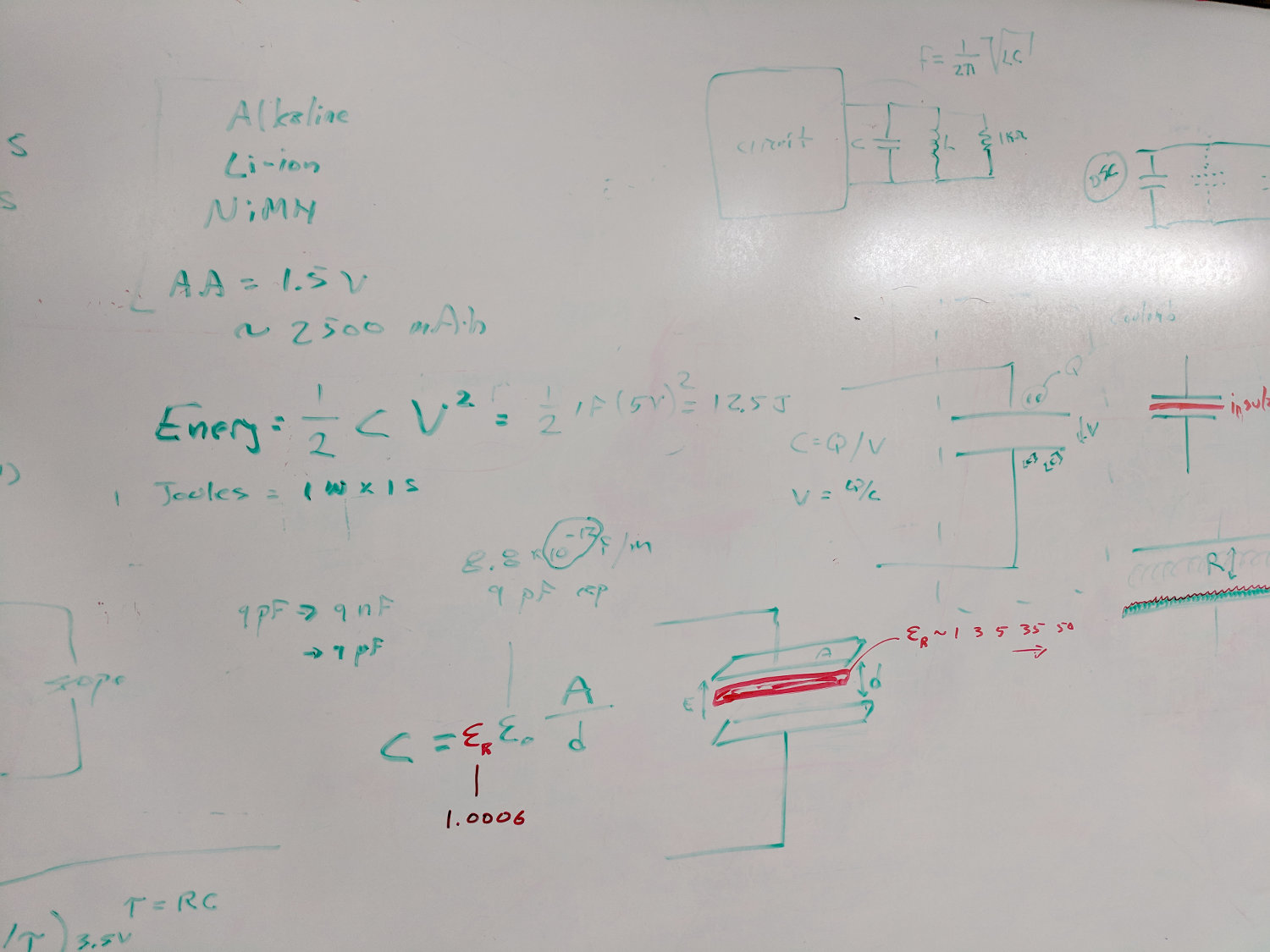
    Whiteboards from the SqWr Electronics Session 5, covering transistors as switches …

    Reviewing I vs V plots, starting with a resistor and then a transistor as a current amplifier:

    SqWr Electronics 5 - whiteboard 1
    SqWr Electronics 5 – whiteboard 1

    Reminder of why you can’t run a transistor at its maximum voltage and current at the same time:

    SqWr Electronics 5 - whiteboard 2
    SqWr Electronics 5 – whiteboard 2

    A resistor load line, with power calculation at the switch on and off coordinates:

    SqWr Electronics 5 - whiteboard 3
    SqWr Electronics 5 – whiteboard 3

    Detail of the power calculations, along with a diagram of the current and voltage when you actually switch the poor thing:

    SqWr Electronics 5 - whiteboard 3 detail
    SqWr Electronics 5 – whiteboard 3 detail

    Oversimplification: most of the power happens in the middle, but as long as the switching frequency isn’t too high, it’s all good.

    Schematic of the simplest possible switched LED circuit, along with a familiar mechanical switch equivalent:

    SqWr Electronics 5 - whiteboard 4
    SqWr Electronics 5 – whiteboard 4

    We started with the “mechanical switch” to verify the connections:

    SqWr Session 5 - Switched LED breadboard
    SqWr Session 5 – Switched LED breadboard

    Building the circuitry wasn’t too difficult, but covering the function generator and oscilloscope hookup took far more time than I expected.

    My old analog Tek 2215 scope was a crowd-pleaser; there’s something visceral about watching a live CRT display you just don’t get from the annotated display on an LCD panel.

    I’d planned to introduce capacitors, but just the cap show-n-tell went well into overtime. We’ll get into those in Session 6, plus exploring RC circuitry with function generators and oscilloscopes.