Ed Nisley's Blog: Shop notes, electronics, firmware, machinery, 3D printing, laser cuttery, and curiosities. Contents: 100% human thinking, 0% AI slop.
Category: Science
If you measure something often enough, it becomes science
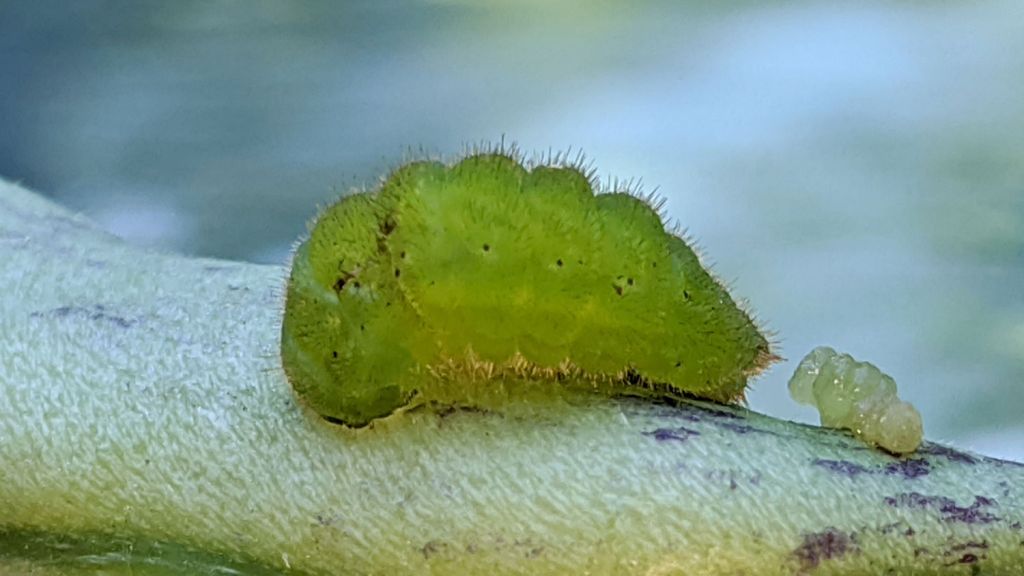
The lump on the right is frass, not a mini-me tagging along behind.
We had no clue what it might be when it grew up, but Google Lens suggested a Striped Hairstreak Butterfly caterpillar and, later that day (and for the first time ever!), we saw an adult Hairstreak fluttering on a goldenrod in the corner of the garden.
As with all caterpillars, you’d never imagine the adult butterfly. It seems they move their hind wings to make predators aim at the south end of a northbound butterfly …
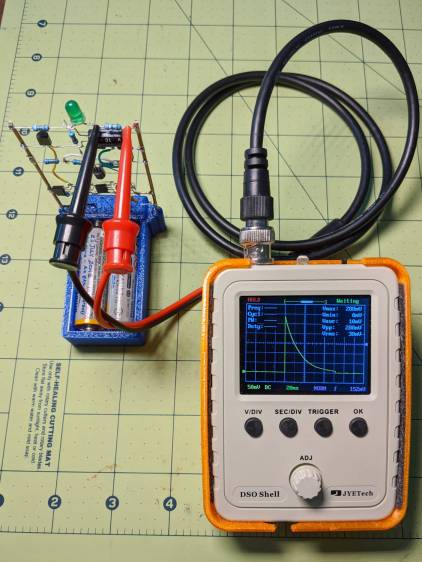
That’s a genuine JYETech DSO150 powered by an 18650 lithium cell and a boost converter set to 9 V. Make sure you get a genuine DSO150 from an authorized seller, rather than one of the myriad knockoffs; it doesn’t cost much more and tends to reward the right folks.
Anyhow, battery power means you can connect it directly across components to measure what would otherwise be a differential voltage:
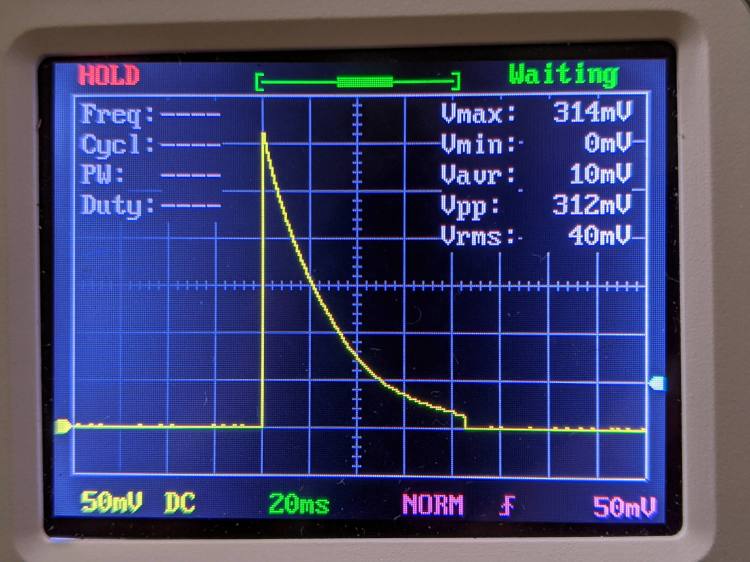
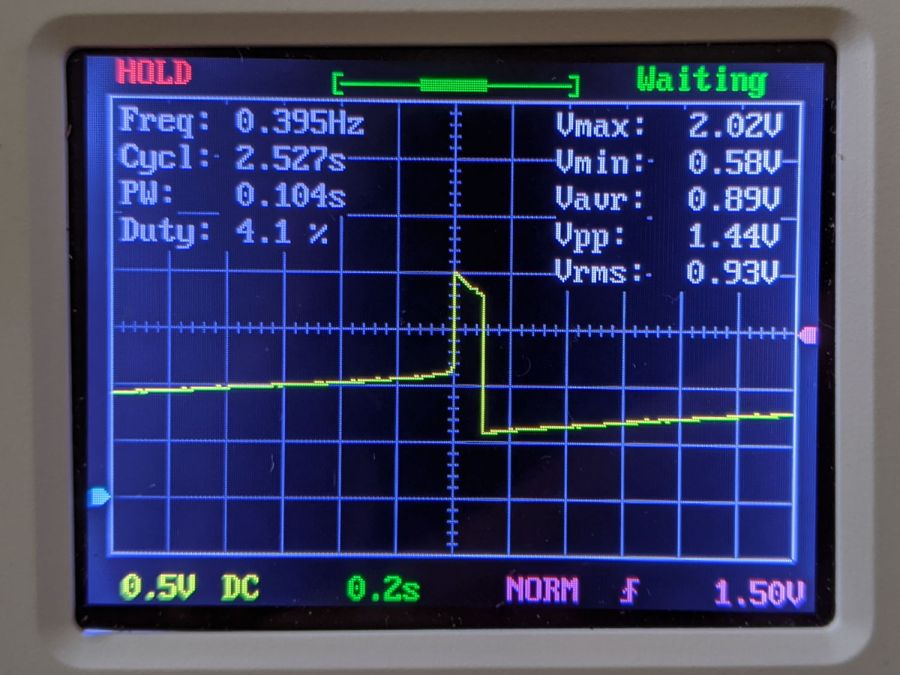
LM3909 – Darl Q1 3x Q2 – 1.5 V – R1 V – DSO150
That’s the voltage across R1, the 39 Ω LED ballast resistor in the discrete LM3909 circuit running from a 1.5 V supply. Divide the 314 mV peak by 39 Ω to get 8 mA of LED current.
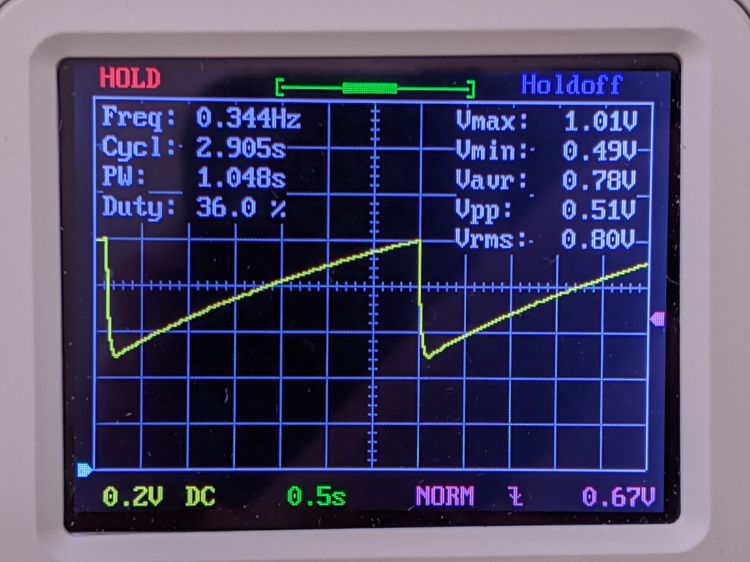
The voltage across C1, the timing and boost capacitor, looks like this:
LM3909 – Darl Q1 3x Q2 – 1.5 V – C1 V – DSO150
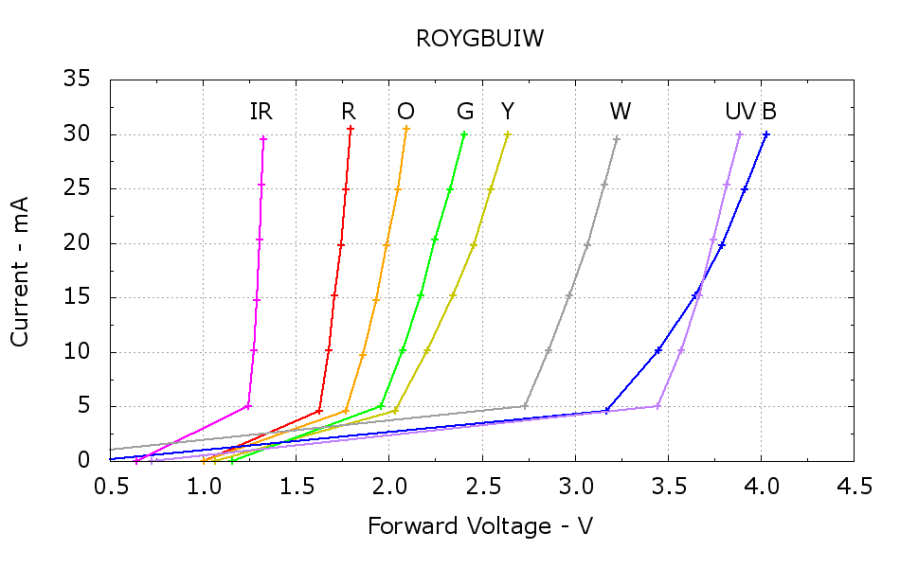
So the cap adds half a volt to the supply in order to put 2.0 V across the LED, which accounts for the relatively low current; the green LED has a forward drop of about 2.2 V at 20 mA and 1.9 V at µA-level current.
For completeness, the voltage across the LED:
LM3909 – Darl Q1 3x Q2 – 1.5 V – Green LED V – DSO150
So, yup, the LED really does see 2.0 V. I love it when the numbers work out.
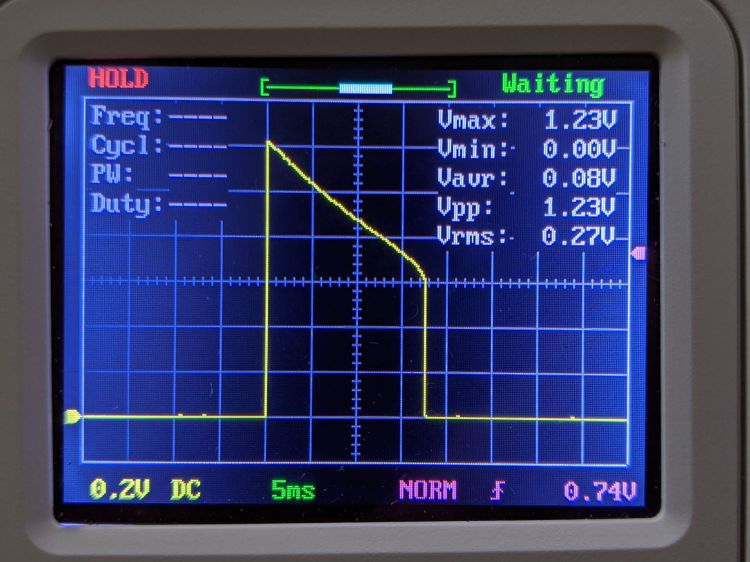
Crank the supply to 3 V and see this across R1:
LM3909 – Darl Q1 3x Q2 – 3.2 V – R1 V – DSO150
The LED current is now 1.23 V / 39 Ω = 33 mA.
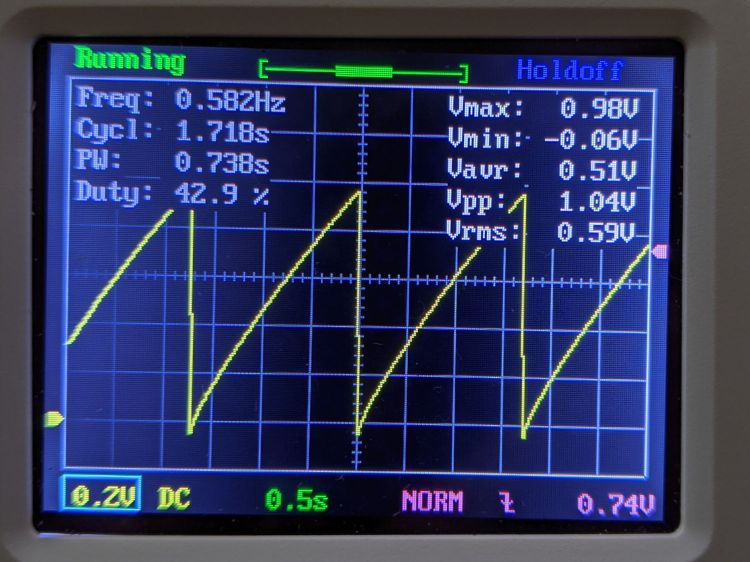
The capacitor just barely enters reverse charge:
LM3909 – Darl Q1 3x Q2 – 3.2 V – C1 V – DSO150
Pop quiz: what voltage to you expect to see across the LED?
I’ll leave further investigation to your imagination, but for low-frequency analog work, you can do worse than a DSO150.
Even linearized, the inchworm was barely 20 mm long; it’s the thought that counts.
The stamens mature in concentric rings, each stamen topped by a pollen grain. Apparently, those grains are just about the most wonderful food ever, as the inchworm made its way around the ring eating each grain in succession:
LTSpice includes a bunch of LEDs I’ll never own, so finding a tabulation of their forward voltages helped match them against various LEDs on hand. The table was sorted by the forward voltage at the diode’s rated average current, which wasn’t helpful for my simple needs, so I re-sorted it on the Vf @ If = 20 mA column over on the right:
The currents come from plugging the various constants into the Schockley Diode Equation and turning the crank.
One could, of course, measure the constants for the diodes on hand to generate a proper Spice model, but that seems like a lot of work for what’s basically a blinking LED.
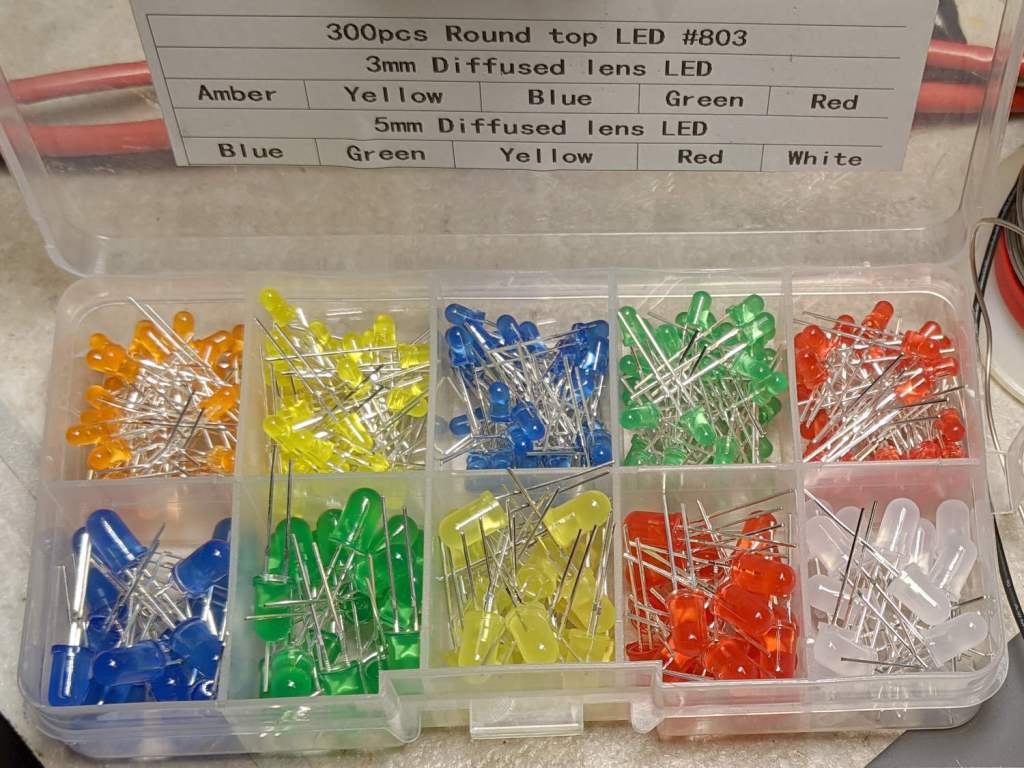
Starting with a box of cheap LEDs from halfway around the planet:
LED kit – case
Measuring the forward voltages didn’t take much effort:
5mm 3mm LED kit – Vf tests
The top array fed the LEDs from a bench power supply through a 470 Ω resistor, with the voltage adjusted to make the current come out right. The bottom array came from the Siglent SDM3045 multimeter’s diode test function, which goes up to 4 V while applying about 400 µA to the diode (the 20 µA header is wrong).
These numbers come into play when blinking an LED from a battery, because a battery voltage much below the Vf value won’t produce much light. It’s a happy coincidence that a single lithium cell can light a white or blue LED …
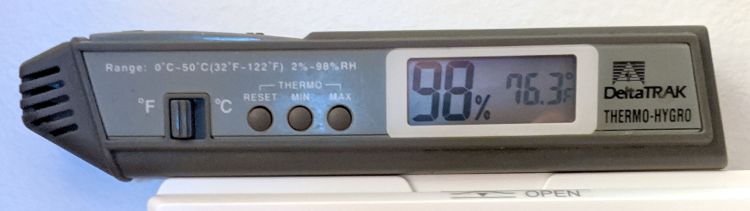
Just before Tropical Storm Isaias rolled through, my hygrometer reached a new high:
Pre-Isaias humidity
The National Weather Service reported 99% at the airport a few miles away, so the meter’s calibration seems about right.
Shortly thereafter, the humidity dropped to the mid-70s as the wind picked up and, over the next few hours, falling branches took out vast swaths of Central Hudson’s electrical infrastructure. My little generator saved our refrigerator & freezer during 15 hours of outage; three days later, thousands of folks around us still have no power.
A confluence of other events, none nearly so dramatic, will throttle my posting over the next two weeks.
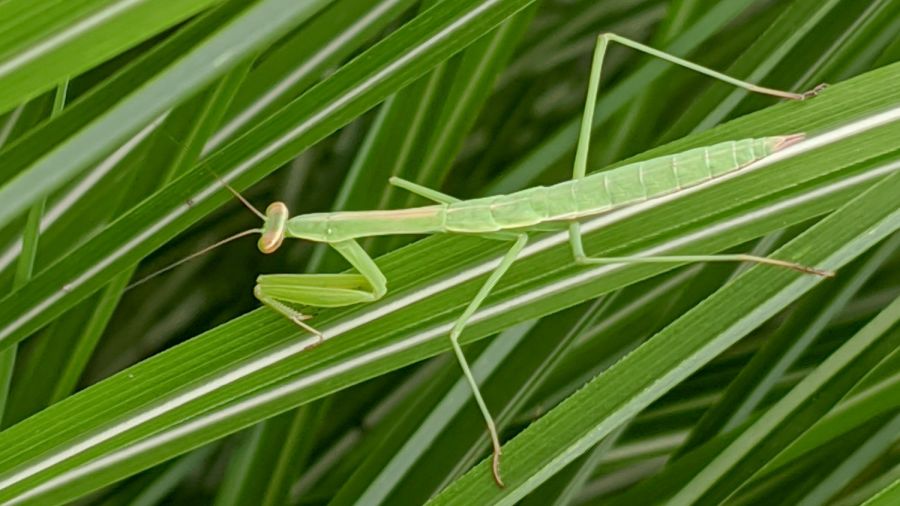
The closest one was about 60 mm long, with plenty of growing ahead in the next few months:
Praying Mantis – 2020-07-24
A few days later, I spotted a smaller one, maybe 40 mm from eyes to cerci, hiding much deeper in the decorative grass clump. Given their overall ferocity, it was likely hiding from its larger sibs.
They have also been stilting their way across the window glass and screens in search of better hunting grounds. My affixing their oothecae to another bush may have disoriented them at first, but they definitely know where their next meal comes from!
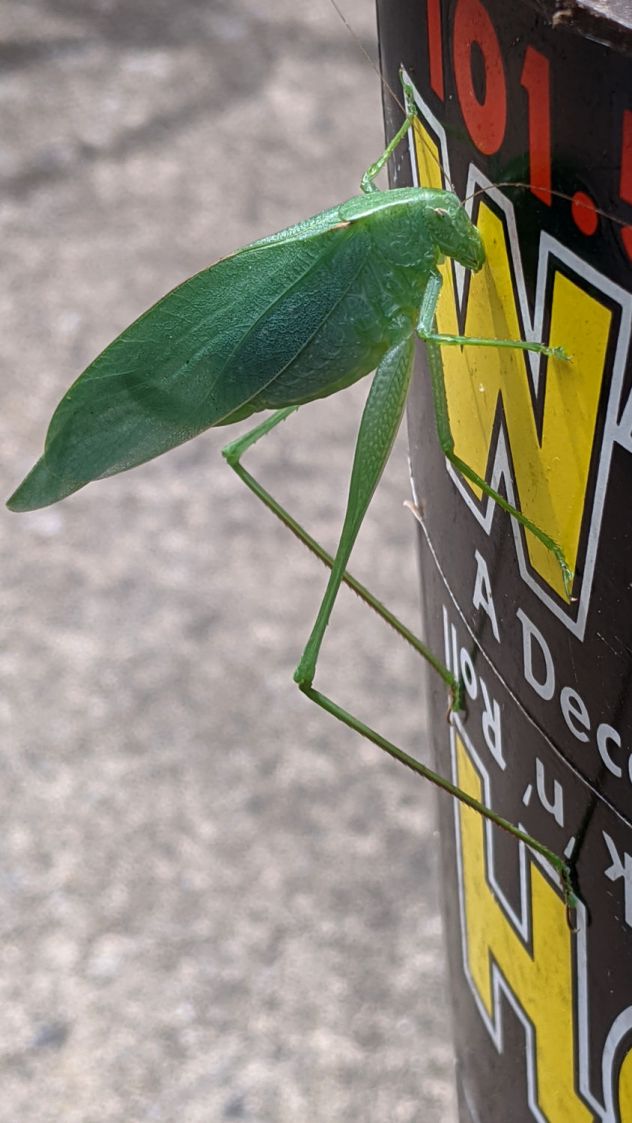
Perhaps as a bonus, a Katydid appeared inside the garage, stuck to the side of a trash can that Came With The House™ long ago:
Katydid
I deported it outside, in hopes of increasing the world’s net happiness.
The stickers covering the can say “WPDH: A Decade of Rock ‘n’ Roll”, suggesting they date back to 1986, ten years after (Wikipedia tells me) WPDH switched from country to rock. Neither genre did much for me, so I never noticed.












 The Smell of Molten Projects in the Morning