Ed Nisley's Blog: Shop notes, electronics, firmware, machinery, 3D printing, laser cuttery, and curiosities. Contents: 100% human thinking, 0% AI slop.
Category: Science
If you measure something often enough, it becomes science
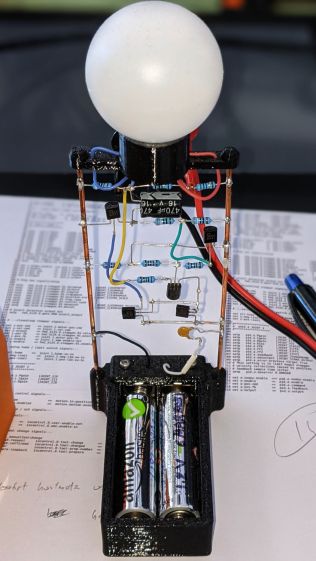
The blue LED inside the radome got fainter as the alkaline AA cells faded away, but remained visible in a dark room until the discrete LM3909 circuitry stopped oscillating with the battery at 1.0 V. One of the cells had flatlined, with the other supplying what little current was needed.
The circuitry restarted with a pair of weak alkalines applying 2.4 V across the bus bars:
LM3909 Blue – 2.4 V alkaline
The LED waveform shows it needs about 2 V:
LM3909 Blue – 2.4 V alkaline
It’s barely visible in normal room light and strikingly bright at night.
Spotted at the corner gas station on a recent walk:
Gas pump barrier – smashed
Judging from the tire tracks and extrapolating from recent weather, a snowplow driver misjudged the truck’s right-side clearance while backing.
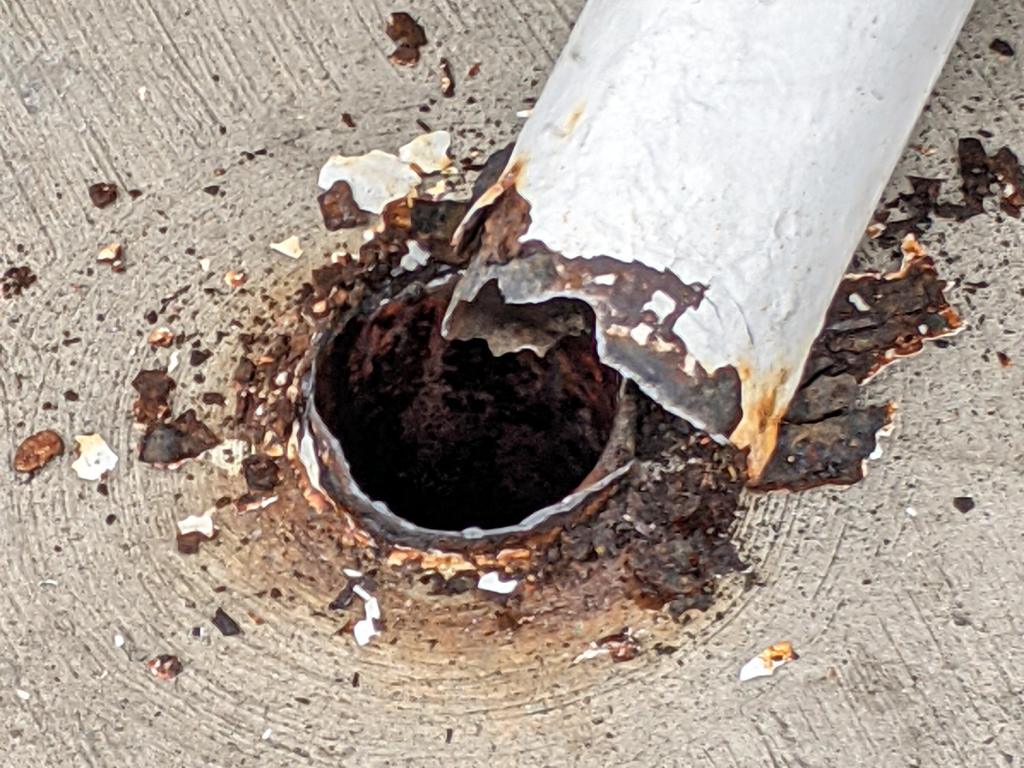
That big steel tube didn’t put up nearly as much resistance as the architect figured after consulting the relevant building codes:
Gas pump barrier – right base
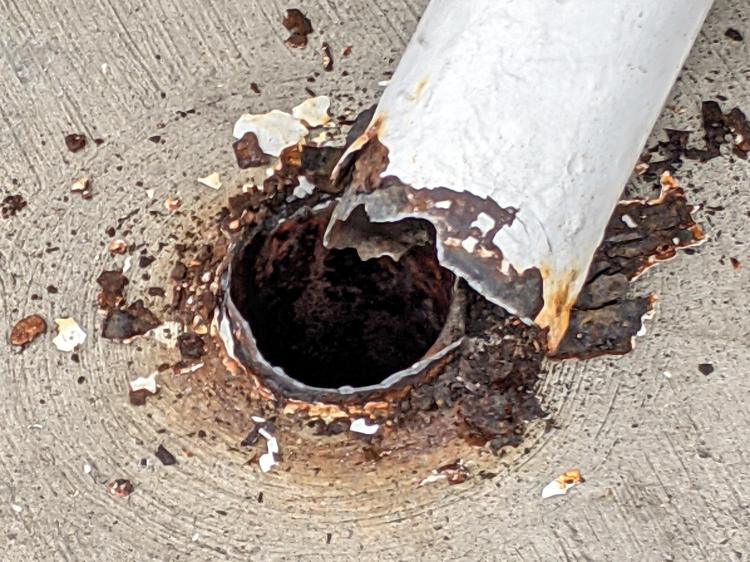
The paint seems to have been the only thing holding the other side together:
Gas pump barrier – left base
Google Streetview suggests the barriers were new-ish in May 2009:
Gas pump barrier – newish 2009-05
Steel is a great construction material, but it doesn’t fare well when installed at grade (or above) where it’s exposed to water and salt. On the other paw, they got over a decade out of it, so maybe it’s as good as it needs to be.
The Aluminum Black package directions tell you to apply it with a swab, rinse, and repeat, which seemed like a lot of work for a handful of pins. Instead, I poured a little into a pill bottle, dumped the pins in, and gave it a good shake to coat the pins, whereupon the cap blew off as the contents proceeded to boil merrily. A quick cold-water rinse calmed things down, with no particular harm done, although I had to chase the threads with a tap to get the black powder out. A layer of oil prettied them up nicely.
Today I Learned: the reaction between selenium dioxide and bare aluminum is strongly exothermic.
You can’t make up results like this for a techie kind of blog:
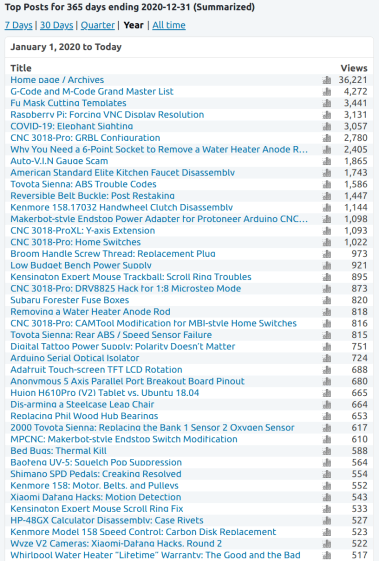
Blog Top Post Summary – 2020-12-31
Given my demographic cohort, bedbugs suddenly seemed downright friendly.
Overall, this blog had 109 k visitors and 204 k page views. The ratio of 1.8 pages / visitor has been roughly constant for the last few years, so I assume most folks find one more interesting post before wandering off.
My take from the increasing volume of ads WordPress shovels at those of you who (foolishly) aren’t using an ad blocker continues to fall:
Blog Ad Summary – 2020-12-31
The CPM graph scale seems deliberately scrunched, but the value now ticks along at 25¢ / thousand impressions, adding up to perhaps $250 over the full year. Obviously, I’m not in this for the money.
The ratio of five ads per page view remains more or less constant. Because Google continues to neuter Chrome’s ad blocking ability, I highly recommend using Firefox with uBlock Origin.
WordPress gives me no control over which ads they serve, nor where they put ads on the page. By paying WordPress about $50 / year I could turn off all their ads and convert the blog into a dead loss. I’m nearing their 3 GB limit for media files on a “free” blog, so the calculation may change late next year.
After replacing the nozzle and filament drive on the M2, it’s definitely time to verify that the Z=0 point remains at the platform surface and the whole affair is properly aligned.
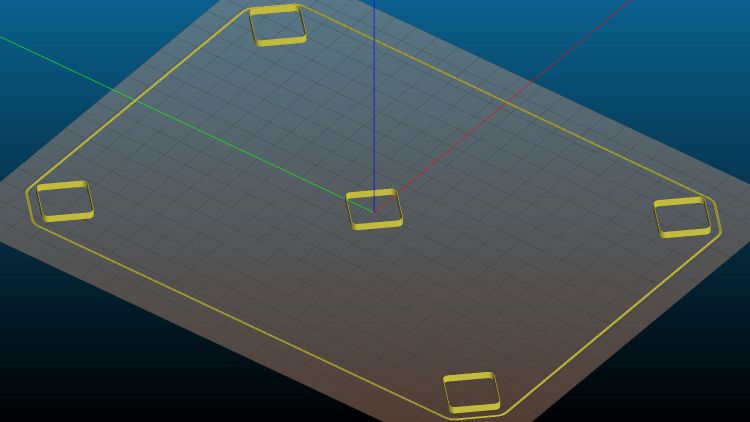
Because they’re well separated and only 3 mm tall, I set Slic3r to print them sequentially to eliminate a whole bunch of back-and-forth travel for each layer.
The outer numbers come from the skirt around the whole platform in units of 0.01 mm: 22 → 0.22 mm. The five inner numbers are the eyeballometric average of four measurements across each square.
They came short enough that adding 0.25 mm to their height would improve the outcome. The scribbles in the upper right corner show the initial Z offset was -2.50 mm, which means -2.75 mm should do the trick; remember to save the new value in EEPROM with M500.
Print the same G-Code file with the new offset and measure:
Calibration Boxes – M206 Z-2.75 – 2020-12-11
Can’t get much closer than that!
The skirt gains only 0.1 mm for reasons unknown to me. It’s a good diagnostic tool for keeping an eye on the overall alignment without having to run more calibration squares, though.
Comparing the center squares (bottom layers facing each other in the middle) from the two sets shows the difference:
Test Squares 2.73 3.01 mm – 2020-12-11
The bottom three layers got pretty well squashed with the previous offset. It’s missing about a full layer, although the nozzle wasn’t mashed flat / blocked against the platform. All the layers in the post-adjustment square look identical, as they should.
The wall thickness on the latter squares runs from 0.40 to 0.44 mm, with an eyeballometric average around 0.43, so tweaking the Extrusion Multiplier down by maybe 5% would be in order if I were being fussy.















 The Smell of Molten Projects in the Morning