Ed Nisley's Blog: Shop notes, electronics, firmware, machinery, 3D printing, laser cuttery, and curiosities. Contents: 100% human thinking, 0% AI slop.
Category: Science
If you measure something often enough, it becomes science
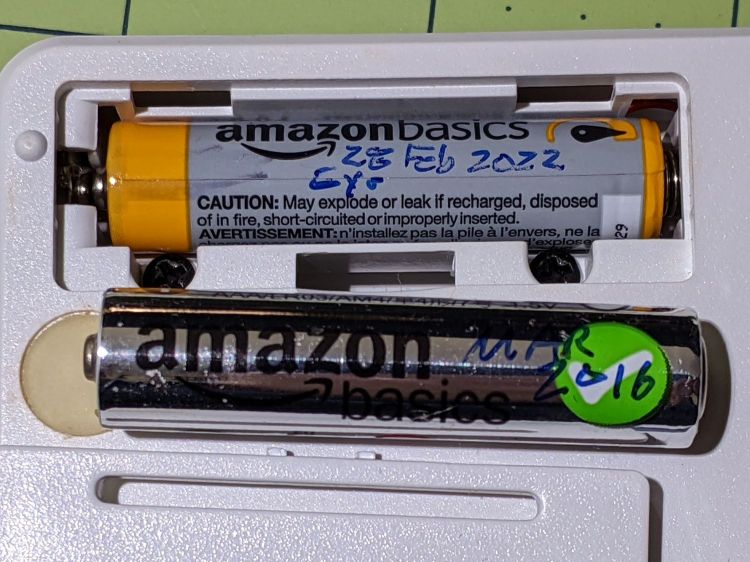
One of the streaming media players behaved funny, which always results in a numeric keypad battery replacement. This AmazonBasics AAA alkaline was down to about 0.5 V and long past its best-used-by date:
Suggestions that Amazon monitors their Marketplace sellers to figure out what’s profitable, then promote a Good Enough house brand product to kill off the competition, seem to describe the situation just about perfectly.
For reasons that made sense at the time, two weeks ago I ventured outside the house. A few days later, this appeared:
Lyme Disease – arm rash
The pallid skin over on the left comes from a bike glove. The central bump is one of those annoying sebaceous hyperplasias appearing after a Certain Age and not relevant here.
Having been around this particular block a few times, Mary recognized the diffuse red rash, sleeping 30 of 36 consecutive hours, and a day-long 103 °F fever as Lyme disease. I’m currently taking 100 mg of doxycycline twice a day and (after a week) feeling better, while sleeping a lot more than usual at random intervals during the day.
We’re both highly aware of Lyme disease: Mary routinely dresses in a complete overlayer of permethrin-sprayed clothing and I generally strip-and-shower immediately after any yard work in similarly sprayed, albeit less enclosing, attire. In this case, we think a tiny Deer Tick nymph affixed itself to the outboard side of my wrist, where I could neither see nor feel it, and (because I didn’t take a shower after being outside for only a few minutes) remained attached long enough to infect me.
Caught and treated early, Lyme disease generally does not progress into “post-treatment Lyme disease”, an ailment rife with what can charitably be described as serious woo, despite some evidence of actual disease.
Some of Mary’s Master Gardener cronies have endured co-infections of Babesia microti and we’ll be watching for those symptoms after doxycycline tamps down the obvious problem.
I’ll be puttering very carefully around heavy machinery and posting irregularly for a few weeks …
Memo to Self: the Basement Shop has a lot to recommend it!
Apparently the stink bug’s armor doesn’t count for much when the spider has the luxury of attacking through a weak spot in the underbelly after the critter stops struggling.
Stink bugs cause considerable damage to crops (notably apples) in the Hudson Valley, but they haven’t been the existential catastrophe we all expected when they first arrived.
The UPS coddling the M2 printer began complaining about a bad battery, so I ran (nearly) all the UPS batteries through the tester:
UPS SLA 2021-10-10
The two blue flubs in the lower left come from the failed battery, with the dotted trace after charging to 13.7 V and letting the current drop to 20 mA.
The red and green traces come from two other UPS batteries installed in 2016, with the dotted traces after charging similarly. The orange-ish trace is from the battery in a Cyberpower UPS bought in 2016, so it looks like all batteries of that vintage fade equally.
Except for another pair of batteries in another UPS that had discharged stone cold dead; it may have been shut down and unplugged during a power outage and they never quite recovered.
After five years, it’s time to refresh the fleet …
The Sony HDR-AX30V helmet camera puts far more demands on its battery than the Planet Bike Superflash:
Batmax NP-BX1 – 2021-09 vs 2020-03
The four traces on the right show the BatMax NP-BX1 lithium batteries (cells, really) originally stored about 3 W·h when they arrived in March 2020. The four solid traces to their left show the capacity dropped to a little over 2 W·h after two riding seasons. Batteries B and C started out above average and are now below, for whatever that means.
The red dotted trace shows the effect of not using the NP-BX1 test holder for that length of time; those homebrew contact pins apparently needed some exercise.
Having replaced the Planet Bike Superflash on Mary’s Tour Easy with a 1 W red LED, testing the eight Panasonic Eneloop AAA cells that have been powering it (and the one on my bike) for the last four years seemed useful:
Panasonic Eneloop AAA – 2021-09 vs 2017-04
The sheaf of curves over on the right came from the first full charge, with the untidy collection below them show the current state after a full charge. This is at an unreasonably high 500 mA discharge.
The overall capacity has dropped by 10%, which isn’t all that bad, but the 10% voltage reduction toward the end of the curves is a Bad Thing for an LED flasher intended to run from 1.5 V alkaline cells. In practice, I recharge the batteries once a week while they are still going strong, but the difference between alkalines and NiMH cells is obvious even at full charge.
Now I can run four pairs through the agingSuperflash on my bike …